

Global AI Data Center Liquid Cooling Market Size and Forecast – 2026 To 2033
The global AI data center liquid cooling market is expected to grow from USD 3.37 Bn in 2026 to USD 12.85 Bn by 2033, registering a compound annual growth rate (CAGR) of 21% from 2026 to 2033. The global AI data center liquid cooling market is driven by growing demand for energy-efficient data center operations. On May 27, 2026, Fuji Electric Co., Ltd. announced that it has developed the world’s first ejector cooling unit capable of reducing power consumption for cooling servers in data centers by up to 85%, and that it will be available for sale in June 2026.
Key Takeaways of the Global AI Data Center Liquid Cooling Market
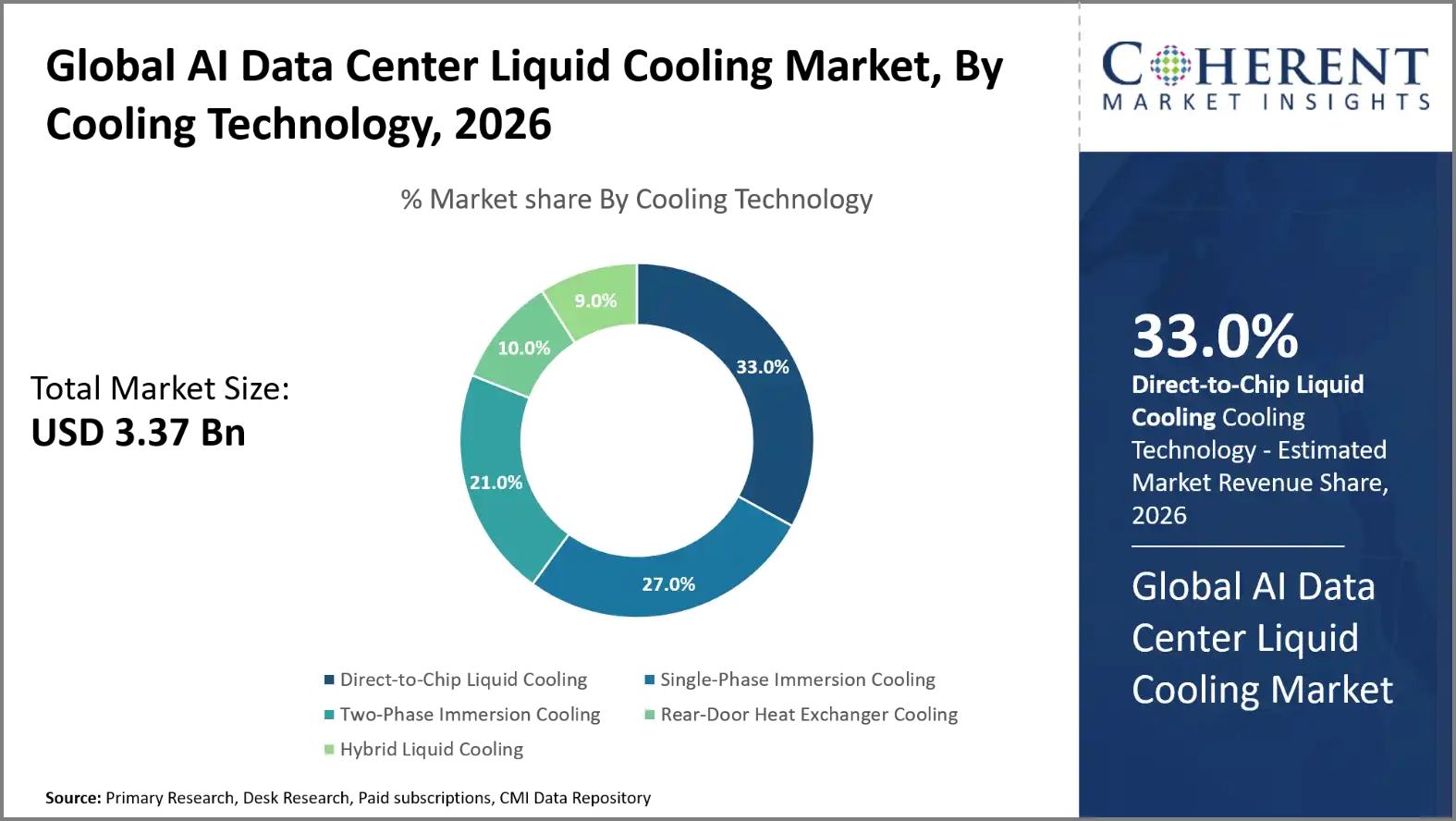
- The Direct-to-Chip Liquid Cooling segment is expected to account for 33.0% of the global AI data center liquid cooling market share in 2026. Rising adoption of direct-to-chip liquid cooling technologies is driving the growth of the segment. On May 20, 2025, JetCool, a Flex company, launched its next-generation SmartPlate System. The sealed direct-to-chip solution became available as an option on selected Dell PowerEdge servers.
- The Hyperscale Data Centers segment is estimated to capture 37.0% of the market share in 2026. Increasing investments in hyperscale AI data centers is majorly driving the growth of the segment. On August 27, 2025, Google announced an additional investment of USD 9 billion in Virginia, U.S. The investment covers cloud infrastructure and artificial intelligence development through 2026.
- The AI Training segment is estimated to capture 39.0% of the market share in 2026. Expansion of high-performance computing infrastructure is driving the growth of the segment. On February 13, 2025, Hewlett Packard Enterprise announced shipment of its first NVIDIA Grace Blackwell GB200 NVL72 system. The rack-scale platform integrates 72 NVIDIA Blackwell graphics processing units and 36 NVIDIA Grace central processing units
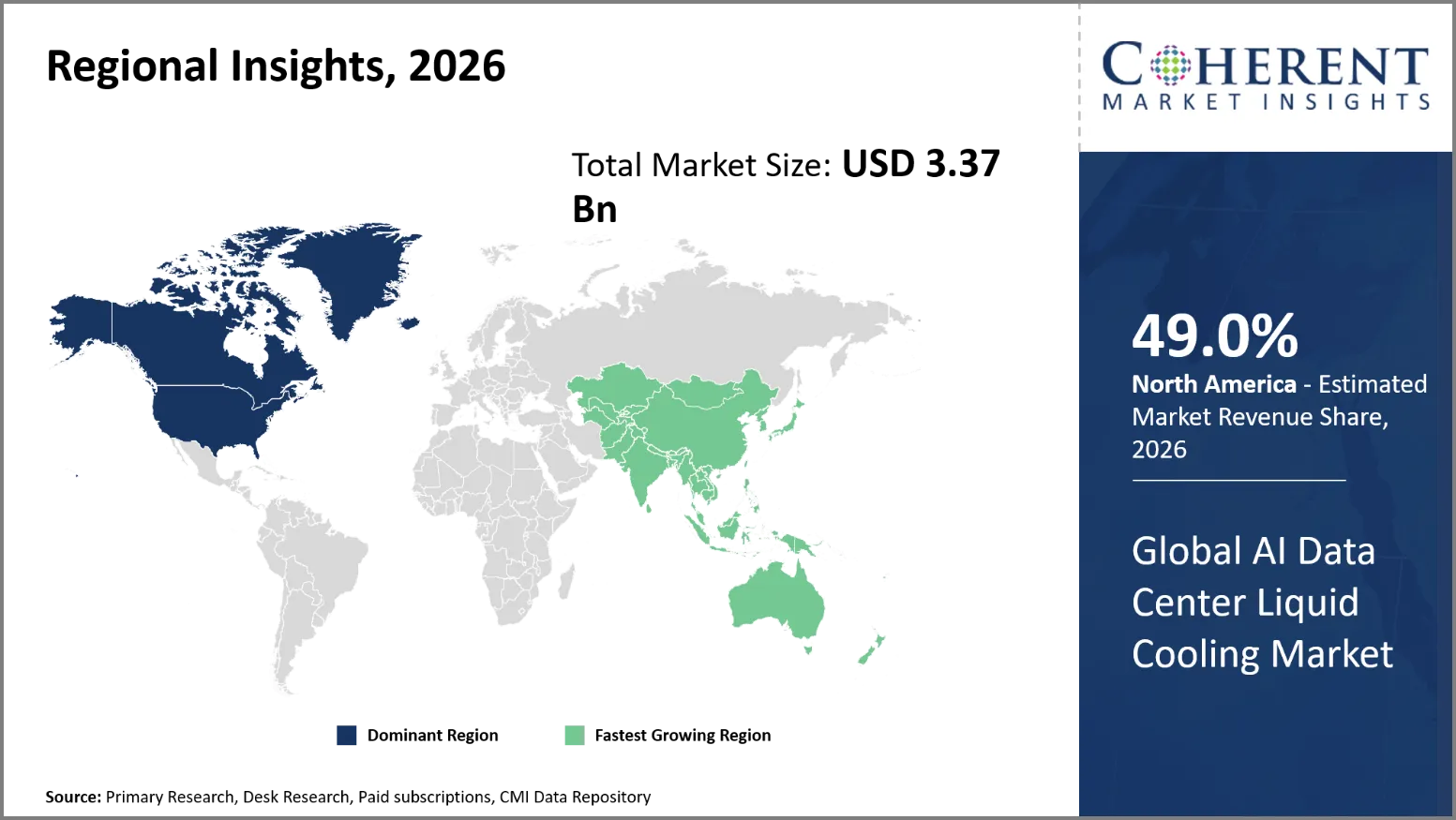
- North America is expected to dominate the AI data center liquid cooling market in 2026 with a market share of 49.0%. Increasing adoption of immersion cooling technologies in North America is driving the growth of the regional market. On July 22, 2025, Dataprana announced the operational launch of its flagship facility in La Marque, Texas. The facility uses 30 immersion-cooled mining containers supplied by Intelliflex and Arctic Systems.
- Asia Pacific is expected to account for 28.0% share in 2026. Integration of liquid cooling with high-density AI server platforms in Asia Pacific is driving the growth of the regional market. On April 25, 2025, ST Telemedia Global Data Centers launched a direct-to-chip liquid cooling showcase at its STT Bangkok 1 facility. The Thailand data center already supported operational AI clusters and high-power-density racks.
Segmental Insights
Why Does Direct-to-Chip Liquid Cooling Dominate the Global AI Data Center Liquid Cooling Market?
The direct-to-chip liquid cooling segment is expected to account for 33.0% of the global AI data center liquid cooling market share in 2026. Direct-to-chip liquid cooling dominates as it efficiently pulls heat from high-powered artificial intelligence systems. The method employs coolant flowing through cold plates mounted directly to the central processing units and graphics processing units. This is one way to deal with the concentrated heat generation of AI servers. It ensures steady operating temperatures during heavy processing demands. Direct-to-chip solutions also lessen the need on traditional air-conditioning infrastructure. Their use enables higher rack densities and better energy efficiency. Demand for direct-to-chip cooling is being supported by increasing adoption of powerful graphics processing units.
On September 12, 2025, Advanced Cooling Technologies, Inc. successfully demonstrated a major advancement in two phase direct-to-chip liquid cooling. The company’s latest cold plate technology is designed to meet the extreme thermal demands of next-generation high-performance computing (HPC) and artificial intelligence (AI) systems.
- Current Industry Events of 2026
- Market Size Estimation
- Regional Breakdown
- Competitive Landscape
- Customer Intelligence
- Segmental Analysis
- Pricing Analysis
- Key Market Drivers, Challenges & Future Trends
- Customized Insights Section
Why is Hyperscale Data Centers the Most Crucial Data Center Type?
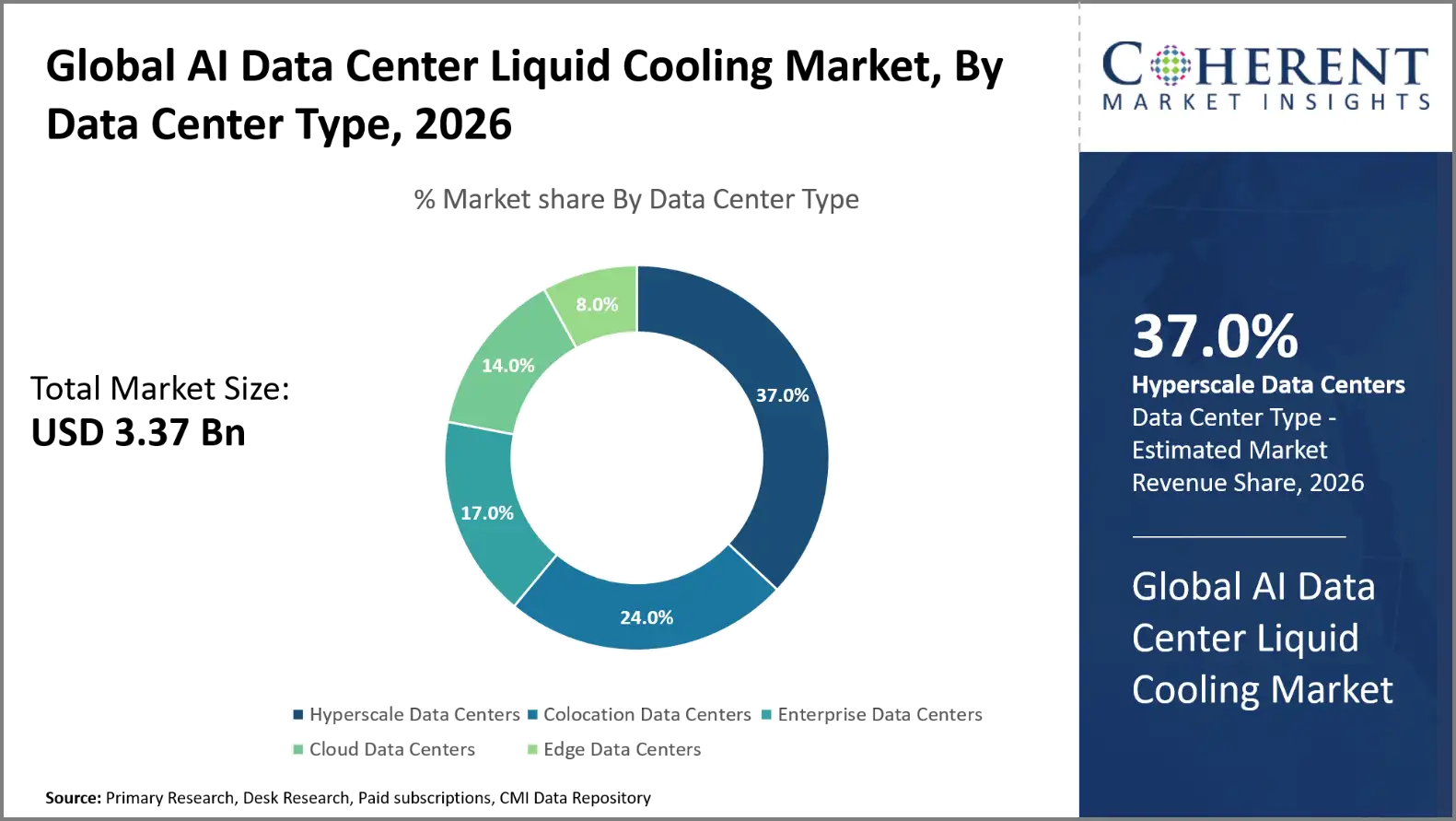
The hyperscale data centers segment is expected to account for 37.0% of the global AI data center liquid cooling market share in 2026. The most important data center type is hyperscale data centers, which house massive artificial intelligence computing infrastructure. These facilities house enormous clusters of servers that need continuous and high-volume thermal control. They have dense deployments of graphics processing units that produce a lot of heat inside a rack. Liquid cooling can assist maintain performance reliability in more demanding computing settings. Energy efficiency and optimized power utilization effectiveness are also key for hyperscale operators. These operational objectives are supported by direct-to-chip and immersion cooling technologies.
On May 29, 2026, Digital Decarbonization Solutions Platform secured financing for its 45MW hyperscale data center campus in Johor, Malaysia. The development incorporates closed-loop liquid cooling and an AI-ready, high-density computing environment. Its capacity has been fully contracted to a leading global hyperscale customer.
AI Training Dominates the Global AI Data Center Liquid Cooling Market
The AI training segment is expected to account for 39.0% of the global AI data center liquid cooling market share in 2026. AI training dominates the global AI data center liquid cooling market because training workloads require substantial computational power. In the course of model development, large language models and generative artificial intelligence systems are trained on large datasets. These operations are characterized by continuous use of the graphics processing unit and focused heat release. Liquid cooling is effective in thermal control of densely packed AI accelerator servers. It helps keep processor performance up during extensive training cycles. Direct-to-chip cooling is very beneficial for the high-performance computing clusters with high thermal design power. This demand is bolstered by growing investments in foundation models and advanced AI infrastructure.
On October 16, 2025, SuperX announced the launch of a rack-scale AI supercomputing infrastructure for training trillion-parameter artificial intelligence models. The device combines 72 NVIDIA Blackwell Ultra GPUs in a single liquid-cooled rack. It gives up to 1.8 exaFLOPS of FP4 compute performance.
Current Events and their Impact
Current Events | Description and its Impact |
European Union Energy Efficiency Directive (EU) 2023/1791 |
|
European Commission Delegated Regulation (EU) 2024/1364 |
|
AI Data Center Liquid Cooling Market Dynamics
Market Drivers
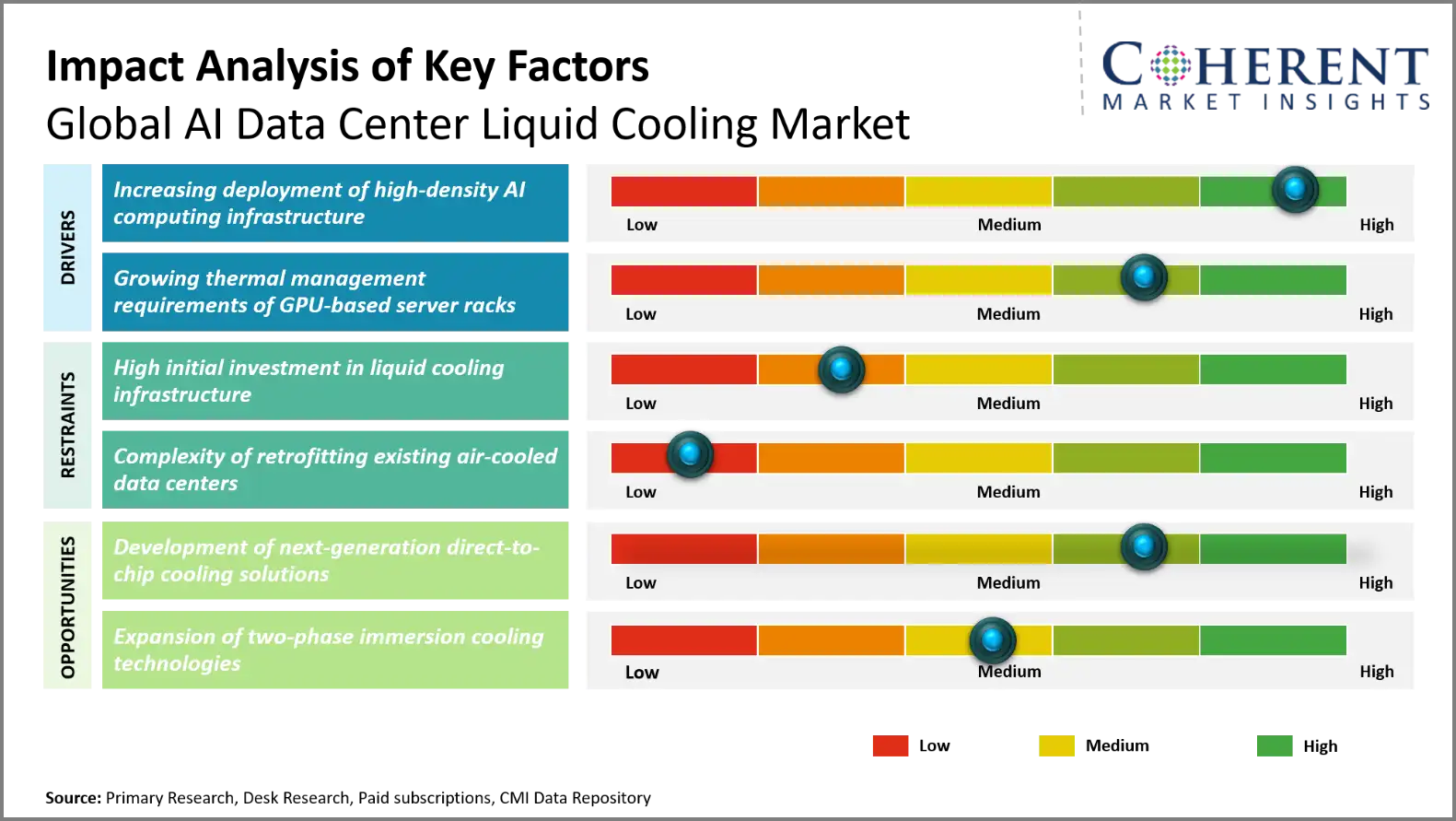
Increasing deployment of high-density AI computing infrastructure
The rapid rise of artificial intelligence infrastructure is boosting the demand for high-density data center deployments. Hyperscale cloud companies are investing in sophisticated graphics processing units and dedicated AI accelerators. These systems are the basis for generative AI, massive language models and advanced machine learning applications. With higher processing densities, racks are generating more heat and consuming more power. Traditional air-cooling has its limits in keeping the temperatures in check in the densely packed server environments. Direct-to-chip and immersion cooling systems are more efficient in heat management. So, the growing investments in AI infrastructure are driving the usage of liquid cooling in hyperscale data centers.
On July 23, 2025, SoftBank Corp. announced that it has deployed a DGX SuperPOD with DGX B200 systems exceeding 4,000 NVIDIA Blackwell GPUs. This makes SoftBank's AI computing platform currently the world's largest NVIDIA DGX SuperPOD with DGX B200 systems. It is scaled with NVIDIA Quantum-2 InfiniBand networking and supports the NVIDIA AI Enterprise software platform.
Growing thermal management requirements of GPU-based server racks
Increasing deployment of powerful graphics processing units is intensifying thermal management requirements across AI data centers. Modern GPU-based server racks produce a lot of heat while they are training and inferencing models heavily. The higher the thermal design power, the greater the risk of overheating and loss of performance. Conventional air-cooling has problems removing the concentrated heat produced by dense accelerator systems. Direct-to-chip liquid cooling means running coolant through to pull heat away from CPUs directly. Another approach is immersion cooling, which removes heat from the components of servers to special dielectric fluids. These technologies offer better temperature stability, bigger rack densities and consistent computer performance.
On March 18, 2025, Vertiv introduced CoolLoop, a rear-door heat exchanger using chilled water for AI and high-performance computing racks. The system delivers up to 80 kW of cooling capacity per rack. It can be used on its own or alongside direct-to-chip liquid cooling devices.
Emerging Trends
- Adoption of direct-to-chip liquid cooling architectures: Data center operators are increasingly turning to direct-to-chip cooling to deal with the heat concentration of the latest graphics processing units and artificial intelligence accelerators.
- Impact: This technique enhances heat removal, increases rack densities, reduces cooling energy requirements and stabilizes processor performance under heavy artificial intelligence workloads.
- Relevance to the market: Companies like Vertiv, Schneider Electric and CoolIT Systems are increasing their portfolios of liquid cooling solutions. Their solutions meet increasing heat demands across hyperscale artificial intelligence infrastructure.
- Development of high-capacity liquid cooling infrastructure: Makers of cooling equipment are working on higher-capacity coolant distribution units, advanced cold plates, and integrated liquid cooling systems for ever-more powerful artificial intelligence server clusters.
- Impact: These advancements allow for circulation of coolant, improved heat transmission, and larger computing installations. They also improve operational dependability in high-density data center environments.
- Relevance to the market: Vertiv’s CoolChip CDU platforms and Schneider Electric’s Motivair liquid cooling portfolio illustrate this advancement. These products are designed to meet the increased cooling capacity requirements in hyperscale installations.
Regional Insights
Why is North America a Strong Market for AI Data Center Liquid Cooling?
North America is expected to account for a market share of 49.0% in 2026. North America benefits from hyperscale cloud investments, sophisticated semiconductor ecosystems and increasing demand for faster computing infrastructure. The big tech firms are building liquid cooling into their next generation data center designs. The Motivair line from Schneider Electric features coolant distribution units with capacities ranging from 105 kilowatts to 2.5 megawatts. Six of the world’s 10 most powerful supercomputers use its cooling methods. The company also provides dynamic cold plates and back door heat exchangers for high density computing. Growing requirements for scalable cooling equipment, specialized thermal components, and integrated infrastructure solutions strengthen regional adoption.
Why Does Asia Pacific AI Data Center Liquid Cooling Market Exhibit High Growth?
Asia Pacific is expected to register the fastest growth with a CAGR of 23.0% over the forecast period. Asia Pacific is projected to account for 28.0% of the global AI data center liquid cooling market in 2026. Asia Pacific is seeing greater use of liquid cooling as hyperscale grows and regional infrastructure gets modernized. Singapore has launched Singapore Standard SS 726:2026 for liquid cooling in tropical data centers. This standard gives guidelines on implementing liquid cooling in adverse temperature and humidity conditions. Equinix HK1 in Hong Kong has also made commercial deployment progress. The facility also has liquid cooling capabilities, which were incorporated in partnership with Dell Technologies and Schneider Electric. These trends point to a growing regional focus on tropical cooling performance, infrastructure adaptability, and unique thermal management requirements.
Global AI Data Center Liquid Cooling Market Outlook for Key Countries
Why is U.S. Emerging as a Major Hub in the AI Data Center Liquid Cooling Market?
The U.S. market is being helped by the large-scale development of AI infrastructure and the increasing usage of closed-loop cooling designs. In September 2025 Microsoft announced the Fairwater AI data center in Wisconsin. Its architecture uses continually circulating liquid cooling to handle the intense heat loads from sophisticated computing equipment. Over 90% of its data center capacity is utilizing closed-loop cooling. In October 2025, Microsoft also revealed its Atlanta Fairwater campus. Both facilities are linked with dedicated networking infrastructure to provide distributed artificial intelligence training. These trends point to increasing demand for integrated cooling solutions built for large-scale GPU infrastructure.
Is China the Next Growth Engine for the AI Data Center Liquid Cooling Market?
The local liquid cooling manufacturing, government-supported computer infrastructure and the rapid growth of intelligent computing centers are all conducive to the Chinese market. Huawei Cloud has built entirely liquid-cooled AI data centers in Guizhou, Inner Mongolia and Anhui. The facilities support 80KW heat dissipation per cabinet and achieve 1.1 power usage effectiveness. China Mobile’s Nanjing Intelligent Computing Center can hold 18,000 racks and 300,000 servers. To accommodate the cabinet power demand of up to about 50 kilowatts, Kehua has designed modular liquid cooling infrastructure for this facility.
Germany AI Data Center Liquid Cooling Market Analysis and Trends
Germany benefits from superior industrial engineering capabilities, scientific computer infrastructure and increasing demand for high-performance research centers. The GSI Helmholtz Centre for Heavy Ion Research collaborated with Rittal to commission direct liquid cooling infrastructure at its Green IT Cube facility in Darmstadt. The system enables computing power exceeding one million watts within a compact installation. Equinix has also established its Frankfurt Enhanced Performance Innovation Center for testing liquid-cooled GPU and CPU platforms. These innovations reinforce Germany's dominance in specialized scientific computing, enterprise AI infrastructure and sophisticated thermal engineering.
Japan AI Data Center Liquid Cooling Market Analysis and Trends
Japan’s market is supported by local AI processor development, government-backed semiconductor research and dedicated computer infrastructure projects. Preferred Networks, Internet Initiative Japan and Japan Advanced Institute of Science and Technology are developing direct liquid-cooled AI computer systems. The cooperation also comprises MN-Core 2 accelerator servers built at Internet Initiative Japan’s Matsue Data Center Park. The July 2025 pilot involved 30 server nodes containing 240 accelerator boards. The partners subsequently developed a dedicated liquid cooling modular data center at Shiroi Data Center Campus. Full-scale operations were scheduled to begin in April 2026.
India AI Data Center Liquid Cooling Market Analysis and Trends
India’s market is helped by the availability of more GPUs, more cooling equipment being manufactured in the country and more hyperscale infrastructure being built. The Ministry of Electronics and Information Technology stated it had onboarded 38,231 GPUs through 14 empaneled service providers. These computing resources serve entrepreneurs, researchers, and academic organizations. Schneider Electric launched its first Motivair liquid-cooling plant in Bengaluru, India, in February 2026. The facility enhances the domestic production capacity and helps the global supply chains. Vertiv subsequently delivered a direct-to-chip cooling installation at CapitaLand's CLDC Mumbai 01 facility. This deployment supports 30 megawatts of AI workloads.
Global AI Data Center Liquid Cooling Market - AI Server Rack Density: Power Consumption and Deployment Benchmarks
Rack Category / Benchmark | Average Rack Power Density | High-Density Deployment Examples | Maximum Supported or Projected Density |
Traditional data center racks | 7.1 kW | Commonly reported configurations of 4–6 kW | 15 kW |
General industry rack installations | 15-25 kW | Increasing deployment of AI and accelerated computing racks | 50 kW or more |
NVIDIA DGX H100 rack | 10.2-40.8 kW | Four DGX H100 systems per rack | 40.8 kW |
NVIDIA GB200 NVL72 rack | Approximately 120 kW | Rack-scale deployment with 72 Blackwell GPUs | 120 kW |
NVIDIA GB200 reference design | 132 kW | Schneider Electric and NVIDIA 7.4 MW AI factory design | 132 kW |
NVIDIA GB300 reference design | 142 kW | Schneider Electric and NVIDIA 7.5 MW AI factory design | 142 kW |
GIGABYTE GB200 NVL72 rack | 130 kW | GIGABYTE GIGAPOD direct liquid-cooled configuration | 130 kW |
GIGABYTE GB300 NVL72 rack | 140 kW | GIGABYTE GIGAPOD direct liquid-cooled configuration | 140 kW |
Vertiv MegaMod HDX infrastructure | 50 kW to above 100 kW | Modular hybrid cooling infrastructure for high-density AI deployments | Above 100 kW |
How is Development of Next-Generation Direct-To-Chip Cooling Solutions Creating New Growth Opportunities in the AI Data Center Liquid Cooling Market?
The development of next-generation direct-to-chip cooling solutions creates growth opportunities by addressing thermal limitations in increasingly powerful AI processors. In June 2026 CoolIT Systems showed a 15-kilowatt single-phase cool plate, over four times what they had shown before. Frore Systems launched its LiquidJet 3D cold plate in October 2025, boasting bespoke micro-structured jet channels for better heat transfer. Supermicro’s DLC-2 architecture also includes cool plates for GPUs, CPUs, RAM, PCIe switches and voltage regulators. These advances extend cooling coverage beyond processors, enabling larger rack density and improved thermal reliability. This presents prospects for specialized cold plate makers, coolant distribution equipment suppliers and integrated cooling solution providers.
On September 29, 2025, Fourier Cooling announced a prefabricated data center module with built-in direct-to-chip liquid cooling. Each container represents 0.5 MW of computing capacity, with a built in chiller plant. The architecture eliminates dependence on separate external chilled-water infrastructure.
Market Players, Key Development, and Competitive Landscape
Key Developments
- On July 15, 2026, Super Micro Computer, Inc. announced the expansion of its Rear Door Heat Exchanger (RDHx) portfolio, further enhancing its end-to-end liquid cooling solutions for high-density AI and HPC infrastructure. The enlarged RDHx range is the foundation of DCBBS and offers customizable cooling capacity, giving a simple-to-deploy path to liquid cooling for new and legacy data centers alike for data center operators.
- On June 2, 2026, ZutaCore, a leader in waterless, direct-to-chip, two-phase liquid cooling announced its USD 100 million Series C fundraising round. The round comprises investments from Mitsubishi Electric, Carrier Ventures, Samsung Electronics and other investors.
- On January 14, 2026, Vertiv revealed new configurations of the Vertiv MegaMod HDX, a prefabricated power and liquid cooling infrastructure solution for high density computing settings including artificial intelligence (AI) and high-performance computing (HPC) deployments.
Competitive Landscape
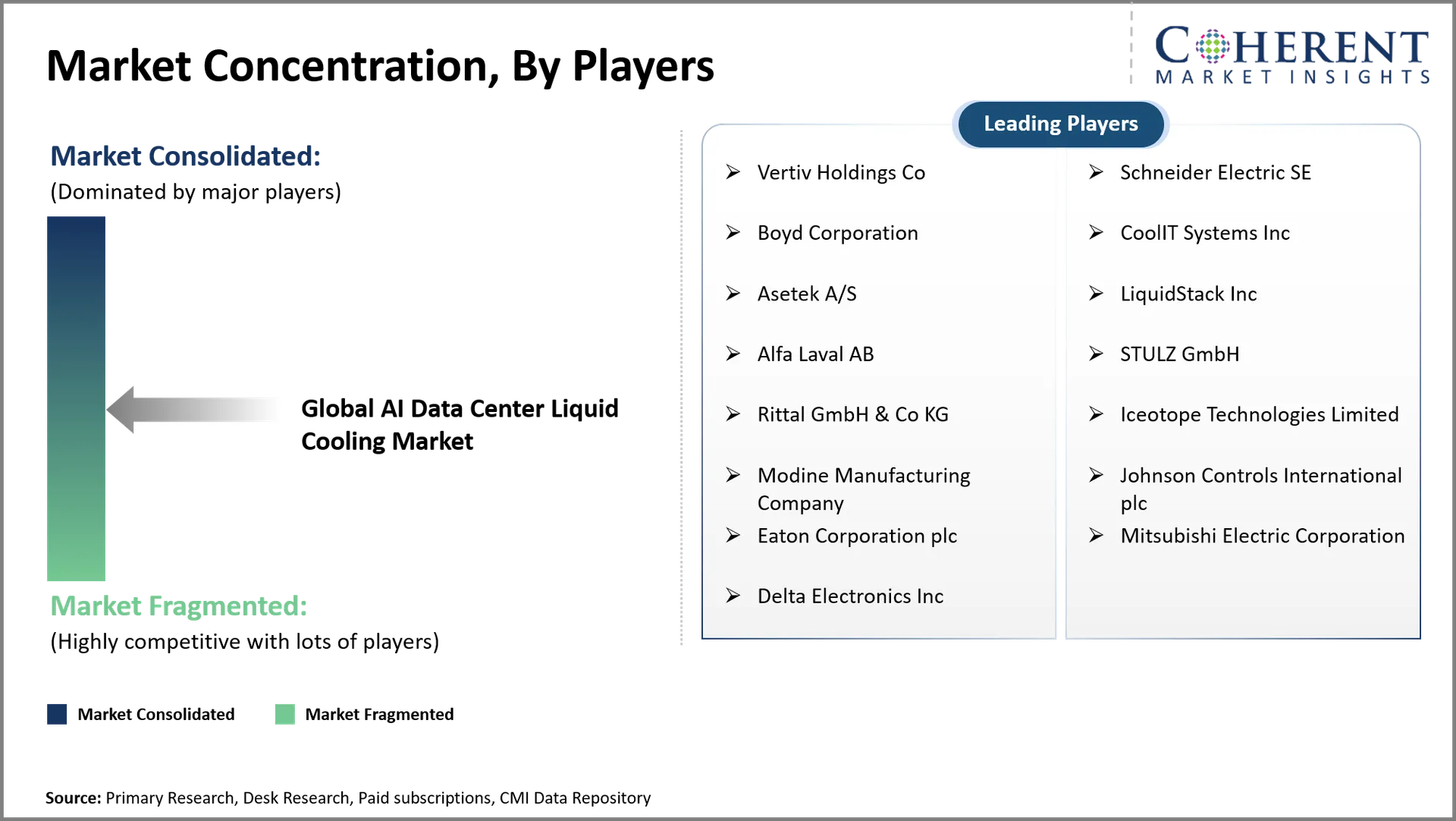
The AI data center liquid cooling market globally has established players in thermal management and specialist cooling technology developers. Vertiv bolsters its position with integrated cooling infrastructure, including CoolChip coolant distribution devices and liquid cooling services. Schneider Electric is looking to achieve total thermal management with Motivair, incorporating chillers, coolant distribution and cold plate technologies. nVent offers liquid cooling distribution and containment solutions for high-density computers. Boyd designs and builds specialized liquid cooling components, including cold plates and thermal management systems. Delta Electronics specializes on integrated power and cooling infrastructure for data centers. These companies compete through cooling capacity, system integration, engineering expertise, and compatibility with advanced AI server platforms.
Top Manufacturers and Notable Products
Top Manufacturers and Notable Products in the AI Data Center Liquid Cooling Market
Manufacturer | Notable Product | Key features |
Vertiv | Vertiv CoolChip CDU family | 70 kW to 2.3 MW capacity options, direct-to-chip and rear-door cooling support, redundant pumps, integrated filtration, leak detection, precise temperature control, in-rack and in-row configurations |
Schneider Electric | Motivair Coolant Distribution Units | Liquid-to-liquid cooling, floor-standing and in-rack configurations, redundant pumps, programmable controls, dynamic flow management, real-time monitoring, high-density AI workload support |
CoolIT Systems | CHx2000 Coolant Distribution Unit | 2,000 kW cooling capacity, 2,125 LPM flow at 35 psi, Redfish integration, group control for up to 20 units, stainless-steel piping, high-capacity AI cluster support |
Delta Electronics | GoCool Liquid Cooling CDU Series | Liquid-to-liquid and liquid-to-air configurations, multiple capacity options, GPU and CPU cooling support, compact infrastructure footprint, integration with broader data center thermal management systems |
Boyd Thermal by Eaton | ROL4000 Coolant Distribution Unit and liquid cold plates | 2 MW cooling capacity at 3°C approach temperature, seal-less N+1 redundant pumps, 0.2-micron filtration, automatic leak detection, custom CPU and GPU |
Market Report Scope
Report Coverage | Details | ||
Base Year | 2025 | Market Size in 2026: | USD 3.37 Bn |
Historical Data For: | 2020 To 2024 | Forecast Period: | 2026 To 2033 |
Forecast Period 2026 To 2033 CAGR: | 21% | 2033 Value Projection: | USD 12.85 Bn |
Geographies covered: |
| ||
Segments covered: |
| ||
Companies covered: | Vertiv Holdings Co, Schneider Electric SE, Boyd Corporation, CoolIT Systems Inc, Asetek A/S, LiquidStack Inc, Alfa Laval AB, STULZ GmbH, Rittal GmbH & Co KG, Iceotope Technologies Limited, Modine Manufacturing Company, Johnson Controls International plc, Eaton Corporation plc, Mitsubishi Electric Corporation, Delta Electronics Inc | ||
Growth Drivers: |
| ||
Restraints & Challenges: |
| ||
Analyst Opinion (Expert Opinion)
- The future of the AI data center liquid cooling industry will depend on scalable thermal architectures and improved cooling precision. Increasing GPU complexity will encourage manufacturers to develop cooling systems beyond conventional cold plate configurations. The main product development priority will be multi-megawatt coolant distribution, flexible cooling infrastructure and intelligent coolant management. Trane Technologies’ LiquidStack CDU 2.X is an example of this strategy. It features architecture-agnostic cooling tailored to meet the increasing demands of AI systems. Delta Electronics is also developing integrated cooling for new 800VDC power systems. These improvements reflect an increasing convergence between power delivery and thermal management.
- The most promising prospects will be in direct-to-chip cooling components, high-capacity coolant distribution units and integrated cooling infrastructure. Direct-to-chip technologies are interesting potential because they solve heat production at the processor level and permit denser and denser accelerator setups. Applications like GPU clusters, AI training infrastructure and high-performance computing facilities will remain significant. The U.S. and China have opportunities to develop advanced AI infrastructure. India offers prospects for localized manufacturing and deployment capabilities. Japan has unique prospects for liquid-cooled accelerator systems and modern computer infrastructure.
- Focus of market participants should be on engineering differentiation, manufacturing scalability and compatibility with emerging server architectures. Cold plate producers must offer solutions for GPUs, CPUs, memory modules and power delivery components. Coolant distribution suppliers need to increase hydraulic balancing, pump redundancy, leak detection, and access for maintenance. Ecolab’s agreement with CoolIT Systems highlights the strategic importance of combining liquid cooling expertise with water management capability. Companies should also establish partnerships with server manufacturers, semiconductor developers, and data center operators. Regional service networks and application-specific testing will strengthen customer confidence and long-term competitiveness.
Speak to the analyst
Want personalized insights?
Take the findings above to one of our principal consultants, or have the report rebuilt around the segments, geographies and competitors you actually track.
Market Segmentation
- Cooling Technology Insights (Revenue, USD Billion, 2021 - 2033)
- Direct-to-Chip Liquid Cooling
- Single-Phase Immersion Cooling
- Two-Phase Immersion Cooling
- Rear-Door Heat Exchanger Cooling
- Hybrid Liquid Cooling
- Data Center Type Insights (Revenue, USD Billion, 2021 - 2033)
- Hyperscale Data Centers
- Colocation Data Centers
- Enterprise Data Centers
- Cloud Data Centers
- Edge Data Centers
- Application Insights (Revenue, USD Billion, 2021 - 2033)
- AI Training
- AI Inference
- High-Performance Computing
- Machine Learning
- Generative AI
- Cloud Computing
- End User Insights (Revenue, USD Billion, 2021 - 2033)
- Cloud Service Providers
- Hyperscale Data Center Operators
- Colocation Providers
- Enterprise IT Organizations
- Government and Research Institutions
- Telecommunication Companies
- Regional Insights (Revenue, USD Billion, 2021 - 2033)
- North America
- U.S.
- Canada
- Latin America
- Brazil
- Argentina
- Mexico
- Rest of Latin America
- Europe
- Germany
- U.K.
- Spain
- France
- Italy
- Russia
- Rest of Europe
- Asia Pacific
- China
- India
- Japan
- Australia
- South Korea
- ASEAN
- Rest of Asia Pacific
- Middle East
- GCC Countries
- Israel
- Rest of Middle East
- Africa
- South Africa
- North Africa
- Central Africa
- North America
- Key Players Insights
- Vertiv Holdings Co
- Schneider Electric SE
- Boyd Corporation
- CoolIT Systems Inc
- Asetek A/S
- LiquidStack Inc
- Alfa Laval AB
- STULZ GmbH
- Rittal GmbH & Co KG
- Iceotope Technologies Limited
- Modine Manufacturing Company
- Johnson Controls International plc
- Eaton Corporation plc
- Mitsubishi Electric Corporation
- Delta Electronics Inc
Sources
Primary Research Interviews
- Data Center Infrastructure Managers & Engineers
- AI Hardware & Server Manufacturers (e.g., NVIDIA, AMD Representatives)
- Liquid Cooling Technology Providers & Solution Architects
- Hyperscale Cloud Service Providers (e.g., AWS, Microsoft Azure, Google Cloud Representatives)
Magazines
- Data Center Dynamics Magazine
- Uptime Magazine (Uptime Institute)
- CoolingPost - Thermal Management & Cooling Industry Magazine
- Data Economy Magazine
Journals
- IEEE Transactions on Components, Packaging and Manufacturing Technology
- International Journal of Heat and Mass Transfer (Elsevier)
- Journal of Electronic Packaging (ASME)
Associations
- Green Grid Association (TGG)
- ASHRAE (American Society of Heating, Refrigerating and Air-Conditioning Engineers)
- Uptime Institute
- Data Center Alliance (DCA)
Public Domain Sources
- U.S. Department of Energy (DOE) - Data Center Energy Efficiency Reports
- European Commission - Green Deal & Data Center Sustainability Guidelines
- International Energy Agency (IEA) - Data Centers & Data Transmission Networks Report
- U.S. Environmental Protection Agency (EPA) - Energy Star Data Center Program
Proprietary Elements
- CMI Data Analytics Tool
- Proprietary CMI Existing Repository of Information for Last 10 Years
Get access to 250+ pages report
Every segment, forecast, competitor profile and data table behind the analysis above — available for instant download.
- ESOMAR Member
- ISO 9001:2015 Certified
- D-U-N-S Registered
- GDPR & CCPA Compliant
Frequently Asked Questions
The global AI data center liquid cooling market is expected to stand at USD 3.37 Bn in 2026 and is expected to reach USD 12.85 Bn by 2033.
The CAGR of the global AI data center liquid cooling market is projected to be 21% from 2026 to 2033.
Increasing deployment of high-density AI computing infrastructure and Growing thermal management requirements of GPU-based server racks are the major factors driving the growth of the global AI data center liquid cooling market.
High initial investment in liquid cooling infrastructure and complexity of retrofitting existing air-cooled data centers are the major factors hampering the growth of the global AI data center liquid cooling market.
In terms of cooling technology, direct-to-chip liquid cooling segment is estimated to dominate the market revenue share in 2026.
Immersion cooling involves submerging server components in dielectric fluids that absorb and transfer operational heat.
Coolant distribution units regulate coolant circulation, temperature, pressure, and flow across server cooling circuits.