

Global AI Education Market Size and Forecast – 2026 To 2033
The global AI education market is expected to grow from USD 11.40 Bn in 2026 to USD 57.25 Bn by 2033, registering a compound annual growth rate (CAGR) of 16.8% from 2026 to 2033. The global AI education market is driven by rising use of automated assessment and grading. On February 16, 2026, Anthropic, an AI safety and research company that’s working to build reliable, interpretable, and steerable AI systems, announced it is partnering with Pratham, one of the largest education non-profits, to develop AI-powered tools that help students learn more effectively.
Key Takeaways of the Global AI Education Market
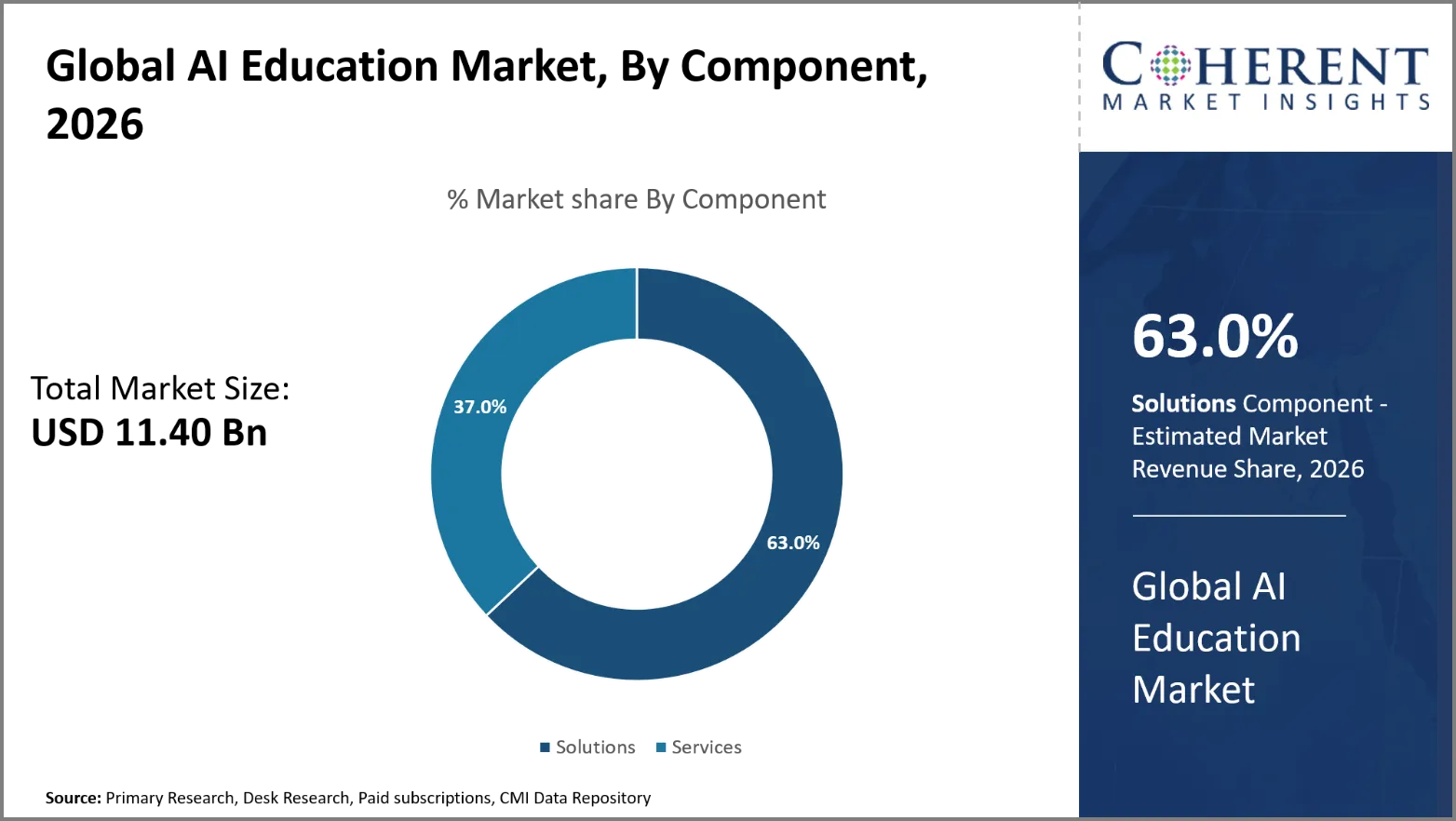
- The Solutions segment is expected to account for 63.0% of the global AI education market share in 2026. Expanding digital learning infrastructure is driving the growth of the segment. On June 17, 2026, The Asian Development Bank signed a USD 10 million financing package with Schoolnet India Limited. The initiative aims to improve learning outcomes for 4.5 million students by expanding digital learning infrastructure across 30,000 government schools.
- The Cloud-Based segment is estimated to capture 71.0% of the market share in 2026. Growing adoption of adaptive learning technologies is majorly driving the growth of the segment. On June 29, 2026, McGraw Hill introduced ALEKS Adventure for Grades 4-5 and ALEKS for Calculus II. These additions extend personalized mathematics instruction from elementary education through advanced university coursework.
- The Machine Learning segment is estimated to capture 37.0% of the market share in 2026. Increasing demand for educational analytics is driving the growth of the segment. On March 3, 2026, ClassLink Insights was launched by ClassLink, at its annual conference. The platform links together ed-tech usage data with student assessment results to assist school officials in analyzing how much digital resources are aiding learning outcomes.
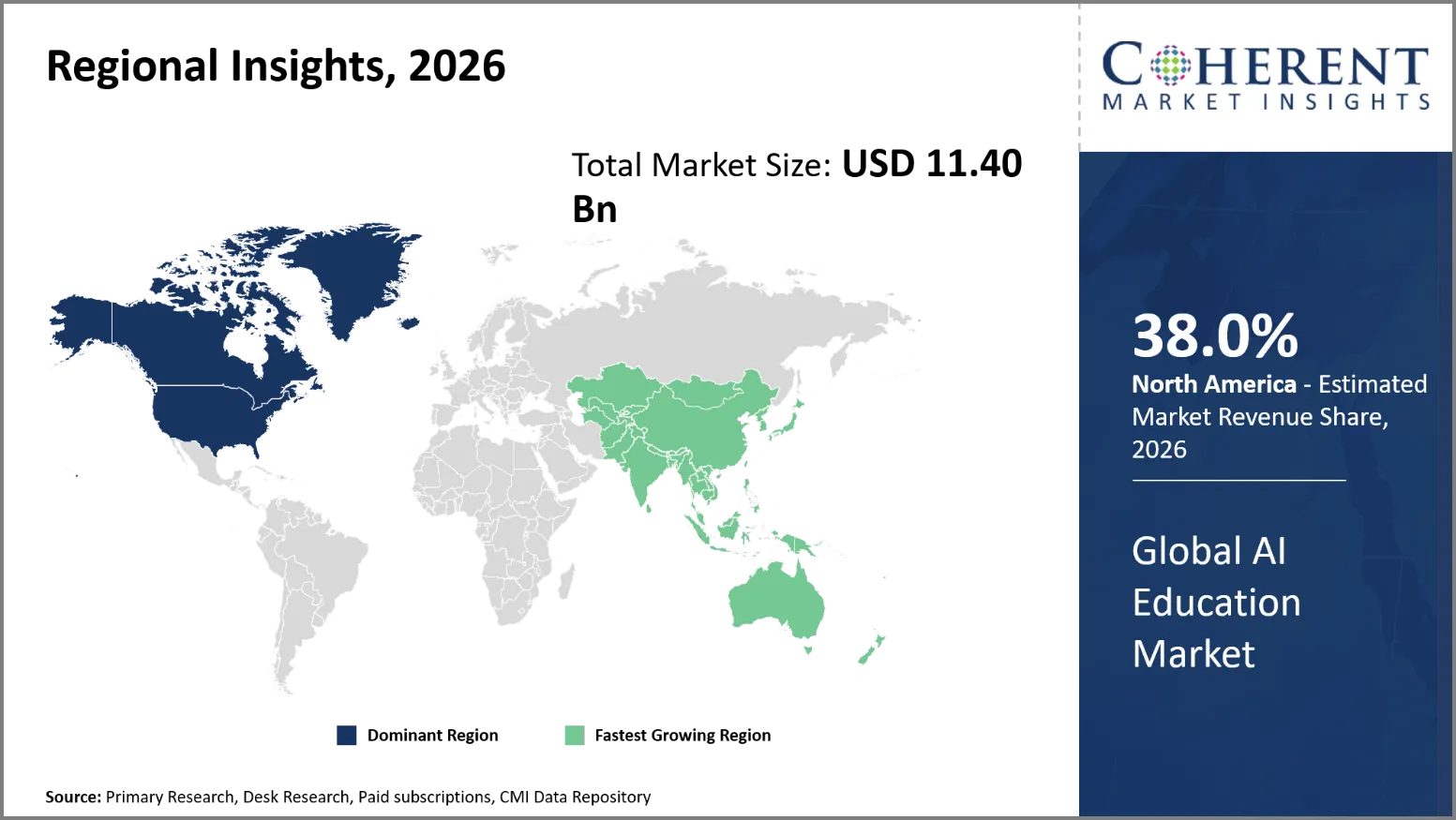
- North America is expected to dominate the AI education market in 2026 with a market share of 38.0%. Rising corporate workforce reskilling requirements in North America is driving the growth of the regional market. On December 2, 2025, FedEx announced an enterprise-wide Artificial Intelligence Education and Literacy program. The corporation is working with Accenture to deliver personalized, role-based learning to its global workforce.
- Asia Pacific is expected to account for 29.0% share in 2026. Growing integration of generative AI into learning environments in Asia Pacific is driving the growth of the regional market. On August 25, 2025, OpenAI unveiled its Learning Accelerator program to improve AI access for educators and learners in India. The initiative also called for distributing some 500,000 ChatGPT licenses and providing training through educational collaborations.
Segmental Insights
Why Does Solutions Dominate the Global AI Education Market?
The solutions segment is expected to account for 63.0% of the global AI education market share in 2026. Solutions lead as educational institutions need practical tools for customized training, automated evaluation and tracking of student achievement. They blend intelligent tutoring, adaptive learning, content authoring, and learning analytics into existing educational workflows. Schools and institutions may identify knowledge gaps, run targeted exercises and provide faster feedback, all while keeping teachers informed. Integrated platforms also empower instructors to address a range of learning needs across both the classroom and the digital environment. The Organization for Economic Co-operation and Development identifies adaptive learning systems and intelligent tutoring as important applications of artificial intelligence in education.
On April 29, 2025, Amazon Web Services announced that Chiang Mai University (CMU), a leading public research institution in Thailand, has built ChatGen and Matthew, industry-first generative AI platforms on the world’s leading cloud. Matthew provides generative AI capabilities to more than 52,000 university staff and students, allowing users to answer questions with document references, summarize content, analyze data and images, create documents, and translate text.
- Current Industry Events of 2026
- Market Size Estimation
- Regional Breakdown
- Competitive Landscape
- Customer Intelligence
- Segmental Analysis
- Pricing Analysis
- Key Market Drivers, Challenges & Future Trends
- Customized Insights Section
Why is Cloud-Based the Most Preferred Deployment Type?
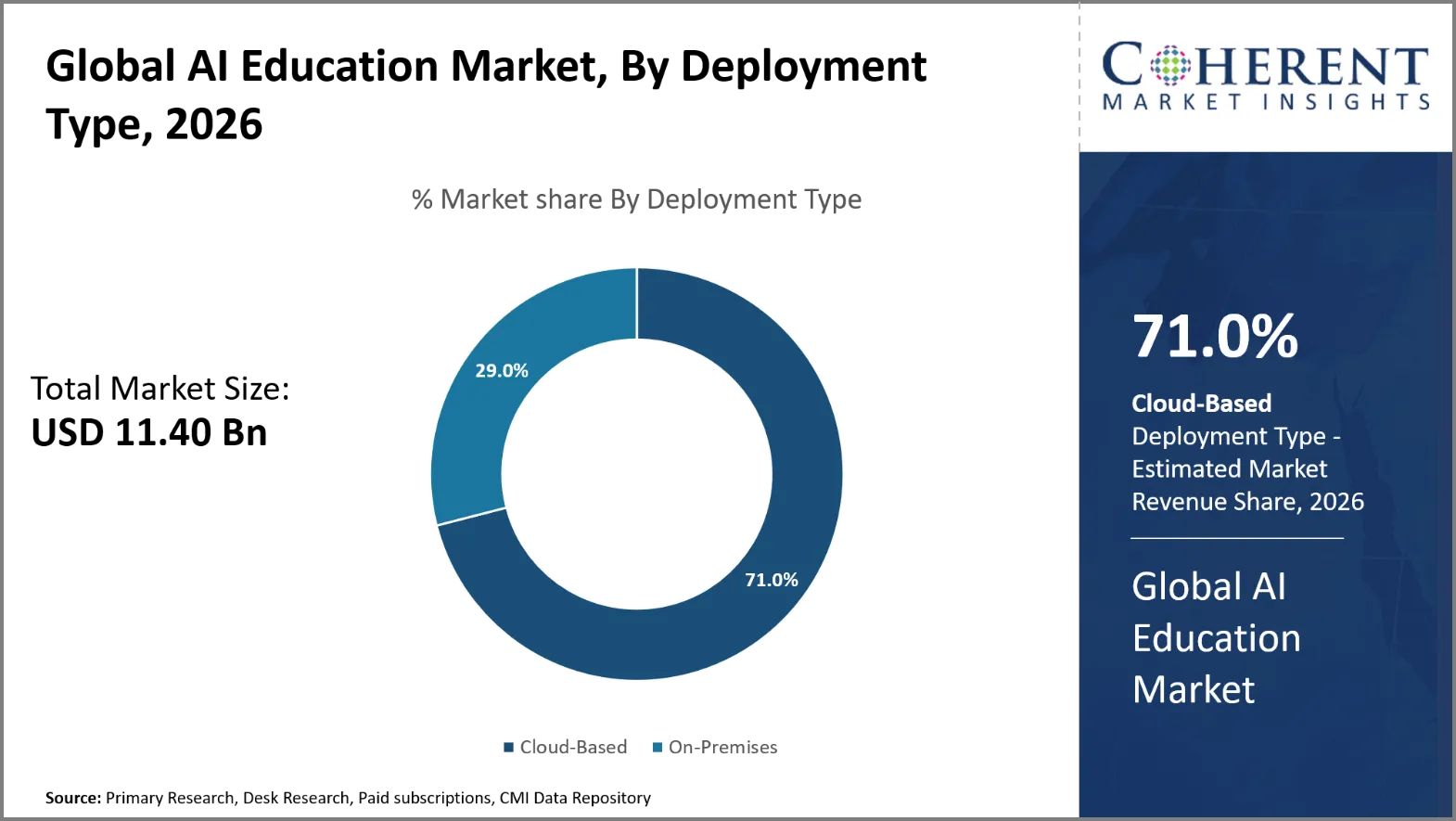
The cloud-based segment is expected to account for 71.0% of the global AI education market share in 2026. The cloud-based deployment is favored since it allows educational institutions to use AI tools without maintaining huge on-premise computing equipment. Cloud solutions provide centralized updates and remote learning, scalable computing resources and integration with learning management systems. Educational applications are useful for flexibility in hybrid learning environments as students and teachers can utilize them on any device, anywhere. Cloud architecture also allows corporations to deploy tutoring assistants, automated grading and learning analytics in several institutions. Accenture LearnVantage, a platform running on Amazon Web Services, provides scalable hybrid learning and personalized educational apps for Indian universities.
On March 8, 2026, Google announced that all 20 public universities in Malaysia had activated Gemini for Education. This impacts roughly 600,000 students and 75,000 professors on their existing Google Workspace for Education configurations. The deployment provides AI assistance for research, learning, and academic activities, supported by secure tools and training.
Machine Learning Dominates the Global AI Education Market
The machine learning segment is expected to account for 37.0% of the global AI education market share in 2026. Machine learning has become a significant component of the Global Artificial Intelligence Education Market since it helps the education system to recognize learning trends and tailor the learning process. The algorithms examine the results of the assessment, the correctness of the answers, the learning progress and the most common mistakes and on this basis offer the appropriate exercises. Adaptive platforms can change the difficulty of questions and the sequencing of learning depending on how each student performs. Teachers can also use predictive knowledge to spot pupils who are failing and offer timely intervention. Adaptive learning technology helps customize basic subjects, according to the Organization for Economic Co-operation and Development, by analyzing performance. Such qualities make machine learning indispensable for scalable, data-driven instructional support.
On July 22, 2026, Instructure introduced Project Athena, an AI study coach it is developing as part of its Instructure Foundry initiative, on July 22, 2026. The application takes course materials, assignments and upcoming tests and creates customized quizzes, study aids and coaching suggestions.
Current Events and their Impact
Current Events | Description and its Impact |
European Union Artificial Intelligence Act Regulation (EU) 2024/1689 |
|
Digital Personal Data Protection Act, 2023, and Digital Personal Data Protection Rules, 2025, India |
|
AI Education Market Dynamics
Market Drivers
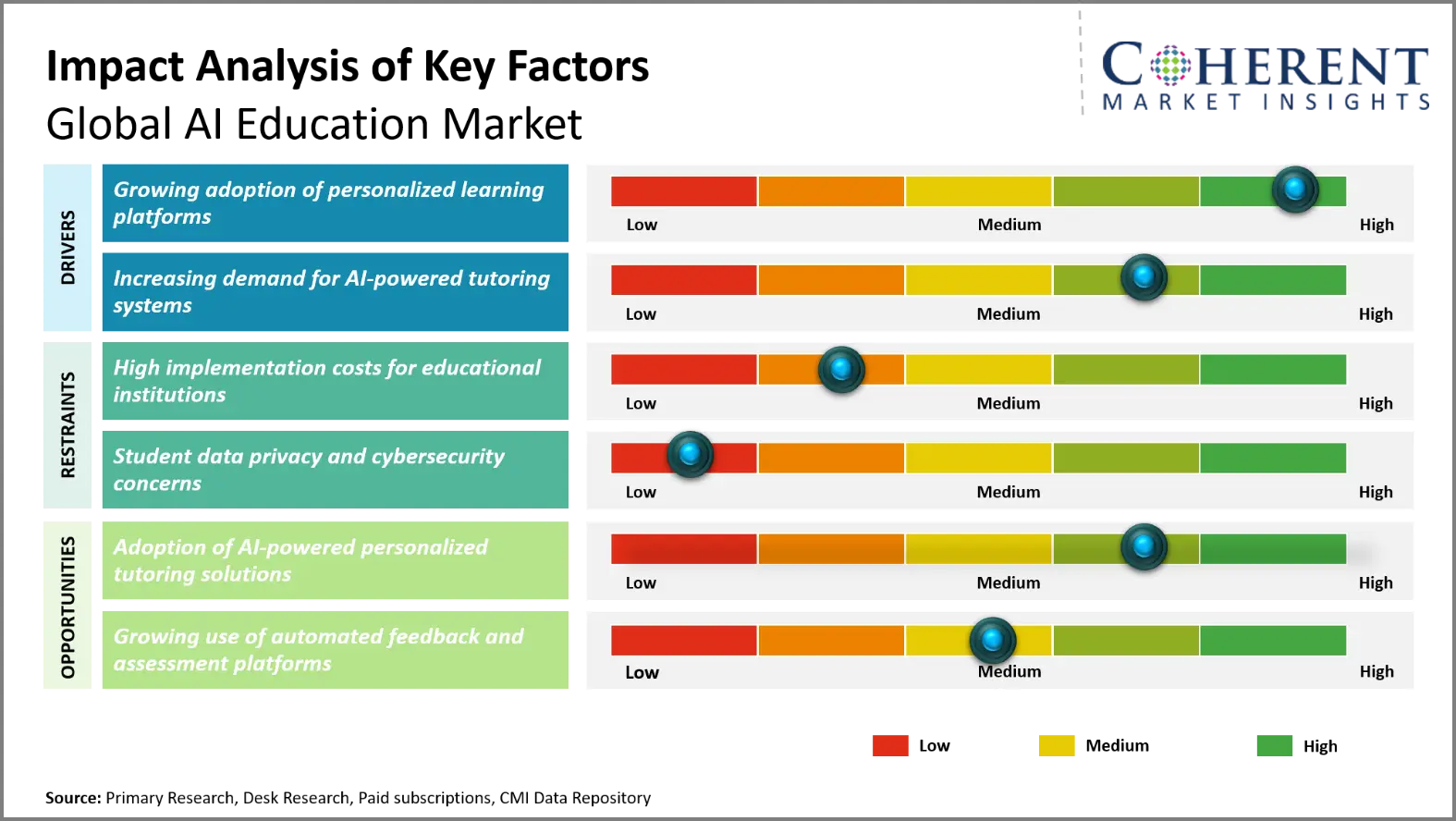
- Growing adoption of personalized learning platforms: The global AI education market is expanding as schools, institutions, and training providers increase their adoption of customized educational platforms. These platforms use student progress, assessment outcomes and knowledge gaps to tailor instructional content. Machine learning algorithms recommend appropriate exercises, adapt the difficulty of learning and provide tailored feedback. Cloud implementation allows institutions to deliver personalized education experiences across multiple devices and locations. The uptake is also driven by the demand for flexible schooling, measurable learning outcomes and inclusive teaching methodologies. To promote teaching efficiency and enhance student engagement, schools and universities are supplementing their existing learning management systems with additional specialized instructional technologies.
- On June 26, 2025, Google Cloud and Pearson announced a multi-year strategic partnership to create breakthrough AI-powered products and services to tailor learning for children, provide educators with insights, and help enhance educational outcomes. This relationship will benefit students utilizing Pearson AI products and services, especially in the K-12 market, with better material and more engaging learning experiences.
- Increasing demand for AI-powered tutoring systems: The increasing demand for artificial intelligence-based tutoring systems is gaining traction in the global AI education industry. The systems offer interactive explanations, practice questions, quick feedback and individualized academic support beyond the regular classroom hours. Conversational teaching powered by generative artificial intelligence can answer student inquiries and clarify complex ideas. More schools and families are adopting these technologies to improve learning accessibility and augment classroom learning. It also solves the different linguistic and educational backgrounds of learners by providing multilingual features. With an emphasis on affordable academic support and lifelong learning, developers are being challenged to improve the quality of tutoring, curriculum alignment and guardrails against inaccurate responses.
- On April 8, 2026, Penda Learning launched Cosmos for its kindergarten through grade-twelve science platform. The assistant guides learners to comprehend difficulties, to explore different explanations, to ask for hints and to select appropriate problem-solving strategies.
Emerging Trends
- Generative AI in Education: Generative artificial intelligence systems deliver explanations, quizzes, lesson plans, and interactive learning materials tailored to student needs and curricular demands.
- Impact: Educators are using less time for preparation, feedback is being transmitted more quickly, and supplemental learning resources are available. They also show the need for accuracy checks.
- Relevance to the market: Institutional use is increasing, creating opportunities for developers to construct content production, teacher support, multilingual help, and safe educational AI apps aligned with curricula.
- Multimodal and Conversational Learning Systems: Educational platforms increasingly use text, audio, images and interactive conversation to teach difficult ideas and cater to varied learning preferences.
- Impact: Multimodal systems promote accessibility, foster active participation and help learners grasp complex concepts through a variety of teaching methods and immediate feedback.
- Relevance to the market: Demand for conversational interfaces and multimodal tutoring is driving investment in adaptive software, speech technologies and integrated artificial intelligence learning systems.
Regional Insights
Why is North America a Strong Market for AI Education?
North America is expected to account for a market share of 38.0% in 2026. The artificial intelligence education industry in North America is reliant on robust university research networks, established education technology companies and partnerships between technology creators and academic institutions. In September 2026, Canada launched the National Artificial Intelligence Literacy Initiative with the Alberta Machine Intelligence Institute. The effort will reach up to one million postsecondary students and more than 50,000 K-12 educators. In the U.S., federal initiatives promote artificial intelligence literacy, educator training and early exposure to artificial intelligence principles. These developments support demand for educator training platforms, university learning tools, and artificial intelligence curriculum development.
Why Does Asia Pacific AI Education Market Exhibit High Growth?
Asia Pacific is expected to register the fastest growth with a CAGR of 17.5% over the forecast period. It is projected to account for 29.0% of the global AI education market in 2026. Asia Pacific’s artificial intelligence education market is gaining momentum through government-backed digital education infrastructure and large-scale integration of artificial intelligence into formal learning. Regional education systems are establishing digital curricula, teacher training and multilingual educational materials. China, India, South Korea and Singapore have differing national approaches to technology-enabled learning. The linguistic diversity in the region offers chances for voice recognition, translation, customized tutoring and culturally relevant educational content. Mobile-first education services assist providers to reach learners beyond traditional classrooms. Demand is increasingly moving away from student applications toward teacher development, vocational learning and artificial intelligence literacy programs to support workforce transitions.
Global AI Education Market Outlook for Key Countries
Why is U.S. Emerging as a Major Hub in the AI Education Market?
Federal programs to promote artificial intelligence literacy, train teachers and encourage educational innovation help the U.S. AI education sector. Executive Order 14277, on April 23, 2025 established a White House Task Force on AI education. In September 2025, major organizations declared commitments to promote artificial intelligence educational resources and professional development. Cengage said it expects to increase its artificial intelligence student assistant to more than 100 titles from 21. Such advances give prospects for adaptive courseware, instructor support tools, and AI-augmented digital textbooks. Still, partnerships between publishers, schools and technology companies are crucial routes to acceptance.
Is China the Next Growth Engine for the AI Education Market?
China’s artificial intelligence education market is moving ahead with coordinated national strategies focusing on curriculum integration and educational infrastructure. In April 2026, five government agencies released the Artificial Intelligence Plus Education Action Plan. The goal of the effort is to create a full-fledged artificial intelligence education system by 2030. Top priorities are artificial intelligence courses in schools, multidisciplinary university programs, intelligent tutoring, automated evaluation and teacher training. The Ministry of Education also promotes national educational computing resources and special educational models. These programs generate demand for learning apps that are aligned with the curriculum, automated grading, intelligent teaching assistants, and institutional artificial intelligence platforms.
U.K. AI Education Market Analysis and Trends
The U.K. artificial intelligence education market is gaining opportunities through targeted tutoring initiatives addressing educational disadvantage. The government has set out plans for safe AI tutoring tools that could help 450,000 disadvantaged kids a year by January 2026. The project stresses personal teaching, oversight by teachers and compliance with the national curriculum. In April 2026, officials called upon educational technology corporations and artificial intelligence labs to come up with classroom-ready solutions. Up to eight companies were expected to begin school testing that summer. These programs create opportunities for adaptive mathematics tutoring, English learning applications, curriculum-aligned assessment, and evidence-based educational software serving schools with limited tutoring resources.
South Korea AI Education Market Analysis and Trends
South Korea’s artificial intelligence education market is shaped by digital curriculum modernization and efforts to strengthen students’ technological capabilities. The country has pursued artificial intelligence-enabled digital textbooks intended to support personalized instruction and provide teachers with learning analytics. Implementation discussions have also highlighted concerns about screen exposure, educational effectiveness, and classroom suitability. The arguments encourage suppliers to demonstrate measurable learning advantages rather than simply relying on the novelty of technology. Possibilities include adaptive math programs, Korean language tutoring aides, instructor dashboards, and interactive science learning tools. Demand is also impacted by school buying decisions, instructor preparation and integration with current digital learning environments.
India AI Education Market Analysis and Trends
India’s artificial intelligence education market is rising with curriculum development, computational thinking initiatives and increasing focus on digital skills. The Ministry of instruction said that it will incorporate artificial intelligence and computational thinking across school instruction from Class 3 in October 2025. The effort includes institutions such as the Central Board of Secondary Education and the National Council of Educational Research and Training. The National Education Policy 2020 also promotes computational thinking and future technologies. These priorities allow for age-appropriate apps for learning artificial intelligence, teacher training, instructional content in regional languages and practical tools for coding. Affordable delivery is still important in reaching the various school systems.
Global AI Education Market - Student Adoption of Generative AI by Region (2025)
Region | Country | Student Adoption |
Asia Pacific | Indonesia | 95% |
Malaysia | 90% | |
India | 84% | |
South Korea | 84% | |
Australia | 77% | |
North America | Canada | 79% |
U.S. | 67% | |
Europe | U.K. | 67% |
Spain | 87% | |
Turkey | 68% |
How is Adoption of AI-Powered Personalized Tutoring Solutions Creating New Growth Opportunities in the AI Education Market?
The expansion of AI-powered personalized tutoring opens up new business channels by enabling education providers to give specialized academic support at scale. In January 2026, the U.K. government stated it would introduce tutoring tools for 450,000 disadvantaged kids, with classroom testing and a national rollout by 2027. Khan Academy said Khanmigo was used by 2 million students, instructors and parents in the U.S. during the 2024-2025 school year. These advancements open commercial opportunities for adaptive math tutoring, curriculum-aligned language learning, diagnostic testing and teacher dashboards. Vendors that can produce measurable learning improvements, safe student interactions and effective integration into schools may grow institutional partnerships and recurrent software demand.
On April 8, 2025, Cengage, the higher education business of global edtech company Cengage Group, announced increased availability of its generative AI tool, Student Assistant. This expansion enables more than one million students can get access to Student Assistant.
Market Players, Key Development, and Competitive Intelligence
Key Developments
- On March 12, 2026, Instructure announced the launch of IgniteAI Agent, marking a major milestone in the company’s vision to serve as the trusted, long-term partner for the future of learning. Powered by Amazon Web Services, the Agent expands Instructure’s IgniteAI suite to move beyond isolated tools. It provides a secure, transparent workflow capability that helps institutions navigate the shift toward agentic AI, in which technology orchestrates time-consuming, low educational value tasks to amplify human potential.
- On January 15, 2026, Microsoft Corp. announced Microsoft Elevate for Educators, a new comprehensive program connecting educators with community, resources and in-demand credentials and new AI-powered capabilities at no additional cost to help schools worldwide prepare educators and students for an AI-driven future.
Competitive Landscape
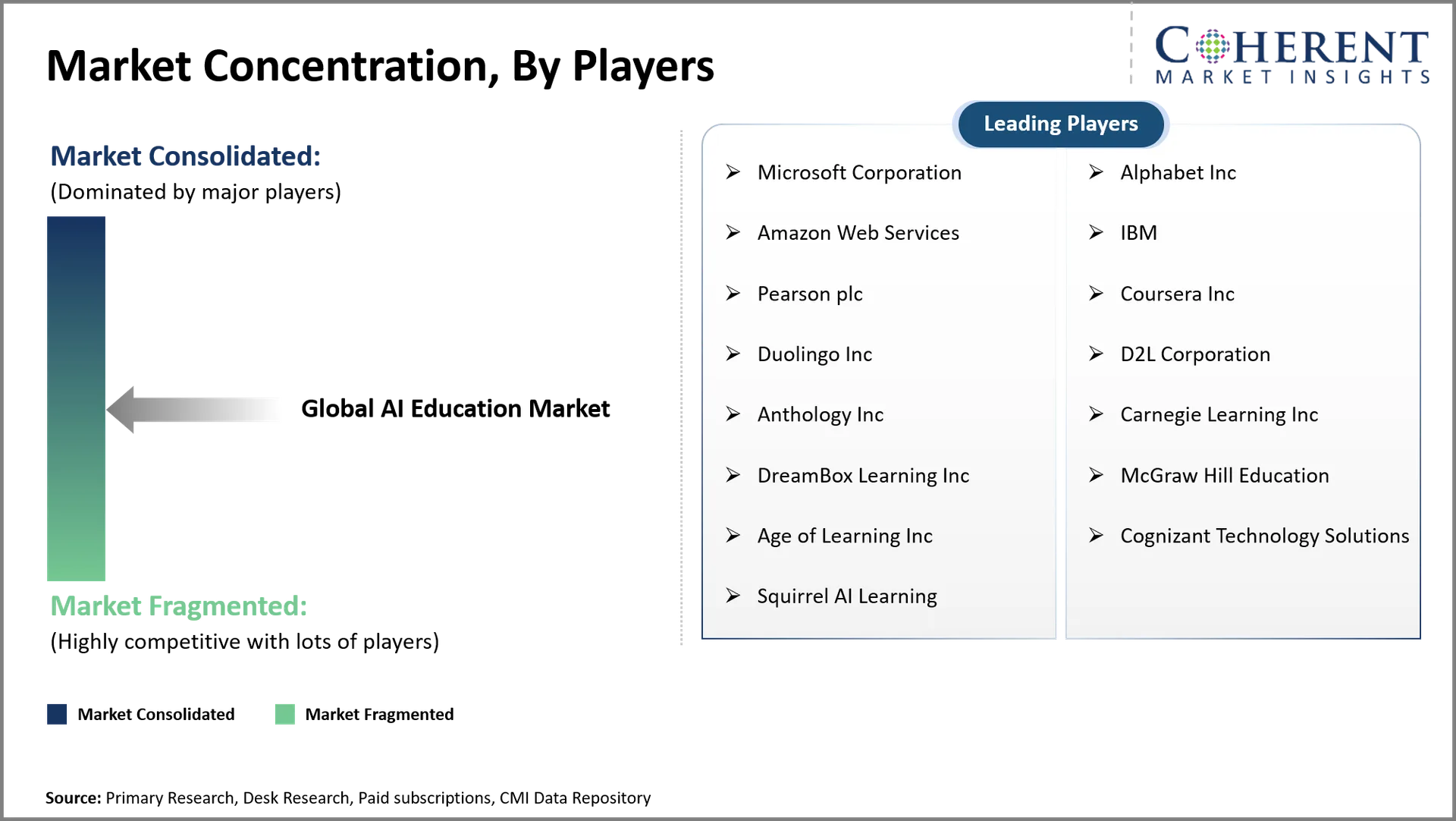
The global AI education market features technology companies, educational publishers, and specialized learning platforms competing through personalized tutoring, teacher assistance, and institutional software integration. Google is also increasing its education offerings with Gemini for Education, NotebookLM and its connection with Khan Academy. In August 2026, Khan Academy released interactive diagrams and teacher-led practice materials powered by Gemini models. Microsoft is adding artificial intelligence to Microsoft 365 Education, including for lesson planning and for helping students learn. OpenAI has dedicated deployments for education including ChatGPT Edu and ChatGPT for Teachers. SchoolAI is focused on instructor guided student interactions and classroom progress monitoring. These companies compete through curriculum alignment, educator control, data protection, and integration with existing educational workflows.
Top Manufacturers and Notable Products/Solutions in the AI Education Market
Manufacturer/Company | Notable Product/Solution | Key features |
Khan Academy | Khanmigo | AI-powered tutoring, Socratic questioning, personalized practice, teacher lesson planning, and progress insights |
Gemini for Education | Personalized study plans, adaptive quizzes, lesson creation, differentiated learning materials, and guided explanations | |
Pearson | Study Prep | AI tutoring, syllabus-matched study plans, video lessons, practice questions, and expert tutor support |
McGraw Hill | ALEKS | Adaptive mathematics learning, knowledge-gap identification, personalized practice, and mastery-based progression |
Instructure | Canvas with IgniteAI | AI-assisted course content, personalized study support, quiz generation, instructional workflows, and learning management integration |
Market Report Scope
Global AI Education Market Report Coverage | |||
Report Coverage | Details | ||
Base Year | 2025 | Market Size in 2026: | USD 11.40 Bn |
Historical Data For: | 2020 To 2024 | Forecast Period: | 2026 To 2033 |
Forecast Period 2026 To 2033 CAGR: | 16.80% | 2033 Value Projection: | USD 57.25 Bn |
Geographies covered: |
| ||
Segments covered: |
| ||
Companies covered: | Microsoft Corporation, Alphabet Inc, Amazon Web Services, IBM, Pearson plc, Coursera Inc, Duolingo Inc, D2L Corporation, Anthology Inc, Carnegie Learning Inc, DreamBox Learning Inc, McGraw Hill Education, Age of Learning Inc, Cognizant Technology Solutions, Squirrel AI Learning | ||
Growth Drivers: |
| ||
Restraints & Challenges: |
| ||
Analyst Opinion (Expert Opinion)
- The future of the global AI education market will increasingly depend on systems that guide learning rather than simply generate answers. Adaptive tutoring, conversational assessment, and interactive visual explanations will become important product capabilities. Focus should be on technologies which detect misconceptions, change difficulty of questions and explain every learning process. This is seen in Khan Academy’s use of interactive diagrams within Khanmigo. General purpose chatbots are less able to fulfill classroom demands than educational platforms with individualized input and teacher oversight.
- Artificial intelligence-powered tutoring, teacher productivity tools and curriculum-aligned assessment are anticipated to present the strongest potential. India presents a unique potential for multilingual tutoring and low-cost applications at the school level. In January 2026, Google announced a USD 8.9 million funding to Wadhwani AI for its adaptive learning initiatives for students and instructors. There are prospects for institutional AI deployments, university learning tools and secure classroom aides in the U.S. China’s prospect lies in government-led curriculum unification and digital education programs. Providers should localize products for national curricula, local languages, procurement methods and student age groupings.
- Market participants must differentiate their offerings based on demonstrable educational accuracy, observable instructional utility, and credible institutional controls. Developers should incorporate in curriculum-based solutions, instructor review processes, student privacy protections and transparent descriptions of artificial intelligence limitations. Collaboration with school districts, colleges, publishers and education ministries can improve dissemination, and relevance to the curriculum. Companies entering India should support regional languages and low bandwidth conditions. In terms of providers who target the U.S., the institutional management and protection of student data should be a focus. Product teams should also test for improper explanations, age-inappropriate responses and over-reliance on automated answers. Those qualities can boost buyer confidence and help sustainable adoption.
Speak to the analyst
Want personalized insights?
Take the findings above to one of our principal consultants, or have the report rebuilt around the segments, geographies and competitors you actually track.
Market Segmentation
- Component Insights (Revenue, USD Billion, 2021 - 2033)
- Solutions
- Services
- Deployment Type Insights (Revenue, USD Billion, 2021 - 2033)
- Cloud-Based
- On-Premises
- Technology Type Insights (Revenue, USD Billion, 2021 - 2033)
- Machine Learning
- Natural Language Processing
- Deep Learning
- Computer Vision
- Generative AI
- Application Insights (Revenue, USD Billion, 2021 - 2033)
- Learning Platforms
- Virtual Facilitators
- Intelligent Tutoring Systems
- Smart Content
- Automated Assessment
- Learning Analytics
- Administrative Automation
- Language Learning
- End User Insights (Revenue, USD Billion, 2021 - 2033)
- K-12 Education
- Higher Education
- Corporate Learning and Training
- Vocational Education
- Others
- Regional Insights (Revenue, USD Billion, 2021 - 2033)
- North America
- U.S.
- Canada
- Latin America
- Brazil
- Argentina
- Mexico
- Rest of Latin America
- Europe
- Germany
- U.K.
- Spain
- France
- Italy
- Russia
- Rest of Europe
- Asia Pacific
- China
- India
- Japan
- Australia
- South Korea
- ASEAN
- Rest of Asia Pacific
- Middle East
- GCC Countries
- Israel
- Rest of Middle East
- Africa
- South Africa
- North Africa
- Central Africa
- North America
Sources
Primary Research Interviews
- AI Education Platform Providers & Developers
- School & University Administrators (K-12 and Higher Education)
- EdTech Investors & Venture Capitalists
- Corporate Learning & Development Managers
Magazines
- EdTech Magazine
- THE Journal (Technological Horizons in Education)
- Wired (AI & Technology in Education Coverage)
- eLearn Magazine
Journals
- Journal of Artificial Intelligence in Education (JAIED)
- Computers & Education (Elsevier)
- British Journal of Educational Technology (BJET)
Associations
- International Society for Technology in Education (ISTE)
- EdTech Industry Network (ETIN)
- Association for the Advancement of Artificial Intelligence (AAAI)
- Society for Information Technology and Teacher Education (SITE)
Public Domain Sources
- U.S. Department of Education - Office of Educational Technology (OET)
- European Commission - Digital Education Action Plan
- World Bank Open Data - Education Statistics
- National Science Foundation (NSF) - AI Research Reports
Proprietary Elements
- CMI Data Analytics Tool
- Proprietary CMI Existing Repository of Information for the Last 10 Years
Get access to 250+ pages report
Every segment, forecast, competitor profile and data table behind the analysis above — available for instant download.
- ESOMAR Member
- ISO 9001:2015 Certified
- D-U-N-S Registered
- GDPR & CCPA Compliant
Frequently Asked Questions
The global AI education market is expected to stand at USD 11.40 Bn in 2026 and is expected to reach USD 57.25 Bn by 2033.
The CAGR of the global AI education market is projected to be 16.8% from 2026 to 2033.
Growing adoption of personalized learning platforms and Increasing demand for AI-powered tutoring systems are the major factors driving the growth of the global AI education market.
High implementation costs for educational institutions and Student data privacy and cybersecurity concerns are the major factors hampering the growth of the global AI education market.
In terms of component, solutions segment is estimated to dominate the market revenue share in 2026.
Machine learning analyzes student performance, identifies knowledge gaps, and recommends suitable learning activities based on individual progress.
Personalized learning platforms adapt content difficulty, instructional sequences, and practice exercises to individual student needs.