

Global Ai in Energy Market Size and Forecast – 2026 To 2033
The Global AI in Energy Market is estimated to be valued at USD 6.04 Bn in 2026 and is expected to reach USD 22.15 Bn by 2033, growing at a compound annual growth rate (CAGR) of 20.4% from 2026 to 2033. Market expansion is supported by the integration of artificial intelligence into electricity distribution, renewable energy management, predictive maintenance, and energy demand forecasting. Utilities are increasingly deploying AI-enabled solutions to improve grid reliability, minimize operational disruptions, and optimize infrastructure investments.
In September 2026, Neoenergia, a subsidiary of Iberdrola in Brazil, announced that it had allocated approximately BRL 30 million to AI initiatives during 2026, including solutions that combine weather forecasts, thermal imaging, and operational data to anticipate grid failures and improve maintenance planning. This investment demonstrates how electricity providers are translating AI capabilities into practical operational improvements, supporting long-term market opportunities.
Key takeaways of the Global Ai in Energy Market
- AI Software and Platforms are expected to expand at a 21.5% CAGR till 2033 and hold 68.6% share in the global AI in energy market in 2026. Utilities like integrated software that combines grid planning, asset monitoring and outage response, without replacing core infrastructure. In November 2025, Schneider Electric announced its One Digital Grid Platform, which integrates these functions through AI-enabled software.
- Machine Learning and Predictive is expected to account for 47.0% of revenue of the global AI in energy market in 2026, growing at a CAGR of 20.8% during the forecast period. The commercial value is in transforming smart meter data into forecasts for electricity consumption and generation that can be acted on. In February 2025, Tigo Energy expanded its Predict+ platform with machine-learning capabilities for forecasting grid demand, renewable generation, and energy market conditions.
- Cloud-Based deployment is expected to achieve an estimated 22.0% CAGR through 2033 and capture 72.5% of the global AI in energy market in 2026. Centralized computing enables energy operators to scale analytics across distributed assets while reducing infrastructure management requirements. In March 2025, Google Cloud announced its collaboration with Carrier to develop AI-enabled home energy management solutions supporting battery orchestration and electricity consumption optimization.
- North America is estimated to experience a CAGR of 18.5% by 2033, accounting for 38.6% of the global AI in energy market revenue in 2026. Its leadership reflects established utility infrastructure, advanced grid analytics capabilities and investments in operational resilience. In May 2026, Pacific Northwest National Laboratory launched its Enhanced Visibility and Event Response initiative to develop AI-driven grid monitoring and event-response capabilities.
- Europe is anticipated to record an estimated 24.0% CAGR through 2033, securing 27.3% of the global AI in energy market in 2026. Cross-border electricity integration and grid digitalization create opportunities for interoperable AI solutions supporting renewable energy management and demand-side flexibility. In June 2026, the European Commission published its Strategic Roadmap for Digitalization and AI in Energy, addressing grid intelligence and secure energy data sharing.
Segmental Insights
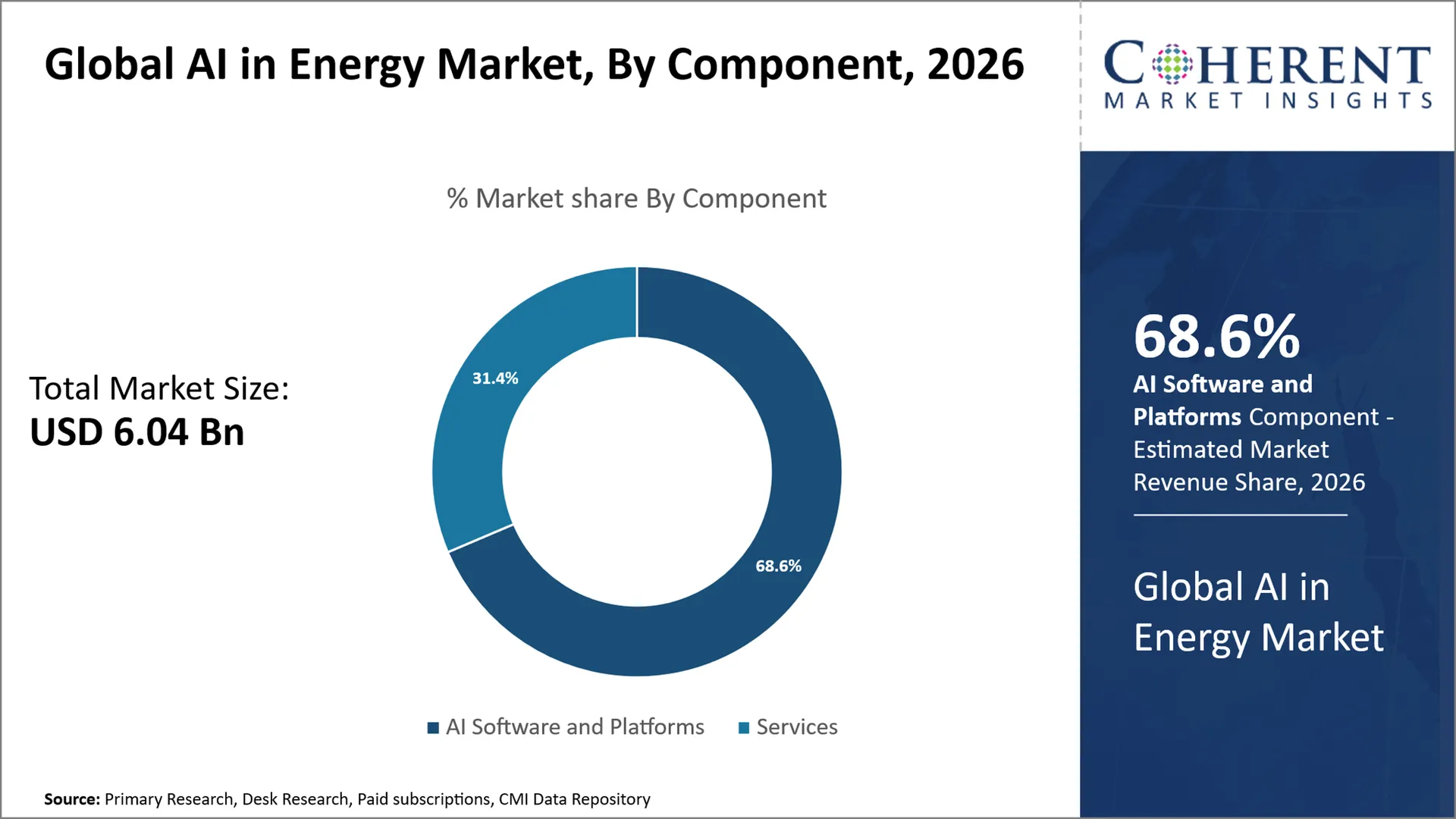
Why Do AI Software and Platforms Dominate the Global AI in Energy Market?
AI Software and Platforms are projected to contribute the highest share of 68.6% to the global AI in energy market by 2026. This is because utilities are increasingly purchasing configurable applications rather than developing analytical tools in-house. They are valuable as they link customer, meter, financial and engineering records to well defined business workflows, where lack of data often slows down implementation. Prebuilt connectors and industry-specific data models can speed deployment cycles, while subscription licensing gives suppliers recurring revenue beyond the initial installation. These applications enable electricity distributors to perform transformer level analysis and to evaluate network investment priorities more consistently. In September 2024, Oracle announced the availability of Oracle Energy and Water Data Intelligence, providing preconfigured utility data pipelines and self-service analytics across operational systems. This type of software packaging is a better commercial proposition for software providers who can reduce the need for customization
- Current Industry Events of 2026
- Market Size Estimation
- Regional Breakdown
- Competitive Landscape
- Customer Intelligence
- Segmental Analysis
- Pricing Analysis
- Key Market Drivers, Challenges & Future Trends
- Customized Insights Section
Why Does Machine Learning and Predictive Analytics Represent the Largest Technology Segment in the Global AI in Energy Market?
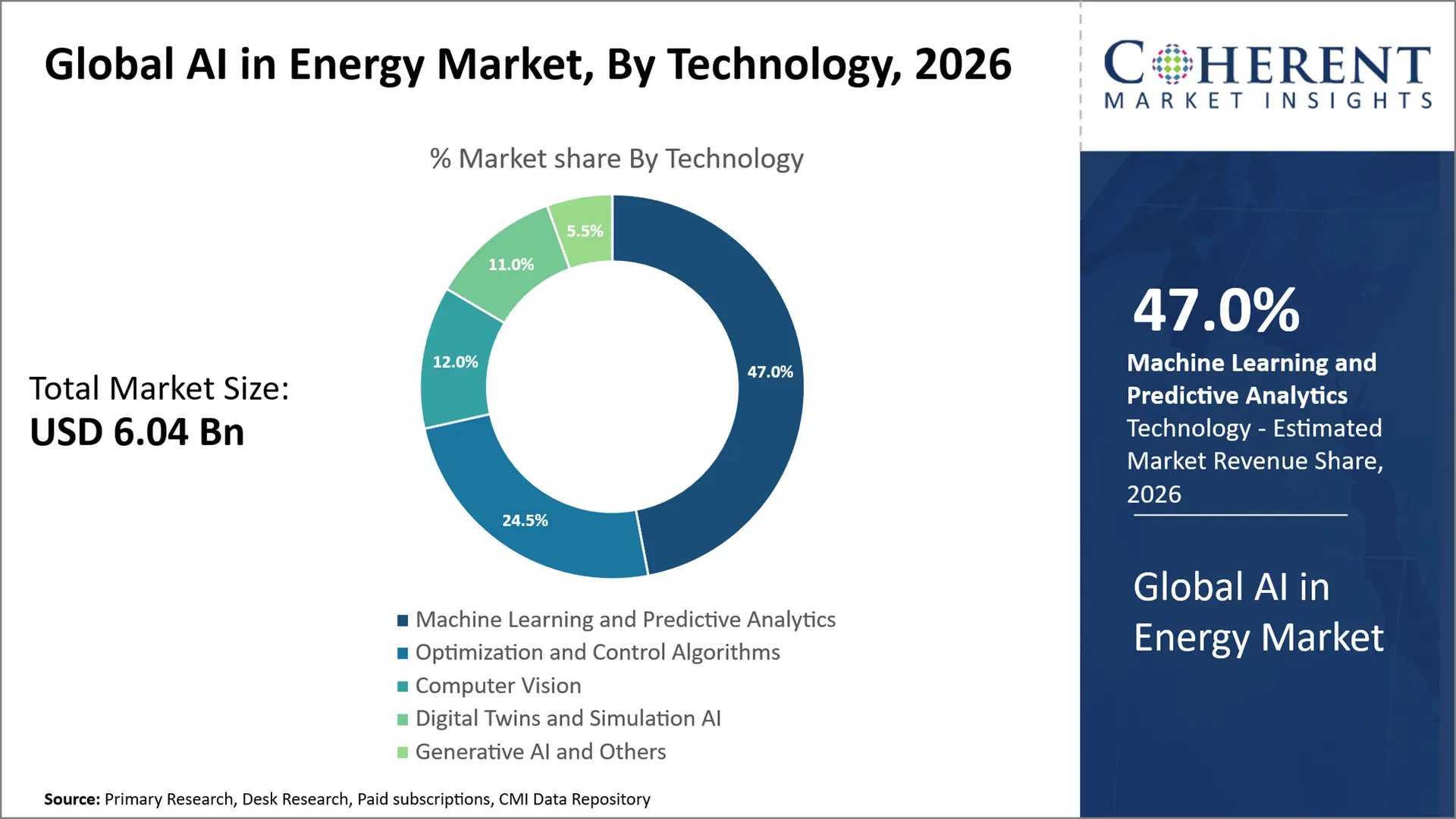
The Machine Learning and Predictive Analytics technology is expected to hold 47.0% of the technology segment of the global AI in energy market in 2026. The technology can detect trends in granular consumption data that traditional rules-based systems cannot. Customer classification can enable distribution companies to develop targeted demand-response programs, distinguish real shifts in consumption from abnormal behavior, and identify where engagement is commercially worthwhile. Metering service providers can broaden their services from data gathering to analytical services, and utilities can target their customers more accurately without uniform incentives. In December 2025, Apraava Energy launched its Discom GPT solution developed in collaboration with WorkOnGrid and was recognized by India’s Ministry of Power. The demonstration included consumer segmentation and behavioral demand-response capabilities enabled by machine learning and artificial intelligence, demonstrating a practical path from smart-meter information to differentiated utility programs.
Why Does Cloud-Based Deployment Dominate the Global AI in Energy Market?
Cloud-Based deployment is expected to be adopted by operators managing renewable portfolios in distributed locations, which is expected to hold 72.5% share of the global AI in energy market in 2026. Instead of isolated on-premises installations, analytical workflows can be updated, computing capacity can be distributed and common access restrictions can be enforced across multiple fleets with centrally managed infrastructure. This deployment model is especially useful for solar, wind and battery operators that require consistent application availability while connecting to local asset systems. Commercially, cloud delivery can enable geographically scalable subscriptions, but integration costs and data residency requirements are still key procurement considerations. In July 2026, GreenBridge.AI, GreenBridge.AI announced its agent-based renewable operations platform on Amazon Web Services that integrates operational and maintenance workflows across energy assets. The architecture shows how a cloud infrastructure can be used to enable AI applications across a portfolio without replicating the software deployments at each site.
Current Events and their Impact
Current Event | Description and Its Impact |
May 2025 – Ofgem Introduces Ethical AI Guidance for the Energy Sector |
|
September 2026 – U.S. Department of Energy Announces GridFM 2.0 Research Project |
|
Global Ai in Energy Market Dynamics
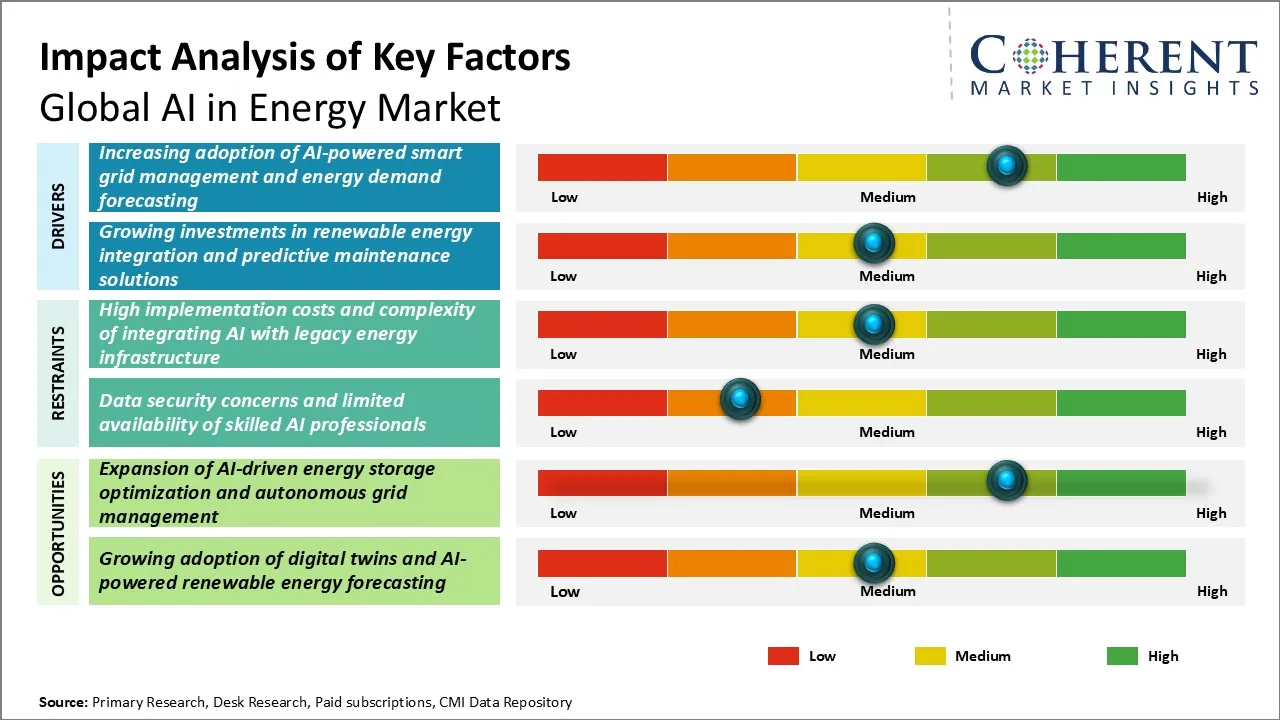
Key Market Drivers
- Increasing Adoption of AI-Powered Smart Grid Management and Energy Demand Forecasting: This is driving the increasing adoption of AI-based smart grid management and energy demand forecasting. Sophisticated analytics allow grid operators to detect network imbalances before outages, prioritize corrective actions, and coordinate distributed energy resources. The capabilities offer opportunities for long-term contracts for utility with software providers and system integrators. In February 2026, GE Vernova launched GridOS for Distribution, integrating grid operations, predictive intelligence, and distributed energy resource management within a unified software environment.
- Growing Investments in Renewable Energy Integration and Predictive Maintenance Solutions: Renewable energy operators are using smart asset inspection and condition-based maintenance to safeguard revenues from electricity generation and avoid unplanned equipment downtime. With the help of AI-enabled image analysis and sensor monitoring, maintenance teams can proactively identify potential defects without relying solely on scheduled manual inspections. This creates commercial opportunities for operators of renewable assets, developers of computer vision and specialist monitoring providers. In January 2026, RWE and its technology partners demonstrated AI-supported autonomous drone inspections of operating offshore wind turbines, highlighting the potential to reduce inspection-related interruptions.
Emerging Market Trends
- Shift Toward Edge AI for Time-Critical Energy Infrastructure: Energy operators are looking increasingly at edge-based AI architectures that process operational information close to substations, transformers and distributed generation assets. The approach lessens the need for ubiquitous cloud connectivity, enabling some monitoring activities to continue when communication infrastructures are impaired. There could be opportunities for equipment suppliers and industrial AI specialists in embedded inference capabilities and secure processing hardware. Interoperability with existing control systems, cybersecurity safeguards, and predictable response times are expected to emerge as important purchase criteria for critical infrastructure applications during the forecast period.
- Evolution Toward Performance-Linked AI Service Contracts: Energy companies are rethinking software purchasing arrangements that mainly charge for platform access and implementation. More and more, buyers want to see contracts tied to operational performance, such as equipment availability, forecasting accuracy and lower maintenance costs. This change could motivate suppliers to bundle software licensing with continuous model validation, technical support and performance monitoring. Contracts based on performance put more risk of delivery on the developers but might increase customer retention and foster recurring revenue from services. Providers that can show independently verified results are likely to have more commercial credibility.
Regional Insights
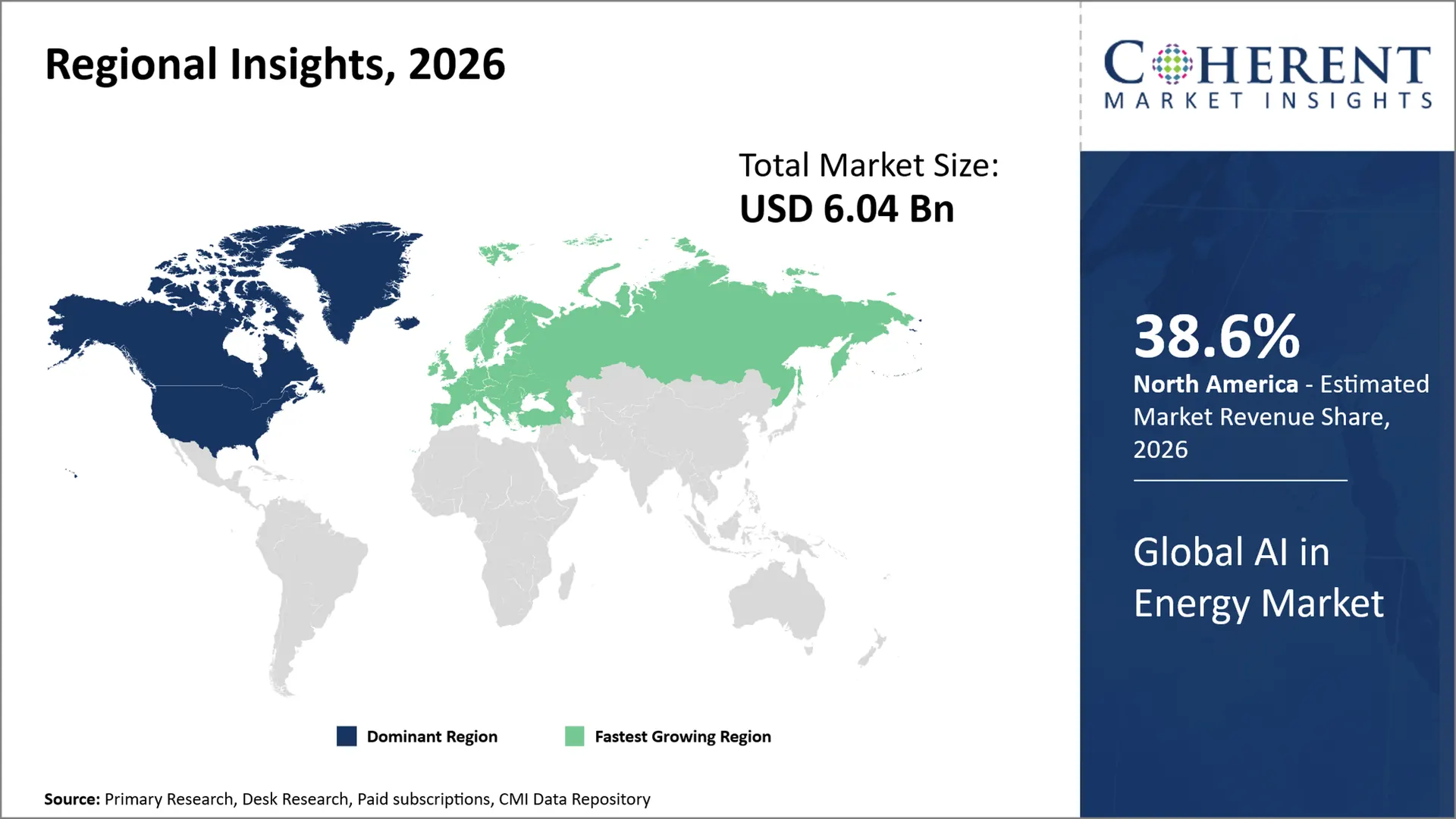
Why Does North America Dominate the Global AI in Energy Market?
North America is projected to dominate the global AI in energy market with a share of 38.6% in 2026. The region is supported by utilities to have the capacity to finance dedicated operational software and to test new approaches over large distribution networks. One particularly important opportunity is to coordinate electric vehicle charging with neighborhood grid capacity rather than immediately expanding every overloaded feeder. Existing utility partnerships in Canada offer a pathway to commercial trials that could later scale across wider networks. In July 2026, BluWave-ai and four Ontario utilities announced a province-wide AI initiative to coordinate connected electric vehicles with local transformer and substation constraints.
Why Is Europe Emerging as the Fastest-Growing Region in the Global AI in Energy Market?
Europe is expected to be the fastest-growing regional market, holding 27.3% of global AI in energy revenue in 2026. The growth of the network demonstrates the need for electricity network operators to share technical knowledge while respecting divergent national operating and data governance rules. There is a large commercial opportunity in reusable AI models that can identify rare infrastructure defects without the need for every utility to buy an expensive standalone training dataset. In June 2026, National Grid and Keen AI secured funding for Britain's Foundational Shared Model Operations project, bringing transmission and distribution operators together around standardized analysis of asset imagery. The initiative also demonstrates how collaborative development can reduce duplicated engineering effort and create a demand for specialized model hosting, validation and adaptation.
Global AI in Energy Market Outlook for Key Countries
Why Is the U.S. a Key Market for the Global AI in Energy Market?
The U.S. remains a strategic country in the global AI in energy market because electricity providers must manage complex customer-service obligations alongside extensive, geographically dispersed operating assets. Artificial intelligence can help to improve access to information for field crews, reduce administrative rework and allow for consistent responses to customer inquiries, all of which are increasingly influencing investment decisions. These requirements create openings for enterprise AI vendors with utility-specific governance and workflow capabilities, rather than just grid simulation tools. Avangrid said in September 2026 it would expand the use of AI across a variety of uses, including asset management, customer interaction analysis, field operations and employee support. The move is emblematic of a growing trend among American utilities to move away from the theoretical and toward practical applications embedded in the delivery of everyday services. Success of the commercial will depend on integration with existing work management systems, careful management of customer records and measurable increases in employee productivity.
Why Does China Support Growth in the Global AI in Energy Market?
China is important to the global AI in energy market because its electricity system must coordinate large renewable generation zones with industrial and urban demand centers across long transmission distances. Rapid deployment of distributed resources also increases the need for accurate operating information across transmission, distribution, and microgrid boundaries. Domestic technology ecosystems and security requirements may focus on procurement, but these conditions may be an opportunity for AI-enabled planning, equipment supervision, and coordinated dispatch. In December 2025, China’s National Development and Reform Commission and National Energy Administration issued guidance to promote the use of AI in grid planning, equipment management, operation, and security. The policy is not about buying stuff right away, but about showing the way to wider digital adoption. Analyst notes that the most effective approach is to use suppliers with expertise in power-system engineering and national grid standards to meet emerging requirements.
Why Is Germany a Strategic Country in the Global AI in Energy Market?
Germany is a strategically important country in the global AI in energy market because its distribution operators must accommodate rooftop solar generation, electrified heating, and vehicle charging across networks with uneven historical asset records. A critical implementation problem is determining the condition and probable installation period of cables when documentation is incomplete. AI can improve investment planning by deriving usable asset information before costly replacement decisions are made. In August 2026, MITNETZ STROM described the Cable Age pilot involving Schleswig-Holstein Netz, Avacon Netz, and E.ON Grid Solutions, which uses AI to estimate installation periods for low-voltage cables from surrounding network records. The initiative points to a distinctive commercial opportunity in data reconstruction and engineering validation. Vendors that complement utility asset expertise, rather than replace it, may find a practical entry point.
Why Is Japan an Important Growth Market for the Global AI in Energy Market?
Japan offers an important market for AI in energy solutions because corporate electricity users face strict supply balancing requirements while seeking to use renewable generation across separate business sites. Forecasting differences between locally produced solar power and receiving-site consumption is central to managing imbalance exposure under electricity wheeling arrangements. This speaks for software that is able to combine generation prediction, load profiles and settlement calculations with a high degree of operational accuracy. In February 2024, NEC began sending excess solar power from its Abiko site to its Tokyo headquarters, using its own proprietary artificial intelligence (AI) to predict generation and consumption. Development shows industrial and commercial buyers can access energy AI directly, by controlling renewable electricity alone, not just through utility-led programs.
Why Is Brazil an Important Growth Market for the Global AI in Energy Market?
Brazil supports growth in the global AI in energy market through its extensive transmission system, where geographically dispersed generation assets make rapid fault interpretation important to electricity reliability. Utilities operating large networks must distinguish individual equipment alarms from wider disturbances and provide operators with usable information before outages spread. These requirements favor AI applications for control room incident response rather than consumer facing energy services. Eletrobras announced in September 2025 that it would roll out C3 AI Grid Intelligence across its transmission assets after an initial deployment of the technology in ten substations. The program is intended for real-time fault monitoring and operational reporting. Commercially, the importance is in creating the need for solutions that can tie substation telemetry with actionable event assessments, but still be compatible with existing protection and dispatch procedures.
AI Technology Deployment and Energy Infrastructure Landscape
Technology | Primary Energy Application | Deployment Landscape | Commercial Significance |
Load Forecasting Based on Machine Learning | Electricity demand forecasting, peak load prediction and consumption pattern analysis | Established commercially, implementation depends on the quality of metering data | Supports scheduling accuracy, procurement planning and better utilization of generation resources |
Adaptive Optimization and Reinforcement Learning | Battery dispatch, operational scheduling and coordination of controllable energy assets | Emerging in applications with strong operational constraints and validation. | Opens up possibilities for optimizing energy storage utilization and dispatch strategies for changing conditions. |
Computer Vision and Automated Defect Detection | Inspection of wind turbine blades, transmission gear and solar equipment | Application specific adoption, commercially deployed in select inspection workflows | Reduces the need for manual inspections and allows for earlier detection of equipment degradation |
Physics-Based Digital Twins | Substation simulation, equipment health assessment and network contingency assessment | From engineering simulation to continuous operational decision support | Helps energy operators compare operational scenarios and evaluate infrastructure risks before implementation |
AI and Anomaly Detection on the Edge | Fault detection, substation intelligence and local equipment monitoring. | Used selectively for situations that require low latency and local processing of data. | Reduces reliance on centralized processing and may allow continued monitoring during communication interruptions |
Generative AI and Language Models for Specific Domains | Analyzing Technical Documents, Finding Maintenance Knowledge and Helping Operators Make Decisions | Early-to-growing adoption with key decisions needing human validation | Helps technicians working with complex equipment documentation & reduces the burden on information retrieval |
How Is AI-Enabled Industrial Energy Flexibility Creating New Growth Opportunities in the Global AI in Energy Market?
There is an emerging commercial opportunity for AI-enabled flexibility management in industrial refrigeration, thermal storage and controllable manufacturing loads, beyond utility-scale grid applications. Many industrial plants have variable electricity consumption, but no common software that can predict the process needs, interpret tariffs and schedule the equipment without compromising the quality of the production.
Developers could provide site specific optimization models bundled with equipment connectors, integration of energy-meters, and auditable operating constraints. Customers would include cold chain operators, industrial parks, commercial campuses and independent energy service firms. The monetization could be a mix of implementation fees, recurring analytics subscriptions and independently verified savings arrangements.
Market Players, Key Development, and Competitive Landscape
Key Developments
- In May 2026, Siemens announced an updated Gridscale X platform and AI-powered capabilities in PSS E transmission-planning software. The development is commercially relevant as utilities can use faster network studies to process complex connection requests and the open integration capabilities allow for utility-developed applications and lower reliance on isolated planning tools.
- In March 2026, Hitachi Energy introduced HMAX Energy, an AI-based suite of services for planning, monitoring and failure prevention for critical electrical assets in March 2026. The offering moves AI commercialization beyond standalone software into lifecycle service agreements, potentially boosting providers’ recurring revenue and customer relationships.
- In September 2025, Octopus Energy Group announced it will spin its AI-based Kraken utility operating platform into a separate company. The proposed structure was intended to accelerate third-party licensing and international expansion, illustrating how energy-focused AI platforms can become independently scalable enterprise software businesses.
Competitive Landscape
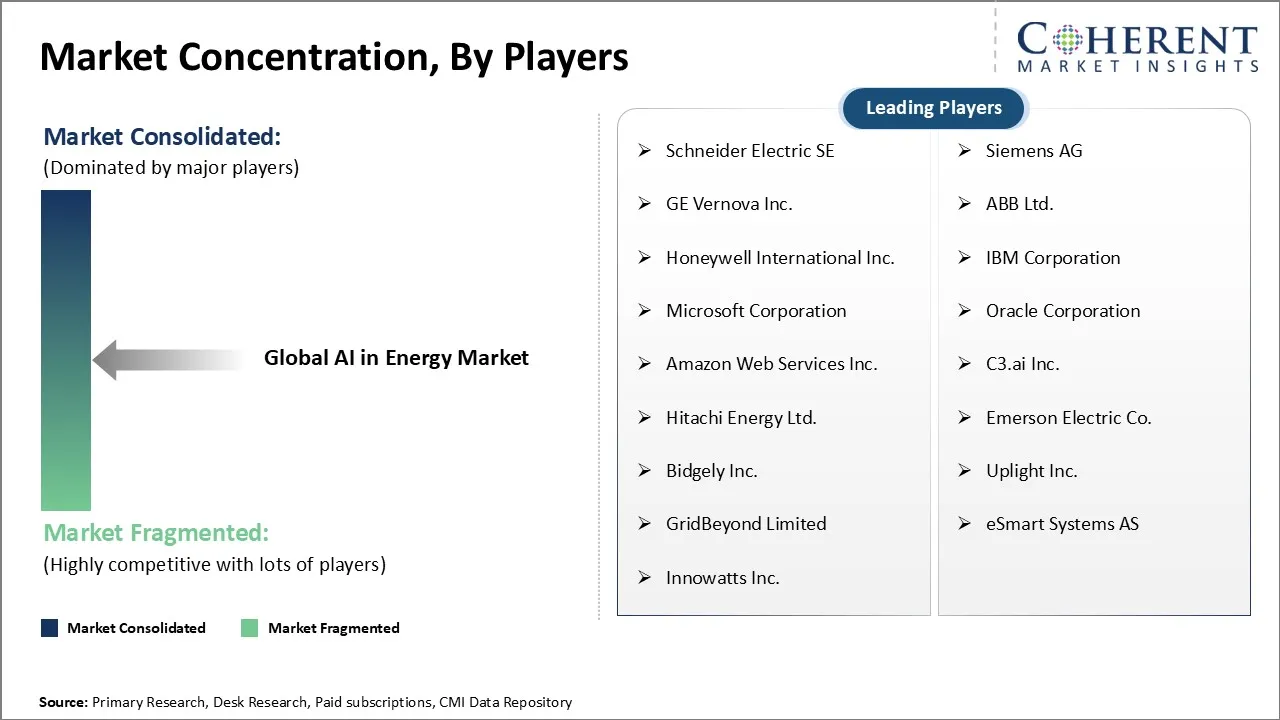
The global AI in energy market is moderately fragmented, combining multinational infrastructure software providers, cloud and analytics companies, industrial automation suppliers, and specialist energy AI developers. Increasingly, the competition is about deployment assurance, not model sophistication. Regional integrators have a role to play with utility relationships, local grid-code expertise and installation support, and smaller specialists stand out with validated algorithms, application-specific datasets and flexible commercial arrangements.
Key Competitive Focus Areas
- AI Model Performance: Demonstrating robustness in prediction, precision in identifying anomalies, and stable operation under different conditions
- System Integration Capabilities: Enabling interoperability with SCADA, energy management systems, smart meters and existing utility databases.
- Total Cost of Ownership: Providing clear visibility on software licensing, cloud computing, implementation and ongoing maintenance.
- Security and Compliance: Ensuring secure data handling, control of access, auditability and compliance with relevant energy-sector requirements.
- Intellectual Property and Data Ownership: Safeguarding proprietary algorithms and defining contractual rights to operational data and model outputs.
- Regional Market Access: Developing relationships with utilities, engineering contractors, and local technology implementation partners.
- Technical Support and Service Reliability: Maintaining dependable software updates, incident-response arrangements, and application-specific engineering assistance.
Market Report Scope
AI in Energy Market Report Coverage | |||
Report Coverage | Details | ||
Base Year | 2025 | Market Size in 2026: | USD 6.04 Bn |
Historical Data For: | 2020 To 2024 | Forecast Period: | 2026 To 2033 |
Forecast Period 2026 To 2033 CAGR: | 20.4% | 2033 Value Projection: | USD 22.15 Bn |
Geographies covered: |
| ||
Segments covered: |
| ||
Companies covered: | Schneider Electric SE, Siemens AG, GE Vernova Inc., ABB Ltd., Honeywell International Inc., IBM Corporation, Microsoft Corporation, Oracle Corporation, Amazon Web Services Inc., C3.ai Inc., Hitachi Energy Ltd., Emerson Electric Co., Bidgely Inc., Uplight Inc., GridBeyond Limited, eSmart Systems AS, Innowatts Inc. | ||
Growth Drivers: |
| ||
Restraints & Challenges: |
| ||
Analyst Opinion (Expert Opinion)
- The next stage of competition in the global AI in energy market is likely to center on ownership of operational decision workflows rather than access to AI models alone. Energy operators will increasingly distinguish between systems that merely generate recommendations and those that establish clear decision authority, exception handling, and accountability. Vendors capable of embedding these functions into everyday operating procedures could secure a more influential position in energy technology procurement.
- Autonomous energy procurement agents could change the way that commercial electricity consumers interact with suppliers and wholesale markets. The introduction of machine-readable tariffs and automated purchasing systems could move energy procurement from periodic contract assessment to continuous optimization of purchasing decisions. This could blur traditional energy retail differentiation and open up opportunities for independent optimization providers. Technology providers who understand the rules of the market, validation of transactions and automated risk limits may be able to capture emerging commercial value.
- Market participants should focus on applications with clear financial outcomes and manageable operational impacts. Investment should be made in proven energy datasets, a robust cybersecurity architecture and expert engineering skills. Providers should develop local implementation partnerships and alternatives where automated systems are not available. Suppliers may face long procurement cycles, liability issues, and limited returns from aggressive investment in fully autonomous control without proven operational safeguards. A phased commercialization strategy is expected to have more favorable long-term economics.
Speak to the analyst
Want personalized insights?
Take the findings above to one of our principal consultants, or have the report rebuilt around the segments, geographies and competitors you actually track.
Market Segmentation
- Component Insights (Revenue, USD Bn, 2021 - 2033)
- AI Software and Platforms
- Services
- Technology Insights (Revenue, USD Bn, 2021 - 2033)
- Machine Learning and Predictive Analytics
- Optimization and Control Algorithms
- Computer Vision
- Digital Twins and Simulation AI
- Generative AI and Others
- Deployment Insights (Revenue, USD Bn, 2021 - 2033)
- Cloud-Based
- On-Premises
- Application Insights (Revenue, USD Bn, 2021 - 2033)
- Renewable Energy Management
- Smart Grid Management and Optimization
- Predictive Maintenance
- Energy Demand Forecasting
- Energy Trading and Price Optimization
- Safety, Security and Other Applications
- End User Insights (Revenue, USD Bn, 2021 - 2033)
- Electric Utilities
- Renewable Energy Developers
- Oil and Gas Companies
- Industrial and Commercial Energy Users
- Other Energy Operators
- Regional Insights (Revenue, USD Bn, 2021 - 2033)
- North America
- U.S.
- Canada
- Latin America
- Brazil
- Argentina
- Mexico
- Rest of Latin America
- Europe
- Germany
- U.K.
- Spain
- France
- Italy
- Russia
- Rest of Europe
- Asia Pacific
- China
- India
- Japan
- Australia
- South Korea
- ASEAN
- Rest of Asia Pacific
- Middle East
- GCC Countries
- Israel
- Rest of Middle East
- Africa
- South Africa
- North Africa
- Central Africa
- North America
- Key Players Insights
- Schneider Electric SE
- Siemens AG
- GE Vernova Inc.
- ABB Ltd.
- Honeywell International Inc.
- IBM Corporation
- Microsoft Corporation
- Oracle Corporation
- Amazon Web Services Inc.
- C3.ai Inc.
- Hitachi Energy Ltd.
- Emerson Electric Co.
- Bidgely Inc.
- Uplight Inc.
- GridBeyond Limited
- eSmart Systems AS
- Innowatts Inc.
Sources
Primary Research Interviews
- Commercial permaculture farmers, agroforestry operators, and regenerative farming experts
- Agricultural cooperatives, farm consultants, crop buyers, and distributors
Stakeholders
- Permaculture farms, smallholder growers, and commercial producers
- Agroforestry operators, agricultural cooperatives, and sustainable farming organizations
End-use Sectors
- Fruits, vegetables, herbs, grains, and nuts
- Livestock farming, food processing, and agricultural retail
Regulatory and Industry Bodies
- Food and Agriculture Organization (FAO)
- U.S. Department of Agriculture (USDA)
- European Commission
- United Nations Environment Programme (UNEP)
Databases
- FAOSTAT agricultural production and land-use datasets
- World Bank agricultural indicators and UN Comtrade
- Eurostat, USDA NASS, and FiBL organic agriculture statistics
- Farm productivity, crop pricing, and agricultural trade databases
Magazines and Journals
- Permaculture Magazine
- Agroforestry Systems
- Agroecology and Sustainable Food Systems
- Agriculture, Ecosystems & Environment
Associations
- Permaculture Association (Britain)
- Permaculture Research Institute
- IFOAM – Organics International
- Regenerative Organic Alliance
Public Domain Sources
- Permaculture farm production, acreage, yield, and revenue data
- Agroforestry adoption, soil health, and crop diversification statistics
- Farm-gate pricing, sustainable agriculture investments, and government initiatives
Key Standards and Regulations
- USDA National Organic Program – 7 CFR Part 205
- Regulation (EU) 2018/848 – Organic Production and Labelling
- FAO's 10 Elements of Agroecology – Voluntary Framework
- Applicable national land-use, soil conservation, and water management regulations
Proprietary Elements
- CMI Data Analytics Tool and proprietary research repository, supplemented by farm-level production estimates, primary interviews, crop pricing, land-use analysis, and competitive intelligence.
Get access to 250+ pages report
Every segment, forecast, competitor profile and data table behind the analysis above — available for instant download.
- ESOMAR Member
- ISO 9001:2015 Certified
- D-U-N-S Registered
- GDPR & CCPA Compliant
Frequently Asked Questions
The CAGR of global AI in energy market is projected to be 20.4% from 2026 to 2033.
The global AI in energy market is estimated to be valued at USD 6.04 billion in 2026 and is expected to reach USD 22.15 billion by 2033.
The report examines key companies, their technology portfolios, competitive positioning, strategic partnerships, and recent business developments.
The report provides country-wise analysis on major markets including United States, China, Germany, India and Japan.
The report enables businesses to evaluate their competitive positioning, market-entry strategies, potential technology partners, and geographic expansion.
The report helps businesses evaluate geographic expansion, competitive positioning, potential technology partnerships, and market-entry strategies.
The global AI in energy market is growing due to the rising adoption of AI-powered smart grid management and energy demand forecasting. Increasing investments in renewable energy integration and predictive maintenance solutions are also driving market growth.