

Global AI Platform Services Market Size and Forecast – 2026 To 2033
The global AI platform services market is expected to grow from USD 5.85 Bn in 2026 to USD 38.50 Bn by 2033, registering a compound annual growth rate (CAGR) of 17% from 2026 to 2033. The global AI platform services market is driven by increasing demand for predictive analytics. On January 28, 2026, Pecan announced the launch of its Predictive AI Agent. The platform converts business questions and raw data into production-grade predictions.
Key Takeaways of the Global AI Platform Services Market
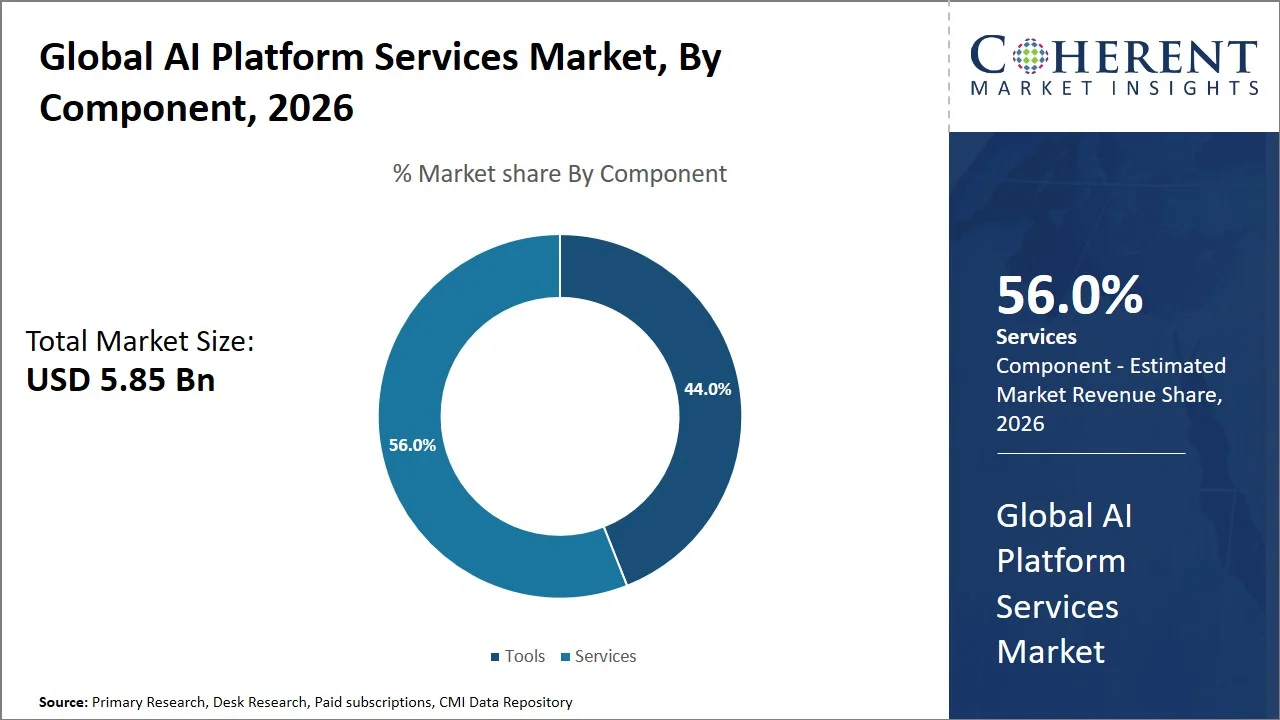
- The Services segment is expected to account for 56.0 % of the global AI platform services market share in 2026. Growing adoption of AI as a Service models is driving the growth of the segment. On April 22, 2026, Google introduced Gemini Enterprise with an upgraded Vertex AI platform. The offering enables businesses to build, deploy, govern, and manage customized AI agents.
- The Cloud segment is estimated to capture 62.0 % of the market share in 2026. Rising demand for real-time business intelligence is majorly driving the growth of the segment. On August 13, 2026, Databricks closed a USD 5 billion strategic funding round at a USD 190 billion valuation. The investment accelerates development for key enterprise AI products like Lakebase, Genie, and Unity AI Gateway.
- The Deep Learning segment is estimated to capture 34.0 % of the market share in 2026. Increasing enterprise automation requirements is driving the growth of the segment. On May 19, 2026, Automation Anywhere added AI-Driven enterprise process platform enhancements. Its Process Reasoning Engine and Context Intelligence Graph improved agent accuracy by more than 30% in internal evaluations.
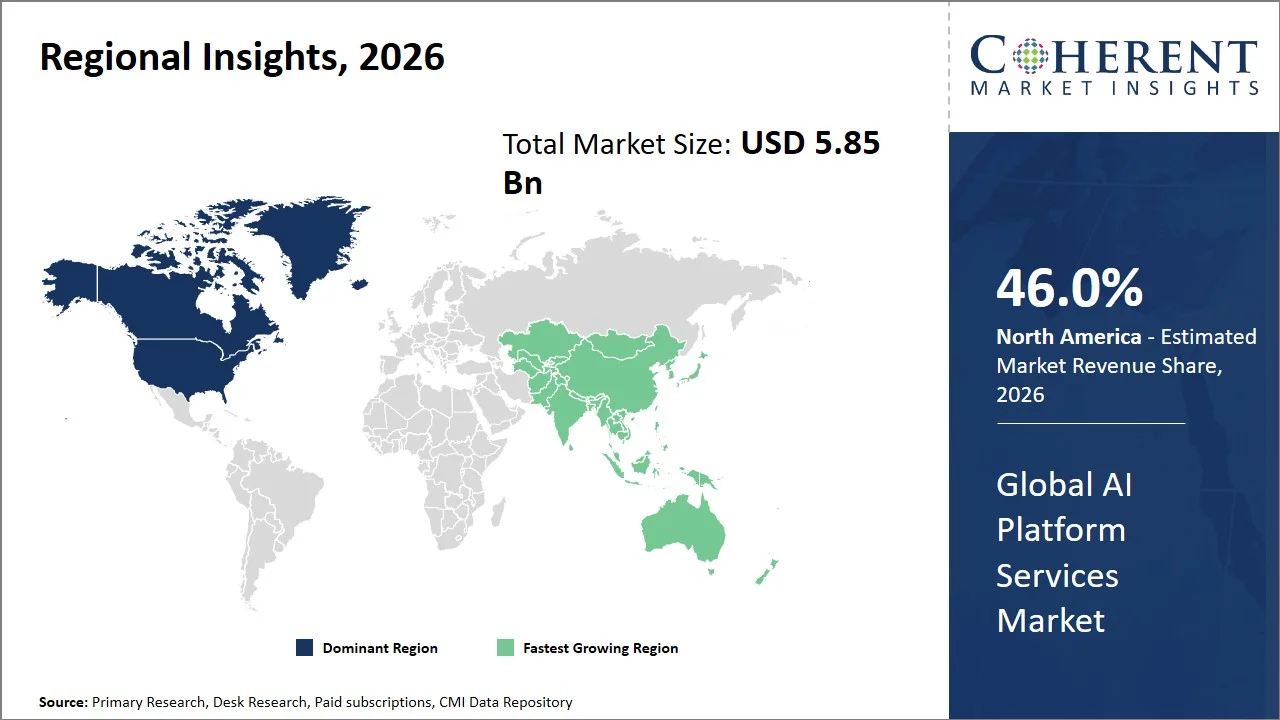
- North America is expected to dominate the AI platform services market in 2026 with a market share of 46.0 %. Expansion of conversational AI applications in North America is driving the growth of the regional market. On June 3, 2026, Meta Platforms launched its AI Business Agent for enterprise customer interactions. The agent manages leads, qualifies them, organizes appointments and assists sales through WhatsApp, Messenger and Instagram.
- Asia Pacific is expected to account for 24.0 % share in 2026. Rising demand for industry-specific AI platforms across Asia Pacific is driving the growth of the regional market. On March 17, 2026, Alibaba launched Wukong, an enterprise AI platform combining multiple agents for document editing, spreadsheets, meeting transcription, and research coordination.
Segmental Insights
Why Does Services Dominate the Global AI Platform Services Market?
The services segment is expected to account for 56.0% of the global AI platform services market share in 2026. Companies need competence to deploy and integrate AI platforms. Service providers provide enterprises with deployment, customization, maintenance, optimization, and continuing technical support. Many companies also lack the in-house knowledge needed to operate complicated AI infrastructure and model settings. Professional and managed services also help firms handle security, governance, scalability and compliance needs. Increasing demand for tailored AI solutions across industries is therefore strengthening adoption of AI platform services. On May 11, 2026, OpenAI announced it is launching the OpenAI Deployment Company, designed to help organizations build and deploy AI systems. The company will extend OpenAI’s ability to embed engineers specialized in frontier AI deployment into organizations working on complex problems in demanding environments.
- Current Industry Events of 2026
- Market Size Estimation
- Regional Breakdown
- Competitive Landscape
- Customer Intelligence
- Segmental Analysis
- Pricing Analysis
- Key Market Drivers, Challenges & Future Trends
- Customized Insights Section
Why is Cloud the Most Preferred Deployment?
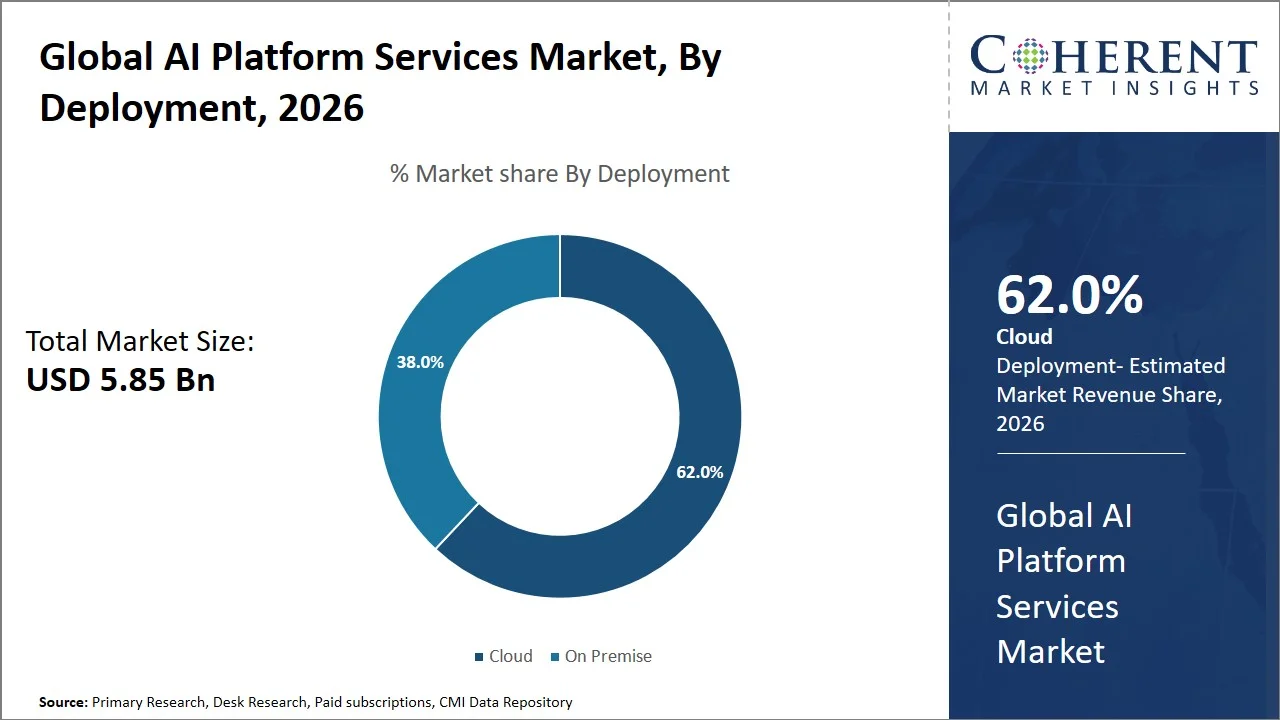
The cloud segment is expected to account for 62.0% of the global AI platform services market share in 2026. Cloud deployment is ideal for rapidly changing artificial intelligence workloads because of its variable computing capability. Organizations can expand their processing capabilities to satisfy the needs of model creation and application. This adaptability lowers the need for large expenditures in dedicated infrastructure and hardware. Cloud systems also offer simpler access to sophisticated computer resources, development tools and AI services. These characteristics make cloud deployment attractive for organizations looking for effective and scalable artificial intelligence implementation. On August 12, 2026, Alibaba Cloud launched the Lingjun Zhenwu M890 supernode as a public cloud service. The system combines 64 computing cards and supports extremely large AI models through cloud-based accelerated computing.
Deep Learning Dominates the Global AI Platform Services Market
The deep learning segment is expected to account for 34.0% of the global AI platform services market share in 2026. Deep learning is being adopted widely as it is able to handle complex information and find patterns that are complicated. It’s capable of running complex apps that rely on picture, speech, language and predictive analytics. More and more organizations are using deep learning for computer vision, recommendation systems, autonomous operations and intelligent automation. The growing availability of dedicated computer resources is also helping to improve the deep learning implementation within organizations. It is these characteristics that are fueling demand for deep learning in AI platform setups. On March 12, 2025, Google DeepMind released Gemini Robotics and Gemini Robotics-ER. These deep learning models enable robots to recognize situations, plan actions, and interact with physical items.
Current Events and their Impact
Current Events | Description and its Impact |
European Union Artificial Intelligence Act |
|
United States Executive Order 14365, 2025 |
|
China Interim Measures For Administration Of Generative Artificial Intelligence Services |
|
AI Platform Services Market Dynamics
Market Drivers
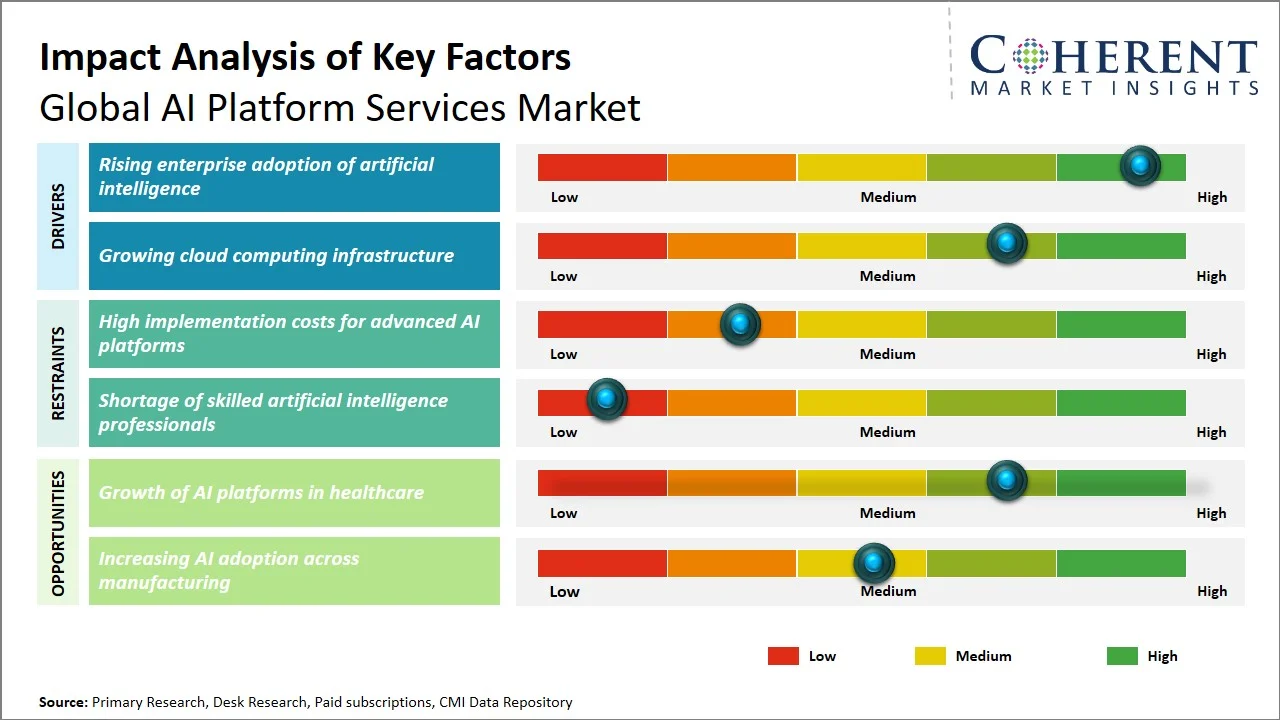
- Rising enterprise adoption of artificial intelligence: Demand for AI platform services is being driven by rising enterprise adoption of artificial intelligence across various business functions. Organizations are rapidly using AI in customer service, marketing, finance, operations, cybersecurity and decision making. AI platforms provide companies with tools such as model building, deployment, monitoring, analytics and automation. Generative artificial intelligence and machine learning skills are also advancing to help spur more usage. Enterprises are increasingly looking for scalable systems that can handle many AI applications and ease infrastructure administration. This wider organizational adoption is fueling continuous demand for AI platform services across different sectors and business sizes. On June 21, 2026, Samsung deployed ChatGPT Enterprise and Codex throughout its global Device Experience division. The rollout will cover cellphones, consumer goods and household appliances.
- Growing cloud computing infrastructure: The growth of AI platform services is being supported by rising cloud computing infrastructure with scalable processing, storage and networking capabilities. Cloud providers are building out infrastructure with specialized processors and faster compute capabilities to meet the needs of demanding artificial intelligence workloads. Businesses can utilize these resources without the need to build large dedicated infrastructure on their premises. Cloud systems also offer flexible capacity management for growing or fluctuating artificial intelligence workloads. Platform usability is further enhanced through integration with data management, application development and AI development services. These features are propelling enterprises to use cloud-based AI platforms for rapidly creating, deploying and administering artificial intelligence applications. On August 19, 2026, Nebius announced plans to raise as much as USD 5 billion to expand its data centers and AI cloud infrastructure. The investment supports a growing need for specialist cloud computing capability.
Emerging Trends
- Generative Artificial Intelligence Integration: More and more AI platforms are integrating generative AI capabilities for content creation, software development, conversational apps and business automation. Enterprises are creating purpose-built apps by integrating with foundation models, leading to productivity gains and speeding innovation across business functions.
- Industry Specific AI Platforms: Vendors are building customized AI platforms for healthcare, banking, manufacturing, retail and telecommunications use cases. Such platforms provide industry-specific data sets, workflows, compliance standards, and analytical capabilities that enable enterprises to adopt artificial intelligence solutions that are in harmony with operational needs and regulatory expectations.
- AI Platform Automation: Model development, deployment, monitoring and optimization are becoming crucial platform features. Machine learning operations tools are making artificial intelligence lifecycle management easier, helping enterprises to manage their growing portfolios of artificial intelligence applications with less hands-on approaches and improved model performance.
- Sovereign Artificial Intelligence Infrastructure: Governments and corporations are building local artificial intelligence infrastructure to enhance data control, technological independence, and regulatory compliance. Sovereign AI efforts are driving investments in regionalized models and secure platforms, artificial intelligence ecosystems relevant to an area and domestic computer resources.
Regional Insights
Why is North America a Strong Market for AI Platform Services?
North America is expected to account for a market share of 46.0% in 2026. North America is enjoying the advantages of enterprise AI deployments, mature cloud infrastructure and large hyperscaler investment. The U.S. and Canada host major AI developers, cloud providers, and semiconductor companies supporting platform ecosystems. Canada’s Cohere is strengthening sovereign enterprise AI capabilities through its planned combination with Germany’s Aleph Alpha. North American enterprises are increasingly moving AI from experimentation toward deeply integrated business processes. Research found that 11% of S&P 500 companies had deeply integrated AI by 2025. Agentic AI is also increasing demand for specialized inference infrastructure and hybrid cloud environments.
Why Does Asia Pacific AI Platform Services Market Exhibit High Growth?
Asia Pacific is expected to register the fastest growth with a CAGR of 19.2% over the forecast period. Asia Pacific is projected to account for 24.0% of the global AI platform services market in 2026. The Asia Pacific region is seeing increasing digitalization, increased data center capacity and government-backed artificial intelligence efforts. India is receiving huge investments from Amazon, Microsoft and Google for cloud and AI infrastructure. India is also building shared AI computing infrastructure with 38,000 graphics processing units. China is developing its own AI capabilities under export limitations and increasing dependence on homegrown models. Microsoft continues serving Chinese enterprises with international operations despite reducing its domestic footprint. These developments are supporting regional demand for sovereign and enterprise AI platforms.
Global AI Platform Services Market Outlook for Key Countries
Why is U.S. Emerging as a Major Hub in the AI Platform Services Market?
The U.S. benefits from its concentration of hyperscalers, AI model developers, semiconductor companies, and enterprise software providers. Microsoft, Amazon Web Services, Google, NVIDIA and Meta Platforms are strengthening artificial intelligence infrastructure and platform capabilities. Deep AI adoption is on the rise in large US firms, with 11% of S&P 500 corporations achieving deep adoption by 2025. The country is also witnessing a rapid proliferation of applications of agentic AI, which demand a lot more inference capability. Companies are being forced to add specialized AI infrastructure on top of their existing cloud environments.
Is China the Next Growth Engine for the AI Platform Services Market?
China is building its AI platform ecosystem around domestic models, local computing infrastructure and national technological self-sufficiency. Export limitations on modern computer resources are spurring Chinese corporations to boost local alternatives. Microsoft has scaled back its activities in China, but continues to serve overseas Chinese companies. The development of local models is becoming increasingly vital as Chinese technology companies compete with international providers. Platform architecture is also being impacted by government restrictions on material produced by AI, data security and personal information. These trends are driving the demand for AI platforms that are locally controlled, and serve enterprise applications, government services, and domestic digital ecosystems.
Germany AI Platform Services Market Analysis and Trends
Germany is focusing on sovereign AI, industrial applications, and secure enterprise installations. In the country, demand is significant from automotive, manufacturing, engineering and public sector businesses seeking controlled data environments. Germany is also funding sovereign AI development through its links to Aleph Alpha. Cohere and Aleph Alpha announce plans to combine, focused on sovereign artificial intelligence and secure corporate applications. Schwarz Group will be responsible for the data center infrastructure through Schwarz Digits. These changes fuel demand for AI platforms focusing on data sovereignty, industrial integration and compliance with European regulations.
U.K. AI Platform Services Market Analysis and Trends
The U.K. is driving the adoption of AI platforms with more government-funded compute, rolling it out across the public sector and developing AI in the U.K. The government has pledged USD 2.70 billion to boost up national computational capability twentyfold by 2030. Isambard-AI in Bristol is widening access to high-performance computing for research and public-sector use. The U.K. is developing Five AI Growth Zones to accelerate the pace of data center building and infrastructure availability. The government has also established funding of up to USD 680 million for UK AI companies.
India AI Platform Services Market Analysis and Trends
India is emerging as an important AI platform market through government initiatives, expanding data centers, and large technology investments. The country is constructing a shared AI computing infrastructure that includes 38,000 graphics processing units. Amazon said that it will invest an additional USD 13 billion in Indian cloud and AI infrastructure till 2030. Microsoft and Google have also invested much in infrastructure. Larsen & Toubro awarded AI data center deal for infrastructure power by NVIDIA Sovereign infrastructure and local language AI models are helping India’s own growth trajectory.
Global AI Platform Services Market - Generative Artificial Intelligence Platform Adoption (2025)
Metric | Adoption Rate |
Organizations Regularly Using Generative Artificial Intelligence | 79% |
Organizations Exploring or Enabling Generative Artificial Intelligence | 93% |
Generative Artificial Intelligence Adoption Rate | 30% |
Organizations Using Generative Artificial Intelligence Organization-Wide | 27% |
Organizations Using Generative Artificial Intelligence In Specific Departments or Projects | 33% |
Organizations Using Generative Artificial Intelligence Apps | 90% |
Enterprise Users Using Generative Artificial Intelligence Apps | 4.9% |
Enterprise Users Using Applications with Generative Artificial Intelligence Features | 75% |
Global AI Platform Services Market - Predictive Analytics Adoption Across Enterprises (2025)
Metric | Adoption Rate |
Enterprises Using Predictive Artificial Intelligence | 50% |
Predictive Analytics Model Development Use Cases | 9% |
Predictive Analytics Model Development in Production | 35% |
Organizations Using Predictive Analytics in Supply Chains | 51% |
Consumer Packaged Goods Enterprises Building Predictive Analytics Capabilities | 70% |
Organizations Using Machine Learning and Predictive Analytics for Forecasting | 8% |
Organizations Planning Machine Learning and Predictive Analytics Adoption | 56% |
How is Growth of AI Platforms in Healthcare Creating New Growth Opportunities in the AI Platform Services Market?
Healthcare is breaking new ground as hospitals, pharmaceutical businesses and medical tech firms transition from siloed AI tools to interconnected platforms. In 2025, 70% of healthcare businesses were actively using AI, with 69% of them using generative AI and big language models, according to NVIDIA. Mayo Clinic and Microsoft are building a frontier model for healthcare, tapping into de-identified clinical data and longitudinal insights. The model will be accessible through the Azure Foundry APIs, allowing for the scale-out of clinical AI applications. NVIDIA is helping drug research, genomics, medical imaging, robotics and digital health through BioNeMo, MONAI and Parabricks. These installations drive demand for specialized platforms, model integration, managed services and healthcare-specific AI infrastructure.
On June 11, 2026, Abridge unveiled the first AI-native clinician intelligence platform organized around the patient, built for clinicians, and designed to help health systems coordinate the clinical, financial, and evidence-based decisions that shape every moment of care.
Market Players, Key Development, and Competitive Landscape
Key Developments
- On August 11, 2026, IBM announced a collaboration with Together AI to deliver IBM and NVIDIA AI infrastructure. Under a multi-year USD 240 million agreement between IBM and Together AI, IBM is positioned to deploy a large cluster of NVIDIA HGX B300 systems on IBM Cloud.
- On July 2, 2026, Microsoft launched the Microsoft Frontier Company with a USD 2.5 billion commitment to help enterprises implement and customize AI models. The company is targeting customers around the world. Microsoft Frontier Company will be embedding 6,000 industry and engineering experts to co-design, deploy and improve AI systems at scale based on measurable business outcomes.
Competitive Landscape
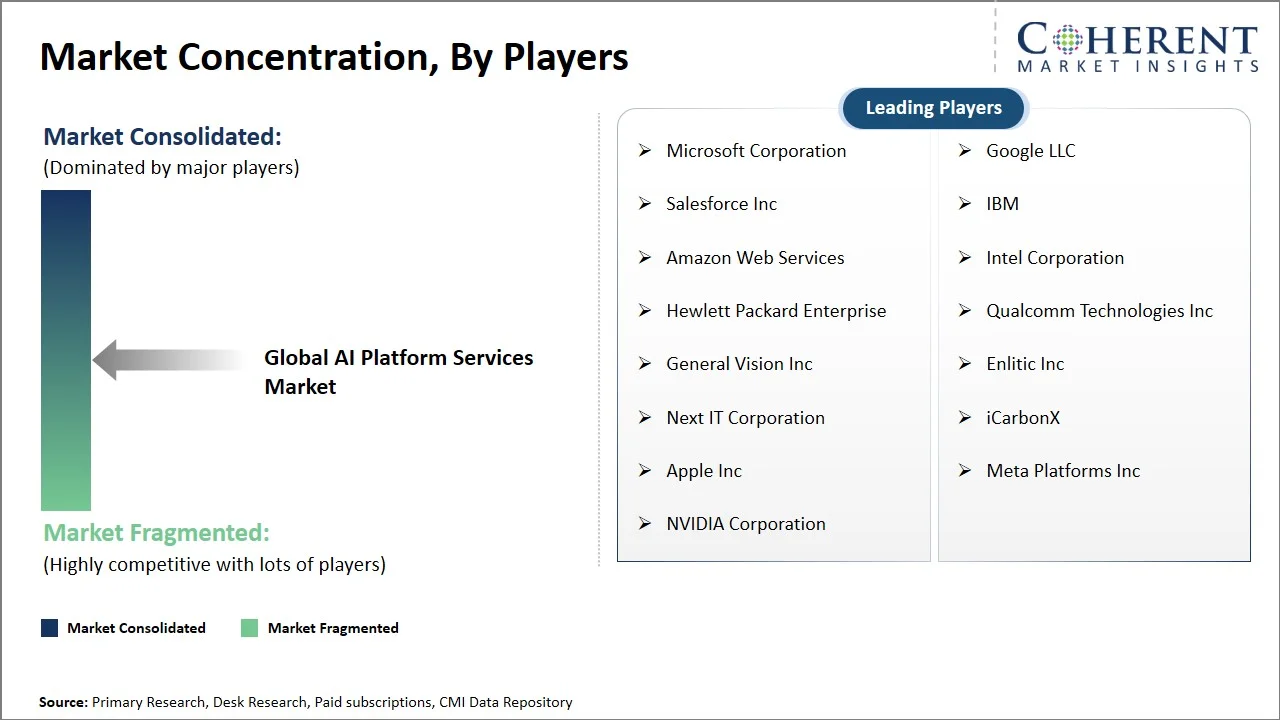
The competitive landscape is led by Microsoft, Google, Amazon Web Services, NVIDIA, and other integrated technology providers. Microsoft is strengthening enterprise adoption through Azure AI and its partnership with Mayo Clinic for healthcare frontier models. Google is scaling its AI infrastructure approach with custom Tensor Processing Units and its new Marvell alliance. NVIDIA is expanding its ecosystem beyond graphics chips. Amazon Web Services is investing in scalable cloud infrastructure and model options for enterprises. The competitive focus is shifting toward inference capacity, specialized hardware, industry models, sovereign infrastructure, and integrated development environments.
Market Report Scope
AI Platform Services Market Report Coverage
| Report Coverage | Details | ||
|---|---|---|---|
| Base Year: | 2025 | Market Size in 2026: | USD 5.85 Bn |
| Historical Data for: | 2020 To 2024 | Forecast Period: | 2026 To 2033 |
| Forecast Period 2026 to 2033 CAGR: | 17% | 2033 Value Projection: | USD 38.50 Bn |
| Geographies covered: |
| ||
| Segments covered: |
| ||
| Companies covered: | Microsoft Corporation, Google LLC, Salesforce Inc, IBM, Amazon Web Services, Intel Corporation, Hewlett Packard Enterprise, Qualcomm Technologies Inc, General Vision Inc, Enlitic Inc, Next IT Corporation, iCarbonX, Apple Inc, Meta Platforms Inc, NVIDIA Corporation | ||
| Growth Drivers: |
| ||
| Restraints & Challenges: |
| ||
Analyst Opinion (Expert Opinion)
- The future of the industry is expected to move toward AI platforms combining models, agents, inference infrastructure, data tools, and governance. Enterprise customers are increasingly seeking complete environments rather than standalone machine learning tools. Agentic AI should become particularly important because autonomous systems require continuous inference and stronger platform orchestration. Recent infrastructure constraints indicate that compute availability remains an important competitive factor. Healthcare, financial services, industrial automation, and software development should remain attractive application areas because they generate recurring AI workloads.
- The strongest geographic opportunity should emerge across the U.S., India, China, and the U.K. India is particularly attractive because national compute capacity is expanding at a steady pace. The government has announced a further 20,000 graphics processing units for 2026. The United Kingdom is creating national compute infrastructure, with up to USD 2.70 billion pledged until 2030. These advancements provide an opportunity for platforms that enable sovereign AI, enterprise inference, research and public sector workloads.
- Market participants need to focus on differentiated AI platforms, not just general-purpose model access. Healthcare platforms must focus on clinical data integration, privacy controls and validated workflows. Industrial platforms should focus on Edge inference, Digital twins, Predictive maintenance and machine vision. Providers should also establish partnerships with semiconductor companies, cloud operators, and domain-specific software vendors. Building efficient inference infrastructure and strong governance capabilities should provide an important competitive advantage as AI workloads become more complex.
Speak to the analyst
Want personalized insights?
Take the findings above to one of our principal consultants, or have the report rebuilt around the segments, geographies and competitors you actually track.
Market Segmentation
- Component Insights (Revenue, USD Billion, 2021 - 2033)
- Tools
- Services
- Managed Services
- Professional Services
- Deployment Insights (Revenue, USD Billion, 2021 - 2033)
- Cloud
- On Premise
- Technology Insights (Revenue, USD Billion, 2021 - 2033)
- Deep Learning
- Machine Learning
- Natural Language Processing
- Machine Vision
- Application Insights (Revenue, USD Billion, 2021 - 2033)
- Forecasts and Prescriptive Models
- Chatbots
- Speech Recognition
- Text Recognition
- Others
- End User Insights (Revenue, USD Billion, 2021 - 2033)
- Manufacturing
- Healthcare
- BFSI
- Research and Academic
- Transportation
- Retail and Ecommerce
- Others
- Regional Insights (Revenue, USD Billion, 2021 - 2033)
- North America
- U.S.
- Canada
- Latin America
- Brazil
- Argentina
- Mexico
- Rest of Latin America
- Europe
- Germany
- U.K.
- Spain
- France
- Italy
- Russia
- Rest of Europe
- Asia Pacific
- China
- India
- Japan
- Australia
- South Korea
- ASEAN
- Rest of Asia Pacific
- Middle East
- GCC Countries
- Israel
- Rest of Middle East
- Africa
- South Africa
- North Africa
- Central Africa
- North America
- Key Players Insights
- Microsoft Corporation
- Google LLC
- Salesforce Inc
- IBM
- Amazon Web Services
- Intel Corporation
- Hewlett Packard Enterprise
- Qualcomm Technologies Inc
- General Vision Inc
- Enlitic Inc
- Next IT Corporation
- iCarbonX
- Apple Inc
- Meta Platforms Inc
- NVIDIA Corporation
Sources
Primary Research Interviews
- Chief Data Officers
- Artificial Intelligence Platform Heads
- Enterprise AI Architects
Journals
- Journal of Artificial Intelligence Research
- Artificial Intelligence Review
- IEEE Transactions on Artificial Intelligence
Associations
- Association for Computing Machinery
- Institute of Electrical and Electronics Engineers
- International Organization for Standardization
- National Institute of Standards and Technology
Public Domain Sources
- United States National Institute of Standards and Technology
- European Commission
- Organization for Economic Co-operation and Development
Proprietary Elements
- CMI Data Analytics Tool
- Proprietary CMI Existing Repository of Information for the Last 10 Years
Get access to 250+ pages report
Every segment, forecast, competitor profile and data table behind the analysis above — available for instant download.
- ESOMAR Member
- ISO 9001:2015 Certified
- D-U-N-S Registered
- GDPR & CCPA Compliant
Missing comfort of reading report in your local language? Find your preferred language:
Transform your Strategy with Exclusive Trending Reports
Frequently Asked Questions
The global AI platform services market is expected to stand at USD 5.85 Bn in 2026 and is expected to reach USD 38.50 Bn by 2033.
The CAGR of the global AI platform services market is projected to be 17% from 2026 to 2033.
Generative AI is increasing demand for platforms supporting foundation models, content generation, AI agents, and enterprise applications.
Cloud infrastructure provides scalable computing, storage, networking, and specialized processing capabilities for demanding AI workloads.
Machine learning enables AI platforms to develop predictive models, automate decisions, identify patterns, and improve business processes.
AI agents are increasing demand for orchestration, inference infrastructure, monitoring, tool integration, and autonomous workflow management.
Edge AI enables organizations to process data closer to connected devices, supporting faster responses in manufacturing, healthcare, transportation, and security applications.