

Customer Data Platform Market Size and Share Analysis: (2026 - 2033)
The Customer Data Platform Market is anticipated to grow at a CAGR of 24% with USD 3.5 Bn in 2026 and is expected to reach USD 15.8 Bn in 2033. The customer data platform market is driven by the shift to first-party data, AI and real-time engagement, and Expanding Regulatory Landscape in the U.S. In 2026, the Customer Data Platform (CDP) industry is rapidly evolving as businesses prioritise unified first‑party data strategies, real‑time customer insights, and AI‑driven personalization to stay competitive. For instance, as of 2026, 20 U.S. states have comprehensive consumer data privacy laws in effect, including newly effective statutes in Indiana, Kentucky, and Rhode Island starting January 1, 2026. These laws broaden obligations around transparency, consent management, and personal data rights for businesses.
Key Takeaways:
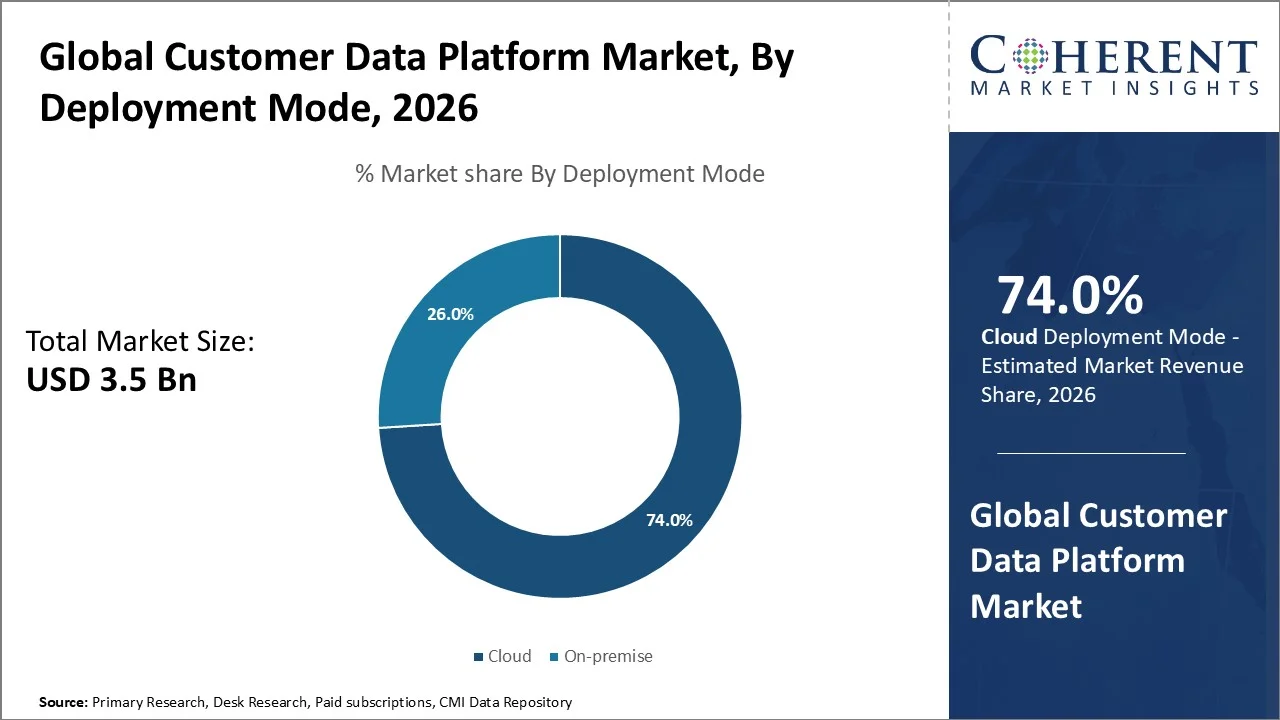
- Cloud is expected to account the largest share of 74.0% in 2026, because enterprises need scalable storage, rapid integration with CRM, e-commerce, advertising, and service platforms, and lower dependence on in-house IT infrastructure. Its relevance is strengthened by rising digital customer interactions: the U.S. Census Bureau reported in March 2026 that e-commerce represented 16.4% of total U.S. retail sales in 2025, while nonstore retailers grew 10.1% year-on-year in March 2026, published in April 2026. NIST’s March 2026 cloud-native API protection guidance further supports secure API-led deployment, making cloud CDPs suitable for real-time customer data unification.
Source: Census.gov; U.S. Department of Commerce; National Institute of Standards and Technology
- Large enterprises will dominate with 63.4% in 2026, because they handle high customer volumes across CRM, ERP, e-commerce, service, and marketing channels, making unified identity resolution, consent management, and advanced analytics essential. Eurostat data published in January 2026 showed 84.67% of EU large enterprises purchased cloud services in 2025, while 65.43% used CRM and 69.24% used BI software, supporting faster CDP integration and enterprise-wide adoption.
- Retail and E-commerce hold the dominant share of 35.7% in 2026 because retailers handle high-frequency browsing, cart, loyalty, payment, delivery, and return data across online and offline touchpoints. Cloud CDPs help unify these signals for real-time personalization, churn control, campaign targeting, and inventory-linked offers. The U.S. Census Bureau, published in April 2026, reported March 2026 nonstore retailers grew 10.1% year-on-year, highlighting stronger digital-commerce data needs.
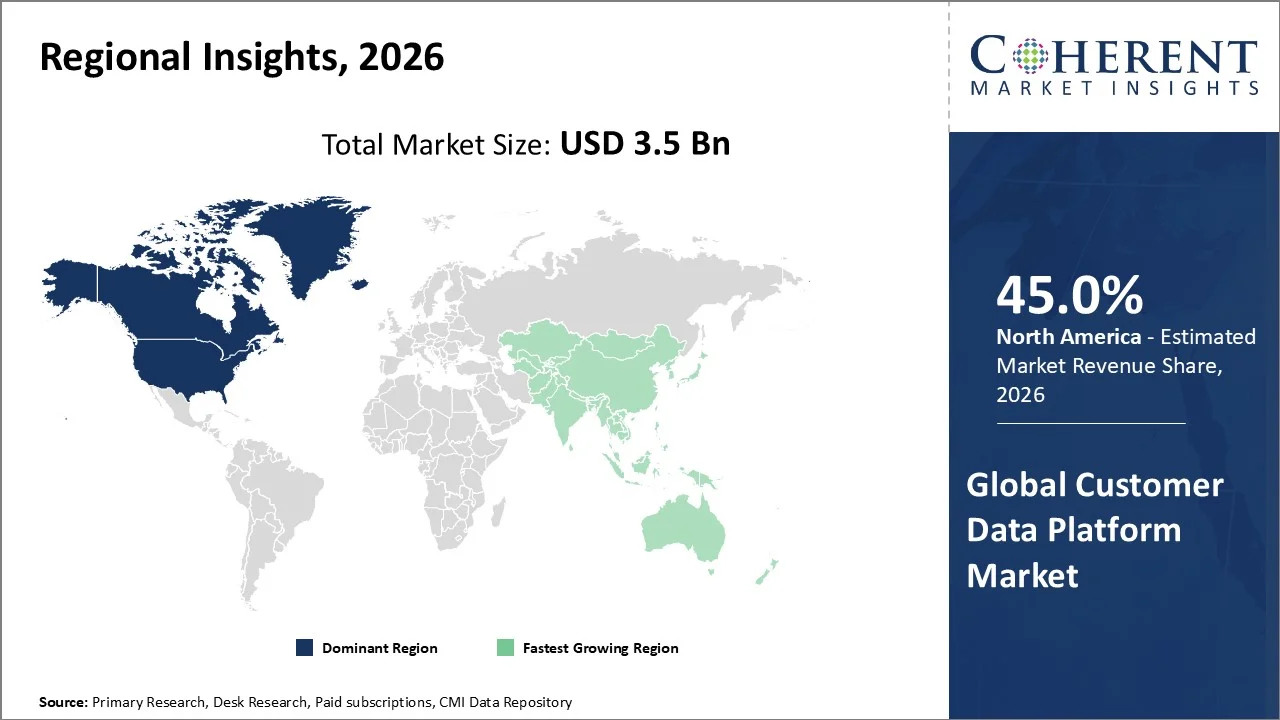
- North America is expected to acquire the dominant share of 45.0% in 2026. North America’s dominance in the Customer Data Platform (CDP) industry is backed by the U.S.’s massive and digitally empowered business base with 5.58 million employer firms in 2023 according to the U.S. Census Bureau, representing a broad pool of enterprise CDP adopters at scale. Additionally, the U.S. Bureau of Economic Analysis tracks the digital economy as a key growth driver, reflecting how data and digital services have become central economic assets that fuel advanced analytics and CDP deployment across sectors.
Growing analysis of real-time and personalized data
Growing real‑time and personalized data analysis significantly drives Global Customer Data Platform market growth by enabling businesses to instantly tailor experiences and engagement. Real‑time analytics lets companies capture and activate live customer behavior across web, app, and CRM channels, improving conversions and customer satisfaction. The growing analysis of real-time and personalized data is significantly driving the Global Customer Data Platform (CDP) Market. As businesses increasingly rely on machine learning and AI models for real-time data analysis, instant decision-making becomes crucial in sectors such as retail, healthcare, and banking. For instance, according to the World Bank’s 2026 report, real-time data capabilities enable governments and businesses to forecast demand and consumer behavior more effectively (World Bank, 2026). Similarly, the United Nations Conference on Trade and Development (UNCTAD) highlights that 69 economies are modernizing their digital platforms for better consumer insights (UNCTAD, 2026). In India, the Ministry of Statistics and Programme Implementation is enhancing its data infrastructure to cater to the growing digital economy, contributing to the market's expansion (Government of India, 2026). This growing reliance on personalized data is propelling the adoption of CDP technologies across industries, improving consumer engagement and market responsiveness.
Source: World Bank; UNCTAD; Government of India
Current Events and Their Impact on the Customer Data Platform Market
Current Event | Description and its Impact |
Government Support for AI Research and Development |
|
Regulatory Shifts in AI and Data Privacy |
|
Funding for Public AI Startups |
|
- Current Industry Events of 2026
- Market Size Estimation
- Regional Breakdown
- Competitive Landscape
- Customer Intelligence
- Segmental Analysis
- Pricing Analysis
- Key Market Drivers, Challenges & Future Trends
- Customized Insights Section
Segmental Insights
Why is Cloud Acquiring the Largest Market Share?
Cloud is projected to account for the largest share of customer data platform in 2026, representing approximately 74.0% of the total volume. The cloud deployment segment remains dominant in the Customer Data Platform market due to its scalability, flexibility, and real‑time data processing capabilities, which support large‑scale data integration and cross‑channel analytics. Governments and large institutions increasingly adopt cloud‑based analytics for improved service delivery and digital transformation. For instance, the World Bank’s 2026 report highlights how cloud‑powered real‑time data systems enhance forecasting and decision‑making across sectors like healthcare and finance (World Bank, 2026). Likewise, the UNCTAD Digital Economy Report (2026) shows that digital platform modernization in 69 economies is largely cloud‑centric, enabling faster deployment of data services and improved insights (UNCTAD, 2026). In India, the Ministry of Statistics and Programme Implementation’s 2026 initiative to modernize data infrastructure prioritizes cloud solutions for real‑time reporting and interoperability (Government of India, 2026). These shifts reinforce cloud deployment’s leadership in delivering efficient, secure, and agile CDP solutions globally.
Source: World Bank; UNCTAD; Ministry of Statistics and Programme Implementation
Large Enterprises holds the Largest Market Share
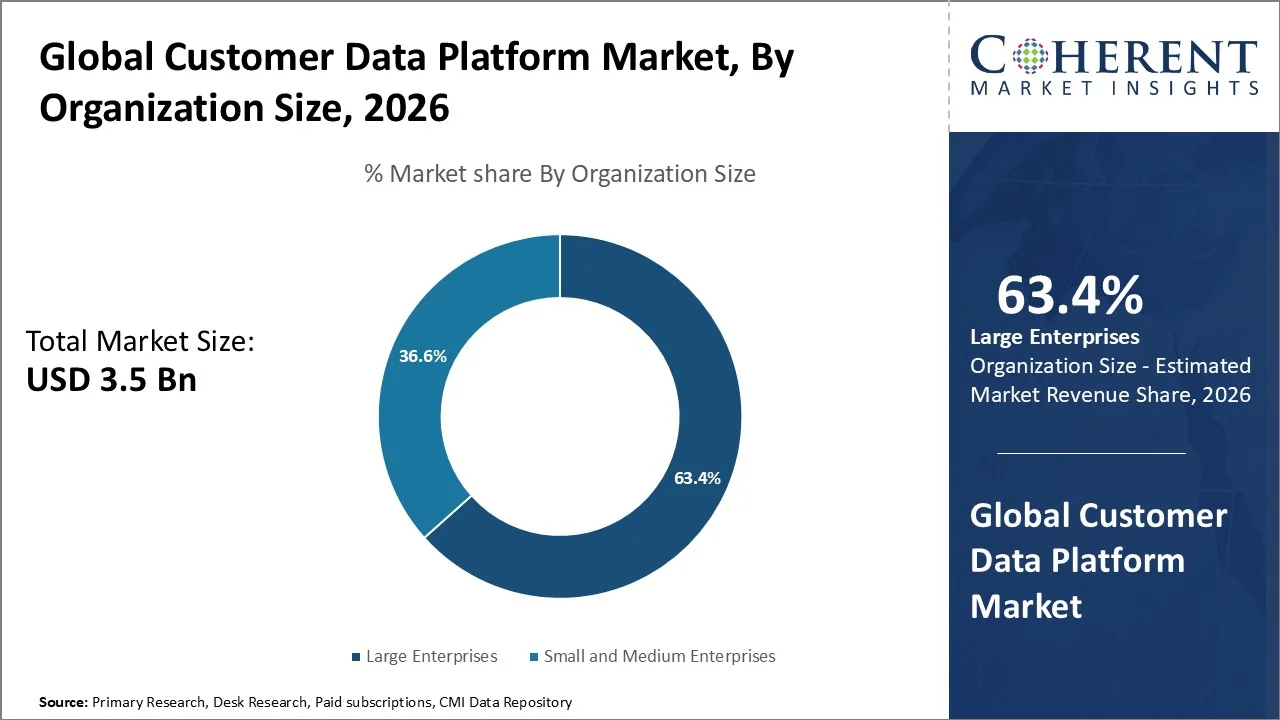
Based on organization size, large enterprises dominate the market, accounting for a significant 63.4% share in 2026, because they generate massive volumes of customer and operational data across departments, requiring unified identity resolution, cross‑channel analytics, and compliance‑ready governance. These organizations often lead digital transformation initiatives, adopting cloud‑based platforms to integrate CRM, sales, service, and marketing systems. For instance, in 2026, according to the UNCTAD Digital Economy Report, digital platform modernization including cloud infrastructure and data analytics is underway in 69 economies, reflecting large enterprises’ prioritization of real‑time insights and scalable data solutions. Furthermore, in India, the Press Information Bureau release from January 2026 highlighted government efforts to modernize statistical systems and digital data infrastructure, underscoring the broader move toward advanced data platforms among large organizations. Enterprises also invest in CDPs to meet regulatory requirements and enhance customer personalization, making them the foremost adopters and drivers of CDP market growth.
Source: UNCTAD (United Nations Conference on Trade and Development); Press Information Bureau (PIB)
Which End User segment dominates the market?
Retail and E-commerce account for the largest share of 35.7% in 2026. The retail and e‑commerce segment lead the Customer Data Platform market because it deals with large, diverse customer interactions across online and physical channels that require unified, real‑time data for personalized experiences, loyalty management, and dynamic pricing. For instance, according to the U.S. Census Bureau’s Quarterly Retail E‑Commerce Report published in 2026, e‑commerce accounted for 16.6% of total U.S. retail sales in Q4 2025, showing continuous growth in online purchasing behavior and digital engagement. Retail trade data from April 2026 also shows retail sales rising year‑over‑year with non‑store (online) retail up 10.1% compared to 2025, indicating strengthening digital commerce demand. These trends push retailers to adopt CDPs to integrate data from websites, apps, loyalty programs, and POS systems to generate insights, reduce churn, and optimize marketing campaigns. High e‑commerce penetration and the need for seamless customer journeys make retail a dominant CDP end‑user segment.
Source: Census.gov; U.S. Department of Commerce
Customer Data Platform Market Trends
Shift from marketing CDP to enterprise-wide customer intelligence platforms – Customer Data Platforms are no longer used only for marketing segmentation and campaign activation. In 2026, enterprises are using CDPs as unified customer intelligence layers across marketing, sales, service, commerce, loyalty, and customer support. Gartner’s 2026 CDP research states that CDP use cases are expanding from marketing to full go-to-market motions and back-office data activation, showing that CDPs are becoming a broader enterprise data foundation.
Rise of agentic AI and AI-powered customer engagement – AI is becoming a core layer inside CDPs as companies use unified customer profiles to support next-best actions, predictive segmentation, customer journey automation, and AI agents. Gartner’s 2026 Magic Quadrant states that the CDP market is bifurcating into “platformization” and “agentification,” meaning CDPs are moving toward integrated enterprise platforms and autonomous AI-driven engagement systems. Salesforce also reported in 2026 that 75% of marketers are using AI, while 78% say they need more personalized content than they can currently produce.
Growth of real-time personalization across digital and physical channels – Brands are increasingly using CDPs to deliver real-time personalization across websites, apps, email, call centers, stores, loyalty programs, and social channels. Adobe’s 2026 AI and Digital Trends report highlights that future customer experiences are expected to be highly personalized and anticipatory in real time, with 80% relevance, while 72% emphasize seamless experiences across digital and physical touchpoints. This is pushing CDPs to support instant profile updates, live audience activation, and omnichannel journey orchestration.
Privacy-first CDPs and consent-led customer data management – Data privacy, consent tracking, and regulatory compliance are becoming central CDP buying criteria. California’s updated CCPA regulations became effective on January 1, 2026, covering disclosures, consumer consent, opt-out rights, and sensitive personal information controls. India’s DPDP Rules also emphasize clear consent notices, breach notification, and consent managers, while the EU Data Act has been applicable since September 2025 to give users greater control over connected-device data. These regulations are pushing CDPs to offer consent management, audit trails, data minimization, preference centers, and permission-based activation.
Regional Insights
North America dominates owing to Mature Digital Ecosystem
North America account 45.0% market share in 2026, due to its mature digital ecosystem, high enterprise adoption of advanced analytics, and continued investment in AI‑enabled marketing technologies. For instance, in May 2026, according to the U.S. Census Bureau’s Quarterly Retail E‑Commerce Sales Report, U.S. retail e‑commerce sales hit $316.1 billion in Q4 2025, rising steadily year‑over‑year and comprising roughly 16.4% of total retail sales, highlighting a large digital consumer base that demands personalized experiences across channels. This fuels CDP adoption by top e‑commerce brands seeking unified customer profiles and real‑time personalization. Companies like Salesforce and Microsoft are embedding CDP capabilities — for example, Salesforce’s Data Cloud and Microsoft Fabric with Customer Insights — into enterprise stacks, enabling enterprise customers to harness first‑party data for marketing and analytics. Additionally, robust digital transformation initiatives and stringent data privacy standards in the U.S. encourage investment in compliant data infrastructure, further solidifying North America’s leadership in the global CDP market.
Asia Pacific Customer Data Platform Market Trends
The Asia-Pacific region is poised to be as the fastest-growing region through 2026-2033, driven by accelerating digital transformation across business and government sectors, expanding internet and smartphone penetration, and large data‑centric enterprise initiatives in India, China, and Southeast Asia. For instance, in January 2025, according to the data published by the Press Information Bureau, the region’s robust digital economy momentum is underpinned by India’s strategic push to become a global digital powerhouse with its digital economy contributing nearly 12% of GDP and expanding rapidly across services and platforms. India’s digitalization and startup ecosystem growth support demand for unified customer data insights across retail, finance, and services. At the same time, OECD’s Economic Outlook for Southeast Asia, China and India 2025 highlights resilient domestic demand and continued investment in technology and services, sustaining long‑term digital adoption. Moreover, APAC enterprises are embracing cloud, AI, and real‑time customer analytics to deliver personalized experiences, forcing widespread customer data platform adoption to unify customer touchpoints and drive business innovation.
Additionally, the Asia‑Pacific Economic Cooperation (APEC) Digital Economy Steering Group reported in January 2026 that the digital economy could account for up to 15.5% of global GDP and underpins roughly 70% of future value creation, reflecting how data ecosystems are central to regional competitiveness. Regional forums and cross‑border policy harmonization efforts further strengthen data flows and interoperability, enabling enterprises to deploy real‑time customer data solutions like CDPs across markets, sectors, and channels.
Growing High Enterprise Adoption of Advanced Analytics is Accelerating the Customer Data Platform Market Demand in United States
The U.S. customer data platform market dominates North America due to its massive e‑commerce market scale, rapid digital adoption, and strong enterprise technology deployment. For instance, according to the U.S. Census Bureau’s Quarterly Retail E‑Commerce Sales Report published March 10, 2026, U.S. retail e‑commerce sales reached US$316.1 billion in Q4 2025 and accounted for over 16% of total retail sales, highlighting sustained digital consumer demand in 2025–26. With the U.S. e‑commerce market crossing the US$1 trillion annual sales mark for the fourth straight year in 2025, retailers are increasingly investing in unified customer data systems to personalize experiences and improve retention. Retail and e‑commerce lead CDP adoption globally, accounting for the largest share of deployments as companies seek real‑time insights and unified customer profiles. Major U.S. brands including Amazon and Walmar leverage CDPs to tailor offers and streamline omnichannel experiences, driving demand for CDP solutions. The US’s high digital penetration, advanced analytics adoption, and large online customer base continue to propel CDP market growth nationally and reinforce its leadership within North America.
China Customer Data Platform Market Trends
China’s dominance in the CDP industry in 2026 stems from its strategic national digital agenda, massive data generation, and robust e‑commerce ecosystem. For instance, in May 2025, the Chinese government released its “Digital China” action plan, emphasizing AI‑plus initiatives, digital infrastructure upgrades, the data industry, and talent development to accelerate digital transformation across enterprises and public services a foundation for advanced customer analytics and unified data platforms. In January 2026, official data showed that China’s online retail sales grew 8.6% year‑on‑year in 2025, with online physical goods sales reaching 13.09 trillion yuan, driven by e‑commerce, livestreaming commerce, and innovation in consumption models, underscoring the scale of digital customer interactions that CDPs must manage. Additionally, April 2026 government figures reported that China produced 52.26 zettabytes of data in 2025, a 27.3% increase year‑on‑year, providing vast data inputs for CDP analytics and real‑time personalization. These policy drivers, data scale, and e‑commerce dynamism collectively position China as a dominant customer data platform market.
Who are the Major Companies in Customer Data Platform Market
Some of the major key players in Customer Data Platform Market are Zeta Global Corp, Oracle Corporation, mParticle Inc., Salesforce.com Inc., BlueConic, Adobe Inc., Tealium, SAP SE, Acquia Inc., and Segment.Io Inc. (Twilio)
Key News
- In April 2026, Twilio Segment introduced new Advanced Audiences features to activate warehouse data faster. The company stated that data teams spend 15–30 hours per week handling manual marketing requests, and its new Linked Audiences releases are designed to unlock warehouse data for marketers while maintaining governance and flexibility. Twilio also announced that Aggregated Filters became generally available in April 2026, allowing marketers to build audiences using sums, counts, averages, and min/max values directly from raw warehouse tables. This supports the shift toward warehouse-native CDP activation.
- In April 2026, Adobe announced new capabilities in Adobe Real-Time CDP to strengthen data foundations, governance, and smarter audience activation. Adobe stated that Real-Time CDP Collaboration now supports richer data collaboration, audience planning, onsite and offsite activation, creative generation, and measurement. Adobe also highlighted zero-copy methodology through Federated Audience Composition, allowing customers to enrich and activate audiences directly from warehouse partners. These updates show that CDPs are evolving toward real-time personalization, privacy-forward data collaboration, and composable customer data activation.
Market Report Scope
Customer Data Platform Market Report Coverage
| Report Coverage | Details | ||
|---|---|---|---|
| Base Year: | 2025 | Market Size in 2026: | USD 3.5 Bn |
| Historical Data for: | 2020 To 2024 | Forecast Period: | 2026 To 2033 |
| Forecast Period 2026 to 2033 CAGR: | 24% | 2033 Value Projection: | USD 15.8 Bn |
| Geographies covered: |
| ||
| Segments covered: |
| ||
| Companies covered: | Zeta Global Corp, Oracle Corporation, mParticle Inc., Salesforce.com Inc., BlueConic, Adobe Inc., Tealium, SAP SE, Acquia Inc., and Segment.Io Inc. (Twilio) | ||
Analyst Opinion
- Customer data platforms are becoming an enterprise data foundation, not only a marketing tool. Gartner’s 2026 Magic Quadrant for Customer Data Platforms states that the market is shifting toward platformization and agentification, where buyers are prioritizing orchestration, warehouse-native/composable architecture, cost-to-value, and agentic AI automation. This shows that CDPs are moving from basic customer databases to strategic infrastructure for real-time customer engagement and AI-led decision-making.
Source: Gartner
- AI-led personalization is the strongest growth trigger for the CDP market. Adobe’s 2026 AI and Digital Trends report highlights that 80% of respondents expect future customer experiences to be highly personalized and anticipatory in real time, while 72% emphasize seamless experiences across digital and physical touchpoints. This directly increases demand for CDPs because brands need unified customer profiles, live data activation, and omnichannel journey orchestration.
Source: Adobe
- Data unification gaps are pushing enterprises toward CDP adoption. Salesforce’s 2026 marketing insights show that 84% of marketers use first-party data, but only 31% are fully satisfied with their data unification ability. Salesforce also noted in February 2026 that teams with unified customer data are 42% more likely to regularly respond to customers and 60% more likely to use AI agents. This makes CDPs critical for AI-ready marketing operations.
Source: Salesforce
- Retail and e-commerce are creating high-volume customer data, strengthening CDP demand. According to the U.S. Census Bureau, published in March 2026, U.S. retail e-commerce sales reached US$316.1 billion in Q4 2025, while e-commerce accounted for 18.3% of total retail sales on a not-adjusted basis. As online, mobile, loyalty, and store interactions expand, retailers increasingly need CDPs to unify behavioral, transactional, and identity data.
Source: U.S. Census Bureau
- The market is moving toward CDP-plus-engagement platforms. In April 2026, Twilio stated that its customer engagement platform unifies communications, customer data, and AI into one infrastructure layer for personalized omnichannel experiences. This indicates that CDP vendors are no longer competing only on data storage; they are competing on activation, automation, AI agents, and measurable customer engagement outcomes.
Source: Twilio
- North America remains the largest and most mature market for CDPs due to strong enterprise digital transformation, abundant tech investment, and major vendor headquarters in the U.S. Europe is the second‑largest regional contributor, with strong adoption across Western Europe especially in the U.K. and France. GDPR and other stringent privacy regulations have pushed European buyers toward GDPR‑compliant CDP solutions that emphasize data governance, consent management, and privacy‑first customer profiles, supporting organized and secure first‑party data strategies. Asia Pacific is the fastest‑growing region, benefiting from rapid digitalization, e‑commerce expansion, and rising enterprise focus on data analytics. Countries like China and India, with burgeoning internet user bases and mobile‑first consumers, are increasingly adopting CDPs to unify multi‑channel customer data and enhance engagement. This regional momentum is expected to continue accelerating through 2026 and beyond. Middle East & Africa and Latin America are emerging markets, with moderate adoption so far but growing interest as marketers invest in real‑time analytics and personalization. While these regions contributed a smaller share of global CDP revenue in 2025, improving digital infrastructures and expanding remote commerce are creating new growth corridors heading into 2026.
Speak to the analyst
Want personalized insights?
Take the findings above to one of our principal consultants, or have the report rebuilt around the segments, geographies and competitors you actually track.
Market Segmentation
- By Deployment Mode (Revenue, USD Bn, 2021-2033)
- Cloud
- On-premise
- By Organization Size (Revenue, USD Bn, 2021-2033)
- Small and Medium Enterprises
- Large Enterprises
- By End User (Revenue, USD Bn, 2021-2033)
- Retail and E-commerce
- BFSI
- Media and Entertainment
- IT and Telecommunication
- Healthcare
- Other (Transportation, Hospitality, Government, and Education)
- By Region (Revenue, USD Bn, 2021-2033)
- North America
- U.S.
- Canada
- Latin America
- Brazil
- Mexico
- Argentina
- Rest of Latin America
- Europe
- Germany
- U.K.
- France
- Italy
- Spain
- Russia
- Rest of Europe
- Asia Pacific
- China
- India
- Japan
- Australia
- South Korea
- ASEAN
- Rest of Asia Pacific
- Middle East
- GCC
- Israel
- Rest of Middle East
- Africa
- South Africa
- Central Africa
- North Africa
- North America
- Competitive Landscape
- Zeta Global Corp
- Oracle Corporation
- mParticle Inc.
- com Inc.
- BlueConic
- Adobe Inc.
- Tealium
- SAP SE
- Acquia Inc.
- Io Inc. (Twilio)
Sources
Primary Research Interviews
- IT leaders, CIOs, and digital transformation managers on adoption challenges, integration issues, and CDP impact on operations, including data quality and unification.
- CDP providers, data engineers, and software developers on AI integration, real-time analytics, and advancements in data governance for personalization and security.
- Analysts, consultants, and tech advisors on market trends, competitive landscape, and CDP’s role in driving engagement and predicting customer behavior.
- Decision-makers in enterprises and public-sector organizations on investment factors, implementation challenges, and data privacy concerns like GDPR compliance and legacy system integration.
Databases
- U.S. Census Bureau - Retail E-Commerce Sales Report
- U.S. Bureau of Economic Analysis (BEA)
- European Commission Digital Strategy Database
- OECD (Organisation for Economic Co-operation and Development) ICT Database
- Gartner’s Magic Quadrant for CDPs
- Forrester Research Reports
Magazines
- AI & Machine Learning Review (IEEE)
- MIT Technology Review
- TechCrunch
- Diginomica
- Forrester Research - MarketingTech News
- Forbes Technology Council
Journals
- Journal of Marketing Research
- Journal of Interactive Marketing
- Journal of Business Research
- Journal of Big Data
- IEEE Transactions on Knowledge and Data Engineering
Newspapers
- The Wall Street Journal - Technology Section
- The Financial Times - Technology Section
- The New York Times - Technology Section
- The Guardian - Technology Section
- TechCrunch
Associations
- Data & Marketing Association (DMA)
- Institute of Electrical and Electronics Engineers (IEEE)
- International Association for Privacy Professionals (IAPP)
- Customer Experience Professionals Association (CXPA)
- American Marketing Association (AMA)
Public Domain Sources
- U.S. Government AI Research Reports (AI.gov)
- National Institute of Standards and Technology (NIST) Whitepapers
- U.S. Federal Government Whitepapers on AI
- European Commission Policy Documents on Digitalization and AI
- Company Annual Reports and Investor Presentations from Publicly Listed Firms
Proprietary Elements
- CMI Data Analytics Tool
- Proprietary CMI Existing Repository of information for last 10 years
Get access to 250+ pages report
Every segment, forecast, competitor profile and data table behind the analysis above — available for instant download.
- ESOMAR Member
- ISO 9001:2015 Certified
- D-U-N-S Registered
- GDPR & CCPA Compliant
Missing comfort of reading report in your local language? Find your preferred language:
Transform your Strategy with Exclusive Trending Reports
Frequently Asked Questions
The Customer Data Platform Market is expected to reach USD 15.8 Bn in 2033.
Major players operating in the global Customer Data Platform Market include Zeta Global Corp, Oracle Corporation, mParticle Inc., Salesforce.com Inc., BlueConic, Adobe Inc., Tealium, SAP SE, Acquia Inc., and Io Inc. (Twilio)
Growing concerns regarding data privacy and security and lack of flexibility of customer data platforms are the major factors hampering the growth of the customer data platform market.
Rise in importance of maintaining customer satisfaction and relationship and Growing analysis of real-time and personalized data are the factors driving the growth of the market over the forecast period.
The Customer Data Platform Market is anticipated to grow at a CAGR of 24% between 2026 and 2033.
Among regions, North America is expected to account for a largest market share in the global Customer Data Platform Market over the forecast period.