

Data Center Construction Market Size and Trends - 2026 to 2033
The global data center construction market is estimated to be valued at USD 72,760.6 Mn in 2026 and is expected to reach USD 126,713.7 Mn by 2033, exhibiting a compound annual growth rate (CAGR) of 8.4% from 2026 to 2033.
Key Takeaways
- By enterprise size, large enterprises hold a majority of the market with a 55.7% share in 2026, driven by their hyperscale and highly reliable data center infrastructure needs.
- By Construction Type, Electrical construction, due to its crucial nature in powering high-density IT equipment and supporting redundancy systems, is expected to capture the highest market share in 2026.
- By tier standards, the tier 3 segment is projected to have the largest market share of 52.5% in 2026, due to its optimal balance between scalability and reliability.
- By end-use industry, IT & telecom is estimated to contribute the highest share of 39.7% in 2026 due to explosive data usage across the globe.
- By Region, North America is the clear and dominant regional market in data center construction, which is anticipated to hold a share of 33.8% in the global market by 2026, assisted by the heavy presence of major technology giants and cloud service providers; the United States contributes the biggest share in the region.
Market Overview
The data center construction market will see significant growth over the forecast period due to rapid growth in data traffic across the world on account of increased internet penetration, adoption of cloud computing , and big data analytics. The rising demand for efficient and scalable data storage from colocation providers and hyperscale operators is expected to drive the new data center construction market growth.
Current Events and Its Impact on the Data Center Construction Market
Current Event | Description and Impact |
AI Revolution and Generative AI Adoption |
|
Global Supply Chain Disruptions and Material Shortages |
|
Geopolitical Tensions and Data Sovereignty Requirements |
|
Role of Artificial Intelligence (AI) in Data Center Construction
AI plays an important role in modern data center construction by improving efficiency, design, and operations. It helps in site selection by analyzing data, optimizes architectural design for the efficient use of power and cooling, and predicts equipment needs based on forecasted workloads.
AI supports both, the integration with advanced cooling systems and energy-saving technologies. Upon completion of construction, further optimization by AI will come through real-time monitoring and predictive maintenance. Under the deal, KDDI and HPE will set up a rack-scale system powered by the latest NVIDIA Blackwell architecture on the NVIDIA GB200 NVL72 platform built by HPE. The data center will minimize its environmental impact by using hybrid cooling-air and liquid cooling.
In June 2025, HPE and KDDI Corporation announced a partnership to launch the Osaka Sakai Data Center by early 2026. The facility will support startups and enterprises with NVIDIA AI infrastructure for developing AI applications and training large language models (LLMs).
- Current Industry Events of 2026
- Market Size Estimation
- Regional Breakdown
- Competitive Landscape
- Customer Intelligence
- Segmental Analysis
- Pricing Analysis
- Key Market Drivers, Challenges & Future Trends
- Customized Insights Section
Segmental Insights
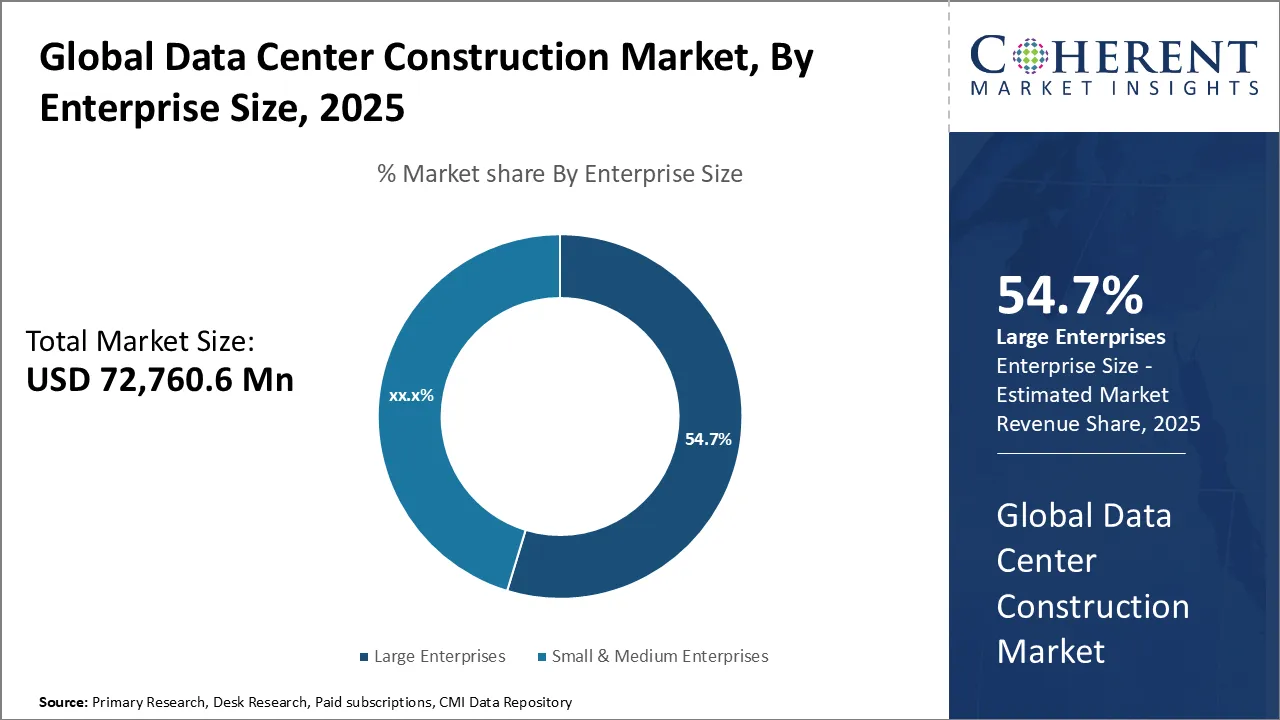
Data Center Construction Market Insights, By Enterprise Size: Large Enterprises Capture Majority of Market Share
By organization size, large enterprises accounted for a 55.7% market share in 2026, reflecting the demand from large enterprises for hyperscale and highly reliable data center infrastructure. Large corporations involved in the cloud services, BFSI, and IT sectors are investing actively in new facilities and expansions for accommodating the digital transformation, AI workloads, and low-latency applications.
SMEs comprise 45.3% market share, and their primary adoption consists of small or edge-focused data centers to support regional operations and localized IT workloads.
For instance, in January 2025, Infosys announced a raft of initiatives to expand enterprise cloud and connectivity capabilities-a strategic partnership with StarHub to offer cloud, cybersecurity, and ICT services; a Google Cloud center of excellence powered by Infosys Topaz; and an extended relationship with Microsoft that aims to help enterprises accelerate generative AI and Azure adoption.
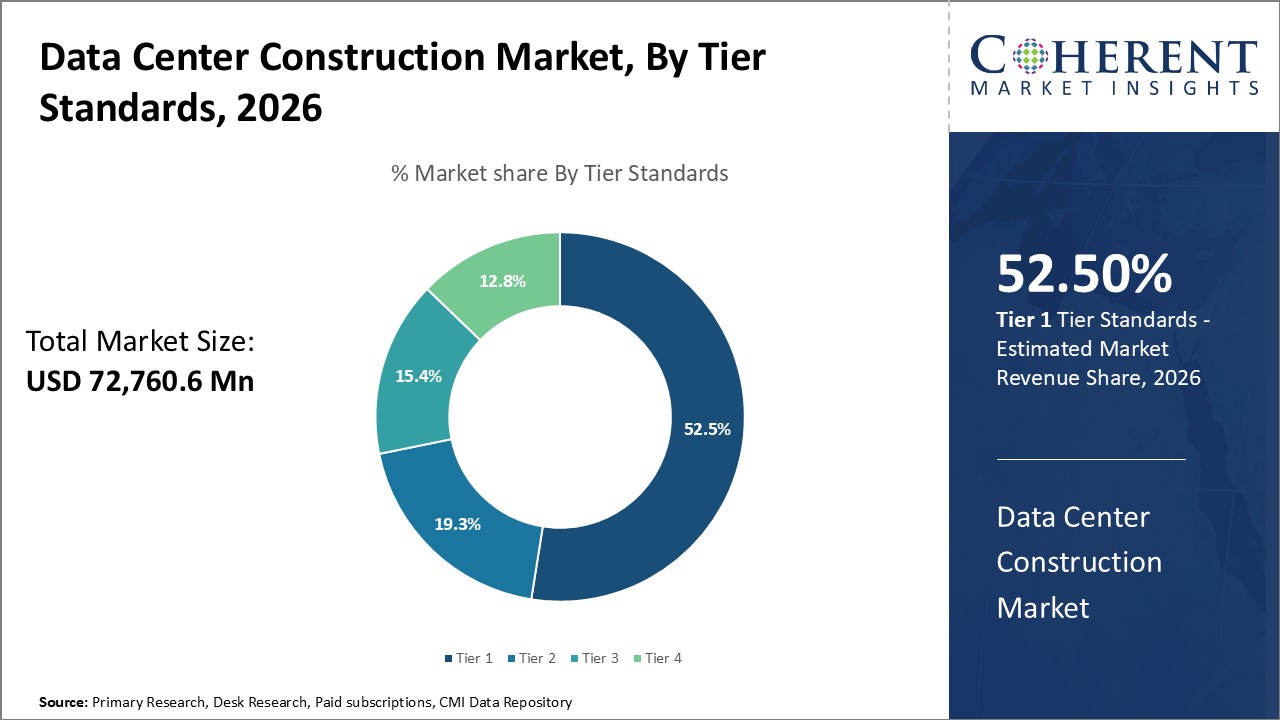
Data Center Construction Market Insights, By Tier standards: Increased Scalability and Reliability Drive Growth in Tier 3 Centers
Based on tier standards, the segment of tier 3 is projected to have the highest market share of 52.5% in 2026 because it offers a balance between scalability and reliability. Tier 3 data centers also provide higher levels of infrastructure resilience through redundant components such as servers, storage, power, and networking. These have multiple independent distribution paths serving the IT equipment to ensure continuity of operations in the event of equipment failures or routine maintenance activities. This highly scalable Tier 3 design allows seamless capacity expansion to support the growing computing and storage demands of businesses. Due to their modular architecture that incorporates hot-swappable components, they can be upgraded incrementally without any major overhauls.
This results in a redundant configuration translating to 99.982% availability, which is sufficiently high for mission-critical applications. Still, due to dual component redundancy instead of multiple levels, the total cost of ownership is notably lower than that of Tier 4 centers.
For example, in February 2025, Heijmans revealed plans for a new 11,000-square-meter data center in Haarlem, Netherlands, planned with a capacity of 10 megawatts. The facility will use modular construction, energy-efficient water recycling, and be heat-network-ready to reuse the waste heat for nearby homes.
Data Center Construction Market Insights, By Construction Type: Electrical Construction Dominates Market Share
By construction type, electrical construction is expected to hold the largest market share in 2026 due to its high utilization in powering high-density IT equipment and enabling redundancy systems. Electrical construction today is comprised of a number of advanced UPS systems, high-capacity power distribution units, and intelligent monitoring solutions that ensure optimum energy efficiency and uptime.
For example, AI-driven demand for data centre infrastructure has seen Schneider Electric invest in U.S. manufacturing. It announced a $700 million investment in the expansion and refurbishing of facilities across eight sites in March 2025 to extend its capability in support of the growing data center market.
Data Center Construction Market Insights, By End-Use: Growth in IT & Telecom Demand Drives Data Center Construction
By end-use, IT & telecom is expected to hold the highest share of 39.7% due to the explosive usage of data across the globe in 2026. Cloud, IoT, big data analytics, and 5G technologies are being widely used, and therefore, leading to an increase in the amount of digital data produced and processed worldwide. Hyperscale cloud providers are continuously scaling up their capacities while telecom operators are ramping up their edge infrastructure for low latency applications targeting consumers and enterprises alike. IT infrastructure and environments are being increasingly migrated to scalable and secure data centers owing to ongoing digital transformation initiatives across industries.
IT modernization initiatives with big data, AI, and advanced analytics require on-premise data centers for localized computing and data sovereignty needs. This is a robust growth opportunity for colocation providers and telehousing services too.
For example, in July 2025, Google announced to invest USD 6 billion to build a 1-gigawatt data center campus in Visakhapatnam, Andhra Pradesh, India, including USD 2 billion for renewable energy infrastructure to power the facility.
Regional Insights
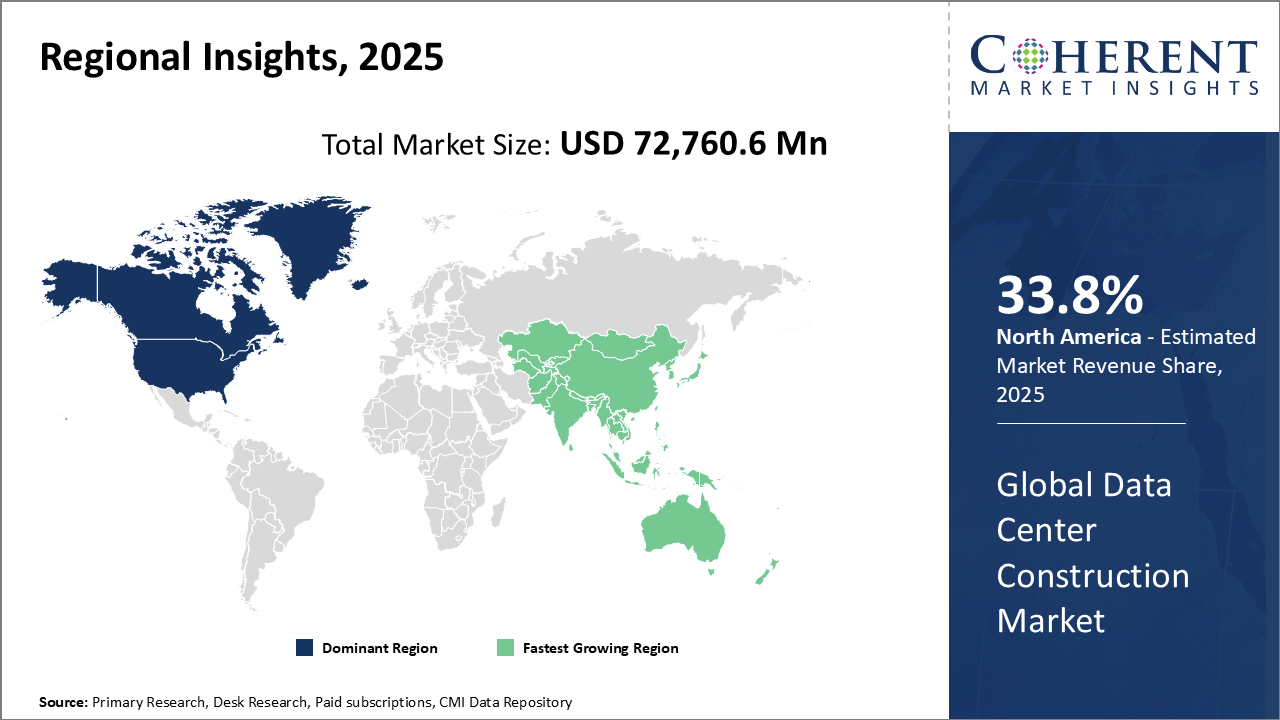
North America Data Center Construction Market Trends
North America is the leading regional market for data center construction, and is poised to hold 33.8% of the global market share in 2026. This region's leadership is supported by the heavy presence of major tech giants and cloud service providers; the U.S. holds the largest share within the region. Strong demand for cloud and connectivity services across enterprise sectors has driven substantial investments in physical infrastructure expansion. Leading corporations are undertaking large-scale projects to develop new facilities and expand their existing footprints.
For instance, in March 2026, Microsoft announced a USD 1.5 billion expansion of its data center operations in San Antonio, Texas, including the construction of multiple new data centers in Medina County. This expansion is aimed at supporting growing enterprise demand for cloud and connectivity services, particularly for Azure cloud services and AI applications, and reflects the broader trend of large corporations investing in physical infrastructure to meet increasing digital workloads.
Asia-Pacific Data Center Construction Market Trends
Asia-Pacific is the fastest-growing regional market, with a global share of 26% anticipated in 2026. In this region, rapid digitalization, increasing internet penetration, and the growth of bandwidth-consuming applications are driving up demand for online services, prompting global data center operators to expand in developing Asian economies.
Countries like China, India, Japan, and South Korea have competitive advantages in terms of lower construction costs, tax incentives, and increasing consumer demand for cloud-based applications. Government initiatives such as Digital India and Made in China 2026 further underscore the strategic focus of the region. The countries in Southeast Asia are also going to emerge as important hubs on the back of stable economic growth, a growing middle class, and improving infrastructure.
In April 2026, China launched the world’s first commercial underwater data center off Hainan Province, using the ocean’s natural cooling to greatly cut energy use. This groundbreaking facility represents a major step forward in sustainable AI development.
Data Center Construction Market Outlook Country-Wise
Europe Data Center Construction Market Trends
Europe is expected to account for 26% of the data center construction market in 2026, driven by the modernization of existing facilities and increasing demand for energy-efficient and low-latency solutions. European operators are increasingly adopting sustainable construction practices, renewable energy integrations, and advanced cooling technologies to meet regulatory standards and client expectations.
For example, the European Commission in March 2024 adopted a delegated regulation providing for an EU-wide scheme to rate the sustainability of data centers. Part of the revised Energy Efficiency Directive, it requires data center operators to report KPIs for energy consumption, renewable energy usage, water consumption, and heat reuse.
United States Data Center Construction Market Trends
The United States is the biggest contributor to North America's data center construction market, driven by strong demand for cloud services, enterprise digital transformation, and hyperscale infrastructure expansion. Major technology companies such as Amazon, Microsoft, and Google have been investing heavily in new campuses, adding capacity, and upgrading existing facilities to support AI, edge computing, and high-performance workloads.
For example, in August 2026, Alphabet's Google announced it will invest USD 9 billion over the next two years to build a new data center campus in Stillwater and expand its Pryor facility in Oklahoma. The investment is designed to help expand U.S. AI and cloud infrastructure, supported by education and workforce development programs.
China Data Center Construction Market Trends
China dominates the Asia-Pacific data center construction market share, supported by rapid digitalization, strong e-commerce growth, and government initiatives like Made in China 2026 and the National Big Data Strategy. Lower construction costs and abundant local talent make it attractive for both domestic and global operators to build hyperscale facilities.
For instance, China launched a cloud of 12 AI-enabled satellites into orbit in May 2026, in a mission that marked a significant development, placing it strongly in the emergent frontier of space-based computing.
India Data Center Construction Market Trends
India is among the fastest-growing data center markets in the world, particularly because of the Digital India initiative by the government, fast internet penetration, and expansion of cloud services. Competitive construction costs and tax incentives also attract significant foreign and domestic investment in hyperscale and edge data centers.
For instance, in September 2024, AdaniConneX announced plans to scale its capacity from 20 MW to 160 MW in Chennai and Mumbai over the next two to three years. Such instances are accelerating the data center construction market revenue.
Market Report Scope
Data Center Construction Market Report Coverage
| Report Coverage | Details | ||
|---|---|---|---|
| Base Year: | 2025 | Market Size in 2026: | USD 72,760.6 Mn |
| Historical Data for: | 2020 To 2024 | Forecast Period: | 2026 To 2033 |
| Forecast Period 2026 to 2033 CAGR: | 8.4% | 2033 Value Projection: | USD 126,713.7 Mn |
| Geographies covered: |
| ||
| Segments covered: |
| ||
| Companies covered: | DPR Construction Inc., Hensel Phelps Construction Co. Inc., Turner Construction Co., Holder Construction Company, and Balfour Beatty US | ||
| Growth Drivers: |
| ||
| Restraints & Challenges: |
| ||
Data Center Construction Market Driver
Demand for Cloud Services
Organizations adopt cloud computing services; there is a corresponding rise in demand for data center capacity. Companies are shifting their computing and storage needs to the cloud to improve agility, accessibility, scalability and reduce costs as compared to maintaining their own on-premise infrastructure. This transition to the cloud has been a major driver of data center expansion by large public cloud providers such as AWS, Microsoft Azure, Google Cloud and others. These are building massive hyperscale data center campuses across the world to support their cloud platform growth. More capacity is always needed to meet the growing demand from businesses and consumers who are moving their IT workloads, applications, and data to the cloud. Cloud adoption will accelerate in the coming years as digital transformation becomes a priority for businesses.
For instance, in June 2025, Amazon announced A$20 billion (around USD13 billion) from 2025 to 2029 to expand its data center infrastructure across Australia.
Data Center Construction Market Opportunities
Edge Computing and 5G Networks
The rise of edge computing and fifth generation cellular networks are driving new opportunities for data center construction market growth. Edge computing refers to placing computing, storage, and applications closer to the physical location where data is being generated and consumed rather than in centralized clouds. This distributed architecture is driven by the need for ultra-low latency and higher bandwidth for applications like augmented reality, autonomous vehicles, IoT, and industrial automation. Roll-out of 5G networks will enable more bandwidth-intensive applications that need edge infrastructure deployments. 5G offers super-fast data speeds and very low latency, which is crucial for things like self-driving cars. But to make this happen, we need data centers on the edge that are capable of handling and transferring data closer to users instead of depending on such centralized facilities.
Analyst Opinion (Expert Opinion)
The data center construction market is witnessing remarkable growth, fueled by the rapid expansion of cloud computing, artificial intelligence, and edge computing across industries. Accelerated digital transformation, driven by remote work trends and surging data generation, is prompting enterprises to significantly expand their infrastructure.
Despite this growth, the market faces several constraints. Strict environmental regulations, rising construction costs, and skilled labor shortages in key regions are creating challenges for project execution. Limitations in power infrastructure and prolonged permitting processes further contribute to delays and operational complexities for construction firms.
Regionally, North America remains dominant because of strong adoptions of cloud services and significant investments by hyperscale operators. The Asia-Pacific region has been emerging as the fastest-growing market, supported by rapid digitalization across developing economies, smart city initiatives by governments, and expanding ecosystems for e-commerce.
Speak to the analyst
Want personalized insights?
Take the findings above to one of our principal consultants, or have the report rebuilt around the segments, geographies and competitors you actually track.
Data Center Construction Industry News
- In August 2025, Meta announced its plan for a $50 billion data center in Louisiana, aimed at supporting the rapidly growing demand for AI infrastructure and advanced computing capabilities in the United States.
- In December 2024, DPR Construction Inc. announced, DPR Brings Mission Critical Expertise to Meta AI Data Center in Louisiana
Market Segmentation
- Tier Standard Insights (Revenue, USD Mn, 2026 - 2033)
- Tier 1
- Tier 2
- Tier 3
- Tier 4
- By Construction Type (Revenue, USD Mn, 2026 - 2033)
- Electrical Construction
- Mechanical Construction
- General Construction
- Others
- By End-use Insights (Revenue, USD Mn, 2026 - 2033)
- IT & Telecom
- BFSI
- Government & Defense
- Healthcare
- Energy
- Others
- By Enterprise Size (Revenue, USD Mn, 2021 - 2033)
- Small & Medium Enterprises
- Large Enterprises
- Regional Insights (Revenue, USD Mn, 2026 - 2033)
- North America
- U.S.
- Canada
- Latin America
- Brazil
- Argentina
- Mexico
- Rest of Latin America
- Europe
- Germany
- U.K.
- France
- Italy
- Russia
- Rest of Europe
- Asia Pacific
- China
- India
- Japan
- Australia
- South Korea
- ASEAN
- Rest of Asia Pacific
- Middle East & Africa
- GCC
- South Africa
- Rest of Middle East & Africa
- Key Players Insights
- DPR Construction Inc.
- Hensel Phelps Construction Co. Inc.
- Turner Construction Co.
- Holder Construction Company
- Balfour Beatty US
Sources
Primary Research Interviews from the following stakeholders
Stakeholders
- Interviews with data center developers, construction contractors, engineering firms, IT infrastructure providers, project managers, and sustainability officers across major regional markets.
Specific stakeholders
- Project managers and site engineers at leading data center construction companies (e.g., DPR Construction, Turner Construction, Hensel Phelps, Holder Construction, Balfour Beatty US)
- Procurement and operations managers at hyperscale and colocation data center operators (e.g., Equinix, Digital Realty, CyrusOne, Meta, Google Cloud)
- Electrical, mechanical, and civil engineers at specialized construction and engineering firms (e.g., Fluor, Jacobs Engineering, Black & Veatch)
- Sustainability and energy-efficiency leads at green building and data center associations (e.g., Uptime Institute, The Green Grid)
- IT infrastructure planning officers at telecom operators and cloud service providers (e.g., AT&T, Verizon, Amazon Web Services)
- Facility managers and operations heads at existing enterprise and hyperscale data centers
- Energy and cooling system specialists at HVAC and power solution providers (e.g., Schneider Electric, Siemens, ABB)
Databases
- U.S. Census Bureau – Construction & Building Permits Data
- U.S. Energy Information Administration (EIA) – Electricity & Data Center Energy Reports
- China Customs Statistics – Industrial Equipment Imports
- Eurostat – ICT Infrastructure Data
- Japan External Trade Organization (JETRO) – Data Center Construction Investments
- Directorate General of Commercial Intelligence and Statistics (DGCIS), India – Construction & Electrical Equipment Data
- Korea Customs Service Data Portal – IT & Electrical Equipment Imports
- Federal Communications Commission (FCC) – Broadband & Telecom Infrastructure Statistics
Magazines
- Data Center Knowledge
- Data Center Frontier
- Mission Critical Magazine
- Data Center Dynamics (DCD)
- Commercial Property Executive – Data Center Section
- Engineering News-Record (ENR)
- TechTarget – SearchDataCenter
- Electrical Contractor Magazine
Journals
- IEEE Transactions on Cloud Computing
- Journal of Facilities Management
- Applied Energy – Data Center Energy Efficiency Section
- Journal of Building Engineering
- International Journal of Critical Infrastructure Protection
- Sustainable Cities and Society – Data Center Sustainability Section
- Energy and Buildings – HVAC & Power Systems for Data Centers
Newspapers:
- The Wall Street Journal – Technology & Infrastructure
- The New York Times – Technology & Business
- Financial Times – Technology & Energy Infrastructure
- Nikkei Asia – IT & Data Center Development
- The Economic Times – Telecom & Data Center Projects
- South China Morning Post – IT Infrastructure
- The Guardian – Technology & Sustainability in Buildings
Associations
- Uptime Institute
- The Green Grid
- Data Center Alliance (DCA)
- AFCOM – Data Center Professionals Association
- Telecom Infra Project (TIP)
- International Data Center Authority (IDCA)
- American Society of Heating, Refrigerating and Air-Conditioning Engineers (ASHRAE) – Data Center Section
- Building Owners and Managers Association (BOMA) – Technology & Data Center Working Group
Public Domain Sources
- U.S. Department of Energy (DOE) – Data Center Energy Efficiency Reports
- European Commission – Digital Infrastructure & Data Center Reports
- Ministry of Industry and Information Technology (MIIT), China – Data Center Policies
- Indian Ministry of Electronics and Information Technology (MeitY) – Data Center & Cloud Policy
- Organisation for Economic Co-operation and Development (OECD) – ICT & Infrastructure Reports
- United Nations – ICT Development Reports
- Environmental Protection Agency (EPA), US – Energy Star Data Center Program Reports
Proprietary Elements
- CMI Data Analytics Tool
- Proprietary CMI Existing Repository of information for last 8 years
*Definition: Data center construction market involves designing, building and renovating facilities that house computer systems and associated components, such as telecommunications and storage systems. This includes constructing server rooms and buildings, as well as installing and configuring cooling systems, power infrastructure, security systems and monitoring tools. The growth of cloud computing, big data and IoT is fueling demand for new data centers and expansions of existing facilities, as companies need more physical infrastructure to store and process digital information.
Get access to 250+ pages report
Every segment, forecast, competitor profile and data table behind the analysis above — available for instant download.
- ESOMAR Member
- ISO 9001:2015 Certified
- D-U-N-S Registered
- GDPR & CCPA Compliant
Missing comfort of reading report in your local language? Find your preferred language:
Transform your Strategy with Exclusive Trending Reports
Frequently Asked Questions
The Data Center Construction Market is estimated to be valued at USD 72,760.6 Mn in 2026, and is expected to reach USD 126,713.7 Mn by 2033.
The CAGR of the data center construction market is projected to be 8.4% from 2026 to 2033.
Demand for cloud services and edge computing and 5G networks are the major factor driving the growth of global data center construction market.
NAvigating the landscape of data center construction and performance issues due to latency are the major factor hampering the growth of global data center construction market.
In terms of tier type, tier 3 segment is estimated to dominate the market in 2026.
DPR Construction Inc., Hensel Phelps Construction Co. Inc., Turner Construction Co., Holder Construction Company, and Balfour Beatty US are the major players.
North America is expected to lead the global data center construction market in 2026.