

Global AI In Radiology Market Size and Forecast – 2026 To 2033
The global AI In radiology market is expected to grow from USD 3,420.0 Mn in 2026 to USD 20,080.0 Mn by 2033, registering a compound annual growth rate (CAGR) of 28.7% from 2026 to 2033. The market for global AI In radiology is poised for significant expansion, fueled by the growing shortage of radiology professionals and rising imaging workloads, which are increasing demand for AI-assisted interpretation and workflow automation.
The Royal College of Radiologists reported a 30% clinical radiology consultant shortfall in UK teaching hospitals in 2025, while 80% of radiology departments reported that AI had reduced workload. This highlights the growing need for AI-enabled radiology solutions to address workforce constraints while improving reporting efficiency and diagnostic workflow capacity across healthcare systems.
Key Takeaways of the Global AI In Radiology Market
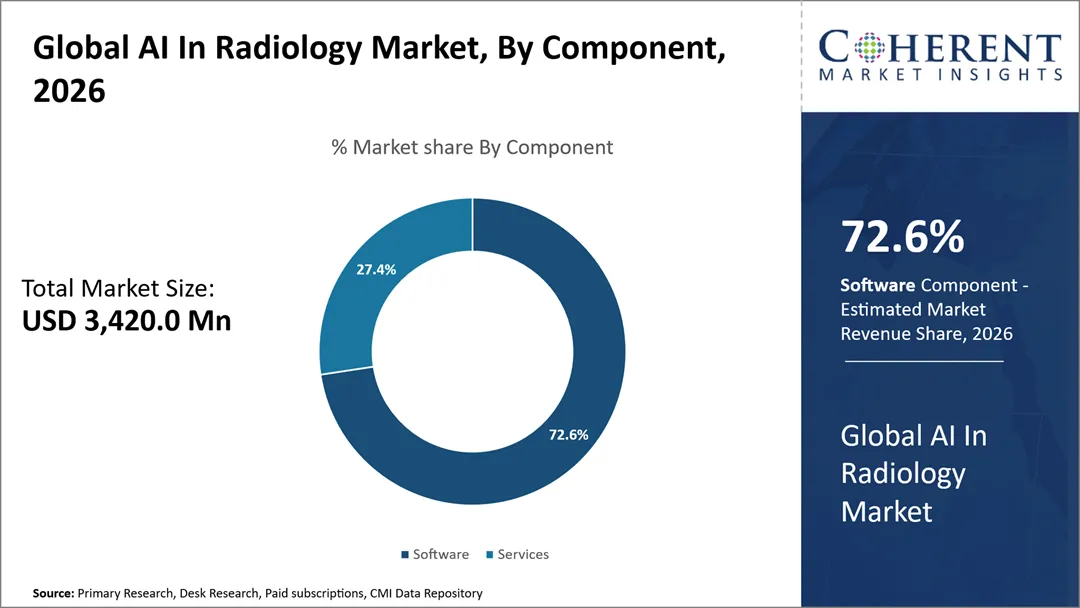
- Software is projected to hold 72.6% of the global AI In radiology market share in 2026, making it dominant component segment across North America due to the established commercialization pathway for AI-based radiology software. For instance, the U.S. FDA classifies automated radiological image-processing software incorporating AI under product code QIH as a Class II device subject to 510(k) review, directly covering AI software used to process and analyze medical images.
- Computed Tomography (CT) is projected to hold 31.8% of the global AI In Radiology market share in 2026, making it dominant imaging modality segment across Asia Pacific as regulatory frameworks increasingly accommodate AI-based imaging software. For instance, Japan’s PMDA regulates diagnostic and treatment software under the PMD Act and maintains a dedicated SaMD review framework, including AI-based medical imaging applications, supporting the regulatory pathway for CT-focused AI solutions.
- Image analysis and diagnosis is projected to hold 39.6% of the global AI In Radiology market share in 2026, making it dominant application segment across Europe as the region strengthens specific requirements for AI-enabled medical-device software. For instance, the European Commission’s MDCG 2019-11 Rev.1, updated in June 2025, provides qualification and classification guidance for medical-device software, while MDCG 2025-6 specifically addresses the interaction between the EU Medical Device Regulations and the AI Act for medical-device AI.
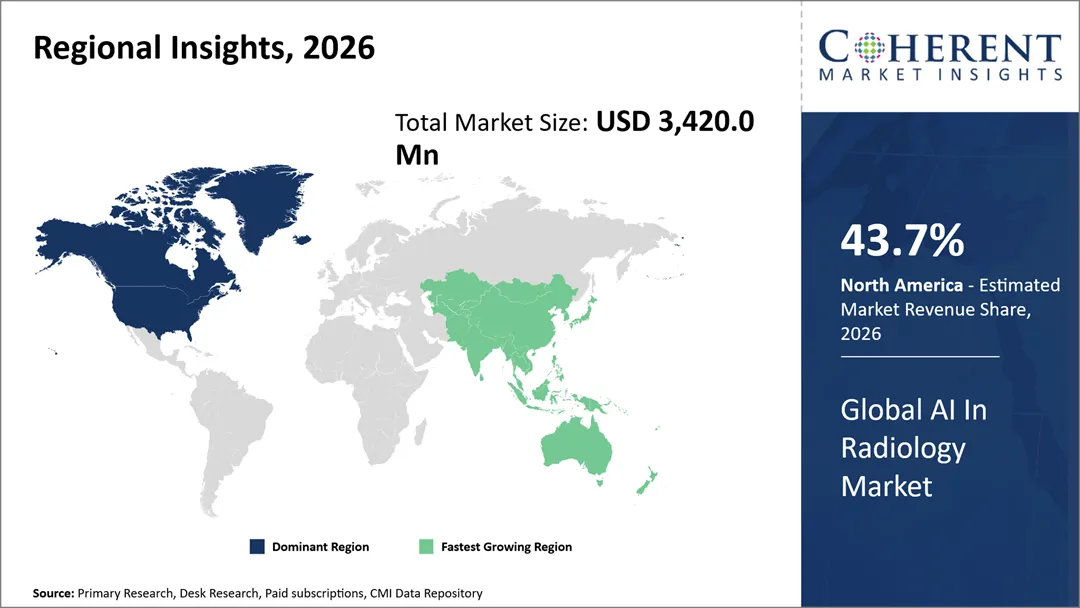
- North America market maintains dominance with an expected share of 43.7% in 2026, bolstered by continued U.S. FDA clearance of AI-based radiology software through established 510(k) pathways. For instance, in February 2026, the U.S. FDA approved Exo Imaging’s AI Platform 2.2 as automated radiological image-processing software under Product Code QIH, reinforcing the region’s active regulatory pathway for AI-enabled radiology solutions.
- Asia Pacific is expected to exhibit the fastest growth in the global AI In Radiology market, registering an estimated CAGR of 38.9% during 2026–2033, driven by strengthening regulatory frameworks for medical-device software and AI-enabled diagnostics. For instance, in February 2026, Singapore’s Health Sciences Authority (HSA) introduced an Artificial Intelligence–Software as a Medical Device (AI-SaMD) regulatory sandbox, allowing public healthcare institutions to deploy low-to-moderately low-risk AI medical devices across multiple institutions under defined safeguards.
Segmental Insights
Why Do Software Dominate the Global AI In Radiology Market?
Software is projected to hold the market share of 72.6% in 2026, due to its capabilities in automating image analysis, performing quantitative measurements, seamless integration into existing workflows and ability to continuously enhance algorithms without additional significant hardware investments. Scalability of software allows healthcare providers to implement it across several imaging modalities and facilities as well as accommodate remote and cloud-based workflows. For instance, in June 2026, the UK government announced a USD 27 million (£20 million) fund which aims to take the use of AI-driven X-ray interpretation tools to all NHS trusts across England by 2029, providing evidence of the wide scalability of software-based radiology AI.
- Current Industry Events of 2026
- Market Size Estimation
- Regional Breakdown
- Competitive Landscape
- Customer Intelligence
- Segmental Analysis
- Pricing Analysis
- Key Market Drivers, Challenges & Future Trends
- Customized Insights Section
Why Does Computed Tomography (CT) Represent the Largest Imaging Modality Segment in the AI In Radiology Market?
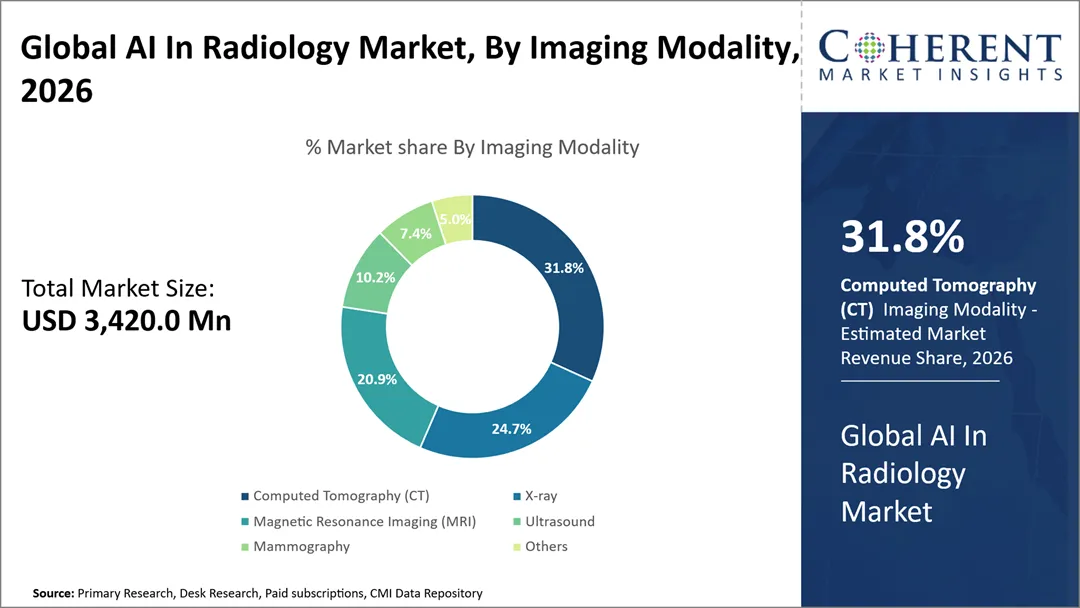
Computed tomography (CT) is projected to hold a market share of 31.8% in 2026, due to large volume of images obtained per case, the large complexity of such data, and diverse applications in oncology, emergency imaging, cardiology and chest imaging (all in high demand for AI for detection and quantification). Additionally, AI assists in triage, segmentation, reconstruction and finding of even minor pathologies in CT studies. For instance, in May 2026, a study published by Radiology: Artificial Intelligence, examined an AI for pulmonary embolism in over 30,000 CT pulmonary angiograms, highlighting its application on a larger clinical scale.
Image Analysis and Diagnosis Segment Dominates the Global AI In Radiology Market
The image analysis and diagnosis segment is projected to hold a market share of 39.6% in 2026, due to AI's role in facilitating automated detection, classification, segmentation, and quantification of abnormalities to increase reliability, and reduce interpretation time. For instance, in September 2025, the Radiological Society of North America reported that the deep-learning model for lung nodule malignancy risk estimation has exhibited high performance in cancer detection while also exhibiting improved false-positive classification using low-dose CT screening images.
Current Events and their Impact
Current Events | Description and its Impact |
CDSCO Issues Guidance on Medical Device Software (July 2026) |
|
EU Updates Medical Device Classification Guidance for AI Software (April 2026) |
|
U.S. FDA Finalizes Clinical Decision Support Software Guidance (January 2026) |
|
AI In Radiology Market Dynamics
Market Drivers
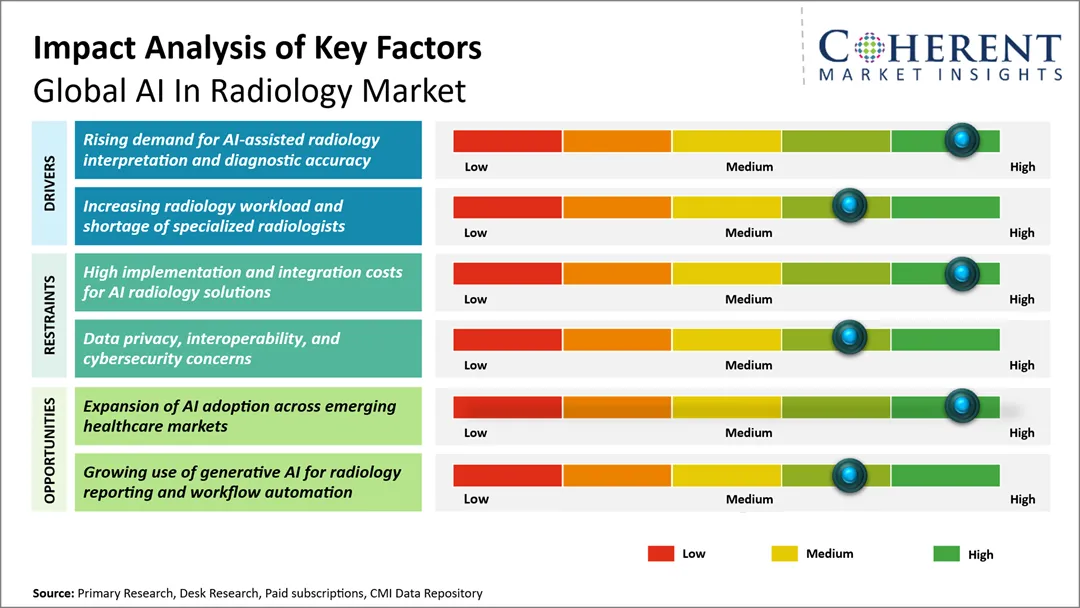
- Rising demand for AI-assisted radiology interpretation and diagnostic accuracy: Increasing imaging volumes and the need to identify abnormalities earlier are encouraging radiology departments to incorporate algorithm-based image analysis into routine workflows. For instance, in March 2026, a multicenter randomized controlled trial published in Nature Medicine found that AI-based prioritization of chest X-rays could accelerate the diagnostic pathway for suspected lung cancer, demonstrating the clinical value of AI-supported imaging workflows.
- Increasing radiology workload and shortage of specialized radiologists: Growing imaging volumes and persistent shortages of qualified radiologists are creating capacity constraints, encouraging healthcare providers to adopt AI tools that can prioritize cases and support reporting workflows. In June 2026, the Royal College of Radiologists reported that demand for complex imaging in the UK was growing by 9% compared with only 4.3% growth in the clinical radiology workforce, highlighting the widening capacity gap.
- Growing adoption of AI for radiology workflow automation: Healthcare providers are increasingly using AI to automate repetitive radiology tasks such as case prioritization, image analysis, and reporting support, allowing radiologists to focus on complex examinations. For instance, in February 2026, the American College of Radiology reported that radiology practices were implementing AI to reduce task load and improve efficiency amid rising imaging demand and workforce constraints.
Emerging Trends
- Generative AI for Radiology Reporting: Generative AI is increasingly being integrated into radiology workflows to automate report drafting, summarize findings, and support structured reporting. This trend is shifting AI applications beyond image interpretation toward end-to-end reporting automation.
- Expansion of Multimodal AI: AI platforms are increasingly combining radiological images with clinical notes, laboratory results, and patient histories to provide more comprehensive diagnostic insights. Multimodal models are expected to strengthen clinical decision support and personalized interpretation.
- Growth of Autonomous AI in Radiology: Autonomous AI solutions are gaining traction for high-confidence abnormality detection, case triage, and preliminary interpretation with limited radiologist intervention. Their use is expanding particularly in high-volume imaging workflows where faster turnaround is required.
Regional Insights
Why is North America a Strong Market for AI In Radiology?
North America leads the global AI In radiology market, accounting for an estimated 43.7% share in 2026, due to robust healthcare system, sophisticated digital health infrastructure & earliest adoption of AI into clinical radiology workflow. Besides, supportive government initiatives, significant funding to R&D of AI and a well-defined framework by U.S. FDA in the region support the overall market maturity.
For instance, in April 2025, National Institutes of Health (NIH) Council of Councils approved the PRIMED-AI Common Fund program and its core goal: combines clinical imaging and multimodal health information for an innovative AI-driven clinical decision support tool strengthening federal funding in medical imaging research with AI. Furthermore, research capacity, coupled with well-established IT structure of the healthcare system help in authentication, application and subsequent large-scale implementation of the AI in radiology products.
Why Does Asia Pacific AI In Radiology Market Exhibit High Growth?
Asia Pacific is expected to exhibit the fastest growth in the global AI In radiology market, registering an estimated CAGR of 38.9% during 2026–2033. The region is projected to account for approximately 22.1% of the global market in 2026, owing to growing healthcare infrastructure, rising healthcare expenditure and increased need for efficient diagnosis solutions. Several countries such as China, Japan, South Korea, and India are actively channeling high funds in digital health programs and government incentives are promoting the deployment of AI systems through policies and innovation hubs.
In 2025, the Ministry of Economy, Trade and Industry (METI) of Japan announced support for AI and healthcare innovation by introducing the GENIAC, a governmental funded support system for developed generative AI with diverse applications for healthcare. In addition, rising patient population, increasing volume of radiology imaging, and increasing shortage of radiologist are positively augmenting the growth.
Global AI In Radiology Market Outlook for Key Countries
Why is the U.S. Leading Innovation and Adoption in the AI In Radiology Market?
The U.S. is at the fore front of the AI in Radiology market as it possesses the highest concentration of AI-powered imaging applications, sophisticated clinical validation ecosystem and developed pathways for AI software to be integrated in radiology workflows. Their expertise shines through in the swift emergence of solutions for automated detection, triage, quantitative imaging, diagnostic decision support across CT, X-ray and MRI.
Is Japan a Favorable Market for AI In Radiology Market?
AI market for Radiology is very promising in Japan due to its outstanding high penetration for diagnostic imaging equipment and regulated approach toward SaMD utilizing AI. There are 24 AI-utilization-designated imaging devices and 51 AI-designated program medical devices approved by PMDA up to Sept. 2025, indicating strong clinical adoption potential.
Is China Emerging as a Key Growth Hub for the AI In Radiology Market?
The AI in Radiology market is witnessing fast expansion in China based on the increasing health digitalization, the growing use of AI medical imaging and increased internal development of high-end medical imaging technologies. Additionally, regulatory initiatives in China are promoting commercial use environments: the National Medical Products Administration of China released measures concerning AI medical device and high-end medical equipment imaging in October 2025, these include technical standards, classification, review, and post-market surveillance.
Why Does Germany Top the European AI In Radiology Market?
Germany leads the European AI In Radiology market because it has very well-organized medical imaging ecosystem, the high digital radiology workflow acceptance, as well as lot of clinical research competencies. With the integrated development of AI in diagnostic imaging (automated detection, image analysis, etc.) as well as the mature health-care IT infrastructure within hospitals and diagnostic imaging networks, the AI market in Europe is enabled to grow rapidly.
Is AI In Radiology Market Developing in South Korea?
South Korea is an emerging market for AI in Radiology, fueled by increasing adoption of AI in diagnostic imaging, and a significant domestic market for medical-AI systems. The regulations concerning AI based medical devices in the country have promoted development and adoption of radiology applications in the country. And expanding role of AI in imaging analysis and computer aided diagnosis has opened up other channels of growth in the market.
How is the expansion of AI adoption across emerging healthcare markets creating new growth opportunities in the AI In radiology market?
The growing digital infrastructure and radiologist shortages, as well as increased demand for cost-effective diagnostics in the emerging Asian, Latin American, and African markets are expected to create huge market opportunities. Cloud-based AI and scalable imaging platforms are capable of enhancing access to advanced imaging analysis in resource limited settings. For instance, in October 2025, Ethiopia adopted a nation-wide AI driven digital x-ray screening programme for tuberculosis, rolling out 225 AI enabling x-ray machines to health facilities across the country. (Source: World Health Organization) The initiative highlights how AI imaging solutions can be upscaled in low resource settings for increased early detection and better access to diagnosis.
Market Players, Key Development, and Competitive Landscape
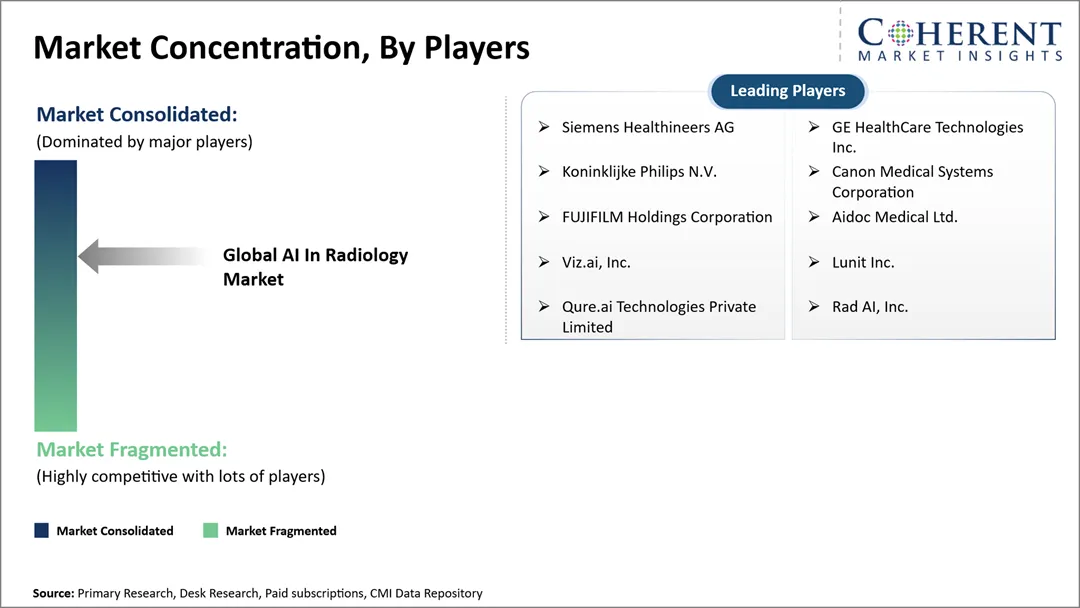
Key Developments
- In August 2026, Radiology Partners entered into a definitive agreement to acquire Everlight Radiology, an international teleradiology provider operating across the UK, Ireland, Australia, New Zealand, and South Africa. The transaction combines Everlight’s international radiologist network with Radiology Partners’ U.S. teleradiology operations and AI-enabled technology capabilities.
- In March 2026, RadNet acquired Gleamer SAS, integrating the Paris-based radiology AI company into its wholly owned subsidiary, DeepHealth. Gleamer serves more than 700 customer contracts across 44 countries with AI solutions spanning musculoskeletal, breast, lung, and neurological applications.
- In March 2026, Sectra AB entered an agreement to acquire oxipit.ai to expand its autonomous AI capabilities in radiology. Oxipit’s portfolio includes CE-marked AI solutions for chest X-ray, CT, and musculoskeletal imaging, including autonomous analysis of chest X-rays. Impact: The acquisition strengthens the integration of autonomous AI into radiology workflows and supports the development of scalable AI-based diagnostic solutions.
- In February 2025, DeepHealth introduced new AI-powered radiology informatics and population screening solutions at ECR 2025, including Diagnostic Suite and SmartMammo, alongside AI solutions for lung, prostate, breast, and brain health. The launch strengthens the integration of AI into radiology interpretation, workflow management, and population screening.
Competitive Landscape
The global AI In radiology market is moderately competitive, with market dynamics shaped by rapid advances in AI-based image analysis, radiology workflow automation, multimodal AI, and integration with PACS/RIS and enterprise imaging platforms. Market participants are increasingly focusing on expanding clinical use cases, strengthening regulatory clearances, and demonstrating measurable improvements in diagnostic accuracy and radiologist productivity. Key focus areas include:
- Development of AI algorithms for automated image detection, classification, segmentation, and quantitative analysis
- Expansion of AI-enabled workflow automation for case prioritization, triage, reporting, and radiologist worklist management
- Integration of AI solutions with PACS, RIS, EMR, and cloud-based enterprise imaging platforms
- Advancement of generative and multimodal AI for automated reporting and combined analysis of imaging with clinical information
- Expansion of AI applications across CT, X-ray, MRI, mammography, and ultrasound to address diverse diagnostic requirements
Market Report Scope
Global AI In Radiology Market Report Coverage | |||
Report Coverage | Details | ||
Base Year | 2025 | Market Size in 2026: | USD 3,420.0 Mn |
Historical Data For: | 2020 To 2024 | Forecast Period: | 2026 To 2033 |
Forecast Period 2026 To 2033 CAGR: | 28.7% | 2033 Value Projection: | USD 20,080.0 Mn |
Geographies covered: |
| ||
Segments covered: |
| ||
Companies covered: | Siemens Healthineers AG, GE HealthCare Technologies Inc., Koninklijke Philips N.V., Canon Medical Systems Corporation, FUJIFILM Holdings Corporation, Aidoc Medical Ltd., Viz.ai, Inc., Lunit Inc., Qure.ai Technologies Private Limited, Rad AI, Inc. | ||
Growth Drivers: |
| ||
Restraints & Challenges: |
| ||
Analyst Opinion (Expert Opinion)
- In the coming years, global AI In radiology market is expected to shift from standalone image-detection tools toward integrated, multimodal AI platforms embedded across the radiology workflow. AI will increasingly support image interpretation, case prioritization, reporting, protocol optimization, and clinical decision support, while generative AI is expected to become an important layer for automating documentation and radiologist communication.
- The maximum opportunities are foreseen within AI-powered CT image analysis and diagnostic support in China, where high imaging volumes, expanding healthcare digitization, and increasing demand for advanced diagnostic capabilities create a favorable environment for scalable AI deployment. Players should prioritize solutions that deliver quantitative analysis, automated detection, and workflow integration rather than single-purpose algorithms.
- In order to gain a competitive advantage market players should differentiate through clinically validated, interoperable AI platforms that integrate seamlessly with existing PACS, RIS, and hospital IT environments. Building multi-modality capabilities, demonstrating measurable workflow and diagnostic improvements, enabling continuous algorithm updates, and developing region-specific solutions will help companies secure long-term adoption and strengthen competitive positioning.
Speak to the analyst
Want personalized insights?
Take the findings above to one of our principal consultants, or have the report rebuilt around the segments, geographies and competitors you actually track.
Market Segmentation
- Component Insights (Revenue, USD Mn, 2021 - 2033)
- Software
- Services
- Imaging Modality Insights (Revenue, USD Mn, 2021 - 2033)
- Computed Tomography (CT)
- X-ray
- Magnetic Resonance Imaging (MRI)
- Ultrasound
- Mammography
- Others
- Application Technique Insights (Revenue, USD Mn, 2021 - 2033)
- Image Analysis and Diagnosis
- Image Reconstruction and Enhancement
- Workflow Management
- Screening and Detection
- Treatment Planning and Monitoring
- Others
- End User Insights (Revenue, USD Mn, 2021 - 2033)
- Hospitals and Clinics
- Diagnostic Imaging Centers
- Specialty Clinics
- Others
- Regional Insights (Revenue, USD Mn, 2021 - 2033)
- North America
- U.S.
- Canada
- Latin America
- Brazil
- Argentina
- Mexico
- Rest of Latin America
- Europe
- Germany
- U.K.
- Spain
- France
- Italy
- Russia
- Rest of Europe
- Asia Pacific
- China
- India
- Japan
- Australia
- South Korea
- ASEAN
- Rest of Asia Pacific
- Middle East
- GCC Countries
- Israel
- Rest of Middle East
- Africa
- South Africa
- North Africa
- Central Africa
- North America
- Key Players Insights
- Siemens Healthineers AG
- GE HealthCare Technologies Inc.
- Koninklijke Philips N.V.
- Canon Medical Systems Corporation
- FUJIFILM Holdings Corporation
- Aidoc Medical Ltd.
- Viz.ai, Inc.
- Lunit Inc.
- Qure.ai Technologies Private Limited
- Rad AI, Inc.
Sources
Primary Research Interviews
- Radiologists specializing in AI-assisted image interpretation and diagnostic workflows
- Radiology department directors and enterprise-imaging decision-makers
- Clinical AI, medical-imaging informatics, and PACS/RIS specialists
- Medical physicists and imaging-technology specialists involved in AI-enabled imaging systems
- AI/ML and clinical-product development specialists involved in radiology software and diagnostic applications
Stakeholders
- AI-based radiology software and medical-imaging technology developers
- Medical imaging equipment and enterprise-imaging technology providers
- PACS, RIS, and healthcare IT solution providers
- Hospitals, diagnostic imaging centers, and specialty clinics
- Healthcare AI implementation, integration, and clinical-validation service providers
- End-use Sectors
- Hospitals & Clinics
- Diagnostic Imaging Centers
- Specialty Clinics
- Other Healthcare Facilities
- Regulatory & Health Bodies
- U.S. Food and Drug Administration (FDA) – Center for Devices and Radiological Health (CDRH)
- European Commission – Medical Device Coordination Group (MDCG)
- Medicines and Healthcare products Regulatory Agency (MHRA), UK
- Pharmaceuticals and Medical Devices Agency (PMDA), Japan
- National Medical Products Administration (NMPA), China
- Central Drugs Standard Control Organisation (CDSCO), India
Databases
- FDA AI-Enabled Medical Devices List
- FDA 510(k) Premarket Notification Database
- ClinicalTrials.gov
- European Union Clinical Trials Information System (CTIS)
- World Health Organization International Clinical Trials Registry Platform (WHO ICTRP)
Journals
- Radiology: Artificial Intelligence
- European Radiology
- Journal of Digital Imaging
- The Lancet Digital Health
Associations
- Radiological Society of North America (RSNA)
- European Society of Radiology (ESR)
- American College of Radiology (ACR)
- Society for Imaging Informatics in Medicine (SIIM)
- European Federation of Radiographer Societies (EFRS)
Public Domain Sources
- U.S. Food and Drug Administration (FDA) – AI-enabled medical-device authorizations and regulatory guidance
- National Center for Biotechnology Information (NCBI) – radiology AI literature and clinical research
- National Institutes of Health (NIH) – medical-imaging and AI research information
- ClinicalTrials.gov – AI-assisted radiology clinical-trial records
- European Commission – medical-device software, MDR, and AI regulatory guidance
- Pharmaceuticals and Medical Devices Agency (PMDA) – AI-based Software as a Medical Device and medical-imaging regulatory information
Proprietary Elements
- CMI Data Analytics Tool, Proprietary CMI Existing Repository of information for last 10 years.
Get access to 250+ pages report
Every segment, forecast, competitor profile and data table behind the analysis above — available for instant download.
- ESOMAR Member
- ISO 9001:2015 Certified
- D-U-N-S Registered
- GDPR & CCPA Compliant
Missing comfort of reading report in your local language? Find your preferred language:
Frequently Asked Questions
The global AI In radiology market is estimated to be valued at USD 3,420.0 Mn in 2026 and is expected to reach USD 20,080.0 Mn by 2033.
Software dominates due to its direct role in automated image analysis, diagnosis support, workflow optimization, and integration with existing radiology systems.
AI in radiology refers to the use of artificial intelligence technologies to analyze medical images and support diagnosis, detection, reporting, and radiology workflows.
The CAGR of global AI In radiology market is projected to be 28.7% from 2026 to 2033.
Rising demand for AI-assisted radiology interpretation and diagnostic accuracy, and increasing radiology workload and shortage of specialized radiologists are the major factors driving the growth of the global AI In radiology market.
High implementation and integration costs for AI radiology solutions, and data privacy, interoperability, and cybersecurity concerns are the major factors hampering the growth of the global AI In radiology market.
In terms of end user, hospitals and clinics are estimated to dominate the market revenue share in 2026.