

Global AI Native RAN Market Size and Forecast – 2026 To 2033
The global AI native RAN market is expected to grow from USD 3.85 Bn in 2026 to USD 22.52 Bn by 2033, at a compound annual growth rate (CAGR) of 28.7% over 2026–2033. The radio access network is the part of a mobile network that connects phones and other devices to the operator’s core through base stations and antennas. For most of its history, it has run on fixed rules written by engineers: which settings to use when a signal weakens, how to point a beam, when to switch a cell off at night. AI native RAN replaces many of those rules with trained models that run inside the network and make decisions in real time. These models sit in baseband software, in RAN intelligent controllers and, increasingly, on GPU-accelerated servers that can also host other AI applications. Operators are now adding AI to the RAN as they upgrade their 5G infrastructure, because open, software-based designs let them run AI software from different suppliers on standard hardware.
The gains are easy to measure. In March 2026, Optus and Ericsson reported that AI-native link adaptation software lifted cell-level downlink throughput by more than 20% in medium to poor radio conditions on the Optus 5G network in Australia, without new hardware or extra spectrum. In February 2026, Rakuten Mobile reported its AI-driven Autonomous Energy Efficiency solution, built on the Rakuten Symphony platform, saves around 20% of RAN energy on its live Open RAN network in Japan. It was also the first operator to be validated at Level 4 autonomy for RAN energy efficiency by TM Forum.
Key Takeaways of the Global AI Native RAN Market
- The software segment is expected to account for 46.8% of the global AI native RAN market share in 2026. Operators can add AI functions such as link adaptation, beamforming and positioning to their installed base through software licences, which is the quickest way to get value from AI in the RAN. In June 2026, Ericsson launched AI in RAN, a software subscription that adds telco-grade AI models to its RAN products for 5G networks without requiring additional hardware.
- The on-premises segment is expected to hold 66.2% of the deployment mode segment in 2026. AI models that act on live radio settings have to meet strict timing limits, so they run at cell sites or in operator-owned edge and central offices. In March 2025, SoftBank Corp. Reported its AITRAS solution had implemented both centralized (C-RAN) and distributed (D-RAN) AI-RAN architectures, with CU and DU processing running on the same NVIDIA Grace Hopper server in the distributed design to reduce hardware at each site.
- The telecom operators segment is expected to account for 74.1% of the market share in 2026. Mobile operators own the spectrum, the sites and the radio equipment, so they are the main buyers of AI native RAN. In March 2026, NTT DOCOMO and SK Telecom published a joint white paper setting out the requirements for advancing vRAN and AI-RAN in mobile networks.
- North America is expected to dominate the AI native RAN market in 2026, with a share of 38.4%. U.S. operators were among the first to test GPU-accelerated RAN on live spectrum, and many of the leading compute and software suppliers are based in the region. In March 2026, Nokia, T-Mobile U.S. and NVIDIA completed an over-the-air test at T-Mobile’s AI-RAN Innovation Center in Seattle, where AI and RAN workloads ran together on a single NVIDIA Grace Hopper 200 server with a commercial 3.7 GHz Massive MIMO radio.
- Asia Pacific is expected to account for 28.6% share in 2026 and register as the fastest-growing region. Governments in South Korea and Japan are funding AI-RAN programmes with operators and vendors. In September 2026, Samsung Electronics signed contracts with KT and SK Telecom for their AI-RAN projects under the Korean Ministry of Science and ICT’s Hyper AI Network initiative, as KT’s sole global vendor and SK Telecom’s main vendor.
Segmental Insights
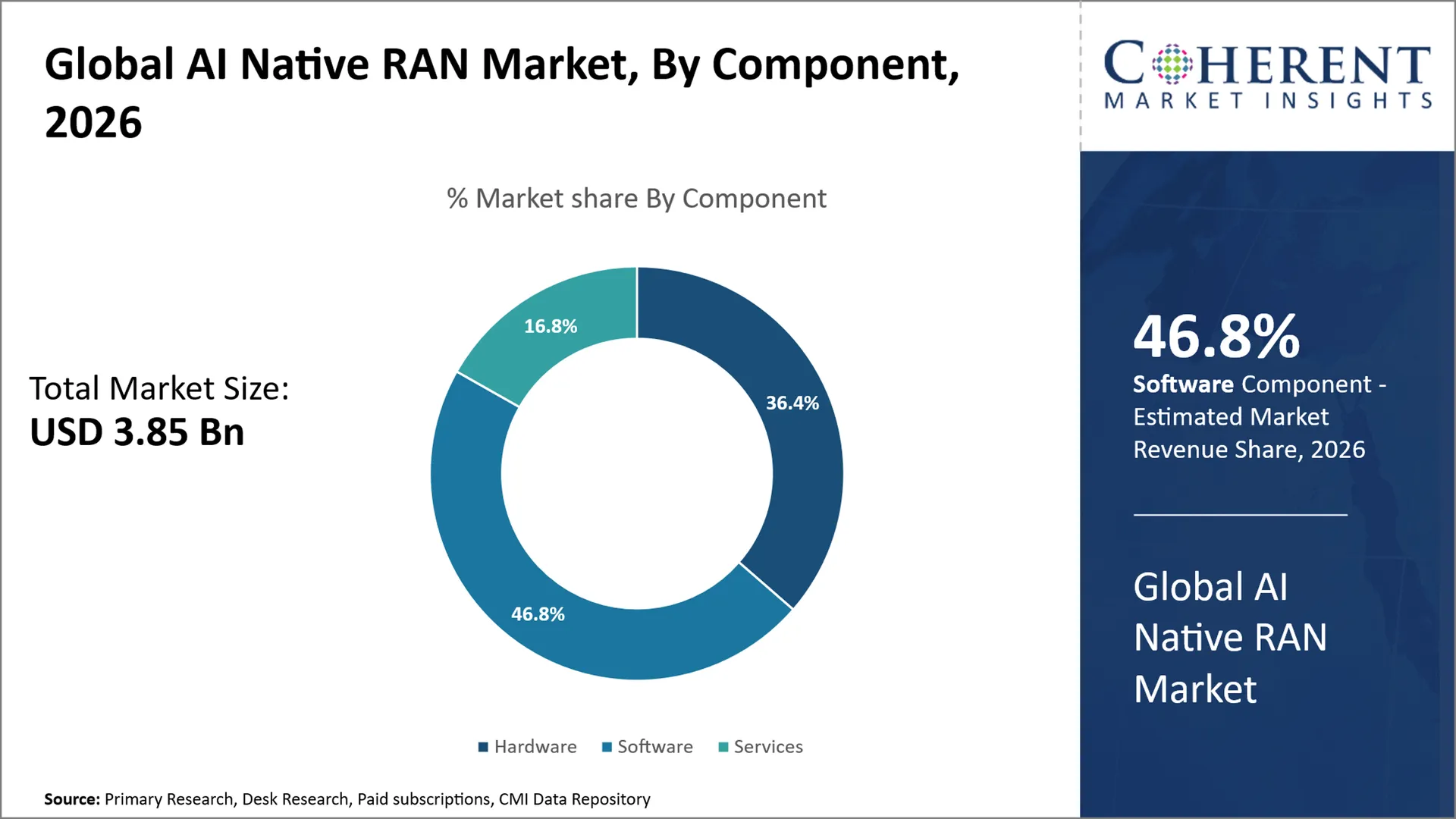
Why Does Software Dominate the Global AI Native RAN Market?
In terms of component, software is expected to account for 46.8% of the global AI native RAN market share in 2026. Most of the value of AI in the RAN sits in code: models for scheduling, link adaptation, beamforming, energy saving and fault detection, together with the controllers and orchestration tools that run them. Operators can switch these features on across thousands of existing sites through a licence or an upgrade, and vendors can keep improving the models after deployment. Payback is also quick, because the results show up in throughput and energy bills within weeks.
Software platforms are becoming more open as well. RAN intelligent controllers (RICs) let operators run applications from several suppliers on the same network and add new AI functions without waiting for a full vendor release.
In February 2026, Rakuten Mobile and Rakuten Symphony announced progress on their nationwide RIC deployment, including expanded third-party rApp integrations and new use cases.
- Current Industry Events of 2026
- Market Size Estimation
- Regional Breakdown
- Competitive Landscape
- Customer Intelligence
- Segmental Analysis
- Pricing Analysis
- Key Market Drivers, Challenges & Future Trends
- Customized Insights Section
Why Does On-Premises Deployment Lead the Market?
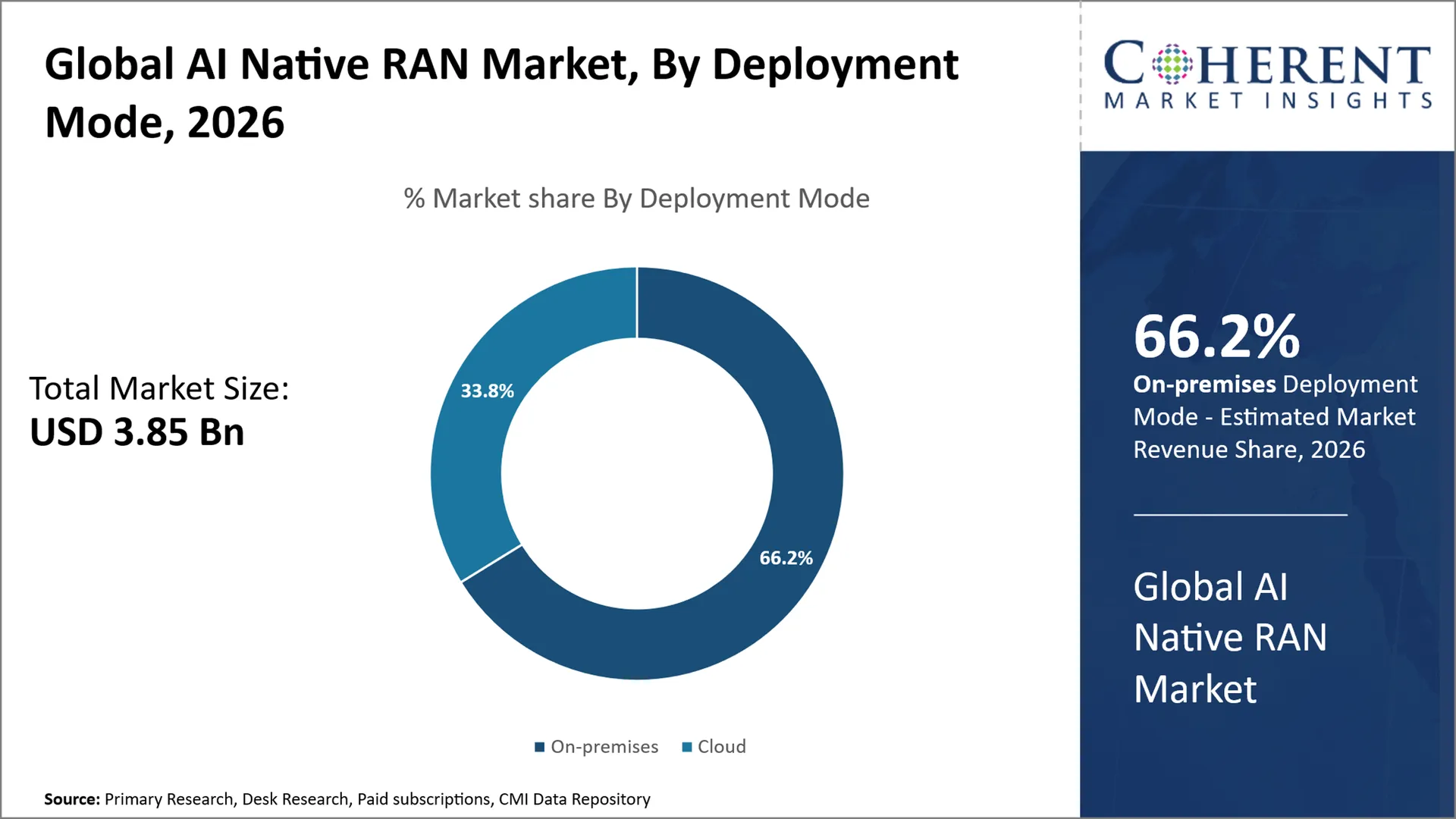
In terms of deployment mode, on-premises is expected to account for 66.2% of the global AI native RAN market share in 2026. A base station makes scheduling decisions within fractions of a millisecond, so AI models that adjust live radio settings must sit close to the radio. Operators also prefer to keep traffic and subscriber data inside their own facilities for security and regulatory reasons. As a result, most AI-RAN compute is installed at cell sites or in operator-owned edge and central offices, either as accelerator boards inside baseband units or as edge servers.
In November 2026, ZTE and Ethio Telecom completed Ethiopia’s first pre-commercial AI-powered RAN (AIR RAN) deployment. It uses ZTE’s AIREngine, an intelligent computing board built into the baseband unit, together with AI-driven beam scheduling to improve radio resource allocation.
Why Do Telecom Operators Lead the End User Segment?
In terms of end user, telecom operators are expected to account for 74.1% of the global AI native RAN market share in 2026. Operators run the public networks that carry almost all mobile traffic, and they face rising data demand with little new spectrum. AI native RAN gives them more capacity and lower energy use from assets they already own. Large operators also have the scale to build in-house AI teams and test centres, and they set the requirements that vendors build to.
In February 2026, NTT DOCOMO reported it had successfully demonstrated AI application operation using its virtualized RAN (vRAN) infrastructure.
Current Events and their Impact
Current Events | Description and its Impact |
Germany’s Deadline to Remove Huawei and ZTE Components from 5G Core Networks (End of 2026) |
|
3GPP Launches the 6G Study under Release 20 (June 2025) |
|
AI Native RAN Market Dynamics
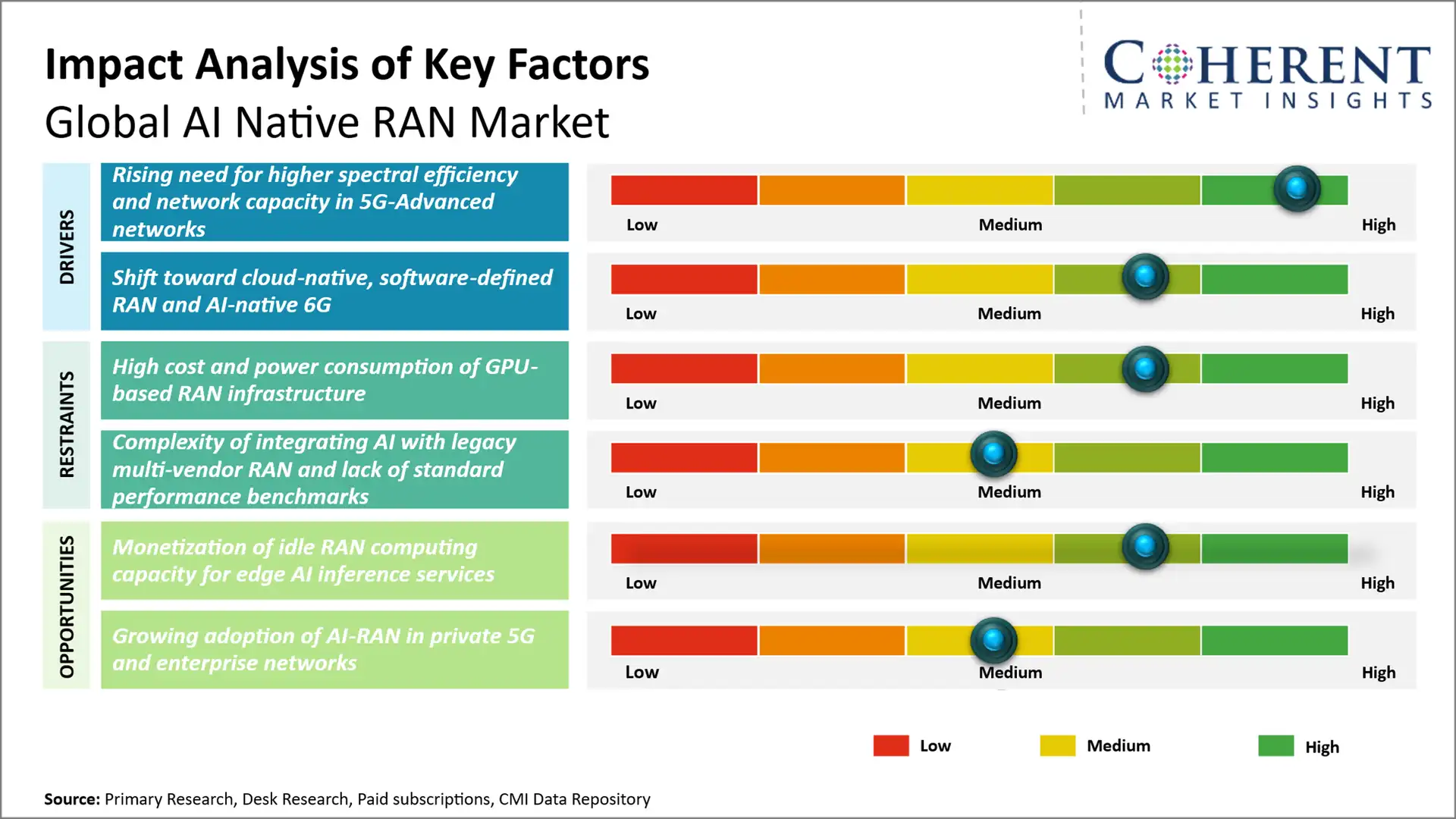
Market Drivers
- Rising need for higher spectral efficiency and network capacity in 5G-Advanced networks: Mobile data traffic keeps growing, and AI applications on phones, smart glasses and other devices add more uplink traffic and tighter latency needs. New spectrum is expensive and slow to arrive, so operators need to get more out of the bands they already hold. Traditional RAN software chooses transmission settings with fixed rules that cannot react quickly enough to changing radio conditions. AI models trained on live network data can pick better settings for each user in real time, which lifts throughput at the cell edge and in crowded areas. For many operators, this is now the cheapest way to add capacity without new sites or spectrum.
- In March 2026, Ericsson reported that it had demonstrated AI-native Link Adaptation with AT&T on a Cloud RAN stack powered by Intel Xeon 6 SoC, with tests showing up to 20% higher throughput than legacy rule-based link adaptation.
- Shift toward cloud-native, software-defined RAN and AI-native 6G: Operators are moving RAN functions from fixed-function hardware to software that runs on general-purpose and accelerated servers. Once the RAN is software, AI models can be added, updated and replaced like any other application, without changing equipment at the site. At the same time, 6G is being designed with AI built into the air interface rather than added later. Operators buying equipment want platforms that can move from 5G-Advanced to 6G through software upgrades, and that favours AI-native designs from the start.
- In February 2026, ahead of MWC Barcelona 2026, DeepSig reported it would demonstrate a pre-6G fully learned waveform running on a 3GPP Release 17 GPU-accelerated open-source RAN stack, in collaboration with NVIDIA, SRS and the AI-RAN Alliance.
Emerging Trends
- Agentic AI is moving into RAN operations: Vendors are adding AI agents that watch the network, diagnose faults, plan a response and carry it out with limited human input. In March 2026, Qualcomm Technologies launched its Agentic RAN Management Service within the Dragonwing RAN Automation Suite, built on collaborative RAN AI agents and designed for commercial radio unit and distributed unit platforms.
- Impact: Day-to-day RAN operation becomes faster and less labour-intensive, and many problems can be fixed before customers notice them.
- Relevance to the market: This expands spending on RAN automation software and favours suppliers with field-proven AI models and operations tools.
- AI and RAN workloads are sharing the same GPU infrastructure: Operators are testing servers that run radio processing and AI applications side by side, so one investment serves both connectivity and AI. In March 2026, Nokia and Indosat Ooredoo Hutchison made Southeast Asia’s first AI-RAN-powered Layer 3 5G call at MWC, using Nokia AirScale remote radio heads and RAN software accelerated by NVIDIA GPUs on Indosat’s cloud-native network.
- Impact: Operators can use one pool of compute for both network functions and AI services, which improves the business case for accelerated hardware at the edge.
- Relevance to the market: This supports demand for GPU-accelerated RAN servers, orchestration software and integration services.
Regional Insights
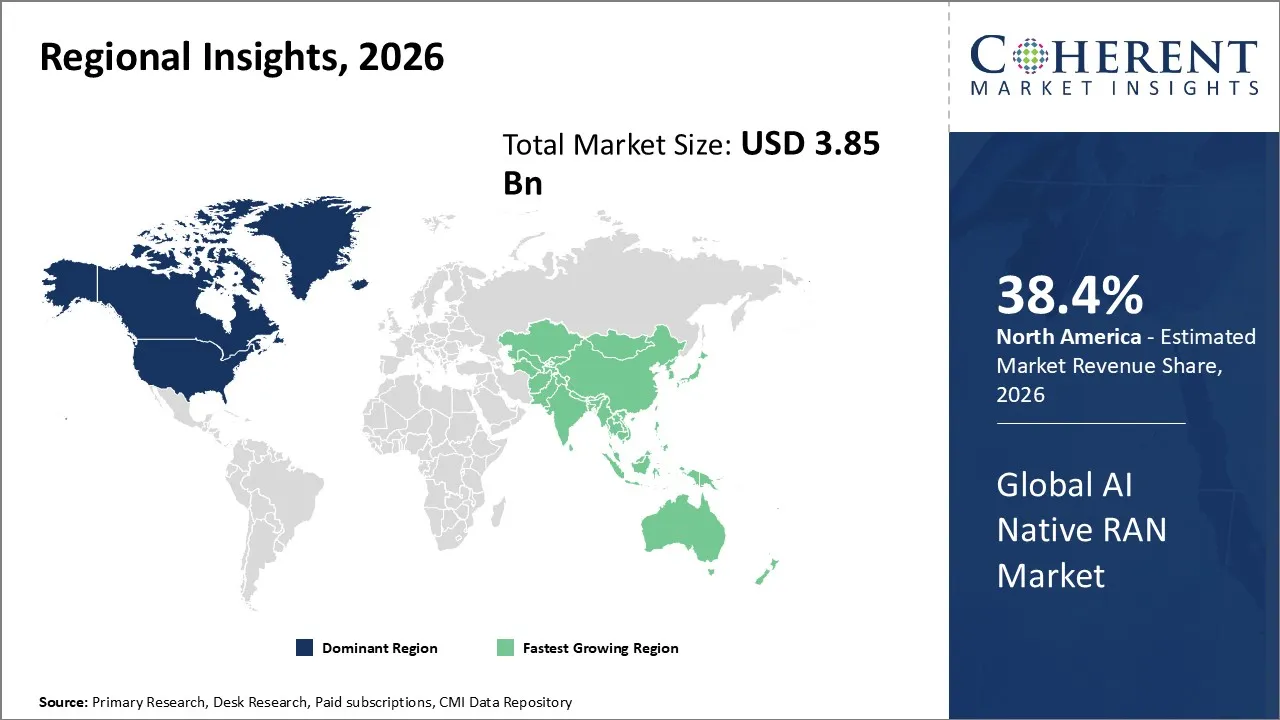
Why Does North America Lead the Global AI Native RAN Market?
North America is expected to account for a market share of 38.4% in 2026, or about USD 1.48 Bn. Major U.S. operators, including T-Mobile and AT&T, are running AI-RAN trials, and some have dedicated innovation centers where vendors test GPU-accelerated RAN on live spectrum. The region is also home to many of the companies that supply the compute and software layers of AI-RAN, including NVIDIA, Intel, Qualcomm, Dell Technologies, Mavenir and DeepSig. Operators here generally have the balance sheets to fund early trials, and U.S. policy treats leadership in 6G and AI networking as a strategic priority.
Why Is Asia Pacific the Fastest-Growing Region in the AI Native RAN Market?
Asia Pacific is expected to account for 28.6% of the global market in 2026, or about USD 1.10 Bn, and register the fastest growth over the forecast period, at an estimated 32.4% CAGR. China has the world’s largest 5G network, while Japan and South Korea have government-backed AI-RAN programmes and operators that test new RAN technology early. The region is also home to major suppliers, including Huawei, ZTE, Samsung, NEC, SoftBank and Rakuten Symphony. Operators in Southeast Asia and Australia are now running their own AI-RAN trials, which widens the customer base beyond the largest markets.
Global AI Native RAN Market Outlook for Key Countries
Is the U.S. the Largest Market for AI Native RAN?
The U.S. AI native RAN market is projected to reach USD 1.36 Bn in 2026, the largest of any country and about 92% of the North American total. U.S. operators are testing AI scheduling, link adaptation and GPU-accelerated RAN at scale, and the country has a strong base of chip, server and AI software suppliers. Open-source RAN software is also gaining support. At MWC Barcelona 2026, DeepSig announced its role as a founding member of the OCUDU Ecosystem Foundation, launched under the Linux Foundation to support interoperable, open-source centralized unit and distributed unit software.
Is China the Main Engine of Growth in Asia Pacific?
China’s AI native RAN market is projected to reach USD 0.41 Bn in 2026, the largest in Asia Pacific. The scale of the network is the main reason. According to China’s Ministry of Industry and Information Technology, the country had 5.009 million 5G base stations by the end of April 2026. With so many sites, even small AI-driven gains in energy use and spectral efficiency add up to large savings. Huawei and ZTE, the two largest domestic RAN vendors, are building AI functions into their 5G-Advanced portfolios for Chinese operators.
Why Is Germany a Key Market for AI Native RAN in Europe?
Germany’s AI native RAN market is projected to reach USD 0.19 Bn in 2026, the largest in Europe. German operators are modernising their networks, and AI-RAN is part of the planning for the next generation of sites. In 2026, NVIDIA reported that Deutsche Telekom is piloting AI-RAN trials with Nokia and NVIDIA at distributed sites and demonstrating AI inference between the device and the network edge.
Japan AI Native RAN Market Analysis and Trends
Japan’s AI native RAN market is projected to reach USD 0.29 Bn in 2026. Japanese operators are among the most active in AI-RAN, and SoftBank, NTT DOCOMO and Rakuten Mobile each run their own programmes. In August 2026, NTT DOCOMO and Samsung Electronics announced the successful validation of user-level AI-RAN optimization technology, which adjusts network settings for individual users rather than for a whole cell.
South Korea AI Native RAN Market Analysis and Trends
South Korea’s AI native RAN market is projected to reach USD 0.17 Bn in 2026. The government sees AI-RAN as a way to influence global 6G standards, and it has brought operators, vendors and research institutes together. In October 2025, NVIDIA agreed to work with Samsung, SK Telecom, KT, LG Uplus and the Electronics and Telecommunications Research Institute (ETRI) to co-develop AI-RAN technology, according to the Korean Ministry of Science and ICT.
Global AI Native RAN Market – Key AI-RAN Computing Platforms
Platform | Producer | Main Features and Uses |
Aerial RAN Computer Pro (ARC-Pro) | NVIDIA Corporation | 6G-ready accelerated computing platform that combines connectivity, computing and sensing; powered by Blackwell RTX PRO GPUs; offered as a reference design for AI-RAN products |
AITRAS | SoftBank Corp. | Converged AI-RAN platform made up of GPU servers, virtualization infrastructure, radio units and an orchestrator; runs SoftBank and third-party RAN software alongside edge AI applications |
PowerEdge servers | Dell Technologies Inc. | Edge servers used in GPU-accelerated AI-RAN deployments, with software and silicon upgrade paths from 5G-Advanced to 6G |
X100 5G RAN Accelerator Card | Qualcomm Technologies, Inc. | RAN accelerator card with commercial-grade Layer 1 software for virtualized and Open RAN deployments |
How Is Idle RAN Computing Capacity Creating New Revenue Opportunities in the AI Native RAN Market?
Mobile networks are built for peak traffic, so much of their capacity sits unused at night and outside busy areas. When the RAN runs on GPU-accelerated servers, that spare capacity can be rented out to run AI inference for other companies close to where the data is created. This turns part of the network from a cost into a source of revenue and makes the case for accelerated hardware much easier to justify. It also gives operators a role in edge AI services for robots, cameras, vehicles and enterprise applications, where low latency matters. Operators that can share compute safely between radio and AI workloads, without hurting network performance, stand to gain the most.
At MWC Barcelona 2026, Nokia and SoftBank Corp. demonstrated how spare AI-RAN compute capacity, identified by SoftBank’s AITRAS Orchestrator, can be used to run third-party AI tasks.
Market Players, Key Development, and Competitive Intelligence
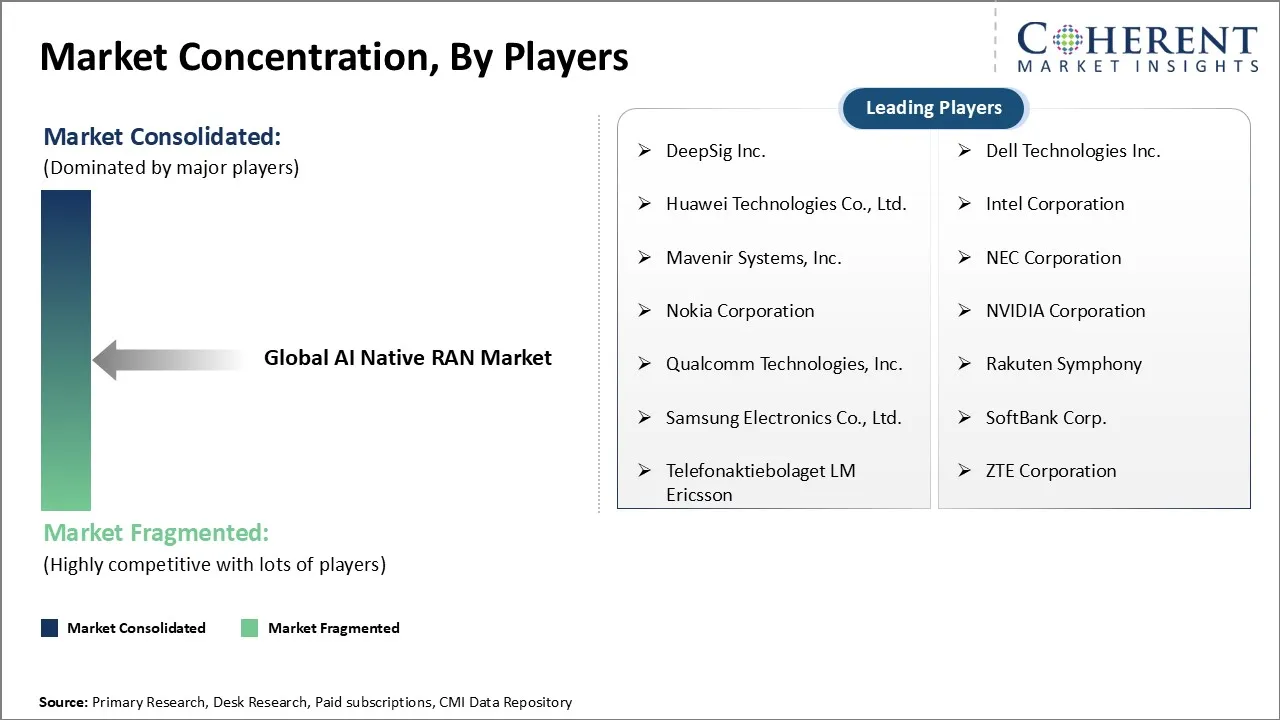
Key Developments
- On April 21, 2026, Rakuten Symphony was selected for a grant from Japan’s Ministry of Economy, Trade and Industry (METI) to run large-scale Open RAN and RIC demonstrations in seven Global South countries across Southeast Asia, Latin America and Africa.
- On October 21, 2026, Nokia announced progress in moving AI-RAN toward commercial deployment and physical AI, and launched a sovereign agentic AI platform for telco autonomy with NVIDIA.
- On February 21, 2025, NEC Corporation announced the development of a near-real-time RAN Intelligent Controller (RIC) for high-performance 5G virtualized RAN (vRAN).
Competitive Landscape
The market is shared between three groups that increasingly work together. Established RAN vendors such as Ericsson, Nokia, Huawei, Samsung, ZTE and NEC hold most operator contracts and are building AI into their radios, basebands and RAN software. Compute and silicon suppliers such as NVIDIA, Intel, Qualcomm and Dell Technologies provide the processors, accelerators and servers that AI-RAN runs on. Software and Open RAN specialists such as Mavenir, Rakuten Symphony and DeepSig supply cloud-native RAN software, intelligent controllers and AI-native physical layer technology. Some operators, led by SoftBank, also build their own AI-RAN platforms. Competition centres on proven performance gains on live networks, software that runs on both existing and accelerated hardware, and a credible path to 6G. Long operator qualification cycles and the need for carrier-grade reliability make it hard for new entrants to win large contracts.
Top Companies and Notable Products in the AI Native RAN Market
Company | Notable Product | Key Features |
Nokia Corporation | anyRAN | RAN software that runs on purpose-built baseband, cloud and GPU-accelerated platforms, evolving into an AI-native architecture |
DeepSig Inc. | OmniPHY-5G | AI-native baseband software that replaces standard 5G high-PHY algorithms with a neural receiver inside the Open RAN distributed unit |
ZTE Corporation | AIR RAN (AI-Reshaped RAN) | Intelligent RAN solution with a site-and-network dual-layer architecture covering spectral, energy and operations efficiency |
Market Report Scope
Global AI Native RAN Market Report Coverage | |||
Report Coverage | Details | ||
Base Year | 2025 | Market Size in 2026: | USD 3.85 Bn |
Historical Data For: | 2021 To 2024 | Forecast Period: | 2026 To 2033 |
Forecast Period 2026 To 2033 CAGR: | 28.70% | 2033 Value Projection: | USD 22.52 Bn |
Geographies covered: |
| ||
Segments covered: |
| ||
Companies covered: | DeepSig Inc., Dell Technologies Inc., Huawei Technologies Co., Ltd., Intel Corporation, Mavenir Systems, Inc., NEC Corporation, Nokia Corporation, NVIDIA Corporation, Qualcomm Technologies, Inc., Rakuten Symphony, Samsung Electronics Co., Ltd., SoftBank Corp., Telefonaktiebolaget LM Ericsson, ZTE Corporation | ||
Growth Drivers: |
| ||
Restraints & Challenges: |
| ||
Analyst Opinion (Expert Opinion)
- Software takes the largest share, but hardware spending is set to grow faster. Software is expected to make up 46.8% of spending in 2026, against 36.4% for hardware and 16.8% for services. That split fits a market where most operators are still adding AI to the sites they already have. It is unlikely to stay this way. As operators move from trials to commercial AI-RAN releases planned from 2027 onward, they will buy GPU-accelerated servers, accelerator cards and AI-ready radios, so hardware is expected to be the fastest-growing component, at an estimated 30.6% CAGR. Operators want proof of payback before they commit, and suppliers that can offer hardware, software and integration as one package tend to win the larger contracts.
- Growth is likely to be strongest in North America and Asia Pacific, with two main risks. North America holds 38.4% of the market in 2026 because U.S. operators and suppliers moved first, while Asia Pacific, at 28.6%, is catching up fastest on the back of national programmes and very large networks. The first risk is cost. GPU-based RAN needs more power and higher upfront spending than traditional baseband, and many operators will limit it to busy sites until unit costs fall. The second risk is integration. AI functions have to work across radios and software from several vendors, and there are still no common benchmarks to compare results. Suppliers that can deliver AI gains on existing hardware while offering an upgrade path to accelerated compute are the least exposed.
Speak to the analyst
Want personalized insights?
Take the findings above to one of our principal consultants, or have the report rebuilt around the segments, geographies and competitors you actually track.
Market Segmentation
- Component Insights (Revenue, USD Billion, 2021 - 2033)
- Hardware
- Software
- Services
- Deployment Mode Insights (Revenue, USD Billion, 2021 - 2033)
- On-premises
- Cloud
- Application Insights (Revenue, USD Billion, 2021 - 2033)
- Network Performance and Spectrum Optimization
- Energy Efficiency Management
- Predictive Maintenance and Fault Management
- Edge AI Services Hosting
- Others (positioning, security, interference detection)
- End User Insights (Revenue, USD Billion, 2021 - 2033)
- Telecom Operators
- Enterprises (private 5G networks)
- Government and Defense
- Regional Insights (Revenue, USD Billion, 2021 - 2033)
- North America
- U.S.
- Canada
- Latin America
- Brazil
- Argentina
- Mexico
- Rest of Latin America
- Europe
- Germany
- U.K.
- Spain
- France
- Italy
- Russia
- Rest of Europe
- Asia Pacific
- China
- India
- Japan
- Australia
- South Korea
- ASEAN
- Rest of Asia Pacific
- Middle East
- GCC Countries
- Israel
- Rest of Middle East
- Africa
- South Africa
- North Africa
- Central Africa
- North America
- Key Players Insights
- DeepSig Inc.
- Dell Technologies Inc.
- Huawei Technologies Co., Ltd.
- Intel Corporation
- Mavenir Systems, Inc.
- NEC Corporation
- Nokia Corporation
- NVIDIA Corporation
- Qualcomm Technologies, Inc.
- Rakuten Symphony
- Samsung Electronics Co., Ltd.
- SoftBank Corp.
- Telefonaktiebolaget LM Ericsson
- ZTE Corporation
Sources
Primary Research Interviews
- Mobile Network Operators (RAN Planning, Network Automation and AI Teams)
- RAN Equipment and Software Vendors
- Semiconductor, Accelerator and Server Suppliers
- Open RAN and RIC Application Developers
- Telecom System Integrators
Magazines
- Light Reading
- RCR Wireless News
- Fierce Network
- TelecomTV
- Mobile World Live
- EE Times
Journals
- IEEE Journal on Selected Areas in Communications
- IEEE Transactions on Wireless Communications
- IEEE Access
- IEEE Communications Magazine
Associations
- AI-RAN Alliance
- O-RAN ALLIANCE
- 3rd Generation Partnership Project (3GPP)
- GSMA
- Next G Alliance
- TM Forum
Public Domain Sources
- 3GPP: Release 20 and 6G study items (RAN#108 and SA#108, June 2025)
- O-RAN ALLIANCE specifications for near-real-time and non-real-time RIC
- German Federal Ministry of the Interior: agreement with mobile operators on critical 5G components, July 2024
- China Ministry of Industry and Information Technology (MIIT): telecom industry statistics, 2026
- Korean Ministry of Science and ICT: AI-RAN and Hyper AI Network programme announcements
- U.S. Securities and Exchange Commission (SEC): company annual filings
- Company press releases
Proprietary Elements
- CMI Data Analytics Tool
- Proprietary CMI Existing Repository of information for last 10 years
Get access to 250+ pages report
Every segment, forecast, competitor profile and data table behind the analysis above — available for instant download.
- ESOMAR Member
- ISO 9001:2015 Certified
- D-U-N-S Registered
- GDPR & CCPA Compliant
Frequently Asked Questions
The global AI native RAN market is estimated to be valued at USD 3.85 Bn in 2026 and is expected to reach USD 22.52 Bn by 2033.
The CAGR of the global AI native RAN market is projected to be 28.7% from 2026 to 2033.
The rising need for higher spectral efficiency and network capacity in 5G-Advanced networks, and the shift toward cloud-native, software-defined RAN and AI-native 6G, are the major factors driving market growth.
The high cost and power consumption of GPU-based RAN infrastructure, and the complexity of integrating AI with legacy multi-vendor RAN along with the lack of standard performance benchmarks, are the major factors hampering market growth.
In terms of component, software is estimated to dominate the market, with a revenue share of 46.8% in 2026.
AI native RAN is a radio access network in which artificial intelligence is built into the core functions of the network, such as scheduling, link adaptation, beamforming and energy management, rather than added later as a separate optimization tool. The AI models run inside the RAN software, on intelligent controllers, or on accelerated computing hardware at the cell site or edge.
AI for RAN uses AI to improve how the radio network itself performs. AI and RAN runs AI workloads and RAN workloads on the same shared computing platform. AI on RAN uses the network’s computing resources to deliver AI applications and services to consumers and enterprises at the edge.