

Global AI Operating Room Analytics Market Size and Forecast – 2026 To 2033
The global AI operating room analytics market is expected to grow from USD 1.84 Bn in 2026 to USD 6.18 Bn by 2033, registering a compound annual growth rate (CAGR) of 18.9% from 2026 to 2033. The market for global AI operating room analytics is poised for significant expansion, fueled by the rising surgical volumes and the need to improve patient safety.
As per the World Health Organization (WHO), 234 million major surgical procedures are performed globally each year, highlighting the high demand for efficient surgical services. The need to reduce preventable complications and improve patient safety supports the adoption of AI-powered operating room analytics for workflow monitoring and data-driven surgical decision making.
Key Takeaways of the Global AI Operating Room Analytics Market
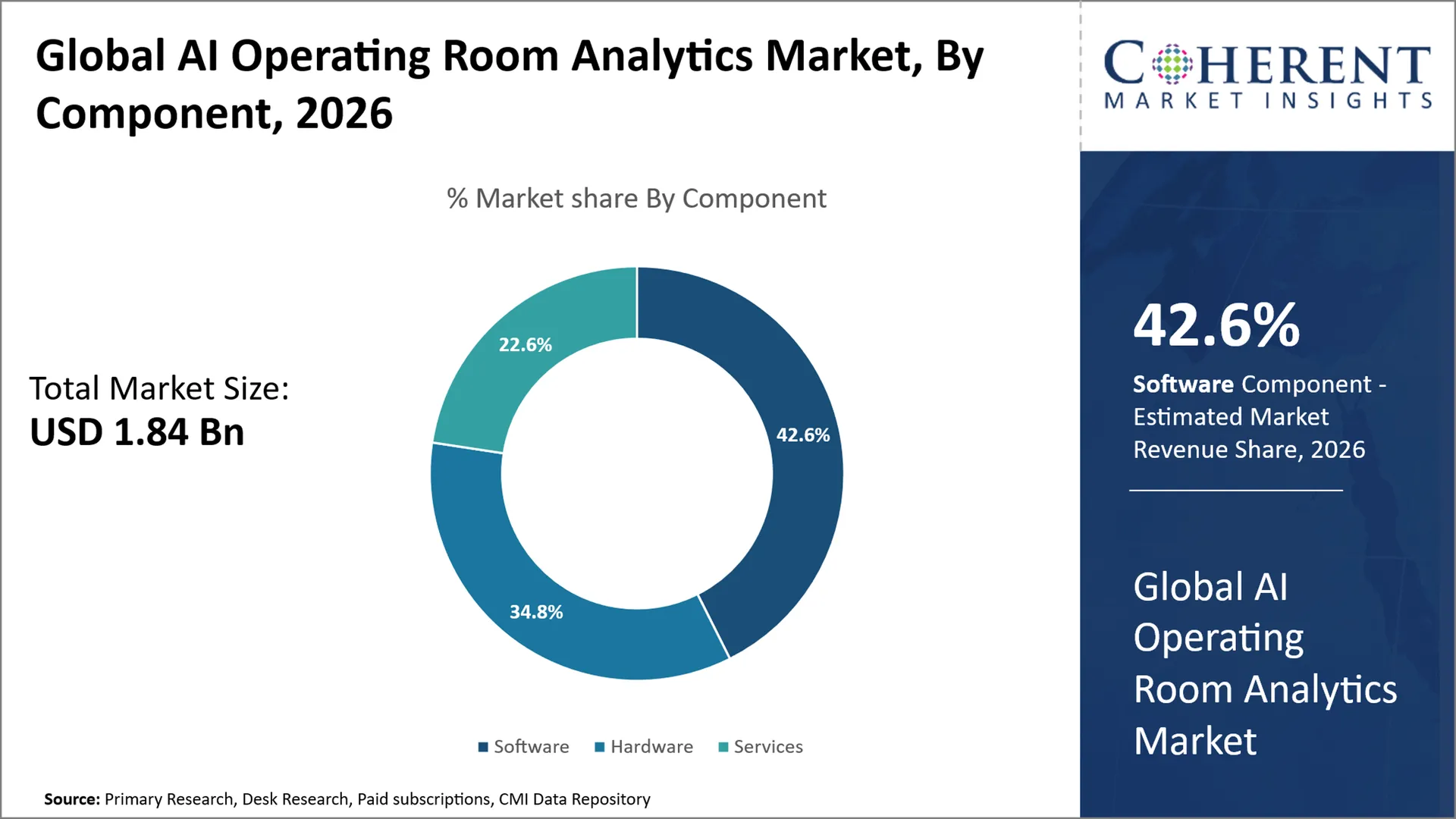
- Software is projected to hold 42.6% of the global AI operating room analytics market share in 2026, making it dominant component segment, with North America leading adoption due to established digital health infrastructure and regulatory oversight of AI-enabled healthcare software. For instance, the U.S. FDA evaluates applicable AI-enabled medical devices through premarket pathways and emphasizes safety and effectiveness throughout the product lifecycle, supporting the development and deployment of clinically reliable software.
- Cloud-Based is projected to hold 38.7% of the global AI operating room analytics market share in 2026, making it dominant deployment mode segment, across Europe supported by demand for scalable analytics and data access across hospital networks. For instance, in Europe, the European Commission’s European Health Data Space (EHDS) framework establishes mechanisms for secure access to and exchange of electronic health data, helping create the digital foundation for connected healthcare analytics platforms.
- Machine learning and deep learning is projected to hold 34.8% of the global AI operating room analytics market share in 2026, making it dominant technology segment, with Europe offering a structured regulatory environment for AI used in medical applications. For instance, the EU AI Act, alongside medical-device regulations, sets requirements for applicable high-risk AI systems, including risk management, data quality, transparency, and human oversight considerations relevant to the safe deployment of AI-based surgical decision-support and analytics tools.
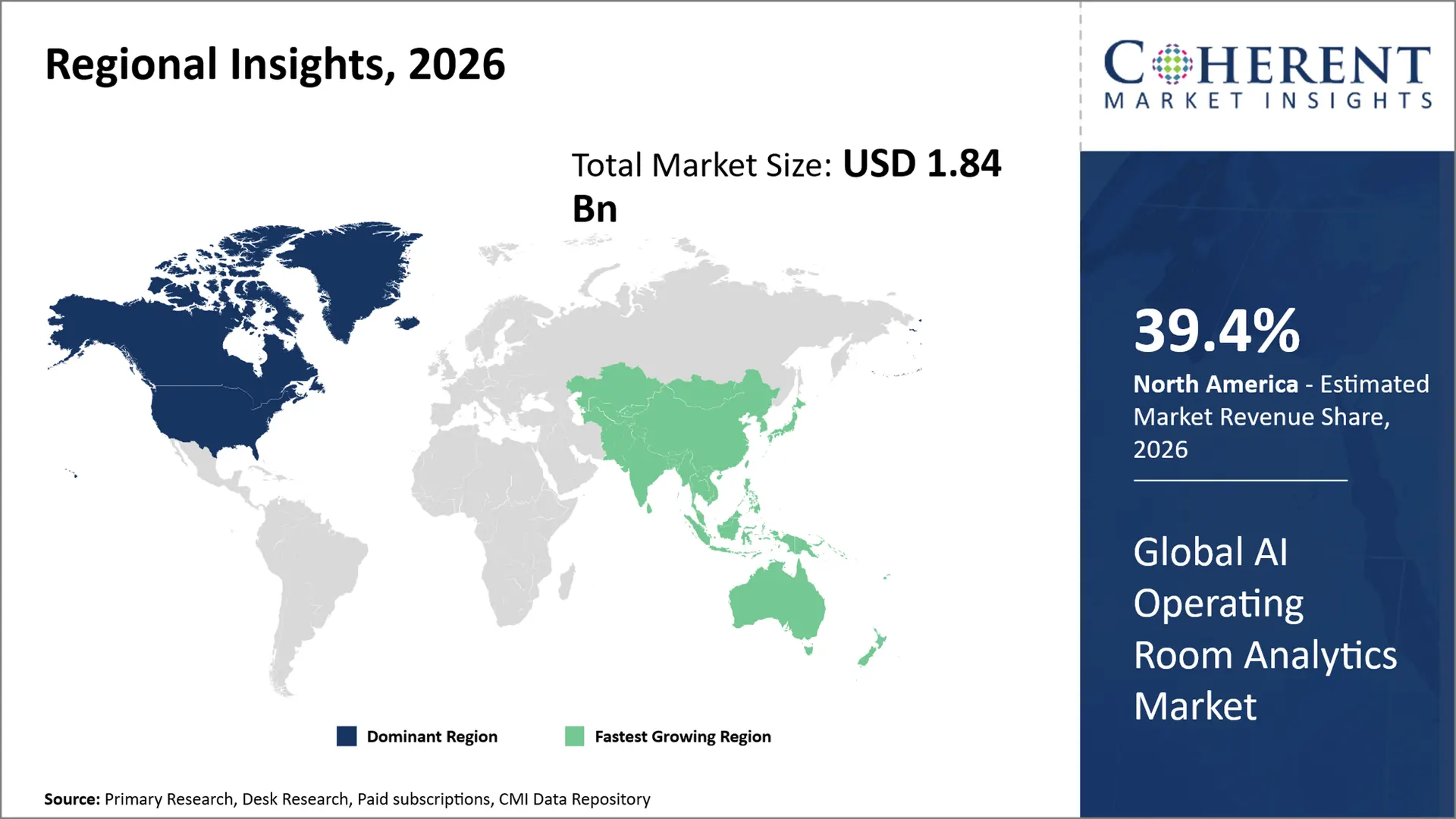
- North America market maintains dominance with an expected share of 39.4% in 2026, bolstered by advanced healthcare infrastructure, strong digital health investment, and increasing demand for surgical workflow optimization. For instance, Mayo Clinic’s operating room management initiatives use data-driven approaches to improve surgical scheduling, resource allocation, and operational efficiency, reflecting the region’s focus on analytics-led surgical care.
- Asia Pacific is expected to exhibit the fastest growth in the global AI operating room analytics market, registering an estimated CAGR of 20.8% during 2026–2033, driven by hospital modernization and growing adoption of digital surgical technologies. For instance, in August 2026, AIG Hospitals in India announced the introduction of the Polyphonic Surgery digital ecosystem in collaboration with Johnson & Johnson to support surgical video review, team collaboration, structured feedback, and clinical learning, illustrating the region’s growing adoption of connected surgical intelligence.
Segmental Insights
Why Do Software Dominate the Global AI Operating Room Analytics Market?
Software is projected to hold the market share of 42.6% in 2026, as it allows the interpretation of operational room data into knowledge that monitors workflow, supports predictive scheduling and clinical decision-making, and optimizes resources. The interface with hospital information system and electronic health record further makes it scalable deployment across healthcare facilities. For instance, LeanTaaS’s iQueue for Operating Rooms uses predictive analytics to optimize surgical scheduling, operating room utilization, and block allocation.
- Current Industry Events of 2026
- Market Size Estimation
- Regional Breakdown
- Competitive Landscape
- Customer Intelligence
- Segmental Analysis
- Pricing Analysis
- Key Market Drivers, Challenges & Future Trends
- Customized Insights Section
Why Does Cloud-Based Represent the Largest Deployment Mode Segment in the AI Operating Room Analytics Market?
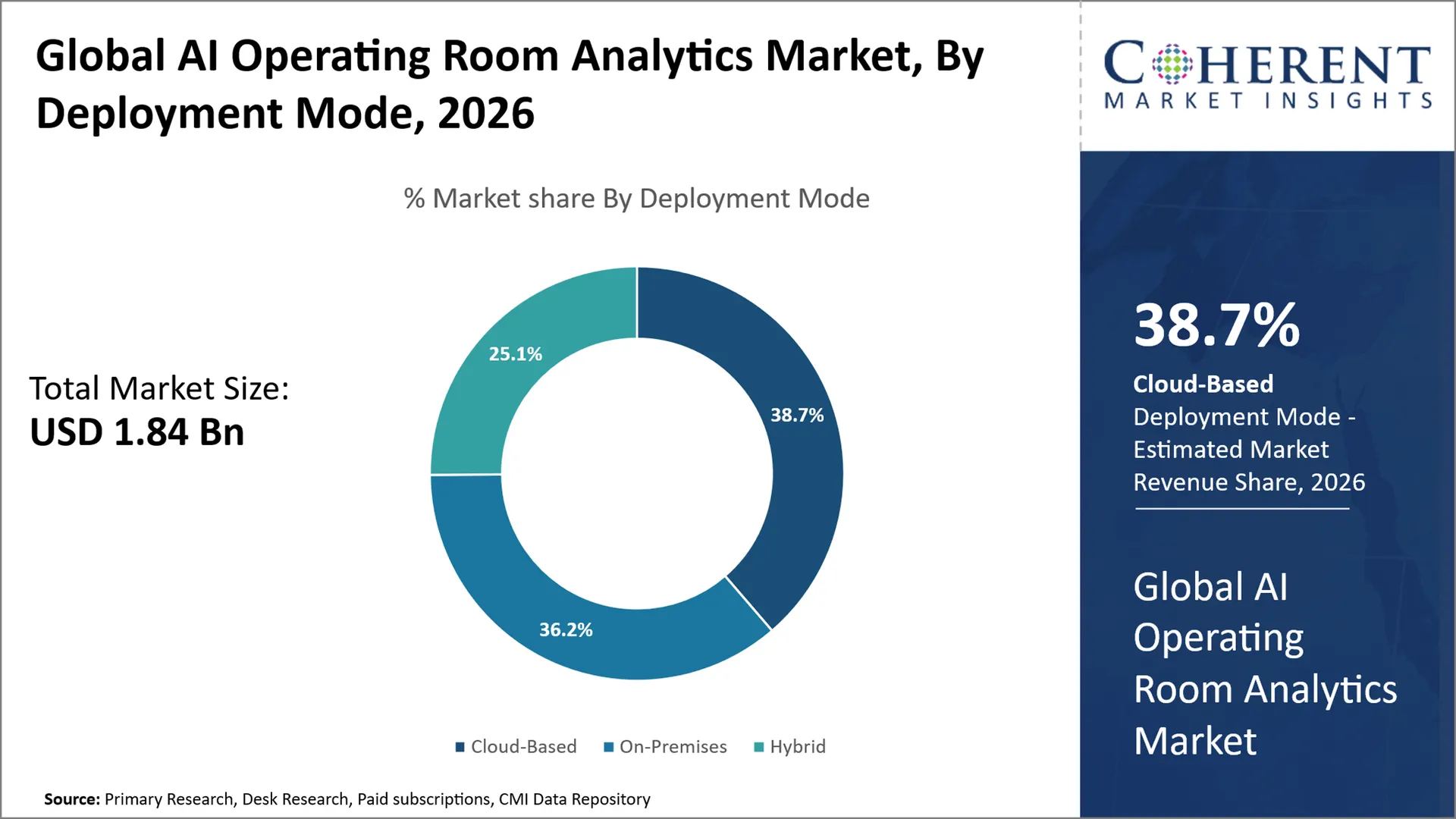
Cloud-based is projected to hold a market share of 38.7% in 2026, due to its scalability, lower upfront infrastructure requirements and its ability to offer hospitals a centralized access point to OR analytics across multiple campuses. It also allows software updates and integration with surgical, clinical and operational data without requiring hospitals to maintain high local computing infrastructure. For instance, Microsoft’s ORHub Surgical Spotlight offers cloud-based analytics that uses operating room information system data to help hospitals identify workflow inefficiencies and improve surgical resource utilization.
Machine Learning and Deep Learning Segment Dominates the Global AI Operating Room Analytics Market
The machine learning and deep learning segment is projected to hold a market share of 34.8% in 2026, due to their capabilities to analyze complex surgical video, physiologic signals and clinical data for the purpose of extracting pattern of procedures and enabling predictive capabilities. Such capabilities enable surgical phase recognition, workflow analysis and data driven quality improvement activities outside the typical scope of reporting. For instance, in November 2024, a published in the National Library of Medicine, developed a deep-learning model to identify surgical phases in laparoscopic gallbladder removal videos, achieving 91.2% overall accuracy on its test dataset.
Current Events and their Impact
Current Events | Description and its Impact |
U.S. FDA Seeks Public Feedback on Generative AI Medical Devices (August 2026) |
|
India Launches SAHI and BODH to Strengthen Healthcare AI (February 2026) |
|
U.S. FDA Issues Draft Guidance on AI Medical Device Lifecycle Management (January 2025) |
|
AI Operating Room Analytics Market Dynamics
Market Drivers
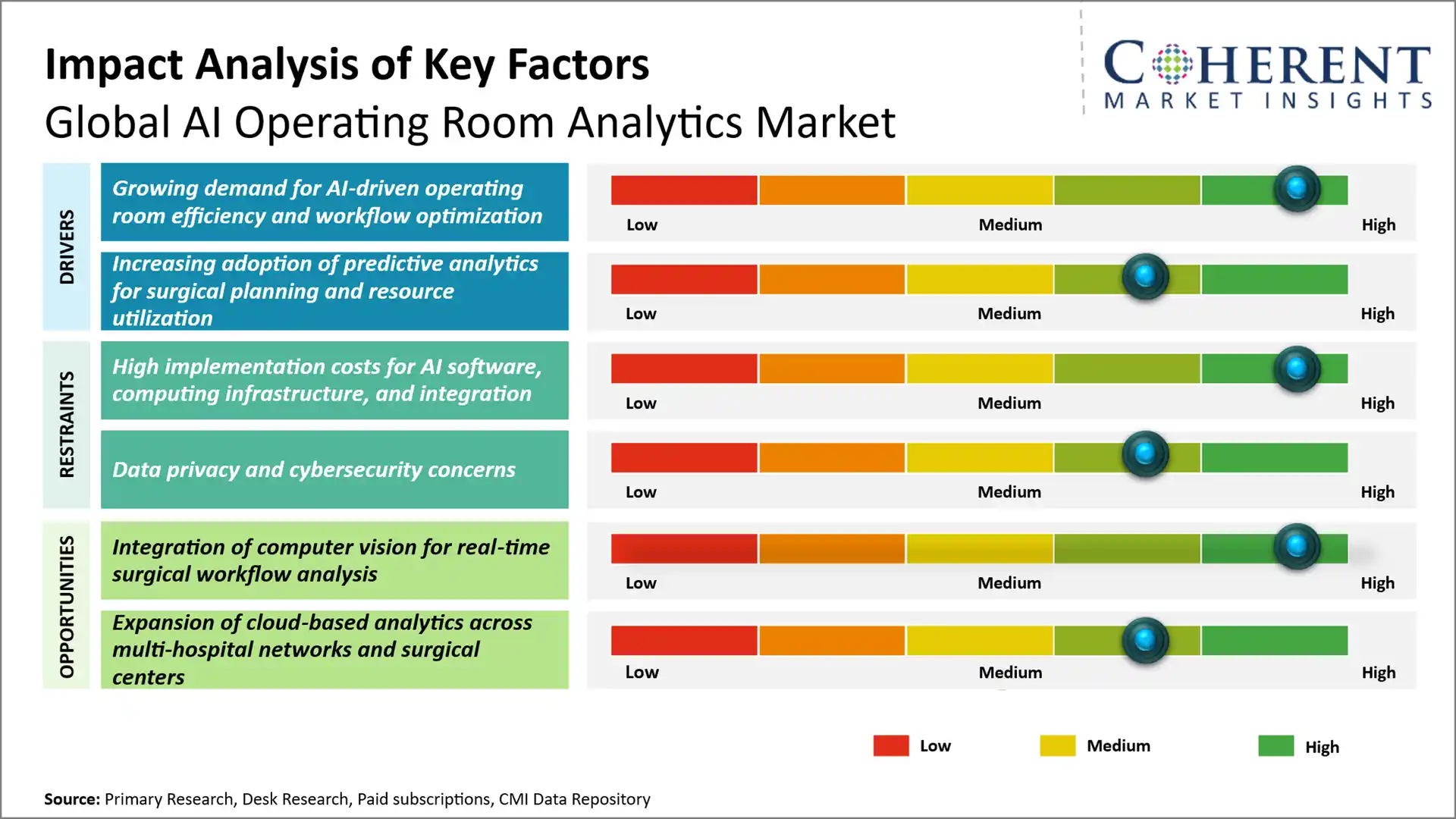
- Growing demand for AI-driven operating room efficiency and workflow optimization: Growing demand for AI-driven operating room efficiency and workflow optimization is a key market driver, as hospitals seek to reduce delays, improve surgical scheduling, and maximize theatre utilization. For instance, AdventHealth Celebration in Florida used Proximie’s AI-enabled computer vision platform to identify workflow bottlenecks; on-time surgical starts increased to 78.45% in May 2025, a six-year record, demonstrating the operational value of data-driven insights
- Increasing adoption of predictive analytics for surgical planning and resource utilization: Increasing adoption of predictive analytics for surgical planning and resource utilization is driving demand for AI operating room analytics, as hospitals seek to forecast procedure durations, optimize scheduling, and allocate staff and equipment efficiently. For instance, in January 2026, a study published in BMJ Health & Care Informatics, using 15,267 hip and knee replacement cases at a single institution, found that machine-learning-based scheduling reduced operating room underutilization by 56.2% compared with conventional scheduling estimates, demonstrating the potential of predictive models to improve surgical capacity planning.
- Growing integration of AI with surgical video and computer vision technologies: Growing integration of AI with surgical video and computer vision technologies is accelerating market adoption by enabling automated recognition of surgical phases, instrument movements, and procedural patterns. These capabilities help clinicians evaluate surgical workflows, identify variations in procedural techniques, and support data-driven quality improvement. For instance, The Chinese University of Hong Kong is developing the AI-ENDO platform, which analyzes endoscopic surgical videos to recognize procedural phases, identify safe and hazardous tissue regions, and locate incision landmarks during gastrointestinal cancer surgery. This demonstrates how computer vision can support real-time surgical safety and workflow analysis.
Emerging Trends
- Real-Time Surgical Workflow Intelligence: Computer vision and machine learning are rapidly being used by AI-powered platforms to monitor procedural efficiency, detect workflow bottlenecks, and evaluate surgical film. Hospitals can use these information to maximize operating room use, cut down on delays, and enhance surgical team collaboration.
- Integration of AI with Robotic-Assisted Surgery: A major trend in robotic-assisted surgical systems is the incorporation of AI analytics, which makes it possible to evaluate surgical performance, instrument movements, and procedural patterns in great detail. Data-driven performance review and ongoing surgical process improvement are supported by this convergence.
- Predictive Analytics for Operating Room Optimization: Healthcare providers are progressively integrating predictive analytics to estimate procedure durations, foresee scheduling delays, and enhance staffing and equipment allocation. Cloud-based platforms and interoperable hospital data systems are significantly enhancing the opportunities for predictive insights throughout multi-hospital networks.
Regional Insights
Why is North America a Strong Market for AI Operating Room Analytics?
North America leads the global AI operating room analytics market, accounting for an estimated 39.4% share in 2026, primarily due to the advanced healthcare infrastructure, early adoption of AI-enabled surgical platforms, and strong collaboration between hospitals, research centers, and technology providers. Additionally, government funding for digital health transformation and well-established regulatory landscape is paving the way for developing, commercializing, and adopting cutting-edge AI surgical applications, like real-time clinical workflows, process efficiencies, and resource optimization. For instance, the U.S. FDA’s Digital Health Center of Excellence supports the development and oversight of digital health technologies, including AI-enabled medical software, to help clarify regulatory pathways for innovative healthcare applications.
Why Does Asia Pacific AI Operating Room Analytics Market Exhibit High Growth?
Asia Pacific is expected to exhibit the fastest growth in the global AI operating room analytics market, registering an estimated CAGR of 20.8% during 2026–2033. The region is projected to account for 22.8% of the global market in 2026, propelled by rising healthcare infrastructure and increased expenditure on various surgical technologies in countries such as China, India, Japan and South Korea. Additionally, government initiatives to improve the access and quality of healthcare services combined with large patient base, raise awareness about AI benefits in the country.
For instance, India’s Ayushman Bharat Digital Mission (ABDM) is developing an interoperable digital health ecosystem to improve access to healthcare information and enable more connected care delivery. This infrastructure can support the integration of AI-driven operating room analytics with hospital information systems and digital clinical workflows. (Source: National Health Authority) Furthermore, digitalization of healthcare system and public-private partnerships are creating scope for AI-enabled surgical workflow analysis, predictive scheduling and optimizing the use of operation theatre resources.
Global AI Operating Room Analytics Market Outlook for Key Countries
Why is the U.S. Leading Innovation and Adoption in the AI Operating Room Analytics Market?
The U.S. will probably be the major innovator and adopters of the technology driven by its flourishing ecosystem of academic medical centers, surgical-technology builders, and hospitals which might be already utilizing data-driven operating room administration. This potential is exemplified by the convergence of surgical video analytics, predictive scheduling, and perioperative information integration to resolve some particular operational points like delays in procedures and unavailable operating room time.
Is China a Favorable Market for AI Operating Room Analytics Market?
There are enormous opportunities for AI operating room analytics in China, especially in computer vision-based surgical workflow analysis, procedure-phase recognition and operating room utilization optimization. Academic evidence points to future benefits to hospitals from AI solutions to convert surgical videos and operating room data into metrics of procedure length, workflow variation and resource utilization. Additionally, applications tailored to China's healthcare systems, China's data needs, and high-volume surgical procedures are expected to have a large market potential.
Is UK Emerging as a Key Growth Hub for the AI Operating Room Analytics Market?
UK is emerging as a significant hub for the development of the AI operating room analytics market particularly for predictive theatre scheduling, workflow optimization and surgical capacity planning. Notable opportunities may exist within solutions to help NHS trusts better manage operating list over-runs, theatre utilization and surgical resource coordination. As well as solutions that successfully deliver tangible operational benefits, providers that can leverage NHS digital systems will be best placed to scale.
Why Does Germany Top the European AI Operating Room Analytics Market?
Germany leads the European AI operating room analytics market in robotics surgery, medical engineering and hospital-based clinical research. Potentially, the greatest opportunity is to combine AI analytics with robotic-guided surgery and clinical image viewing, which could allow an analysis of the algorithms guiding procedures and the post-procedure performance reviews. This creates scope for specialized analytics solutions that complement Germany’s established surgical technology ecosystem.
Is AI Operating Room Analytics Market Developing in Japan?
Japan looks to be a potential market for AI operating room analytics with potential applications such as automation of the surgical workflow, the prediction of procedure times and OR resource planning. The application of such solutions with robotic-assisted surgery and advanced medical imaging solutions can allow hospitals to analyze procedure data and optimize their orchestration. Vendors with solutions compatible with the healthcare sectors existing infrastructure and hospital information systems may be best suited to pursue this potential market.
Key Data Inputs and Applications in AI Operating Room Analytics
Data input | AI analytics application | Expected operational value |
Surgical video feeds | Surgical phase recognition and workflow monitoring | Improved workflow visibility and procedural documentation |
Operating room timestamps | Procedure-duration prediction and turnover analysis | Better scheduling and reduced delays |
Staff and equipment activity data | Resource utilization and coordination analysis | More efficient staff and equipment allocation |
Electronic health records and patient data | Procedure risk assessment and outcomes analytics | Better-informed perioperative planning |
Medical device and physiological data | Intraoperative monitoring and anomaly detection | Earlier identification of potential issues |
Historical surgical and operational data | Predictive scheduling and performance benchmarking | Improved resource planning and continuous quality improvement |
How is the integration of computer vision for real-time surgical workflow analysis creating new growth opportunities in the AI operating room analytics market?
Computer vision is expected to have a profound impact on the global AI operating room analytics market. Automated surgical phase recognition, instrument tracking and real-time workflow analysis are expected to become feasible, along with a greater degree of coordination and operating room efficiency. For instance, the University of Toronto’s Surgical Safety Technologies research ecosystem has explored AI-driven analysis of operating room video and audio to identify workflow patterns and potential safety risks, supporting data-informed surgical quality improvement.
Market Players, Key Development, and Competitive Landscape
Key Developments
- On October 19, 2026, XRlabs announced an USD 8.4 million seed funding round led by Playground Global, with participation from Eka Ventures. Its platform uses computer vision and deep learning to integrate live surgical video, navigation data, and preoperative imaging, supporting real-time surgical awareness and workflow. The funding will support engineering and clinical team expansion, regulatory development, and further clinical evidence generation across the UK, Europe, and the U.S.
- In September 2026, Proximie in collaboration with Amazon Web Services (AWS), Deloitte, and eight NHS hospital sites, launched a year-long surgical AI evaluation across 104 operating theatres, endoscopy suites, and catheterisation laboratories. Its Intelligence Suite uses AI to identify workflow bottlenecks and improve operating room efficiency, with the programme covering more than 20,000 procedures annually. This initiative highlights growing adoption of AI-driven analytics to optimise surgical capacity and resource utilisation.
- In June 2026, Oracle Health announced a collaboration with Theator to bring AI-powered surgical intelligence into the operating room. The partnership aims to use surgical video analysis and AI-driven insights to help clinicians evaluate surgical performance, identify workflow improvement opportunities, and support data-driven decision-making. This development highlights the growing integration of AI analytics into surgical care.
Competitive Landscape
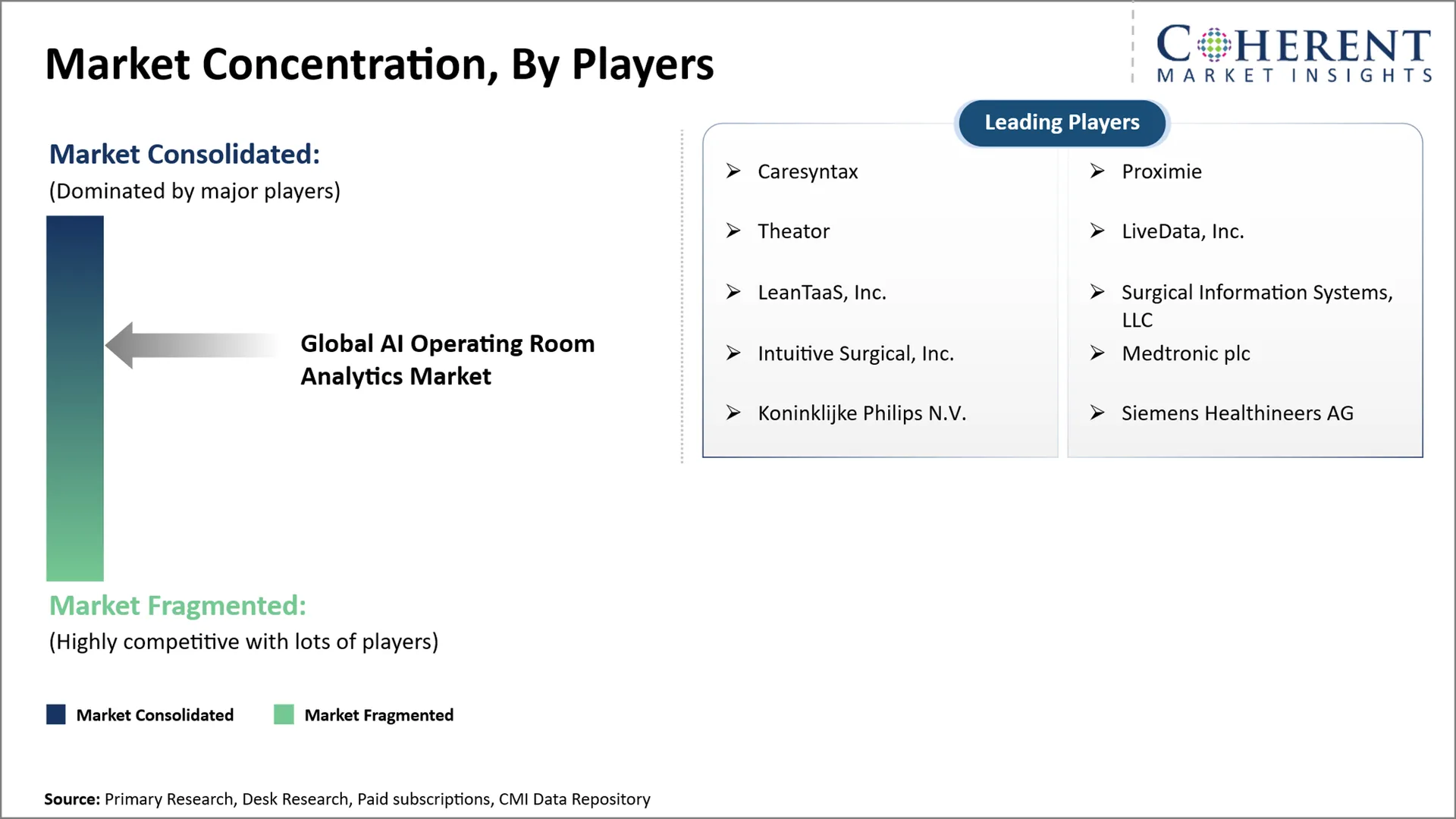
The global AI operating room analytics market is characterized by competition centered on real-time surgical workflow analysis, computer vision, predictive analytics, data interoperability, and operating room performance optimization. Market participants focus on translating surgical video and clinical data into actionable insights that improve procedural efficiency, resource utilization, and patient safety. Key focus areas include:
- AI-powered surgical workflow monitoring and real-time operating room performance analysis.
- Computer vision and surgical video analytics for procedure-phase recognition and workflow assessment.
- Predictive modeling for surgical scheduling, procedure-duration forecasting, and resource allocation.
- Integration of surgical data from imaging systems, electronic health records, and connected medical devices.
- Postoperative outcomes analytics, complication-risk assessment, and continuous surgical quality improvement.
- Cloud-based and hybrid analytics platforms for scalable deployment across multi-hospital networks.
- Integration of AI analytics with robotic-assisted surgery and intraoperative decision-support systems.
- Emphasis on clinical validation, data privacy, cybersecurity, interoperability, and clinician trust in AI-generated insights.
Market Report Scope
AI Operating Room Analytics Market Report Coverage | |||
Report Coverage | Details | ||
Base Year | 2025 | Market Size in 2026: | USD 1.84 Bn |
Historical Data For: | 2020 To 2024 | Forecast Period: | 2026 To 2033 |
Forecast Period 2026 To 2033 CAGR: | 18.9% | 2033 Value Projection: | USD 6.18 Bn |
Geographies covered: |
| ||
Segments covered: |
| ||
Companies covered: | Caresyntax, Proximie, Theator, LiveData, Inc., LeanTaaS, Inc., Surgical Information Systems, LLC, Intuitive Surgical, Inc., Medtronic plc, Koninklijke Philips N.V., Siemens Healthineers AG | ||
Growth Drivers: |
| ||
Restraints & Challenges: |
| ||
Analyst Opinion (Expert Opinion)
- In the coming years, global AI operating room analytics market will be shaped by the transition from retrospective performance reporting to real-time, predictive, and increasingly automated operating room management. AI platforms are expected to evolve beyond tracking surgical workflows to forecasting procedure duration, identifying operational bottlenecks, improving resource utilization, and supporting data-driven clinical decisions. Integration with surgical video systems, electronic health records, connected medical devices, and robotic-assisted surgery platforms will strengthen the role of analytics in operating room operations. Over time, solutions that demonstrate measurable improvements in utilization, workflow efficiency, and surgical quality are likely to gain wider adoption.
- The maximum opportunities are foreseen within AI-powered surgical workflow and OR efficiency analytics in the U.S., where hospitals can use AI to predict procedure durations, identify workflow bottlenecks, optimize surgical scheduling, and improve operating room utilization. A second opportunity exists in predictive scheduling and resource utilization analytics in India, where expanding hospital infrastructure and rising surgical demand can increase the need for cost-effective solutions that improve operating theatre efficiency.
- In order to gain a competitive advantage market players should prioritize solutions that deliver measurable operational value rather than offering analytics dashboards alone. Demonstrating improvements in operating room utilization, turnaround time, scheduling accuracy, and resource allocation can strengthen the business case for adoption. Players should develop interoperable platforms that integrate with existing hospital information systems, surgical video equipment, and connected devices, minimizing implementation complexity.
Speak to the analyst
Want personalized insights?
Take the findings above to one of our principal consultants, or have the report rebuilt around the segments, geographies and competitors you actually track.
Market Segmentation
- Component Insights (Revenue, USD Bn, 2021 - 2033)
- Software
- Hardware
- Services
- Deployment Mode Insights (Revenue, USD Bn, 2021 - 2033)
- Cloud-Based
- On-Premises
- Hybrid
- Technology Insights (Revenue, USD Bn, 2021 - 2033)
- Machine Learning and Deep Learning
- Computer Vision and Image Analytics
- Natural Language Processing
- Predictive Analytics
- Application Insights (Revenue, USD Bn, 2021 - 2033)
- Surgical Workflow and OR Efficiency Analytics
- Surgical Planning and Decision Support
- Intraoperative Monitoring and Guidance
- Surgical Outcomes and Risk Analytics
- Resource Utilization and Scheduling Analytics
- Others
- End User Insights (Revenue, USD Bn, 2021 - 2033)
- Hospitals and Health Systems
- Ambulatory Surgical Centers (ASCs)
- Specialty Surgical Centers
- Others
- Regional Insights (Revenue, USD Bn, 2021 - 2033)
- North America
- U.S.
- Canada
- Latin America
- Brazil
- Argentina
- Mexico
- Rest of Latin America
- Europe
- Germany
- U.K.
- Spain
- France
- Italy
- Russia
- Rest of Europe
- Asia Pacific
- China
- India
- Japan
- Australia
- South Korea
- ASEAN
- Rest of Asia Pacific
- Middle East
- GCC Countries
- Israel
- Rest of Middle East
- Africa
- South Africa
- North Africa
- Central Africa
- North America
- Key Players Insights
- Caresyntax
- Proximie
- Theator
- LiveData, Inc.
- LeanTaaS, Inc.
- Surgical Information Systems, LLC
- Intuitive Surgical, Inc.
- Medtronic plc
- Koninklijke Philips N.V.
- Siemens Healthineers AG
Sources
Primary Research Interviews
- Operating room directors and surgical operations leaders — operating room utilization, surgical scheduling, procedure delays, turnaround times, staffing, and resource allocation.
- Hospital administrators and healthcare executives — AI adoption strategies, operating room performance management, implementation costs, and return on investment.
- Surgeons and surgical department heads — surgical workflow analysis, intraoperative decision support, surgical video analytics, and clinical usability.
- Anesthesiologists and perioperative care specialists — operating room coordination, anesthesia workflow, procedure-duration forecasting, and perioperative data integration.
- Clinical informaticians and healthcare data scientists — AI model development, predictive analytics, clinical data integration, and performance validation.
- Biomedical engineers and medical technology specialists — integration of surgical equipment, imaging systems, sensors, and connected operating room technologies.
- Healthcare IT and cybersecurity leaders — interoperability, electronic health record integration, cloud deployment, data governance, and cybersecurity.
- AI/ML specialists and computer vision researchers — surgical video interpretation, workflow recognition, machine learning, deep learning, and real-time analytics.
- Healthcare procurement and technology purchasing leaders — vendor evaluation, software licensing, implementation requirements, and purchasing priorities.
Stakeholders
- Hospitals and health systems — adoption of AI-enabled operating room management, surgical workflow analytics, and resource optimization.
- Ambulatory surgical centers (ASCs) — procedure scheduling, throughput improvement, staffing coordination, and operating room utilization.
- Surgical technology and medical device companies — integration of analytics with surgical equipment, imaging systems, and robotic-assisted surgery platforms.
- AI operating room analytics software providers — surgical workflow intelligence, predictive scheduling, computer vision, and performance dashboards.
- Healthcare IT and enterprise software providers — integration with hospital information systems, electronic health records, and clinical data platforms.
- Cloud computing and data infrastructure providers — scalable analytics, data processing, AI deployment, and secure storage.
- End-use Sectors
- Hospitals and Health Systems
- Ambulatory Surgical Centers (ASCs)
- Specialty Surgical Centers
- Academic Medical Centers and Teaching Hospitals
- Multi-Hospital and Integrated Healthcare Networks
- Regulatory & Health Bodies
- U.S. Food and Drug Administration (FDA), United States — regulation of AI-enabled medical devices, software as a medical device, and relevant clinical decision-support technologies.
- Office of the National Coordinator for Health Information Technology (ONC), United States — health information technology standards, interoperability, and electronic health information exchange.
- European Commission, European Union — AI governance, data protection policy, and regulatory frameworks relevant to healthcare AI.
- European Medicines Agency (EMA), European Union — regulatory and scientific guidance relevant to medicines and medical-product development; relevant when analytics intersects with regulated clinical systems.
- National Medical Products Administration (NMPA), China — medical device registration, oversight, and regulation of relevant AI-enabled medical technologies.
Databases
- Healthcare Cost and Utilization Project (HCUP), United States — hospital utilization, inpatient procedures, healthcare costs, and surgical care data.
- Centers for Medicare & Medicaid Services (CMS), United States — hospital quality measures, healthcare utilization, provider information, and public healthcare datasets.
- AHRQ Patient Safety Network (PSNet), United States — patient safety events, surgical safety, healthcare quality, and clinical risk information.
- National Inpatient Sample (NIS), United States — hospital discharge data useful for analyzing surgical procedures, inpatient utilization, and associated healthcare costs.
Associations
- Association of periOperative Registered Nurses (AORN) — perioperative nursing practices, operating room safety, workflow standards, and surgical care improvement.
- American College of Surgeons (ACS) — surgical quality improvement, clinical standards, surgical outcomes, and professional education.
- American Society of Anesthesiologists (ASA) — anesthesia practice, perioperative care, patient safety, and operating room coordination.
- Healthcare Information and Management Systems Society (HIMSS) — healthcare digital transformation, AI adoption, interoperability, and health information technology.
- Association for the Advancement of Medical Instrumentation (AAMI) — medical technology standards, device safety, healthcare technology management, and interoperability-related practices.
- American Hospital Association (AHA) — hospital operations, healthcare technology adoption, hospital management, and health-system priorities.
Public Domain Sources
- U.S. Food and Drug Administration (FDA) — AI-enabled medical devices, digital health technologies, software as a medical device, and relevant regulatory information.
- Agency for Healthcare Research and Quality (AHRQ) — hospital performance, patient safety, healthcare quality, surgical care, and healthcare utilization research.
- National Institutes of Health (NIH) — biomedical research, surgical innovation, clinical research, and AI-related healthcare research.
- World Health Organization (WHO) — AI governance in healthcare, digital health frameworks, patient safety, and responsible AI implementation.
Proprietary Elements
- CMI Data Analytics Tool, Proprietary CMI Existing Repository of information for last 10 years.
Get access to 250+ pages report
Every segment, forecast, competitor profile and data table behind the analysis above — available for instant download.
- ESOMAR Member
- ISO 9001:2015 Certified
- D-U-N-S Registered
- GDPR & CCPA Compliant
Frequently Asked Questions
The global AI operating room analytics market is estimated to be valued at USD 1.84 Bn in 2026 and is expected to reach USD 6.18 Bn by 2033.
Software dominates due to its ability to analyze surgical workflows, generate actionable insights, and optimize operating room efficiency.
AI operating room analytics uses artificial intelligence to analyze surgical and operational data to improve workflow efficiency, resource utilization, and surgical outcomes.
The CAGR of global AI operating room analytics market is projected to be 18.9% from 2026 to 2033.
Growing demand for AI-driven operating room efficiency and workflow optimization, and increasing adoption of predictive analytics for surgical planning and resource utilization are the major factors driving the growth of the global AI operating room analytics market.
High implementation costs for AI software, computing infrastructure, and integration, and data privacy and cybersecurity concerns are the major factors hampering the growth of the global AI operating room analytics market.
In terms of technology, machine learning and deep learning is estimated to dominate the market revenue share in 2026.