

Global AI in Computer Vision Market Size and Forecast – 2026-2033
The Global AI in Computer Vision Market is estimated to be valued at USD 34.94 billion in 2026 and is expected to reach USD 254.51 billion by 2033, exhibiting a compound annual growth rate (CAGR) of 32.8% from 2026 to 2033.
Key Takeaways of the Global AI in Computer Vision Market:
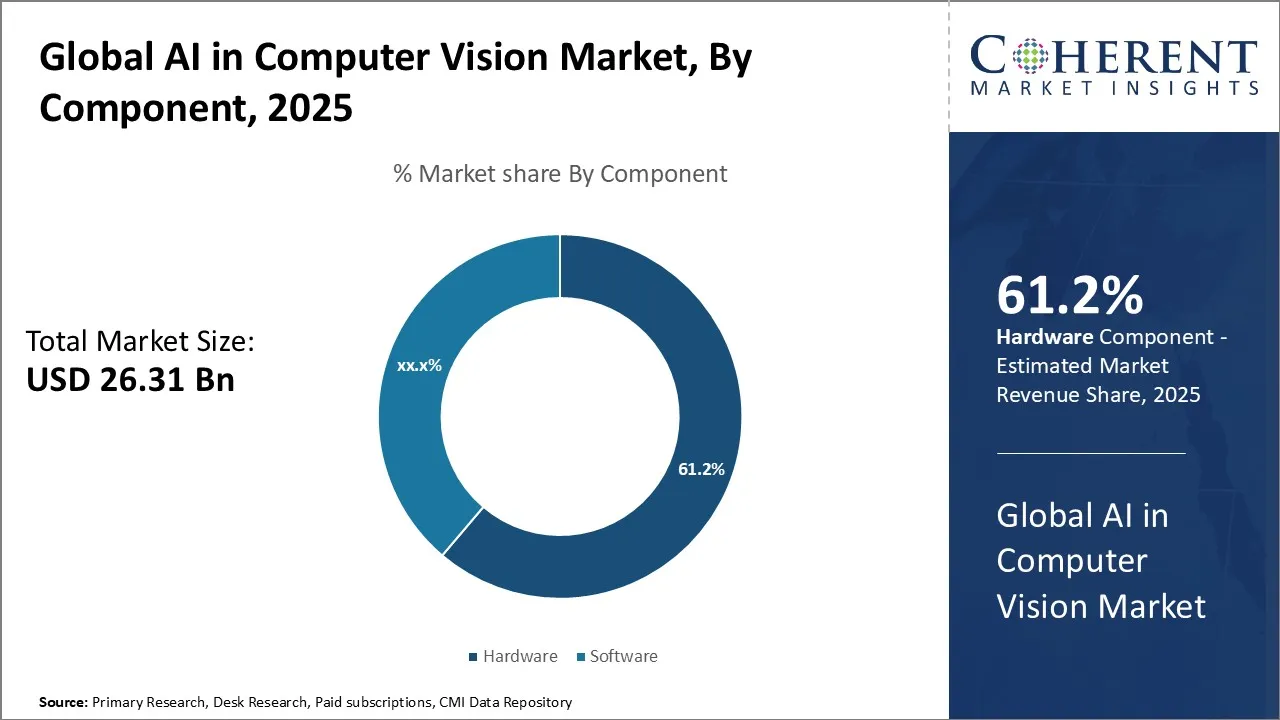
- The hardware segment leads the market, holding an estimated share of 62.2% in 2026.
- The inference segment is projected to dominate with a share of 66.3% in 2026.
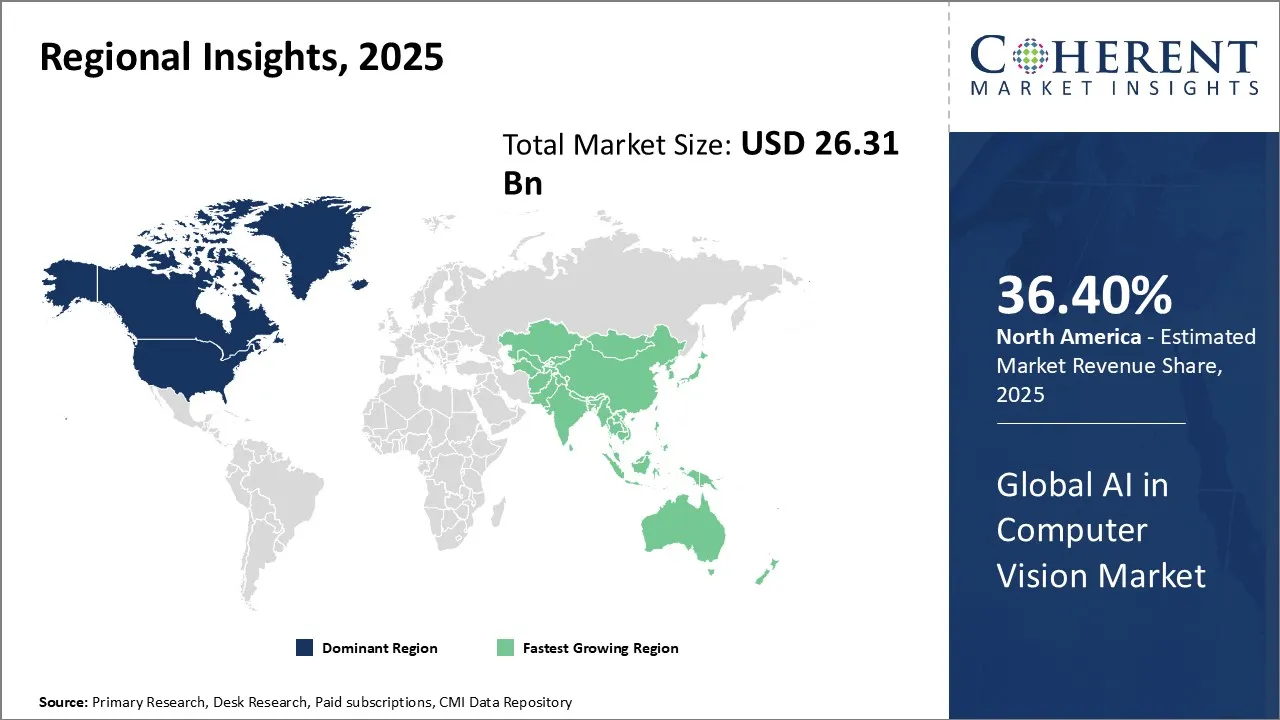
- North America is estimated to lead the market with a share of 36. 4% in 2026. Asia Pacific, holding a share of 28.9% in 2026, is projected to be the fastest growing region.
Market Overview:
The AI in computer vision market is witnessing several key trends, such as the integration of deep learning algorithms, the development of edge computing solutions, and the increasing adoption of 3D computer vision systems. Also, the growing demand for autonomous vehicles and the need for improved security are all benefitting the market largely. As businesses continue to understand the potential of AI-powered computer vision in optimizing processes and improving efficiency, the market will maintain its strong growth rate over the forecast period.
Current Events and their Impact:
Current Events | Description and its impact |
EU Artificial Intelligence Act and Compliance Demands |
|
Rise of Generative AI and Integration into Computer Vision Capabilities |
|
Segmental Analysis
- Current Industry Events of 2026
- Market Size Estimation
- Regional Breakdown
- Competitive Landscape
- Customer Intelligence
- Segmental Analysis
- Pricing Analysis
- Key Market Drivers, Challenges & Future Trends
- Customized Insights Section
Global AI in Computer Vision Market Insights, by Component – Hardware Leads Due to the increasing demand for advanced AI-powered computer vision systems
The hardware segment of the global AI in computer vision market is experiencing significant growth, holding an estimated share of 62.2% in 2026. AI-based computer vision solutions are seeing adoption in different sectors, such as healthcare, automotive, retail, and manufacturing. These industries are using computer vision technology to improve their processes and gain valuable insights from visual data.
Moreover, advancements in hardware components, such as cameras, sensors, and processors, are further fueling the growth of this segment. The development of high-resolution cameras and sophisticated sensors enables the capture of high-quality images and videos, which is crucial for accurate computer vision analysis.
Another factor driving the growth of the hardware segment is the increasing demand for edge computing solutions. Edge computing allows for the processing of data closer to the source, reducing latency and enabling real-time decision-making. This is particularly important in applications such as autonomous vehicles, where quick and accurate processing of visual data is critical for safety and performance.
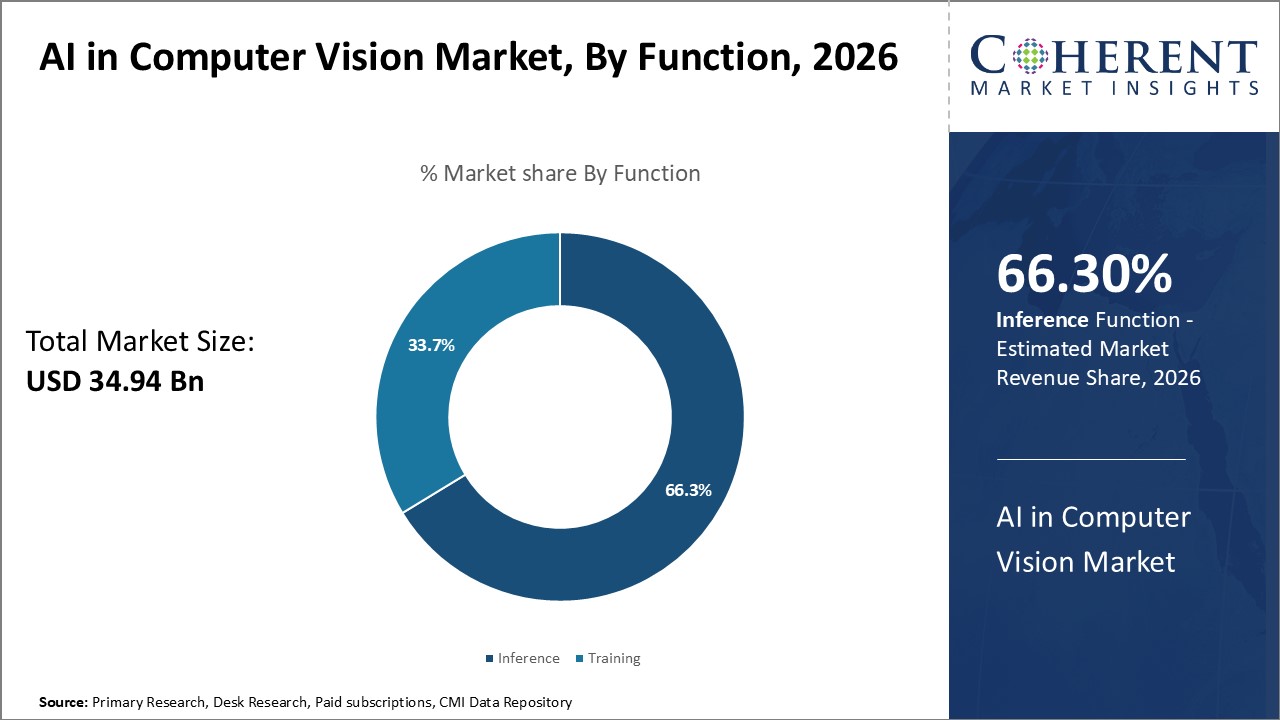
Global AI in Computer Vision Market Insights, by Function – Inference Leads due to the Growing Need for Real-Time Decision-making
The inference segment of the Global AI in Computer Vision Market is experiencing significant growth, holding an estimated share of 66.3% in 2026. Inference refers to the process of using trained AI models to make predictions or decisions based on new input data. In the context of computer vision, inference involves analyzing visual data in real-time to identify objects, detect anomalies, or perform other tasks. Industries such as automotive, healthcare, and retail require computer vision systems that can process and analyze visual data quickly and accurately. For example, in autonomous vehicles, inference is critical for detecting obstacles, recognizing traffic signs, and making split-second decisions to ensure safe navigation.
Additionally, the development of dedicated hardware, such as AI accelerators and neural processing units (NPUs), optimizes the performance of inference tasks, making it possible to deploy computer vision systems in resource-constrained environments. In 2024, NVIDIA expanded its Jetson Orin family, launching Jetson Orin Nano and Jetson Orin NX modules—compact yet powerful edge AI platforms specifically designed for real-time computer vision applications.
End User Feedback & Unmet Needs in the AI in Computer Vision Market:
- End users, especially in sectors like healthcare and manufacturing, often report challenges with AI accuracy in real-world scenarios involving low lighting, occlusion, or complex backgrounds. AI models still struggle with edge cases, leading to false positives/negatives.
- There is growing feedback from automotive and surveillance industries regarding the latency issues in cloud-based processing. Users are demanding faster, real-time AI inference at the edge, especially for mission-critical applications like autonomous driving or security alerts.
- In sectors like retail and smart cities, customers express growing concerns over how visual data is stored, processed, and shared. There is increasing demand for AI systems that align with privacy laws (e.g., GDPR, HIPAA) and support on-premise processing.
- In 2024, Walmart piloted AI computer vision in select stores to reduce shelf gaps and improve inventory tracking. While the initiative boosted shelf visibility by over 30%, the company faced challenges with the system’s sensitivity to lighting variations and misidentifying empty shelves during peak hours.
Regional Insights:
North America AI in Computer Vision Market Analysis and Trends
North America, holding a share of 36.4% in 2026, is estimated to dominate in the global AI in computer vision market. Government policies and initiatives, such as the American AI Initiative, have also benefitted the AI industry in the region. Notable companies contributing to the region's dominance include Google, Microsoft, Amazon, IBM, and NVIDIA. For instance, in March 2026, NVIDIA (USA) introduced its Isaac GR00T robotics model at GTC 2026, an advanced AI framework designed for high-fidelity 3D visual perception and simulation in industrial robotics.
Asia Pacific AI in Computer Vision Market Analysis and Trends
Asia Pacific, holding a share of 28.9% in 2026, is expected to exhibit the fastest growth in the global AI in computer vision market. The region's rapid economic development, coupled with increasing investments in AI technologies, has created a fertile ground for market expansion. Countries like China, Japan, and South Korea have emerged as major players in the AI industry, with their governments actively promoting AI adoption through national strategies and policies.
The region's thriving technology ecosystem, which includes companies like Alibaba, Tencent, Baidu, and SenseTime, has further accelerated the growth of AI in the Computer Vision Market. For instance, in October 2022, Baidu (China) launched its ERNIE-ViLG 2.0, a next-generation multimodal AI model that combines computer vision and natural language processing to generate detailed visual content from text prompts.
Global AI in Computer Vision Market Outlook for Key Countries:
U.S. AI in Computer Vision Market Analysis and Trends
The U.S. AI in computer vision market is characterized by its strong research and development capabilities, robust investment landscape, and presence of major technology companies. The country's leadership in AI innovation is supported by a thriving startup ecosystem, renowned academic institutions, and favorable government policies. Key players such as Google, Microsoft, Amazon, and NVIDIA have been at the forefront of developing advanced computer vision technologies and solutions. The adoption of AI in computer vision is witnessing significant growth across various industries, including healthcare, retail, automotive, and surveillance.
China AI in Computer Vision Market Analysis and Trends
China AI in computer vision market has experienced remarkable growth in recent years, driven by the country's ambitious AI strategy and substantial investments in research and development. The government's "New Generation Artificial Intelligence Development Plan" has set the stage for China to become a global leader in AI by 2030. The country's vast population, extensive data resources, and supportive policies have attracted both domestic and international companies to develop and deploy AI-powered computer vision solutions. Notable players in the Chinese market include Alibaba, Tencent, Baidu, and SenseTime, which have made significant contributions to the advancement of computer vision technologies.
Japan AI in Computer Vision Market Analysis and Trends
Japan continues to be a key player in the global AI in computer vision market, leveraging its strong technological capabilities and innovative spirit. The country's focus on robotics and automation has driven the adoption of AI in computer vision across various industries, including manufacturing, healthcare, and transportation. Japan's government has implemented policies and initiatives to promote AI development, such as the "AI Technology Strategy" and the "Society 5.0" vision. Major Japanese companies, including Hitachi, Fujitsu, and NEC, have been actively involved in developing and deploying AI-powered computer vision solutions.
Germany AI in Computer Vision Market Analysis and Trends
Germany AI in computer vision market is characterized by its strong industrial base and expertise in machine vision technologies. The country's "Industry 4.0" initiative has been a driving force behind the adoption of AI in manufacturing and automation. German companies, such as Siemens, Bosch, and BASF, have been leveraging AI-powered computer vision solutions to optimize production processes, improve quality control, and enhance operational efficiency. The country's robust automotive industry has also been a significant adopter of AI in computer vision, with applications in autonomous driving and advanced driver assistance systems.
Market Players, Key Development, and Competitive Intelligence:
Top Strategies Followed by Global AI in Computer Vision Market Players
- Established players are investing heavily in R&D to stay ahead of the competition and maintain their market dominance.
- In 2025, Microsoft announced a significant expansion of its AI R&D efforts, investing over $3 billion into its AI Co-Innovation Lab in Wisconsin, U.S.
- Mid-level players in the market are focusing on delivering cost-effective solutions to target price-sensitive consumers.
- Mobvoi (China), a mid-sized AI company, introduced a budget-friendly AI vision chipset in 2024 tailored for consumer electronics and security devices.
- Small-scale players are specializing in specific areas of computer vision to differentiate themselves from larger competitors and capture a loyal customer base.
- Strayos (U.S.), a startup, developed AI-powered drone vision software specifically for mining and construction site analysis, offering hyper-specialized terrain mapping and material detection.
Key Developments:
- In June 2025, ai, a provider of advanced AI software for high-end ADAS, autonomous driving, and robotics automation, announced Helm.ai Vision, a production-grade urban perception system designed for Level 2+ and Level 3 autonomous driving in mass-market vehicles.
- In June 2025, Meta Platforms agreed to take a 49% stake in artificial intelligence startup Scale AI for USD 14.8 billion.
- In May 2025, NVIDIA unveiled new chips for building and deploying artificial intelligence models at its annual GTC conference. The company revealed Blackwell Ultra, a family of chips shipping in the second half of 2025, as well as Vera Rubin, the company’s next-generation graphics processing unit, or GPU, that is expected to ship in 2026.
- In May 2025, at its I/O 2025 conference, Google confirmed that its newly revealed Android XR platform will first appear in frames from Gentle Monster and Warby Parker. This development marks a significant progression in the smart glasses landscape, moving beyond early iterations like Google Glass.
Market Report Scope
AI in Computer Vision Market Report Coverage
| Report Coverage | Details | ||
|---|---|---|---|
| Base Year: | 2025 | Market Size in 2026: | USD 34.94 Bn |
| Historical Data for: | 2020 To 2024 | Forecast Period: | 2026 To 2033 |
| Forecast Period 2026 to 2033 CAGR: | 32.8% | 2033 Value Projection: | USD 254.51 Bn |
| Geographies covered: |
| ||
| Segments covered: |
| ||
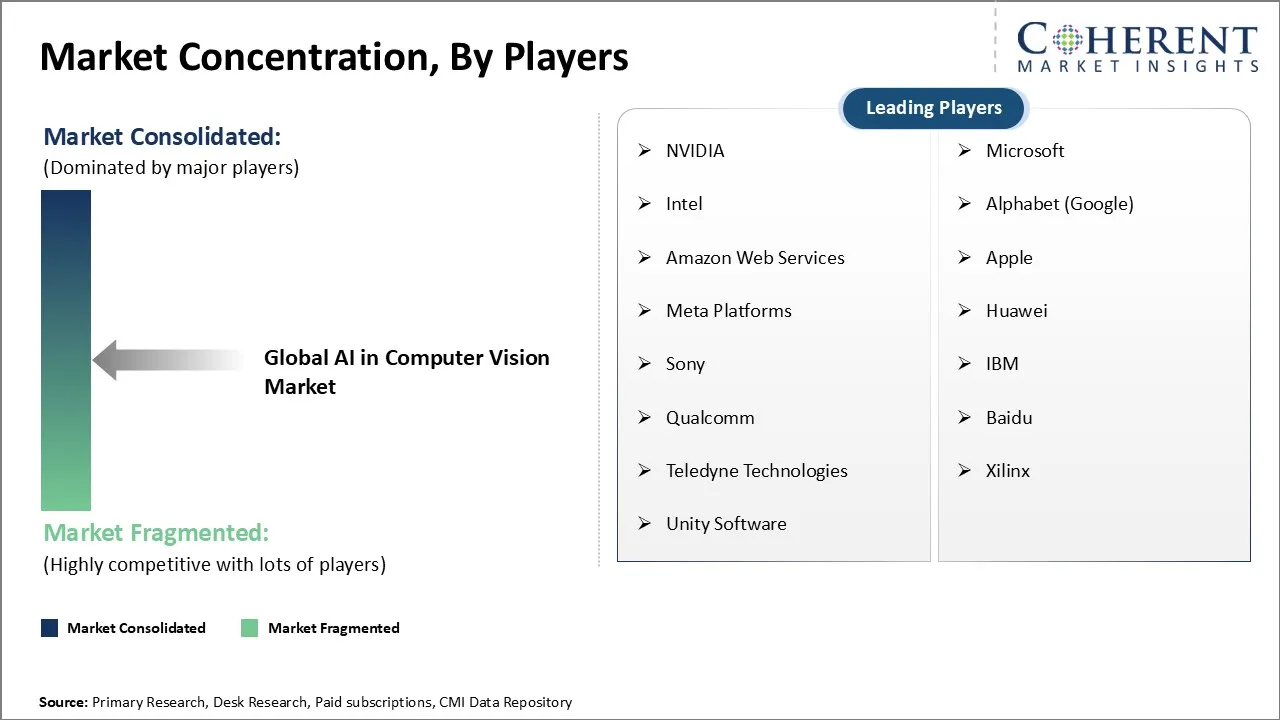
| Companies covered: | NVIDIA, Microsoft, Intel, Alphabet (Google), Amazon Web Services, Apple, Meta Platforms, Huawei, Sony, IBM, Qualcomm, Baidu, Teledyne Technologies, Xilinx, and Unity Software | ||
| Growth Drivers: |
| ||
| Restraints & Challenges: |
| ||
Market Dynamics
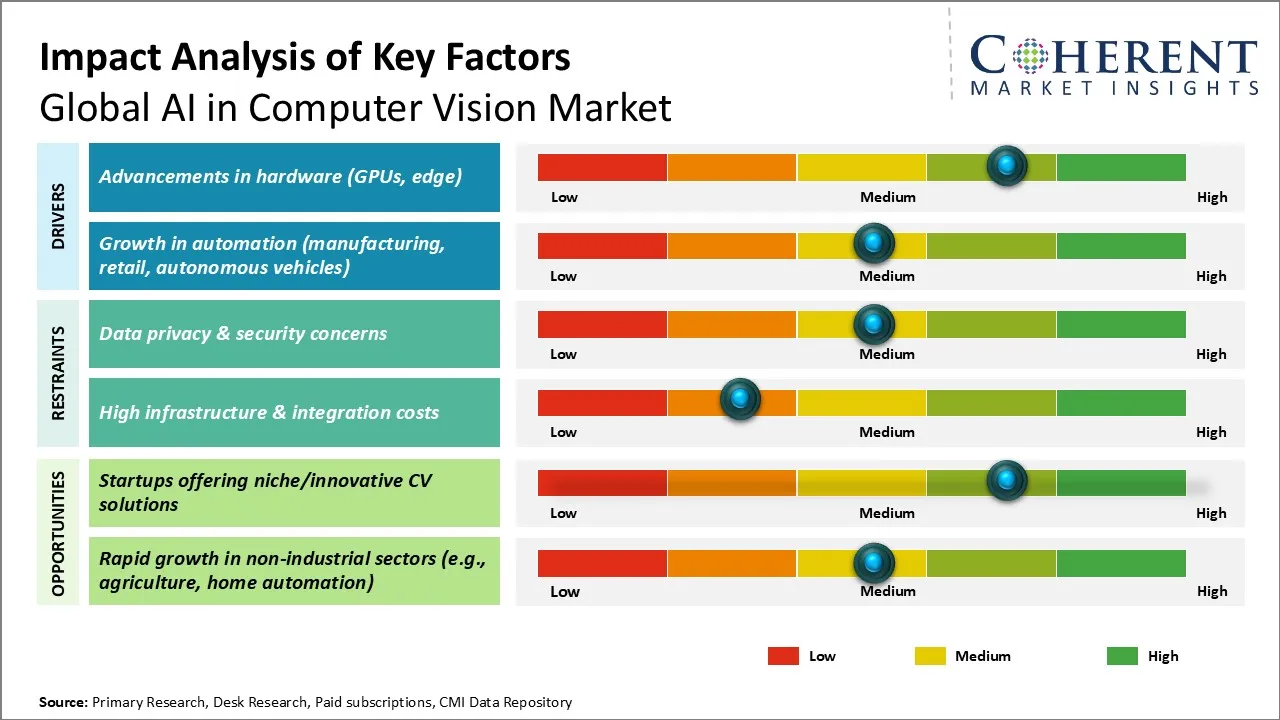
Global AI in Computer Vision Market Driver - Advancements in hardware (GPUs, edge)
Graphics Processing Units (GPUs) have become increasingly powerful, offering parallel processing capabilities that significantly enhance the performance of AI algorithms in computer vision applications. These high-performance GPUs enable faster training of deep learning models and real-time inference, making AI-powered computer vision systems more efficient and cost-effective. Moreover, the development of edge computing devices has brought AI capabilities closer to the data source, reducing latency and enabling real-time processing of visual data.
In March 2025, NVIDIA showcased advancements in edge AI hardware with enhanced Jetson Orin Nano modules, which bring powerful AI capabilities to compact edge devices. Edge devices equipped with AI accelerators can perform complex computer vision tasks locally, without relying on cloud-based processing, thereby improving response times and data privacy.
Global AI in Computer Vision Market Opportunity – Startups Offering Niche/Innovative CV Solutions
Startups in the global AI in computer vision market are well-positioned to address specific industry verticals or tackle unique challenges that established players may overlook. By focusing on specialized applications and developing cutting-edge computer vision technologies, startups can carve out a competitive advantage in the market. For example, Kognic (Sweden-based startup) raised over USD 20 million in late 2024 to scale its data management and quality assurance platform for computer vision in autonomous vehicles.
The agility and adaptability of startups allow them to quickly respond to market demands and iterate on their offerings. Additionally, startups often have the advantage of being unburdened by legacy systems and can leverage the latest advancements in AI and computer vision to create disruptive solutions.
Analyst Opinion (Expert Opinion):
- The convergence of computer vision with natural language processing—seen in models like OpenAI’s GPT-4o and Baidu’s ERNIE-ViLG—is ushering in a new era of context-aware visual understanding. These systems can interpret images, text, and speech simultaneously, enabling smarter assistants, autonomous agents, and real-time industrial monitoring.
- With the launch of ultra-efficient chips by NVIDIA, Intel, and startups like Axelera AI, on-device processing is becoming viable even in power-constrained environments. This shift is critical for latency-sensitive use-cases like autonomous vehicles, smart surveillance, and surgical robotics, where cloud dependence is a liability.
- The future of AI in computer vision lies in domain-specific solutions—from AI-guided endoscopy in healthcare to precision livestock monitoring in agriculture. As startups and mid-tier players deliver tailored models trained on unique datasets, the market will fragment into verticalized ecosystems, each with its own pace of innovation.
Speak to the analyst
Want personalized insights?
Take the findings above to one of our principal consultants, or have the report rebuilt around the segments, geographies and competitors you actually track.
Market Segmentation
- Component Insights (Revenue, USD Bn, 2021 - 2033)
- Hardware
- Software
- Function Insights (Revenue, USD Bn, 2021 - 2033)
- Inference
- Training
- Regional Insights (Revenue, USD Bn, 2021 - 2033)
- North America
- U.S.
- Canada
- Latin America
- Brazil
- Argentina
- Mexico
- Rest of Latin America
- Europe
- Germany
- U.K.
- Spain
- France
- Italy
- Russia
- Rest of Europe
- Asia Pacific
- China
- India
- Japan
- Australia
- South Korea
- ASEAN
- Rest of Asia Pacific
- Middle East
- GCC Countries
- Israel
- Rest of Middle East
- Africa
- South Africa
- North Africa
- Central Africa
- North America
- Key Players Insights
- NVIDIA
- Microsoft
- Intel
- Alphabet (Google)
- Amazon Web Services
- Apple
- Meta Platforms
- Huawei
- Sony
- IBM
- Qualcomm
- Baidu
- Teledyne Technologies
- Xilinx
- Unity Software
Sources
Primary Research Interviews:
Stakeholders:
- Technology Companies and AI Startups (e.g., CTOs, R&D Heads)
- Computer Vision Software Developers and Engineers
- Edge Hardware Manufacturers and GPU Providers
- Autonomous Vehicle OEMs and System Integrators
- Hospital Administrators and Medical Imaging Specialists
- Security and Surveillance Firms deploying AI-based systems
- Smart Factory & Industrial Automation Specialists
Databases:
- Asia Pacific Innovation Index (APII)
- U.S. Bureau of Technology Statistics
- Digital Economy Outlook – OECD
- AI Vision Applications Database (AVAD)
- North American Smart Tech Repository
Magazines:
- AI Systems Today
- Edge Intelligence Weekly
- Machine Vision World
- Smart Mobility Insights
- AIoT Business Review
Journals:
- Journal of Visual Artificial Intelligence
- IEEE Transactions on Pattern Analysis and Machine Intelligence
- Journal of Autonomous Systems and Robotics
- Computer Vision and Image Understanding Journal
- Applied AI in Healthcare Technology
Newspapers:
- The Tech Times (Global)
- Asia Business AI Daily
- Silicon Valley Observer
- Digital India Business Standard
- North America Innovation Post
Associations:
- International Association for Artificial Intelligence in Vision (IA-AIV)
- Computer Vision Industry Consortium (CVIC)
- AI Hardware Alliance (AIHA)
- Global Smart Cities Council (GSCC)
- North American Machine Vision Alliance (NAMVA)
Public Domain Sources:
- World Bank – Digital Infrastructure Reports
- United Nations Centre for AI Policy (UNCAIP)
- U.S. National Institute of Standards and Technology (NIST)
- EU Artificial Intelligence Strategy Portal
- ResearchGate
Proprietary Elements:
- CMI Data Analytics Tool, Proprietary CMI Existing Repository of information for the last 8 years
Get access to 250+ pages report
Every segment, forecast, competitor profile and data table behind the analysis above — available for instant download.
- ESOMAR Member
- ISO 9001:2015 Certified
- D-U-N-S Registered
- GDPR & CCPA Compliant
Missing comfort of reading report in your local language? Find your preferred language:
Transform your Strategy with Exclusive Trending Reports
Frequently Asked Questions
The global AI in computer vision market is estimated to be valued at USD 34.94 billion in 2026 and is expected to reach USD 254.51 billion by 2033.
The CAGR of global AI in computer vision market is projected to be 32.8% from 2026 to 2033.
Advancements in hardware (GPUs, edge) and Growth in automation (manufacturing, retail, autonomous vehicles) are the major factors driving the growth of global AI in computer vision market.
Data privacy & security concerns and High infrastructure & integration costs are the major factors hampering the growth of global AI in computer vision market.
In terms of component, the hardware segment is estimated to dominate the market revenue share in 2026.
NVIDIA, Microsoft, Intel, Alphabet (Google), Amazon Web Services, Apple, Meta Platforms, Huawei, Sony, IBM, Qualcomm, Baidu, Teledyne Technologies, Xilinx, and Unity Software are the major players operating in AI in computer vision market.
North America is expected to lead the global AI in computer vision market in 2026.