

Global AI Scribes Market Size and Forecast – 2026 To 2033
The global AI scribes market is expected to grow from USD 1,420.0 Mn in 2026 to USD 5,260.0 Mn by 2033, registering a compound annual growth rate (CAGR) of 20.6% from 2026 to 2033. The global market for AI scribes is projected to witness significant growth during the forecast period attributed to the high adoption of the EHRs systems having a wide digital base supporting the integration of clinical documentation solutions powered by artificial intelligence (AI).
The Office of the National Coordinator for Health Information Technology (ONC) reported that 91% of office-based physicians had used certified EHR technology by 2024, providing evidence that a significant number of physicians have a strong potential to incorporate AI scribes into the clinic.
Key Takeaways of the Global AI Scribes Market
- Ambient AI scribes are projected to hold 54.8% of the global AI scribes market share in 2026, making it dominant type segment. Europe especially the UK, has been encouraging the adoption of ambient documentation in healthcare. In April 2025, NHS England released guidance on AI-enabled ambient scribing solutions being used in healthcare. The guidance explained how the solutions help in the generation of structured clinical notes and support workflows.
- Software and platforms are projected to hold 62.7% of the global AI scribes market share in 2026, making it dominant component segment. Publicly funded digital health programs in North America, particularly in Canada, are quickly integrating AI-powered clinical documentation platforms. Canada Health Infoway’s AI Scribe Program provides up to 10,000 fully sponsored licenses for one year to eligible primary care physicians of its vendor solutions, which are rigorously assessed for clinical usability, EHR integration, privacy and security.
- Clinical documentation and note generation are projected to hold 48.6% of the global AI scribes market share in 2026, making it dominant application segment. Asia Pacific is growing steadily with AI-enabled clinical documentation and note generation solutions, India is witnessing significant growth with the introduction of multilingual digital health solutions. On November 6, 2026, India's national health authority introduced it Ambient AI-enabled Voice Scribe that converts doctor-patient conversations into clinical notes in various Indian languages, which are then imported to the Ayushman Bharat Health Account (ABHA) ecosystem.
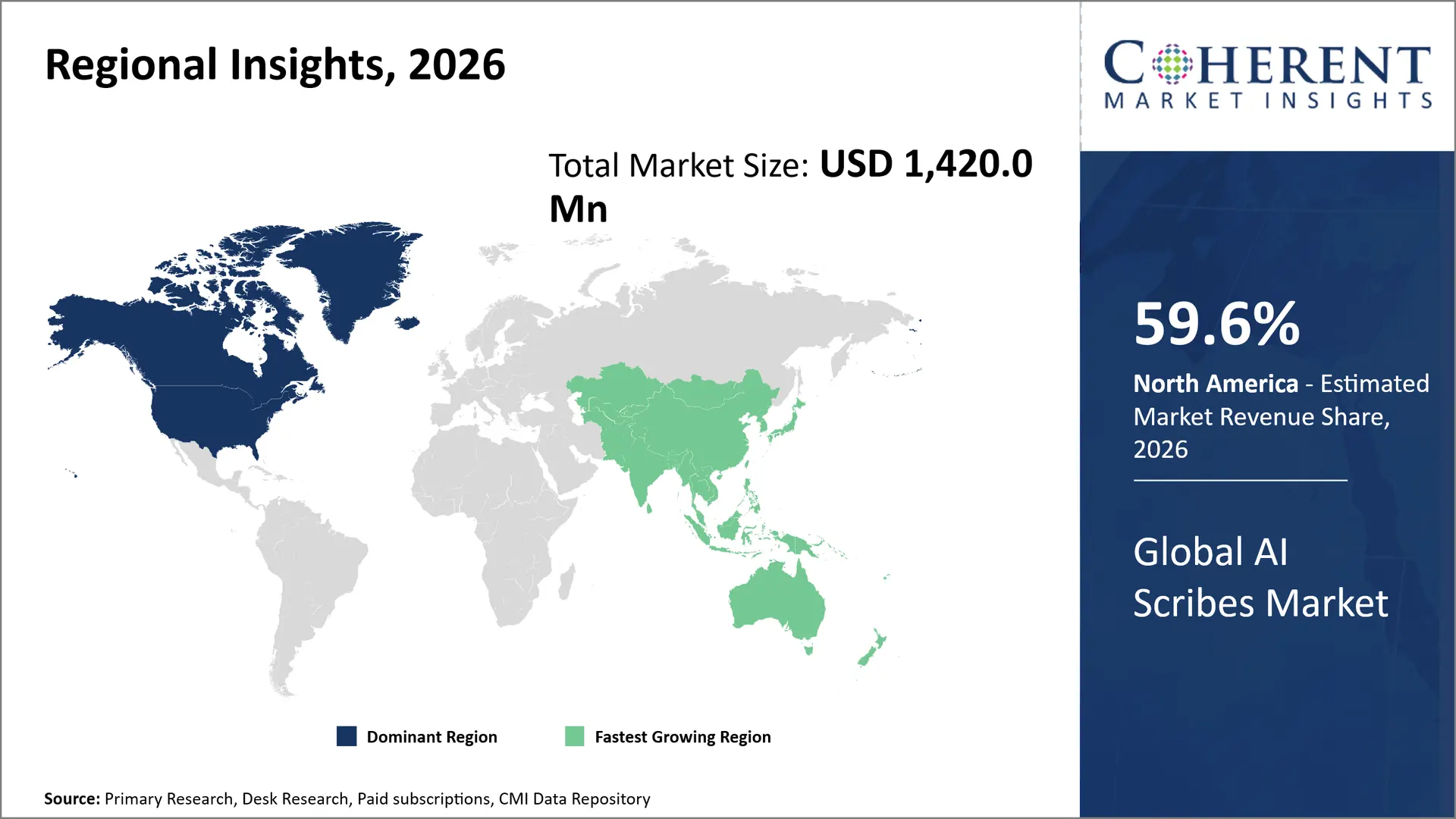
- North America market maintains dominance with an expected share of 59.6% in 2026, owing to presence of matured digital health care ecosystem, high adoption of EHRs and comprehended AI-based clinical documentation in hospitals and physician practices. In April 2026, the U.S. Defense Health Agency deployed ambient AI scribing technology across the Military Health System after successful pilot deployments at four military treatment facilities, highlighting increasing institutional acceptance of automated clinical documentation.
- Asia Pacific is expected to exhibit the fastest growth in the global AI scribes market, registering an estimated CAGR of 24.8% during 2026–2033, ascribed to increased healthcare digitalization, increased investments in AI-enabled clinical workflows, the rising need for multilingual documentation solution and others. The National University Health System in Singapore adopted their proprietary ambient AI scribe, Medi Voice, in September 2024. An additional 3,919 users adopted this technology by February 2026 which demonstrated the implementation of AI-based documentation services across the medical industry.
Segmental Insights
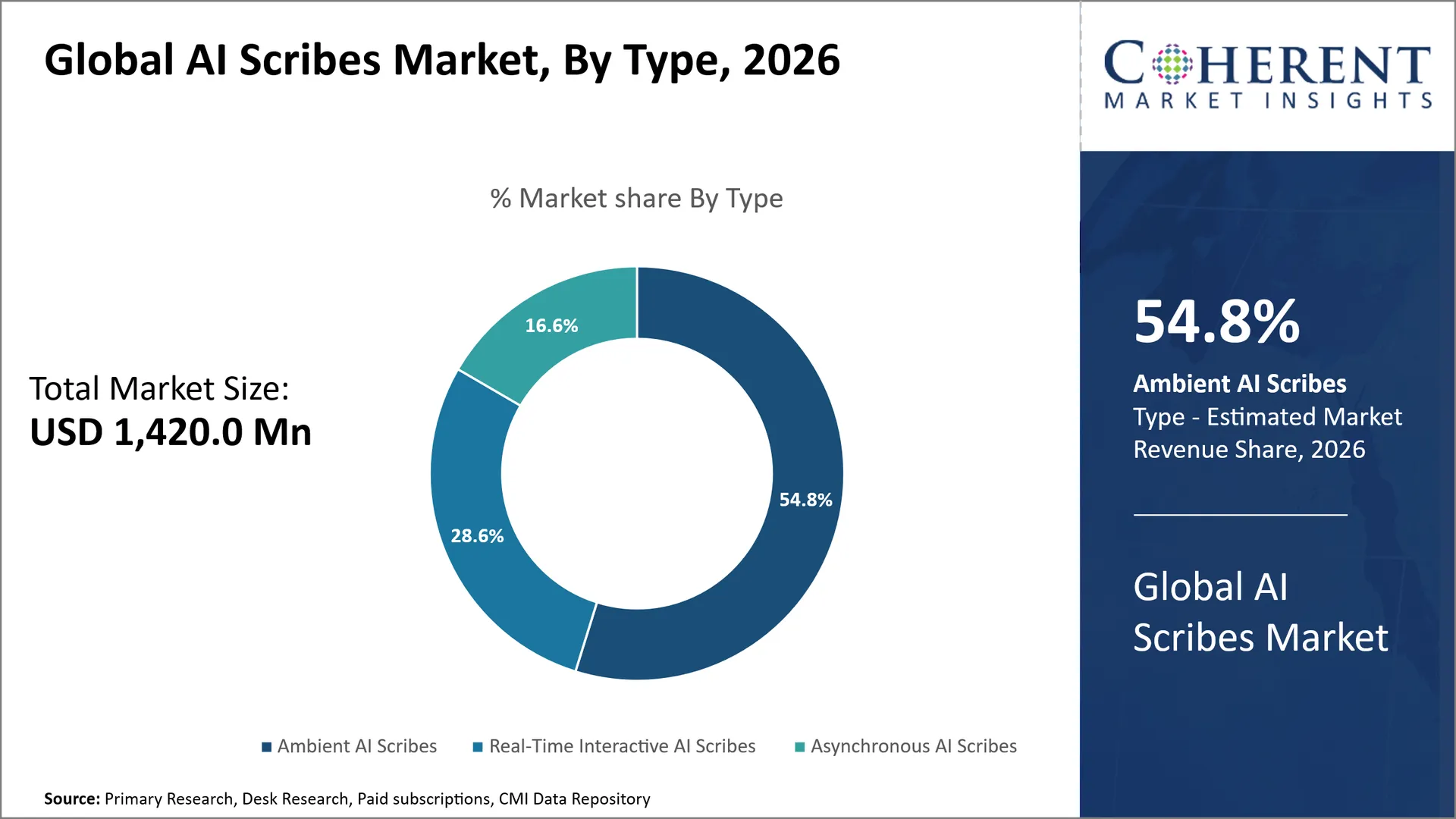
Why Do Ambient AI Scribes Dominate the Global AI Scribes Market?
Ambient AI scribes are projected to hold the market share of 54.8% in 2026, owing to their ability to record clinician-patient discussions in real-time and automatically generate structured clinical notes with very little manual input. These scribe types are expected to significantly decrease the documentation burden for the doctors, allowing them to focus on the patient. For instance, Cleveland Clinic launched an enterprise-wide deployment of ambient AI scribes in March 2025. The deployment of these scribes resulted in the registration of more than 4,000 ambulatory care clinicians within 4 months, demonstrating the scalability of ambient documentation offerings across healthcare systems. (Source: Springer Nature Limited)
- Current Industry Events of 2026
- Market Size Estimation
- Regional Breakdown
- Competitive Landscape
- Customer Intelligence
- Segmental Analysis
- Pricing Analysis
- Key Market Drivers, Challenges & Future Trends
- Customized Insights Section
Why Do Software and Platforms Represent the Largest Component Segment in the AI Scribes Market?
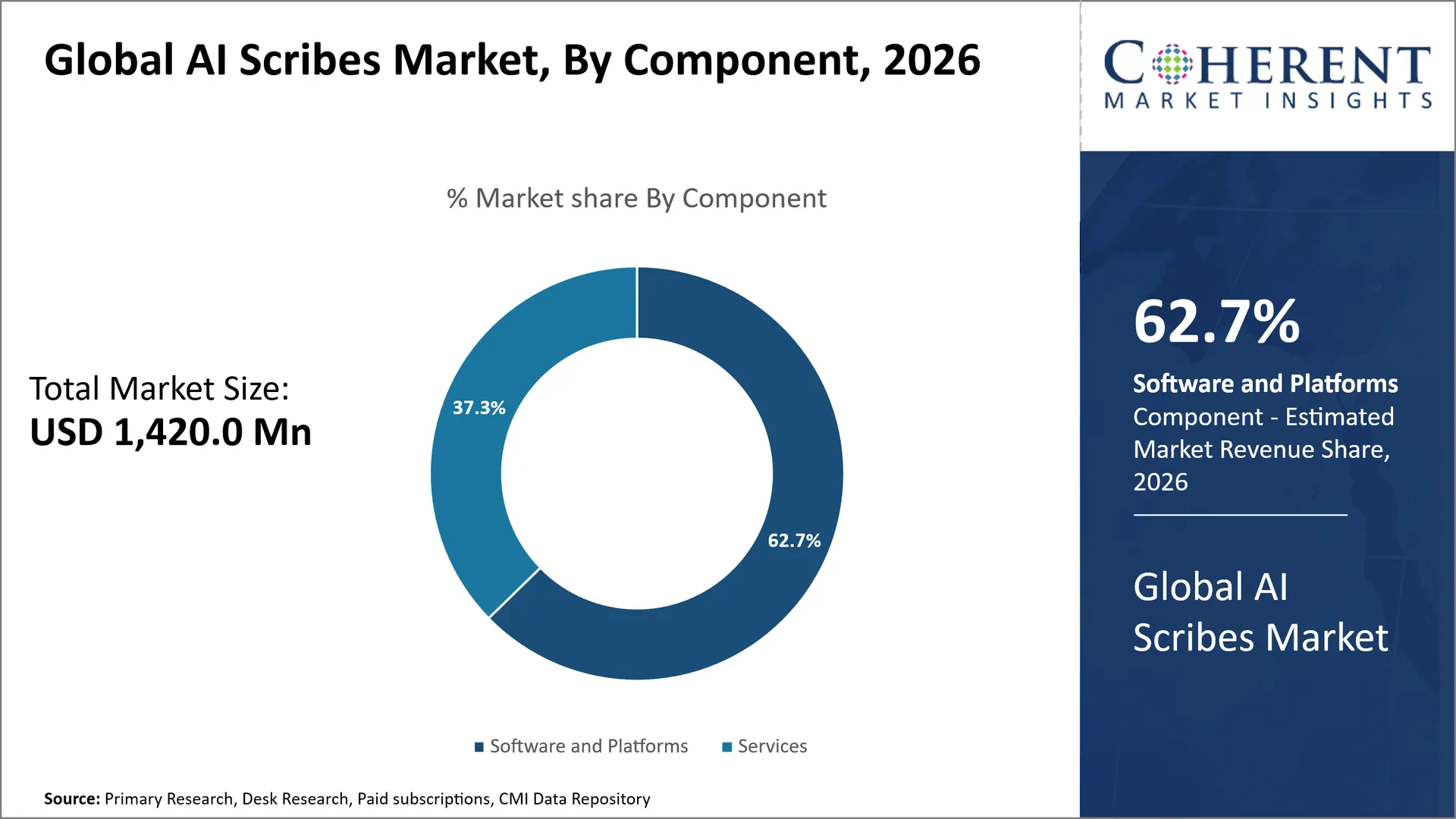
Software and platforms are projected to hold a market share of 62.7% in 2026, owing to their ability to provide scalable clinical documentation, customizable workflows and easy integration with electronic health records in all care environments. Cloud-based platforms with advanced natural language processing and generative artificial intelligence features could provide real-time note creation and automated billing. For instance, in June 2025, Huma launched Hi Scribe on its Huma Cloud Platform, deployed across 870 practices, to automate the generation of clinical notes, creation of billing codes and EHR integration.
Clinical Documentation and Note Generation Segment Dominates the Global AI Scribes Market
The clinical documentation and note generation segment are projected to hold a market share of 48.6% in 2026, owing to the significant applications of the note-taking in the translation of conversations between physician and patient into structured medical record. This would likely create a drastic reduction in the manual writing of the documents and drive efficiency in the clinical workflows. For instance, in August 2025, Highmark Health launched an enterprise-wide partnership with Abridge to deploy ambient clinical documentation technology driven by artificial intelligence across Allegheny Health Network. The technology will automate the real-time creation and ingestion of clinical documentation into the EHR.
Current Events and their Impact
Current Events | Description and its Impact |
UK Medicines and Healthcare Products Regulatory Agency (MHRA) Clarifies Regulatory Status of Ambient Voice Technologies Used in the NHS (July 2026) |
|
U.S. GAO Releases Report on AI for Medical Notes and Coding (July 2026) |
|
AI Scribes Market Dynamics
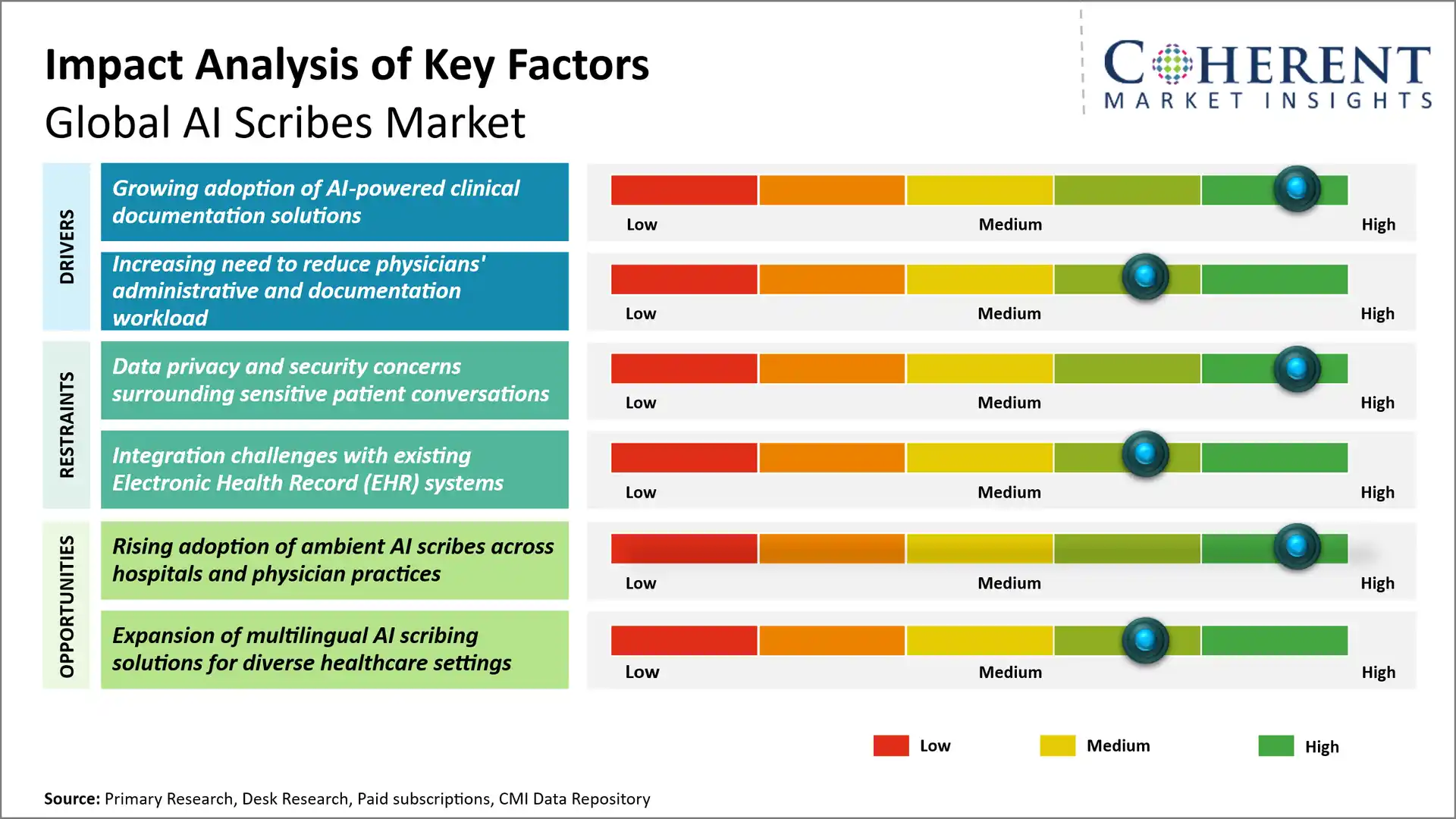 Market Drivers
- Growing adoption of AI-powered clinical documentation solutions: The rise in usage of AI-driven clinical documentation solutions is driven by the need for reducing the administrative burdens on physicians and improving the efficiency of documentation procedures so that clinicians focus more on the patient. In January 2026, Orlando VA Health Care System reported the use of ambient AI scribe technology in a few patient appointments of Veterans to generate draft medical notes in real time.
- Increasing need to reduce physicians' administrative and documentation workload: The growing administrative load from electronic health records (EHRs), note-taking in the room, and documentation after hours continues to drive a surge in demand for artificial intelligence (AI) scribes that can help free up physicians' time. In April 2026, a study published by the JAMA Network, involving 8,581 clinicians at five academic medical centers found the use of AI scribes was associated with a 16-minute decrease in daily documentation time for every eight hours of scheduled patient care.
- Growing integration of AI with digital healthcare infrastructure: Healthcare providers are integrating artificial intelligence (AI) -enabled documentation tools into their digital health platforms to optimize clinical workflows and ease documentation work. Alberta Health Services implemented the AI scribe in 105 urban and rural sites and has so far generated more than 21,500 clinical sessions by 197 emergency physicians in a nine-month evaluation period.
Emerging Trends
- Expansion of ambient AI scribing solutions: Medical staff members have growing inclusiveness of technologies, known as ambient malevolent genius, which automatically gives a record of the patient-doctor interaction and generates series clinical notes.
- Impact: This development lessens the documentation effort and improves the productivity of the clinician and allows greater focus on patient interactions.
- Market Relevance: There is an increasing need for real-time AI scribing tools which include better speech recognition and easy integration to EHR.
- Integration of generative AI with clinical workflows: AI scribe platform developers are moving toward application of generative AI technology that can be used for automated note summarization, clinical coding and documentation.
- Impact: This leads to better documentation, automated administrative workflows and less manual record processing.
- Market Relevance: This advancement provides an opening for a more sophisticated artificial intelligence scribing software with specialty specific documentation and enhanced workflow automation.
Regional Insights
Why is North America a Strong Market for AI Scribes?
North America leads the global AI scribes market, accounting for an estimated 59.6% share in 2026, owing to the presence of mature healthcare infrastructure, robust technology ecosystem, and increasing investments to deploy AI-powered clinical solutions. The increasing government investments to promote patient outcomes and efficiency through digitization of healthcare processes, along with increasing adoption of AI-backed clinical documentation solutions to reduce burden on clinical staff are expected to support market growth. For instance, in January 2026, the Government of the Northwest Territories, Canada launched a one-year pilot of its Mika AI Scribe across the territory. The pilot balances privacy, patient consent, and clinician review of notes generated by Mika to achieve responsible technology in healthcare.
Why Does Asia Pacific AI Scribes Market Exhibit High Growth?
Asia Pacific is expected to exhibit the fastest growth in the global AI scribes market, registering an estimated CAGR of 24.8% during 2026–2033. The region is projected to account for 16.2% of the global market in 2026, due to high penetration rate of healthcare digitalization, infrastructure improvement, and surging adoption of AI scribes in the region. The governments of countries including China, India, South Korea, and Japan have adopted various strategic initiatives to stimulate innovation in AI in the healthcare sector, which is expected to benefit the growth of the healthcare AI scribes market in the region.
For instance, in August 2026, South Korea published its Basic Strategy for AI-Based Healthcare, which lays out a plan for building digital infrastructure across the country and the use of AI tools in public health centers and primary care clinics. The tools include the one that automate the documentation process for clinic notes. It is expected to enable the use of AI scribing in everyday care. (Source: Ministry of Culture, Sports and Tourism)
Global AI Scribes Market Outlook for Key Countries
Why is the U.S. Leading Innovation and Adoption in the AI Scribes Market?
The U.S. catalyzes innovation and adoption of AI scribes market attributed to the existing strong ecosystem of specialty ambient AI developers, generative AI expertise, and mature electronic health record (EHR) integration ecosystem. The market is maturing from transcription automation to context-aware clinical note writing, specialty-specific notes, and automated coding. In addition, the significant adoption opportunity at a large-scale for hospitals, health systems, and independent physician practices cements the U.S as the leading market for AI scribes.
Is Japan a Favorable Market for AI Scribes Market?
Japan is an attractive market for AI scribes with its deep healthcare tech ecosystem, rising demand for generative AI applications and a pressing need to improve clinical documentation productivity amid an aging population. The scope looks promising for Japanese-language ambient AI scribes that can effectively decipher medical jargons, specialty-based consultations, and colloquialisms by region. Products that integrate easily with hospital information systems and electronic health record systems are expected to have high adoption rates by hospital and physician practices.
Is China Emerging as a Key Growth Hub for the AI Scribes Market?
China is projected to emerge as an important growth ground for AI Scribes market driven by the rapid progression of healthcare led Chinese-language generative artificial intelligence technology, growth in digital hospital infrastructure, and growing adoption of artificial intelligence by clinicians. Emerging opportunity for Chinese-language ambient AI scribes that can accurately process clinical language, local language variants, and specialty-specific patient consultations is high. Large public hospitals and private hospital groups will drive the demand for AI ambient scribes and medical documentation platforms that are native to local EHRs.
Why Does Germany Top the European AI Scribes Market?
Germany is a major market for AI scribes in Europe, fueled by the country’s large hospital population, advanced health IT infrastructure and increasing adoption of digitized clinical workflows. Opportunities for ambient AI scribe vendors include the growing implementation of automated clinical documentation in the German language, the precise identification of medical terminology and the integration into electronic patient record systems. In addition, German market adoption is being supported by the country's focus on reducing physician administration and improving clinical documentation efficiency.
Is AI Scribes Market Developing in Canada?
Canada's AI scribes market is at a very nascent stage with huge market growth potential and the demand for ambient documentation solutions in hospitals, physician practices, and primary care setting. The growing interest for relieving physicians of administrative workload coupled with more funding towards digitization of healthcare and EHR integrations are driving opportunities for vendors to provide their AI scribing solutions in the country. Additionally, the need for solution that caters to Canadian medical terminologies, privacy laws, and different clinical workflows is expected to provide huge traction.
Impact of Ambient AI Scribes on Clinical Documentation Efficiency
Key performance indicator | Reported impact |
Time spent on notes per appointment | 20.4% reduction |
Same-day appointment notes closure rate | Increased from 66.2% to 72.4% |
Weekly after-hours work time per workday | 30.0% reduction |
Clinician-typed documentation | 29.6% reduction |
How is the rising adoption of ambient AI scribes across hospitals and physician practices creating new growth opportunities in the AI scribes market?
As the adoption of ambient AI scribes grows in hospitals and physician practices, these tools are unlocking new possibilities to automate clinical documentation, reduce the administrative burden on physicians and free them up to better engage with patients. They also provide new means of engaging with and partnering with electronic health record platforms and telehealth workflows. For instance, Queensland, Australia’s Metro South Health has implemented ambient AI scribes across its public health system following a trial in September 2026. Clinicians reported an average of 59 minutes of documentation saved a day per clinician. With increasing use, this will enable the development of scalable AI scribes platforms integrated into clinical workflows and electronic medical records. (Source: Queensland Government)
Market Players, Key Development, and Competitive Landscape
Key Developments
- In July 2026, the AI scribe vendor Abridge Al INC bought up Altrina, a startup focusing on AI agents and multi-step workflow automation. Through the acquisition, Abridge gained increased knowledge around their browser-based AI agents, EHR workflow automation and production infrastructure. This is expected to expand the areas of AI scribing that Abridge can support outside of clinical note writing, the overall scope of automation for a user's clinical and administrative workflows.
- In January 2026, Tandem Health AB announced the acquisition of Juvoly, a leading Dutch provider of AI scribes for medical documentation to enable AI based clinical documentation across European healthcare systems. The company currently serves over 1500 general practitioners practices and handles over 200,000 consultations a month. This expands Tandem's expertise in generating clinical notes automatically, speech-based documentation and integration with existing workflows, at a time of rising market share concentration among providers of AI scribes.
- In May 2024, Suki AI, Inc. entered into a national group purchasing agreement with Premier, Inc. to make its artificial intelligence (AI) scribing platform available to over 4,350 member hospitals and health systems. Suki Assistant uses generative AI to transcribe and transcribe the conversations of clinicians and patients and automatically generate clinical notes. It also provides medical coding and Electronic Health Record (EHR) integration services. This is expected to accelerate the adoption of AI-powered clinical documentation solutions by US healthcare providers.
Competitive Landscape
The global AI scribes market is highly competitive and dynamic with specialized AI scribe startups, healthcare technology companies and large EHR vendors. The players in the market focus on developing ambient listening solutions, ensuring AI notes are accurate, expanding into other specialty-specific products, and strengthening their existing integrations with electronic health records (EHRs). Competition may be driven more by AI scribe solutions' accuracy to clinically document, EHR integration, data privacy/security, workflow considerations, scalability and ability to adapt to various medical specialties. Key focus areas include:
- Emerging ambient artificial intelligence scribing solutions
- Seamless documentation and clinical workflow management AI scribe platforms
- Extension of specialty AI documentation function
- Advancement in the treatment of multilingual speech recognition and medical terminology
Market Report Scope
AI Scribes Market | |||
Report Coverage | Details | ||
Base Year | 2025 | Market Size in 2026: | USD 1,420.0 Mn |
Historical Data For: | 2020 To 2024 | Forecast Period: | 2026 To 2033 |
Forecast Period 2026 To 2033 CAGR: | 20.6% | 2033 Value Projection: | USD 5,260.0 Mn |
Geographies covered: |
| ||
Segments covered: |
| ||
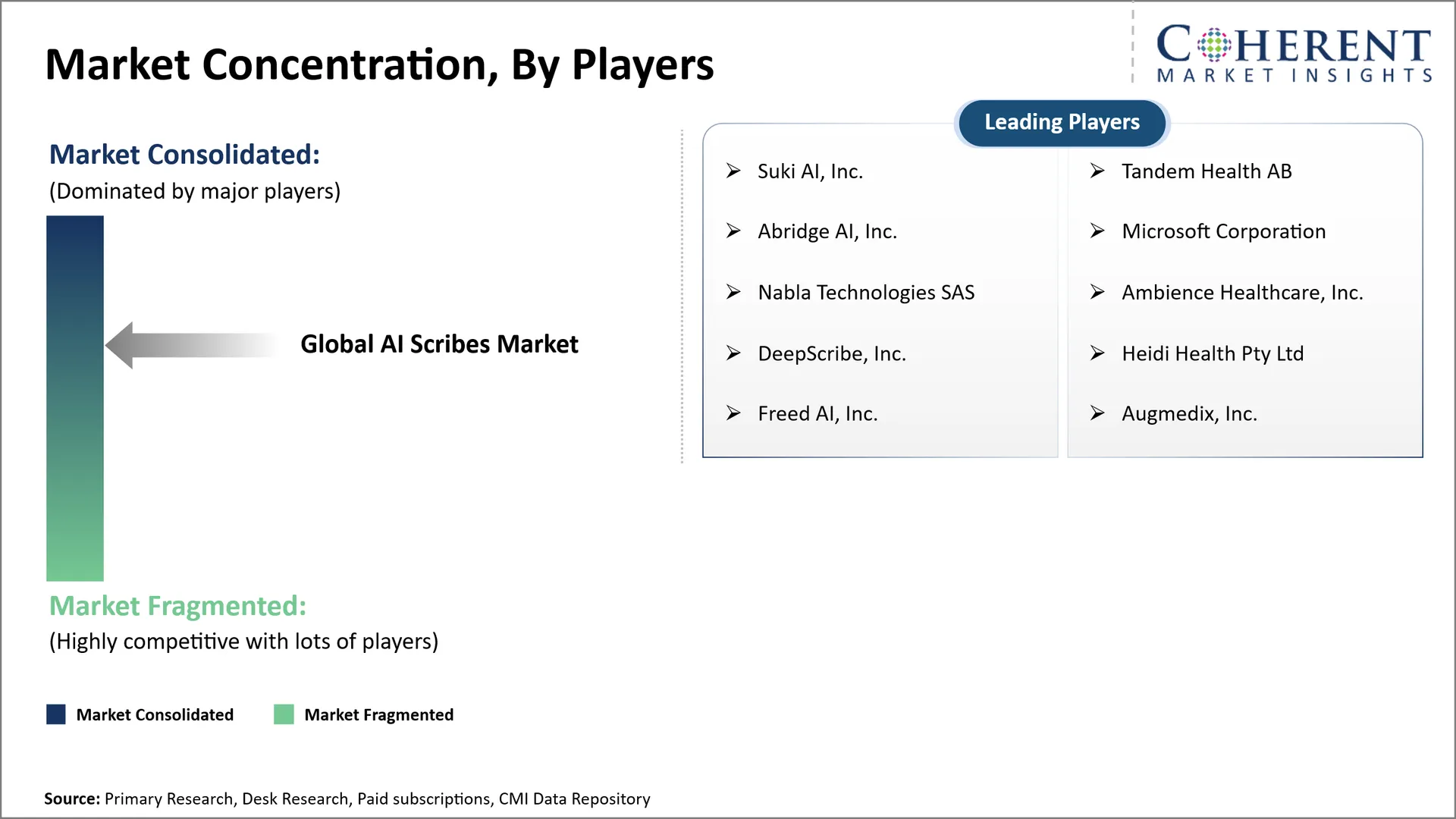
Companies covered: | Suki AI, Inc., Tandem Health AB, Abridge AI, Inc., Microsoft Corporation, Nabla Technologies SAS, Ambience Healthcare, Inc., DeepScribe, Inc., Heidi Health Pty Ltd, Freed AI, Inc., Augmedix, Inc. | ||
Growth Drivers: |
| ||
Restraints & Challenges: |
| ||
Analyst Opinion (Expert Opinion)
- In the coming years, global AI scribes market will be shaped by the shift from traditional speech-to-text documentation tools to ambient clinical workflows platforms. Increasing adoption of generative artificial intelligence, next-generation speech recognition, and electronic health record platforms will lead to an increasing level of contextual, specialty-specific, and automation-enabled clinical documentation. Long-term, AI scribes are expected to evolve beyond simple note generation to include clinical summarization, coding, billing, and broader administrative workflows.
- The significant growth opportunity is expected to be in Ambient AI Scribes of notes and documentation for the U.S. Ambient solutions can address the note and documentation load that often burdens high-volume clinical practices, while note generation in itself is one of the primaries, essential, and repeated workflows for the treating physician. The U.S. market has considerable commercialization potential based on the prevalence of the EHR environment, provider base, and the escalating attention to reducing administrative burden.
- In order to gain a competitive advantage market players should focus on clinical accuracy, specialty-adapted speech engines, and integration with popular EHRs as opposed to transcription features. Better privacy features, public note verification processes and multi-language features are the key to building provider trust and adoption. Additionally, market players should develop scalable solutions with granular pricing models and show quantifiable benefits in documentation efficiency and clinician productivity to win long-term healthcare contracts.
Speak to the analyst
Want personalized insights?
Take the findings above to one of our principal consultants, or have the report rebuilt around the segments, geographies and competitors you actually track.
Market Segmentation
- Type Insights (Revenue, USD Mn, 2021 - 2033)
- Ambient AI Scribes
- Real-Time Interactive AI Scribes
- Asynchronous AI Scribes
- Component Insights (Revenue, USD Mn, 2021 - 2033)
- Software and Platforms
- Services
- Application Insights (Revenue, USD Mn, 2021 - 2033)
- Clinical Documentation and Note Generation
- EHR Documentation and Integration
- Medical Coding and Billing
- Clinical Workflow Automation
- End User Insights (Revenue, USD Mn, 2021 - 2033)
- Hospitals and Health Systems
- Physician Practices and Clinics
- Ambulatory Care Centers
- Others
- Regional Insights (Revenue, USD Mn, 2021 - 2033)
- North America
- U.S.
- Canada
- Latin America
- Brazil
- Argentina
- Mexico
- Rest of Latin America
- Europe
- Germany
- U.K.
- Spain
- France
- Italy
- Russia
- Rest of Europe
- Asia Pacific
- China
- India
- Japan
- Australia
- South Korea
- ASEAN
- Rest of Asia Pacific
- Middle East
- GCC Countries
- Israel
- Rest of Middle East
- Africa
- South Africa
- North Africa
- Central Africa
- North America
- Key Players Insights
- Suki AI, Inc.
- Tandem Health AB
- Abridge AI, Inc.
- Microsoft Corporation
- Nabla Technologies SAS
- Ambience Healthcare, Inc.
- DeepScribe, Inc.
- Heidi Health Pty Ltd
- Freed AI, Inc.
- Augmedix, Inc.
Sources
Primary Research Interviews
- Physicians and clinicians using AI-powered clinical documentation solutions
- Clinical informatics specialists and healthcare IT professionals
- Hospital administrators and digital health implementation specialists
- EHR integration and clinical workflow management experts
Stakeholders
- AI scribe solution developers and technology providers
- Ambient AI and clinical documentation platform providers
- Electronic Health Record (EHR) software providers and integration partners
- Hospitals and multi-specialty health systems adopting AI scribing solutions
- Physician practices, outpatient clinics, and ambulatory care providers
- End-use Sectors
- Hospitals and health systems
- Physician practices and clinics
- Outpatient care settings
- Telehealth service providers
- Regulatory & Health Bodies
- NHS England
- Medicines and Healthcare products Regulatory Agency (MHRA), UK
- Office of the National Coordinator for Health Information Technology (ONC), U.S.
- U.S. Government Accountability Office (GAO)
Public Domain Sources
- NHS England – Guidance on AI-enabled ambient scribing products
- U.S. Government Accountability Office – Science & Tech Spotlight: AI for Medical Notes and Coding
- JAMA Network – Clinical documentation and AI scribe research
- JMIR Medical Informatics – AI scribe implementation research
Proprietary Elements
- CMI Data Analytics Tool, Proprietary CMI Existing Repository of information for last 10 years.
Get access to 250+ pages report
Every segment, forecast, competitor profile and data table behind the analysis above — available for instant download.
- ESOMAR Member
- ISO 9001:2015 Certified
- D-U-N-S Registered
- GDPR & CCPA Compliant
Frequently Asked Questions
The global AI scribes market is estimated to be valued at USD 1,420.0 Mn in 2026 and is expected to reach USD 5,260.0 Mn by 2033.
Ambient AI scribes dominate because of their ability to automate real-time clinical documentation to remove administrative burdens from doctors so they can focus on their patients.
AIT scribes are sophisticated technology that leverage artificial intelligence technology to transcribe the interaction that happens between the patient and the physician, which is then used to generate a clinical note to ease documentation workload.
The CAGR of global AI scribes market is projected to be 20.6% from 2026 to 2033.
Growing adoption of AI-powered clinical documentation solutions, and increasing need to reduce physicians' administrative and documentation workload are the major factors driving the growth of the global AI scribes market.
Data privacy and security concerns surrounding sensitive patient conversations, and integration challenges with existing Electronic Health Record (EHR) systems are the major factors hampering the growth of the global AI scribes market.
In terms of component, software and platforms are estimated to dominate the market revenue share in 2026.