

Global AI SoC Market Size and Forecast – 2026 To 2033
The global AI SoC market is expected to grow from USD 41.20 Bn in 2026 to USD 90.60 Bn by 2033, registering a compound annual growth rate (CAGR) of 11.6% from 2026 to 2033. The global AI SoC market is driven by growing deployment of advanced driver assistance systems. On September 5, 2025, Qualcomm Technologies, Inc. and BMW Group introduced Snapdragon Ride Pilot, the companies’ new automated driving system resulting from a three-year collaborative effort. This state-of-the-art AD system is built on Qualcomm Technologies’ Snapdragon Ride system-on-chips (SoCs) using the leading-edge Snapdragon Ride AD software stack co-developed by both companies.
Key Takeaways of the Global AI SoC Market
- The Central Processing Unit segment is expected to account for 34.0% of the global AI SoC market share in 2026. Expanding use of AI in smartphones and personal computers is driving the growth of the segment. On September 24, 2025, Qualcomm introduced the Snapdragon 8 Elite Gen 5 Mobile Platform. The processor integrates third-generation Qualcomm Oryon central processing unit cores and an upgraded Hexagon neural processing unit.
- The Integrated AI SoCs segment is estimated to capture 52.0% of the market share in 2026. Increasing demand for energy-efficient on-device inference is majorly driving the growth of the segment. On January 6, 2026, Ambiq Micro introduced its Atomiq system-on-chip. The processor integrates a neural processing unit based on its Subthreshold Power Optimized Technology platform.
- The Low-Performance AI SoCs segment is estimated to capture 44.0% of the market share in 2026. Growing investment in autonomous systems and industrial automation is driving the growth of the segment. On August 25, 2025, NVIDIA announced general availability of its Jetson AGX Thor developer kit and production modules. The platform uses NVIDIA Blackwell architecture for advanced robotics computing.
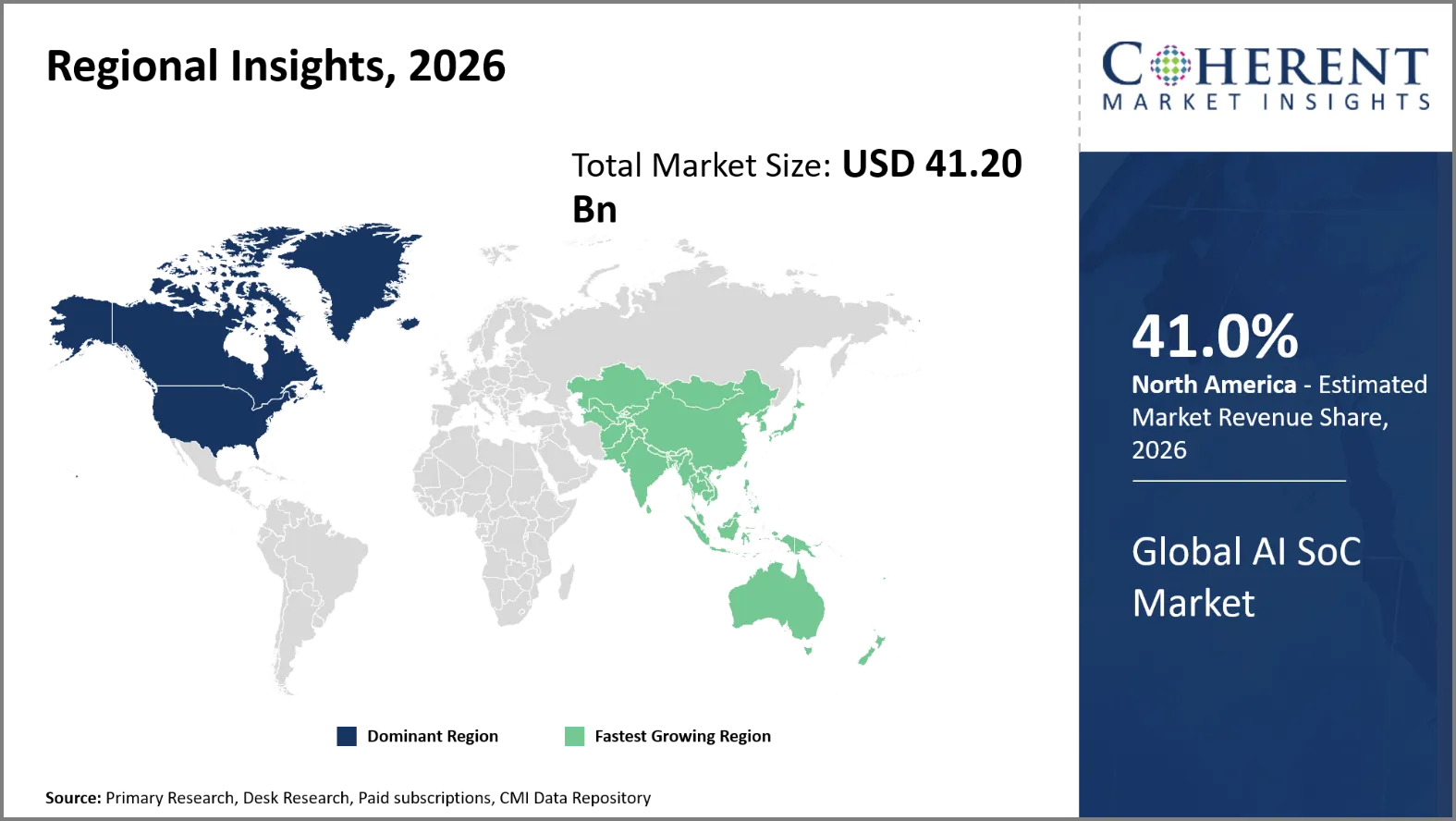
- North America is expected to dominate the AI SoC market in 2026 with a market share of 41.0%. Growing adoption of integrated neural processing units for consumer devices in North America is driving the growth of the regional market. On January 6, 2025, Qualcomm Technologies released the Snapdragon X platform, increasing its Snapdragon X Series range.
- Asia Pacific is expected to account for 33.0% share in 2026. Growing emphasis on low-power AI chips for IoT devices in Asia Pacific is driving the growth of the regional market. In July 2025, Renesas Electronics introduced its RA8P1 microcontroller family. The devices combine Arm Cortex-M85 and Cortex-M33 processors with an Arm Ethos-U55 neural processing unit.
Segmental Insights
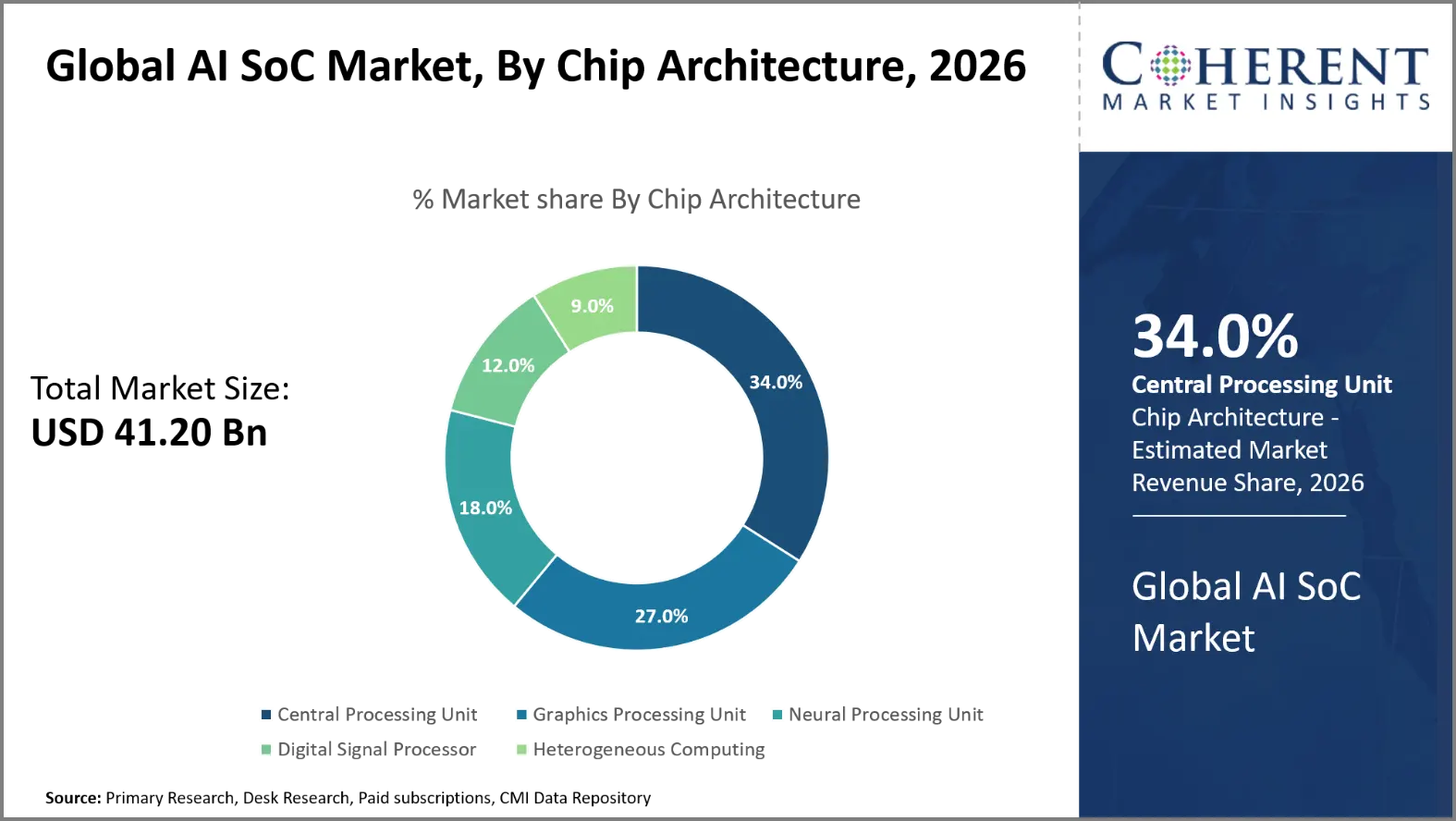
Why Does Central Processing Unit Dominate the Global AI SoC Market?
The central processing unit segment is expected to account for 34.0% of the global AI SoC market share in 2026. Central processing units dominate because of the flexible computing capabilities they give for a wide variety of AI tasks. They have a programmable architecture that can analyze data, run applications and coordinate systems. They also control operating systems, memory allocation, and communication amongst integrated hardware components. Compatibility with AI software frameworks will further drive use in consumer electronics, automotive systems, and industrial devices. More and more manufacturers are adding artificial intelligence acceleration to traditional processor architectures. This way, processing efficiency is increased and the need on separate computer elements is decreased.
On January 5, 2026, Intel unveiled Intel Core Ultra Series 3 processors, the first AI PC platform built on Intel 18A process technology that was designed and manufactured in the U.S. Powering over 200 designs from leading global partners, Series 3 will be the most broadly adopted and globally available AI PC platform Intel has ever delivered.
- Current Industry Events of 2026
- Market Size Estimation
- Regional Breakdown
- Competitive Landscape
- Customer Intelligence
- Segmental Analysis
- Pricing Analysis
- Key Market Drivers, Challenges & Future Trends
- Customized Insights Section
Why is Integrated AI SoCs the Most Crucial Integration Type?
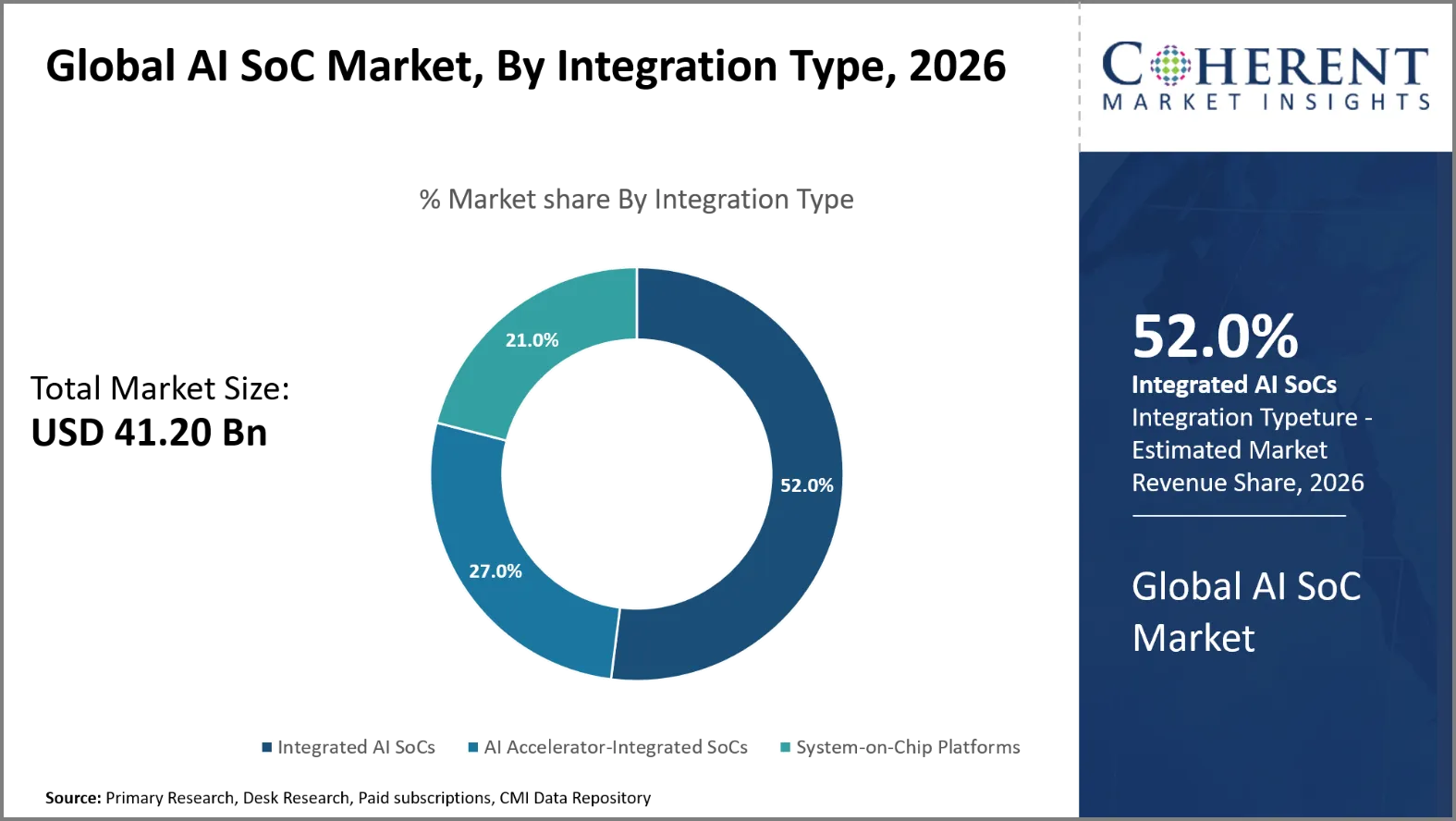
The integrated AI SoCs segment is expected to account for 52.0% of the global AI SoC market share in 2026. Integrated AI SoCs are a major class of integration since they integrate artificial intelligence processing capabilities into small semiconductor architectures. These technologies incorporate processor units, memory controllers and dedicated artificial intelligence accelerators on single chips. This architecture decreases communication latency among separated components and improves the efficiency of overall processing. Integrated designs also reduce power consumption and hardware complexity and system development expenses. They have a small architecture that allows them to be deployed on smartphones, smart home devices, automotive electronics and industrial equipment. The growing need for on-device artificial intelligence further fuels adoption.
On March 11, 2025, MediaTek introduced its Genio 720 and Genio 520 IoT platforms. The Taiwanese semiconductor company designed these integrated platforms for smart-home, retail, industrial, and commercial devices. Both platforms combine octa-core CPUs with dedicated neural processing units. Their integrated NPUs deliver up to 10 TOPS of AI performance.
Low-Performance AI SoCs Dominates the Global AI SoC Market
The low-performance AI SoCs segment is expected to account for 44.0% of the global AI SoC market share in 2026. Low-performance AI SoCs are the front runners, as many AI applications need efficient processing rather than significant computational power. The chips can carry out routine activities such as voice recognition, image enhancement, predictive maintenance and basic machine learning operations. They consume less power which makes them ideal for battery powered electronics and connected devices that are always on. Low production costs and easier hardware integration are also a plus for manufacturers. Smartphones, smart speakers, wearables and Internet of Things technology are also in strong demand. The category is also driven by the increasing deployment of edge artificial intelligence.
On October 28, 2025, Nuvoton Technology launches NuMicro M55M1 AI microcontroller. The business paired an Arm Cortex-M55 processor with an Arm Ethos-U55 neural processing unit. The NPU provides up to 110 GOPS of compute performance. The chip is aimed at entry-level edge AI applications such as keyword recognition, intelligent audio, facial recognition, and anomaly detection.
Current Events and their Impact
Current Events | Description and its Impact |
European Union Artificial Intelligence Act Regulation (EU) 2024/1689 |
|
U.S. Advanced Semiconductor Export Control Regulation 89 FR 96790; 90 FR 4544; 91 FR 1684 |
|
AI SoC Market Dynamics
Market Drivers
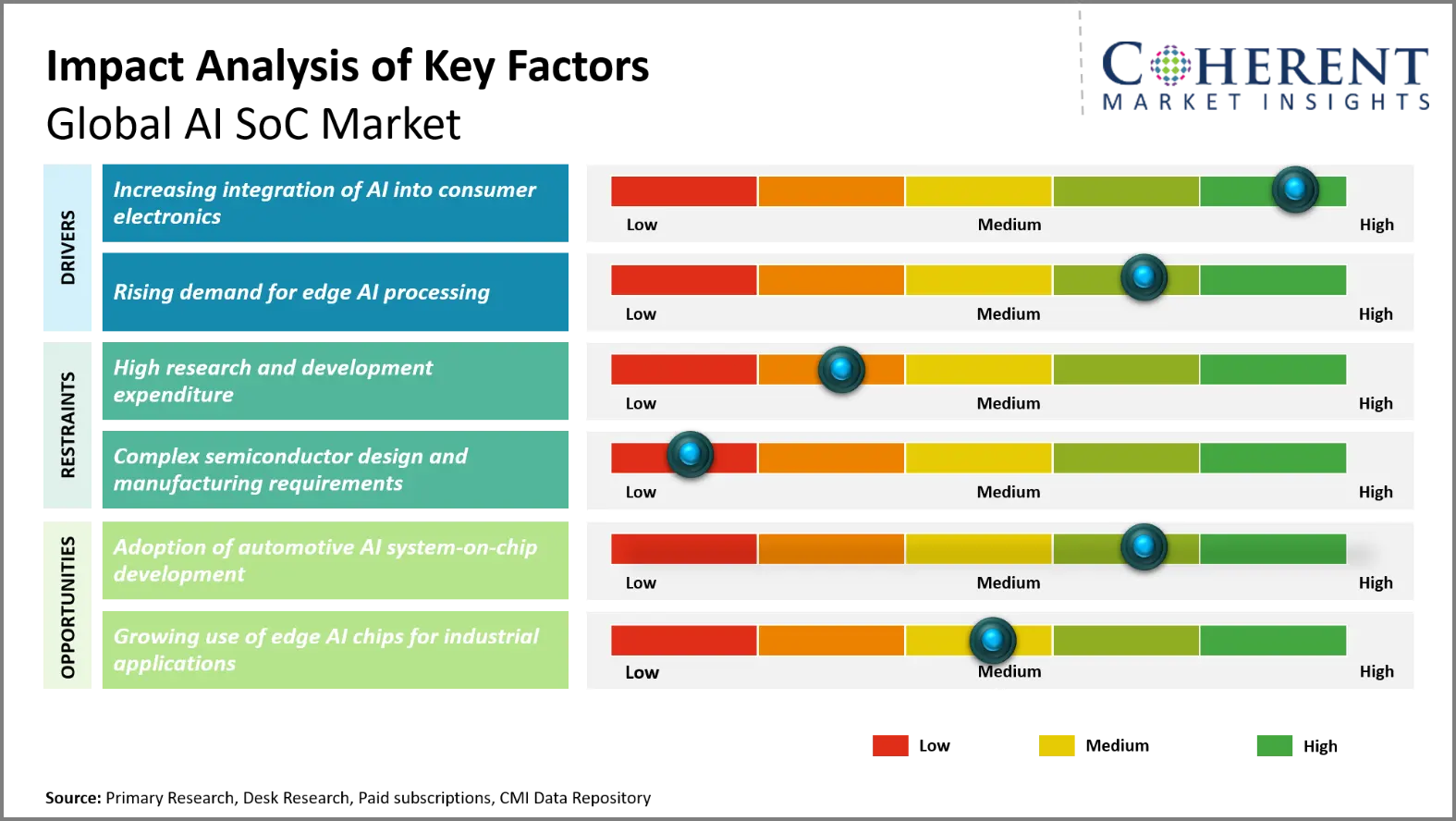
- Increasing integration of AI into consumer electronics: Growing integration of artificial intelligence in consumer electronics propels the demand for specialized AI System-on-Chip solutions. Smartphones, computers, televisions and smart home gadgets are embedding increasingly advanced computing capabilities. These applications include speech recognition, image improvement, personalized suggestion and real-time language processing. Chipmakers have been adding neural processing units to speed up artificial intelligence workloads and reduce reliance on cloud computing. The growing deployment of generative AI capabilities pushes the demand for integrated AI SoCs further. This trend forces semiconductor makers to produce tiny and power-efficient computers with enhanced computing capability. Rising consumer expectations for intelligent device functionality continue strengthening market demand.
- On January 23, 2025, Samsung Electronics announced the Galaxy S25 Ultra, Galaxy S25+ and Galaxy S25, setting a new standard as a true AI companion with most natural and context-aware mobile experiences ever created. Introducing multimodal AI agents, the Galaxy S25 series is the first step in Samsung’s vision to change the way users interact with their phone.
- Rising demand for edge AI processing: Rising demand for edge AI processing supports the adoption of AI SoCs across connected devices and industrial applications. Edge computing allows artificial intelligence workloads to be run closer to where data is created. This reduces latency, eliminates network dependency and improves real-time decision making. Applications include driverless cars, industrial robots, surveillance systems, medical gadgets and Internet of Things devices. These devices are designed with dedicated neural processing units for running machine learning algorithms efficiently. Increasing worries about data privacy and the cost of cloud infrastructure also promote local processing. Therefore, manufacturers are progressively developing customized AI SoCs that provide lower power consumption, faster inference and compact integration.
- On October 15, 2025, Synaptics Incorporated introduced its new Astra SL2600 Series multimodal Edge AI processors, promising excellent power and performance. The Astra SL2600 series is the next generation of low-cost intelligent devices that enable the cognitive Internet of Things (IoT).
Emerging Trends
- Integration of Generative AI Accelerators: AI SoC makers are now increasingly including dedicated neural processing units and generative artificial intelligence accelerators. These components allow smartphones, laptops and smart devices to run complicated artificial intelligence tasks locally.
- Impact: This minimizes dependence on cloud, improves energy efficiency and makes inference faster. It’s also powering powerful generative AI capabilities across consumer and enterprise devices.
- Relevance to the market: The growing use of on-device generative artificial intelligence is boosting demand for integrated AI SoCs. To boost performance and commercial competitiveness, semiconductor manufacturers are focusing on customized architectures.
- Development of Energy-Efficient Edge AI SoCs: Semiconductor makers are progressively developing low-power AI SoCs for edge computing applications. They allow real-time inference for industrial equipment, automotive electronics, surveillance systems and connected gadgets.
- Impact: Energy efficient architectures minimize the operating cost, processing delays and network dependency. They also boost the performance of the battery and enable uninterrupted AI activities across connected devices.
- Relevance to the market: Increasing AI adoption presents opportunity for specialized AI SoC vendors. The need for small computers that can perform inference efficiently, have connectivity built-in, and can compute reliably is growing.
Regional Insights
Why is North America a Strong Market for AI SoC?
North America is expected to account for a market share of 41.0% in 2026. North America benefits from AI SoC development through hyperscale computer infrastructure, semiconductor design innovation, and advanced AI deployment. NVIDIA builds GPU architectures for AI inference and training. Advanced Micro Devices makes embedded CPUs and accelerators called Instinct. Qualcomm adds AI processing to more Snapdragon platforms. Intel designs integrated processors that power AI personal PCs and edge applications. Microsoft, Amazon and Google are building more bespoke silicon for their cloud infrastructure. This helps bolster regional demand for specialized computing architectures. As investments in AI infrastructure increase, semiconductor designers are creating processors that allow for high-performance computing, accelerated workloads, and energy-efficient data processing.
Why Does Asia Pacific AI SoC Market Exhibit High Growth?
Asia Pacific is expected to register the fastest growth with a CAGR of 11.0% over the forecast period. It is projected to account for 33.0% of the global AI SoC market in 2026. Asia Pacific draws advantage from semiconductor manufacturing capabilities, modern packaging infrastructure and growing artificial intelligence hardware production. Taiwan Semiconductor Manufacturing Company manufactures innovative processors for premier semiconductor design companies. Samsung Electronics produces and researches semiconductor fabrication technology and integrated processors. SK Hynix Provides High-Bandwidth Memory for Next-Generation Artificial Intelligence Computing Systems Japan boosts semiconductor research with Rapidus, existing equipment vendors China's Huawei builds Ascend CPUs to power its local artificial intelligence infrastructure. South Korea’s memory makers are supporting high-performance computer needs. Investments in semiconductor fabrication, packaging and memory technologies are boosting AI SoC development in the region. Closer coordination between chip designers and manufacturing facilities helps to shore up regional supply chain capabilities.
Global AI SoC Market Outlook for Key Countries
Why is U.S. Emerging as a Major Hub in the AI SoC Market?
The U.S. gains from the creation of specialized artificial intelligence processors, hyperscale cloud infrastructure, and cutting-edge semiconductor design. Blackwell GPUs NVIDIA Blackwell GPUs for faster computation and generative artificial intelligence Advanced Micro Devices manufactures Instinct accelerators for demanding computer applications. Qualcomm incorporates hexagon neural processing units into Snapdragon systems. Apple designs Neural Engine technology that enables on-device intelligence across its products. Amazon makes Trainium and Inferentia chips for cloud applications. Google builds Tensor Processing Units for training and inference in artificial intelligence. Microsoft builds Maia accelerators for its cloud infrastructure. These investments drive local AI SoC innovation. The increasing need for specific cloud computing drives the customization of processors and the optimization of architectures.
Is China the Next Growth Engine for the AI SoC Market?
The development of domestic artificial intelligence infrastructure and the localization of semiconductor technology are in China's interests. Huawei makes Ascend CPUs for AI training and inference. Cambricon makes custom artificial intelligence accelerator chips. Alibaba makes its own chips for its cloud computing infrastructure. Baidu manufactures Kunlun AI CPUs for intelligent computing applications. Semiconductor manufacturing activities are helping to create indigenous processors. Chinese artificial intelligence firms are increasingly turning to domestically made computing technologies. They are also building their software ecosystems and processor architectures to serve the domestic semiconductor producers. These activities are intended to stimulate the development of AI SoCs for use in cloud computing, telephony, industrial automation and intelligent products. Opportunities for Chinese semiconductor designers are rising on the back of growing demand for domestic computing infrastructure.
Taiwan AI SoC Market Analysis and Trends
Taiwan has developed advanced semiconductor production, foundry expertise and sophisticated packaging skills. The chips that are designed by NVIDIA, Apple and Advanced Micro Devices are made by Taiwan Semiconductor Manufacturing Company. Its fabrication facilities are designed to accommodate complicated chip architectures and the rigorous requirements of artificial intelligence computing. MediaTek produces CPUs with artificial intelligence capabilities for smartphones and linked devices. Realtek designs semiconductor technologies that assist communication and networking applications. ASE Technology Holding offers semiconductor assembly and packaging. These capabilities bolster Taiwan’s position in global AI SoC supply chains. The growing demand for sophisticated packaging and high-performance computing processors is pushing more innovation in semiconductor production. Taiwan's specialized manufacturing ecosystem offers a wide variety of AI processor designs.
Japan AI SoC Market Analysis and Trends
Japan has advanced expertise in semiconductor equipment, automotive electronics, robotics, and specialized processor development. Renesas Electronics manufactures automotive processors for intelligent car systems and advanced driver assistance applications. Sony Semiconductor Solutions develops image sensors supporting computer vision and artificial intelligence applications. Toshiba develops semiconductor technologies for industrial and automotive applications. Rapidus is boosting the country’s semiconductor manufacturing capacity through research and development partnerships. Tokyo Electron provides equipment that supports advanced chip manufacture for semiconductor manufacturing. The Japanese robotics sector also needs processors that are efficient enough to allow for real-time sensing and control. Increasing car electrification provides prospects for smart semiconductor integration. These breakthroughs are driving AI SoC applications in manufacturing, mobility and industrial automation.
South Korea AI SoC Market Analysis and Trends
South Korea benefits from advanced memory manufacturing, semiconductor integration, and artificial intelligence infrastructure development. Samsung Electronics develops Exynos processors integrating artificial intelligence capabilities for mobile applications. Samsung also develops technologies for semiconductor fabrication and packaging. SK Hynix provides high-bandwidth memory to support powerful artificial intelligence accelerators. Its memory technology power heavy computational workloads across data centers. Rebellions develop specialized artificial intelligence processors for inference applications. FuriosaAI develops neural processing units supporting efficient artificial intelligence computing. Increased collaboration between semiconductor makers and artificial intelligence developers spurs domestic innovation. South Korean memory power backs sophisticated AI SoC designs. The expanding uses of intelligent computing present potential in automobile electronics, telecommunications, and industrial systems.
Global AI SoC Market - AI Chipset Shipments by Application (2025)
Application | 2025 Shipments (Million Units) |
Audio and Sound Processing | 102.8 |
Machine Vision | 206.6 |
Sensor Data Analysis | 192.6 |
Display Technologies | 84.0 |
Gateway Processing | 122.9 |
On-Premises Server Processing | 2.5 |
Network Processing | 102.8 |
How is Adoption of Automotive AI System-on-Chip Development Creating New Growth Opportunities in the AI SoC Market?
Automotive AI SoC development unlocks growth prospects in intelligent driving systems, centralized vehicle computing and software-defined vehicle architectures. Advanced driver assistance and automated driving applications are supported on NVIDIA DRIVE Thor and Qualcomm Snapdragon Ride platforms. Volkswagen Group and NXP Semiconductors formed a strategic partnership in October 2026 to drive standardized semiconductor architectures for future software-defined automobiles. They work together in pairs of zonal controllers and central computer processors, which reduces the complexity of the electronic control units. This design offers over-the-air upgrades, car safety functions and scalable software integration. The rising use of intelligent cockpit systems, camera-based perception, and automotive sensor processing drives manufacturers to build specialized AI SoCs.
On October 21, 2025, NXP Semiconductors announced the i.MX 952 applications processor, part of NXP’s i.MX 9 series. The i.MX 952 applications processor is designed for AI-enabled vision, human-machine interfaces (HMIs) and in-cabin sensing applications, using sensor fusion powered by the integrated eIQ Neutron Neural Processing Unit to deliver driver monitoring, child presence detection and more.
Market Players, Key Development, and Competitive Intelligence
Key Developments
- On July 23, 2026, AMD introduced the AMD Ryzen AI Embedded X100 Series processors, delivering leadership performance for the demands of physical AI. Designed to accelerate perception, reasoning and real-time control workloads, these processors integrate up to 16 high-performance AMD Zen 5 CPU cores, a discrete-class integrated GPU and power-efficient NPU on a single embedded SoC.
- On June 24, 2026, OpenAI and Broadcom unveiled Jalapeño, an accelerator architected around OpenAI’s vision for the future of LLM inference, and the first AI accelerator in a multi-generation compute platform the companies are building together to make advanced AI faster, more reliable, and more accessible to more people.
- On March 24, 2026, Arm Holdings plc announced the next evolution of the Arm compute platform, extending into production silicon products for the first time in the company’s history. This begins with the launch of the Arm AGI CPU, an Arm-designed CPU for AI data centers, built to address a rising class of agentic AI workloads.
Competitive Landscape
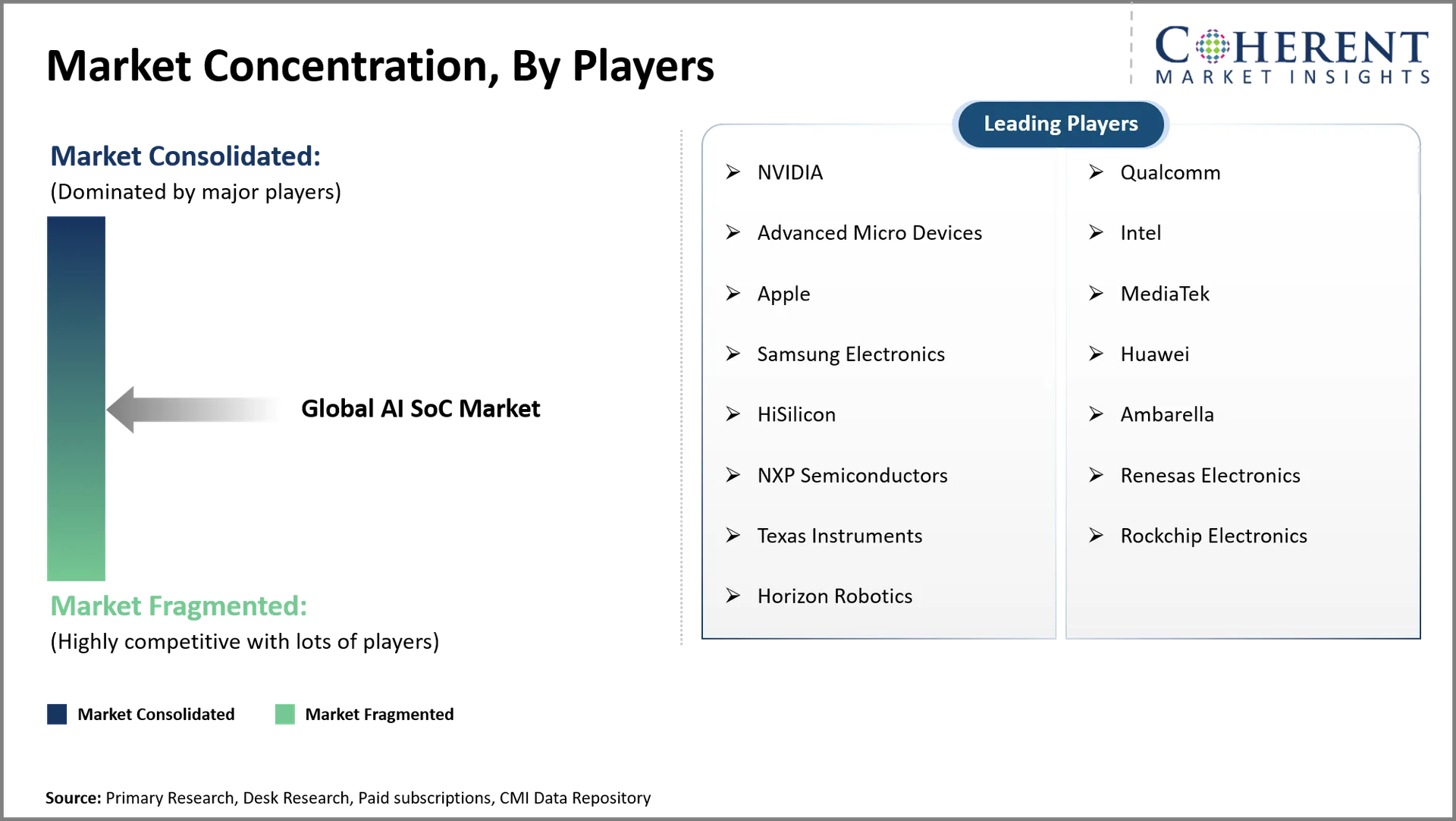
NVIDIA leads advanced AI SoC development through Blackwell GPUs and CUDA software integration. Its focus is on infrastructure for faster computing, AI training, and inference. Advanced Micro Devices is competing with Instinct accelerators and EPYC CPUs for high-performance computing. Qualcomm’s Snapdragon platforms and Hexagon neural processing units are targeting smartphones, automotive systems and edge computing. Apple designs integrated Neural Engine technology that powers on-device intelligence across its product ecosystem. Google builds Tensor Processing Units for artificial intelligence workloads in the cloud. Huawei builds Ascend chips to enable local AI infrastructure Semiconductor Manufacturing Company raises the stakes in competitiveness with sophisticated fabrication and packaging capability. They include architectural diversity, software compatibility, power efficiency, and particular computing applications.
Top Manufacturers and Notable Products in the AI SoC Market
Manufacturer | Notable Product | Key features |
NVIDIA | GB10 Grace Blackwell Superchip | Combines Grace CPU and Blackwell GPU architecture, supports 128 GB unified memory, enables local AI model development and inference |
Qualcomm | Snapdragon 8 Elite Gen 5 | Integrates Qualcomm Oryon CPU, Adreno GPU, and Hexagon NPU, supports generative AI processing, provides advanced on-device inference and power-efficient computing |
Apple | M5 | Integrates CPU, GPU, Neural Engine, and unified memory architecture, supports on-device AI workloads, accelerates machine learning and graphics processing |
Advanced Micro Devices | Ryzen AI Embedded X100 | Combines Zen 5 CPU, RDNA 3.5 GPU, and XDNA 2 NPU, supports up to 50 AI TOPS, targets robotics and autonomous embedded systems |
MediaTek | Dimensity 9500 | Integrates an all-big-core CPU, Arm GPU, and ninth-generation NPU, supports generative AI processing, improves power efficiency and on-device AI performance |
Market Report Scope
Global AI SoC Market Report Coverage | |||
Report Coverage | Details | ||
Base Year | 2025 | Market Size in 2026: | USD 41.20 Bn |
Historical Data For: | 2020 To 2024 | Forecast Period: | 2026 To 2033 |
Forecast Period 2026 To 2033 CAGR: | 11.60% | 2033 Value Projection: | USD 90.60 Bn |
Geographies covered: |
| ||
Segments covered: |
| ||
Companies covered: | NVIDIA, Qualcomm, Advanced Micro Devices, Intel, Apple, MediaTek, Samsung Electronics, Huawei, HiSilicon, Ambarella, NXP Semiconductors, Renesas Electronics, Texas Instruments, Rockchip Electronics, Horizon Robotics | ||
Growth Drivers: |
| ||
Restraints & Challenges: |
| ||
Analyst Opinion (Expert Opinion)
- The future of the AI SoC industry will increasingly depend on specialized computing architectures and efficient artificial intelligence inference. Generative artificial intelligence will expand processor requirements across consumer electronics, automotive systems, robotics, and enterprise infrastructure. Manufacturers will be interested in local processing, lower latency and decreased power consumption and therefore integrated AI SoCs will become more and more significant. It’s up to semiconductor makers to design architectures that are optimized for computing performance, memory bandwidth and thermal efficiency. Advanced packaging will also become increasingly crucial to combine processors and memory and accelerators together. There will be opportunities for those building flexible architecture in growing artificial intelligence use cases.
- Integrated AI SoCs that support edge computing, automotive intelligence and intelligent consumer electronics will present the strongest potential. Opportunities in automotive applications include enhanced driver assistance systems, intelligent cockpit processors, and centralized vehicle computing. Consumer electronics makers need chips that can run generative artificial intelligence, image processing and speech recognition. There are potential for cloud computing infrastructure and advanced semiconductor design in the U.S. Taiwan has prospects through superior manufacturing and packaging capabilities. South Korea is providing prospects through memory integration and smart semiconductor development. China offers potential with the development of its own artificial intelligence gear.
- Market participants should enhance distinctiveness through application-specific architectures, enhanced packaging and software optimization. For semiconductor designers, the focus should be on neural processing units that allow for efficient inference and demanding computational workloads. Car vendors need to build processors that meet functional safety, reliability and automotive qualification standards. Local capabilities for generative artificial intelligence should be enhanced by consumer electronics vendors, while power consumption should be reduced. Companies should have strategic relationships with foundries, packaging companies and software houses. Diversifying production regionally can enhance supply chain resilience. Strong software compatibility, predictable performance, and efficient memory integration will help manufacturers secure customer adoption.
Speak to the analyst
Want personalized insights?
Take the findings above to one of our principal consultants, or have the report rebuilt around the segments, geographies and competitors you actually track.
Market Segmentation
- Chip Architecture Insights (Revenue, USD Billion, 2021 - 2033)
- Central Processing Unit
- Graphics Processing Unit
- Neural Processing Unit
- Digital Signal Processor
- Heterogeneous Computing
- Integration Type Insights (Revenue, USD Billion, 2021 - 2033)
- Integrated AI SoCs
- AI Accelerator-Integrated SoCs
- System-on-Chip Platforms
- Processing Capability Insights (Revenue, USD Billion, 2021 - 2033)
- Low-Performance AI SoCs
- Mid-Range AI SoCs
- High-Performance AI SoCs
- Application Insights (Revenue, USD Billion, 2021 - 2033)
- Consumer Electronics
- Smartphones and Tablets
- Personal Computers
- Automotive
- Data Centers and Edge Servers
- Industrial Automation
- Healthcare Devices
- Others
- Regional Insights (Revenue, USD Billion, 2021 - 2033)
- North America
- U.S.
- Canada
- Latin America
- Brazil
- Argentina
- Mexico
- Rest of Latin America
- Europe
- Germany
- U.K.
- Spain
- France
- Italy
- Russia
- Rest of Europe
- Asia Pacific
- China
- India
- Japan
- Australia
- South Korea
- ASEAN
- Rest of Asia Pacific
- Middle East
- GCC Countries
- Israel
- Rest of Middle East
- Africa
- South Africa
- North Africa
- Central Africa
- North America
- Key Players Insights
- NVIDIA
- Qualcomm
- Advanced Micro Devices
- Intel
- Apple
- MediaTek
- Samsung Electronics
- Huawei
- HiSilicon
- Ambarella
- NXP Semiconductors
- Renesas Electronics
- Texas Instruments
- Rockchip Electronics
- Horizon Robotics
Sources
Primary Research Interviews
- AI SoC Chip Designers & Architects
- Semiconductor Manufacturers & Foundries
- AI Hardware Solution Providers
- Consumer Electronics & Automotive OEMs
Magazines
- IEEE Spectrum
- EE Times (Electronic Engineering Times)
- Semiconductor Digest
- Electronics Weekly
Journals
- IEEE Journal of Solid-State Circuits
- Journal of Semiconductor Technology and Science
- ACM Transactions on Embedded Computing Systems
Associations
- Semiconductor Industry Association (SIA)
- SEMI (Global Semiconductor Equipment & Materials International)
- Consumer Technology Association (CTA)
- Edge AI and Vision Alliance
Public Domain Sources
- U.S. Semiconductor Industry Data - U.S. Department of Commerce
- European Chips Act - European Commission Official Portal
- World Semiconductor Trade Statistics (WSTS)
- USPTO (U.S. Patent and Trademark Office) - AI SoC Patent Filings
Proprietary Elements
- CMI Data Analytics Tool
- Proprietary CMI Existing Repository of information for last 10 years
Get access to 250+ pages report
Every segment, forecast, competitor profile and data table behind the analysis above — available for instant download.
- ESOMAR Member
- ISO 9001:2015 Certified
- D-U-N-S Registered
- GDPR & CCPA Compliant
Frequently Asked Questions
The global AI SoC market is expected to stand at USD 41.20 Bn in 2026 and is expected to reach USD 90.60 Bn by 2033.
The CAGR of the global AI SoC market is projected to be 11.6% from 2026 to 2033.
Increasing integration of AI into consumer electronics and Rising demand for edge AI processing are the major factors driving the growth of the global AI SoC market.
High research and development expenditure and Complex semiconductor design and manufacturing requirements are the major factors hampering the growth of the global AI SoC market.
In terms of chip architecture, central processing unit segment is estimated to dominate the market revenue share in 2026.
The global AI SoC market comprises integrated semiconductor chips combining processing components and artificial intelligence acceleration capabilities.
Neural processing units accelerate artificial intelligence operations while improving processing efficiency and power management.