
Flat 45% off this market research report
Nov 26 – 29 · Direct purchase only · Not applicable to customized reports

Global AI Synthetic Training Data Platforms Market Size and Forecast – 2026 To 2033
The global AI synthetic training data platforms market is expected to grow from USD 0.95 Bn in 2026 to USD 5.40 Bn by 2033, registering a compound annual growth rate (CAGR) of 28.2% from 2026 to 2033. The global AI synthetic training data platforms market is driven by rising privacy requirements for enterprise AI development services. On November 24, 2025, SAS Data Maker was made available in the Microsoft Marketplace, the unified online destination for customers to buy trusted cloud solutions, AI apps and agents to meet their business needs.
Key Takeaways of the Global AI Synthetic Training Data Platforms Market
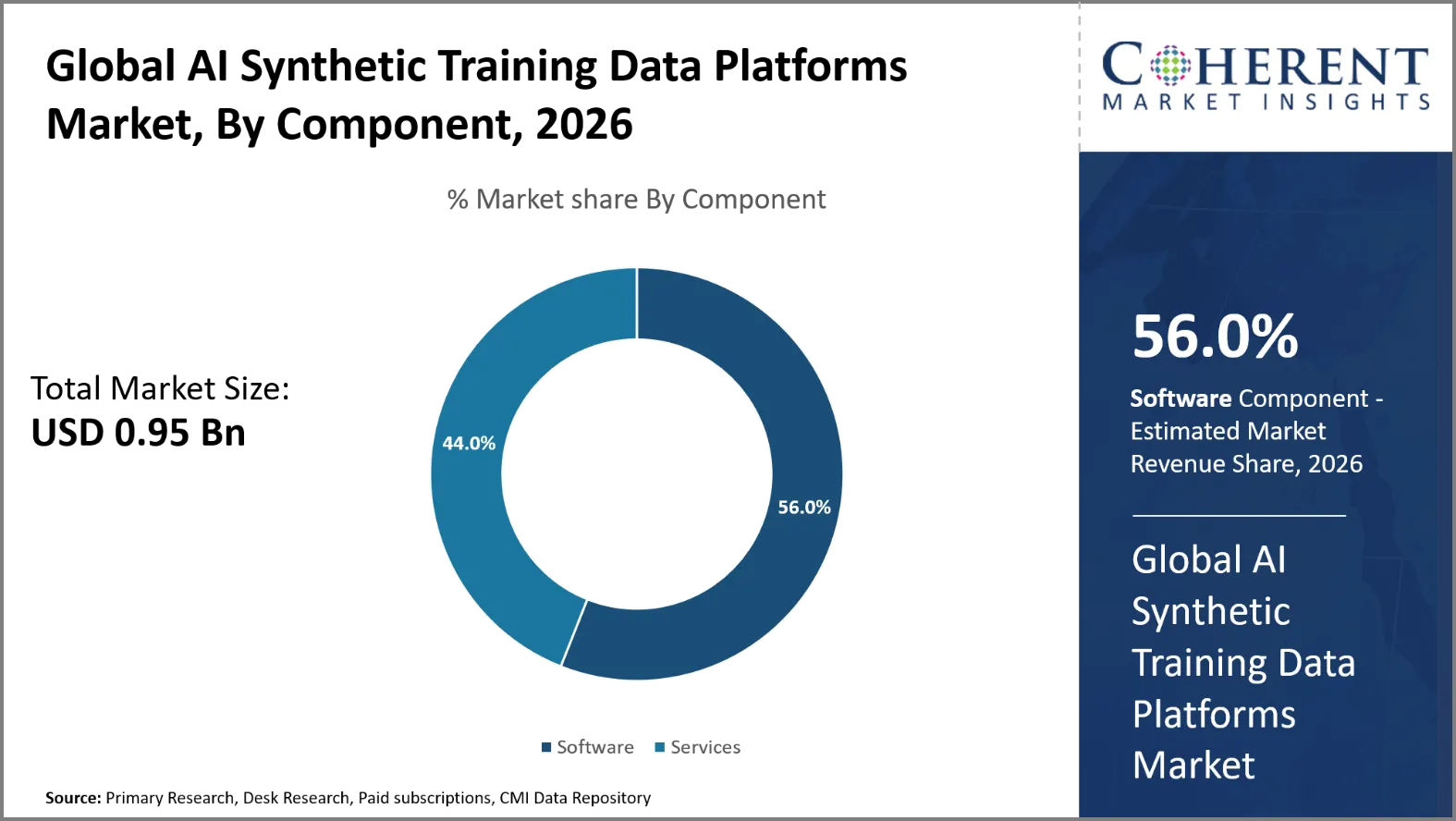
- The Software segment is expected to account for 56.0% of the global AI synthetic training data platforms market share in 2026. Increasing adoption of generative AI and foundation models is driving the growth of the segment. On February 10, 2026, Athenatech AI launched its subsidiary AxxonAI with a synthetic data intelligence platform. The platform combines large language models, Generative Adversarial Networks, and retrieval-augmented generation.
- The Cloud-Based segment is estimated to capture 52.0% of the market share in 2026. Growing demand for synthetic data in autonomous vehicle training is majorly driving the growth of the segment. On March 26, 2025, Wayve launched GAIA-2, a generative video world model for assisted and automated driving. The platform generates controllable driving scenarios with improved environmental diversity and realism.
- The Generative Adversarial Networks segment is estimated to capture 34.0% of the market share in 2026. Expansion of computer vision and robotics simulation environments is driving the growth of the segment. On January 15, 2026, DataMesh launched DataMesh Robotics for industrial embodied artificial intelligence training. The platform uses executable industrial digital twins to generate dynamic synthetic environments.
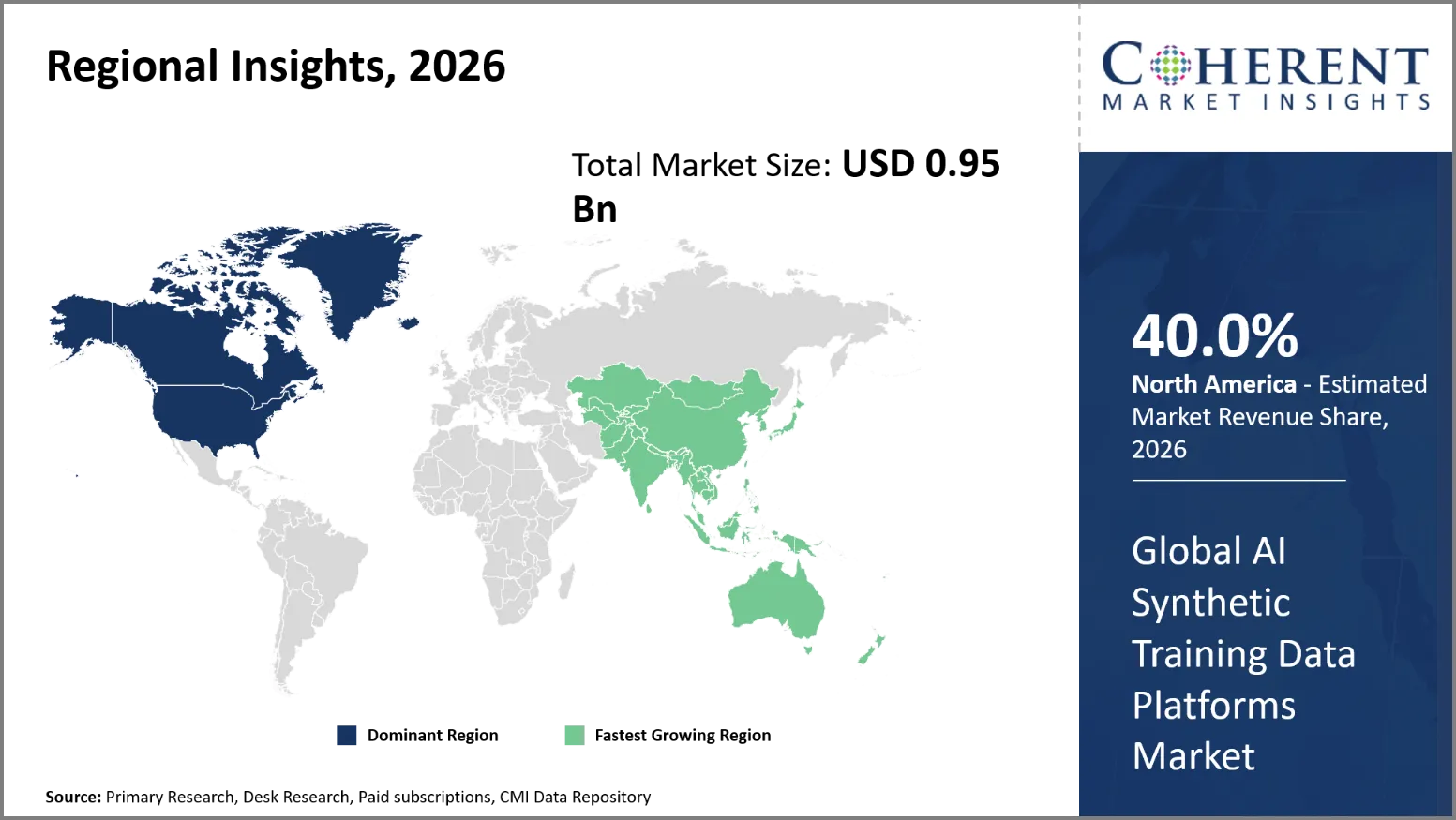
- North America is expected to dominate the AI synthetic training data platforms market in 2026 with a market share of 40.0%. Development of privacy-preserving synthetic healthcare datasets in North America is driving the growth of the regional market. On November 30, 2025, Amazon Web Services introduced privacy-enhancing synthetic dataset generation within AWS Clean Rooms. The capability enables collaborating organizations to generate artificial datasets from combined confidential information.
- Asia Pacific is expected to account for 27.0% share in 2026. Creation of multilingual synthetic datasets for large language models in Asia Pacific is driving the growth of the regional market. On October 13, 2025, NVIDIA released Nemotron-Personas-India, an open synthetic dataset designed for culturally representative Indian artificial intelligence development. The dataset contains 21 million synthetic personas and approximately 7.7 billion tokens.
Segmental Insights
Why Does Software Dominate the Global AI Synthetic Training Data Platforms Market?
The software segment is expected to account for 56.0% of the global AI synthetic training data platforms market share in 2026. Organizations need to be able to generate synthetic datasets at scale, which is why software prevails. These platforms automate the generation, transformation, labeling, validation, and augmentation of data. They support structured, unstructured, picture, video, text and tabular datasets. Plus, the software platforms are integrated with machine learning workflows and interface with the existing company data infrastructure. Companies employ these capabilities to lessen their reliance on costly data collection in the real world. They also address privacy limitations and the absence of representative training datasets.
On April 22, 2025, Tonic.ai, the leader in privacy-preserving data synthesis, announced that it has acquired Fabricate, the state-of-the-art synthetic data generation tool from Mockaroo. As part of the acquisition, Fabricate’s creator and Mockaroo CEO & Founder, Mr. Mark Brocato, will join the Tonic.ai team to lead the product’s continued development.
- Current Industry Events of 2026
- Market Size Estimation
- Regional Breakdown
- Competitive Landscape
- Customer Intelligence
- Segmental Analysis
- Pricing Analysis
- Key Market Drivers, Challenges & Future Trends
- Customized Insights Section
Why is Cloud-Based the Most Preferred Deployment Type?
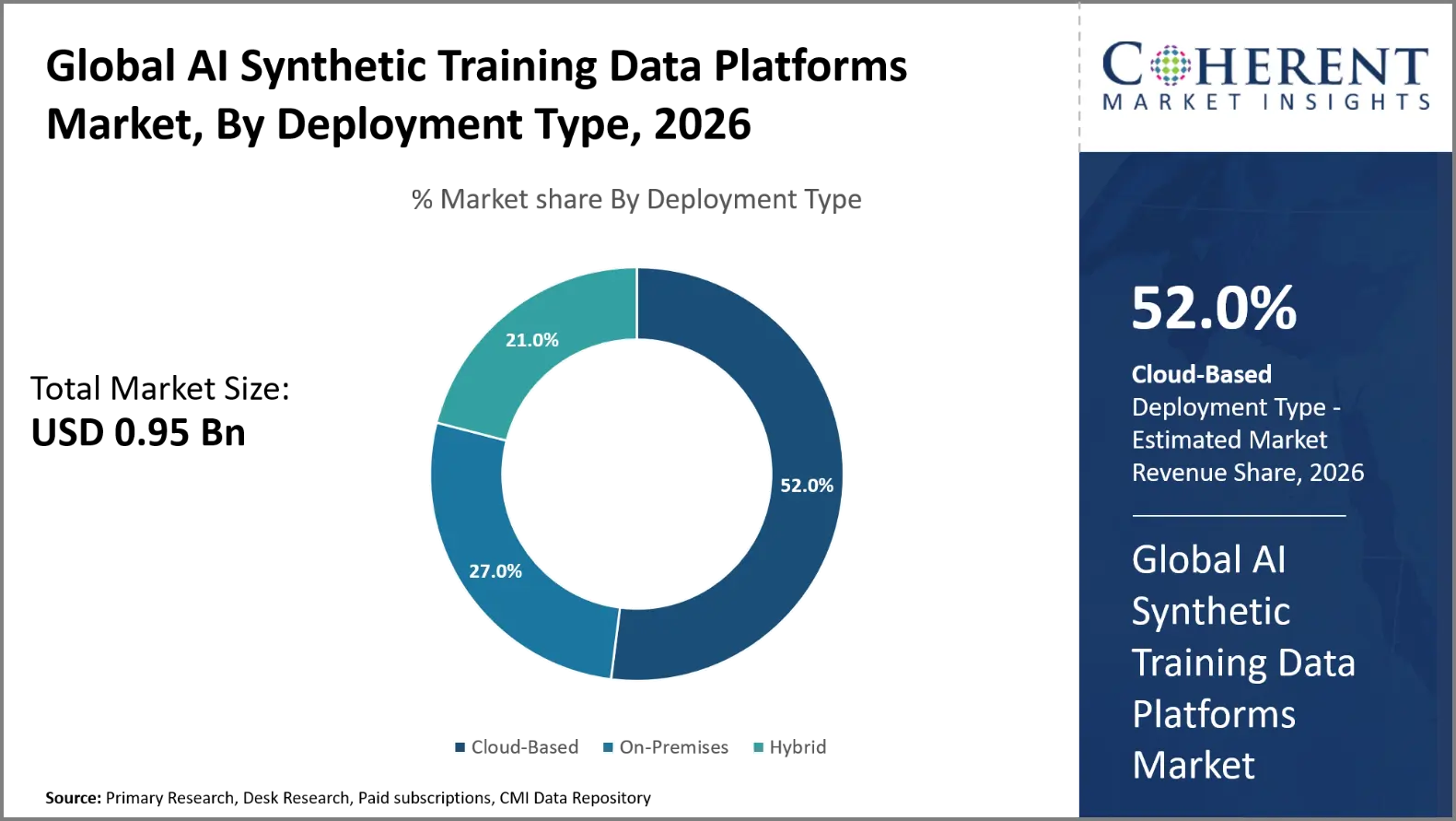
The cloud-based segment is expected to account for 52.0% of the global AI synthetic training data platforms market share in 2026. Cloud-based deployment is preferred because synthetic data generation requires substantial computing resources. Cloud infrastructure can supply elastic processing capability for massive dataset creation workloads. That allows organizations to scale up their computer resources without purchasing dedicated hardware. Cloud systems also facilitate collaboration among geographically dispersed data science teams. They offer centralized dataset administration, automated pipelines, and connection with cloud-based machine learning environments. Infrastructure for synthetic data workloads is provided by Amazon Web Services, Microsoft Azure and Google Cloud.
On June 11, 2025, Nebius and Saturn Cloud launched a GPU-powered MLOps cloud. Their offering combines Nebius AI Cloud infrastructure with Saturn Cloud’s machine learning platform. Users receive on-demand access to NVIDIA Hopper GPUs. Data science teams can run notebooks, jobs, and deployments without purchasing dedicated accelerators.
Generative Adversarial Networks Dominates the Global AI Synthetic Training Data Platforms Market
The generative adversarial networks segment is expected to account for 34.0% of the global AI synthetic training data platforms market share in 2026. Generative Adversarial Networks dominate synthetic data generation because they produce realistic datasets through competitive neural network training. Their design consists of a generator and a discriminator that iteratively improve the quality of synthetic data. The generator makes fake samples and the discriminator tries to figure out how close they are to genuine datasets. This adversarial method can assist in generating realistic photos, videos and structured training data. Generative Adversarial Networks are especially useful for autonomous driving and computer vision applications. Automotive developers employ synthetic road sceneries to educate perception systems in diverse weather situations. Medical organizations can generate synthetic medical images for the development of diagnostic algorithms.
On May 8, 2025, UnitX Labs unveiled GenX, a platform that can generate synthetic defect pictures from just three genuine samples. Rare defect scenarios for training industrial computer vision can be generated by manufacturers. Its automatic validation procedure also examines generated photos to help model development. This is to address restricted defect availability across factory inspection environments.
Current Events and their Impact
Current Events | Description and its Impact |
European Union - Artificial Intelligence Act Regulation (EU) 2024/1689 |
|
European Union - General Data Protection Regulation |
|
AI Synthetic Training Data Platforms Market Dynamics
Market Drivers
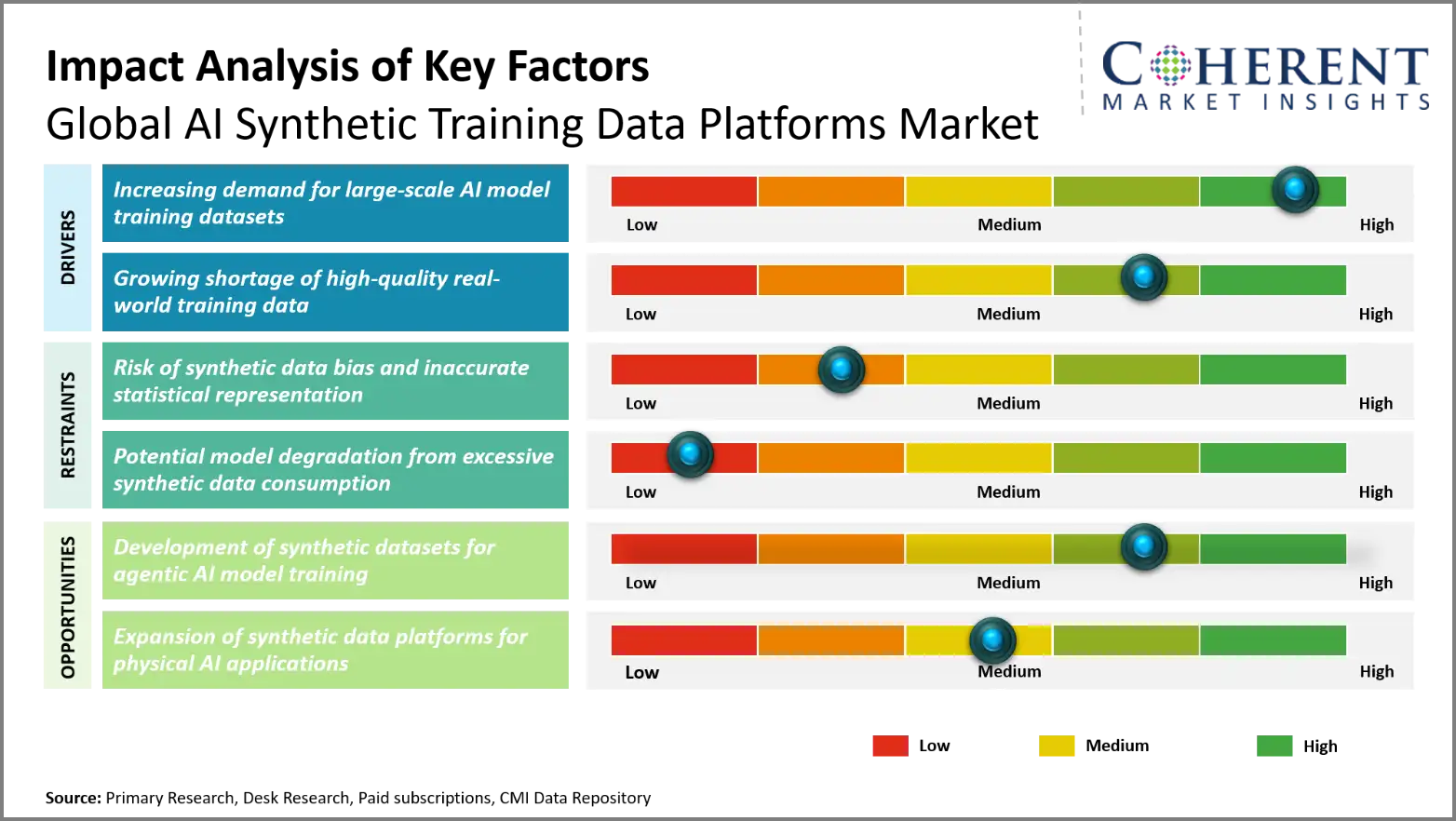
- Increasing demand for large-scale AI model training datasets: As artificial intelligence models get more complicated, the need for large-scale training datasets is increasing. Large language models, autonomous systems and multimodal applications require very large amounts of training instances. Developers require varying datasets with distinct languages, settings, behaviors and operational situations. Traditional methods of data collection can be very expensive in terms of money and operations. Synthetic training data platforms address this by creating false datasets at scale. They produce text, photos, video, audio, and structured information for particular purposes. NVIDIA Corporation supports large scale synthetic data generation through its Omniverse and Cosmos ecosystems.
- On July 30, 2025, Cognizant announced the launch of AI Training Data Services, a new product aimed to enable organizations to construct, fine-tune and apply AI models at speed and scale. Cognizant is currently leveraging its expertise to further AI innovation for worldwide 2000 clients. With strong experience as a data and AI model training partner, Cognizant is identifying digital native pioneers.
- Growing shortage of high-quality real-world training data: Organizations are increasingly adopting synthetic data platforms due to dearth of high-quality real-world training data. Many AI applications need specialized datasets which are hard to obtain. Developers of self-driving vehicles require samples of rare accidents, harsh weather and unexpected road conditions. Healthcare developers have limits on medical records and sensitive patient data. Financial institutions also have little data on new fraud patterns and rare transactions. Real-world datasets are commonly characterized by missing values, inaccurate annotations, and demographic imbalances. Synthetic data-producing technologies mitigate these limitations by creating training instances in a controlled and realistic manner.
- On September 24, 2025, Scale AI expanded its Physical AI Data Engine. The company says it has logged more than 100,000 work hours in its prototyping facility in San Francisco. Its datasets are a blend of human demonstrations, robotic data collecting and fine-grained semantic annotations.
Emerging Trends
- Increasing Adoption of Multimodal Synthetic Data Generation: Synthetic data platforms are actively generating text, pictures, audio and video datasets in a coordinated fashion. It is a development in support of multimodal AI models that need to connect training instances across data formats.
- Impact: Multimodal creation enhances the coverage of model training and minimizes the need on separately obtained datasets. It also allows for more complete testing of complicated artificial intelligence systems.
- Relevance to the market: The synthetic visual data generated by the NVIDIA Cosmos is physically grounded for robotics and autonomous systems. This opens new prospects for multimodal simulation and training supporting platforms.
- Growing Integration of Synthetic Data with Digital Twins: Increasingly, organizations are adopting synthetic data creation with digital twins and simulation environments. This approach produces fake training situations that mimic complicated industrial procedures and changing physical environments.
- Impact: Integration allows for reproducible scenario creation and controlled testing. This allows developers to train artificial intelligence models using unusual circumstances without having to perform costly physical trials again.
- Relevance to the market: Examples of industrial simulation applications are Siemens Industrial Copilot and NVIDIA Omniverse. Their ecosystems offer chances for synthetic data platforms to serve developers of robotics, manufacturing and predictive maintenance.
Regional Insights
Why is North America a Strong Market for AI Synthetic Training Data Platforms?
North America is expected to account for a market share of 40.0% in 2026. The region experiences excellent geospatial intelligence, aircraft simulation and industrial computer vision applications. The Digital Imaging and Remote Sensing Lab at Rochester Institute of Technology is collaborating with Rendered.ai on physically accurate sensor simulation. Their partnership aids in the development of synthetic imaging for satellite, drone and ground-based sensors. Planet Labs has leveraged this ability to replicate hyperspectral imagery for its Tanager satellite. The scenarios generated involve a variety of methane plumes and environmental circumstances. These programs offer developers a means of validating detection algorithms before collection of operational footage. North American demand also benefits from established cloud infrastructure and defense technology procurement.
Why Does Asia Pacific AI Synthetic Training Data Platforms Market Exhibit High Growth?
Asia Pacific is expected to register the fastest growth with a CAGR of 31.5% over the forecast period. It is projected to account for 27.0% of the global AI synthetic training data platforms market in 2026 and the region has the benefits of government-backed training datasets, fintech experimentation and regional artificial intelligence development. Since 2017, South Korea’s AI Hub has been distributing artificial intelligence training datasets. Its datasets are composed on facial recognition datasets and organized Korean patent information. The project revealed synthetic financial data sets, built in cooperation with Dong-eui University and domestic data firms in 2024. Singapore’s Privacy Enhancing Technologies Sandbox promotes commercial experiments with privacy-preserving technologies. These projects promote the production of synthetic datasets for regulated financial services and public sector use cases. Regional demand also reflects language diversity and specialized datasets for Asian consumer markets.
Global AI Synthetic Training Data Platforms Market Outlook for Key Countries
Why is U.S. Emerging as a Major Hub in the AI Synthetic Training Data Platforms Market?
In the U.S., there are particular synthetic imagery needs for geospatial intelligence, aerospace and security applications. Rendered.ai offers cloud-based synthetic data synthesis with adjustable sensor simulations and automatic annotating. Its partnership with Esri links ArcGIS content to synthetic environment development. This enables developers to create labeled imagery for computer vision training. Rendered.ai also supports simulated Synthetic Aperture Radar datasets and rare-object detection applications. Its collaboration with the Rochester Institute of Technology expands access to DIRSIG sensor simulation capabilities. As these applications emerge for satellite operators and defense technology developers, the necessity for physically precise training data is growing.
Is China the Next Growth Engine for the AI Synthetic Training Data Platforms Market?
China’s market advantage lies on embodied AI development, industrial robots and government-supported data infrastructure. The National Data Administration shall encourage high-quality industrial data sets and life-cycle data management. In 2026, China had more than 70 operational embodied artificial intelligence training institutions. Another 40 facilities remained under construction or planning. A Beijing-based embodied artificial intelligence platform reportedly aggregated 1.5 million hours of human video data. Its datasets combine human demonstrations with simulated synthetic data. These developments create demand for artificial training environments supporting humanoid robots, industrial automation, and autonomous machine operations.
U.K. AI Synthetic Training Data Platforms Market Analysis and Trends
The U.K. benefits from synthetic data use in financial crime detection, content moderation, and government statistical research. SafeToNet creates synthetic photos and videos with bad lighting, fuzzy footage and low quality camera circumstances. These datasets enhance training of safety technology models. Financial Conduct Authority – Digital Sandbox: Helps with synthetic financial transaction dataset development. The initiative involves Napier AI, Plenitude Consulting and The Alan Turing Institute. They are working on limited access to sensitive transactional data. The Office for National Statistics also has policies on the generation and release of synthetic data. These kind of applications create need for specific datasets in regulated industries.
France AI Synthetic Training Data Platforms Market Analysis and Trends
France is benefiting from the excellent research in privacy-preserving machine learning and the increasing deployment of Artificial Intelligence by industrial companies. The Inria MAGNET team works with Craft.ai on the production of synthetic data with privacy constraints. Their research includes differential privacy, quality criteria for datasets, and statistical disclosure concerns. The Inria LSD research project is also interested in synthetic data generated by generative models. Applications include physics, clinical research and protein engineering. The adoption of generative artificial intelligence by French small and medium-sized firms went from 15% in 2023 to 31% in 2024, Bpifrance reported. These trends are positive for demand for specialized synthetic datasets and privacy-focused generation methods.
Canada AI Synthetic Training Data Platforms Market Analysis and Trends
Experimentation in the public sector, prudent AI development and modernization of health data are good for the Canadian market. Synthetic data is a tool to train models and test algorithms, according to the Immigration, Refugees and Citizenship Canada. Its artificial intelligence strategy is focused on privacy protection with artificially created information. The proposed Health Sector Data Space in Canada further backs the necessity for safe clinical data infrastructure. The plan includes specific federal investment to enable standardized healthcare databases. Provincial hospital information can support research involving clinical outcomes and treatment patterns. These developments create opportunities for synthetic data platforms serving healthcare analytics, immigration processing, and public administration.
Global AI Synthetic Training Data Platforms Market - Synthetic Datasets for Humanoid Robot Training
Dataset / Platform | Robot embodiment | Data category | Main training tasks | Dataset duration | Sensor modalities |
AgiBot World Beta | AgiBot G1 humanoid | Real-world teleoperation | Pick-and-place, folding, cleaning, cooking, sorting | 2976.4 hours | RGB, depth, tactile, proprioception, language, actions |
Humanoid Everyday | Unitree G1 and H1 | Real-world teleoperation | Locomotion, dexterous manipulation, tool use, human interaction | 31.8 hours | RGB, depth, LiDAR, tactile, IMU, proprioception |
NVIDIA GR00T synthetic motion pipeline | Simulated humanoid and robot embodiments | Synthetic motion generation | Object stacking, grasping, manipulation | 6500 equivalent human demonstration hours | Simulated motion, robot state, visual data |
NVIDIA GR00T Teleop GR1 | Fourier GR-1 | Real-world teleoperation | Humanoid manipulation and object handling | 88.4 hours | Video, robot state, actions |
Unitree G1 washing-machine task | Unitree G1 with Inspire hands | Real-world teleoperation | Whole-body coordination, laundry handling, object placement | 4.5 hours | Video, robot joint states, actions |
How is Development of Synthetic Datasets for Agentic AI Model Training Creating New Growth Opportunities in the AI Synthetic Training Data Platforms Market?
The development of synthetic datasets for agentic artificial intelligence creates opportunities for training autonomous systems requiring multi-step decision-making. Unlike conventional models, AI agents require datasets containing tool selection, planning sequences, API interactions, memory retrieval, and error recovery examples. Platforms can generate simulated workflows covering unsuccessful tool calls, conflicting instructions, and changing task conditions. For example, BrowserGym provides standardized web environments for evaluating browser-based AI agents. WorkArena evaluates agents performing enterprise software tasks within ServiceNow environments. These applications create demand for synthetic interaction trajectories, reinforcement learning environments, and automated task evaluation datasets. Specialized platforms can generate thousands of controlled agent execution scenarios without manually recording every interaction. This creates commercial opportunities in enterprise automation, autonomous software engineering, and multi-agent system development.
Market Players, Key Development, and Competitive Landscape
Key Developments
- On June 9, 2026, Syntho announced the acquisition of the MOSTLY AI Brand. Going forward, the MOSTLY AI brand will continue under the name MOSTLY AI, powered by Syntho. This acquisition strengthens Syntho’s position as leading solution provider in the rapidly growing synthetic data market and reinforces its commitment to making representative synthetic data accessible for organizations worldwide.
- On March 16, 2026, NVIDIA announced the NVIDIA Physical AI Data Factory Blueprint, an open reference architecture that unifies and automates how training data is generated, augmented and evaluated, reducing the costs, time and complexity of training physical AI systems at scale.
- On April 8, 2025, Tonic.ai announced that it has signed a strategic collaboration agreement (SCA) with Amazon Web Services (AWS). This agreement will help organizations in regulated industries accelerate the adoption of generative AI by providing enterprises with privacy-preserving synthetic data solutions that enable AI-driven innovation while ensuring data security and compliance.
Competitive Landscape
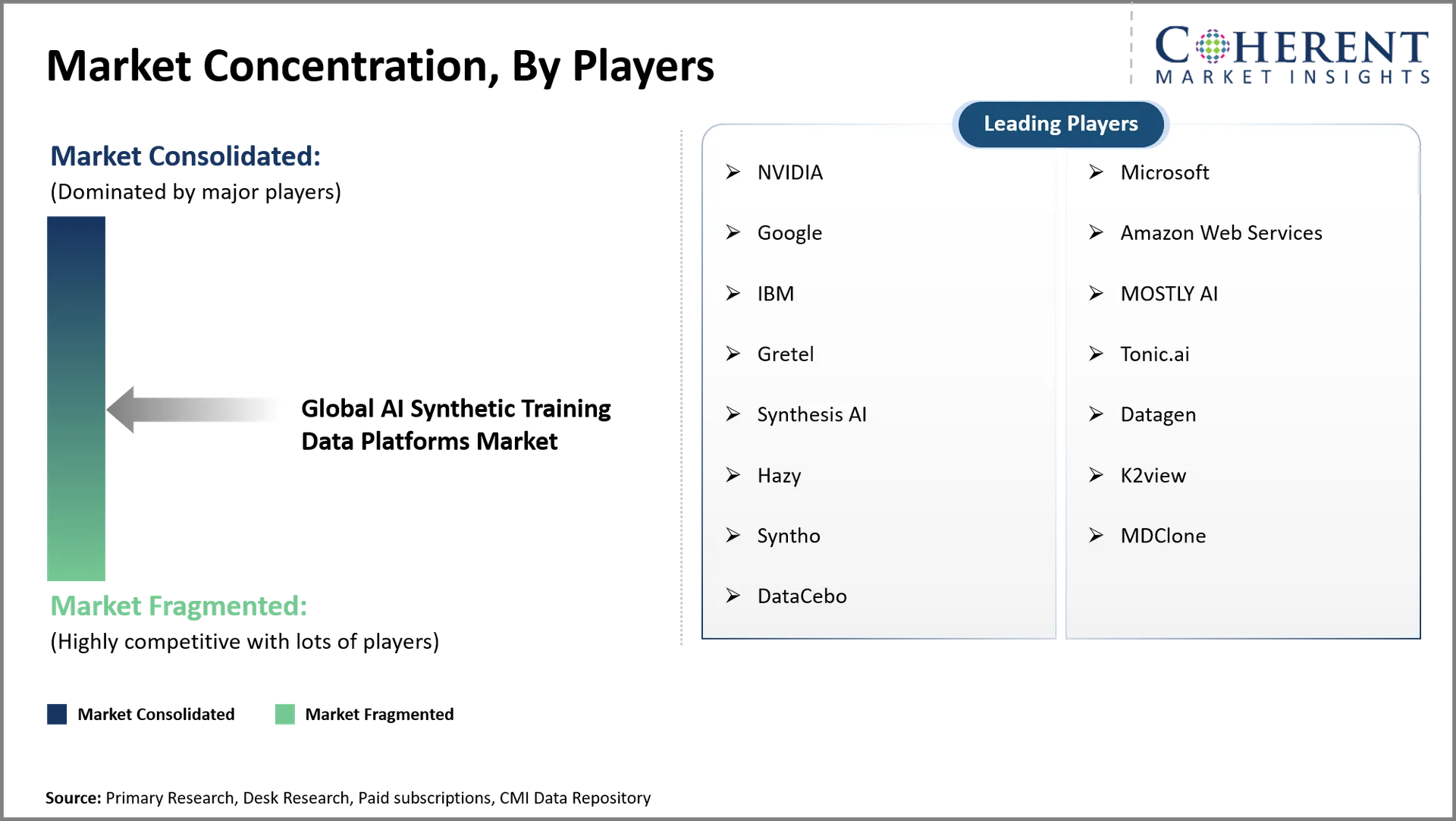
The AI synthetic training data platforms market is a competitive one, segmented into infrastructure providers and synthetic data specialists. NeMo Data Designer, NeMo Safe Synthesizer and Cosmos global foundation models give a leg up to NVIDIA Corporation. It combines the fabrication of synthetic data sets with fast computing and the creation of physical AI. Syntho enhances enterprise synthetic data capabilities with MOSTLY AI brand with privacy-focused tabular data production. With Tonic Fabricate, Tonic Structural and Tonic Textual, Tonic.ai is focused on realistic developer datasets. SAS Data Maker is designed for enterprise analytics by SAS Institute Inc. Parallel Domain specializes in simulated environments and perception training for autonomous systems. These companies compete through generation quality, privacy controls, scenario realism, and integration capabilities.
Top Companies/Manufacturers and Notable Products/Solutions in the AI Synthetic Training Data Platforms Market
Company/Manufacturer | Notable Product/Solution | Key features |
NVIDIA Corporation | Isaac GR00T, Isaac Lab, Isaac Sim, GR00T-Dreams | Synthetic motion generation, physics-based simulation, reinforcement learning, imitation learning, multimodal robot foundation models, sim-to-real workflows |
Lightwheel | Lightwheel-Platform Enterprise, SimFoundry, EgoSuite, RoboFinals | SimReady 3D assets, synthetic trajectory generation, egocentric human demonstrations, tactile and proprioceptive data, simulation-based evaluation |
Genesis AI | Genesis Physics Engine and simulation platform | Physics-based simulation, synthetic training data generation, realistic physical interaction modeling, robot foundation-model development |
Duality AI | Falcon Digital Twin Platform and Vibe Sim | Digital twin environments, synthetic sensor data, scenario generation, physics-based simulation, text-prompt-driven synthetic data workflows |
Applied Intuition | Dana Physical AI Platform and Simulation & Evaluation | Neural reconstruction, high-fidelity simulation, scenario generation, data ingestion, quality control, cloud and on-premises workflows |
Market Report Scope
Global AI Synthetic Training Data Platforms Market Report Coverage | |||
Report Coverage | Details | ||
Base Year | 2025 | Market Size in 2026: | USD 0.95 Bn |
Historical Data For: | 2020 To 2024 | Forecast Period: | 2026 To 2033 |
Forecast Period 2026 To 2033 CAGR: | 28.20% | 2033 Value Projection: | USD 5.40 Bn |
Geographies covered: |
| ||
Segments covered: |
| ||
Companies covered: | NVIDIA, Microsoft, Google, Amazon Web Services, IBM, MOSTLY AI, Gretel, Tonic.ai, Synthesis AI, Datagen, Hazy, K2view, Syntho, MDClone, DataCebo | ||
Growth Drivers: |
| ||
Restraints & Challenges: |
| ||
Analyst Opinion (Expert Opinion)
- The industry will increasingly shift toward synthetic datasets designed for specific model architectures and operational environments. General-purpose tabular generators will coexist with specialized systems generating video, sensor, behavioral, and agent-interaction data. Physical AI will create substantial demand for realistic simulation environments. Robotics developers will require datasets containing manipulation errors, object interactions, and changing environmental conditions. Enterprise AI developers will increasingly need synthetic tool-use trajectories and multi-agent collaboration examples. Platforms combining generation, evaluation, and provenance management will become strategically important. Hybrid datasets combining real observations and synthetic examples will remain essential for maintaining model reliability.
- The strongest opportunities will emerge in multimodal synthetic data, physical AI simulation, and agentic AI training datasets. Image and video generation will support autonomous driving and industrial robotics. Synthetic patient records will create opportunities in healthcare model development. Financial transaction generation will support fraud detection and risk modelling. The U.S. has potential in robotics, driverless cars and advanced AI infrastructure. China has an opportunity in humanoid robotics and industrial automation. The United Kingdom offers interesting applications in financial services and enterprise automation. Firms that build specialized datasets for these applications can gain stronger positions in the market.
- Market companies are expected to build industry-specific generation engines rather than relying only on general-purpose synthetic datasets. They should focus on measurable privacy protection, statistical fidelity and model performance validation. Training needs can be met through partnerships with automobile manufacturers, hospitals, financial institutions and robotics companies. Companies should link synthetic data production to reinforcement learning and model evaluation processes. “Investing in rare-event simulation can give a competitive advantage for autonomous driving and robotics solutions. Vendors should also build data sets in local languages and privacy measures that are specific to the jurisdiction. Transparent data provenance and reproducible creation methods will increase enterprise purchasing trust.
Speak to the analyst
Want personalized insights?
Take the findings above to one of our principal consultants, or have the report rebuilt around the segments, geographies and competitors you actually track.
Market Segmentation
- Component Insights (Revenue, USD Billion, 2021 - 2033)
- Software
- Services
- Deployment Type Insights (Revenue, USD Billion, 2021 - 2033)
- Cloud-Based
- On-Premises
- Hybrid
- Generation Technique Insights (Revenue, USD Billion, 2021 - 2033)
- Generative Adversarial Networks
- Variational Autoencoders
- Diffusion Models
- Transformer-Based Generation
- Agent-Based Simulation
- Rule-Based Data Generation
- Data Type Insights (Revenue, USD Billion, 2021 - 2033)
- Tabular Data
- Text Data
- Image Data
- Video Data
- Audio Data
- Time-Series Data
- Sensor Data
- Multimodal Data
- Application Insights (Revenue, USD Billion, 2021 - 2033)
- AI and Machine Learning Model Training
- Large Language Model Training
- Computer Vision Training
- Autonomous Systems Training
- Robotics Training
- Model Testing and Validation
- Data Augmentation
- AI Model Fine-Tuning
- End User Insights (Revenue, USD Billion, 2021 - 2033)
- BFSI
- Healthcare and Life Sciences
- Automotive
- Manufacturing
- Retail and E-Commerce
- IT and Telecommunications
- Aerospace and Defense
- Information Technology
- Regional Insights (Revenue, USD Billion, 2021 - 2033)
- North America
- U.S.
- Canada
- Latin America
- Brazil
- Argentina
- Mexico
- Rest of Latin America
- Europe
- Germany
- U.K.
- Spain
- France
- Italy
- Russia
- Rest of Europe
- Asia Pacific
- China
- India
- Japan
- Australia
- South Korea
- ASEAN
- Rest of Asia Pacific
- Middle East
- GCC Countries
- Israel
- Rest of Middle East
- Africa
- South Africa
- North Africa
- Central Africa
- North America
- Key Players Insights
- NVIDIA
- Microsoft
- Amazon Web Services
- IBM
- MOSTLY AI
- Gretel
- Tonic.ai
- Synthesis AI
- Datagen
- Hazy
- K2view
- Syntho
- MDClone
- DataCebo
Sources
Primary Research Interviews
- AI/ML Data Scientists & Researchers
- Synthetic Data Platform Vendors & Developers
- Enterprise AI Solution Architects
- Data Annotation & Labeling Service Providers
Magazines
- MIT Technology Review
- AI Business Magazine
- Wired (AI & Machine Learning Editions)
- Analytics Insight Magazine
Journals
- Journal of Artificial Intelligence Research (JAIR)
- IEEE Transactions on Neural Networks and Learning Systems
- Nature Machine Intelligence
Associations
- Association for the Advancement of Artificial Intelligence (AAAI)
- Partnership on AI
- Data & AI Alliance
- International Association of Privacy Professionals (IAPP)
Public Domain Sources
- National Institute of Standards and Technology (NIST) – AI Publications
- European Commission – AI & Data Strategy Reports
- U.S. Department of Commerce – AI & Technology Reports
- OpenAI Research Publications & Whitepapers
Proprietary Elements
- CMI Data Analytics Tool
- Proprietary CMI Existing Repository of Information for Last 10 Years
Get access to 250+ pages report
Every segment, forecast, competitor profile and data table behind the analysis above — available for instant download.
- ESOMAR Member
- ISO 9001:2015 Certified
- D-U-N-S Registered
- GDPR & CCPA Compliant
Frequently Asked Questions
The global AI synthetic training data platforms market is expected to stand at USD 0.95 Bn in 2026 and is expected to reach USD 5.40 Bn by 2033.
The CAGR of the global AI synthetic training data platforms market is projected to be 28.2% from 2026 to 2033.
Increasing demand for large-scale AI model training datasets and Growing shortage of high-quality real-world training data are the major factors driving the growth of the global AI synthetic training data platforms market.
Risk of synthetic data bias and inaccurate statistical representation and Potential model degradation from excessive synthetic data consumption are the major factors hampering the growth of the global AI synthetic training data platforms market.
In terms of component, software segment is estimated to dominate the market revenue share in 2026.
Synthetic datasets simulate road conditions, pedestrians, unusual obstacles, and adverse weather for autonomous driving algorithms.
AI synthetic training data platforms generate artificial datasets for training, testing, and validating artificial intelligence models.