

Global Air Pollution Control Systems Market Size and Forecast – 2026 To 2033
The Global Air Pollution Control Systems Market is estimated to be valued at USD 91.23 Bn in 2026 and is expected to reach USD 139.92 Bn by 2033, growing at a compound annual growth rate (CAGR) of 6.30% from 2026 to 2033. Market expansion is being supported by tighter industrial emission requirements, modernization of aging pollution-control infrastructure, and continued investment in power generation, metals, cement, chemicals, refining, and waste-treatment facilities.
Industrial operators are increasingly prioritizing systems that can achieve lower particulate and gaseous emissions while reducing energy consumption and adapting to variable process conditions. In June 2024, Metso reintroduced its High Efficiency Scrubber for ferrous and non-ferrous metallurgy, oil and gas, and chemical applications. The system supports both greenfield and brownfield installations and incorporates an adjustable scrubbing zone with digital pressure-drop optimization, highlighting continued investment in more efficient and adaptable industrial gas-cleaning technologies.
Key Takeaways of the Global Air Pollution Control Systems Market
- Scrubbers are estimated to record a 6.7% CAGR from 2026 to 2033 and are expected to hold 32.1% of the global air pollution control systems market in 2026. Their leadership reflects broad applicability across sulfur dioxide, acid gas, and refinery exhaust treatment, where operators require reliable, high-efficiency removal. In September 2025, Babcock & Wilcox received an initial USD 10 million wet gas scrubbing order for a major Canadian refinery.
- Particulate Matter control is estimated to post a 6.2% CAGR from 2026 to 2033 and is expected to account for 40.7% of the global air pollution control systems market in 2026. Its importance reflects the strict control of dust, soot, and fine particles across power, cement, metals, and manufacturing facilities. In February 2024, the U.S. EPA tightened the annual PM₂.₅ standard from 12 to 9 micrograms per cubic meter.
- Power Generation is estimated to advance at a 5.8% CAGR from 2026 to 2033 and is expected to represent 26.6% of the global air pollution control systems market in 2026. Utilities remain major buyers because large combustion units require layered controls for particulate, sulfur oxide, and nitrogen oxide emissions. In December 2025, India’s Ministry of Power confirmed that thermal plants were using ESP, FGD, and NOx combustion-modification technologies to meet stack-emission norms.
- Asia Pacific is estimated to grow at a 6.5% CAGR from 2026 to 2033 and is expected to command 37.2% of the global air pollution control systems market in 2026. The region’s extensive power, cement, steel, refining, and manufacturing capacity creates substantial requirements for new installations and retrofits. In January 2024, China’s Ministry of Ecology and Environment issued ultra-low-emission plans for the cement and coking industries, including phased transformation targets through 2028.
- Europe is estimated to expand at a 7.3% CAGR from 2026 to 2033 and is expected to account for 27.4% of the global air pollution control systems market in 2026. Faster growth reflects tighter plant-level permitting and broader industrial coverage, which can accelerate filtration, scrubbing, and multi-pollutant system upgrades. In August 2024, the European Commission’s revised Industrial Emissions Directive entered into force with stricter emission limits and expanded sector coverage.
Segmental Insights
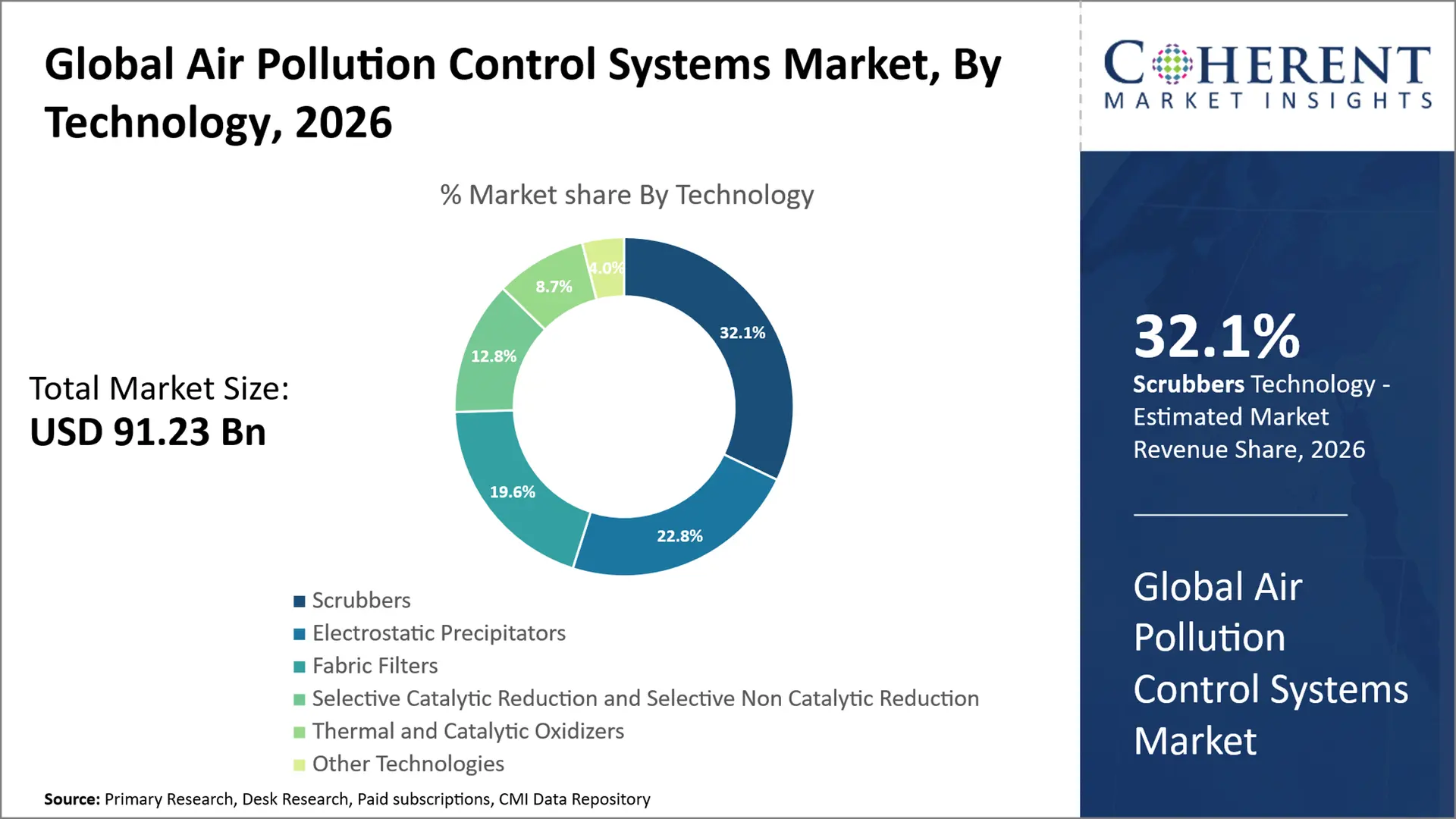
Why Do Scrubbers Dominate the Global Air Pollution Control Systems Market?
Scrubbers are expected to account for 32.1% of the global air pollution control systems market in 2026, leading the technology category because they can combine pollutant removal with gas cooling, conditioning, and process integration in a single engineered train. Demand is especially strong where exhaust streams are hot, moisture-laden, corrosive, or chemically complex. Suppliers can differentiate through wet, dry, and hybrid designs, corrosion-resistant materials, reagent optimization, and heat-recovery integration. This gives scrubbers commercial relevance beyond conventional sulfur control, including applications in refining, waste-to-energy, pulp and paper, and carbon-capture pretreatment. In June 2025, Valmet secured its first order for a carbon-capture pretreatment solution combining a condensing flue gas scrubber with a wet electrostatic precipitator, demonstrating how scrubber systems are being integrated into next-generation flue-gas treatment architectures.
- Current Industry Events of 2026
- Market Size Estimation
- Regional Breakdown
- Competitive Landscape
- Customer Intelligence
- Segmental Analysis
- Pricing Analysis
- Key Market Drivers, Challenges & Future Trends
- Customized Insights Section
Why Does Particulate Matter Represent the Largest Pollutant Type in the Global Air Pollution Control Systems Market?
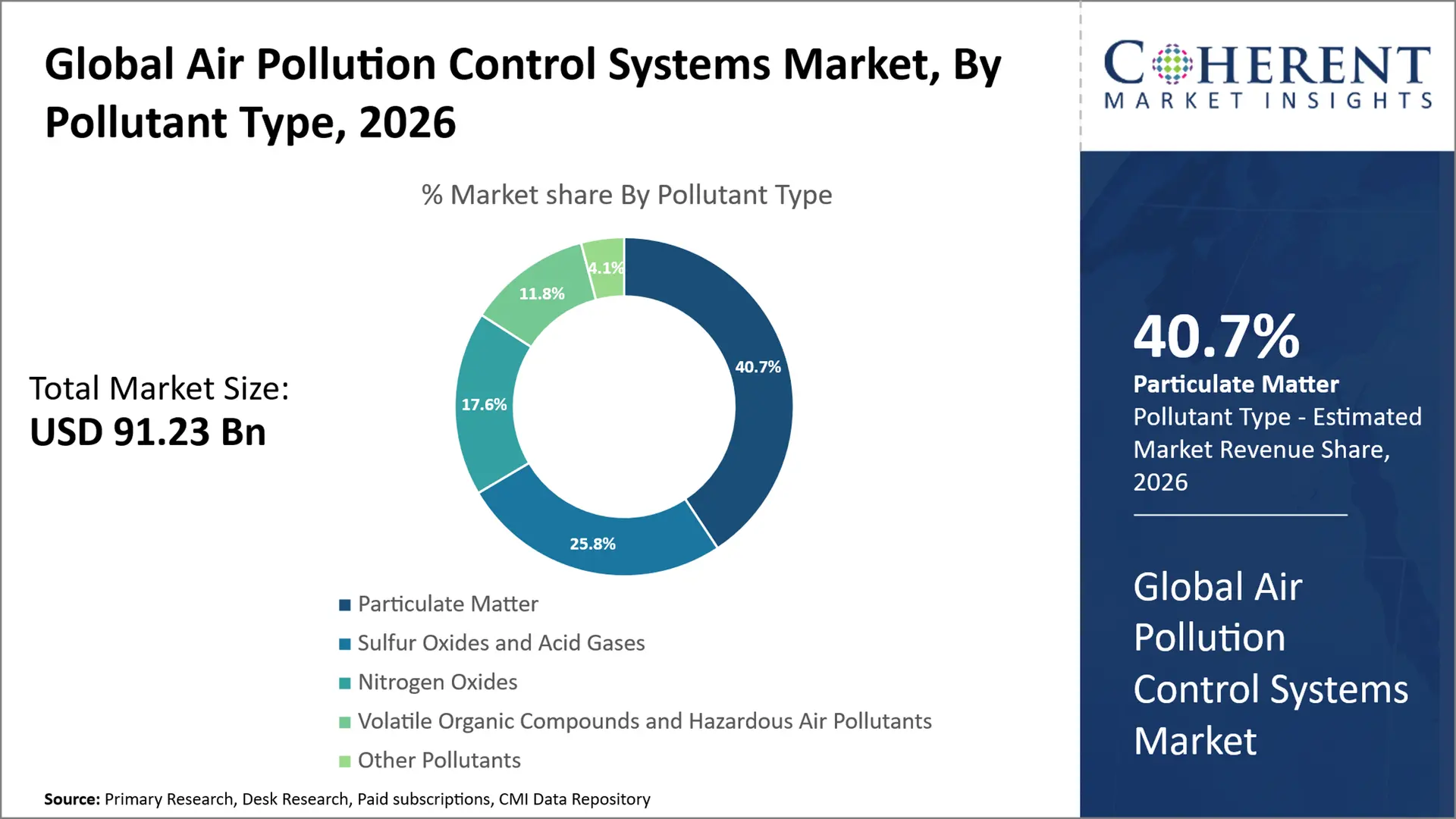
Particulate Matter is expected to represent 40.7% of the global air pollution control systems market in 2026, making it the largest pollutant category because solid and aerosol emissions occur across a broad range of industrial processes. Cement grinding, metal processing, bulk-material handling, combustion, woodworking, and mineral operations require continuous dust capture, creating a large installed base for baghouses, cartridge collectors, and electrostatic precipitators. Commercially, this creates recurring demand for filter media, sensors, cleaning systems, maintenance, and performance upgrades rather than only one-time equipment purchases. Supply-side innovation is increasingly focused on understanding particle behavior and optimizing filtration under different operating conditions. In February 2025, Nederman inaugurated an innovation center in Helsingborg with dedicated testing capabilities and a dust laboratory to accelerate industrial air-filtration development and particulate-control optimization.
Why Does Power Generation Dominate the Application Segment of the Global Air Pollution Control Systems Market?
Power Generation is expected to hold 26.6% of the global air pollution control systems market in 2026, leading the application category because utility-scale plants handle very large, continuous flue-gas volumes and typically require several control stages within one emissions-management system. Thermal assets can combine particulate capture, sulfur removal, nitrogen-oxide control, ducting, monitoring, reagent handling, and auxiliary equipment, creating a higher project value per site than many smaller industrial installations. The long operating life of power stations also sustains retrofit, upgrade, consumables, and maintenance demand. For suppliers, the strongest opportunities lie in integrating new controls with existing boilers without compromising availability or efficiency. In October 2025, Tata Power commissioned a flue gas desulphurisation system at its Jojobera power plant, illustrating continued capital deployment for stack-emission control within operating generation assets.
Current Events and Their Impact
Current Event | Description and Its Impact |
Taiwan Strengthens SRF and Waste-Derived Fuel Pollution Controls – January 2025 |
|
UK Consults on New Best Available Techniques for Industrial Emissions – March 2026 |
|
Canada Amends Multi-Sector Air Pollutants Regulations – December 2025 |
|
Global Air Pollution Control Systems Market Dynamics
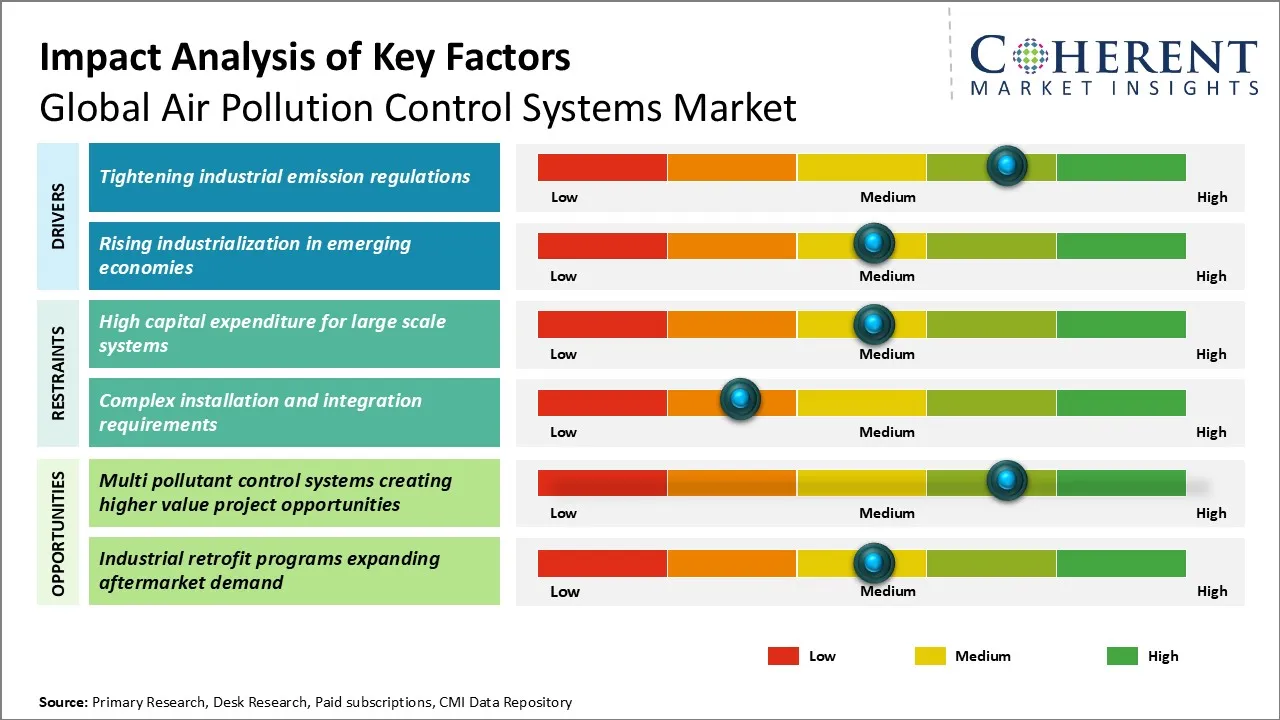
Key Market Drivers
- Tightening industrial emission regulations: Tightening industrial emission regulations are converting air-quality compliance from a periodic capital decision into a continuing engineering requirement. Lower allowable emissions and stronger monitoring obligations encourage utilities and industrial operators to reassess NOx-control equipment, instrumentation, operating practices, and retrofit timing. This benefits SCR and SNCR suppliers, controls integrators, CEMS providers, and aftermarket service firms that can guarantee compliant performance. In October 2024, South Coast AQMD amended Rule 1135, which sets NOx limits for electricity-generating facilities and establishes requirements for generating units on Santa Catalina Island.
- Rising industrialization in emerging economies: Rising industrialization in emerging economies expands the installed base of combustion, metallurgical, material-processing, and other emission-intensive assets that require engineered air-pollution controls from the design stage. New integrated plants create demand not only for primary equipment but also for ducting, dust collection, gas treatment, monitoring, commissioning, and long-term service. Equipment manufacturers and EPC specialists with local execution capabilities stand to benefit most. In May 2025, Tata Steel inaugurated its Kalinganagar Phase II expansion in Odisha, increasing crude-steel capacity from three to eight million tonnes per annum.
Emerging Market Trends
- Digital Closed-Loop Optimization Is Redefining Pollution-Control Operations: Digital closed-loop optimization is shifting air pollution control from static hardware toward continuously managed environmental performance. Operators are increasingly valuing control architectures that connect emissions measurements with fan speed, reagent dosing, pressure drop, temperature, and equipment health. This enables maintenance to be planned around performance deterioration rather than fixed intervals and helps reduce excess reagent or energy use. Suppliers able to integrate instrumentation, controls, analytics, and service expertise should gain stronger lifecycle relationships, while vendors focused only on standalone mechanical equipment may face greater commoditization pressure.
- Carbon-Capture-Ready Flue-Gas Conditioning Is Entering System Design: Carbon-capture-ready flue-gas conditioning is emerging as a new design consideration for air pollution control projects. Capture systems generally perform better when upstream particulate matter, sulfur compounds, nitrogen oxides, aerosols, and other contaminants are tightly managed, encouraging plant owners to evaluate air-quality equipment as part of a broader emissions architecture. This favors adaptable treatment trains, heat integration, low-leakage ducting, and controls that can accommodate future process changes. Over the forecast period, engineering compatibility with carbon-management investments could become an important procurement differentiator for large industrial sites.
Regional Insights
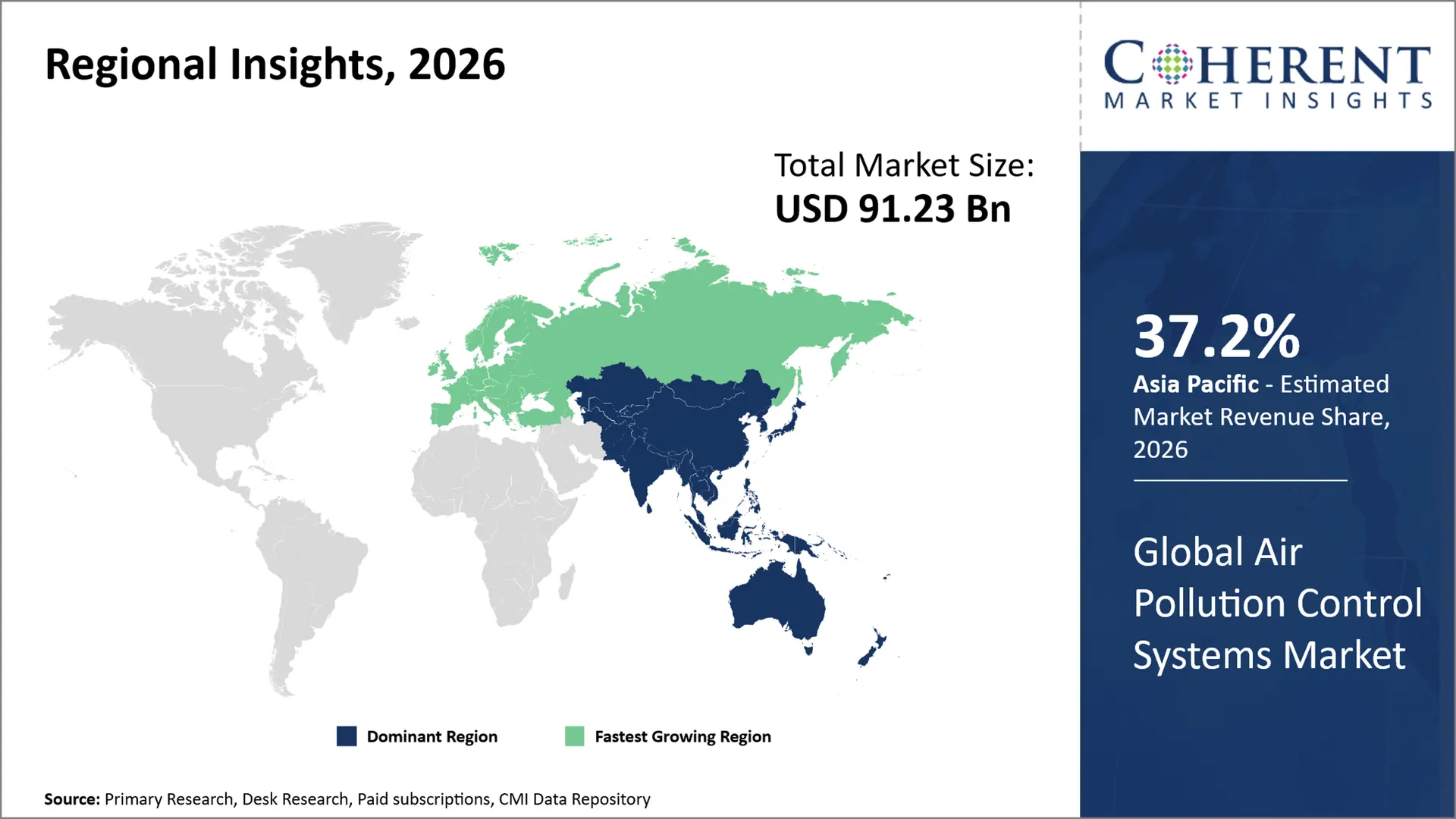
Why Does Asia Pacific Dominate the Global Air Pollution Control Systems Market?
Asia Pacific is expected to account for 37.2% of the global air pollution control systems market in 2026, supported by the region’s concentration of coal-based power, steel, cement, non-ferrous metals, refining, chemicals, and rapidly expanding manufacturing capacity. This industrial mix creates simultaneous demand for particulate capture, sulfur removal, NOx control, acid-gas treatment, and continuous emissions monitoring. Unlike mature markets dominated mainly by replacement spending, Asia Pacific combines greenfield installations with large retrofit programs, giving suppliers opportunities across equipment, EPC, commissioning, and aftermarket services. Local manufacturing of filters, fabricated vessels, ducting, and balance-of-plant components also improves project economics. In November 2024, India’s environment ministry issued draft environmental standards for aluminium plants, illustrating how tighter source-specific requirements continue to broaden pollution-control needs across major Asian industries.
Why Is Europe Emerging as the Fastest-Growing Region in the Global Air Pollution Control Systems Market?
Europe is expected to hold 27.4% of the global air pollution control systems market in 2026 and emerge as the fastest-growing region because investment is shifting toward high-specification retrofits rather than basic first-time installations. Steel, cement, chemicals, glass, pulp and paper, waste treatment, and large combustion plants must increasingly align pollution control with Best Available Techniques, energy efficiency, and deeper industrial transformation. This favors advanced fabric filtration, SCR, scrubbers, oxidizers, emissions monitoring, and integrated controls that can upgrade existing assets without full plant replacement. Suppliers with strong lifecycle engineering and compliance expertise should capture disproportionate value. In February 2026, the European Environment Agency reported that progress in reducing emissions from energy-intensive industries had stalled and that further cuts would require full implementation of environmental legislation and more transformative industrial changes.
Global Air Pollution Control Systems Market Outlook for Key Countries
Why Is the U.S. a Key Market for the Global Air Pollution Control Systems Market?
The U.S. remains a key country for the global air pollution control systems market because its opportunity is anchored in a large installed base of power stations, refineries, chemical complexes, cement plants, metals facilities, and other regulated stationary sources. Demand is therefore weighted toward modernization, equipment replacement, catalyst and filter renewal, digital controls, and reliability-focused retrofits rather than only greenfield systems. State and federal air-quality requirements also make emissions performance an operating constraint for older assets, sustaining spending on SCR, FGD, electrostatic precipitators, and monitoring systems. In February 2026, the U.S. Department of Energy selected coal-plant modernization projects that included a new SCR system at Kentucky Utilities’ Ghent Unit 2 and major ESP- and FGD-related upgrades at other plants, demonstrating continued capital expenditure on air-quality control equipment.
Why Is India Important in the Global Air Pollution Control Systems Market?
India is important to the global air pollution control systems market because rapid growth in electricity demand, steelmaking, cement production, refining, chemicals, and urban infrastructure is occurring alongside stricter scrutiny of stack emissions. The commercial need is particularly strong for brownfield engineering, where pollution-control equipment must be fitted into operating plants with space, outage, water, and reagent constraints. India also has an expanding domestic supplier base for electrostatic precipitators, bag filters, scrubbers, FGD packages, and related fabrication, improving localization and service responsiveness. This creates opportunities for both EPC suppliers and component manufacturers. In January 2025, Thermax completed the performance-guarantee test of an FGD system at a thermal power station in Koderma, Jharkhand, validating domestic execution capability for large-scale sulfur-control projects under Indian operating conditions.
Why Does China Support Growth in the Global Air Pollution Control Systems Market?
China supports growth in the global air pollution control systems market through the scale of its coal power, steel, cement, coking, non-ferrous metals, chemicals, and industrial boiler base. The country combines a very large installed equipment base with continuing requirements for ultra-low-emission retrofits, process optimization, catalyst replacement, dust collection, and multi-pollutant controls. Its domestic manufacturing ecosystem also supports large-volume production of ESPs, baghouses, SCR catalysts, scrubber components, fans, and monitoring equipment, reducing deployment costs and supporting replacement activity. In December 2024, China’s State Council Information Office reported that more than 95% of coal-fired power plants and 45% of crude steel capacity had already undergone ultra-low-emission upgrades, demonstrating the exceptional installed base on which further optimization and lifecycle service demand can develop.
Why Is Germany a Strategic Country in the Global Air Pollution Control Systems Market?
Germany is a strategic country for the global air pollution control systems market because its industrial structure includes chemicals, metals, cement, glass, engineered manufacturing, waste incineration, and energy-intensive processes that require sophisticated emissions management. Buyers typically prioritize verified performance, low energy consumption, automation, maintenance access, and compatibility with broader plant-efficiency programs. These requirements support premium demand for integrated filtration, DeNOx, gas-cleaning, and monitoring solutions. Germany’s strong environmental-engineering base also gives the country significance as both an end market and a technology-export hub. In February 2026, the German Environment Agency reported that although 2025 air-quality limits were met, additional improvements were still required to meet the stricter 2030 particulate matter and nitrogen dioxide thresholds, reinforcing the need for continued emissions reduction across stationary and other sources.
Why Is Brazil an Important Growth Market for the Global Air Pollution Control Systems Market?
Brazil is an important growth market for air pollution control systems because its demand base extends across mining and metals, pulp and paper, cement, refining, chemicals, biomass-fired industrial boilers, and large processing facilities. These sectors generate distinct combinations of particulate matter, sulfur compounds, NOx, VOCs, and process dust, favoring application-specific systems rather than a single standardized technology. Market development is also influenced by state-level licensing and monitoring, making local engineering, field service, and adaptation to fuel and process conditions commercially important. In January 2025, Brazil’s second-stage national air-quality standards under CONAMA Resolution 506/2024 entered into force, tightening the reference framework for air-quality management and strengthening the policy basis for emissions reduction, monitoring, and future control measures across industrialized states.
Air Pollution Control Technology Adoption Landscape
Technology | Primary Control Role | Adoption Landscape | Commercial Implication |
Wet and Dry Scrubbers | Removal of sulfur oxides acid gases and soluble or reactive contaminants | Established across power refining chemicals waste treatment and other high-volume exhaust applications | Competition increasingly depends on removal efficiency corrosion resistance reagent consumption wastewater implications and retrofit flexibility |
Electrostatic Precipitators | Capture of particulate matter and fly ash from high-volume gas streams | Mature technology with continued relevance in power generation cement metals and large combustion processes | Upgrade opportunities center on electrode performance power controls modernization and maintaining collection efficiency under changing process conditions |
Fabric Filters and Baghouse Systems | Fine particulate and process-dust capture | Widely deployed where low outlet dust levels and flexible particulate control are required | Filter-media life pressure-drop management cleaning systems and reliable replacement supply increasingly influence total ownership cost |
SCR and SNCR Systems | Nitrogen oxide reduction from combustion exhaust | Adoption remains important in power generation boilers kilns furnaces and other thermal processes | Catalyst management ammonia utilization temperature-window optimization and system integration are becoming important differentiators |
Thermal and Catalytic Oxidizers | Destruction of VOCs hazardous organic pollutants and process fumes | Important in chemical petrochemical coating specialty manufacturing and solvent-intensive operations | Customers increasingly evaluate heat recovery fuel consumption catalyst durability process variability and safe handling of complex exhaust streams |
Continuous Emissions Monitoring and Digital APC Optimization | Real-time verification and operating optimization across pollution-control assets | Moving from compliance-only monitoring toward integrated operational decision support | Vendors can create recurring value through diagnostics predictive maintenance automated reagent control performance reporting and lifecycle service contracts |
How Are Advanced Manufacturing Emissions Creating New Growth Opportunities in the Global Air Pollution Control Systems Market?
Advanced manufacturing offers an underdeveloped opportunity because battery, semiconductor, solar, specialty-electronics, and high-purity materials facilities generate emission profiles that differ from conventional utility or heavy-industry stacks. Acid gases, solvent vapors, fine particles, reactive compounds, and intermittent exhaust loads require localized capture and carefully sequenced treatment rather than one standardized plant-wide device. Suppliers can capture this opportunity through modular scrubber and oxidizer packages, point-of-use abatement, corrosion-resistant materials, smart monitoring, and service models designed around rapid production changes. Commercial success will depend on application engineering, hazardous-gas expertise, qualification support, compact system design, local spare-parts availability, and the ability to integrate controls with factory automation. Specialist technology providers can compete effectively where process knowledge matters more than project scale, while established equipment groups can use broader service networks to win multi-site programs. The strongest positions should come from suppliers that combine contamination control, safety engineering, compliance documentation, and fast commissioning without disrupting sensitive manufacturing operations.
Market Players, Key Development, and Competitive Intelligence
Key Developments
- In December 2025, CECO Environmental announced a record order exceeding USD 135 million including an emissions-management solution for a large Texas natural-gas power facility supporting data-center expansion. This matters for the global air pollution control systems market because new power infrastructure is translating into ultra-low-emission system procurement.
- In October 2025, John Cockerill reported designing and installing a custom exhaust-gas treatment system for electric-vehicle battery combustion testing using quenching and caustic scrubbing. This matters for the global air pollution control systems market because battery testing creates specialized abatement requirements beyond conventional industrial stacks.
- In June 2025, ANDRITZ announced a contract from Technische Betriebe Solingen to renew its German waste-to-energy plant’s flue-gas cleaning system using TurboSorp technology. This matters for the global air pollution control systems market because it demonstrates continuing demand for lifecycle retrofits that strengthen multi-pollutant removal.
Competitive Landscape
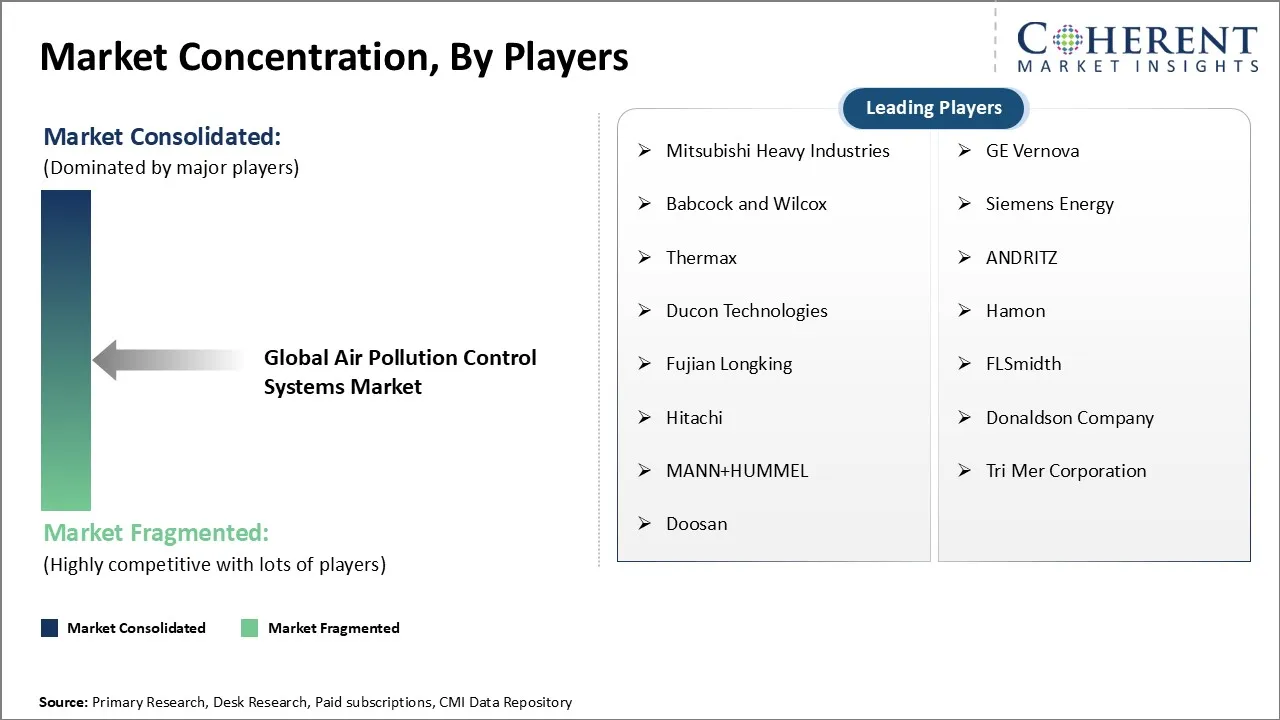
The global air pollution control systems market is moderately consolidated at the large-project level but fragmented across regional and application-specific niches. Global engineering groups compete for complex turnkey packages, while regional fabricators and specialist technology suppliers remain relevant in retrofits and customized installations. Competition centers on guaranteed emissions performance, lifecycle cost, integration capability, delivery reliability, regulatory know-how, and the depth of aftermarket technical support.
Key focus areas include
- Guaranteed emissions performance: Buyers increasingly evaluate whether suppliers can consistently achieve permitted outlet conditions across variable operating loads rather than judging equipment on nominal design specifications alone.
- Lifecycle economics: Energy consumption reagent requirements catalyst replacement filter-media life water use and maintenance frequency increasingly influence procurement alongside initial equipment pricing.
- System engineering capability: Suppliers capable of combining gas characterization equipment selection ductwork controls instrumentation and commissioning can capture more value than component-only vendors.
- Retrofit execution capability: Brownfield installations reward compact layouts short shutdown requirements modular construction and the ability to integrate new equipment without disrupting production.
- Aftermarket and technical service: Installed-base support replacement components troubleshooting optimization and compliance assistance provide recurring revenue and strengthen customer retention.
- Regional manufacturing and sourcing: Local fabrication service centers and spare-parts availability can reduce project lead times transportation costs and operational downtime for industrial customers.
- Application specialization: Providers with deep knowledge of cement metals chemicals refining waste treatment and advanced manufacturing can defend margins through process-specific engineering rather than price competition alone.
Market Report Scope
Global Air Pollution Control Systems Market Report Coverage | |||
Report Coverage | Details | ||
Base Year | 2025 | Market Size in 2026: | USD 91.23 Bn |
Historical Data For: | 2021 To 2024 | Forecast Period: | 2026 To 2033 |
Forecast Period 2026 To 2033 CAGR: | 6.30% | 2033 Value Projection: | USD 139.92 Bn |
Geographies covered: |
| ||
Segments covered: |
| ||
Companies covered: | Mitsubishi Heavy Industries, GE Vernova, Babcock and Wilcox, Siemens Energy, Thermax, ANDRITZ, Ducon Technologies, Hamon, Fujian Longking, FLSmidth, Hitachi, Donaldson Company, MANN+HUMMEL, Tri Mer Corporation, Doosan | ||
Growth Drivers: |
| ||
Restraints & Challenges: |
| ||
Analyst Opinion (Expert Opinion)
- The global air pollution control systems market leadership is likely to migrate from suppliers selling individual control devices toward providers capable of assuming responsibility for complete emissions performance over an asset’s operating life. Buyers will increasingly value engineering integration monitoring optimization maintenance and compliance support as one commercial package. This transition should make installed-base relationships and service capability more strategically important than equipment manufacturing scale alone.
- Changes in industrial energy systems could alter the pollutant profiles for which conventional control equipment was originally designed. Greater use of alternative fuels electrified processes waste-derived feedstocks and new manufacturing chemistries may create more variable exhaust compositions. Suppliers with adaptable treatment architectures strong process-engineering capabilities and rapid application development should be better positioned than businesses tied closely to standardized systems designed around legacy combustion environments.
- Market participants should prioritize modular engineering, low-energy operation, corrosion-resistant designs, advanced diagnostics, and local service capability while remaining disciplined on fixed-price project risk. High-value customer relationships should be built around difficult emissions problems where application knowledge creates pricing power. Companies should also diversify critical filter catalyst reagent and fabricated-component sourcing while avoiding excessive investment in narrowly configured technologies whose economics depend on a single legacy process or fuel pathway.
Speak to the analyst
Want personalized insights?
Take the findings above to one of our principal consultants, or have the report rebuilt around the segments, geographies and competitors you actually track.
Market Segmentation
- Technology Insights (Revenue, USD Bn, 2021 - 2033)
- Scrubbers
- Electrostatic Precipitators
- Fabric Filters
- Selective Catalytic Reduction and Selective Non Catalytic Reduction
- Thermal and Catalytic Oxidizers
- Other Technologies
- Pollutant Type Insights (Revenue, USD Bn, 2021 - 2033)
- Particulate Matter
- Sulfur Oxides and Acid Gases
- Nitrogen Oxides
- Volatile Organic Compounds and Hazardous Air Pollutants
- Other Pollutants
- Application Insights (Revenue, USD Bn, 2021 - 2033)
- Power Generation
- Cement and Metal Processing
- Chemical and Petrochemical
- Oil and Gas
- Waste Incineration and Waste to Energy
- Other Applications
- Installation Type Insights (Revenue, USD Bn, 2021 - 2033)
- New Installations
- Retrofit and Upgrades
- Replacement Systems
- System Configuration Insights (Revenue, USD Bn, 2021 - 2033)
- Single Pollutant Control Systems
- Multi Pollutant Control Systems
- Sales Model Insights (Revenue, USD Bn, 2021 - 2033)
- Direct Equipment and System Contracts
- EPC and Turnkey Contracts
- Distributors and Other Channels
- Regional Insights (Revenue, USD Bn, 2021 - 2033)
- North America
- U.S.
- Canada
- Latin America
- Brazil
- Argentina
- Mexico
- Rest of Latin America
- Europe
- Germany
- U.K.
- Spain
- France
- Italy
- Russia
- Rest of Europe
- Asia Pacific
- China
- India
- Japan
- Australia
- South Korea
- ASEAN
- Rest of Asia Pacific
- Middle East
- GCC Countries
- Israel
- Rest of Middle East
- Africa
- South Africa
- North Africa
- Central Africa
- North America
Sources
Primary Research Interviews
- Air pollution control system manufacturers and technology suppliers
- EPC contractors system integrators and environmental engineering firms
- Power utilities industrial plant operators and environmental compliance professionals
Stakeholders
- Scrubber ESP fabric filter SCR and SNCR system manufacturers
- Emission monitoring equipment and filtration component suppliers
- EPC contractors engineering consultants distributors and service providers
- Power cement metals chemicals refining oil and gas and waste treatment companies
End-use Sectors
- Power generation
- Cement and metal processing
- Chemical and petrochemical
- Oil and gas
- Waste incineration and waste-to-energy
Regulatory and Industry Bodies
- U.S. Environmental Protection Agency EPA
- European Commission
- European Environment Agency EEA
- Ministry of Ecology and Environment of China MEE
- Central Pollution Control Board CPCB India
- World Health Organization WHO
- International Organization for Standardization ISO
Databases
- Company annual reports and investor presentations
- UN Comtrade environmental equipment trade data
- Eurostat industrial and environmental databases
- U.S. EPA emissions and facility databases
- Industrial production energy and emissions databases
- Air pollution control equipment pricing installation and replacement databases
Magazines and Journals
- Journal of Cleaner Production
- Atmospheric Environment
- Environmental Pollution
- Journal of the Air & Waste Management Association
- Fuel
- Energy & Environmental Science
Associations
- Air & Waste Management Association A&WMA
- Institute of Clean Air Companies ICAC
- European Environmental Bureau EEB
- International Energy Agency IEA
- Global Cement and Concrete Association GCCA
- Regional environmental engineering and air quality associations
Public Domain Sources
- Industrial air emissions data
- Power plant and industrial capacity statistics
- Air quality monitoring and pollution inventories
- Flue gas treatment project data
- Industrial retrofit and compliance investment data
- Emission reduction technology developments
- Environmental policy and permitting updates
Key Standards and Regulations
- U.S. Clean Air Act requirements
- U.S. EPA National Ambient Air Quality Standards NAAQS
- EU Industrial Emissions Directive IED
- EU Ambient Air Quality Directive
- China industrial emission and ultra-low-emission standards
- India CPCB and MoEFCC industrial emission standards
- ISO air quality and emissions monitoring standards
Proprietary Elements
- CMI Data Analytics Tool
- Proprietary CMI repository containing 10+ years of air pollution control system demand technology adoption installation base pricing retrofit activity emission regulations industrial capacity project developments regional deployment and competitive intelligence.
Get access to 250+ pages report
Every segment, forecast, competitor profile and data table behind the analysis above — available for instant download.
- ESOMAR Member
- ISO 9001:2015 Certified
- D-U-N-S Registered
- GDPR & CCPA Compliant
Frequently Asked Questions
The CAGR of global air pollution control systems market is projected to be 6.30% from 2026 to 2033.
The global air pollution control systems market is estimated to be valued at USD 91.23 Bn in 2026 and is expected to reach USD 139.92 Bn by 2033.
Tightening industrial emission regulations and continued industrialization in emerging economies are the major factors supporting the growth of the global air pollution control systems market.
High capital expenditure for large scale systems and Complex installation and integration requirements are the major factors hampering the growth of global air pollution control systems market.
In terms of technology, scrubbers are estimated to dominate the market revenue share in 2026.
Mitsubishi Heavy Industries, GE Vernova, Babcock and Wilcox, Siemens Energy, Thermax, ANDRITZ, Ducon Technologies, Hamon, Fujian Longking, FLSmidth, Hitachi, Donaldson Company, MANN+HUMMEL, Tri Mer Corporation, Doosan are the major players.
Asia Pacific is expected to lead the global air pollution control systems market in 2026.