

Global Animals Wearing Clothes Market Size and Forecast – 2026 To 2033
The global animals wearing clothes market is estimated to be valued at USD 912.2 Mn in 2026 and is expected to reach USD 1,129.5 Mn by 2033, growing at a compound annual growth rate (CAGR) of 3.1% from 2026 to 2033. This steady expansion reflects increasing consumer interest in pet fashion and functional apparel, supported by rising pet ownership, stronger pet humanization trends, and growing acceptance of animals as lifestyle companions across major markets. Expansion of online retail platforms, direct-to-consumer brands, and specialty pet marketplaces is improving product accessibility, enabling wider assortment availability across functional wear, seasonal clothing, and fashion-oriented categories.
In July 2025, Xcel Brands partnered with K9 Wear to develop and launch the “Trust. Respect. Love by Cesar Millan” pet lifestyle brand, combining K9 Wear’s functional pet apparel expertise with Xcel’s brand-building and distribution capabilities. The partnership highlights increasing investment by consumer lifestyle companies into premium pet apparel categories and strengthens the transition of animal clothing from a niche accessory segment into a broader lifestyle market.
Key Takeaways of the Global Animals Wearing Clothes Market
- Coats and Jackets are estimated to expand at a 3.3% CAGR during 2026–2033 and account for 34.6% of the global animals wearing clothes market in 2026, reflecting their dual role in weather protection and everyday pet styling. Functional insulation, water resistance, harness compatibility, and seasonal refresh cycles support repeat purchases. In December 2025, Petco introduced new cold-weather pet apparel including quilted hooded puffer jackets and reversible vests.
- Dogs are projected to record an estimated 3.0% CAGR during 2026–2033 and hold 61.8% of the global animals wearing clothes market in 2026, supported by their large ownership base, frequent outdoor exposure, broader size-specific apparel availability, and stronger owner willingness to purchase functional and decorative clothing. In June 2025, APPA’s Dog & Cat Report highlighted dogs’ deep integration into household life and evolving owner purchasing behavior.
- Polyester is expected to post an estimated 3.2% CAGR during 2026–2033 and represent 43.6% of the global animals wearing clothes market in 2026, as manufacturers favor lightweight, quick-drying, abrasion-resistant fabrics that can support insulation, stretch, and weather-focused designs at scalable price points. In August 2025, Ruffwear introduced its Climate Changer Vest and Jacket using 100% recycled polyester fleece for canine warmth and mobility.
- North America is estimated to grow at a 2.9% CAGR during 2026–2033 while accounting for 42.0% of the global animals wearing clothes market in 2026, underpinned by mature pet-specialty retail, seasonal apparel purchasing, premiumization, and strong participation in outdoor activities with companion animals. In March 2025, PetSmart unveiled its Arcadia Trail outdoor collection featuring breathable pet apparel alongside gear designed for canine summer adventures.
- Europe is forecast to register an estimated 4.1% CAGR during 2026–2033 and capture 28.4% of the global animals wearing clothes market in 2026, making it the fastest-growing region as fashion-led pet ownership increasingly intersects with seasonal gifting, coordinated family dressing, and accessible mass-market retail. In November 2025, Primark promoted a new pet collection in Ireland featuring pet pyjamas, licensed jumpers, and festive outfits for companion animals.
Segmental Insights
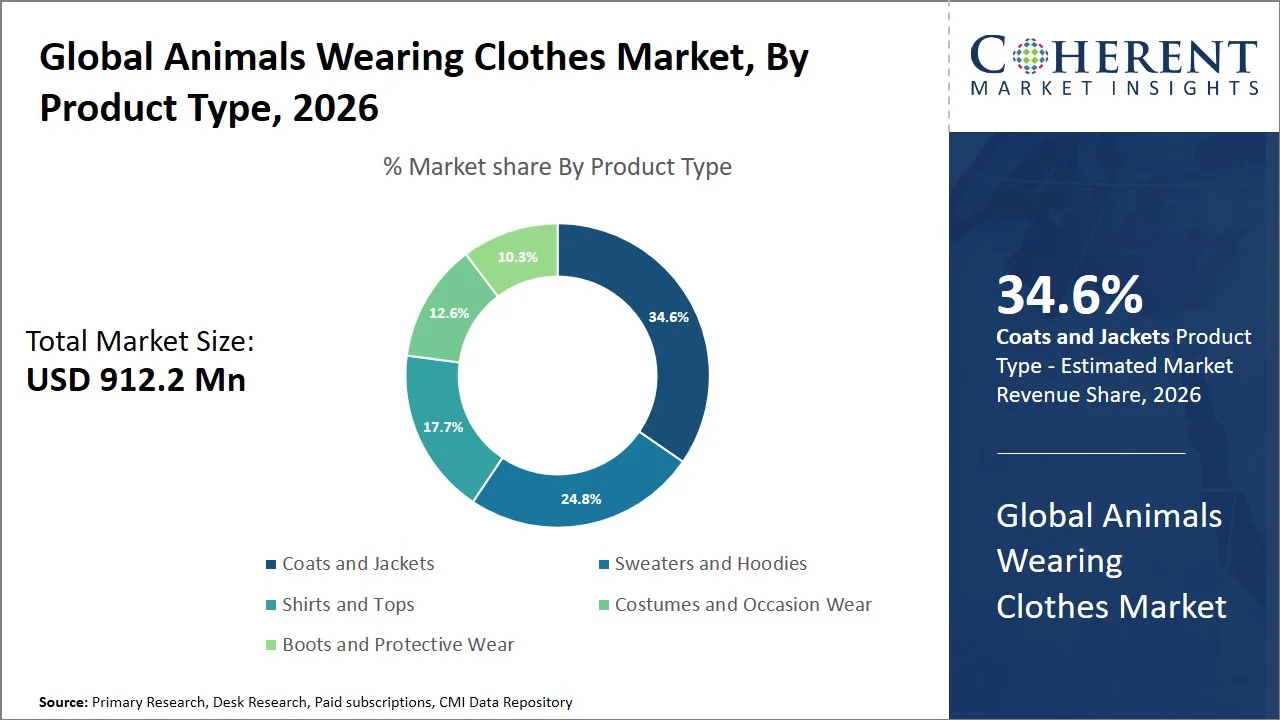
Why Do Coats and Jackets Dominate the Global Animals Wearing Clothes Market?
Coats and Jackets are expected to account for 34.6% of the global animals wearing clothes market in 2026. Their lead reflects engineering versatility across temperature control, rain and snow protection, visibility, harness access, and unrestricted movement. Unlike occasion-led apparel, outerwear addresses recurring walking and outdoor-use needs, supporting repeat seasonal purchases and higher-value technical products. On the supply side, pattern grading, adjustable closures, seam protection, lightweight insulation, and breed-sensitive sizing allow manufacturers to serve a wide body-shape range without changing the core product architecture. This gives retailers a commercially efficient category spanning autumn, winter, wet-weather, and adventure assortments. In February 2026, Non-stop dogwear detailed a jacket-development system covering more than 15 styles, typically 11–15 sizes, and a fit-testing database of over 1,000 dogs. The scale of this fit engineering illustrates the product sophistication reinforcing coats and jackets as the leading product type.
- Current Industry Events of 2026
- Market Size Estimation
- Regional Breakdown
- Competitive Landscape
- Customer Intelligence
- Segmental Analysis
- Pricing Analysis
- Key Market Drivers, Challenges & Future Trends
- Customized Insights Section
Why Do Dogs Represent the Largest Animal Type in the Global Animals Wearing Clothes Market?
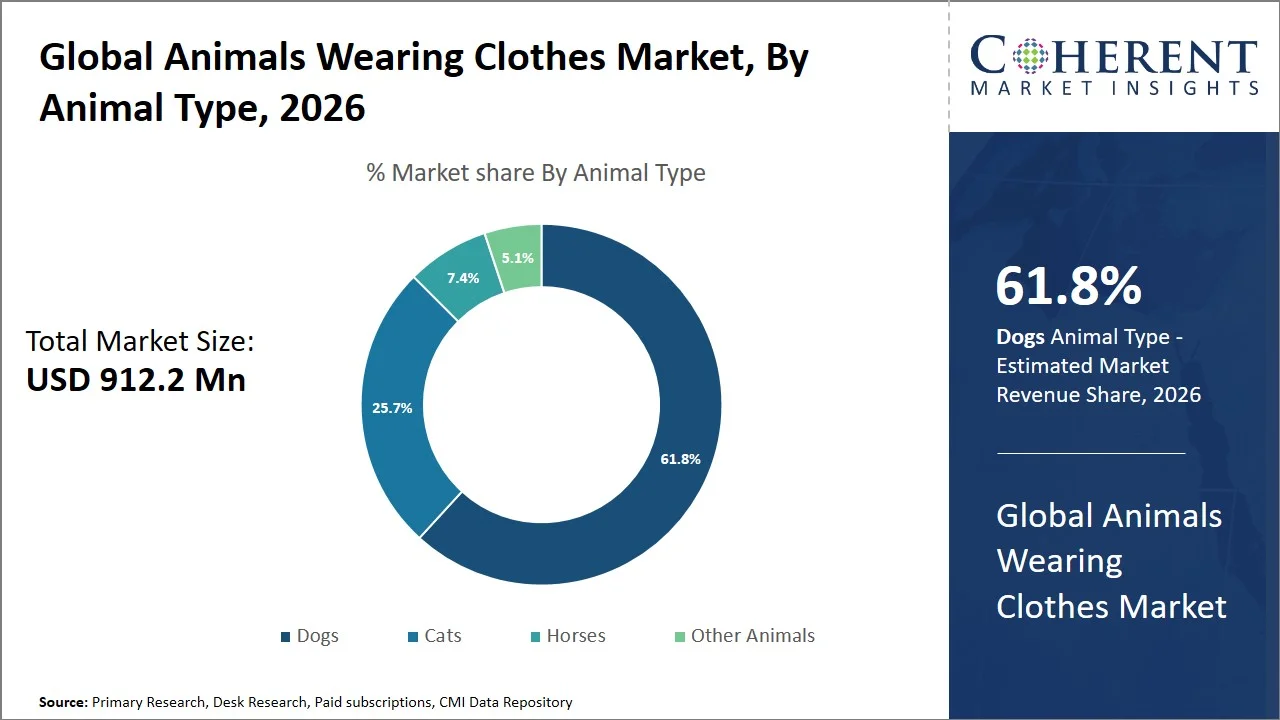
Dogs are expected to represent 61.8% of the global animals wearing clothes market in 2026, reflecting the widest addressable use-case base among companion animals. Dog apparel is purchased not only for appearance, but also for walking, rain protection, cold-weather insulation, paw protection, visibility, recovery, and outdoor recreation. Frequent human-dog mobility makes wearable products easier to integrate into everyday routines than clothing for less externally active pets. Manufacturers also benefit from established dog-specific sizing systems, harness compatibility, breed-led merchandising, and a large ecosystem of specialty and lifestyle brands, creating deeper assortments and faster product refreshes. Commercially, dogs allow suppliers to sell functional and fashion products across multiple price tiers and seasons. In October 2024, Crocs and BARK launched Pet Crocs, breathable EVA booties created for dogs after strong consumer requests. The collaboration shows how dog wearables can attract mainstream lifestyle brands and extend purchasing beyond traditional pet-specialty products.
Why Does Polyester Dominate the Material Segment of the Global Animals Wearing Clothes Market?
Polyester is expected to hold 43.6% of the global animals wearing clothes market in 2026 because it offers manufacturers a favorable balance of performance, processing flexibility, and scalable cost. The fiber can be engineered into lightweight shells, fleece, quilted linings, reflective outerwear, quick-drying garments, and water-resistant constructions, allowing one material family to support several apparel functions. Its dimensional stability and washability are valuable in pet clothing, where products encounter mud, rain, repeated laundering, and abrasion from outdoor movement. Polyester also accepts color, print, padding, and laminate treatments efficiently, helping suppliers refresh seasonal designs without changing core manufacturing processes. In September 2025, Next official product history recorded its four-leg shower-resistant dog coat, constructed with 100% polyester shell and lining and incorporating fleece insulation and reflective trim. That configuration demonstrates polyester’s ability to combine protection, warmth, visibility, and fashion within a mass-retail garment.
Current Events and their Impact
Current Event | Description and Its Impact |
December 2024 – EU General Product Safety Regulation Becomes Applicable |
|
January 2025 – California PFAS Restrictions for Textile Articles Take Effect |
|
Global Animals Wearing Clothes Market Dynamics
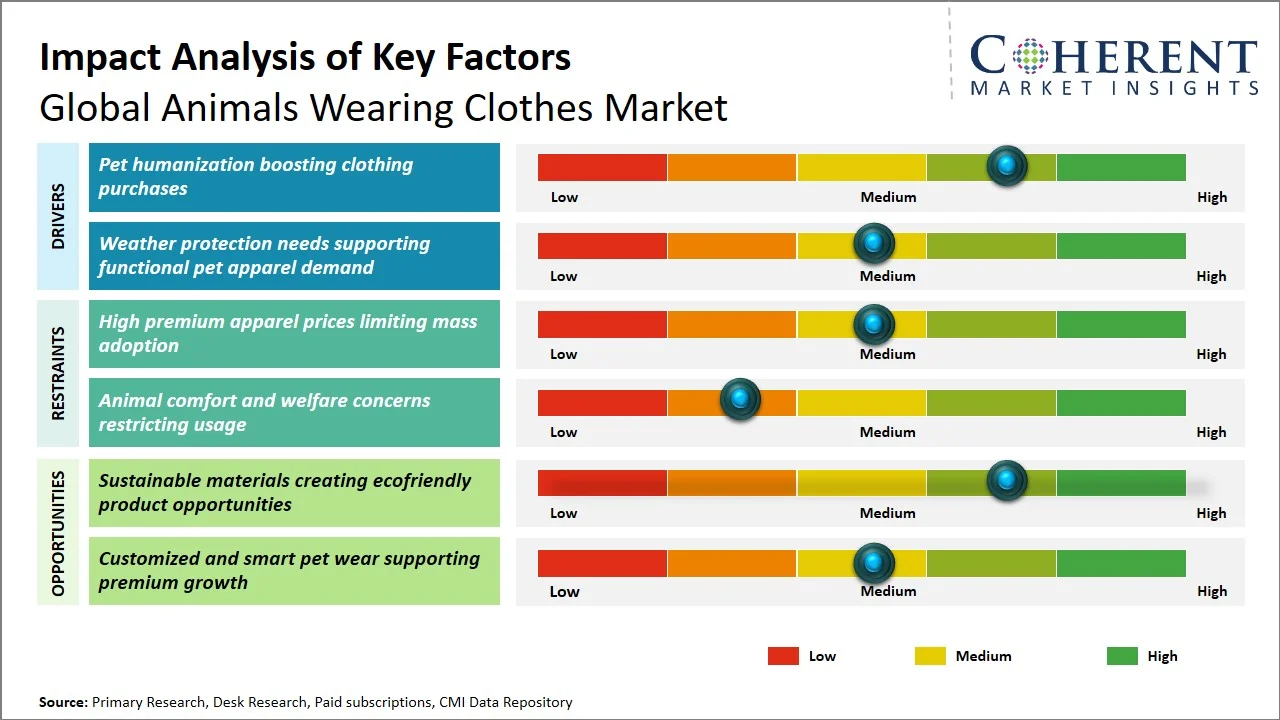
Key Market Drivers
- Pet Humanization Boosting Clothing Purchases: Pet humanization is changing animal-clothing purchases from occasional novelty spending into household lifestyle merchandising. Owners increasingly use apparel to include pets in outings, celebrations, and personal styling, expanding demand across fashion, occasion wear, and accessories while giving retailers more reasons to refresh assortments. Specialist designers, fashion labels, marketplaces, and private-label manufacturers benefit because emotional attachment supports visually differentiated purchases. In April 2025, Shanghai’s municipal government reported that Petjoy Fashion Week was attracting domestic designers and overseas brands, while pet fashion was broadening beyond garments into shoes, accessories, backpacks, and wearables.
- Weather Protection Needs Supporting Functional Pet Apparel Demand: Weather protection is creating a needs-based market in which garment choice depends on breed physiology, age, coat density, activity, and local conditions. This mechanism supports technical rainwear, insulated layers, wind barriers, and easy-on garments while making fit, mobility, and washability more important than decorative styling. Outdoor pet wear brands, textile suppliers, and specialty retailers benefit from higher-functional-value products and season-specific replacement cycles. In December 2025, Spark Paws published cold-weather guidance explaining that sweater requirements vary by breed, size, age, health, fur type, and climate, reinforcing demand for condition-specific apparel rather than universal winter products.
Emerging Market Trends
- Shift Toward Modular and Layer-Compatible Pet Wardrobes: Pet apparel is moving toward coordinated wardrobe systems rather than isolated garments. Suppliers are designing base layers, mid-layers, removable insulation, weather shells, and garments with harness access so owners can adjust coverage according to activity and conditions. This changes assortment economics by encouraging complementary purchases instead of one-off seasonal transactions. Technical pet wear specialists and manufacturers using coordinated pattern architectures should benefit, while novelty-focused sellers may face pressure as buyers increasingly evaluate animal clothing through functionality, interoperability, comfort, and repeated-use value.
- Fit Intelligence Becoming a Core Digital Merchandising Capability: Fit is becoming a merchandising capability rather than only a product-development task. Digital size selectors, body-shape profiles, detailed measurement guidance, and improved garment visualization can reduce uncertainty before purchase and help brands manage anatomical variation more systematically. Over the forecast period, suppliers that integrate reusable fit data into design and e-commerce workflows should improve conversion, reduce avoidable returns, and rationalize size inventories. Brands relying on generic size charts may experience greater margin pressure as buyers become less tolerant of inconsistent sizing across successive apparel purchases.
Regional Insights
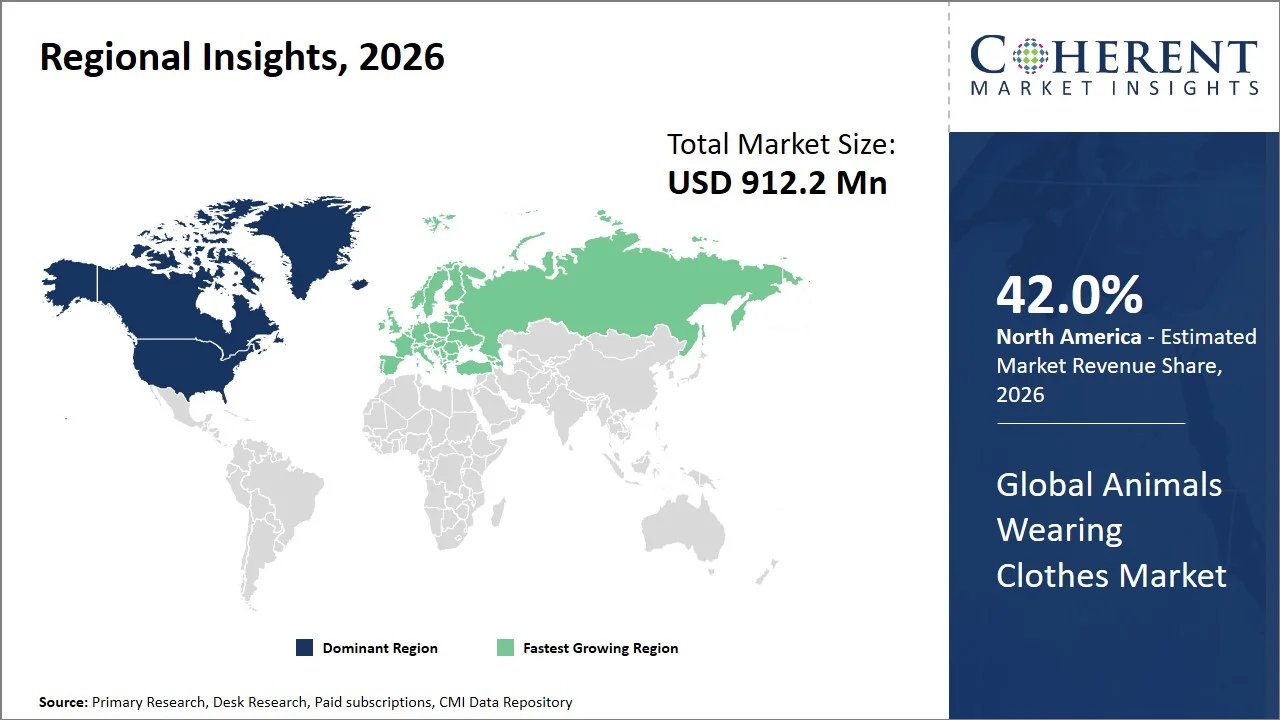
Why Does North America Dominate the Global Animals Wearing Clothes Market?
North America is expected to account for 42.0% of the global animals wearing clothes market in 2026, reflecting the region’s ability to convert pet apparel from a niche accessory into a regularly merchandised consumer category. Large-format retailers and digital platforms provide wide SKU visibility, standardized sizing, convenient fulfillment, and frequent seasonal assortment rotation, making clothing easier to discover and purchase beyond specialist pet stores. Brands can also serve multiple price tiers, from affordable novelty pieces to technical garments, which broadens the addressable customer base. Strong private-label development further encourages retailers to refresh colors, prints, fits, and occasion-based collections rapidly. In April 2025, Target relaunched its Boots & Barkley pet-accessories brand with more than 150 new products and expanded categories, including apparel; Target also stated that around 70% of its guests are pet owners, demonstrating the scale of mainstream retail exposure available to pet clothing.
Why Is Europe Emerging as the Fastest-Growing Region in the Global Animals Wearing Clothes Market?
Europe is expected to hold 28.4% of the global animals wearing clothes market in 2026 and emerge as the fastest-growing region as pet apparel increasingly adopts the design logic of established European outerwear and textile industries. Market development is supported by demand for layered, weather-adapted garments, premium construction, and materials selected for durability and comfort rather than purely decorative use. European consumers’ sensitivity to product longevity and material responsibility is also encouraging suppliers to emphasize reusable, well-constructed pieces and more thoughtful fabric choices. The region’s dense cross-border retail environment allows distinctive collections developed in one fashion market to reach neighboring countries quickly, supporting faster design diffusion. In October 2025, H&M Group announced an ARKET and Barbour autumn/winter collaboration that included a waxed-cotton dog jacket with tartan lining, directly illustrating how European apparel expertise is extending into functional, design-led clothing for companion animals.
Global Animals Wearing Clothes Market Outlook for Key Countries
Why Is the U.S. a Key Market for the Global Animals Wearing Clothes Market?
The U.S. is estimated to represent 35.6% of the global animals wearing clothes market in 2026, making it the largest individual country market. Demand is diversified across practical winter wear, rain protection, outdoor apparel, costumes, licensed designs, and everyday fashion, reducing dependence on any single buying occasion. A large base of specialty pet retailers and digitally native sellers supports broad size, breed, and style availability, while consumers can readily compare fit, materials, reviews, and pricing online. The country’s wide climatic variation also supports differentiated apparel requirements across states and seasons. Importantly, U.S. merchandising extends pet clothing into sports fandom, celebrations, and personalized products, creating additional purchase occasions. Chewy’s current U.S. assortment spans coats and parkas, rain gear, hoodies, sweaters, shirts, dresses, working apparel, cooling products, and costumes, illustrating the category breadth supporting repeat purchases across functional and lifestyle applications.
Why Is China Important in the Global Animals Wearing Clothes Market?
China is estimated to account for 8.2% of the global animals wearing clothes market in 2026, supported by the rapid development of the urban companion-animal economy and growing willingness to treat pets as household members. Apparel demand is particularly relevant among younger city-based owners who purchase clothing for appearance, seasonal comfort, photography, social-media content, and special occasions. China also has a highly developed textile and consumer-goods manufacturing ecosystem, allowing domestic suppliers to respond rapidly to changing styles, materials, and price points. E-commerce and livestream-based retail further shorten the journey between product discovery and purchase, benefiting trend-sensitive pet-fashion categories. Supporting this consumer shift, in April 2025, JD.com’s 2025 Pet Industry Report found that 25.6% of surveyed pet owners purchased outfits for their pets, providing direct evidence that clothing has become an established element of China’s humanized pet-care spending.
Why Is Japan a Strategic Market for the Global Animals Wearing Clothes Market?
Japan is estimated to hold 4.7% share of the global animals wearing clothes market in 2026, reflecting a mature pet-care culture in which apparel combines fit, comfort, aesthetics, and seasonal functionality. The prevalence of smaller companion dogs supports demand for precisely sized garments, while consumers show strong interest in coordinated designs, cooling wear, rainwear, winter layers, and character-themed products. Japan’s specialty retail environment also favors detailed construction, fabric quality, and regular collection updates rather than purely price-led purchasing. A notable opportunity is emerging beyond traditional small-dog apparel as suppliers develop more inclusive sizing for medium and large breeds. In October 2025, Creative Yoko announced that its Pet Paradise brand would expand medium- and large-dog products from the autumn/winter season; pet wear already represented approximately half of the company’s product lineup, highlighting continued assortment development around increasingly diverse breed-size requirements.
Why Is Germany a Strategic Country in the Global Animals Wearing Clothes Market?
Germany is estimated to contribute 6.1% share of the global animals wearing clothes market in 2026, supported by a substantial pet-owning population, established specialty retail infrastructure, and consumer preference for functional, durable products. Demand is particularly relevant for rainwear, winter coats, reflective garments, and walking-oriented apparel designed around changing seasonal conditions. German purchasing behavior also creates opportunities for garments differentiated through material quality, fit, washability, longevity, and practical construction rather than novelty alone. Specialist stores provide product guidance, while online platforms expand access to breed-specific sizes and niche designs, creating an effective omnichannel route to market. In April 2026, Germany’s IVH and ZZF reported that the national pet industry generated nearly USD 8.11 billion in 2025, including more than USD 1.74 billion through online channels, while specialist retailers remained the principal sales channel for pet supplies and accessories, demonstrating a strong commercial infrastructure for adjacent apparel categories.
Why Is Brazil an Important Growth Market for the Global Animals Wearing Clothes Market?
Brazil is estimated to account for 3.4% of the global animals wearing clothes market share in 2026, making it an important Latin American growth market supported by an established companion-animal consumer base and expanding pet-specialty retail. Clothing demand differs from colder markets, with lightweight shirts, decorative outfits, costumes, post-surgical garments, and apparel for cooler southern regions and winter periods having greater commercial relevance than heavy insulation nationwide. Pet celebrations, gifting, and visually distinctive designs also create demand beyond weather protection, while online retail broadens access to varied sizes and affordable styles outside major metropolitan stores. Practical seasonal use remains relevant in colder periods. In June 2025, Brazilian pet retailer Petz highlighted clothing as part of appropriate cold-weather care for sensitive animals, particularly puppies, older pets, and short-haired dogs, supporting the functional role of animal apparel alongside Brazil’s fashion-oriented pet-consumption culture.
Innovation and Market Transformation Landscape
Innovation Theme | Current Adoption Stage | Market Evolution | Strategic Implication |
Functional Performance Enhancement | Established | Pet apparel is shifting from decorative clothing toward performance-oriented products designed for weather resistance, mobility, comfort, and outdoor activities. | Brands investing in technical fabrics, ergonomic construction, and purpose-driven designs can achieve stronger differentiation and justify premium pricing. |
Premium Fashion and Lifestyle Integration | Rapidly Expanding | Animal clothing is increasingly adopting human fashion trends through seasonal collections, coordinated designs, luxury-inspired aesthetics, and limited-edition releases. | Fashion brands, lifestyle retailers, and premium pet companies can capture higher-value consumers through brand-led pet lifestyle positioning. |
Personalized and Breed-Specific Product Development | Growing | Demand is increasing for customized garments based on breed characteristics, body measurements, pet personality, and owner preferences. | Companies with flexible production capabilities and digital customization platforms can improve customer engagement and reduce size-related dissatisfaction. |
Sustainable Pet Apparel Ecosystems | Emerging | Manufacturers are exploring recycled materials, responsible sourcing, durable construction, and longer product lifecycles as sustainability becomes more relevant in purchasing decisions. | Sustainability capabilities can strengthen brand reputation, improve regulatory readiness, and attract environmentally conscious pet owners. |
Digital Commerce and Data-Driven Merchandising | Advanced | Online channels are enabling broader product discovery, virtual sizing support, customer reviews, personalization, and rapid testing of new designs. | Companies leveraging digital customer insights can optimize inventory planning, improve conversion rates, and expand internationally without extensive physical retail networks. |
Pet Wellness-Oriented Clothing Solutions | Emerging | Apparel is increasingly intersecting with health, recovery, protection, and comfort applications through products designed for sensitive animals, rehabilitation, and specialized needs. | Suppliers capable of combining apparel expertise with veterinary and wellness applications can access higher-value niches beyond traditional fashion categories. |
How Is Veterinary-Integrated Recovery Apparel Creating New Growth Opportunities in the Global Animals Wearing Clothes Market?
Veterinary-integrated recovery apparel represents an underdeveloped opportunity beyond conventional fashion and weather wear. Post-surgical suits, wound-protection garments, mild-compression designs, lick-deterrent coverage, and dermatology-focused clothing can turn animal apparel into a care-support product with clearer functional value. Priority customers include veterinary clinics, specialty hospitals, groomers, and owners managing recovery or recurring skin conditions across dogs and cats. Suppliers can capture the opportunity by co-designing garments with veterinary professionals, offering clinic sizing kits, improving access openings and closure placement, and building washable, breathable product platforms with clear use instructions. Bundled discharge packs and clinic replenishment programs could also create recurring B2B demand rather than relying solely on discretionary retail purchases. Participation requires stronger fabric-safety controls, ergonomic pattern development, consistent size availability, quality assurance, and distributor education than fashion-led apparel typically demands. The opportunity should favor specialist and vertically integrated suppliers able to connect textile engineering with veterinary-channel credibility, while pure fashion brands may need partnerships to compete effectively.
Market Players, Key Development, and Competitive Landscape
Key Developments
- In August 2026, adidas launched its Clubs Pet Collection featuring pet apparel and accessories inspired by Arsenal FC, Bayern Munich, Liverpool FC, Manchester United, Real Madrid CF, and other clubs. The initiative expands animal clothing into club-football merchandising and creates additional licensing-led purchase occasions around household sports fandom.
- In November 2025, CLOT unveiled its inaugural pet collection, translating signature streetwear motifs into pet tees, hoodies, silk outerwear, and accessories for a global debut at ComplexCon. The move shows how established fashion intellectual property can enter animal apparel through limited drops and existing lifestyle retail channels.
- In September 2025, L.Bean announced its second Northern Attitude collaboration with Noah Kahan, with the later pet-focused drop including a reversible Dog Field Jacket inspired by its outdoor heritage. The development demonstrates how established human-apparel design assets can be extended into coordinated owner-pet lifestyle merchandising.
Competitive Landscape
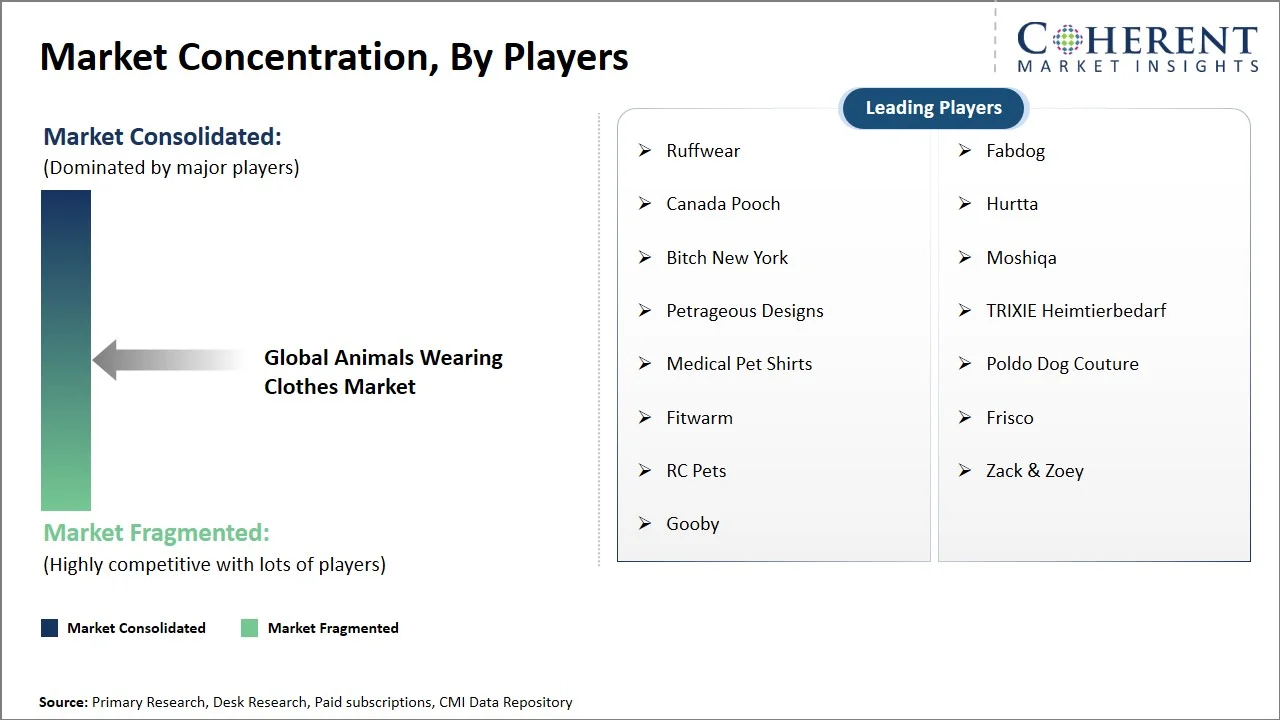
The global animals wearing clothes market is fragmented, with specialist pet wear brands, outdoor-equipment companies, fashion labels, licensed-merchandise operators, private-label manufacturers, regional sellers, and mass retailers competing across different price and use-case tiers. Competitive advantage increasingly depends on material performance, design-refresh speed, dependable supply, compliance discipline, inventory management, brand relevance, and the ability to reach customers through specialty, marketplace, and direct-to-consumer channels.
Key focus areas include:
- Functional Material Performance: Suppliers compete on insulation, weather resistance, breathability, abrasion tolerance, flexibility, and wash durability.
- Seasonal Design Speed: Short development cycles help brands capitalize on holidays, weather changes, cultural moments, and rapidly changing aesthetics.
- SKU and Inventory Discipline: Controlling combinations of size, color, style, and season is critical to limiting markdown exposure and unsold inventory.
- Omnichannel Customer Access: Specialty stores, branded websites, marketplaces, and mass retail provide different advantages in discovery, fitting support, and reach.
- Private-Label Manufacturing Flexibility: Retailers favor suppliers capable of small runs, quick specification changes, consistent quality, and reliable replenishment.
- Material Compliance and Traceability: Chemical documentation, component records, product-safety processes, and supplier visibility increasingly influence market access.
- Licensing and Collaboration Capability: Access to entertainment, sports, fashion, and cultural intellectual property can create differentiated limited-edition demand when supported by disciplined royalty and inventory economics.
Market Report Scope
Animals Wearing Clothes Market Report Coverage
| Report Coverage | Details | ||
|---|---|---|---|
| Base Year: | 2025 | Market Size in 2026: | USD 912.2 Mn |
| Historical Data for: | 2020 To 2024 | Forecast Period: | 2026 To 2033 |
| Forecast Period 2026 to 2033 CAGR: | 3.1% | 2033 Value Projection: | USD 1,129.5 Mn |
| Geographies covered: |
| ||
| Segments covered: |
| ||
| Companies covered: | Ruffwear, Fabdog, Canada Pooch, Hurtta, Bitch New York, Moshiqa, Petrageous Designs, TRIXIE Heimtierbedarf, Medical Pet Shirts, Poldo Dog Couture, Fitwarm, Frisco, RC Pets, Zack & Zoey, Gooby | ||
| Growth Drivers: |
| ||
| Restraints & Challenges: |
| ||
Analyst Opinion (Expert Opinion)
- The global animals wearing clothes market leadership is likely to depend less on maintaining the largest catalogue and more on creating economically reusable product architectures. Suppliers that can retain validated core silhouettes while changing fabrics, trims, graphics, and seasonal themes should shorten development cycles and reduce inventory complexity. This structure can create stronger margins than repeatedly developing unrelated designs and should increasingly separate disciplined apparel operators from assortment-led sellers.
- Localized micro-batch and increasingly on-demand production could materially alter traditional pet-apparel economics. Digital pattern files, flexible cutting, short-run printing, and responsive manufacturing can allow suppliers to produce closer to confirmed demand rather than committing heavily before a season begins. Participants that master this model could reduce markdown risk and serve niche body types economically, putting pressure on competitors dependent on long production runs and forecast-heavy wholesale purchasing.
- The global animals wearing clothes market participants should prioritize repeatable quality control, material documentation, demand forecasting, disciplined assortment planning, and flexible regional fulfilment. Evergreen products should provide the commercial base, while fashion capsules and licensed collections should be managed selectively to avoid excessive royalty costs and inventory exposure. Suppliers should also diversify manufacturing and key textile inputs, because dependence on a narrow vendor base can undermine delivery reliability precisely when weather or seasonal demand peaks.
Speak to the analyst
Want personalized insights?
Take the findings above to one of our principal consultants, or have the report rebuilt around the segments, geographies and competitors you actually track.
Market Segmentation
- Product Type Insights (Revenue, USD Mn, 2021 - 2033)
- Coats and Jackets
- Sweaters and Hoodies
- Shirts and Tops
- Costumes and Occasion Wear
- Boots and Protective Wear
- Animal Type Insights (Revenue, USD Mn, 2021 - 2033)
- Dogs
- Cats
- Horses
- Other Animals
- Material Insights (Revenue, USD Mn, 2021 - 2033)
- Polyester
- Cotton
- Nylon
- Wool
- Others
- Application Insights (Revenue, USD Mn, 2021 - 2033)
- Weather Protection
- Fashion and Decorative Wear
- Health and Protective Wear
- Special Occasions
- Distribution Channel Insights (Revenue, USD Mn, 2021 - 2033)
- Online Retail
- Pet Specialty Stores
- Supermarkets and Hypermarkets
- Veterinary and Grooming Channels
- Others
- Regional Insights (Revenue, USD Mn, 2021 - 2033)
- North America
- U.S.
- Canada
- Latin America
- Brazil
- Argentina
- Mexico
- Rest of Latin America
- Europe
- Germany
- U.K.
- Spain
- France
- Italy
- Russia
- Rest of Europe
- Asia Pacific
- China
- India
- Japan
- Australia
- South Korea
- ASEAN
- Rest of Asia Pacific
- Middle East
- GCC Countries
- Israel
- Rest of Middle East
- Africa
- South Africa
- North Africa
- Central Africa
- North America
- Key Players Insights
- Ruffwear
- Fabdog
- Canada Pooch
- Hurtta
- Bitch New York
- Moshiqa
- Petrageous Designs
- TRIXIE Heimtierbedarf
- Medical Pet Shirts
- Poldo Dog Couture
- Fitwarm
- Frisco
- RC Pets
- Zack & Zoey
- Gooby
Sources
Primary Research Interviews
- Pet apparel manufacturers, pet fashion brands, outdoor petwear companies, distributors, retailers, e-commerce sellers, and veterinary apparel suppliers
- Product designers, textile specialists, sourcing professionals, pet industry executives, veterinarians, groomers, and animal welfare experts
Stakeholders
- Pet clothing manufacturers, pet accessory brands, specialty petwear companies, fashion-led pet apparel producers, and private-label manufacturers
- Fabric suppliers, textile processors, garment manufacturers, packaging suppliers, distributors, online marketplaces, and retail channel partners
- Pet owners, veterinary clinics, grooming centers, pet care organizations, and animal welfare communities
End-use Sectors
- Companion animal care and pet lifestyle applications
- Weather protection and outdoor pet activities
- Pet fashion, decorative wear, and special occasions
- Veterinary recovery, protective clothing, and wellness applications
Regulatory and Industry Bodies
- Animal welfare organizations and veterinary associations
- Consumer product safety authorities
- Textile and apparel regulatory bodies
- Environmental and sustainability compliance organizations
- Regional pet industry associations
Databases
- Company annual reports, investor presentations, and corporate filings
- Pet industry databases and retail intelligence platforms
- E-commerce product listings and pricing databases
- Consumer pet ownership and spending databases
- Trade statistics, textile databases, and import-export datasets
- Product portfolio and competitive intelligence databases
Magazines and Journals
- Pet industry publications
- Veterinary and animal health journals
- Textile technology and apparel innovation publications
- Fashion and lifestyle industry publications
- Consumer behavior and retail research journals
Associations
- American Pet Products Association (APPA)
- European Pet Food Industry Federation (FEDIAF)
- International pet industry associations
- National pet care and veterinary associations
- Textile and apparel industry associations
Public Domain Sources
- Pet ownership trends and consumer behavior developments
- Pet fashion and lifestyle product innovations
- Outdoor pet activity and functional apparel developments
- Retail and e-commerce channel expansion
- Sustainability trends in pet products and textile materials
Key Standards and Regulations
- Consumer product safety requirements for pet accessories
- Textile material safety and chemical compliance standards
- Product labeling and consumer information requirements
- Sustainable textile sourcing and environmental regulations
- International trade and import regulations for pet apparel products
Proprietary Elements
- CMI Data Analytics Tool, Proprietary CMI repository containing 10+ years of pet care, consumer goods, retail, and lifestyle market intelligence.
Get access to 250+ pages report
Every segment, forecast, competitor profile and data table behind the analysis above — available for instant download.
- ESOMAR Member
- ISO 9001:2015 Certified
- D-U-N-S Registered
- GDPR & CCPA Compliant
Missing comfort of reading report in your local language? Find your preferred language:
Frequently Asked Questions
The global animals wearing clothes market is estimated to be valued at USD 912.2 million in 2026 and is expected to reach USD 1,129.5 million by 2033.
The CAGR of global animals wearing clothes market is projected to be 3.1% from 2026 to 2033.
The global animals wearing clothes market is witnessing trends such as premium pet fashion, personalized apparel, sustainable materials, functional protective clothing, and digital-first pet apparel shopping experiences.
Animals wearing clothes are primarily used for weather protection, fashion and decorative purposes, health-related protection, outdoor activities, and special occasions.
Animals wearing clothes are sold through online platforms, pet specialty stores, supermarkets, hypermarkets, veterinary and grooming channels, and specialized pet retailers.
Buyers typically consider factors such as pet comfort, proper sizing, material quality, durability, weather suitability, ease of use, design preferences, and product safety before purchasing animal clothing.
Pet humanization boosting clothing purchases and Weather protection needs supporting functional pet apparel demand are the major factors driving the growth of global animals wearing clothes market.