

Global Antifouling Coatings Market Size & Forecast – 2026 To 2033
The Global Antifouling Coatings Market is estimated to be valued at USD 2,252.6 Mn in 2026 and is expected to reach USD 3,432.1 Mn by 2033, exhibiting a compound annual growth rate (CAGR) of 6.20% from 2026 to 2033. Market expansion is supported by rising commercial shipping activity, recurring vessel drydocking, increasing shipbuilding output, and greater use of protective coatings on vessel hulls, propellers, offshore structures, and aquaculture equipment.
Shipowners are increasingly selecting self-polishing, low-friction, and biocide-free coating technologies to control marine growth, limit hydrodynamic resistance, reduce fuel consumption, and extend maintenance intervals. Environmental restrictions on harmful active substances are also encouraging investment in cleaner formulations and controlled coating-removal practices. In October 2024, the International Maritime Organization issued revised guidance covering the safe removal, collection, treatment, and disposal of antifouling coatings, strengthening compliance requirements for shipyards and coating-service providers.
Key Takeaways of the Global Antifouling Coatings Market
- Self polishing copolymer coatings are expected to hold 44.8 % of the global antifouling coatings market in 2026 because controlled surface renewal maintains biocide release, limits roughness, and supports predictable performance across varied operating profiles. In October 2025, Jotun reported that DNV verified SeaQuantum X200 at 1.0% average speed loss over a dock-to-dock period.
- Cargo and container vessels are expected to account for 34.6 % of the global antifouling coatings market in 2026 because large wetted hull areas, intensive sailing schedules, and fuel-cost exposure make fouling control commercially critical. In February 2024, Nippon Paint Marine reported that its A-LF-Sea and FASTAR coatings delivered fuel and emissions savings for WAN HAI’s container fleet.
- Vessel hulls are expected to represent 61.8 % of the global antifouling coatings market in 2026 because they provide the largest treated surface and directly influence drag, fuel consumption, emissions, and drydock economics. In June 2026, PPG Industries published findings showing that electrostatic application of marine hull coatings improved transfer efficiency and reduced overspray at EDR Antwerp.
- Asia Pacific is expected to command 58.9 % of the global antifouling coatings market in 2026, supported by concentrated shipbuilding, repair yards, commercial fleets, and marine-coating production across China, South Korea, Japan, and Southeast Asia. In December 2025, AkzoNobel extended its marine coatings partnership with Winning Shipping in China to support lower-carbon vessel operations.
- Europe is expected to hold 21.3 % of the global antifouling coatings market in 2026 and expand the fastest as carbon-accounting obligations increase the commercial value of cleaner hulls and lower resistance. In January 2025, the European Commission confirmed that FuelEU Maritime became fully applicable, requiring covered ships calling at European ports to reduce onboard energy greenhouse-gas intensity.
- Biocide-Free Formulations Reshape Product Strategy: Biocide-free and low-leach formulations are reshaping antifouling product strategy as shipowners seek environmental compatibility without sacrificing long-term hull performance. Suppliers must strengthen polymer design, surface-energy control, field validation, and application guidance. The trend raises development costs but creates premium-positioning opportunities for companies that can document durability, cleaning compatibility, and operating efficiency across different vessel speeds, routes, and idle periods.
- Performance-Based Fleet Management Gains Ground: Antifouling procurement is moving toward performance-based fleet management rather than stand-alone paint purchasing. Owners increasingly evaluate coatings alongside hull monitoring, cleaning schedules, fuel models, and drydock planning. This favors suppliers offering verified in-service data, technical support, and digital performance tracking, while smaller formulators may face pressure unless they partner with shipyards, inspection providers, or fleet-management platforms.
Segmental Insights
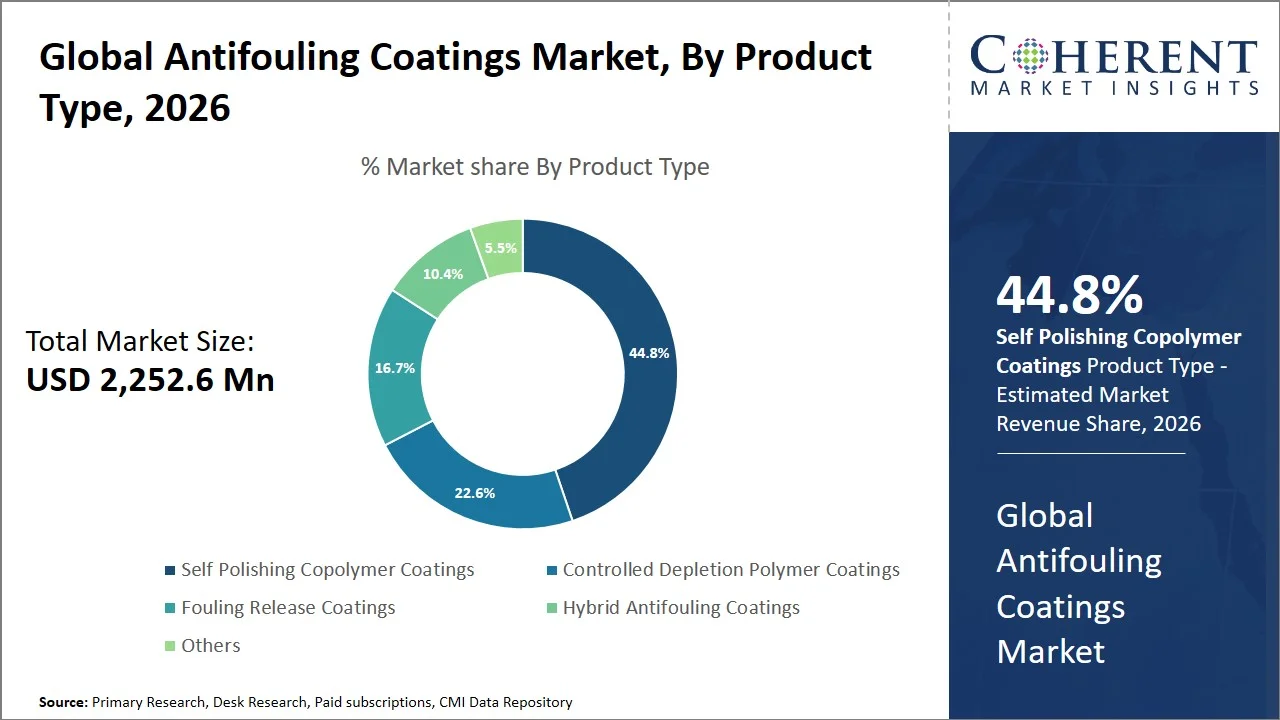
Why Do Self Polishing Copolymer Coatings Dominate the Global Antifouling Coatings Market?
Self polishing copolymer coatings are expected to hold 44.8% of the global antifouling coatings market in 2026 because they offer shipowners a standardized coating platform that can be specified by binder chemistry, active package, film thickness, vessel activity, and intended docking interval. Their controlled surface reaction exposes a renewed functional layer during service and reduces the accumulation of exhausted coating, supporting easier recoating at subsequent drydocks. Self-Polishing Copolymer (SPC) products are available for newbuilding and maintenance programs across multiple vessel classes, giving global fleets greater procurement flexibility than highly specialized systems. Manufacturers can differentiate products by trading pattern and protection period, while shipyards benefit from familiar spray, curing, inspection, and repair procedures. In April 2025, the International Maritime Organization issued in-water cleaning guidance that identified self-polishing coatings as one of the two principal groups of current antifouling coatings and described hydrolysis and erosion as their operating mechanisms.
- Current Industry Events of 2026
- Market Size Estimation
- Regional Breakdown
- Competitive Landscape
- Customer Intelligence
- Segmental Analysis
- Pricing Analysis
- Key Market Drivers, Challenges & Future Trends
- Customized Insights Section
Why Do Cargo and Container Vessels Represent the Largest Vessel Type in the Global Antifouling Coatings Market?
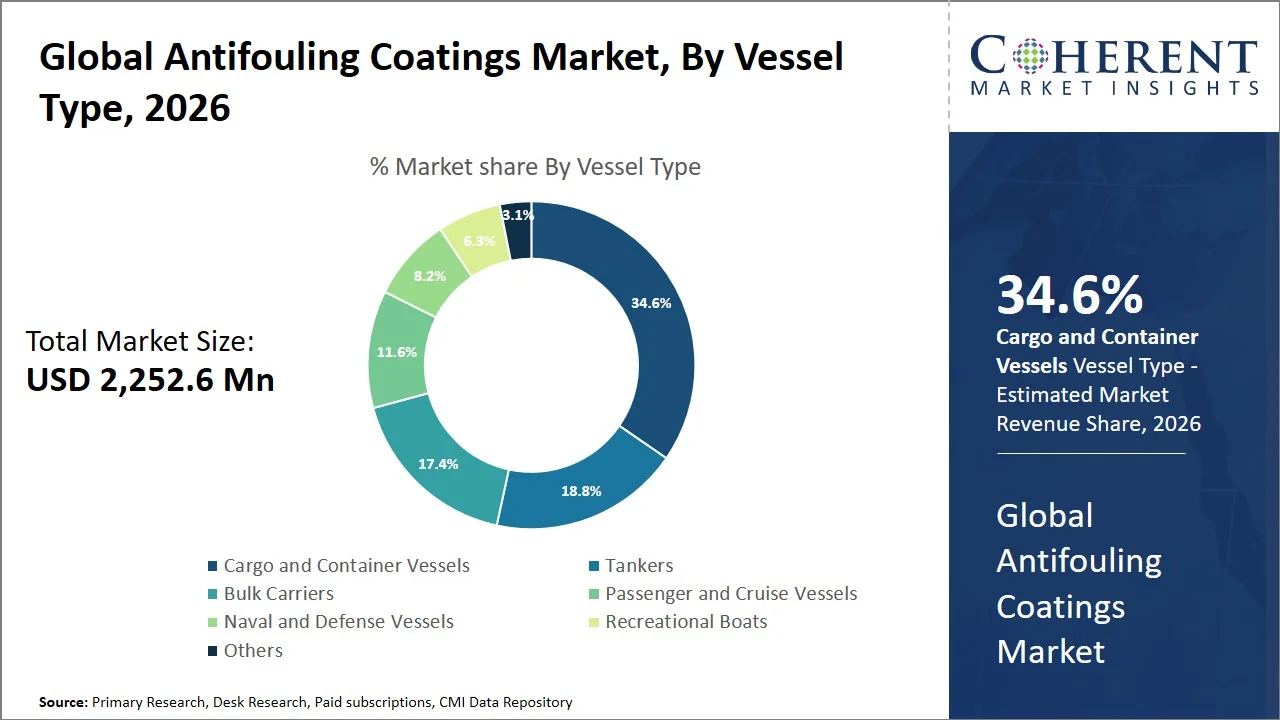
Cargo and container vessels are expected to account for 34.6% of the global antifouling coatings market in 2026 because liner and cargo operators manage sizeable fleets through recurring class-survey and drydock programs, generating large, repeatable coating tenders. These ships trade across warm, temperate, and high-fouling waters and experience variable port residence, making broad-spectrum protection and dependable service life central to fleet specifications. Sister-ship standardization also allows owners to compare coating condition, maintenance outcomes, and voyage performance across multiple assets before extending a product fleetwide. Suppliers with port-adjacent inventory, globally consistent formulations, inspection teams, and yard relationships are therefore better positioned to secure long-term contracts. In March 2025, Yang Ming Marine Transport’s annual report disclosed that 26 vessel hulls received energy-saving, low-friction paint during scheduled drydocking in 2024, demonstrating the procurement scale available when a container carrier upgrades coatings across its operating fleet.
Why Do Vessel Hulls Dominate the Application Segment of the Global Antifouling Coatings Market?
Vessel hulls are expected to represent 61.8% of the global antifouling coatings market in 2026 because every seagoing vessel requires extensive protection across its continuously immersed external structure. Hull treatment consumes substantially more coating than propellers, running gear, sea chests, or aquaculture equipment and normally involves an integrated primer, anticorrosive layer, tie coat, and antifouling finish. Selection is closely linked to substrate condition, surface preparation, overcoating windows, docking duration, inspection requirements, and compatibility with future cleaning. This creates recurring revenue for coating manufacturers, blasting contractors, applicators, surveyors, and hull-maintenance providers rather than a single product sale. In October 2024, Lloyd’s Register awarded Graphite Innovation & Technologies Inc (GIT) Coatings the maritime industry’s first Enhanced Antifouling Type Approval for its graphene-based XGIT-Fuel hull coating, validating performance before and after grooming without increased roughness or coating-thickness loss.
Global Antifouling Coatings Market Dynamics
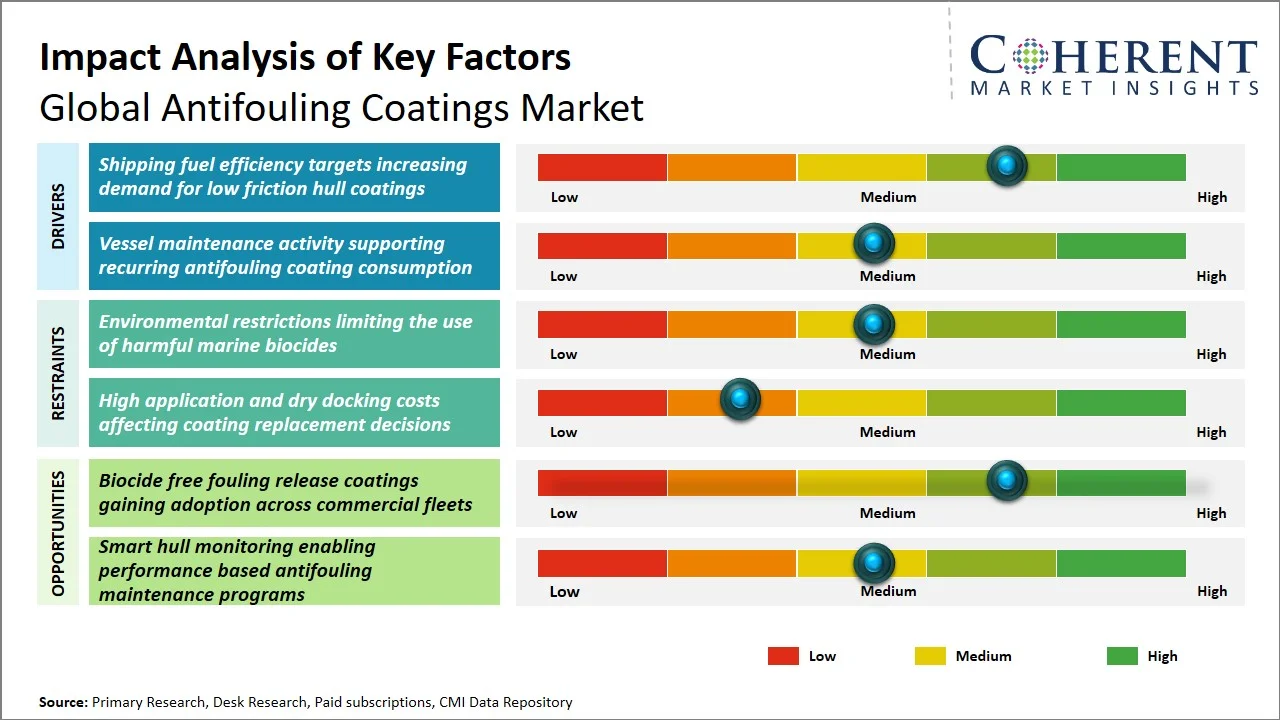
Key Market Drivers
- Shipping Efficiency Targets Elevate Low-Friction Hull Coatings: Shipping fuel-efficiency targets are turning antifouling selection into an operating-cost and carbon-management decision. Fouling increases hydrodynamic resistance, so coatings that maintain a smoother underwater surface can reduce propulsion demand without altering engines or vessel architecture. Fleet owners, charterers, coating formulators, active-ingredient suppliers, shipyards, and hull-performance specialists benefit as procurement shifts from paint price per liter toward verified lifecycle economics. The commercial advantage is the strongest where operators can link coating condition with fuel use, voyage profile, speed loss, and compliance performance. Suppliers must therefore support claims with application control, in-service data, and route-specific recommendations. In January 2025, I-Tech signed a supply and license agreement enabling a major Asian paint producer to incorporate Selektope into new antifouling formulations, extending access to barnacle-control chemistry intended to keep hulls cleaner and reduce friction, fuel consumption, and emissions.
- Recurring Drydock Activity Sustains Coating Consumption: Vessel maintenance and repair activity creates recurring antifouling consumption because underwater systems must be inspected, prepared, repaired, and recoated during scheduled dockings. Unlike newbuilding demand, maintenance volumes are distributed across an installed global fleet and cover spot repairs, complete hull renewal, boot-top treatment, niche areas, and compatibility with retained coating layers. Coating manufacturers, abrasives suppliers, applicators, inspection firms, distributors, and repair yards benefit from this repeating service cycle. Commercial success depends on rapid specification, local stock, predictable curing, technical supervision, and the ability to fit coating work within tightly sequenced dock schedules. In August 2025, India’s Ministry of Ports, Shipping and Waterways highlighted the modernization of ship-repair infrastructure, including Cochin Shipyard’s new dry dock and international ship-repair facility with a ship lift and multiple workstations, expanding capacity for vessel maintenance and associated hull-coating work.
Emerging Market Trends
- Cleanability-by-Design Reshapes Coating Development: Cleanability-by-design is becoming a distinct product-development pathway in the global antifouling coatings market. Instead of treating in-water cleaning as an emergency response, formulators are designing surfaces that tolerate controlled grooming without excessive roughening, delamination, or uncontrolled release of coating constituents. This changes testing priorities because adhesion, abrasion response, cleaning frequency, and compatibility with brushes or robotic tools must be evaluated together. Coating suppliers, cleaning-technology developers, ship managers, and inspection providers can benefit from integrated maintenance protocols, while products that perform well only under untouched laboratory conditions may lose relevance. Over the forecast period, owners are likely to request coating-cleaning combinations supported by defined operating windows and condition-monitoring rules. The trend could also encourage service contracts in which suppliers share responsibility for maintaining hull condition between drydocks rather than ending their involvement after application.
- Component-Specific Antifouling Systems Gain Relevance: Antifouling portfolios are becoming more substrate- and component-specific as vessel owners recognize that hull plating, propellers, thrusters, sea chests, sensors, offshore equipment, and aquaculture structures experience different flow, abrasion, material, and fouling conditions. A universal coating specification can create adhesion problems, interfere with equipment performance, or leave high-risk niche areas insufficiently protected. Suppliers are therefore developing systems tailored to metals, composites, elastomers, plastics, and sensitive electronic surfaces, supported by dedicated primers and application procedures. Specialist formulators and distributors with technical application knowledge stand to gain, while broad-line producers may need partnerships to cover smaller but higher-value applications. During the forecast period, this trend should expand revenue beyond conventional hull paint and make component mapping part of vessel coating plans, creating opportunities for bundled kits, installer training, and aftermarket replacement programs.
Current Events and their Impact
Current Events | Description and its Impact |
U.S. EPA PIP (3:1) Final Rule – October 2024 |
|
EU Medetomidine Approval Extension – May 2026 |
|
Regional Insights
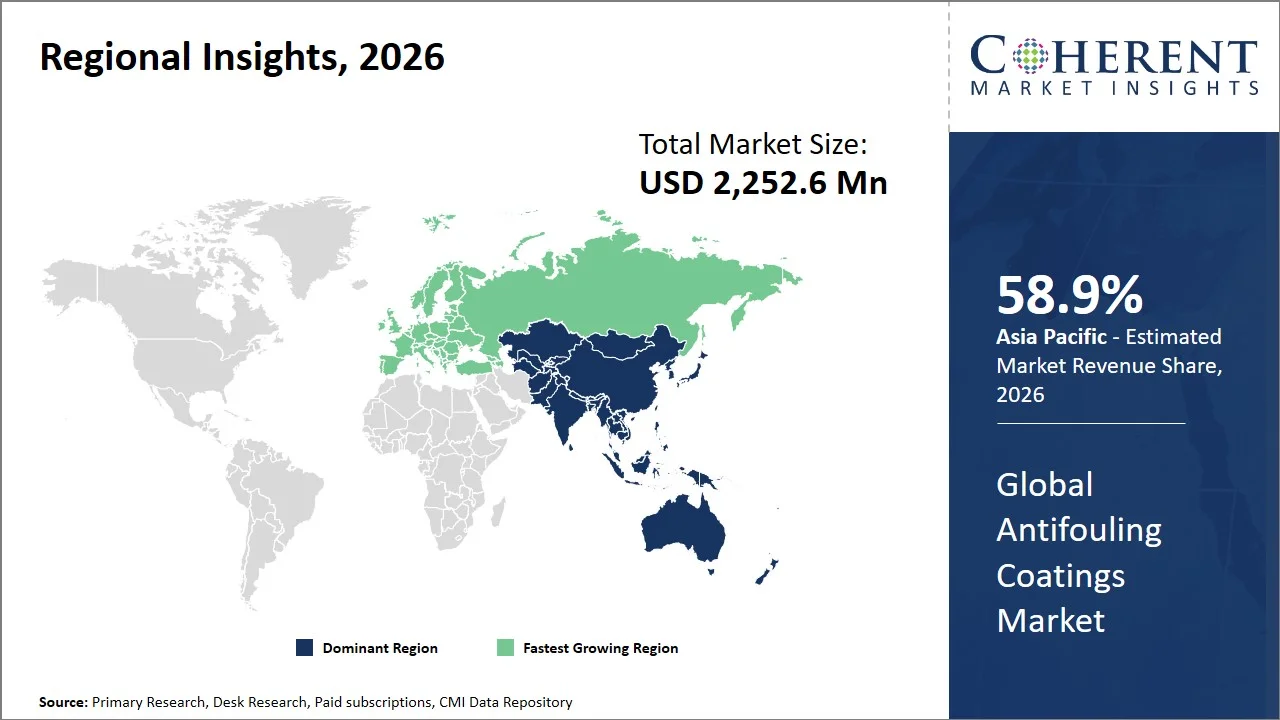
Why Does Asia Pacific Dominate the Global Antifouling Coatings Market?
Asia Pacific is expected to account for 58.9% of the global antifouling coatings market in 2026 because the region concentrates the world’s largest shipbuilding, vessel-delivery, and drydock ecosystems. China, South Korea, and Japan support high-volume coating consumption through commercial new buildings, while Singapore and other regional hubs generate recurring maintenance demand from internationally trading fleets. Local formulation plants, marine-coating distributors, classification expertise, and yard-qualified applicators shorten supply lead times and make fleetwide specifications easier to execute. Warm waters and heavily trafficked ports also increase the operational importance of reliable fouling control. In February 2026, China’s State Council reported that the country completed 53.69 million deadweight tons of shipbuilding output during 2025, representing 56.1% of the global total. This production scale creates substantial demand for primers, tie coats, and antifouling systems at vessel construction and delivery stages.
Why is Europe Emerging as the Fastest-Growing Region in the Global Antifouling Coatings Market?
Europe is expected to hold 21.3% of the global antifouling coatings market in 2026 and emerge as the fastest-growing region as vessel operators connect hull condition more directly with carbon costs, voyage efficiency, and environmental compliance. The region combines large merchant fleets, ferry and cruise operations, recreational boating, advanced repair yards, and strong marine-coatings research. European buyers are increasingly evaluating biocide release, cleaning compatibility, coating longevity, and verified speed-loss performance during procurement. This supports investment in silicone, fouling-release, and lower-impact maintenance solutions rather than routine repainting alone. In November 2024, Denmark-based Hempel launched Infinity, a water-based, biocide-free recharger for its silicone yacht coatings, designed to renew hydrogel performance and extend the existing coating’s service for another season. The development illustrates Europe’s movement toward lower-material, lifecycle-based hull maintenance models.
Global Antifouling Coatings Market Outlook for Key Countries
Why is the U.S. a Key Market for the Global Antifouling Coatings Market?
The U.S. is a key market for antifouling coatings because demand arises from naval fleets, commercial shipping, inland and coastal vessels, offshore assets, fishing boats, and one of the world’s largest recreational-boating communities. Product selection varies substantially across warm southern waters, colder northern ports, freshwater systems, and vessels with long idle periods, creating room for ablative, hard, fouling-release, and specialized running-gear coatings. Domestic demand also benefits manufacturers that can satisfy military specifications, environmental rules, yard procedures, and technical-service requirements. Maintenance planning is commercially important because coating damage and accumulated fouling can reduce operating range and increase drydock costs. In June 2025, the U.S. Naval Sea Systems Command updated its Joint Fleet Maintenance Manual with guidance for waterborne hull cleaning intended to conserve fuel and restore naval-system effectiveness. This reinforces the role of coating-compatible cleaning within U.S. fleet maintenance programs.
Why Does China Support Growth in the Global Antifouling Coatings Market?
China supports growth in the global antifouling coatings market through unmatched shipbuilding throughput, extensive commercial fleets, major container ports, and dense clusters of coating formulators, raw-material suppliers, shipyards, and application contractors. Antifouling demand is generated at both ends of the vessel lifecycle: large orderbooks require newbuilding coatings, while expanding operating fleets create future drydock and recoating volumes. Chinese yards also increasingly construct LNG carriers, vehicle carriers, containerships, and other technically demanding vessels whose owners require globally accepted coating specifications and service support. In August 2025, the Shanghai municipal government announced a three-year plan to transform Changxing Island into a world-class modern shipbuilding hub, covering high-end equipment, technology innovation, resilient industrial chains, and advanced factories. The initiative should strengthen local demand for high-performance hull coatings while encouraging suppliers to provide automated application support, inspection capability, and internationally documented product performance.
Why is Germany a Strategic Country in the Global Antifouling Coatings Market?
Germany is a strategic country in the global antifouling coatings market because it combines high-value shipbuilding, repair capability, commercial ports, yacht activity, marine engineering, and a strong specialty-chemicals and applied-research base. German customers place considerable emphasis on documented coating performance, environmental compatibility, process quality, and lifecycle economics. This creates opportunities for suppliers of low-leach binders, biodegradable polymers, surface-treatment technologies, laboratory testing, and mechanized hull-cleaning systems. The country’s research-to-industry ecosystem can also accelerate the transition from conventional biocidal products toward coatings designed for controlled degradation or cleaning compatibility. In April 2025, Fraunhofer IFAM announced the BioSHIP project to develop a biodegradable, self-polishing ship coating using substantially lower levels of toxic heavy metals while maintaining long-term antifouling performance. The project demonstrates Germany’s importance as an innovation and validation center for next-generation marine coating chemistries.
Why is Japan Important in the Global Antifouling Coatings Market?
Japan remains important in the global antifouling coatings market because its shipowners, shipbuilders, coating producers, classification organizations, and equipment suppliers operate across the complete maritime value chain. Japanese yards construct technologically advanced commercial vessels, while domestic fleets require dependable coatings for varied trading routes and long service intervals. Buyers typically prioritize predictable polishing behavior, application quality, compatibility with maintenance schedules, and precise chemical documentation. Japan’s role in classification and maritime compliance also influences how coating suppliers prepare material declarations and hazardous-material records for international customers. In July 2025, ClassNK issued revised technical information requiring suppliers and shipyards to use updated material-declaration formats reflecting clarified cybutryne thresholds in antifouling-system coating samples. The change strengthens demand for traceable formulations, accurate raw-material data, and compliance-ready documentation, favoring suppliers that can integrate regulatory support with marine coating performance.
Why is Brazil an Important Growth Market for the Global Antifouling Coatings Market?
Brazil is an important growth market for antifouling coatings because its long coastline, offshore oil and gas operations, coastal shipping, naval requirements, fishing fleet, and inland-waterway transport create diverse submerged-surface protection needs. Demand is concentrated around shipbuilding and repair clusters serving tankers, offshore support vessels, barges, patrol vessels, and production-related marine assets. Tropical and subtropical waters can create demanding fouling conditions, increasing the value of correctly specified coatings and planned hull maintenance. Public financing for vessel construction, modernization, docking, and repair supports coating consumption across newbuilding and maintenance applications. In January 2025, Brazil’s federal government reported that the naval sector closed 2024 with USD 5.98 billion authorized for more than 430 projects, including vessel construction, repairs, drydocking, and modernization. This project pipeline expands opportunities for coating manufacturers, distributors, blasting contractors, applicators, and inspection providers.
Technology Adoption Landscape in the global antifouling coatings market
Technology | Adoption Level | Key Application Area | Business Impact |
Silyl-acrylate and silyl-methacrylate self-polishing binders | High | Commercial vessel hulls in newbuilding and maintenance programs | Deliver controlled surface renewal, predictable active release, and extended protection between scheduled drydockings. |
Silicone and hydrogel fouling-release surfaces | Medium | High-activity vessels, passenger ships, yachts, and selected offshore assets | Reduce surface adhesion and hydrodynamic resistance while lowering reliance on conventional leaching biocides. |
Microdosed active-substance delivery systems | Medium | Barnacle control within advanced antifouling formulations | Enable targeted biological performance at lower active concentrations but require strong regulatory and formulation expertise. |
Robotic-grooming-compatible coating systems | Medium | In-water hull maintenance between drydock periods | Allow controlled cleaning without premature coating damage, supporting cleaner hulls and more predictable operating performance. |
ISO 19030-aligned hull-performance analytics | Medium | Fleetwide verification of speed loss and coating performance | Converts coating claims into operational evidence, enabling lifecycle-cost comparisons and performance-based procurement. |
Plural-component airless spray and digital film-thickness control | High | Shipyard application, coating mixing, and quality assurance | Improves mixing accuracy, coverage consistency, material utilization, and conformity with specified dry-film thickness. |
How are Low-Activity Marine Assets Creating New Growth Opportunities in the Global Antifouling Coatings Market?
Idle and irregularly operated marine assets create an underdeveloped opportunity for antifouling systems engineered around inactivity rather than continuous vessel speed. Offshore support vessels, reserve fleets, workboats, ferries, naval auxiliaries, aquaculture equipment, and seasonal recreational craft may remain stationary long enough for conventional movement-assisted coatings to underperform. Suppliers can capture this opportunity through low-activity formulations, fouling-release surfaces, niche-area protection, scheduled inspection, and cleaning-compatible service packages. Commercial differentiation should focus on predictable protection during lay-up, rapid return to service, substrate compatibility, and documented maintenance instructions. Market entry requires long-duration static immersion testing, warm-water field trials, applicator training, local service partners, and regulatory dossiers for any active substances used. Specialists in foul-release chemistry and condition monitoring could establish early leadership, although global coating companies possess advantages in yard approvals and distribution. Vertically integrated providers combining coating supply, inspection, grooming, and performance reporting may capture the strongest customer relationships because they can manage the complete inactivity-risk cycle rather than sell a standalone paint.
Market Players, Key Development, and Competitive Landscape
Key Developments
- In August 2025, Chugoku Marine Paints launched SEAFLO NEO SL ZX, an ultra-low-friction silyl-methacrylate antifouling coating for globally trading vessels. The product was positioned around sustained antifouling performance, lower expected speed loss, fuel savings, and improved vessel-efficiency management. This is important for the global antifouling coatings market because it strengthens competition around measurable lifecycle performance rather than basic fouling prevention alone.
- In August 2025, Seacoat presented its clear, hard-film silane-siloxane antifouling coating for commercial, military, cruise, tanker, and recreational vessels. The company positioned the system as biocide-free and compatible with repeated underwater grooming. This is important for the global antifouling coatings market because hard, cleanable surfaces could support alternative maintenance models combining durable coatings with scheduled robotic or manual hull cleaning.
- In July 2025, Hydrex implemented Ecospeed coating during overboard-pipe repairs on multiple vessels in Rotterdam. Repaired and newly installed pipe interiors were coated to protect submerged and chemically exposed surfaces against corrosion and operational wear. This is important for the global antifouling coatings market because it demonstrates how advanced marine coatings can generate aftermarket value across difficult niche areas that require rapid repair, specialized application, and extended service protection.
Competitive Landscape
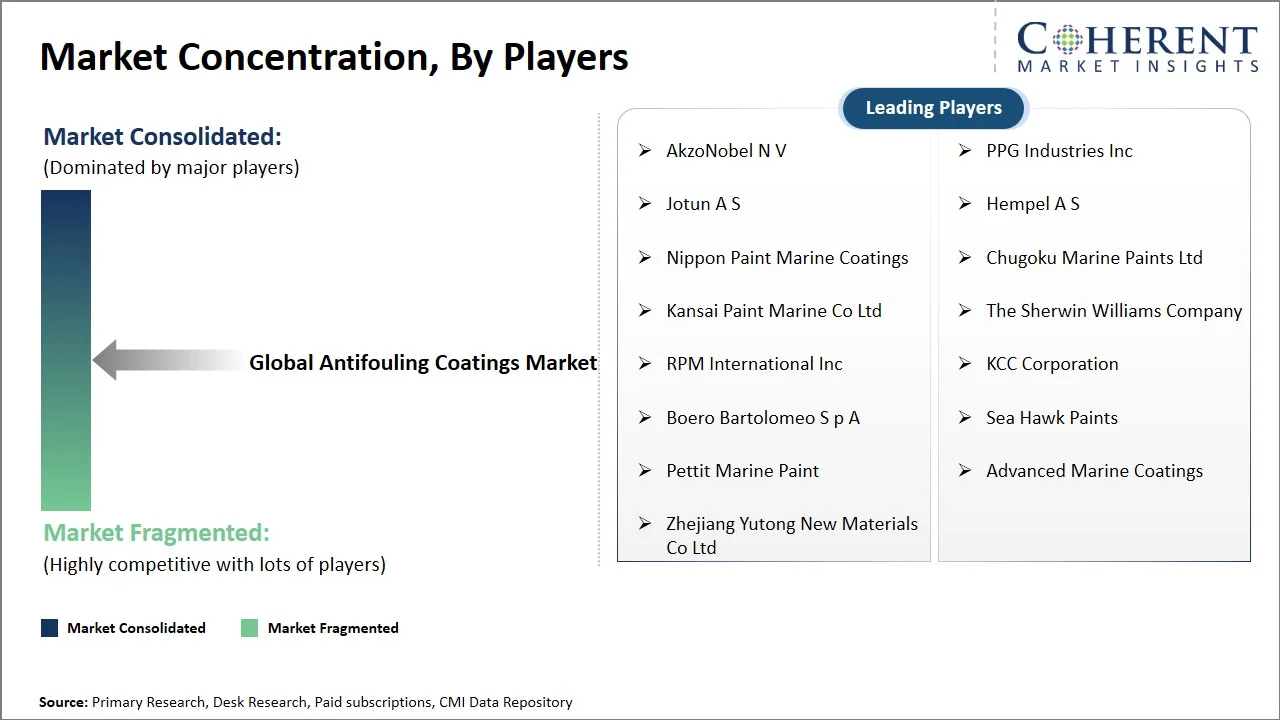
The global antifouling coatings market is moderately consolidated at the international commercial-shipping level but fragmented across recreational, aquaculture, regional, and component-specific applications. Multinational coating groups compete through global shipyard approvals, formulation portfolios, technical-service networks, and fleet contracts, while specialist companies focus on biocide-free surfaces, active ingredients, propellers, sensors, and cleaning-compatible technologies. Competition increasingly depends on documented operational performance rather than coating price alone.
Key focus areas include
- Verified hull performance: Suppliers differentiate through speed-loss control, fouling resistance, coating condition, and consistency across operating routes.
- Lifecycle economics: Shipowners assess application cost alongside fuel exposure, cleaning requirements, recoating intervals, and off-hire risk.
- Regulatory capability: Active-substance registrations, chemical traceability, safety documentation, and regional approvals influence market access.
- Global supply reliability: International fleets favor products supported by consistent formulations, local inventory, and technical teams near major yards.
- Application quality: Surface preparation, climatic control, mixing accuracy, film thickness, and curing supervision materially affect coating performance.
- Portfolio customization: Vessel speed, activity level, idle time, water temperature, route, and docking interval require tailored specifications.
- Technical relationships: Long-term access to shipowners, fleet managers, yards, class societies, and applicators strengthens contract retention.
- Specialist partnerships: Alliances with inspection, robotic-cleaning, performance-monitoring, and underwater-service providers expand solution coverage.
Market Report Scope
Antifouling Coatings Market Report Coverage
| Report Coverage | Details | ||
|---|---|---|---|
| Base Year: | 2025 | Market Size in 2026: | USD 2,252.6 Mn |
| Historical Data for: | 2020 To 2024 | Forecast Period: | 2026 To 2033 |
| Forecast Period 2026 to 2033 CAGR: | 6.20% | 2033 Value Projection: | USD 3,432.1 Mn |
| Geographies covered: |
| ||
| Segments covered: |
| ||
| Companies covered: | AkzoNobel N V, PPG Industries Inc, Jotun A S, Hempel A S, Nippon Paint Marine Coatings, Chugoku Marine Paints Ltd, Kansai Paint Marine Co Ltd, The Sherwin Williams Company, RPM International Inc, KCC Corporation, Boero Bartolomeo S p A, Sea Hawk Paints, Pettit Marine Paint, Advanced Marine Coatings, and Zhejiang Yutong New Materials Co Ltd | ||
| Growth Drivers: |
| ||
| Restraints & Challenges: |
| ||
Analyst Expert (Analyst Opinion)
- The global antifouling coatings market leadership is likely to shift from supplying coating volumes toward contracting for defined hull-condition outcomes. Shipowners may increasingly purchase integrated packages combining specification, application supervision, inspection, cleaning protocols, performance reporting, and recoating advice. Suppliers capable of accepting partial responsibility for clean-hull duration or operational performance will be better positioned to deepen fleet relationships and reduce price-based comparison.
- Regulatory divergence among major shipping jurisdictions could weaken the economics of maintaining one globally uniform antifouling formulation. Active substances accepted in one market may face restrictions or prolonged review elsewhere, forcing suppliers to develop modular regional portfolios. Regulatory science, dossier ownership, substitute-active qualification, and rapid reformulation could therefore become as strategically important as conventional coating chemistry.
- Manufacturers should invest in cleanability testing, low-activity performance, binder development, digital condition baselines, applicator training, and dual sourcing of critical raw materials. Niche surfaces and irregularly operated fleets deserve greater commercial attention. Companies should avoid excessive investment in unvalidated environmental claims or complex features without proven service value, as premature failure can create warranty exposure and damage shipyard confidence.
Speak to the analyst
Want personalized insights?
Take the findings above to one of our principal consultants, or have the report rebuilt around the segments, geographies and competitors you actually track.
Market Segmentation
- Product Type Insights (Revenue, USD Mn, 2021 - 2033)
- Self Polishing Copolymer Coatings
- Controlled Depletion Polymer Coatings
- Fouling Release Coatings
- Hybrid Antifouling Coatings
- Others
- Vessel Type Insights (Revenue, USD Mn, 2021 - 2033)
- Cargo and Container Vessels
- Tankers
- Bulk Carriers
- Passenger and Cruise Vessels
- Naval and Defense Vessels
- Recreational Boats
- Others
- Application Insights (Revenue, USD Mn, 2021 - 2033)
- Vessel Hulls
- Propellers and Running Gear
- Offshore Structures
- Aquaculture Equipment
- Others
- Vessel Lifecycle Insights (Revenue, USD Mn, 2021 - 2033)
- Maintenance and Repair
- Newbuilding
- Regional Insights (Revenue, USD Mn, 2021 - 2033)
- North America
- U.S.
- Canada
- Latin America
- Brazil
- Argentina
- Mexico
- Rest of Latin America
- Europe
- Germany
- U.K.
- Spain
- France
- Italy
- Russia
- Rest of Europe
- Asia Pacific
- China
- India
- Japan
- Australia
- South Korea
- ASEAN
- Rest of Asia Pacific
- Middle East
- GCC Countries
- Israel
- Rest of Middle East
- Africa
- South Africa
- North Africa
- Central Africa
- North America
- Key Players Insights
- AkzoNobel N V
- PPG Industries Inc
- Jotun A S
- Hempel A S
- Nippon Paint Marine Coatings
- Chugoku Marine Paints Ltd
- Kansai Paint Marine Co Ltd
- The Sherwin Williams Company
- RPM International Inc
- KCC Corporation
- Boero Bartolomeo S p A
- Sea Hawk Paints
- Pettit Marine Paint
- Advanced Marine Coatings
- Zhejiang Yutong New Materials Co Ltd
Source
Primary Research Interviews
- Antifouling coating manufacturers and raw-material suppliers
- Shipowners, fleet managers, shipbuilders, repair yards, applicators, and distributors
- Marine coating, technical service, procurement, quality, regulatory, and sales executives
- Hull-cleaning providers, inspectors, classification professionals, and environmental specialists
Stakeholders
- Marine coating and active-ingredient manufacturers
- Commercial fleets, naval operators, offshore companies, and aquaculture users
- Shipyards, drydocks, applicators, distributors, inspection agencies, and classification societies
End-use Sectors
- Cargo vessels, container ships, tankers, and bulk carriers
- Passenger, cruise, naval, and recreational vessels
- Offshore structures, aquaculture equipment, propellers, and running gear
Regulatory & Government Bodies
- International Maritime Organization
- U.S. Environmental Protection Agency and U.S. Coast Guard
- European Commission and European Chemicals Agency
- Australian, Singaporean, Chinese, and Japanese maritime authorities
- National environmental, chemical-control, port, and vessel-safety agencies
Databases
- UN Comtrade and UNCTADstat
- IMO GISIS and Equasis
- Eurostat, EU PRODCOM, and USITC DataWeb
- World Bank and OECD databases
- National fleet, shipbuilding, port, drydock, and trade databases
- SEC EDGAR and company filings
Magazines and Journals
- Coatings World
- Paint & Coatings Industry
- Marine Log
- Seatrade Maritime News
- Progress in Organic Coatings
- Biofouling
- Marine Pollution Bulletin
- Ocean Engineering
Associations
- International Chamber of Shipping
- BIMCO
- Intertanko and Intercargo
- International Association of Classification Societies
- Association for Materials Protection and Performance
- National marine-coating, shipbuilding, and shipowner associations
Public Domain Sources
- IMO and UNCTAD
- European Commission and European Chemicals Agency
- U.S. Environmental Protection Agency
- National maritime administrations, ports, customs, and environmental regulators
- Classification society publications
- Company reports, product data sheets, safety documents, and press releases
Key Standards and Regulations
- IMO Anti-fouling Systems Convention and Biofouling Guidelines
- ISO 19030 hull-performance measurement
- ISO 15181 biocide-release testing
- ISO 8501 surface preparation
- ISO 12944 protective coating requirements
- EU Biocidal Products Regulation and REACH
- National restrictions on organotin, cybutryne, copper, and other biocides
Proprietary Elements
- CMI Data Analytics Tool, Proprietary CMI Existing Repository of information for last 10 years.
Get access to 250+ pages report
Every segment, forecast, competitor profile and data table behind the analysis above — available for instant download.
- ESOMAR Member
- ISO 9001:2015 Certified
- D-U-N-S Registered
- GDPR & CCPA Compliant
Missing comfort of reading report in your local language? Find your preferred language:
Transform your Strategy with Exclusive Trending Reports
Frequently Asked Questions
The CAGR of the global antifouling coatings market is projected to be 6.20% from 2026 to 2033.
The global antifouling coatings market is estimated to be valued at USD 2,252.6 million in 2026 and is expected to reach USD 3,432.1 million by 2033.
Vessel hulls are the leading application because they require extensive protection against marine growth, hydrodynamic drag, corrosion, and fuel-efficiency losses.
Cargo and container vessels generate the highest demand due to their large hull areas, intensive operating schedules, and recurring drydocking and maintenance requirements.
Biocide-free formulations, low-friction coatings, robotic hull cleaning, performance monitoring, and cleaning-compatible coating systems are reshaping product development and fleet-maintenance strategies.
Shipping fuel efficiency targets increasing demand for low friction hull coatings and vessel maintenance activity supporting recurring antifouling coating consumption are the major factors driving the growth of the global antifouling coatings market.
Environmental restrictions limiting the use of harmful marine biocides and high application and dry docking costs affecting coating replacement decisions are the major factors hampering the growth of the global antifouling coatings market.