

Oilfield Chemicals Market Size and Forecast – 2026 to 2033
The Oilfield Chemicals Market is estimated to be valued at USD 33,556.8 Mn in 2026 and is expected to reach USD 50,124.8 Mn by 2033, exhibiting a compound annual growth rate (CAGR) of 5.9% from 2026 to 2033.
Key Takeaways
- By Type, Rheology Modifiers acquired the prominent share of 27.6% in 2026 as increasing drilling complexity.
- By Nature, Organic hold the largest market share in 2026 owing to its environmental regulations and sustainability goals.
- By Application, Upstream segment accounted for 76.8% of the market in 2026, driven by ongoing exploration and drilling activities in oil and gas fields, where chemicals are essential for well stimulation, drilling fluid formulation, corrosion inhibition, and enhanced oil recovery.
- By Location, onshore acquired the prominent share of 81.8% in 2026 as growth in unconventional oil & gas exploration.
- By Distribution Channel, Direct Sales acquired the prominent share in 2026 as customization and technical support.
- By Region, North America holds the largest market share of 34% in 2026 owing to its shale boom and unconventional resource development.
Market Overview
Oil and gas companies rely on oilfield chemicals to improve exploration, drilling, well stimulation, production, and maintenance processes. Growing interest in unconventional reserves, redevelopment of mature fields, and increased offshore drilling projects continue to drive the oilfield chemicals market demand. The industry applies these chemicals mainly in drilling fluids, cementing, production, and workover operations. Advancements in technology and stricter environmental rules are prompting the shift toward more efficient and eco-friendly solutions.
Current Events and their Impact on the Oilfield Chemicals Market
Current Events | Description and its impact |
Geopolitical Tensions in the Middle East |
|
Advancements in Enhanced Oil Recovery (EOR) Technologies |
|
Fluctuations in Global Oil Prices |
|
End-user Feedback and Unmet Needs in the Oilfield Chemicals Market
- Demand for Custom Chemical Formulations: Operators consistently request tailored chemical blends suited to specific reservoir conditions, especially in unconventional plays and deepwater zones. Off-the-shelf solutions often fall short, prompting a need for greater collaboration between chemical suppliers and field engineers to develop site-specific, performance-optimized products that address unique temperature, pressure, and contamination challenges.
- Need for Truly Green and Compliant Products: End-users want more eco-friendly chemicals that meet strict environmental regulations without compromising on performance. Despite market claims, many “green” products lack transparency or consistency in harsh conditions. Operators are asking for independent validation, better biodegradability, and improved compatibility with water reuse and zero-discharge operations, particularly in sensitive ecosystems.
- Faster Delivery and Localized Support: Feedback indicates frustration over long lead times and limited availability in remote drilling areas. Operators need faster response times, localized inventories, and in-field technical support to adjust formulations on-site. Chemical companies face pressure to improve supply chain agility and regional presence, especially during unplanned interventions or urgent completions.
- Current Industry Events of 2026
- Market Size Estimation
- Regional Breakdown
- Competitive Landscape
- Customer Intelligence
- Segmental Analysis
- Pricing Analysis
- Key Market Drivers, Challenges & Future Trends
- Customized Insights Section
Role of Artificial Intelligence (AI) in Oilfield Chemicals Industry
AI plays a transformative role in the oilfield chemicals sector by optimizing formulation, performance prediction, and deployment strategies. Through machine learning and data analytics, AI can analyze vast datasets from reservoirs, wells, and lab tests to design more effective chemical treatments, such as corrosion inhibitors, scale preventers, and demulsifiers. It enables real-time monitoring and adaptive control of chemical dosing, reducing waste and improving efficiency.
In June 2025, Baker Hughes and Repsol announced a partnership to implement the Leucipa™ automated field production solution, featuring a generative AI-powered virtual assistant. This assistant uses natural language processing to simplify data access and interpretation, providing real-time insights, predictive analytics, and production optimization through an easy-to-use chat interface.
Segmental Insights
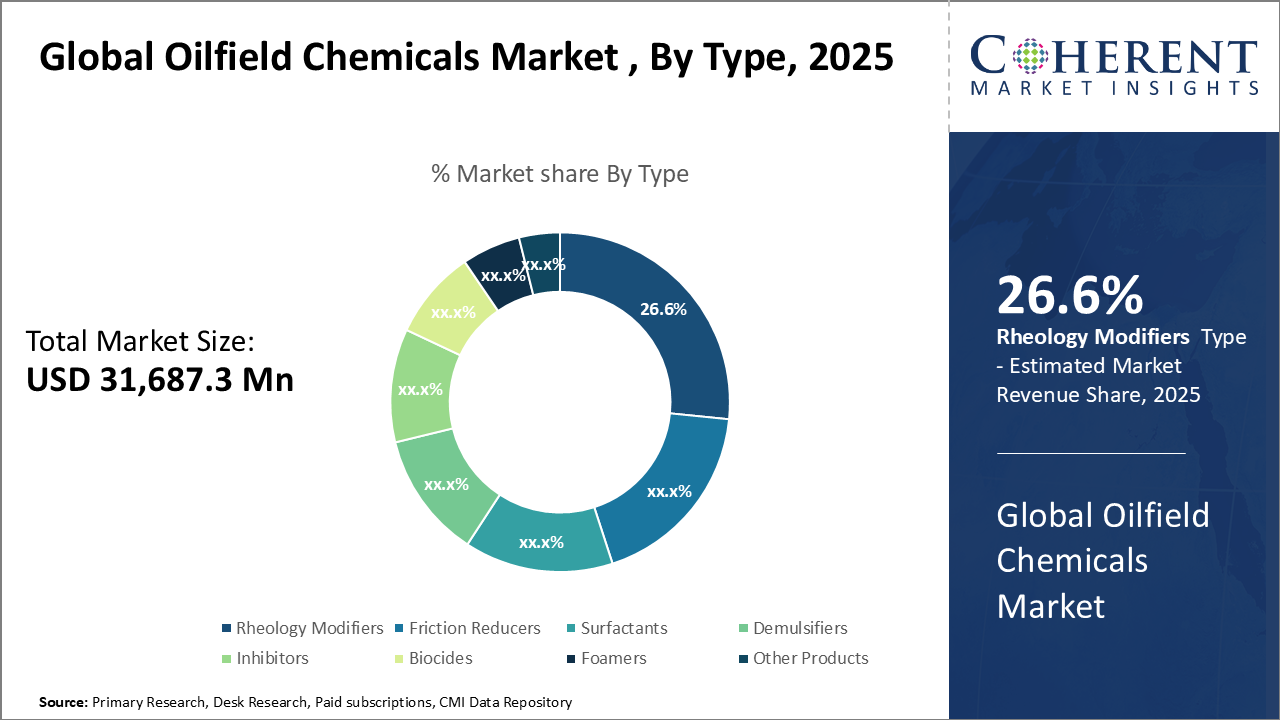
Oilfield Chemicals Market Insights, By Type - Rheology Modifiers contribute the highest share of the market owing to its technological advancements in polymer chemistry
Rheology modifiers segment is expected to contribute 27.6% share in the oilfield chemicals market in 2026. These chemicals are essential for controlling rheological properties of drilling fluids to prevent pipe sticking and ensure smooth drilling operations. They aid in suspending cuttings and balancing hydrostatic pressure of drilling fluids. Rheology modifiers are extensively used in oil well cementing where they enable proper placement of cement slurry and provide zonal isolation between formations. They control fluid loss and maintain stability of cement slurries during setting and hardening. Their use in completion fluids prevents fluid migration and ensures well integrity during stimulation processes.
In September 2024, Nouryon introduced Structure® Silk starch, the latest addition to its Structure® range of naturally derived and sustainable rheology modifiers.
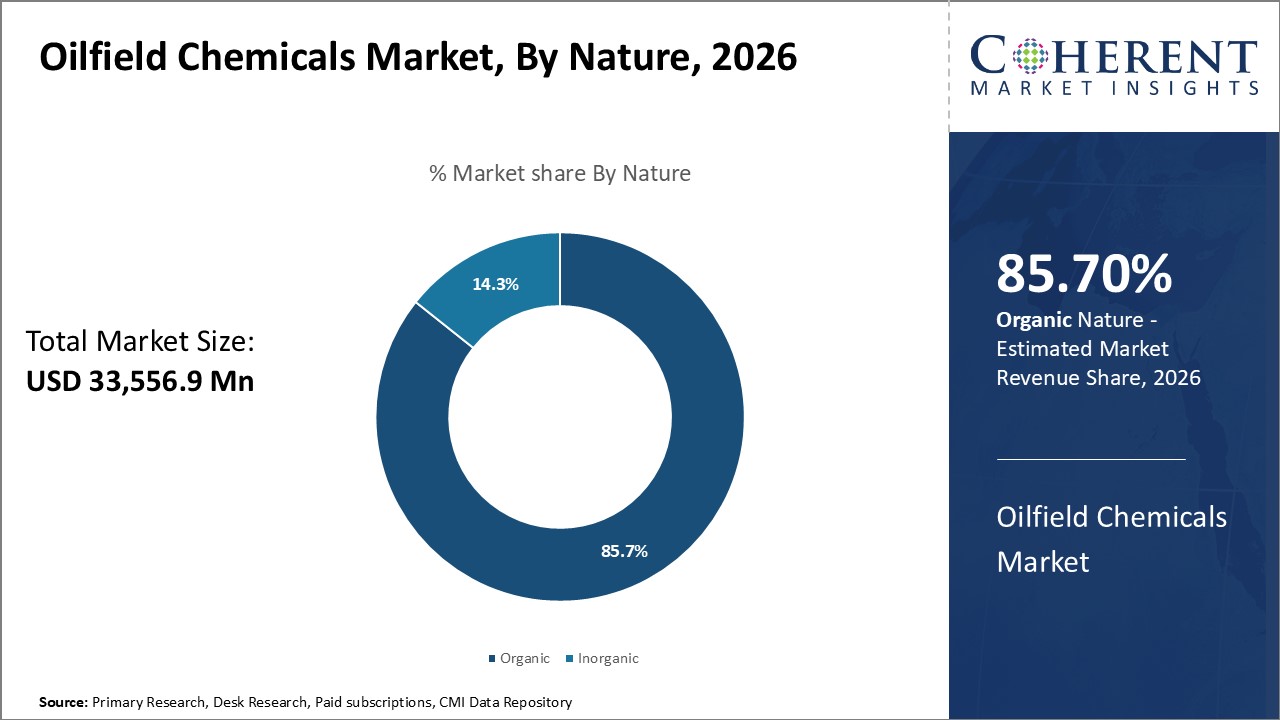
Oilfield Chemicals Market Insights, By Nature - Organic contribute the highest share of the market owing to its rising demand for unconventional oil & gas resources
Oil and gas companies are increasingly adopting organic oilfield chemicals in response to stricter environmental regulations and a stronger focus on sustainable drilling practices. These chemicals, made from natural or biodegradable materials, help reduce ecological impact while offering lower toxicity and better compatibility with water treatment and reuse systems. Innovations in green chemistry and bio-based technologies are improving their performance and reliability. By using organic alternatives, operators aim to meet ESG objectives and reduce long-term risks associated with traditional chemical use.
For instance, in July 2025, Versalis, the chemical arm of Eni S.p.A., unveiled a new subsidiary, Versalis Oilfield Solutions S.r.l., to deliver specialized products and services to the global oil drilling industry. The company is actively directing capital toward organic projects to enhance its production outlook.
Oilfield Chemicals Market Insights, By Application: The upstream segment contributes the highest share of the market owing to its critical role in exploration and production activities
The Upstream segment accounted for 76.8% of the market in 2026. The demand is driven by ongoing exploration and drilling activities in oil and gas fields, where chemicals are essential for well stimulation, drilling fluid formulation, corrosion inhibition, and enhanced oil recovery. Increasing offshore and onshore drilling projects, along with technological advancements in unconventional reservoirs, are further boosting the adoption of oilfield chemicals in upstream operations.
In June 2025, Monumental Energy Corp. completed the workover and resumed commercial production at the Copper Moki-2 (CM-2) well in New Zealand’s Taranaki Basin. The company aimed to restore oil and associated gas production from the Mt. Messenger sands and resolve flow restrictions identified in previous operations.
Oilfield Chemicals Market Insights, By Location: Onshore contribute the highest share of the market owing to its faster project turnaround and lower CAPEX
Onshore locations is expected to contribute the maximum share to the oilfield chemicals market in terms of location. This is primarily attributed to advantages like bulk hydrocarbon reserves concentrated on land, well-developed pipeline infrastructure and relatively lower operational costs for onshore projects. Onshore fields worldwide hold over 81.8% of the total global oil & gas reserves and account for 65% of the annual hydrocarbon production. Large established reservoirs and new unconventional resource developments push chemical demand significantly here. Vast pipeline networks facilitate the bulk transportation of produced hydrocarbons as well as oilfield chemicals to onshore locations, ensuring reliable supply chains.
For instance, in May 2024, Petrobras initiated a bidding process to contract four large rigs to drill oil and gas production wells onshore. The drilling will take place in fields located in Bahia—such as Araçás, Fazenda Azevedo, Massapê, Taquipe, and Fazenda Boa Esperança—and in Amazonas, including Rio do Urucu, Sudoeste do Urucu, Leste Urucu, and Arara Azul.
Oilfield Chemicals Market Insights, By Distribution Channel: Direct sales contribute the highest share of the market owing to its strategic alliances and market expansion
The demand for customized chemical solutions and specialized technical support drives direct sales in the oilfield chemical market, allowing suppliers to tackle specific operational challenges firsthand. By reducing intermediaries, this approach streamlines supply chains, enhances delivery efficiency, and cuts costs. Companies also expand their market presence and enter new regions by forming strategic alliances through direct sales. For instance, in February 2026, Centrium Energy Solutions™, a newly launched oil and gas chemical supplier, implemented a domestic distribution model to address key challenges in sourcing, logistics, and performance. With this approach, the company aims to reduce supply chain risks and enhance the reliability of upstream and midstream products.
Regional Insights
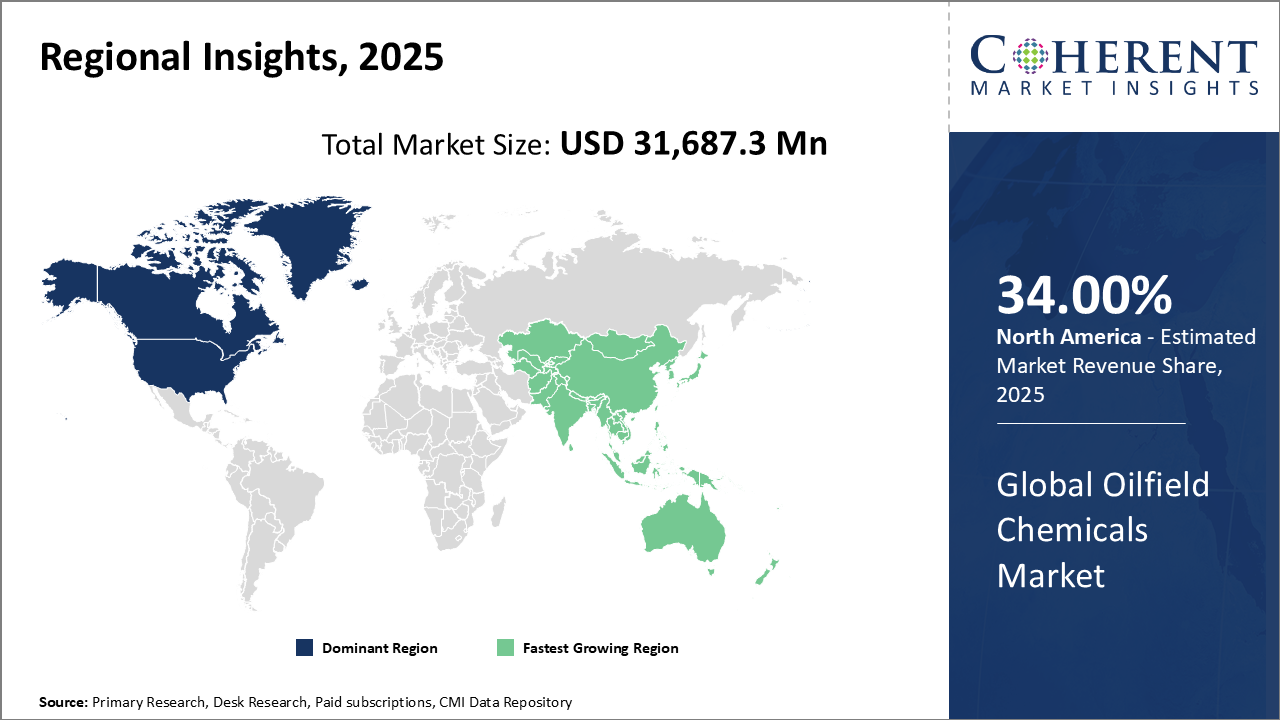
North America Oilfield Chemicals Market Trends
North America leads the Oilfield Chemicals market with 34.00% share in 2026. Oil and gas operators in North America are adopting biodegradable and eco-friendly chemicals to comply with stricter environmental rules and meet transparency expectations. Companies in the industry are leveraging digital tools such as IoT, AI, and real-time monitoring to optimize chemical usage, enhance operational efficiency, and cut down on waste. Ongoing shale and unconventional drilling, along with improved recovery from aging wells, sustain strong demand for specialty chemicals. Strategic moves into offshore and emerging basins continue to drive the oilfield chemicals market growth. For instance, as of July 25, 2026, Berkshire Hathaway is exploring the potential sale of Pilot Water Solutions (PWS), a subsidiary acquired in stages since 2017 and fully integrated into Berkshire's portfolio in 2024.
Asia Pacific Oilfield Chemicals Market Trends
China, India, Southeast Asia, and Australia are rapidly advancing shale gas projects and deepwater drilling, which increases the demand for specialty chemicals like drilling fluids, fracturing agents, and corrosion and scale inhibitors to support operations in harsh environments. Oil and gas companies across Asia-Pacific are adopting smart chemicals, IoT-enabled dosing, and AI monitoring to optimize chemical consumption, enhance real-time process control, and minimize waste during drilling and production activities.
United States Oilfield Chemicals Market Trends
Oil and gas operators in the U.S. are actively using biodegradable, low-toxicity, and nano-enhanced chemicals—such as polymer nanoparticles and nano-surfactants—to improve oil recovery while complying with environmental standards. Chemical manufacturers are formulating stronger solutions for offshore projects across the country, supporting operations in harsh conditions. Regulatory authorities at both federal and state levels are tightening oversight, prompting companies to improve chemical transparency and safety, especially after incidents like fracking disclosure issues in Colorado.
For instance, in June 2026, Nouryon, a global specialty chemicals leader, opened its Innovation Center for oilfield applications. With this launch, the company strengthens its commitment to developing innovative, sustainable solutions tailored to the oilfield industry in the region.
China Oilfield Chemicals Market Trends
China is actively adopting enhanced oil recovery (EOR) techniques—like chemical flooding and CO₂ injection—to extend production from aging fields such as Shengli and strengthen domestic energy security. Operators rely on specialized polymers, surfactants, and EOR chemicals to support output. Chinese regulators and companies are prioritizing eco-friendly, biodegradable chemicals to meet tighter emissions and wastewater standards. In response, manufacturers are developing green formulations that deliver strong performance while minimizing environmental harm. For instance, in April 2026, China Petroleum & Chemical Corporation announced the discovery of over 140 million tonnes of proven geological shale oil reserves, including 11.3599 million tonnes of technically recoverable reserves, at its Shengli Oilfield. This marks the first shale oil field in China with proven geological reserves exceeding 100 million tonnes to receive certification from the Ministry of Natural Resources.
Market Report Scope
Oilfield Chemicals Market Report Coverage
| Report Coverage | Details | ||
|---|---|---|---|
| Base Year: | 2025 | Market Size in 2026: | USD 33,556.8 Mn |
| Historical Data for: | 2020 To 2024 | Forecast Period: | 2026 To 2033 |
| Forecast Period 2026 to 2033 CAGR: | 5.9% | 2033 Value Projection: | USD 50,124.8 Mn |
| Geographies covered: |
| ||
| Segments covered: |
| ||
| Companies covered: | Baker Hughes Company, Halliburton Energy Services Inc, SLB, Dow, and Weatherford | ||
| Growth Drivers: |
| ||
| Restraints & Challenges: |
| ||
Oilfield Chemicals Market Trend
- Shift Toward Environmentally Sustainable Formulations
The oilfield chemicals market is seeing a clear shift toward environmentally sustainable and biodegradable products. Operators are adopting green formulations to meet stricter environmental regulations and reduce ecological impact, especially in offshore and water-sensitive regions. These eco-friendly chemicals must still deliver performance under extreme pressure and temperature. This trend is pushing manufacturers to innovate with plant-based surfactants, biodegradable scale inhibitors, and non-toxic corrosion inhibitors that align with ESG commitments and reduce long-term environmental liabilities, further enhancing the oilfield chemicals market share.
- Integration of Smart Technologies and Digital Monitoring
Digitalization is transforming the way oilfield chemicals are applied and managed. Operators are using smart sensors, AI, and IoT-based systems to monitor chemical dosing, fluid performance, and system health in real time. This trend supports more efficient chemical use, reduces waste, and enhances operational reliability. It also helps identify early warning signs of scale buildup, corrosion, or fluid imbalance—reducing non-productive time and maintenance costs while enabling precision treatment across both conventional and unconventional reservoirs.
Oilfield Chemicals Market News
- In March 2025, Centrium Energy Solutions™, a chemical supplier for the oil and gas industry, developed a domestic distribution model to address key challenges in sourcing, logistics, and performance. By providing access to over 5,200 U.S.-based raw materials and offering formulation support, the company aims to minimize supply chain risks and enhance the reliability of upstream and midstream products.
- In February 2025, Baker Hughes, an energy technology company, launched three new electrification technologies designed to enhance reliability, improve efficiency, and reduce emissions in both onshore and offshore operations. These technologies support applications across traditional oil and gas as well as emerging energy sectors.
- In June 2025, Heisenberg Chemicals, a proprietary oilfield technologies solution, formed a landmark strategic partnership with Benson Petroleum LLC, Paret Mining LLC, and the Benson Jewish Ministries Foundation. Together, they are focusing on developing more than 1,000 acres of mineral-rich land in Bowling Green, Kentucky—an area positioned for high-output production of natural gas, tar sands, and sweet crude oil.
Analyst Opinion (Expert Opinion)
- The oilfield chemicals market is at a critical inflection point where traditional approaches no longer suffice. Operators and service companies must aggressively pivot toward sustainability without sacrificing operational performance. The surge in demand for biodegradable and low-toxicity chemicals is not just regulatory lip service; it reflects growing investor and stakeholder pressure for measurable Environmental, Social, and Governance (ESG) outcomes. For instance, Shell’s commitment to fully green chemical inputs in their Permian Basin operations underscores how industry leaders are setting new benchmarks.
- Moreover, the rapid integration of digital technologies into chemical management—such as Halliburton’s use of AI-driven chemical dosing systems—demonstrates how data analytics can materially reduce chemical waste and optimize treatment efficacy. Operators ignoring this trend risk inefficiencies and higher operational costs in an increasingly competitive environment.
- Furthermore, the heightened complexity of reservoirs, especially in unconventional and deepwater plays, demands bespoke chemical solutions. Off-the-shelf chemicals are proving inadequate, as evidenced by Chevron’s recent collaborations with specialty chemical developers to tailor polymers and friction reducers specific to their South Texas shale assets. This bespoke trend will likely intensify, with suppliers who fail to innovate rapidly losing relevance.
Speak to the analyst
Want personalized insights?
Take the findings above to one of our principal consultants, or have the report rebuilt around the segments, geographies and competitors you actually track.
Market Segmentation
- Type Insights (Revenue, USD Mn, 2026 - 2033)
- Inhibitors
- Demulsifiers
- Rheology Modifiers
- Friction Reducers
- Biocides
- Surfactants
- Foamers
- Other Products
- By Nature (Revenue, USD Mn, 2026 - 2033)
- Organic
- Inorganic
- By Application Insights (Revenue, USD Mn, 2026 - 2033)
- Drilling
- Production
- Cementing
- Workover & Completion
- By Location Insights (Revenue, USD Mn, 2026 - 2033)
- Onshore
- Offshore
- By Distribution Channel (Revenue, USD Mn, 2026 - 2033)
- Direct Sales
- Indirect (Via Distributors)
- Regional Insights (Revenue, USD Mn, 2026 - 2033)
- North America
- U.S.
- Canada
- Latin America
- Brazil
- Argentina
- Mexico
- Rest of Latin America
- Europe
- Germany
- U.K.
- Spain
- France
- Italy
- Russia
- Rest of Europe
- Asia Pacific
- China
- India
- Japan
- Australia
- South Korea
- ASEAN
- Rest of Asia Pacific
- Middle East & Africa
- GCC Countries
- Israel
- Rest of Middle East & Africa
- Key Players Insights (Revenue, USD Mn, 2021 - 2033)
- Baker Hughes Company
- Halliburton Energy Services Inc.
- SLB
- Dow
- Weatherford
Sources
Primary Research Interviews
- Industry experts and chemical formulators
- Oil and gas operators and field engineers
- Environmental compliance officers
- Technology solution providers in oilfield services
Databases
- U.S. Energy Information Administration (EIA)
- National Energy Board of China
- International Energy Agency (IEA)
- Government geological and mineral resource databases
Magazines
- Oil & Gas Journal
- World Oil Magazine
- Hydrocarbon Processing
- Chemical Engineering
Journals
- Journal of Petroleum Science and Engineering
- SPE Journal (Society of Petroleum Engineers)
- Energy & Fuels
- Journal of Applied Polymer Science
Newspapers
- The Wall Street Journal – Energy Section
- Financial Times – Energy and Environment
- The New York Times – Energy & Environment
- Reuters – Oil & Energy News
Associations
- American Petroleum Institute (API)
- Society of Petroleum Engineers (SPE)
- International Association of Oil & Gas Producers (IOGP)
- Chemical Manufacturers Association
Public Domain Sources
- U.S. Environmental Protection Agency (EPA) reports
- Government publications on drilling regulations and chemical disclosures
- Patent databases for oilfield chemical innovations
- Publicly available company annual reports and sustainability disclosures
Proprietary Elements
- CMI Data Analytics Tool, and Proprietary CMI Existing Repository of information for last 8 years
Get access to 250+ pages report
Every segment, forecast, competitor profile and data table behind the analysis above — available for instant download.
- ESOMAR Member
- ISO 9001:2015 Certified
- D-U-N-S Registered
- GDPR & CCPA Compliant
Missing comfort of reading report in your local language? Find your preferred language:
Transform your Strategy with Exclusive Trending Reports
Frequently Asked Questions
The Oilfield Chemicals Market is estimated to be valued at USD 33,556.8 Mn in 2026, and is expected to reach USD 50,124.8 Mn by 2033.
The CAGR of the Oilfield Chemicals Market is projected to be 5.9% from 2026 to 2033.
Growing demand for enhanced oil recovery techniques and increasing complexity of drilling operations are the major factors driving the growth of the global oilfield chemicals market.
Volatility in crude oil prices and stringent government regulations are the major factors hampering the growth of the global oilfield chemicals market.
In terms of type, rheology modifiers is estimated to dominate the market revenue share in 2026.
Baker Hughes Company, Halliburton Energy Services Inc, SLB, Dow, and Weatherford are the major players.
North America is expected to lead the global oilfield chemicals market