

Heptanoic Acid Market Size and Share Analysis: 2026 - 2033
The Heptanoic Acid market was valued at USD 3.3 Bn in 2026 and is forecast to reach a value of USD 4.4 Bn by 2033 at a CAGR of 4.5% between 2026 and 2033.
Key Takeaways
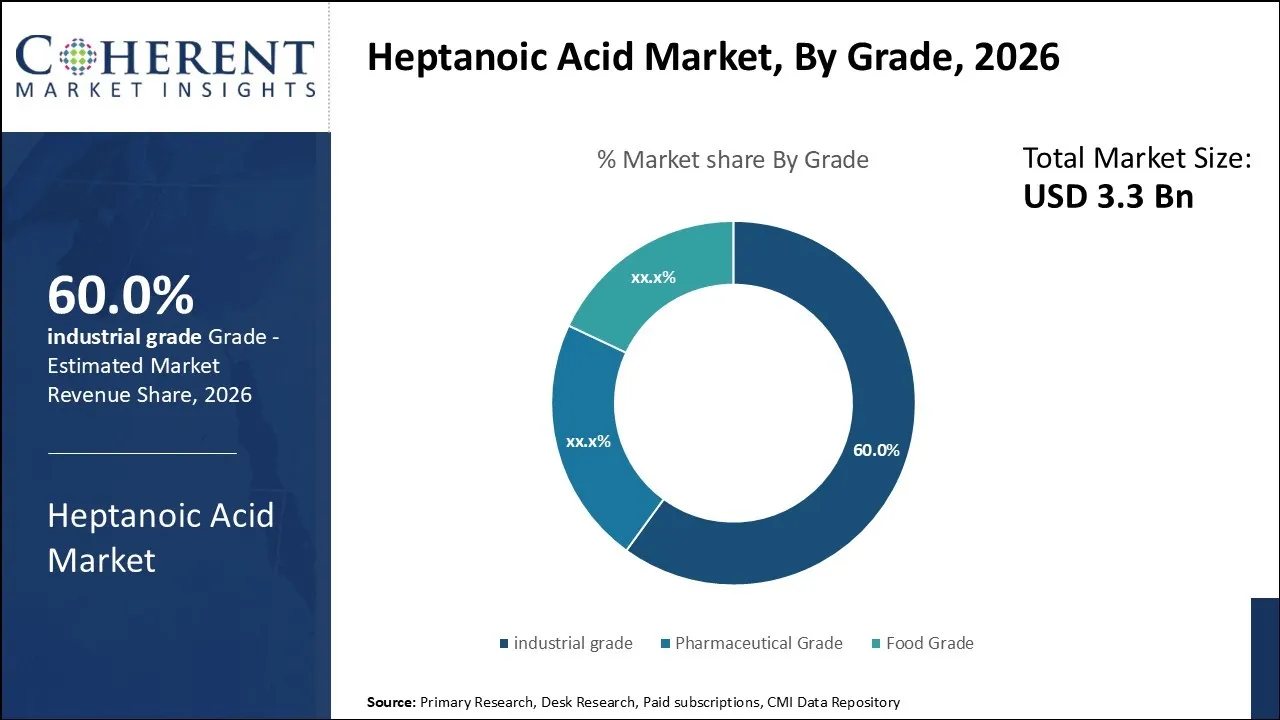
- Based on grade, the industrial grade segment is expected to hold 60% share of the market in 2026.
- Based on application, the lubricant segment is projected to account for 55% share of the market in 2026.
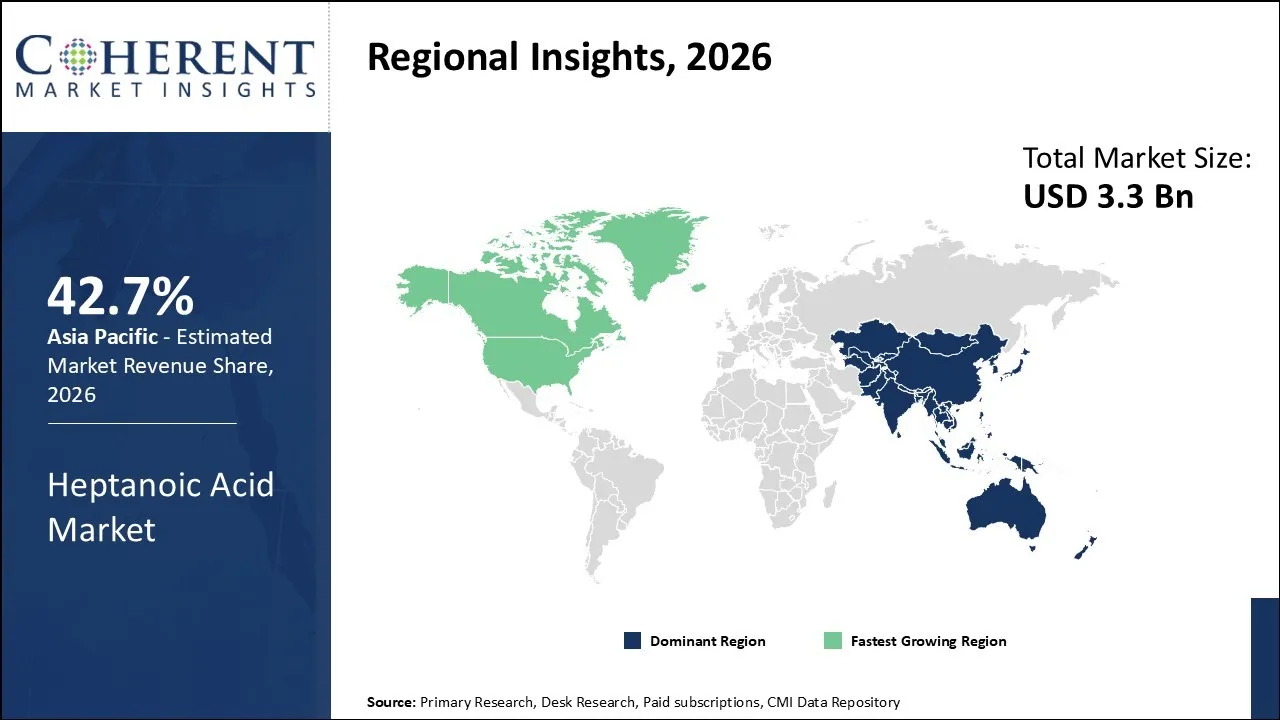
- Based on Region, Asia Pacific is set to lead the heptanoic acid market with 42.7% share in 2026. While, North America is anticipated to have the fastest growing region.
Market Overview
Enanthic acid, also called heptanoic acid, is an organic compound composed of a seven-carbon chain terminating in a carboxylic acid functional group. It is an oily liquid with an unpleasant, rancid odor. It contributes to the odor for some of the rancid oils. It is slightly soluble in water, but very soluble in ethanol and ether. Salts and esters of enanthic acid are called enanthates or heptanoates. Heptanoic Acid is one of the components of vanilla and cheese. The primary use of caproic acid is in the manufacture of esters for artificial flavors, and in the manufacture of hexyl derivatives, such as hexylphenols. Salts and esters of caproic acid are known as caproates or hexanoates.
Current Events and their Impacts on the Heptanoic Acid Market
Current Event | Description and its Impact |
Launch of Bio-Based Heptanoic Acid |
|
Regulatory Support for Sustainable Chemicals |
|
Segmental Insights
- Current Industry Events of 2026
- Market Size Estimation
- Regional Breakdown
- Competitive Landscape
- Customer Intelligence
- Segmental Analysis
- Pricing Analysis
- Key Market Drivers, Challenges & Future Trends
- Customized Insights Section
Heptanoic Acid Market Insights, By Grade - Industrial Grade represent the largest share in the market
In terms of grade, the industrial grade segment is expected to lead the market with 66.4% share in 2026, primarily owing to its extensive application across a variety of industrial processes and manufacturing sectors. Industrial Grade Heptanoic Acid is widely recognized for its role as a crucial intermediate in the production of plasticizers, lubricants, artificial flavors, and peroxides, which cater to diverse end-use industries such as automotive, construction, and packaging.
For instance, in June 2025, OQ Chemicals announced that it had begun dedicated heptanoic acid production at its Oberhausen, Germany, facility. The investment expanded the company’s carboxylic acid portfolio and enhanced supply chain security for its customers. Commercial quantities of European-produced heptanoic acid were made available upon the production launch.
Heptanoic Acid Market Insights, By Application - Lubricant dominate the market
In terms of application, the lubricant segment is expected to hold 60% share of the market in 2026. Owing to the increasing demand for high-performance and eco-friendly lubricants across various industries. Heptanoic acid serves as a crucial intermediate in the synthesis of esters used in lubricant formulations, offering excellent biodegradability, low toxicity, and good lubricity, which align closely with the growing global emphasis on sustainability and environmental regulations.
Lubricants formulated with heptanoic acid derivatives are especially sought after in sectors such as automotive, aerospace, and industrial machinery, where reducing friction and wear significantly impacts equipment longevity and energy efficiency. For example, government initiatives aimed at reducing vehicular emissions and promoting greener alternatives have accelerated the adoption of biodegradable lubricants.
Regional Insights
Asia Pacific Heptanoic Acid Market Analysis & Trends
Asia Pacific is expected to dominate the heptanoic acid market with 42.7% share in 2026. Growth is driven by expanding industrial activity, chemical manufacturing capabilities, and wider applications across end-use industries. Key countries, China, India, Japan, and South Korea, are experiencing rising demand for specialty chemicals due to rapid urbanization, infrastructure development, and a growing focus on sustainable, bio-based products.
For instance, according to the NITI Aayog Chemical Industry Report 2025, specialty chemicals are highly R&D-intensive, making up over 50% of India’s total chemical exports.
North America Heptanoic Acid Market Analysis & Trends
North America is expected to exhibit the fastest growth, driven by a strong domestic chemical manufacturing industry, supportive regulatory frameworks, and robust R&D investments. The United States and Canada are leading this trend, with initiatives from the U.S. Environmental Protection Agency promoting bio-based and sustainable chemicals. These efforts have encouraged domestic manufacturers to scale up bio-derived heptanoic acid production, serving end-users in pharmaceuticals, agrochemicals, and food additives.
For instance, the EPA’s 2025 Green Chemistry Challenge Awards recognize companies developing innovative green chemistry processes or products, fostering environmental benefits, innovation, and economic growth.
Heptanoic Acid Market Outlook Country-Wise
The China Heptanoic Acid Market Trends
China contributes the highest share in the Heptanoic Acid market in the region owing to its substantial industrial base and the presence of large-scale chemical manufacturing infrastructure. The country’s dominance arises from its robust petrochemical and pharmaceutical industries, where Heptanoic Acid serves as a crucial intermediate chemical in producing plasticizers, lubricants, and specialty chemicals. A key driver behind China’s leadership is its policy focus on upgrading chemical production capabilities to prioritize high-value specialty chemicals rather than commodity chemicals.
For instance, the Ministry of Industry and Information Technology (MIIT) in China has emphasized the development of green chemical technologies and biodegradables, creating substantial demand for intermediates like Heptanoic Acid used in advanced polymer formulations.
U.S. Heptanoic Acid Market Trends
In terms of North America, the U.S. contributes the highest share in the Heptanoic Acid market in this region owing to several critical factors that have positioned it as the leading segment within the broader North American landscape. The U.S. benefits from a highly developed industrial base, particularly in the manufacturing and chemical processing sectors, which are the primary consumers of Heptanoic Acid.
Heptanoic Acid, used extensively as a precursor in the synthesis of esters for flavors and fragrances, as well as in pharmaceutical and agrochemical applications, finds robust demand due to the U.S.’s diversified industrial ecosystem. A vital driver behind this dominance is the well-established infrastructure that supports large-scale production and distribution.
Market Report Scope
Heptanoic Acid Market Report Coverage
| Report Coverage | Details | ||
|---|---|---|---|
| Base Year: | 2025 | Market Size in 2026: | USD 3.3 Bn |
| Historical Data for: | 2020 To 2024 | Forecast Period: | 2026 To 2033 |
| Forecast Period 2026 to 2033 CAGR: | 4.5% | 2033 Value Projection: | USD 4.4 Bn |
| Geographies covered: |
| ||
| Segments covered: |
| ||
| Companies covered: | Acme synthetic chemicals, Akshay Chemicals, Alfa Aesar,Arkema, Cayman Chemical, Handanshi Kenzcheng Chemical Co., Ltd, Intellichemie Industries, Jinan Chenghui Shuangda Chemical Co., Ltd, Kalpasutra Chemical Pvt. Ltd., Merck KGaA, National Analytical Corporation, Neuchatel Chemie Specialties, OQ Chemical GmbH, Parchem Fine & Specialty Chemicals, Spectrum Chemical, Synerzine, Inc., Tokyo Chemical Industries Co., Ltd, VWR International, LLC, and Wujiang New Sunlion Chemical Co., Ltd. | ||
| Growth Drivers: |
| ||
| Restraints & Challenges: |
| ||
Heptanoic Acid Market Driver
Growing demand from pharmaceutical and cosmetic industries
The pharmaceutical and cosmetic industries have emerged as pivotal drivers for the expanding heptanoic acid market, fundamentally reshaping its growth trajectory through diverse application demands. In pharmaceuticals, heptanoic acid serves as a crucial intermediate in the synthesis of various active pharmaceutical ingredients (APIs), particularly in the production of antifungal medications and specialized therapeutic compounds.
Increasing use in food flavoring and fragrance applications
The expanding application of heptanoic acid in food flavoring and fragrance industries represents a pivotal driver for market expansion, fundamentally reshaping consumption patterns across multiple sectors. Heptanoic acid, also known as enanthic acid, serves as a crucial intermediate compound in creating synthetic flavoring agents that replicate natural fruit essences, particularly those found in grapes, berries, and tropical fruits.
Heptanoic Acid Market Opportunity
Development of bio-based heptanoic acid production methods
The development of bio-based heptanoic acid production methods represents a transformative opportunity in the heptanoic acid market, driven by the global shift towards sustainable manufacturing processes and stringent environmental regulations. Traditional heptanoic acid production relies heavily on petroleum-derived feedstocks and chemical synthesis processes that generate significant carbon emissions and environmental waste. However, emerging biotechnological approaches utilizing microbial fermentation, enzymatic processes, and renewable biomass feedstocks are revolutionizing production methodologies.
Analyst Opinion (Expert Opinion)
- The heptanoic acid market demonstrates robust momentum driven by expanding applications across pharmaceuticals, food additives, and specialty chemicals sectors. Rising demand for antimicrobial agents in food preservation and cosmetic formulations serves as a primary growth catalyst, particularly as consumers increasingly seek natural preservation alternatives. The pharmaceutical industry's growing utilization of heptanoic acid as an intermediate for drug synthesis, especially in antifungal and antibacterial medications, significantly propels market expansion.
- Asia-Pacific emerges as the dominant regional market, fueled by substantial chemical manufacturing capabilities in China and India, coupled with increasing pharmaceutical production activities. The region benefits from cost-effective manufacturing infrastructure and expanding end-user industries, positioning it as the fastest-growing market globally.
- However, market growth faces constraints from stringent regulatory frameworks governing chemical usage in food and pharmaceutical applications. Environmental concerns regarding chemical waste disposal and production processes present additional challenges for manufacturers seeking sustainable operations.
- Significant opportunities exist in developing bio-based heptanoic acid production methods, addressing sustainability concerns while meeting growing demand. The expanding nutraceutical sector presents untapped potential, particularly for medium-chain fatty acid supplements. Additionally, emerging applications in agrochemicals and polymer production offer promising growth avenues.
- Strategic focus on research and development activities, coupled with sustainable manufacturing practices, will determine competitive positioning. Companies investing in green chemistry approaches and expanding production capabilities in high-growth regions are likely to capture substantial market share in this evolving landscape.
Speak to the analyst
Want personalized insights?
Take the findings above to one of our principal consultants, or have the report rebuilt around the segments, geographies and competitors you actually track.
Global Heptanoic Acid Market: Key Developments
- In 2025, launched Oleris n-Heptanoic Acid. It is a bio-based, seven-carbon linear fatty acid made from renewable castor oil and is designed for sustainable and eco-friendly applications.
Market Segmentation
- By Grade
- Industrial Grade
- Pharmaceutical Grade
- Food Grade
- By Application
- Cosmetics
- Flavours & Fragrance
- Chemical Synthesis
- Pharmaceutical Ingredient
- Lubricant
- Others (Corrosion Inhibition etc.)
- By Region
- North America
- U.S.
- Canada
- Latin America
- Brazil
- Argentina
- Mexico
- Rest of Latin America
- Europe
- Germany
- U.K.
- Spain
- France
- Italy
- Russia
- Rest of Europe
- Asia Pacific
- China
- India
- Japan
- Australia
- South Korea
- ASEAN
- Rest of Asia Pacific
- Middle East & Africa
- GCC Countries
- Israel
- Rest of Middle East & Africa
- North America
- Key Players
- Acme synthetic chemicals
- Akshay Chemicals
- Alfa Aesar,Arkema
- Cayman Chemical
- Handanshi Kenzcheng Chemical Co., Ltd
- Intellichemie Industries
- Jinan Chenghui Shuangda Chemical Co., Ltd
- Kalpasutra Chemical Pvt. Ltd.
- Merck KGaA
- National Analytical Corporation
- Neuchatel Chemie Specialties
- OQ Chemical GmbH
- Parchem Fine & Specialty Chemicals
- Spectrum Chemical
- Synerzine, Inc.
- Tokyo Chemical Industries Co., Ltd
- VWR International, LLC
- Wujiang New Sunlion Chemical Co., Ltd.
Sources
Primary Research Interviews
- Chemical manufacturers and producers
- Raw material suppliers and distributors
- End-user industry representatives (pharmaceuticals, food & beverage, cosmetics)
- Industry experts and consultants
- Others
Databases
- Global Trade Atlas
- ICIS Database
- Others
Magazines
- Chemical & Engineering News
- Chemical Week
- ICIS Chemical Business
- Chemical Processing Magazine
- Others
Journals
- Journal of Chemical Technology & Biotechnology
- Industrial & Engineering Chemistry Research
- Chemical Engineering Journal
- Others
Newspapers
- Chemical Industry Digest
- Asian Chemical News
- European Chemical News
- Chemical Market Reporter
- Others
Associations
- American Chemistry Council (ACC)
- European Chemical Industry Council (CEFIC)
- Chemical Manufacturers Association
- International Association of Chemical Distributors
- Others
Public Domain Sources
- U.S. Environmental Protection Agency (EPA)
- European Chemicals Agency (ECHA)
- FDA databases and publications
- World Health Organization reports
- Others
Proprietary Elements
- CMI Data Analytics Tool
- Proprietary CMI Existing Repository of Information for the Last 8 Years
Get access to 250+ pages report
Every segment, forecast, competitor profile and data table behind the analysis above — available for instant download.
- ESOMAR Member
- ISO 9001:2015 Certified
- D-U-N-S Registered
- GDPR & CCPA Compliant
Missing comfort of reading report in your local language? Find your preferred language:
Transform your Strategy with Exclusive Trending Reports
Frequently Asked Questions
The global heptanoic acid market size was valued at USD 3.3 Bn in 2026 and is expected to reach USD 4.4 Bn in 2033.
Major players operating in the market include Acme synthetic chemicals, Akshay Chemicals, Alfa Aesar,Arkema, Cayman Chemical, Handanshi Kenzcheng Chemical Co., Ltd, Intellichemie Industries, Jinan Chenghui Shuangda Chemical Co., Ltd, Kalpasutra Chemical Pvt. Ltd., Merck KGaA, National Analytical Corporation, Neuchatel Chemie Specialties, OQ Chemical GmbH, Parchem Fine & Specialty Chemicals, Spectrum Chemical, Synerzine, Inc., Tokyo Chemical Industries Co., Ltd, VWR International, LLC, and Wujiang New Sunlion Chemical Co., Ltd.
Among grade, the industrial grade segment estimated significant revenue in 2026.
The increasing demand of industrial lubricants is the major driving factor to propel the overall product demand during the forecast period.
The market is estimated to exhibit a CAGR of 4.5% till 2033.
Among region, Asia Pacific is expected to witness significant growth over the forecast period.