

Global Humic Acid Market Size and Share Analysis - 2026 to 2033
Humic Acid Market is estimated to be valued at USD 1,432.17 Bn in 2026 and is expected to reach USD 2,438.62 Bn in 2033, exhibiting a compound annual growth rate (CAGR) of 7.9% from 2026 to 2033.
Key Takeaways
- On the basis of Application, Agriculture Segment accounted for 54% of the revenue share in the global humic acid market. This is due to increasing need to achieve more yield per area of land for catering to the rising demand for food.
- Asia Pacific holds 40% market share in the humic acid market. This is due to its sophisticated agricultural industry and strong focus on sustainable agriculture.
Market Overview
The humic acid market is driven by the growing concern regarding climate-friendly agricultural practices, organic fertilizer requirements, and the growing utilization of humic substances for soil health improvement, water retention, and nutrient uptake. Additionally, the rise in precision farming methods and the need for eco-friendly soil conditioner propel the growth of the market. Nano-humic products and bio-activated products are also enhancing the efficacy of humic acid even more, hence its demand in agriculture, horticulture, and environment remediation industries. However, volatility in raw material availability and regulatory issues in a few markets can influence the growth of the industry.
Current Events and Its Impacts on Humic Acid Market
Current Events | Description and its impact |
ProdOz Issues Humic-Enriched Fertilizer to Promote Regenerative Farming in Australia
|
|
Indonesia Converts Coal Waste into Humic Acid-Based Sustainable Fertilize |
|
Integration of New Technologies
Technological innovation is rapidly transforming the humic acid world, propelling effectiveness and adoption in agricultural and environmental applications. Astonishingly, green-chemistry extraction technologies—e.g., hydrothermal humification—now convert diverse biomasses to artificial humic acids (A-HA) within minutes with high-purity, function-enriched products perfect for soil fertility and carbon sequestration.
Nanotechnology integration is a red flag: nano-humic acid compounds induce plant uptake, seed germination, and stress tolerance through improved soil interaction. Included with this, slow-release and blend bio stimulants combine humic substance with microbes or fertilizer to provide continuous nutrients supply and the stimulation of the soil microbiome.
In precision agriculture, application of humic acid is increasingly becoming smarter. Soil sensors, drones, satellite imagery, and autonomous ground-rover robots offer real-time, spatially resolved measurements. This enables variable-rate application—maximizing humic effectiveness while minimizing resources used.
Furthermore, AI-driven mobile soil testing is bringing laboratory-quality analysis into the farm at reasonable cost, helping farmers apply humic precisely. Bio-activated humic acids, with supplementary beneficial microbes, are becoming increasingly popular in encouraging soil fertility and immunity from pathogens. It is increasingly being utilized in environmental processes as well: humic acid is increasingly being applied in bioremediation systems and water treatment systems, taking advantage of its chelation ability to precipitate out heavy metals and poisons.
The new technologies—ranging from advanced extraction and nano-formulations to precision agritech and AI applications—are enhancing the functionality, sustainability, and scalability of humic acid uses. Such synergies are rendering humic solutions essential constituents of modern, eco‑friendly agriculture and environmental remediation procedures.
- Current Industry Events of 2026
- Market Size Estimation
- Regional Breakdown
- Competitive Landscape
- Customer Intelligence
- Segmental Analysis
- Pricing Analysis
- Key Market Drivers, Challenges & Future Trends
- Customized Insights Section
Segmental Insights
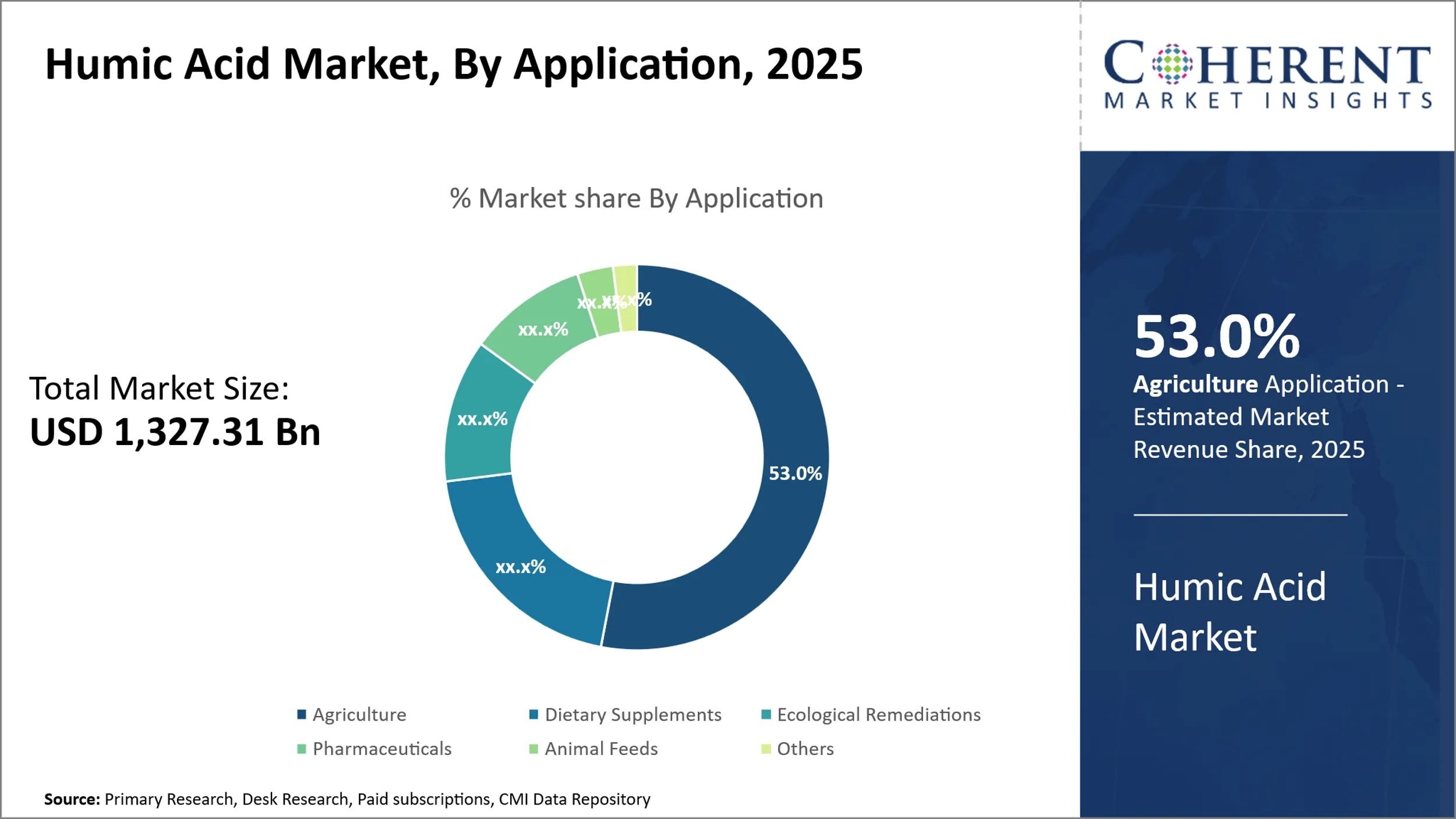
Humic Acid Market Insights, By Application: Agriculture Dominance is Driven by The Need for Higher Crop Yields to Meet Growing Food Demand
On the basis of application, in 2026, the agriculture segment accounted for 54% of the revenue share in the global humic acid market. The increasing need to achieve more yield per area of land for catering to the rising demand for food is expected to support growth of this segment.
Regional Insights
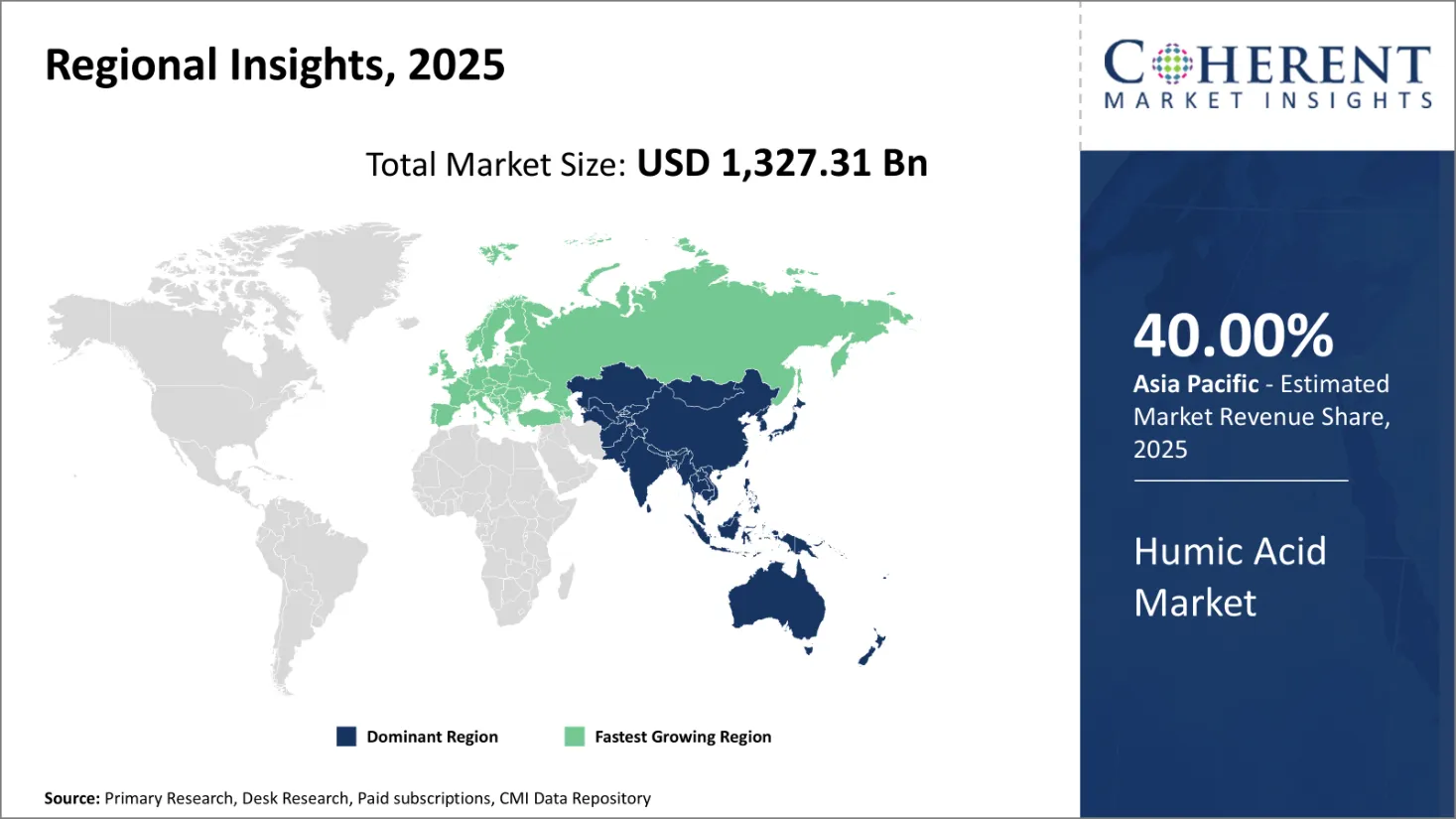
Asia Pacific Humic Acid Market Analysis and Trends
The Asia Pacific region is projected to lead the market with a 40% share in 2026, driven by rapid agricultural expansion, rising food needs, and growing awareness of sustainable farming. Governments are promoting organic inputs to improve soil fertility and crop yields. As farmers seek eco-friendly solutions to boost productivity, humic acid emerges as a key soil enhancer across the region.
For instance, in Marh 2026, Seawin Biotech Group showcased its marine-based biostimulants, including fulvic acid products, at CAC 2026 in Shanghai, highlighting its innovation in sustainable agriculture. With exports to over 80 countries, Seawin emphasized its commitment to soil health and crop productivity through advanced marine biological fertilizers, reinforcing Asia-Pacific’s growing influence in the global humic substances market
Europe Humic Acid Market Analysis and Trends
Europe region is expected to exhibit the fastest growing in the market, stems from its strong commitment to organic farming, strict environmental regulations, and widespread awareness of soil health. Farmers increasingly adopt humic substances to enhance crop yields, reduce chemical dependency, and restore degraded soils. Government incentives and sustainability goals further accelerate market growth across the region.
For instance, in Decembre 2024, Germany’s Leibniz Institute ATB developed a method to artificially produce humic substances using hydrothermal humification, rapidly converting organic waste into soil-enhancing compounds. Field trials in Potsdam showed improved tree health, highlighting the potential for sustainable agriculture and carbon sequestration. The innovation supports circular bioeconomy goals and reduces reliance on mined humates.
Humic Acid Market Dominating Countries
China Humic Acid Market Analysis and Trend
China is the world's largest producer and exporter of humic acid with the vast deposits of leonardite and lignite, the primary raw materials. As a manufacturing powerhouse with local market demand for sustainable agriculture, China dominates low-cost manufacturing as well as global supply.
United States Humic Acid Market Analysis and Trend
The U.S. market is vast for premium humic acid owing to a huge commercial farming sector and increasing demand for organic and soil health-focused inputs. U.S. products' high-quality profile resulting from high-level R&D and regulatory compliance makes them the choice in overseas markets like North America and Europe.
For instance, in April 2026, HGS BioScience, backed by Paine Schwartz Partners, acquired Menefee Mining Corporation and Earthgreen Products, expanding its footprint in the humic acid market. The move strengthens HGS’s access to high-quality humate deposits from New Mexico’s Menefee Formation and supports its growth into broader biostimulant segments, including microbials and seaweed extracts.
India Humic Acid Market Analysis and Trend
India is rapidly emerging as a major consumer and humic acid manufacturer from its huge agricultural industry and demand for green, organic agriculture. Government incentives towards environmentally friendly inputs have favored domestic manufacture, eliminating the need for imports.
Market Report Scope
Humic Acid Market Report Coverage
| Report Coverage | Details | ||
|---|---|---|---|
| Base Year: | 2025 | Market Size in 2026: | USD 1,432.17 Bn |
| Historical Data for: | 2020 To 2024 | Forecast Period: | 2026 To 2033 |
| Forecast Period 2026 to 2033 CAGR: | 7.9% | 2033 Value Projection: | USD 2,438.62 Bn |
| Geographies covered: |
| ||
| Segments covered: |
| ||
| Companies covered: | Faust Bio-Agricultural Services, Humic Growth Solutions, Inc., Italpoliina S.p.A., LaboratoiresGoemar SAS, Koppert B.V., Sikko Industries, Black Earth Humic, Changsha Xian Shan Yuan Agriculture, Agbest Technology, Nature's Lawn & Garden, Humintech, Everwood Farm, Daymsa, and WinField Solutions. | ||
| Growth Drivers: |
| ||
| Restraints & Challenges: |
| ||
Humic Acid Market Drivers
- Increasing adoption of sustainable agriculture across the globe
The adoption of eco-friendly fertilizers and chemicals for sustainable farming is expected to boost the demand for humic acid in the coming years. Furthermore, stringent rules and regulations imposed by statutory governing organizations such as the U.S. Environmental Protection Agency (EPA) against the usage of chemical-based fertilizers are further estimated to fuel the humic acid market growth worldwide.
Moreover, the increasing need for ecological remediation of soil to reduce the carbon footprint and protect the soil and groundwater from contamination are boosting the demand for humic acid. Furthermore, the properties of humic acid such as higher ion exchange and absorption capacity are expected to propel the demand for humic acid over the forecast period.
In May 2025, India’s Ministry of Agriculture amended its 1985 Fertilizer Control Order to add detailed specifications for humic and fulvic acid biostimulants, including mandated minimum concentrations, permissible forms, and crop-specific dosage guidelines, solidifying humic acid’s role under sustainable fertilizer regulations.
Key Developments
- In October 2024, AgroLiquid announced its acquisition of Monty’s Plant Food, a Kentucky-based company known for its humic-based fertilizers. This merger aims to strengthen AgroLiquid’s position in the sustainable nutrient solutions market. The integration brings together innovative humic technologies with wide distribution capabilities.
- In March 2024, Huma® acquired Gro-Power, a California-based manufacturer of soil conditioners and humic acid products. This strategic move expanded Huma’s portfolio in North America, enabling it to offer enhanced soil fertility solutions. The acquisition supports the growing demand for sustainable crop inputs in U.S. agriculture.
Analyst View
- The worldwide market for humic acid is witnessing strong momentum, led largely by the surging move toward sustainable farming techniques and mounting demand for organic agriculture. Rising consciousness among farmers regarding soil degradation and the requirement for organic fertilizers is driving the market growth forcefully.
- The increasing use of precision farming methods and the promotion of organic agriculture by the government are opening up large growth opportunities for humic acid producers.
- North America is the leading region, thanks to developed agricultural infrastructure, high organic farming penetration rates, and effective regulatory backing of sustainable farming. The region enjoys developed distribution channels and huge outlays on research and development in agriculture.
- Asia-Pacific is the most rapidly expanding regional market, driven by increasing farming activities, mounting population pressure on food security, and increasing government attention towards sustainable farming programs. China and India are seeing speedy adoption of organic fertilizers due to concerns over soil degradation and export market requirements.
- The market offers substantial opportunities in creating new humic acid products, broadening markets outside of agriculture to pharmaceuticals and cosmetics, and forming strategic partnerships with agricultural cooperatives to drive increased market access and programs for educating farmers.
Market Segmentation
- Global Humic Acid Market, By Application (Revenue, USD Bn, 2021 - 2033)
- Agriculture
- Animal Feed
- Ecological Remediation
- Dietary Supplements
- Pharmaceuticals
- Others
- Global Humic Acid Market, By Region (Revenue, USD Bn, 2021 - 2033)
- North America
- U.S.
- Canada
- Latin America
- Brazil
- Argentina
- Mexico
- Rest of Latin America
- Europe
- Germany
- U.K.
- Spain
- France
- Italy
- Russia
- Rest of Europe
- Asia Pacific
- China
- India
- Japan
- Australia
- South Korea
- ASEAN
- Rest of Asia Pacific
- Middle East
- GCC Countries
- Israel
- Rest of Middle East
- Africa
- South Africa
- North Africa
- Central Africa
- Company Profiles
- Faust Bio-Agricultural Services
- Humic Growth Solutions, Inc.
- Italpoliina S.p.A.
- LaboratoiresGoemar SAS
- Koppert B.V.
- Sikko Industries
- Black Earth Humic
- Changsha Xian Shan Yuan Agriculture
- Agbest Technology
- Nature's Lawn & Garden
- Humintech
- Everwood Farm
- Daymsa
- WinField Solutions
Sources
Primary Research Interviews
- Humic acid manufacturers and suppliers
- Agricultural input distributors and retailers
- Organic farming consultants and advisors
- Endusers (farmers and agricultural cooperatives)
- Others
Databases
- FAO Statistical Database (FAOSTAT)
- USDA National Agricultural Statistics Service
- ITC Trade Map Database
- Others
Magazines
- Agriculture & Food Security Magazine
- Crop Protection Magazine
- Organic Farming Business Magazine
- Fertilizer International Magazine
- Others
Journals
- Journal of Agricultural and Food Chemistry
- Applied Soil Ecology
- Soil Biology and Biochemistry
- Others
Newspapers
- Farm Progress
- The Western Producer
- AgriPulse Communications
- AgriNews
- Others
Associations
- International Humic Substances Society (IHSS)
- Organic Trade Association (OTA)
- International Fertilizer Association (IFA)
- Sustainable Agriculture Research and Education (SARE)
- Others
Public Domain Sources
- U.S. Environmental Protection Agency (EPA) reports
- European Food Safety Authority (EFSA) publications
- Ministry of Agriculture government reports
- United Nations Environment Programme documents
- Others
Proprietary Elements
- CMI Data Analytics Tool
- Proprietary CMI Existing Repository of information for last 8 years
Get access to 250+ pages report
Every segment, forecast, competitor profile and data table behind the analysis above — available for instant download.
- ESOMAR Member
- ISO 9001:2015 Certified
- D-U-N-S Registered
- GDPR & CCPA Compliant
Missing comfort of reading report in your local language? Find your preferred language:
Transform your Strategy with Exclusive Trending Reports
Frequently Asked Questions
The Humic Acid Market size is estimated to be valued at USD 1,432.17 Bn in 2026, and is expected to reach USD 2,438.62 Bn by 2033.
The CAGR of the global Market is projected to be 7.9% from 2026 to 2033.
Increasing adoption of sustainable agriculture across the globe is fuelling the growth of the market.
Agriculture segment is the leading component segment in the market.
Increasing number of substitutes of humic acid are restraining the growth of the market.
Faust Bio-Agricultural Services, Humic Growth Solutions, Inc., Italpoliina S.p.A., LaboratoiresGoemar SAS, Koppert B.V., Sikko Industries, Black Earth Humic, Changsha Xian Shan Yuan Agriculture, Agbest Technology, Nature's Lawn & Garden, Humintech, Everwood Farm, Daymsa, and WinField Solutions.