

Global AR Smart Glasses Market Size and Forecast – 2026 To 2033
The global AR smart glasses market is expected to grow from USD 2.50 Bn in 2026 to USD 35.00 Bn by 2033, registering a compound annual growth rate (CAGR) of 18.2% from 2026 to 2033. The global AR smart glasses market is driven by advancements in lightweight optical waveguides and micro-displays. On January 7, 2026, Vuzix Corporation and Himax Technologies, Inc. announced a new Optical Component Reference Design for AR glasses. The design combines Himax's ultra-compact HX7319FL color sequential Front-lit LCoS micro-display with Vuzix’ high-efficiency waveguide technology.
Key Takeaways of the Global AR Smart Glasses Market
- The Standalone AR Glasses segment is expected to account for 57.0% of the global AR smart glasses market share in 2026. Growing applications in logistics warehousing and field services is driving the growth of the segment. On August 12, 2025, Vuzix introduced its LX1 smart glasses for warehouse and distribution operations. The ruggedized device supports hands-free voice control and a claimed 10-hour operating runtime.
- The Marker-Based Augmented Reality segment is estimated to capture 44.0% of the market share in 2026. Increasing use of remote assistance and real-time information overlays is majorly driving the growth of the segment. On June 3, 2026, TeamViewer announced a collaboration with Microsoft to improve its Assist AR remote assistance solution. The integration uses Microsoft's Windows artificial intelligence application programming interface for Video Super Resolution.
- The Bluetooth segment is estimated to capture 52.0% of the market share in 2026. Rising integration of artificial intelligence into wearable devices is driving the growth of the segment. On June 26, 2025, Xiaomi introduced its AI glasses in China, combining wearable eyewear with artificial intelligence and first-person imaging.
- North America is expected to dominate the AR smart glasses market in 2026 with a market share of 34.0%. Increasing adoption in healthcare training and medical visualization in North America is driving the growth of the regional market. On September 1, 2026, Stryker announced that its SportSuite Vision application had received U.S. Food and Drug Administration De Novo authorization for intraoperative use with Apple Vision Pro.
- Asia Pacific is expected to account for 32.0% share in 2026. Development of lightweight optical waveguides and energy-efficient displays in Asia Pacific is driving the growth of the regional market. On June 10, 2025, Cellid announced two upgraded waveguide products, targeting brighter augmented reality displays. Its plastic R30-FL (C) waveguide provides around twice the brightness of the previous generation, while its glass C30-AG (C) provides more than three times the brightness of the previous model.
Segmental Insights
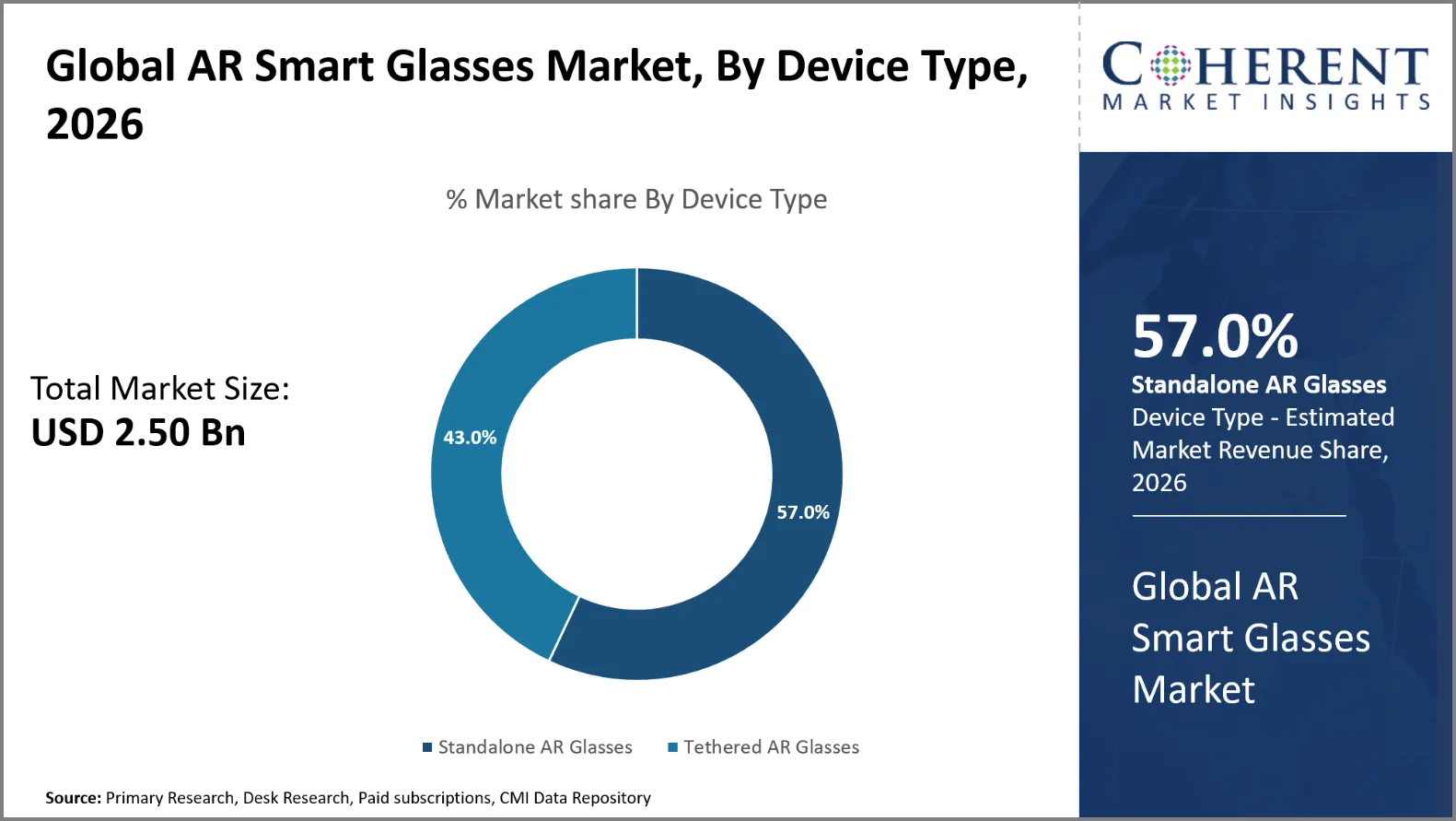
Why Does Standalone AR Glasses Dominate the Global AR Smart Glasses Market?
The standalone AR glasses segment is expected to account for 57.0% of the global AR smart glasses market share in 2026. Standalone AR smart glasses are attractive to users since they do not require constant connection with smartphones or other external computing equipment. Integrated CPUs, sensors, displays, batteries and operating systems make it possible to run compatible apps independently. This architecture improves mobility and makes deployment easier in industrial maintenance, healthcare, logistics, education and field services. Workers can receive digital instructions, navigation cues and other information while keeping their hands free for the physical work. The stand-alone designs offer less dependence on cabling and more freedom in the workplace. But battery life, thermal management, device weight and CPU power are still important considerations when buying.
On September 6, 2025, during IFA 2025, INMO Technology unveiled the Air3 with all-in-one design including computing, sensors and battery. The glasses employ a Micro OLED display from Sony with optical waveguide tech and a Snapdragon XR CPU. They have 1080p resolution, 600-nit brightness and a field of vision of 36 degrees.
- Current Industry Events of 2026
- Market Size Estimation
- Regional Breakdown
- Competitive Landscape
- Customer Intelligence
- Segmental Analysis
- Pricing Analysis
- Key Market Drivers, Challenges & Future Trends
- Customized Insights Section
Why is Marker-Based Augmented Reality the Most Preferred Technology Type?
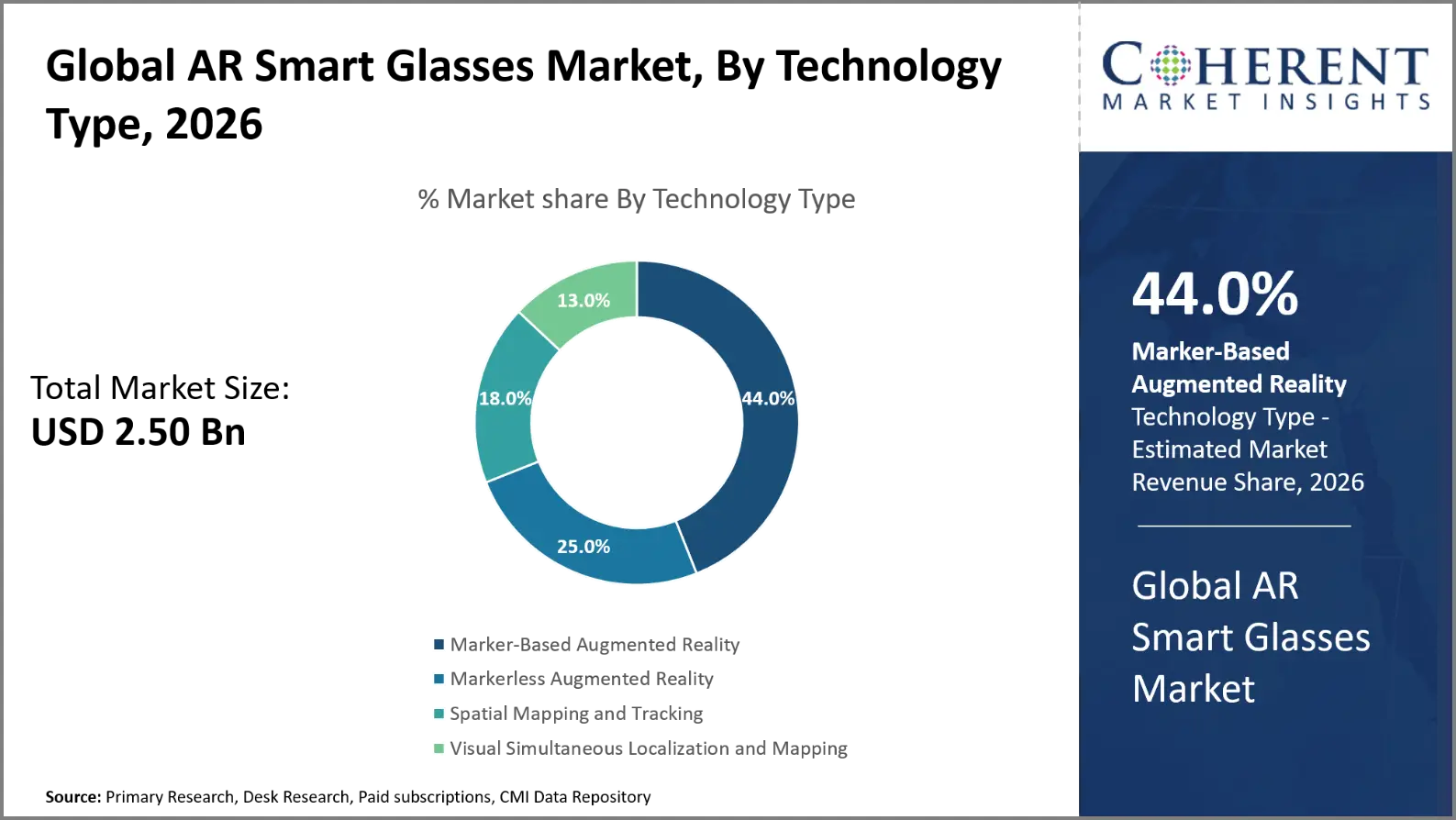
The marker-based augmented reality segment is expected to account for 44.0% of the global AR smart glasses market share in 2026. Marker-based augmented reality is preferred for applications requiring reliable object recognition and consistent placement of digital information. The system recognizes visual markers that users set up in advance, labels, symbols and Quick Response codes. When detected, these markers trigger digital instructions, 3D models or contextual information in the user's field of view. Marker-based tracking is commonly used in manufacturing, equipment maintenance, training, retail demonstrations and educational applications where it provides consistent performance in controlled situations. This allows developers to create particular visuals without having to rely fully on complicated environmental mapping.
On September 29, 2025, Zappar released multi-image tracking for Zapworks Designer, which enables a single augmented reality project to detect several predetermined image targets. Every target can trigger its dedicated digital scene without a separate QR code or project.
Bluetooth Dominates the Global AR Smart Glasses Market
The Bluetooth segment is expected to account for 52.0% of the global AR smart glasses market share in 2026. Bluetooth is key in the AR smart glasses market, allowing wireless connections with smartphones and other devices. It is low power and pairs with a device for audio playback, voice commands, notifications and certain control capabilities. Manufacturers can also leverage Bluetooth to incorporate smart glasses into the existing mobile ecosystem without the need for dedicated wireless accessories. Users can make and receive calls, talk to digital assistants and even use supported smartphone functionality, all hands-free. For example, Optinvent’s ORA-2 smart glasses provide Bluetooth connectivity with compatible smart devices. Broad device compatibility and familiar pairing processes also contribute to uptake in consumer and enterprise applications.
On February 3, 2025, Lenskart launched Phonic smart glasses, that offer Bluetooth audio, smartphone calling and voice assistant support. The glasses feature temple speakers and a physical button to toggle between features. Compatible Android and Apple smartphones enable users to listen to music, answer calls and provide voice instructions.
Current Events and their Impact
Current Events | Description and its Impact |
European Data Protection Board Statement on Smart Glasses, 2026 |
|
European Union Artificial Intelligence Act Regulation (EU) 2024/1689 |
|
AR Smart Glasses Market Dynamics
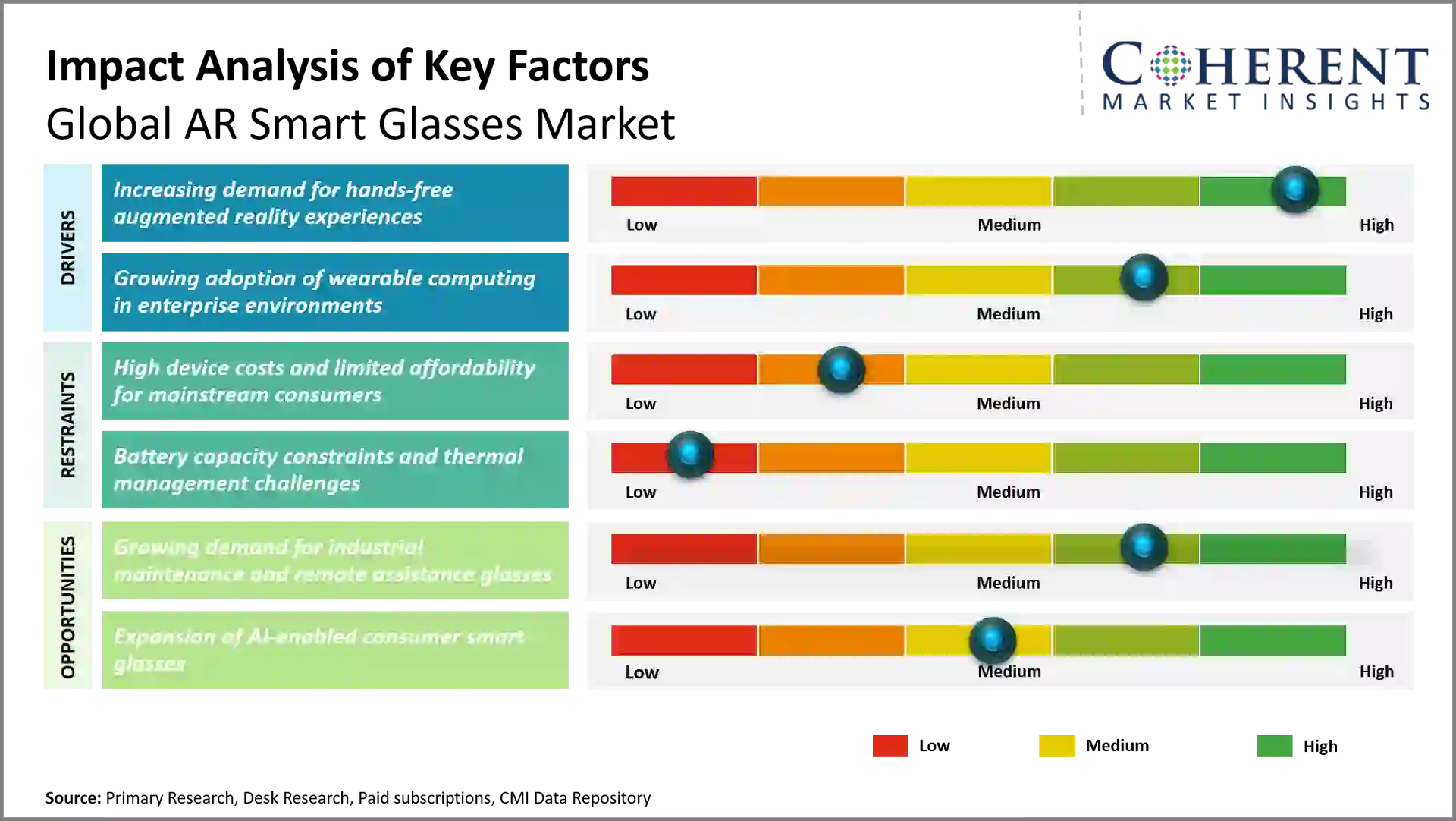
Market Drivers
Increasing demand for hands-free augmented reality experiences
Growing demand for hands-free augmented reality experiences is helping the adoption of AR smart glasses across consumer and professional applications. They superimpose digital instructions, navigation cues, notifications and contextual information in the user’s field of view. The user is not required to constantly fiddle with smartphones or tablets to get information. This skill is especially useful for equipment maintenance, warehouse picking, remote help, healthcare treatments and industrial inspections. Voice control and gesture control make it more accessible and easier to operate. Advances in light-weight optics displays, battery efficiency and artificial intelligence assistants are making hands-free interactions more viable. As users demand mobility, productivity, and instant access to information, manufacturers are building more comfortable AR glasses with enhanced visuals and intuitive controls.
On December 1, 2025, Meta and EssilorLuxottica released Ray-Ban Meta Gen 2 in India, with better 3K video capture, improved AI capabilities and up to eight hours of battery life. Users can invoke Meta AI with voice commands, take photos, record videos and respond to messages without holding a smartphone.
Growing adoption of wearable computing in enterprise environments
Increasing adoption of wearable computing in enterprise environments is fueling demand for AR smart glasses across manufacturing, logistics, healthcare and field services. Businesses utilize these gadgets to deliver real-time job instructions, show technical information and connect front-line workers with remote experts. Warehouse workers can see the actual stock and get instructions for picking items. Maintenance staff can use digital overlays to evaluate equipment and access professional help for complex repairs. Such applications could increase procedural uniformity and support staff training, as well as eliminate job switching. They are also more valuable with integration to enterprise software, inventory platforms and industrial Internet of Things systems. Organizations want to enhance operational efficiency, manage skills shortages and standardize procedures across scattered sites, and are increasingly looking at wearable computing for these reasons.
On April 13, 2026, Vuzix Corporation announced the beginning of its Pick and Pack Validation Program to help firms evaluate and grow wearable computing throughout warehouse operations. This bundle is for the smart glasses LX1 and M400 with pre-installed Mobilium software. It contains five workflows on picking assistance, goods receipt, packing aid, pallet building and bin audits.
Market Restraints
- High device costs and technical limitations: The use of high-powered optical displays, tiny CPUs, sensors and batteries, which add to the higher manufacturing cost, limits the adoption of AR smart glasses. Battery life, heat management, narrow fields of view and weight of the device can be limiting considerations for prolonged use.
- Privacy concerns and limited user acceptance: AR smart glasses with cameras may raise worries about unlawful recording, personal data collection and surveillance at the workplace. Ambiguous recording measures and social awkwardness may limit uptake. Development expenses are raised and deployment across various nations and industries is hindered by compliance rules.
Emerging Trends
- Integration of artificial intelligence assistants: AR smart glasses are increasingly merging with AI assistants that allow voice commands, contextual information retrieval, object detection, and real-time translation. These characteristics make the hands-free interaction more convenient and extend the use in industrial maintenance, navigation, education and customer support.
- Advancements in lightweight optical displays: Companies are developing compact waveguides, micro-LED displays and improved optical systems to provide better visual clarity and make devices lighter. Such enhancements allow longer wear with comfort, better visibility of digital overlays, and assist acceptance in consumer and enterprise applications.
- Expansion of enterprise remote assistance: Companies utilize AR smart glasses for remote troubleshooting, equipment inspections, warehousing operations and training of frontline staff. Remote assistance for field staff is possible with live visual collaboration, which can eliminate the need for travel, operational delays, and equipment downtime.
- Growing emphasis on privacy and energy efficiency: Manufacturers are focusing on visible recording indicators, on-device processing, energy-efficient wireless connectivity and better battery management. These developments address privacy concerns, allow for longer device use, and enable wider adoption in professional situations requiring safe and dependable wearable computing.
Regional Insights
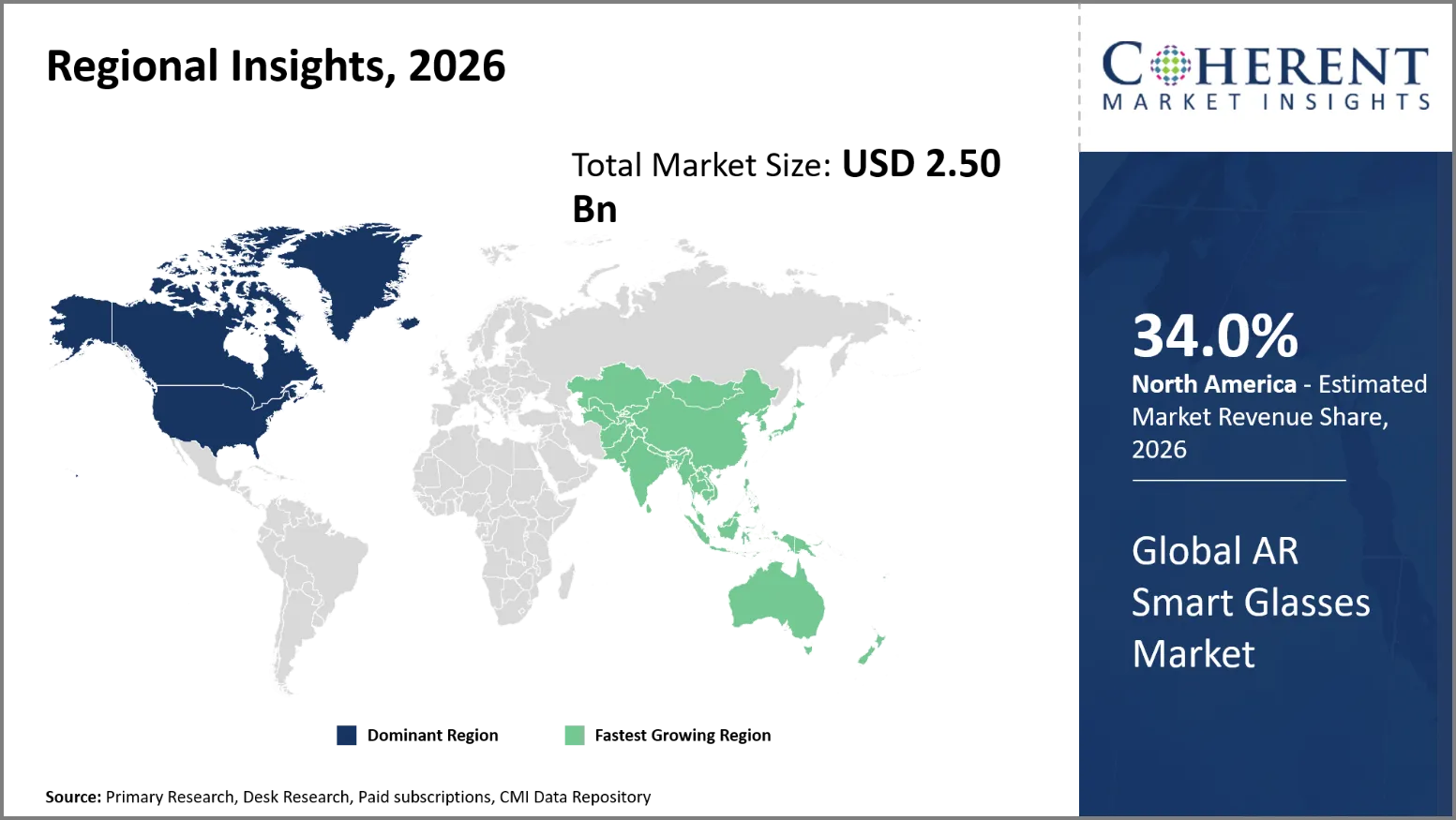
Why is North America a Strong Market for AR Smart Glasses?
North America is expected to account for a market share of 34.0% in 2026. AR smart glasses market in North America is driven by consumer adoption of camera-enabled eyewear and existing enterprise deployments. Meta and EssilorLuxottica increased their product portfolio with Ray-Ban Meta and Oakley Meta, which paired popular eyewear shapes with cameras, audio and AI technologies. Meta in September 2025 debuted the Ray-Ban Meta Gen 2, bringing 3K Ultra HD video and better battery life. Enterprise demand is also driving adoption, notably in logistics and infrastructure operations. In March 2026, Vuzix announced expanded smart glasses deployments by a major online retailer across the U.S. and Canada. These deployments support hands-free workflows and operational efficiency.
Why Does Asia Pacific AR Smart Glasses Market Exhibit High Growth?
Asia Pacific is expected to register the fastest growth with a CAGR of 19.1% over the forecast period. The region is projected to account for 32.0% of the global AR smart glasses market in 2026. Integrated electronics supply chains, optical component know-how and quick product development throughout China, Japan and South Korea favors Asia Pacific’s growth. Manufacturing alliances can help organizations build lightweight frames, display modules, cameras, and tiny computing systems. Chinese firm Rokid has teamed together with Lens Technology to make Rokid Glasses, whose production began in June 2025. Japanese firms offer proven optical and imaging competence, while South Korean suppliers enhance regional display capabilities. The rising popularity of AI-enabled wearables is prompting regional manufacturers to include translation, voice interaction, navigation and visual aid. These complementary capabilities support product innovation and manufacturing scale.
Global AR Smart Glasses Market Outlook for Key Countries
Why is U.S. Emerging as a Major Hub in the AR Smart Glasses Market?
The U.S. market has developed technology platforms, consumer eyewear distribution and demand for wearable artificial intelligence. Meta’s Ray-Ban Meta Gen 2 adds a 12-megapixel camera, open-ear speakers and enhanced video capture. Launched in September 2025, it brought 3K ultra-HD recording and a longer battery life. Enterprise installations offer another path for growth. In March 2026, Vuzix announced new orders for their M400 smart glasses and initial orders for the Ultralite Pro program from a large online shop. These deployments enable warehouse workflows and infrastructure activities. American technology companies also provide software, artificial intelligence, cloud platforms and developer tools.
Is China the Next Growth Engine for the AR Smart Glasses Market?
Local wearable brands, clustered electronics production and fast uptake of artificial intelligence in consumer products are supporting China’s market. Rokid Glasses, with MicroLED waveguide displays, were released in September 2025 and weigh 49 grams. It has real-time translation, object recognition, navigation and transcription. Another major advantage is the collaboration in manufacturing. “Production has begun at the Lens Technology facility in Hunan in June 2025, the partner of Rokid. China’s domestic ecosystem also includes companies like Xiaomi and Alibaba. These companies boost competition in voice-enabled wearables, display hardware and artificial intelligence services.
Germany AR Smart Glasses Market Analysis and Trends
Germany’s AR smart glasses business is backed by industrial engineering, precision optics and digital manufacturing activities. ZEISS formed its Extended Reality business unit in October 2025 to combine know-how in vision correction, optical systems and integration for extended reality devices. Its characteristics are relevant for firms seeking prescription compliant optics and improved visual performance. German industrial enterprises also use augmented reality for equipment service, technical training, assembly guidance and remote collaboration. Siemens advocates the use of augmented reality for industrial training, inspection, and collaboration in digital production. This expertise reinforces Germany’s position in enterprise applications and specialized optical technologies.
Japan AR Smart Glasses Market Analysis and Trends
Japan’s AR smart glasses industry is supported by the established habits of wearing glasses, precise electronics and an increasing availability of consumer devices with artificial intelligence. Ray-Ban Meta Gen 2 and Oakley Meta were launched in Japan in May 2026 by Meta and EssilorLuxottica. The products blend hands-free artificial intelligence, cameras, audio and speech interaction with recognizable eyewear styles. Optical fashions are suitable with prescriptions, making them more relevant for everyday wearers. Japan's electronics sector is also strong in imaging, micro components and display engineering. These characteristics promote prospects in translation, travel assistance, remote collaboration and wearable interfaces for everyday use.
South Korea AR Smart Glasses Market Analysis and Trends
South Korea’s AR smart glasses business is supported by semiconductor engineering, mobile device ecosystems, display competence, and partnerships between tech and fashion industries. In May 2026, Samsung Electronics and Google showcased ideas for intelligent eyeglasses with Gentle Monster and Warby Parker. The devices being designed combine a traditional look for eyeglasses, smartphone connectivity and voice-activated artificial intelligence help. Samsung then launched their smart glasses in July 2026, broadening its approach to wearable AI. These advancements bode well for a design-first approach to customer uptake. South Korea's electronics ecosystem also creates opportunities for compact components, efficient power management, and integration with connected mobile services.
Global AR Smart Glasses Market - Optical Waveguide Development For Augmented Reality Smart Glasses
Company | Development | Date | Waveguide technology | Key Technical Point |
SCHOTT | RealView 2.0 Lightweight | September 3, 2026 | High-index optical glass | Refractive index 2.0; blue-light transmission above 96% at 460 nm over a 10 mm optical path; 150 mm, 200 mm and 300 mm wafer options |
Applied Materials | SENZ integrated visual platform | June 17, 2026 | Integrated waveguide optics and light engine | Integrated waveguides, light engine, sensing, vision correction and electronic dimming |
Vuzix and Himax Technologies | Prescription-ready optical component reference design | January 7, 2026 | Waveguide with front-lit liquid crystal on silicon micro-display | 30-degree field of view configurations; brightness above 1000 nits |
Cellid | Two AR glasses reference designs | December 2, 2025 | Plastic and glass waveguides | Binocular 30-degree field of view; Micro-LED projector brightness up to 3000 nits |
Applied Materials and GlobalFoundries | Waveguide fabrication collaboration in Singapore | September 23, 2025 | Semiconductor-process-based waveguide fabrication | High-volume fabrication partnership; production capacity not publicly disclosed |
How is Growing Demand for Industrial Maintenance and Remote Assistance Glasses Creating New Growth Opportunities in the AR Smart Glasses Market?
Growing demand for industrial maintenance and remote assistance glasses is creating opportunities for AR smart glasses manufacturers to address costly equipment servicing and skilled technician shortages. For example, Vuzix M400 smart glasses enable technicians to communicate live visuals, receive digital work instructions, and receive remote expert help while repairing. RealWear’s Navigator series allows hands-free cooperation in industrial contexts such as energy facilities, manufacturing plants and field service operations. These technologies allow specialists to detect defects without traveling to the location, minimizing equipment downtime and unnecessary service calls. Integration with computerized maintenance management systems and industrial Internet of Things platforms opens more options for connected maintenance operations. Manufacturers can distinguish their devices by features such as an intrinsically safe design, prescription compatibility, noise-resistant voice controls, and reliable functioning in tough industrial conditions.
On March 17, 2025, Hitachi Construction Machinery Co., Ltd., HMS Co., Ltd. and Holo-Light GmbH developed new-look XR smart glasses. The highly durable and advanced accessory allows technicians to receive remote support from their service desk with a visual aid, using XR technology that enables the combination of real and virtual spaces; and deliver fast and high-quality onsite service.
Market Players, Key Development, and Competitive Landscape
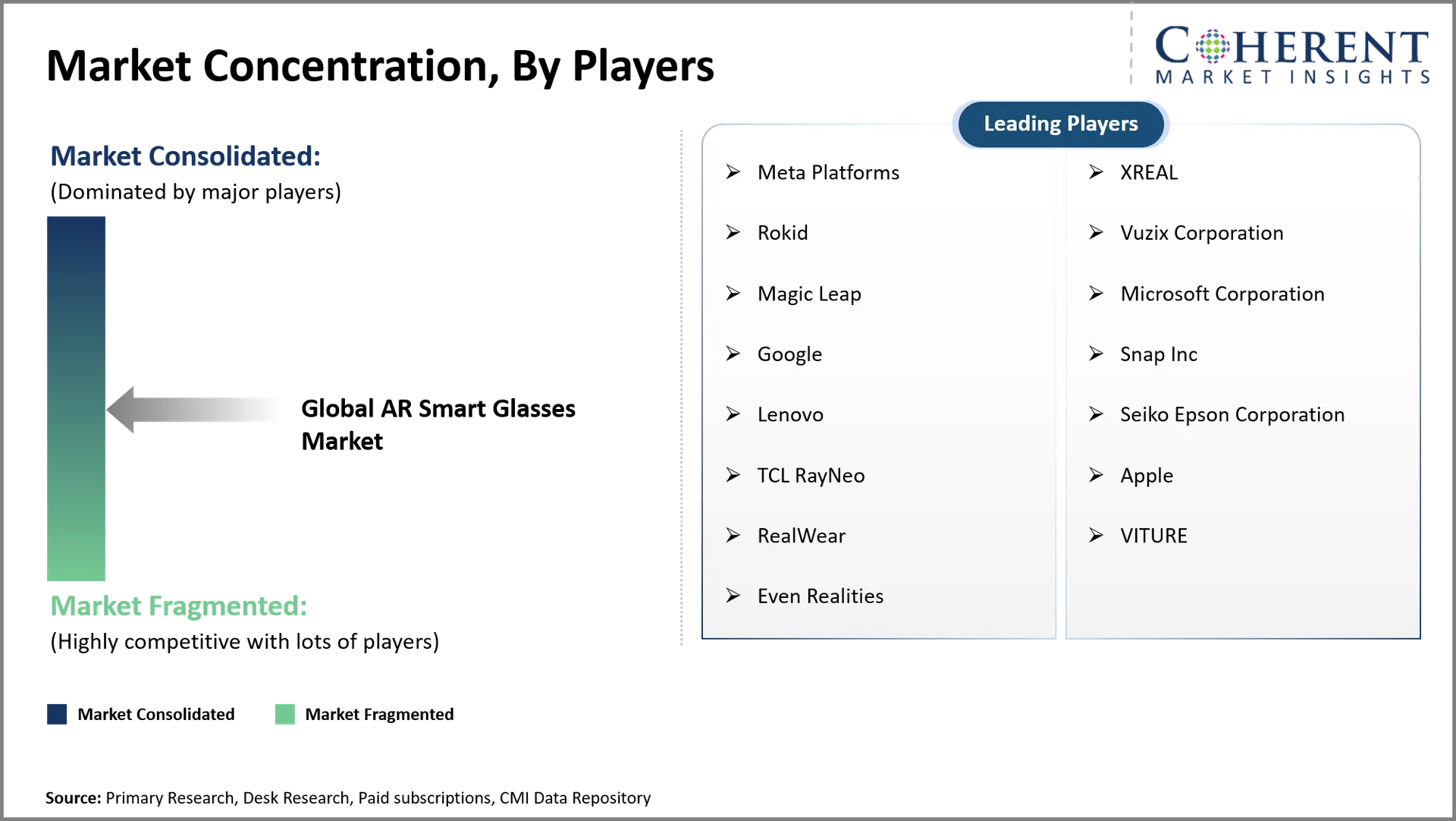
Key Developments
- On June 17, 2026, Applied Materials, Inc. unveiled SENZ, an integrated ambient visual platform that combines waveguide optics, light engine, sensing, vision correction and electronic dimming technology in a single system designed for AI-powered next-generation display smart glasses. By giving customers a complete co-optimized solution, SENZ will reduce time-to-market and manufacturing complexity while enabling more flexible product designs and premium user experiences.
- On June 16, 2026, Snap Inc. unveiled SPECS, introducing see-through AR glasses designed for computing, entertainment, productivity, and shared experiences. Snap highlighted its investments in proprietary operating systems, optics, displays, computer vision, and developer tools.
- On February 18, 2026, Vuzix Corporation announced the launch of Vuzix Solutions, a new portfolio of integrated enterprise smart glasses deployment kits designed to accelerate hands-free productivity for frontline workers. Each ruggedized Solutions Kit combines Vuzix smart glasses with pre-configured, industry-leading software, providing organizations with a streamlined path to deployment and immediate operational impact.
Competitive Landscape
Meta Platforms, Vuzix, XREAL, Rokid, RealWear, RayNeo and Xiaomi dominate the global AR smart glasses industry. Ray-Ban Meta combines eyeglasses design, cameras, audio and artificial intelligence with EssilorLuxottica’s distribution network, with Meta Platforms targeting consumer uptake. Vuzix is aiming at enterprise with M400 smart glasses, waveguide optics, remote help and industrial workflows. XREAL is focused on display-based glasses for spatial computing and entertainment while Rokid pairs lightweight eyewear with translation and artificial intelligence. RayNeo competes with budget display products, whereas RealWear concentrates on tough devices for industrial field applications. Competitive differentiation increasingly depends on comfort, optical quality, battery performance, privacy controls, software compatibility, and distribution partnerships.
Top Manufacturers and Notable Products in the AR Smart Glasses Market
Manufacturer | Notable Product | Key features |
Meta Platforms | Meta Platforms | Hands-free photography, open-ear audio, voice-controlled Meta AI, 3K video recording |
Vuzix Corporation | Vuzix Corporation | Rugged industrial design, voice control, remote assistance, barcode scanning, hands-free workflows |
RealWear | RealWear | Hands-free voice interface, rugged construction, remote expert support, industrial workflow access |
Rokid | Rokid | Lightweight design, artificial intelligence assistant, real-time translation, camera, navigation and contextual display |
XREAL | XREAL | Micro-OLED displays, spatial display adjustment, immersive viewing, USB-C connectivity, external device compatibility |
AR Smart Glasses Market Report Coverage | |||
Report Coverage | Details | ||
Base Year | 2025 | Market Size in 2026: | USD 2.50 Bn |
Historical Data For: | 2020 To 2024 | Forecast Period: | 2026 To 2033 |
Forecast Period 2026 To 2033 CAGR: | 18.2% | 2033 Value Projection: | USD 35.00 Bn |
Geographies covered: |
| ||
Segments covered: |
| ||
Companies covered: | Meta Platforms, XREAL, Rokid, Vuzix Corporation, Magic Leap, Microsoft Corporation, Google, Snap Inc, Lenovo, Seiko Epson Corporation, TCL RayNeo, Apple, RealWear, VITURE, Even Realities | ||
Growth Drivers: |
| ||
Restraints & Challenges: |
| ||
Analyst Opinion (Expert Opinion)
- The future of AR smart glasses will be to provide digital help that’s effective but doesn’t sacrifice the comfort of regular eyewear. More and more consumer devices will include voice AI, cameras, audio, translation, and contextual assistance. But when users need navigation overlays, or technical diagrams, or hands-free tutorials, eyewear with displays will become important.” Manufacturers need to concentrate on lightweight frames, prescription compatibility, dependable battery life and unobtrusive controls. Companies who make the glasses pleasant for full day wear will have greater opportunity to establish recurring usage.
- The biggest prospects are in industrial maintenance, logistics, healthcare support and consumer artificial intelligence eyewear. Vuzix and RealWear take specialized approaches with wearable screens and ruggedized hands-free devices for industrial applications. Meta's Ray-Ban cooperation shows the commercial advantages of recognizable style and existing eyewear distribution in consumer applications. China offers prospects in manufacturing, component integration and economically cost products. Interesting applications are found in Germany in industrial engineering and in Japan in optical technology and precision electronics. Product plans should be based on what each country can do, not one universal design.
- Market players should compete with measurable product advantages rather than developing artificial intelligence features without apparent consumer benefits. There is need for custom versions from manufacturers for industrial safety, prescription users, logistics workers and everyday consumers. Partnerships with enterprise software vendors can link glasses to maintenance systems, warehouse apps and remote support platforms. Companies also need to do a better job of improving optical clarity, outdoor visibility, thermal management and battery replacement alternatives. Local data processing, adjustable recording settings and privacy indications may alleviate client concerns. Flexible pricing, consistent after-sales support, and promises to software updates can improve client retention and long-term competitiveness.
Speak to the analyst
Want personalized insights?
Take the findings above to one of our principal consultants, or have the report rebuilt around the segments, geographies and competitors you actually track.
Market Segmentation
- Device Type Insights (Revenue, USD Billion, 2021 - 2033)
- Standalone AR Glasses
- Tethered AR Glasses
- Technology Type Insights (Revenue, USD Billion, 2021 - 2033)
- Marker-Based Augmented Reality
- Markerless Augmented Reality
- Spatial Mapping and Tracking
- Visual Simultaneous Localization and Mapping
- Connectivity Type Insights (Revenue, USD Billion, 2021 - 2033)
- Bluetooth
- Wi-Fi
- Cellular Connectivity
- Wired Connectivity
- Application Insights (Revenue, USD Billion, 2021 - 2033)
- Media and Entertainment
- Gaming
- Industrial Maintenance
- Healthcare
- Education and Training
- Logistics and Warehousing
- Retail and E-Commerce
- Defense and Aerospace
- Regional Insights (Revenue, USD Billion, 2021 - 2033)
- North America
- U.S.
- Canada
- Latin America
- Brazil
- Argentina
- Mexico
- Rest of Latin America
- Europe
- Germany
- U.K.
- Spain
- France
- Italy
- Russia
- Rest of Europe
- Asia Pacific
- China
- India
- Japan
- Australia
- South Korea
- ASEAN
- Rest of Asia Pacific
- Middle East
- GCC Countries
- Israel
- Rest of Middle East
- Africa
- South Africa
- North Africa
- Central Africa
- North America
- Key Players Insights
- Meta Platforms
- XREAL
- Rokid
- Vuzix Corporation
- Magic Leap
- Microsoft Corporation
- Snap Inc
- Lenovo
- Seiko Epson Corporation
- TCL RayNeo
- Apple
- RealWear
- VITURE
- Even Realities
Sources
Primary Research Interviews
- AR Smart Glasses Manufacturers & OEMs
- Enterprise Technology Solution Providers
- Augmented Reality Software Developers
- Retail & Industrial End-Users
Magazines
- Wired Magazine
- IEEE Spectrum
- Augmented World Expo (AWE) Magazine
- Tech Crunch Magazine
Journals
- Journal of Augmented Reality and Mixed Reality (De Gruyter)
- IEEE Transactions on Visualization and Computer Graphics
- International Journal of Human-Computer Studies (Elsevier)
Associations
- Augmented Reality for Enterprise Alliance (AREA)
- Consumer Technology Association (CTA)
- XR Association (XRA)
- International Data Management Association (DAMA)
Public Domain Sources
- U.S. Patent and Trademark Office (USPTO) – AR Technology Patents
- European Commission Digital Strategy Reports
- World Economic Forum (WEF) Reports on Emerging Technologies
- U.S. Bureau of Labor Statistics – Technology Adoption Data
Proprietary Elements
- CMI Data Analytics Tool
- Proprietary CMI Existing Repository of Information for Last 10 Years
Get access to 250+ pages report
Every segment, forecast, competitor profile and data table behind the analysis above — available for instant download.
- ESOMAR Member
- ISO 9001:2015 Certified
- D-U-N-S Registered
- GDPR & CCPA Compliant
Frequently Asked Questions
The global AR smart glasses market is expected to stand at USD 2.50 Bn in 2026 and is expected to reach USD 35.00 Bn by 2033.
The CAGR of the global AR smart glasses market is projected to be 18.2% from 2026 to 2033.
Increasing demand for hands-free augmented reality experiences and Growing adoption of wearable computing in enterprise environments are the major factors driving the growth of the global AR smart glasses market.
High device costs and limited affordability for mainstream consumers and battery capacity constraints and thermal management challenges are the major factors hampering the growth of the global AR smart glasses market.
In terms of device type, standalone AR glasses segment is estimated to dominate the market revenue share in 2026.
Augmented reality smart glasses are wearable devices that display digital information alongside the user's view of the physical environment.
They display repair instructions and equipment information while connecting technicians with remote specialists for troubleshooting.