

Micro-LED Market Analysis & Forecast - 2026 to 2033
The micro-LED market is estimated to be valued at USD 1.10 Bn in 2026 and is expected to reach USD 13.56 Bn by 2033, growing at a compound annual growth rate (CAGR) of 35.4% from 2026 to 2033.
Key Takeaways
- Based on Panel Size, the small and medium-sized panels segment is expected to lead the market with 42% share in 2026.
- Based on Application, the smartphones and tablets sub-segment, under display segment is expected to hold the largest share of the market in 2026.
- Based on End Use Vertical, the Consumer Electronic segment is projected to account for the highest t share of the market in 2026.
- Based on Region, Asia Pacific is set to lead the micro-LED market with 43% share in 2026. While, North America is anticipated to be fastest growing region.
Market Overview
Micro-LED is a minimized form of LED with matrix, which offers superior energy efficiency, color, brightness, and response time. It is also known as microLED or mLED. Micro-LED is used in smartphones, tablets, laptop, television, smart watch, head-up displays, and other near-to eye (NTE) devices.
Current Events and Its Impact on the Micro-LED Market
Current Event | Description and its Impact |
Apple's Micro-LED Display Development and Supply Chain Commitments |
|
European Green Deal and Semiconductor Sovereignty Initiatives |
|
What is the Investments By Corporates in Micro-LED Market?
Company / Region | Investment Amount | Focus Area | Strategic Impact |
Apple (US) | USD 1.5+ billion | AR/VR devices, wearables, future iPhones | Driving innovation in consumer electronics, boosting U.S. Micro‑LED market share |
Samsung (South Korea) | USD ~2 billion | Large‑format Micro‑LED TVs | Strengthening premium TV segment, global commercialization |
LG (South Korea) | USD ~1 billion | Home cinema, luxury displays | Expanding luxury consumer electronics adoption |
BOE (China) | USD 300+ million subsidies | Smartphone & TV panels | Government‑backed expansion, Asia‑Pacific dominance |
TCL (China) | USD 200+ million subsidies | Large‑scale Micro‑LED fabs | Scaling production capacity in China |
PlayNitride (Taiwan) | USD 500 million+ subsidies & private funding | Micro‑LED chip development | Leading small/medium display innovation |
VueReal (Canada) | USD 40 million funding | MicroSolid Printing platform | Automotive, wearables, AR/VR applications |
Plessey (UK) | USD 100 million+ funding & partnerships | Micro‑LED transfer tech | Collaboration with Meta for AR/VR |
Sony (Japan) | USD ~500 million R&D | Crystal LED displays | Focus on professional & cinema markets |
AUO (Taiwan) | USD ~300 million investment | Wearables & automotive displays | Expanding into niche high‑growth sectors |
Government of China | USD 500+ million subsidies | National display strategy | Ensuring global leadership in Micro‑LED manufacturing |
Meta (US) | Undisclosed (multi‑hundred million) | AR/VR headsets | Partnering with Plessey for Micro‑LED integration |
Intel & TSMC (US/Taiwan) | Joint R&D (hundreds of millions) | Semiconductor integration | Exploring Micro‑LED for advanced computing displays |
- Current Industry Events of 2026
- Market Size Estimation
- Regional Breakdown
- Competitive Landscape
- Customer Intelligence
- Segmental Analysis
- Pricing Analysis
- Key Market Drivers, Challenges & Future Trends
- Customized Insights Section
Segmental Insights
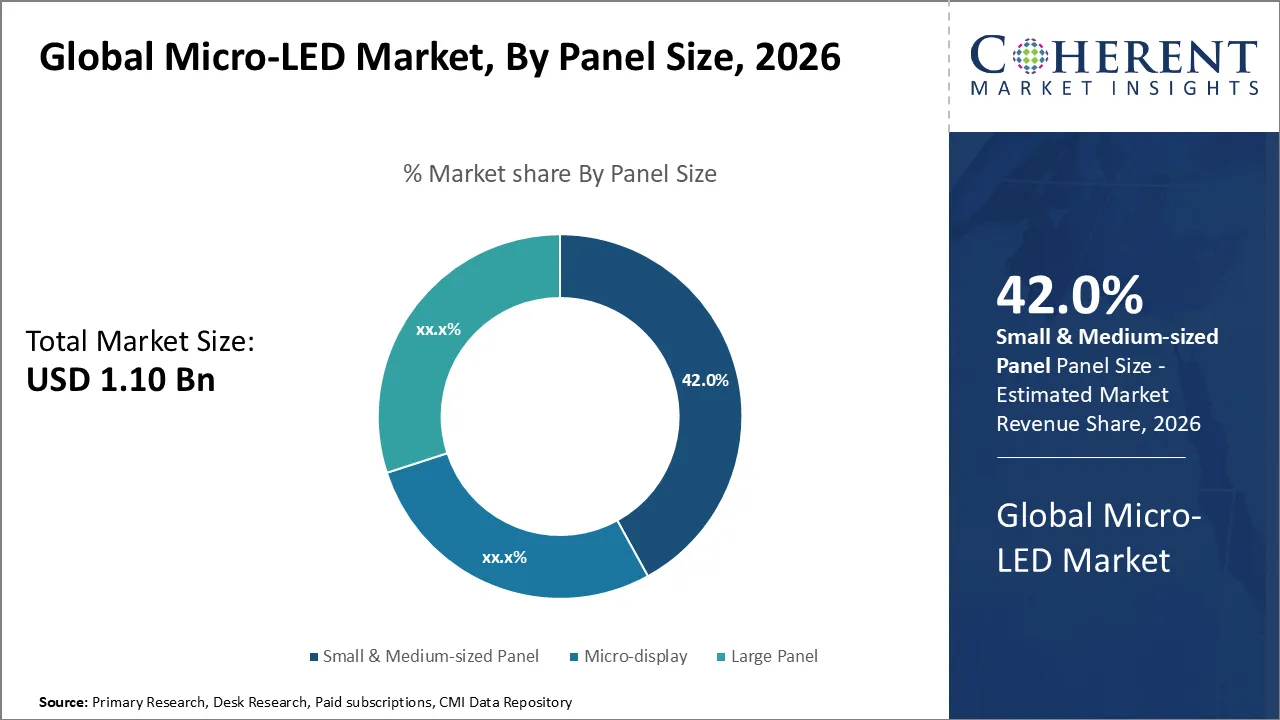
Global Micro-LED Market Insights, By Panel Size: Small and medium-sized panels is led by smartphones, tablets, and smartwatches
In terms of panel size, the small and medium-sized panels segment is expected to hold 42% share of the market in 2026. Smartphones, tablets, and smartwatches use them, which means they make greater revenues than micro-displays or large panels. They are the most practical entry point as they are easy to make and people want them, while large panels have problems with cost and scalability.
For instance, in July 2025, the Google XR glasses indicates that Raxium's Micro-LEDs are used to power near-to-eye displays, which are part of the small and medium-sized panel segment. These micro-displays make it possible to have AR and VR experiences that are light and have an immense amount of detail. They are different from substantial TV panels as they are early adopters in consumer electronics.
Global Micro-LED Market Insights, By Application: Smartphones and tablets lead Micro-LED profits, backed by huge demand and big tech adoption
In terms of application, the display segment is dominating, where the smartphones and tablets sub-segment is expected to lead the market with largest share in 2026. They are in business as they have a huge customer base, people want brighter, more energy-efficient displays, and big tech companies use them. Smartphones and tablets make the most profits since they are widely used, even though near-to-eye devices and smartwatches are growing quickly.
For instance, in July 2025, Q-Pixel's new ultra-small pixel Micro-LEDs are aimed at smartphones, tablets, and wearables. Their fine-pitch arrays make it possible for small devices to have high-resolution, energy-efficient displays. This new technology is different from large-panel Micro-LED TVs as it focuses on small and medium-sized panels. This is a step toward using Micro-LED technology in mobile consumer electronics.
Global Micro-LED Market Insights, By End Use Vertical: Consumer electronics lead is driven by smartphones, tablets, and wearables
In terms of end use vertical, the consumer electronic segment is projected to account for the highest share of the market in 2026. Smartphones, tablets, and wearables contribute to most of the revenue, which implies that these products are becoming more common. Automotive, advertising, and aerospace applications are still not widely used due to high costs and production problems. Consumer electronics are the fastest way to make income, which is why they were the most popular in the early years.
For instance, in September 2025, AUO and Garmin worked together to make the fēnix 8 Pro, which is the first smartwatch in the world with a Micro-LED display. Its 1.4-inch circular panel has 326 PPI resolution, bright colors, extreme brightness, and durability. This is an important milestone forward in making Micro-LED technology available in more than just TVs.
Regional Insights
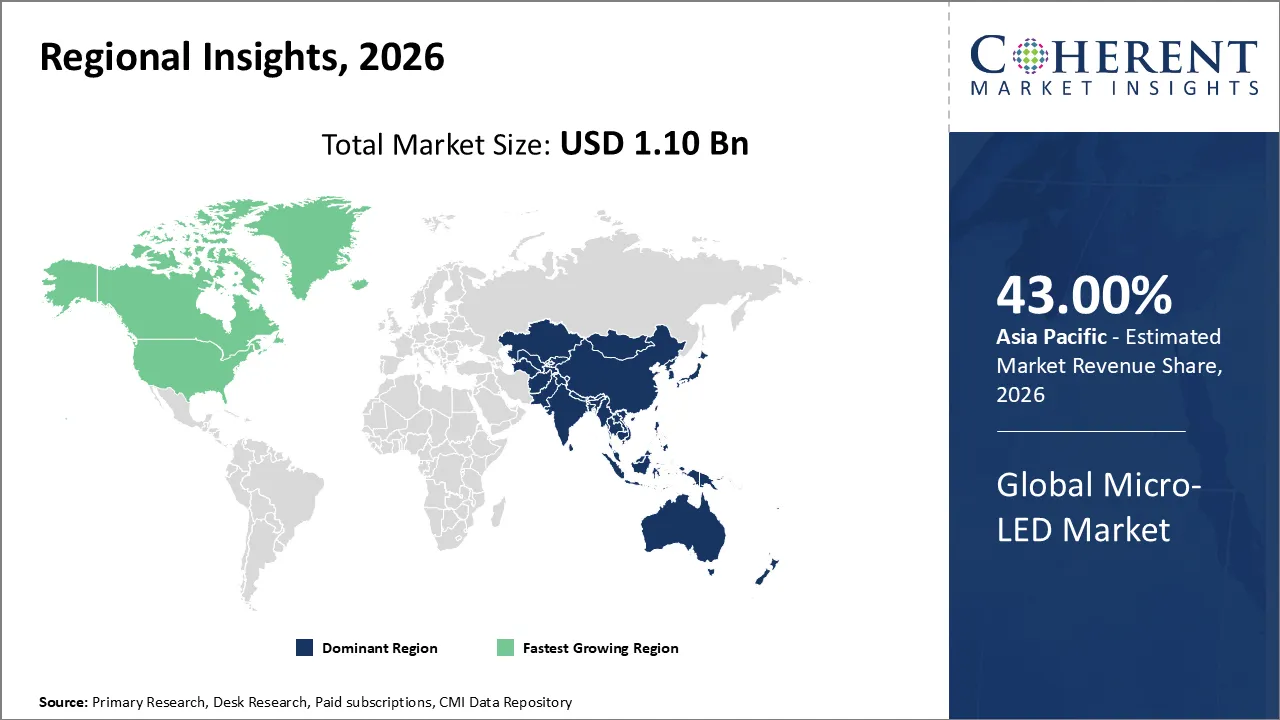
Asia Pacific Micro-LED Market Analysis & Trends
Asia Pacific is dominating the micro-LED market with 43% share in 2026, due to China, South Korea, Taiwan, and Japan all have strong manufacturing bases. Government support, advanced supply chains, and large enterprises like Samsung, LG, AUO, and BOE all help people use them. The regional market is growing even faster as growing numbers of people want high-end TVs, smartphones, and wearables.
For instance, in December 2025, JBD launched with the Roadrunner-I, a full-color Micro-LED projector made for small consumer uses. It uses cutting-edge Micro-LED microdisplay technology to project images that are ultra-bright and clear in a small, portable package. This new technology is aimed at AR glasses and portable devices. It shows how Micro-LED is becoming more important in practical, next-generation consumer electronics beyond TVs.
North America Micro-LED Market Analysis & Trends
North America is expected to exhibit the fastest growth of the market, as Apple is spending considerable amounts of funding on next-generation displays, AR/VR is becoming more popular, and Silicon Valley startups are making important advances. The region has the fastest-growing Micro-LED market due to individuals want high-end devices and the region has significant amounts of advanced R&D infrastructure. The market is growing quickly in wearables and electronics.
For instance, in December 2025, LG introduced the MAGNIT Active Micro-LED Display, which uses cutting-edge technology to change the way people watch movies at home. The large-format screen has ultra-bright visuals, vivid colors, and great contrast that delivers immersive viewing experiences. This launch illustrates that Micro-LED is becoming more than just a prototype and is now being used in high-end entertainment for picky audiences all over the world.
Global Micro-LED Market Outlook Country-Wise
China Micro-LED Market Trends
Strong government support, subsidies, and strategic initiatives are driving China's demand for Micro-LEDs in 2026. Leading companies like BOE and TCL speed up commercialization, and increasing numbers of individuals want high-end TVs, smartphones, and wearables, which makes them more popular. China is the main place for Micro-LED growth as it has strong supply chains and major domestic markets.
For instance, in November 2025, VueReal, a Canadian company that produces Micro-LEDs, moved into China with its MicroSolid Printing platform. The technology makes it easy to move Micro-LEDs onto different surfaces for use in cars, consumer electronics, and wearables. VueReal wants to speed up commercialization by working with Intralink. They have $40 million in funding to help them execute this in markets around the world.
The U.S. Micro-LED Market Trends
In 2026, the U.S. demand for Micro-LED goes through the roof as Apple is spending considerable amounts of funding on next-generation displays, AR/VR is becoming more popular, and Silicon Valley startups are making huge advances. North America is the fastest-growing Micro-LED market in the world due to people want high-end TVs, smartphones, and wearables that are brighter and more efficient.
For instance, in December 2025, Hisense introduced its high-end Micro-LED TVs to the U.S., which offer ultra-bright images, deep contrast, and bright colors for high-end home entertainment. These large-format displays are marketed as high-end consumer electronics. They showcased Micro-LED's potential beyond prototypes by providing immersive viewing experiences and marking an important step toward the technology becoming more widely used.
Market Report Scope
Micro-LED Market Report Report Coverage
| Report Coverage | Details | ||
|---|---|---|---|
| Base Year: | 2025 | Market Size in 2026: | USD 1.10 Bn |
| Historical Data for: | 2020 To 2024 | Forecast Period: | 2025 To 2032 |
| Forecast Period 2026 to 2033 CAGR: | 35.4% | 2033 Value Projection: | USD 13.56 Bn |
| Geographies covered: |
| ||
| Segments covered: |
| ||
| Companies covered: | Apple Inc., Sony Corp., Tianma Micro-electronics, Ostendo Technologies, Inc., Oculus, VerLASE Technologies, Samsung Electronics Co., Ltd., ALLOS Semiconductors GmbH, JBD Inc, GLO-USA, INC., Uniqarta, Inc, Epistar Corporation, VueReal, Aledia, Plessey Semiconductors Ltd, Mikro Mesa Technology Co., Ltd., and Sharp Corporation | ||
| Growth Drivers: |
| ||
| Restraints & Challenges: |
| ||
Micro‑LED Market Driver
Premium Consumer Electronics
Premium consumer electronics drive the micro-LED market size in 2026, with adoption in luxury TVs, smartphones, wearables, and AR/VR devices. Superior brightness, energy efficiency, and durability make Micro‑LED ideal for high‑end products. Investments by Apple, Samsung, and LG expand demand, positioning premium electronics as the largest growth segment.
AR/VR & MR Devices
AR/VR and MR devices significantly boost the micro-LED market share in 2026, as immersive headsets demand ultra‑bright, energy‑efficient, and compact displays. Micro‑LED technology enables lightweight designs with superior resolution and durability, driving adoption by Apple, Meta, and other innovators, positioning extended reality as a key growth segment globally.
Micro‑LED Market Opportunity
Government & Corporate Investment
Government and corporate investment play a critical role in shaping the micro-LED market forecast for 2026 and beyond. Strategic funding, subsidies, and R&D initiatives accelerate commercialization, reduce production costs, and expand adoption across consumer electronics, automotive, and AR/VR industries.
Analyst Opinion (Expert Opinion)
The micro-LED market is moving from early use to wider commercial use in a variety of display applications. According to reliable research, micro-LED displays could reach tens of millions of units by the early 2030s. This is as there is an increasing amount of demand for high-brightness, energy-efficient panels in large-format signs and high-end consumer devices. Micro LED is expected to make up just over one percent of all global display shipments as it is a new technology and is aimed at high-end markets.
Display modules continue to be the most popular application area, and most of the current installations are for regular TVs and signs. Adoption is also growing in small devices like smartwatches and extended reality (XR) headsets. Wearable shipments show that people are very interested in ultra-compact, high-contrast screens. The digital signage segment continues to take advantage of micro-LED benefits like being readable in daylight and lasting a long time. This has led to installations in public and commercial spaces.
Regional activity shows that Asia-Pacific is the best place for manufacturing and shipping as it has advanced semiconductor ecosystems and a lot of production in one place. North America is known for speeding up investments, especially in defense-grade visualization systems and automotive cockpit displays. In contrast, new regions are starting to use micro-LED solutions in their urban digital infrastructure.
Key changes in the industry include ongoing improvements in mass-transfer yields and pixel miniaturization. These are important for lowering unit costs and making commercial uses possible beyond niche premium segments. Even though it is hard to make and costs a great deal of money, micro-LED technology is steadily growing in both the consumer electronics and specialized display markets.
Speak to the analyst
Want personalized insights?
Take the findings above to one of our principal consultants, or have the report rebuilt around the segments, geographies and competitors you actually track.
Recent Developments
- In October 2025, LG launched its MAGNIT Active Micro-LED, which started a new era in high-end home theaters. Micro-LED is a high-end alternative to OLED as it has ultra-high brightness, contrast, and durability.
- In November 2025, CEA-Leti announced a program with multiple partners to speed up AI using Micro-LED data links. It indicates that Micro-LED can do more than simply displays. The project uses fast, energy-efficient communication to improve the performance of AI hardware.
Market Segmentation
- Panel Size Insights (Revenue, USD Bn, 2026 - 2033)
- Micro-display
- Small and Medium-sized Panel
- Large Panel
- Application Insights (Revenue, USD Bn, 2026 - 2033)
- Display
- Near-to-Eye (NTE) Device
- Smartphone and Tablet
- Smart Watch
- Head-up Display (HUD)
- Laptop and Monitor
- Television
- Digital Signage
- Lighting
- Automotive Lighting
- General Lighting
- End Use Vertical Insights (Revenue, USD Bn, 2026 - 2033)
- Automotive
- Advertising
- Consumer Electronics
- Aerospace & Defense
- Others
- Region Insights (Revenue, USD Bn, 2026 - 2033)
- North America
- U.S.
- Canada
- Latin America
- Brazil
- Argentina
- Mexico
- Rest of Latin America
- Europe
- Germany
- U.K.
- Spain
- France
- Italy
- Russia
- Rest of Europe
- Asia Pacific
- China
- India
- Japan
- Australia
- South Korea
- ASEAN
- Rest of Asia Pacific
- Middle East & Africa
- South Africa
- GCC Countries
- Israel
- Rest of Middle East & Africa
- North America
- Key Players in the Global Micro-LED Market
- Apple Inc.
- Sony Corp.
- Tianma Micro-electronics
- Ostendo Technologies, Inc.
- Oculus
- VerLASE Technologies
- Samsung Electronics Co., Ltd.
- ALLOS Semiconductors GmbH
- JBD Inc
- GLO-USA, INC.
- Uniqarta, Inc
- Epistar Corporation
- VueReal
- Aledia
- Plessey Semiconductors Ltd
- Mikro Mesa Technology Co., Ltd.
- Sharp Corporation
Sources
Primary Research Interviews
- Micro-LED Display Panel Manufacturers
- Micro-LED Chip & Epitaxy Suppliers
- Display Module & System Integrators
- Consumer Electronics OEMs (Smartphones, TVs, Wearables)
- AR/VR Device Manufacturers
- Display Technology Consultants
- Others
Databases
- Bloomberg Terminal
- Thomson Reuters Eikon
- Others
Magazines
- Display Daily
- LEDinside Magazine
- Electronics Weekly
- Semiconductor Digest
- Others
Journals
- Journal of Display Technology
- IEEE Journal of Selected Topics in Quantum Electronics
- Applied Physics Letters
- Optics Express
- Others
Newspapers
- Financial Times
- The Wall Street Journal
- Reuters
- Bloomberg News
- Others
Associations
- Society for Information Display (SID)
- Optoelectronics Industry Development Association (OIDA)
- IEEE Photonics Society
- LED Lighting Industry Association (LIA)
- Others
Public Domain Sources
- U.S. Department of Energy (DOE) – Solid-State Lighting Program
- National Institute of Standards and Technology (NIST)
- European Commission – Digital & Industry Directorate
- World Intellectual Property Organization (WIPO) Patent Database
- National Science Foundation (NSF) Publications
- Others
Proprietary Elements
- CMI Data Analytics Tool
- Proprietary CMI Existing Repository of Information for the Last 8 Years
Get access to 250+ pages report
Every segment, forecast, competitor profile and data table behind the analysis above — available for instant download.
- ESOMAR Member
- ISO 9001:2015 Certified
- D-U-N-S Registered
- GDPR & CCPA Compliant
Missing comfort of reading report in your local language? Find your preferred language:
Transform your Strategy with Exclusive Trending Reports
Frequently Asked Questions
The Micro-LED Market is estimated to be valued at USD 1.10 Bn in 2026, and is expected to reach USD 13.56 Bn by 2033.
The CAGR of the Micro-LED Market is projected to be 35.4% from 2026 to 2033.
Premium Consumer Electronics and AR/VR & MR Devices are expected to drive the market growth.
The small and medium-sized panels is the leading panel size segment in the market.
High Manufacturing Costs and Low Yield in Mass Transfer are expected to hinder the global Micro-LED Market over the forecast period.
The major players operating in the market include Apple Inc., Sony Corp., Tianma Micro-electronics, Ostendo Technologies, Inc., Oculus, VerLASE Technologies, Samsung Electronics Co., Ltd., ALLOS Semiconductors GmbH, JBD Inc, GLO-USA, INC., Uniqarta, Inc, Epistar Corporation, VueReal, Aledia, Plessey Semiconductors Ltd, Mikro Mesa Technology Co., Ltd., and Sharp Corporation