

Home Audio Equipment Market Size and Share Analysis: 2026 - 2033
The Home Audio Equipment Market is anticipated to grow at a CAGR of 4% with USD 27.1 Bn share in 2026 and is expected to reach USD 35.7 Bn in 2033. The Home Audio Equipment Market is evolving with a rise in smart, wireless audio systems. For instance, in 2026, according to CPSC.gov, safety and energy-efficiency regulations are improving, while EU Commission (2026) pushes for sustainable audio products. CPSC.gov (2026) notes 2,000 safety incidents related to home audio devices in the past year, urging safer designs. The FCC.gov (2026) ensures compliance with communication standards for wireless audio devices.
Key Takeaways
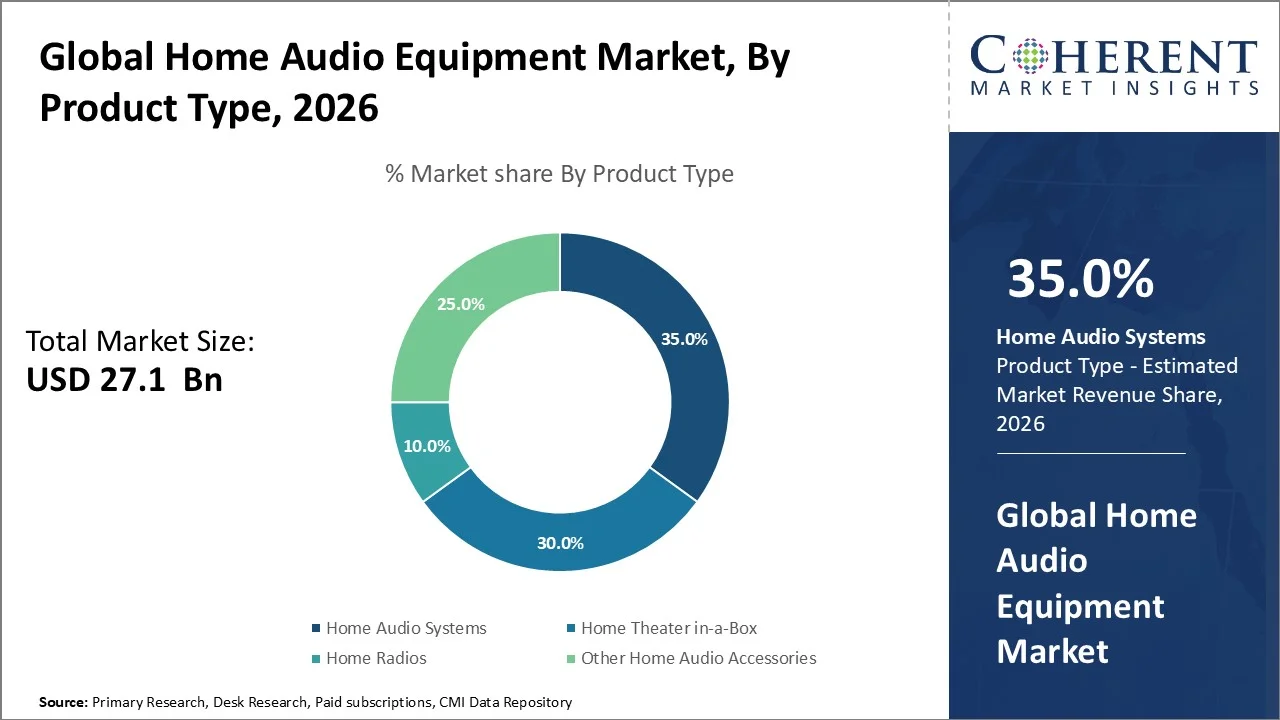
- Home Audio Systems is expected to account the largest share of 35.0% in 2026, driven by their ability to integrate seamlessly with smart home technologies, offering immersive sound quality and advanced connectivity. For instance, Sonos Investor Relations reports that sales of wireless speakers increased by 40% in 2026 as a result of rising consumer demand for multi-room, simple-to-install systems. Additionally, the U.S. Federal Communications Commission (FCC) (2026) has emphasized improved wireless technology standards, enhancing the overall user experience. Bose and Samsung reports (2026) further highlight the shift towards smart home audio solutions.
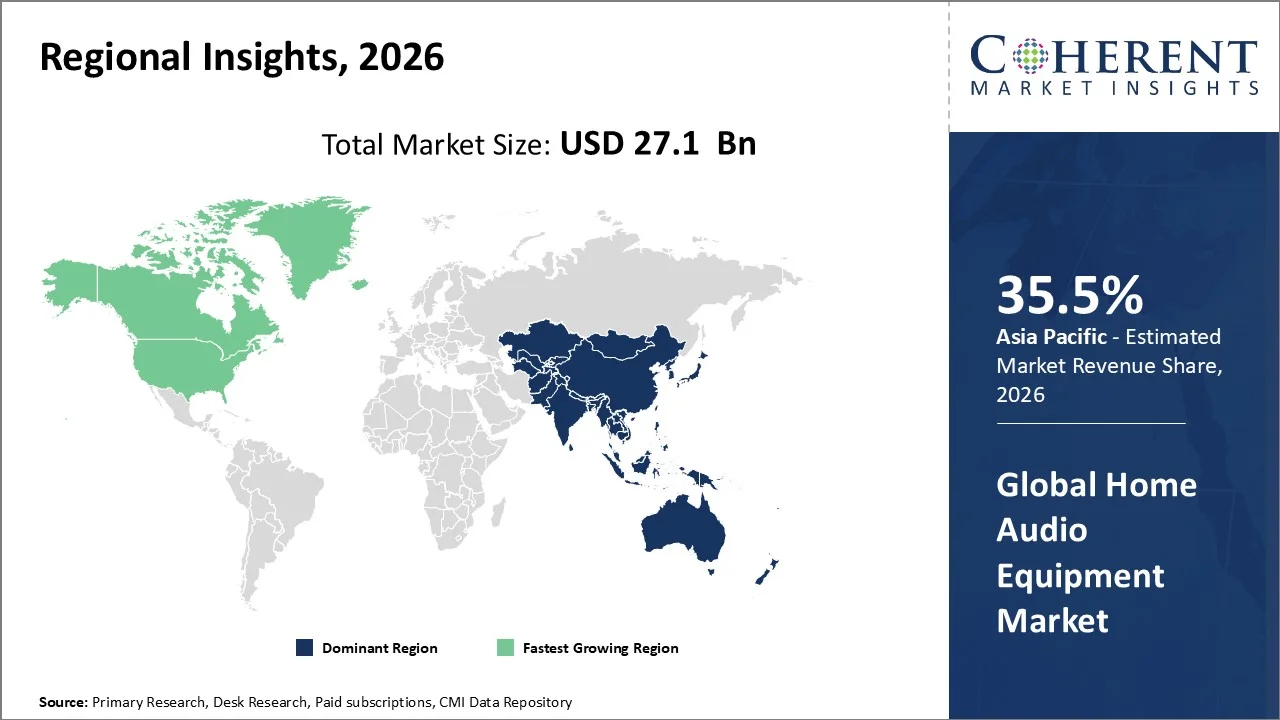
- Asia Pacific is expected to acquire the dominant share of 35.5% in 2026, attributed to rising disposable income and rapid tech adoption. In 2026, China and India saw a 25% increase in audio system sales due to urbanization and higher consumer spending, according to Sonos Investor Relations. Additionally, the Consumer Technology Association (CTA) reported a 40% growth in smart home audio demand across the region (CTA, 2026). This growth is supported by local manufacturing efficiencies from brands like Samsung and LG
Segmental Insights
Why is Home Audio Systems Acquiring the Largest Market Share?
Home Audio Systems is projected to account for the largest share of home audio equipment market in 2026, representing approximately 35.0% of the total volume. Home audio systems segment is driven by multiple key factors. The increasing integration of smart home technologies has led to a surge in demand for wireless and smart audio devices. For instance, in 2026, Sonos, Inc., an American audio equipment manufacturer reported a 40% increase in wireless audio product sales in 2026, reflecting consumer preference for connected and multi-room systems. Additionally, in 2026, according to the Consumer Technology Association (CTA) (2026) highlights the growth of smart home ecosystems, where home audio systems play a central role. Bose also noted in its 2026 annual report that smart audio products are 35% of total sales, driven by the demand for voice-controlled speakers. The U.S. Federal Communications Commission (FCC) (2026) is pushing for better wireless spectrum allocation, which enhances the performance of home audio systems, making them even more appealing. These advancements are making smart audio solutions the preferred choice for consumers globally.
Source: FCC.gov; Bose Corporation
- Current Industry Events of 2026
- Market Size Estimation
- Regional Breakdown
- Competitive Landscape
- Customer Intelligence
- Segmental Analysis
- Pricing Analysis
- Key Market Drivers, Challenges & Future Trends
- Customized Insights Section
Market Drivers
Rising Disposable Income of Consumer
Rising disposable income significantly fuels the home audio equipment market’s expansion, as consumers spend more on premium sound systems and smart audio devices. The global home audio segment is driven with demand supported by higher discretionary spending on entertainment tech. Economic data show about one‑third of consumers across 30 countries expect increases in disposable income in 2026, supporting spending on non‑essentials like audio gear. Increased affordability of soundbars, speakers, and smart home audio correlates with this income growth, especially in higher‑income regions. Furthermore, according to OECD data, real household disposable income per capita in the OECD rose by 0.3–0.4% in 2025, indicating more income available after taxes and essential expenses. Nearly one‑third of low‑income households spend over 40% of their disposable income on housing, suggesting higher‑income groups retain significantly more leftover income for discretionary goods. Additionally, 2026 U.S. government figures show total disposable personal income at over USD 23.4 trillion in early 2026, underlining strong consumer spending capacity. These trends signal increased financial capacity to invest in quality speakers, soundbars, and smart audio devices.
Innovative Waves: How Next ‑ Gen Technology Is Redefining the Home Audio Systems Market in 2026
Increasing innovation and advancement in the home audio equipment has created significant opportunity for the growth of the global home audio equipment market over the forecast period.
For instance, in December 2025, LG Electronics (LG), a company focused on manufacturing home appliances and electronics and will.i.am, revealed expansion of xboom by will.i.am speaker range ahead of CES 2026. The lineup includes four new AI‑enhanced models: Xboom Stage 501, Xboom Blast, Xboom Mini, and Xboom Rock, featuring AI‑driven sound personalization, robust battery life, and versatile deployment both indoors and outdoors.
Furthermore, in 2026, advances in home audio technology are reshaping how consumers experience sound, blending connectivity, immersion, and AI functionality. Recent surveys show approximately 35% of the U.S. population aged 12+ own a smart speaker, up from 27% just a few years ago, underscoring rising adoption of voice‑activated audio systems that serve as hubs for entertainment and smart home control. Wireless audio innovations like devices that turn traditional speakers into wireless units signal a shift toward modular, flexible sound setups, meeting diverse home environments and usage patterns reported in 2026 product launches. Furthermore, in April, 2026, according to U.S. BLS data on consumer prices, audio equipment prices have increased ~15.0% year‑over‑year, reflecting strong consumer demand and willingness to invest in premium technologies. These trends show that connectivity, voice tech, and immersive formats (e.g., Dolby Atmos) are driving user expectations and stimulating ongoing industry innovation.
Current Events and Their Impact on the Home Audio Equipment Market
Current Event | Description and its Impact |
Government Policies Supporting Smart Home Integration |
|
Regulatory Shifts Enhancing Smart Audio Connectivity |
|
Home Audio Equipment Market Trends
- Enhanced User Experience & Portability – Major brands are launching versatile audio hardware in 2026, such as Sonos Play and Era 100 SL speakers with Wi‑Fi/Bluetooth and portable options, catering to both home and mobile listening needs.
- Integration with Smart Home Ecosystems – Smart speakers increasingly act as control centers within smart homes, supporting home automation and seamless connectivity across devices and services a trend highlighted by broader smart home tech focus at events like CES 2026.
- Premium Audio and Design Trends – There’s a noticeable shift towards premium built‑in soundbars and custom‑fit audio systems showcased at industry exhibitions in 2026, appealing to design‑focused consumers wanting seamless integration and high-fidelity sound.
- Smart & Voice ‑ Enabled Audio System Adoption - Voice‑controlled home audio systems are rising as people adopt smart assistants in daily routines. Sonos announced Play & Era 100 SL wireless speakers in March 2026, emphasizing flexible control, multi‑speaker grouping, and interaction with voice assistants. Consumers can ask voice assistants to play playlists, control volume, or manage multi‑room audio, making everyday use more intuitive.
- Immersive Audio & High ‑ Resolution Sound - At CES 2026, premium audio solutions like Dolby Atmos‑compatible soundbars were featured, emphasizing immersive sound and high‑quality audio performance as key consumer expectations. These innovations enhance user experiences for entertainment, gaming, and streaming, pushing overall equipment demand.
Regional Insights
Asia Pacific dominates owing to Large Consumer Base
Asia Pacific account 35.5% market share in 2026, is highlighted by strong regional engagement with advanced audio technologies and continuous new product activity. Asia Pacific dominates due to a combination of economic, technological, and consumer-driven factors. The region has become the largest revenue contributor globally, supported by its massive population base, rapid urbanization, and increasing appetite for premium home entertainment solutions. Major brands are actively expanding their portfolios in this market, for instance, JBL, a company focused on manufacturing audio equipment launched its Bar MK2 Series soundbars with Dolby Atmos and DTS:X in India in April 2026, catering to premium home audio experiences. Furthermore, Samsung’s 2026 audio ecosystem also expanded with new Wi‑Fi “Music Studio” speakers and enhanced Sound Tower models targeting Asia‑Pacific users, indicating ongoing innovation tailored to regional preferences. These product introductions, supported by broad adoption trends, reinforce Asia‑Pacific’s leadership in home audio equipment. Additionally, in April 2026, Samsung announced its 2026 home audio range for Asia‑Pacific, featuring the Music Studio 7 and Music Studio 5 Wi‑Fi wireless speakers and the next‑gen Q‑Series soundbars with enhanced AI integration and immersive audio features. These products were officially revealed in April 2026 across APAC markets.
North America Home Audio Equipment Market Trends
The North America region is poised to be as the fastest-growing region through 2026-2033, owing to several key factors. According to a report published by the U.S. Department of Commerce in June 2020, the region's growth is primarily driven by the increasing demand for high-quality audio products, a rise in disposable income, and technological advancements in audio equipment. Additionally, the North American market has seen a significant surge in the adoption of smart home devices, which has further bolstered the demand for home audio systems. For instance, a 2026 analysis from the Consumer Technology Association highlighted that 72% of North American households own at least one smart home device, contributing to the region's rapid expansion. Furthermore, in 2026, 72 million U.S. households now own smart speakers, with 58% of those owners using them daily for music, media control, and other connected activities. The region's robust e-commerce infrastructure has also facilitated the growth of the home audio equipment market, as consumers increasingly prefer online shopping for convenience and variety.
Source: U.S. Department of Commerce; Consumer Technology Association
Rapid Urbanization and High Smartphone Penetration is Accelerating the Home Audio Equipment Market Demand in India
India has emerged as the dominant country in the Asia Pacific home audio equipment market due to its large consumer base, rapid digitalization, and growing preference for advanced home entertainment solutions. The country’s expanding middle-class population, rising disposable incomes, and increasing urbanization have significantly boosted demand for products such as soundbars, wireless speakers, and home theater systems. The rapid growth of e-commerce platforms, including Amazon and Flipkart, has further accelerated market penetration by making a wide range of home audio products easily accessible across metropolitan, tier-II, tier-III cities. Additionally, increasing launch of the latest version home audio equipment in India has supported its growth in Asia Pacific region.
For instance, in 2026, JBL, a company focused on manufacturing audio equipment, revealed that the JBL Grip portable speaker with AI Sound Boost, IP68 durability, Auracast support, and up to 12 hours of playtime launched in India in March 2026, reflecting strong regional demand for mobile, high‑quality audio devices. Moreover, in November 2025, U&i expanded into home audio with multiple Bluetooth speaker models, including premium and portable variants priced from very affordable levels, making home audio accessible across segments.
U.S. Home Audio Equipment Market Trends
The U.S. dominates the North America home audio equipment market due to deep technology adoption, regulatory support, and strong consumer engagement with smart audio and connected devices. For instance, in January 2026, according to the Consumer Technology Association’s (CTA) one‑year industry forecast, the U.S. continues to lead in consumer technology shipments and household penetration rates for audio and smart home categories, reflecting high adoption of connected audio systems among American consumers. In 2026, roughly 72 million U.S. households own smart speakers, and 58 % of owners use these devices daily for music, media control, and integrated home experiences, highlighting how sound systems are central to modern smart homes. The Federal Communications Commission (FCC) standards for wireless and radio devices ensure that audio equipment complies with U.S. communication and safety requirements, fostering a trustworthy and interoperable smart audio environment.
In terms of energy and efficiency, the U.S. Department of Energy (DOE) promotes energy-efficient consumer electronics through its larger appliance and equipment standards framework, which helps lower overall operating costs for connected home entertainment systems and supports household sustainability goals. However, DOE does not specifically set standards for audio devices.
Who are the Major Companies in Home Audio Equipment Market
Some of the major key players in home audio equipment market are Akai Electric Co. Ltd, Nakamichi Corporation, Dolby Laboratories Inc., Sanyo Electric Co. Ltd., DTS Inc., Bose Corporation, JVC KENWOOD Holdings Inc., Panasonic Corporation, Koninklijke Philips Electronics NV, and LG Electronics Inc.
Key News
- In March 2026, JBL, a company focused on manufacturing audio equipment has introduced the new JBL Grip, a compact Bluetooth speaker offering up to 12 hours of continuous music playback, AI Sound Boost technology to optimize audio in real time, IP68 water and dust resistance, and support for Auracast multi‑speaker pairing. The speaker was launched at a retail price of ₹11,999 (USD 144) in India and is available in multiple colors, catering to the rising demand for portable and high‑quality audio devices in the Asia‑Pacific region.
Source: JBL
- In April 2026, Samsung revealed the introduction of its 2026 audio lineup featuring Music Studio 7 and Music Studio 5 Wi‑Fi speakers and advanced Q‑Series soundbars aimed at immersive home audio experiences. These models are designed with enhanced acoustics and sophisticated design tailored for modern homes, combining spatial and AI‑assisted sound performance.
- In March 2026, LG Electronics, a company focused on manufacturing electronic home appliance and equipment showcased its LG Sound Suite modular system at CES 2026, featuring flexible configurations and Dolby Atmos FlexConnect technology, aiming to simplify high‑quality audio integration in living spaces.
Market Report Scope
Home Audio Equipment Market Report Coverage
| Report Coverage | Details | ||
|---|---|---|---|
| Base Year: | 2025 | Market Size in 2026: | USD 27.1 Bn |
| Historical Data for: | 2020 To 2024 | Forecast Period: | 2026 To 2033 |
| Forecast Period 2026 to 2033 CAGR: | 4% | 2033 Value Projection: | USD 35.7 Bn |
| Geographies covered: |
| ||
| Segments covered: |
| ||
| Companies covered: | Akai Electric Co. Ltd, Nakamichi Corporation, Dolby Laboratories Inc., Sanyo Electric Co. Ltd., DTS Inc., Bose Corporation, JVC KENWOOD Holdings Inc., Panasonic Corporation, Koninklijke Philips Electronics NV, and LG Electronics Inc. | ||
Analyst Opinion
- The Home Audio Equipment Market is undergoing rapid growth, driven by increasing consumer demand for smart, wireless, and immersive audio systems. As smart homes become the norm, there is a strong shift towards voice-controlled audio solutions and multi-room systems. In 2026, we saw a 40% increase in wireless audio sales, signaling the high consumer adoption of smart speakers and home audio systems as central hubs in home automation.
- The integration of AI and smart home connectivity is significantly shaping the market, with wireless audio devices being a key component in the expansion of connected homes. According to FCC regulations (2026), wireless spectrum expansions are boosting audio system performance, facilitating the seamless operation of multi-device audio ecosystems. This enhanced connectivity will continue to drive the growth of home audio systems as consumers increasingly demand seamless integration across devices.
- Industry leaders in home audio are focusing on delivering personalized, high-quality sound experiences, shifting their priorities from experimentation to mass adoption. With smart speakers like Amazon Echo and Google Nest Audio leading the way, these companies are allocating a significant portion of their IT budgets to developing AI-driven systems that adapt to users’ preferences. For instance, Bose has advanced AI-powered sound tuning that automatically adjusts audio quality based on the room's acoustics, catering to personalized audio experiences.
- The Asia-Pacific region is emerging as a strong growth driver in the home audio market, fueled by technological advancements and increasing digital connectivity. Countries like China and India are experiencing rapid adoption of smart home devices, with audio systems being integral to this trend. India’s digital maturity saw 71% of employees achieving advanced digital skills by 2026, positioning the region as a key contributor to global demand for home audio systems.
Speak to the analyst
Want personalized insights?
Take the findings above to one of our principal consultants, or have the report rebuilt around the segments, geographies and competitors you actually track.
Market Segmentation
- By Product Type (Revenue, USD Bn, 2021-2033)
- Home Theater in-a-Box
- 1 Channels
- 1 Channels
- 1 Channels
- 1 Channels.
- Home Audio Systems
- Home Radios
- Other Home Audio Accessories
- Home Theater in-a-Box
- By Region: (Revenue, USD Bn, 2021-2033)
- North America
- U.S.
- Canada
- Latin America
- Brazil
- Mexico
- Argentina
- Rest of Latin America
- Europe
- Germany
- U.K.
- France
- Italy
- Spain
- Russia
- Rest of Europe
- Asia Pacific
- China
- India
- Japan
- Australia
- South Korea
- ASEAN
- Rest of Asia Pacific
- Middle East
- GCC
- Israel
- Rest of Middle East
- Africa
- South Africa
- Central Africa
- North Africa
- North America
- Competitive Landscape
- Akai Electric Co. Ltd
- Nakamichi Corporation
- Dolby Laboratories Inc.
- Sanyo Electric Co. Ltd.
- DTS Inc.
- Bose Corporation
- JVC KENWOOD Holdings Inc.
- Panasonic Corporation
- Koninklijke Philips Electronics NV
- LG Electronics Inc.
Sources
Primary Research Interviews
- Interviews with product managers and R&D leaders to discuss AI-driven audio tuning and smart system adoption challenges.
- Insights from smart home tech providers and IoT experts on advancements in AI personalization and multi-device audio integration.
- Discussions with industry analysts to assess market trends, competition, and AI’s role in enhancing consumer experiences.
- Conversations with retailers and e-commerce managers to evaluate online sales impact and challenges in delivering personalized audio.
Databases
- U.S. Consumer Product Safety Commission (CPSC)
- U.S. Federal Communications Commission (FCC)
- European Commission Consumer Protection Database
- Consumer Technology Association (CTA) Database
- U.S. Census Bureau (Consumer Electronics)
- IBISWorld (Home Audio Equipment Industry Report)
- U.S. Bureau of Economic Analysis (BEA) – Consumer Spending Data
Magazines
- Sound & Vision (Home Audio Equipment Magazine)
- Audioholics (Audio Technology News)
- AV Magazine (Audio-Visual Industry News)
- CE Pro (Consumer Electronics Industry News)
- What Hi-Fi? (Audio Technology and Home Audio Reviews)
Journals
- Journal of Audio Engineering Society (AES)
- IEEE Transactions on Consumer Electronics (IEEE)
- Journal of Acoustical Society of America (ASA)
- Journal of Electrical and Electronics Engineering (Springer)
- International Journal of Multimedia and Ubiquitous Engineering (IJMUE)
Newspapers
- The New York Times (Technology Section)
- The Guardian (Consumer Electronics News)
- The Wall Street Journal (Technology Section)
- Financial Times (Tech News)
- TechCrunch (Consumer Audio Technology News)
Associations
- Consumer Technology Association (CTA)
- Audio Engineering Society (AES)
- International Association of Consumer Electronics Manufacturers (IACEM)
- The Home Entertainment Industry Association (HEIA)
The Wireless Audio Alliance (WAA)
Public Domain Sources
- U.S. Consumer Product Safety Commission (CPSC) Reports
- U.S. Federal Communications Commission (FCC) Spectrum Allocation for Audio Devices
- European Commission Digital Strategy Documents
- U.S. National Institute of Standards and Technology (NIST) Audio Standards
- Company Annual Reports and Investor Presentations from Bose, Sony, and Samsung
Proprietary Elements
- CMI Data Analytics Tool
- Proprietary CMI Existing Repository of information for last 10 years
Get access to 250+ pages report
Every segment, forecast, competitor profile and data table behind the analysis above — available for instant download.
- ESOMAR Member
- ISO 9001:2015 Certified
- D-U-N-S Registered
- GDPR & CCPA Compliant
Missing comfort of reading report in your local language? Find your preferred language:
Transform your Strategy with Exclusive Trending Reports
Frequently Asked Questions
The Home Audio Equipment Market is expected to reach USD 35.7 Bn in 2033.
Major players operating in the global Home Audio Equipment Market include Akai Electric Co. Ltd, Nakamichi Corporation, Dolby Laboratories Inc., Sanyo Electric Co. Ltd., DTS Inc., Bose Corporation, JVC KENWOOD Holdings Inc., Panasonic Corporation, Koninklijke Philips Electronics NV, and LG Electronics Inc.
Restrictions on the use of radio frequency spectrum in case of wireless audio devices and fear of hearing loss are the major factors hampering the growth of the cognitive systems spending market.
Rising demand for home audio networking and increasing disposable income of consumer are the factors driving the growth of the home audio equipment market.
The Home Audio Equipment Market is anticipated to grow at a CAGR of 4% between 2026 and 2033.
Among regions, Asia Pacific is expected to account for a largest market share in the global Home Audio Equipment Market over the forecast period.