

MEMS Microphone Market Size and Forecast – 2026 to 2033
The MEMS Microphone Market is anticipated to grow at a CAGR of 9.1% with USD 24.9 Bn in 2026 and is expected to reach USD 38.7 Bn in 2033. Rising demand for smartphones, wearables, smart speakers, and IoT devices drives the MEMS microphone market by increasing the need for compact, high-performance audio components. As of 2026, around 5.65 billion people globally use smartphones, representing nearly 70% of the world’s population.
Key Takeaways
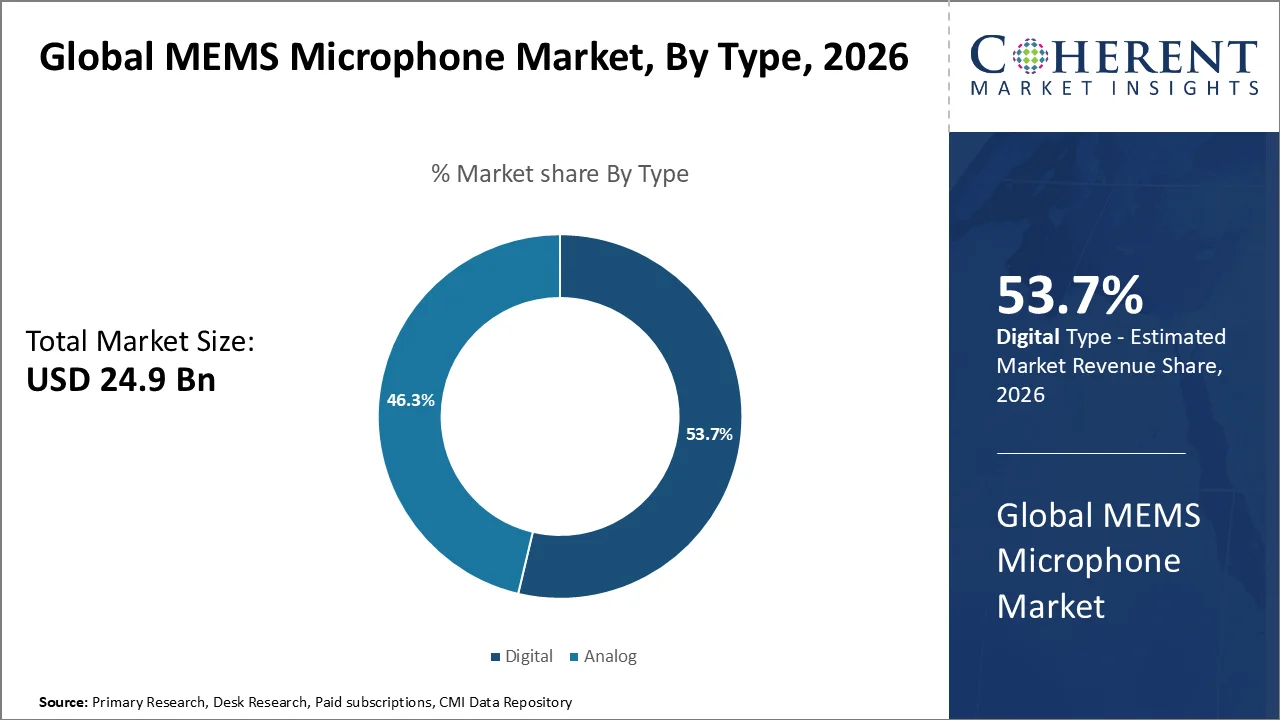
- By Type, Digital hold the largest market share of 53.7% in 2026 owing to its growth of smartphones and consumer electronics, driven by the rapid growth of smartphones and consumer electronics, with global smartphone shipments expected to exceed 1.4 billion units annually.
- By Technology, Capacitive expected to hold largest market share of 54.6% in 2026 owing to the high audio quality and superior signal-to-noise ratio (SNR).
- By SNR, High (>=60 dB, < 64 dB) acquired the prominent market share of 42.2% in 2026 owing to the rising demand for clear voice recognition.
- By Application, Consumer Electronics captures the largest market share of 38.8% in 2026 owing to its expansion of true wireless stereo (TWS) earbuds and headsets, owing to rising demand for TWS earbuds, where global shipments are expected to surpass 500 million units.
- By Region, Asia Pacific is expected to acquire the dominant share of 41.70% in 2026 owing to its strong consumer electronics manufacturing base. According to the Ministry of Commerce of the People's Republic of China, China’s government-backed consumer goods trade-in programs generated USD 73.33 billion in sales by April 12, 2026, benefiting nearly 69.78 million purchases.
Current Events and Their Impact
Current Event | Description and its Impact |
China Rare Earth Export Controls |
|
European Chips Act |
|
Segmental Insights
- Current Industry Events of 2026
- Market Size Estimation
- Regional Breakdown
- Competitive Landscape
- Customer Intelligence
- Segmental Analysis
- Pricing Analysis
- Key Market Drivers, Challenges & Future Trends
- Customized Insights Section
Why is Digital Acquiring the Largest Market Share?
Digital hold the largest market share of 53.7% in 2026 owing to its expansion of IoT and smart home devices. Manufacturers are driving the growth of digital MEMS microphones by increasing their use in smartphones, TWS earbuds, smart speakers, laptops, and wearable devices that need compact, energy-efficient, and high-performance audio components. According to our research, the smart speaker industry is anticipated to surpass 30 billion by 2033. Consumers and businesses are boosting demand for voice assistants, speech recognition, noise cancellation, and AI-based audio processing applications. Digital MEMS microphones provide stronger resistance to electromagnetic interference, simplify processor integration, and enable advanced functions such as beamforming and far-field voice capture. Expanding IoT networks and growing adoption of automotive voice-interface systems are also fueling market demand. In March 2026, Same Sky and its Audio Group introduced microphone development kits with four detachable evaluation circuits and plated-through-hole I/O terminals for flexible testing. The kits include digital MEMS microphones and electret condenser microphones with unidirectional, omnidirectional, and noise-canceling configurations.
Capacitive holds the Largest Market Share
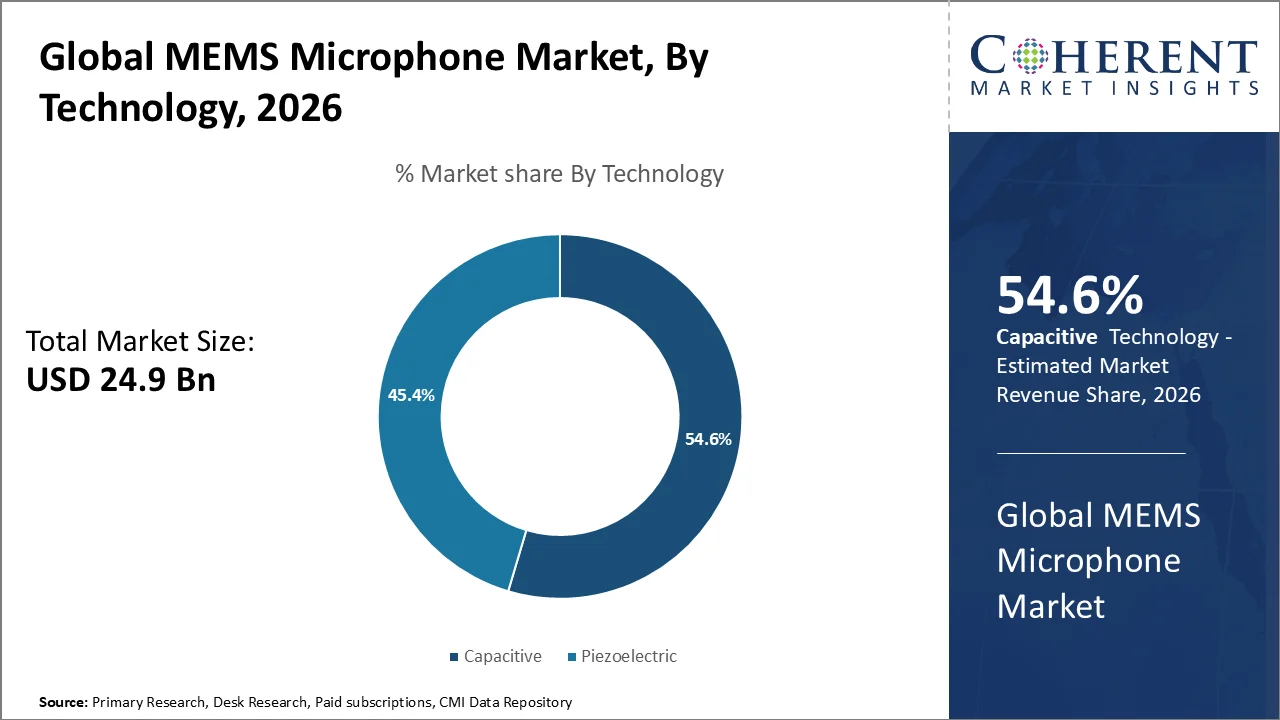
In the MEMS Microphone Market, capacitive technology is anticipated to account for the largest market share of 54.6% in 2026, supported by increasing demand for compact, low-power, and high-sensitivity audio components across consumer electronics. The segment’s growth is strongly linked to expanding shipments of smartphones and TWS earbuds, with global TWS device shipments projected to exceed 500 million units in 2026. Capacitive MEMS microphones are widely preferred for applications requiring enhanced voice clarity and noise suppression in AI-powered devices.
Which Application segment dominates the market?
Consumer Electronics captures the largest market share of 38.8% in 2026 owing to its rising adoption of voice assistants. Increasing adoption of virtual assistants, gaming, video streaming, and remote communication drives higher demand. Ongoing advancements in compact device design, along with wider use of IoT-enabled and AI-powered electronics, further push manufacturers to incorporate MEMS microphones across consumer applications. For instance, in September 2025, Infineon Technologies expanded its XENSIV MEMS microphone portfolio with two new digital models, IM72D128V and IM69D129F. The company designed them to deliver high audio performance, low power consumption, and strong environmental durability.
MEMS Microphone Market Trends
- Growing adoption of voice-enabled devices such as smartphones, smart speakers, wearables, and laptops is increasing demand for high-performance MEMS microphones with enhanced sound clarity and noise suppression. Global smartphone shipments are expected to remain above 1.4 billion units annually, while smart speaker installations surpassed 320 million units worldwide in 2025.
- Rising integration of multi-microphone arrays and beamforming technologies is improving far-field voice capture in noisy environments. Premium smartphones and TWS earbuds now commonly integrate 3–6 MEMS microphones per device to support active noise cancellation (ANC) and spatial audio features.
- Expansion of AI-driven audio processing, including speech recognition and virtual assistants, accelerates the need for low-power, high-sensitivity MEMS microphones in connected devices. In January 2026, Oxtak introduced the Moneypenny AI voice recorder at CES 2026. The device features dual MEMS microphones for meeting recordings and supports AI-powered meeting summaries, real-time translations, and question answering through services including Claude, DeepSeek, Gemini, Grok, and OpenAI. It includes Wi-Fi, Bluetooth, and a 4-inch touchscreen, while AI features are accessible through Oxtak’s mobile apps and web platform via annual subscriptions ranging from US$39 to US$399.
Regional Insights
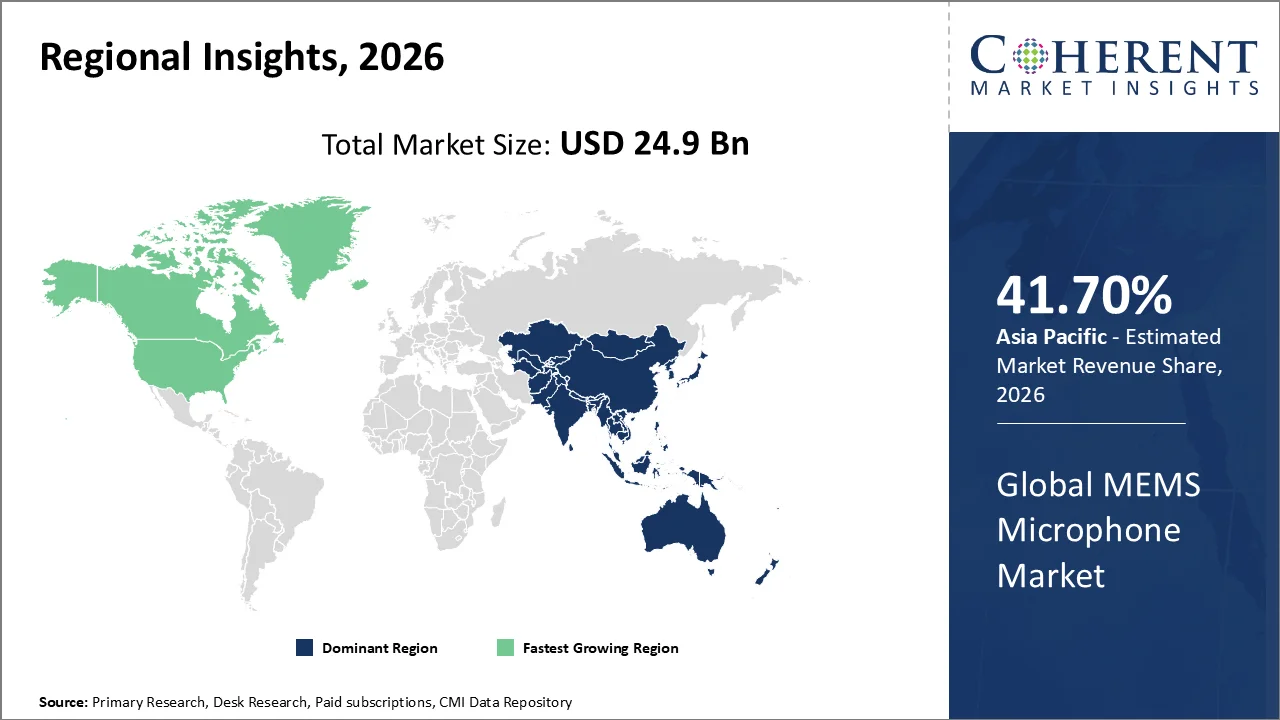
Asia Pacific dominates owing to government support for digitalization and smart manufacturing
Asia Pacific is expected to acquire the dominant share of 41.70% in 2026. Manufacturers and device makers reinforce Asia Pacific’s position in the MEMS microphone market by expanding production and assembly of smartphones, earbuds, laptops, and smart devices across the region. They leverage strong semiconductor ecosystems, cost-effective manufacturing capabilities, and well-established supply chains. Rising consumer demand for voice-enabled electronics, IoT devices, and smart home systems further accelerates adoption. Rapid urbanization, increasing digital connectivity, and growth in automotive electronics production support wider usage, while ongoing investments in AI and 5G infrastructure continue to drive regional market expansion. By 2036, around 600 million people, representing 40% of the population, are expected to live in urban areas, compared with 31% in 2011.
North America MEMS Microphone Market Trends
Manufacturers in North America accelerate MEMS microphone adoption by embedding them into smartphones, smart speakers, laptops, wearables, and automotive systems that demand accurate voice capture and effective noise reduction. They respond to strong demand for voice assistants, AI-enabled devices, and unified communication platforms across consumer and enterprise segments. Continuous innovation in semiconductor design and audio processing supports this growth. Expanding smart home networks, increasing use of connected vehicles, and the rise of remote work practices further drive the need for high-performance MEMS microphones with consistent acoustic precision.
Japan MEMS Microphone Market Trends
Manufacturers in Japan drive MEMS microphone adoption by integrating them into advanced consumer electronics, automotive systems, and industrial devices that need precise and dependable audio performance. They meet strong demand for compact, high-quality components in smartphones, cameras, and wearable devices. Japan’s emphasis on innovation in robotics, AI-enabled technologies, and smart mobility further boosts usage. Expanding applications in automotive infotainment, cabin monitoring, and voice control systems reinforce demand, while ongoing advances in semiconductor technology improve integration efficiency and acoustic performance. For instance, Audio-Technica launched the ATH-SQ1TW2NC earbuds in Japan, featuring a compact square design. The company offers them for pre-order at 12,980 yen (~$85) in black, café latte, forest green, gray, pink, and white camel.
United States MEMS Microphone Market Trends
Manufacturers in the United States are boosting the use of MEMS microphones by integrating them into smartphones, smart speakers, laptops, wearables, and advanced automotive platforms that depend on precise voice recognition and effective noise suppression. Increasing reliance on voice assistants, AI-based solutions, and communication tools across both consumer and business settings fuels demand. Strong capabilities in semiconductor design and audio technology further support market expansion. The growing penetration of smart homes, connected vehicles, and hybrid work models continues to reinforce the need for high-performance MEMS microphones.
Who are the Major Companies in MEMS Microphone Industry
Some of the major key players in MEMS Microphone Market are AAC Technologies, Knowles LLC, Goertek, InvenSense, Inc., Cirrus Logic, Inc., STMicroelectronics, CUI, Inc, Infineon Technologies AG, and Vesper Technologies Inc.
Key News
- In October 2025, Knowles Corporation introduced its flagship MM60 MEMS microphone at the 2025 EUHA Convention in Nuremberg, Germany. The company designed it to enhance AI-powered hearing aids by delivering cleaner audio signals and reduced noise.
Market Report Scope
MEMS Microphone Market Report Coverage
| Report Coverage | Details | ||
|---|---|---|---|
| Base Year: | 2025 | Market Size in 2026: | USD 24.9 Bn |
| Historical Data for: | 2020 To 2024 | Forecast Period: | 2026 To 2033 |
| Forecast Period 2026 to 2033 CAGR: | 9.1% | 2033 Value Projection: | USD 38.7 Bn |
| Geographies covered: |
| ||
| Segments covered: |
| ||
| Companies covered: | AAC Technologies, Knowles LLC, Goertek, InvenSense, Inc., Cirrus Logic, Inc., STMicroelectronics, CUI, Inc, Infineon Technologies AG, and Vesper Technologies Inc. | ||
Analyst Opinion
- The MEMS microphone market is not expanding on the back of incremental device upgrades alone—it is being structurally reshaped by voice-first computing. For example, Amazon has shipped over 500 million Alexa-enabled devices globally, and each smart speaker or display typically integrates multiple MEMS microphones for far-field voice capture and beamforming, directly increasing per-device content demand rather than just unit growth.
- The shift toward multi-microphone architectures is now standard across premium consumer electronics. Flagship smartphones such as Apple’s iPhone series and Samsung Galaxy devices routinely integrate 3–4 MEMS microphones per unit to enable spatial audio recording, active noise cancellation, and computational audio processing.
- Audio performance expectations are rising sharply, and measurable benchmarks reflect this. Modern high-performance MEMS microphones achieve signal-to-noise ratios above 65 dB, enabling clear voice capture even in environments exceeding 80 dB ambient noise, such as subway stations or urban streets.
Speak to the analyst
Want personalized insights?
Take the findings above to one of our principal consultants, or have the report rebuilt around the segments, geographies and competitors you actually track.
Market Segmentation
- By Type: (Revenue, USD Bn, 2021-2033)
- Digital
- Analog
- By Technology: (Revenue, USD Bn, 2021-2033)
- Capacitive
- Piezoelectric
- By SNR: (Revenue, USD Bn, 2021-2033)
- Very high (>=64dB)
- High (>=60 dB, < 64 dB)
- Low (<= 59 dB)
- By Application: (Revenue, USD Bn, 2021-2033)
- Consumer Electronics (Mobile Phones and Others)
- IoT & VR
- Hearing Aids
- Others
- By Region
- North America
- U.S.
- Canada
- Latin America
- Brazil
- Mexico
- Argentina
- Rest of Latin America
- Europe
- Germany
- U.K.
- France
- Italy
- Spain
- Russia
- Rest of Europe
- Asia Pacific
- China
- India
- Japan
- Australia
- South Korea
- ASEAN
- Rest of Asia Pacific
- Middle East
- GCC
- Israel
- Rest of Middle East
- Africa
- South Africa
- Central Africa
- North Africa
- North America
- Key Players
- AAC Technologies
- Knowles LLC
- Goertek
- InvenSense, Inc.
- Cirrus Logic, Inc.
- STMicroelectronics
- CUI, Inc
- Infineon Technologies AG
- Vesper Technologies Inc.
Sources
Primary Research interviews
- MEMS microphone manufacturers
- OEM and ODM electronics product designers
- Audio device engineers (smartphones, wearables, IoT devices)
- Semiconductor fabrication and packaging experts
- Procurement managers in consumer electronics companies
Databases
- IEEE Xplore Digital Library
- ScienceDirect
- Google Scholar
- USPTO (United States Patent and Trademark Office) database
- ESPACENET (European Patent Office database)
- National government trade statistics portals
Magazines
- Electronics For You
- EE Times
- IEEE Spectrum
- EDN Network
- Semiconductor Engineering Magazine
Journals
- IEEE/ASME Journal of Microelectromechanical Systems
- Sensors and Actuators A: Physical
- Journal of Microelectromechanical Systems (JMEMS)
- Microsystems & Nanoengineering Journal
- Applied Physics Letters
Newspapers
- The Economic Times
- The Hindu Business Line
- Financial Times
- The Wall Street Journal
- Nikkei Asia
Associations
- IEEE (Institute of Electrical and Electronics Engineers)
- SEMI (Semiconductor Equipment and Materials International)
- Acoustical Society of America (ASA)
- Consumer Technology Association (CTA)
- International Electrotechnical Commission (IEC)
Public Domain sources
- Government electronics and semiconductor policy documents
- Trade and customs import-export data portals
- World Bank open data
- United Nations Comtrade database
- Company annual reports and investor presentations (public filings)
Proprietary Elements
- CMI Data Analytics Tool, and Proprietary CMI Existing Repository of information for last 10 years
Get access to 250+ pages report
Every segment, forecast, competitor profile and data table behind the analysis above — available for instant download.
- ESOMAR Member
- ISO 9001:2015 Certified
- D-U-N-S Registered
- GDPR & CCPA Compliant
Missing comfort of reading report in your local language? Find your preferred language:
Transform your Strategy with Exclusive Trending Reports
Frequently Asked Questions
The MEMS Microphone Market is anticipated to grow with USD 24.9 Billion in 2026 and is expected to reach USD 38.7 Billion in 2033.
The market is expected to witness a CAGR of 9.1% during the forecast period.
Increasing adoption of next-generation consumer electronics is expected to drive growth of the market during the forecast period.
Consumer Electronics sub-segment holds the largest market share among the Application segment.
Asia Pacific held the largest share of the market.
Key players operating in the global MEMS microphones are AAC Technologies, Knowles LLC, Goertek, InvenSense, Inc., Cirrus Logic, Inc., STMicroelectronics, CUI, Inc, Infineon Technologies AG, and Vesper Technologies Inc.