

Webcams Market Size and Share Analysis: 2026 - 2033
The global webcams market size is projected to grow from USD 10,979 Mn in 2026 to USD 18,501 Mn by 2033, registering a compound annual growth rate (CAGR) of 8.9% during the forecast period (2026-2033). Growth in this market will be attributed to increasing demand for remote communication, the rise of hybrid working, online learning and healthcare facilities, and advancements in webcam technology. Hybrid work has become the leading model, adopted by 64% of organizations, while 98% of employees seek some level of remote flexibility.
Key Takeaways from the Webcams Market Report
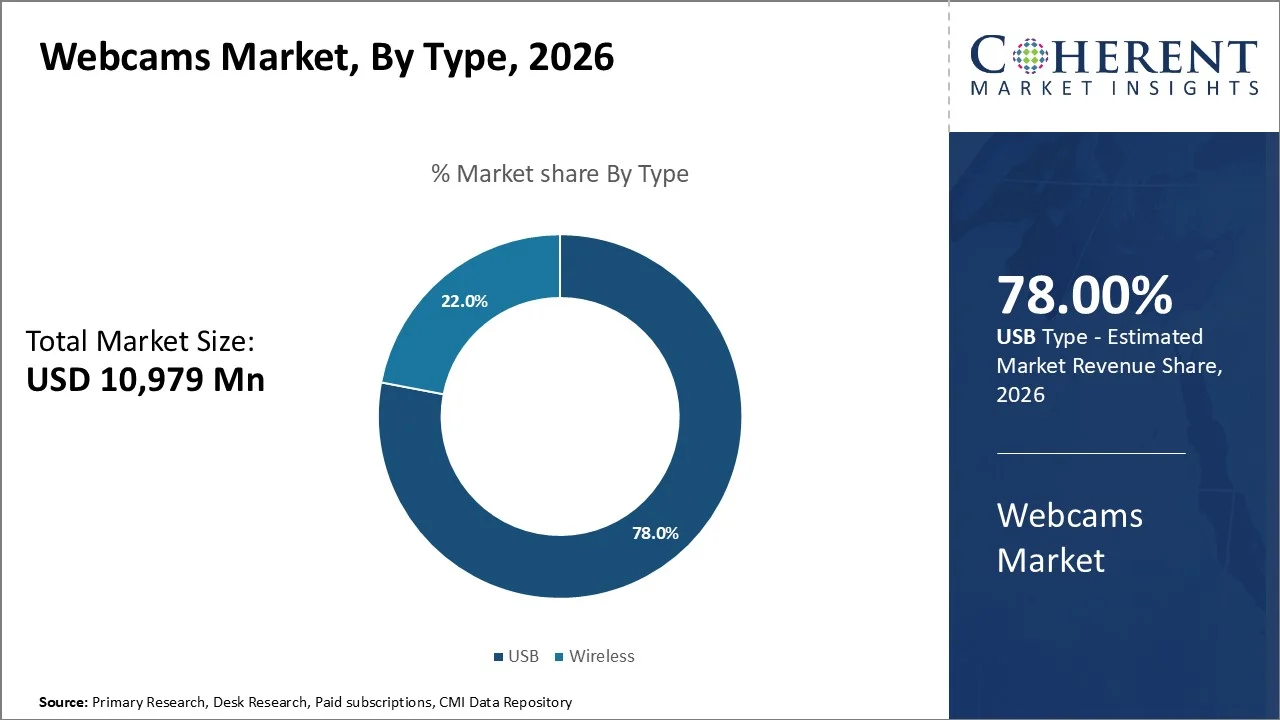
- USB webcams will dominate the industry with a 78% share by 2026 since they will continue to be used in personal computers, laptops, and enterprise-level video conferencing technology. As indicated by International Data Corporation (IDC), USB-enabled peripheral devices have continued to be the dominant form factor for both enterprise and consumer level computing applications because of easy installation and cross-platform compatibility.
- Digital webcams segment will lead the market by accounting for 98% of the share in 2026 due to fast adoption of high-definition and 4K video, artificial intelligence features including auto-focus and face recognition, and easy compatibility with current operating systems and messaging tools. From research findings conducted on digital imaging processing systems, AI-driven image improvement technologies and CMOS technology have played a huge role in the shift to digital video cameras.
- The e-commerce segment will have the highest market share of 68% by 2026, owing to increasing consumer preference for purchasing electronic products through online portals due to increased availability of products, lower prices, and ease of comparing products. According to recent information, the retail e-commerce statistics of the United States Census Bureau reveal that online electronics sales are rising more rapidly than physical store sales.
- Video conferencing segment is expected to retain its leading position in terms of market share at 38% by 2026 due to increasing use of hybrid working models, e-learning, and corporate communication applications. According to Microsoft Work Trend Index reports, hybrid work has become a permanent operating model for a large share of global enterprises, significantly increasing demand for video-enabled communication devices.
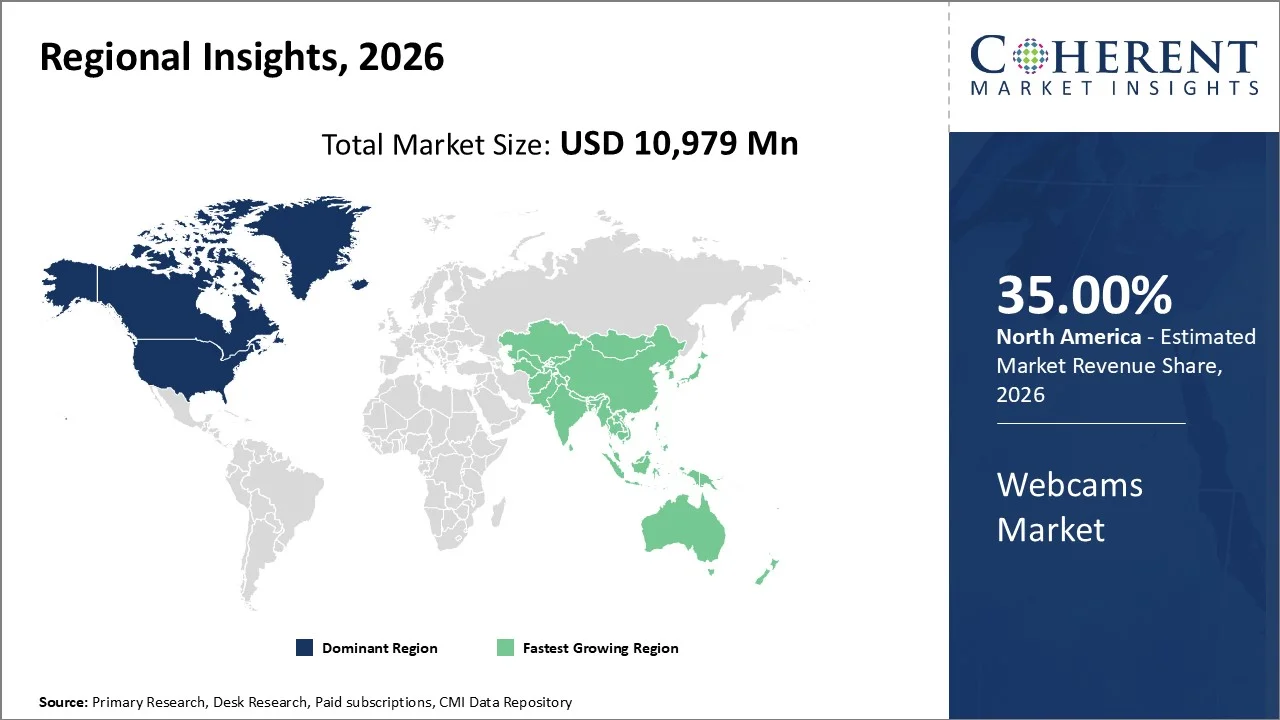
- North America is estimated to capture the major share of 35%, owing to its extensive penetration in hybrid and remote working models. As per reports from the U.S. Bureau of Labor Statistics and the FCC on broadband infrastructure, extensive digitization and cloud deployment further help maintain leadership in the communication hardware market space.
Segmental Insights
Why Is Demand for USB Webcams Rising Rapidly in the Market?
In terms of the type of webcams, the USB webcam will take the lead with an expected market share of 78%. It is favored because of its universal compatibility and ease of connection on PCs and laptops, as well as in corporate conference rooms. It is a better product than wireless cameras due to its advantages.
Webcams using the USB connection interface have proved more favorable than any other due to their reliable connectivity and user-friendly nature. Growing adoption of hybrid work environments and conducting video conferences make the use of such technology even more relevant due to the convenience they provide.
In September 2025, Microsoft announced major enhancements to Windows Studio Effects, enabling AI-powered camera features like background blur, auto-framing, and face tracking to work not only with built-in laptop cameras but also with external USB webcams.
- Current Industry Events of 2026
- Market Size Estimation
- Regional Breakdown
- Competitive Landscape
- Customer Intelligence
- Segmental Analysis
- Pricing Analysis
- Key Market Drivers, Challenges & Future Trends
- Customized Insights Section
Which Technology Segment Leads the Webcams Market?
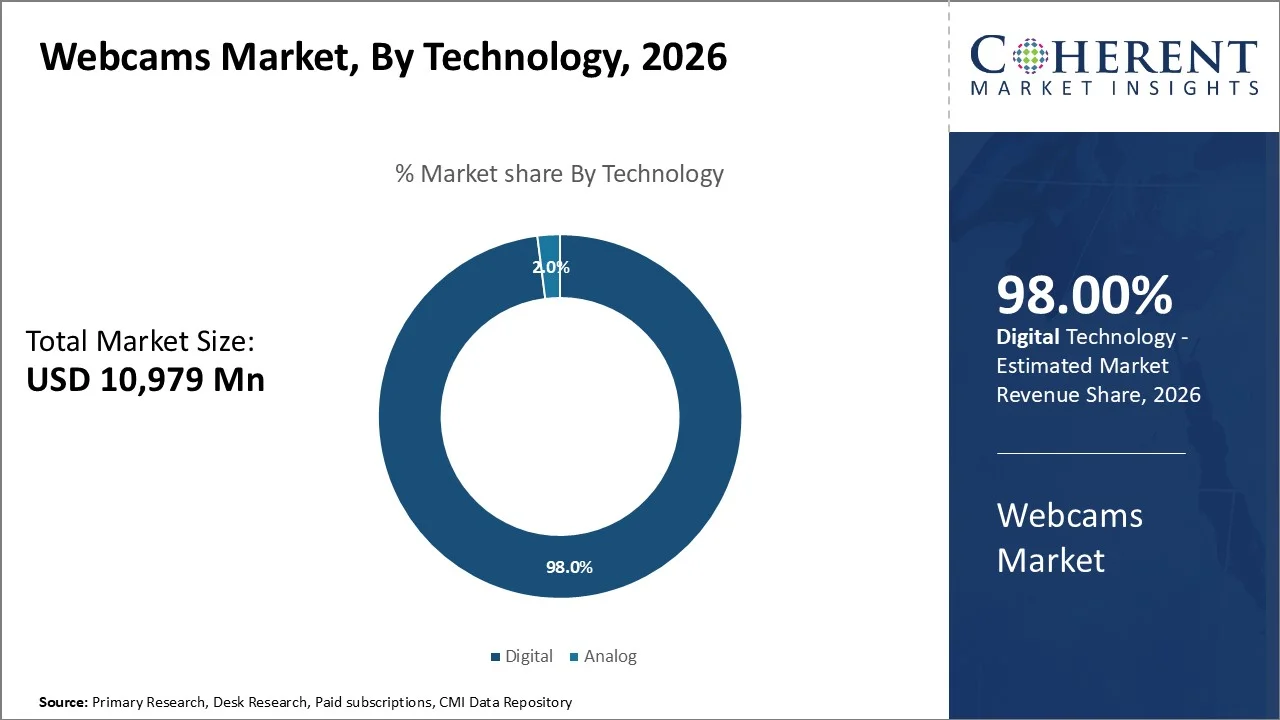
According to technology, digital webcams will lead with an impressive market share of about 98% in 2026, owing to innovations in high-definition, full high-definition, and 4K image quality features. Additionally, artificial intelligence technology is still being used to improve the focus, face detection, background blur, and noise canceling features.
Digital webcams have become the industry standard due to their superior performance, compatibility with new systems of operation, and connection with primary communication networks such as Zoom, Microsoft Teams, and Google Meet. Analog cameras, on the other hand, have increasingly become redundant because of their poor resolution levels and failure to connect intelligently.
In January 2026, Logitech introduced AI-powered conference camera solutions for hybrid work environment.
Why Is E-commerce Driving Webcams Market Growth?
Based on distribution channel, the e-commerce segment is expected to take up the largest market share at 68%, due to the increasing preference among consumers to purchase their electronics products online. The wide range of products available, together with their affordability, reviews from other consumers, and delivery at your doorstep, make it easy for them to purchase products online.
E-commerce platforms enable consumers to easily compare multiple webcam options. While retail stores continue to serve corporations and large-scale buyers, the rise of online shopping is becoming very popular because customers are looking for convenience when buying products.
In April 2026, Flipkart expanded its digital commerce ecosystem into new service categories, including entertainment ticketing and fast-delivery services in India, reflecting a broader strategy to strengthen its position as a multi-category e-commerce ecosystem.
Why Is Video Conferencing the Leading End-User Segment?
According to the end-user, video conferencing holds the biggest market share of 38% in 2026 due to increasing use of hybrid work environment, remote learning technologies, and business applications. There has been a dependency on virtual conferences; hence, webcams have become a must-have communication device.
Communication apps such as Zoom, Microsoft Teams, and Google Meet have become important components of our daily life at workplaces, schools, and even during social gatherings. Regular usage of these platforms for face-to-face communications through video conferencing has led to the growing need for reliable webcams.
In March 2026, Microsoft announced major upgrades to Microsoft Teams Rooms and AI-powered collaboration features, enabling improved cross-platform meetings with Zoom and Google Meet interoperability on supported enterprise hardware.
Expansion of Online Education and Virtual Learning Ecosystems is Driving Demand Growth
Fast development of digital learning platforms has been one of the key motivating factors behind the increase in the popularity of webcams because many firms are adopting video communications as an important aspect of their traditional learning platforms. The increased interest in the use of virtual classes by learning organizations will continue pushing the growth of webcam sales.
In August 2025, BBC launched the BBC Learning Hub, a free global education platform offering over 1,000 video-based lessons, activities, and multimedia learning resources for K–12 students and teachers.
Current Events and Their Impact on the Webcams Market
Current Event | Description and its Impact |
Global Expansion of Hybrid Work Infrastructure Policies (2025–2026) |
|
Data Privacy and Video Surveillance Regulations (EU GDPR Updates & Global AI Rules 2025–202 |
|
Webcams Market Trends
- Webcams are becoming integral to business IT infrastructure as the trend towards working from home and remote collaboration becomes more prevalent, with businesses relying heavily on software such as Zoom, Microsoft Teams, and Google Meet for conference calls and communication.
- The increased use of smart features in webcams including auto-framing, face detection, and video enhancement has resulted in a change in the course of development for webcams, offering smart video communication solutions.
- The growing trend of online education has led to the increased use of webcams because schools and colleges rely on live video technology to perform their tasks in such settings.
- Rapid growth of content generation, streaming, and the economy of creators results in growing demand for top-quality webcams, as consumers seek high resolutions, optimized performance under dim light, and high-quality streaming support. Platforms like YouTube and Twitch are fostering sustained adoption on the part of influencers and gaming streamers seeking top-notch video results.
Regional Insights
Strong Adoption of Hybrid Work Making North America a Dominant Webcams Market
The North America region is expected to capture the highest market share of 35% in 2026. The dominance of North America is driven by the presence of hybrid and remote working cultures, the prevalence of video conferencing solutions, and the use of highly sophisticated AI-powered webcam solutions. North America holds the leading position in terms of the adoption rate of premium webcams owing to the usage of virtual collaboration tools.
In January 2026, Logitech introduced AI-powered conference camera solutions for hybrid work environment.
Rapid Digitalization Making Asia-Pacific a High-Growth Webcam Market
Asia-Pacific is expected to be the fastest-growing region through 2026-2033 owing to its high growth in the online learning sector, content creation industry, and use of digital communication. The countries that comprise the Asia Pacific region include China, India, Japan, and South Korea.
The growing number of people and increasing use of the internet in the region is resulting in more demand for webcams not only for academic and business use but even on a personal level. This trend is caused by the increasing popularity of virtual classrooms and other online learning systems.
In March 2024, Logitech announced the expansion of its MX Brio 4K AI webcam, designed for professionals and hybrid workplaces, with increased distribution across Asia-Pacific markets including India, China, Japan, and Southeast Asia.
U.S. Webcams Market Trends
The U.S. market for webcams is forecasted to witness healthy growth over the forecast period due to the high popularity of the hybrid working environment culture, higher usage of business video conferencing tools, and quick incorporation of AI-powered webcam technology. The United States continues to rank among the leading markets for premium webcams owing to high levels of digital infrastructure development and a need for quality video communication products.
In July 2025, Elgato launched the Facecam 4K webcam in the U.S. market, offering 4K 60fps recording, Sony STARVIS 2 sensor, and professional manual controls for streamers and content creators.
China Webcams Market Forecast
China is expected to continue being among the leading webcam markets in terms of size and growth rate over the forecast period, owing to fast-paced digitalization, rise in e-learning, and adoption of flexible work-from-home models. China also benefits from having a large customer base and robust manufacturing capabilities for the production of webcams.
In April 2026, China’s smart camera and imaging ecosystem continued expanding with stricter national attention on security, AI-based imaging, and data protection in connected camera systems
Who are the Major Companies in Webcams Industry
Some of the major key players in webcams are Canon Inc., Cisco Systems, Inc., D-Link Corporation, Koninklijke Philips N.V., Lenovo, Logitech, Microsoft, Razer Inc., Sony Corporation, Xiaomi, Hewlett Packard Enterprise Development LP, Quantum, Intel Corporation, and AUSDOM.
Industry News
- In February 2026, Canon Inc. announced it maintained No.1 global share in interchangeable-lens cameras for the 23rd consecutive year, strengthening its dominance in imaging technologies used in webcams, broadcast cameras, and remote visual systems.
- In March 2024, Logitech launched the MX Brio 4K webcam, featuring AI-enhanced image quality, auto-light correction, and Sony STARVIS sensor technology, targeting enterprise hybrid work users.
- In January 2024, Microsoft introduced AI enhancements in Microsoft Teams, including auto framing, noise suppression, and intelligent camera optimization, increasing demand for high-quality webcams in enterprise environments.
Market Report Scope
Webcams Market Report Coverage
| Report Coverage | Details | ||
|---|---|---|---|
| Base Year: | 2025 | Market Size in 2026: | USD 10,979 Mn |
| Historical Data for: | 2020 To 2024 | Forecast Period: | 2026 To 2033 |
| Forecast Period 2026 to 2033 CAGR: | 8.9% | 2033 Value Projection: | USD 18,501 Mn |
| Geographies covered: |
| ||
| Segments covered: |
| ||
| Companies covered: | Canon Inc., Cisco Systems, Inc., D-Link Corporation, Koninklijke Philips N.V., Lenovo, Logitech, Microsoft, Razer Inc., Sony Corporation, Xiaomi, Hewlett Packard Enterprise Development LP, Quantum, Intel Corporation, and AUSDOM | ||
| Growth Drivers: |
| ||
| Restraints & Challenges: |
| ||
Analyst Opinion
- Webcams are driven by the structural nature of the industry through the transition from analog to digital. With over 300 million daily video conferencing users globally across platforms like Zoom, Microsoft Teams, and Google Meet, webcams have become a core productivity tool rather than a discretionary device.
- Remote working and collaboration will forever alter behavior in the workplace. Currently, almost 70% of organizations globally offer at least one type of hybrid working model, guaranteeing a consistent requirement for webcams to be utilized externally.
- Upgrading technology has led to increased replacement rates. The fast adoption rate of webcams that feature artificial intelligence, high-resolution of 4K and automatic framing in low light is forcing individuals and firms to replace old equipment, leading to continuous growth of the market.
Speak to the analyst
Want personalized insights?
Take the findings above to one of our principal consultants, or have the report rebuilt around the segments, geographies and competitors you actually track.
Webcams Market Segmentation
- By Type
- USB
- Wireless
- By Technology
- Analog
- Digital
- By Distribution Channel
- Brick & Mortar
- E-commerce
- By End User
- Security & Surveillance
- Entertainment
- Video Conference
- Live Events
- Visual Marketing
- Others
- Global Webcams Market, By Region
- North America
- U.S.
- Canada
- Latin America
- Brazil
- Mexico
- Argentina
- Rest of Latin America
- Europe
- Germany
- U.K.
- France
- Italy
- Spain
- Russia
- Rest of Europe
- Asia Pacific
- China
- India
- Japan
- Australia
- South Korea
- ASEAN
- Rest of Asia Pacific
- Middle East
- GCC
- Israel
- Rest of Middle East
- Africa
- South Africa
- Central Africa
- North Africa
- North America
Sources
Primary Research Interviews
- Interviews with webcam manufacturers, OEM hardware engineers, tier-1 and tier-2 electronics component suppliers, enterprise IT decision makers, video conferencing platform providers, streaming hardware developers, and industry technical experts
Databases
- Government ICT and digital economy databases
- Consumer electronics shipment and production databases
- International trade statistics databases (webcams, USB cameras, imaging modules)
- Customs/import-export data portals for electronic peripherals
- Semiconductor and optical sensor production databases
Magazines
- Consumer electronics and IT hardware trade magazines
- Video conferencing and unified communication technology publications
- Gaming, streaming, and creator economy magazines
- Digital imaging and optical technology industry magazines
Journals
- Peer-reviewed computer vision and imaging technology journals
- Artificial intelligence and machine learning research journals (video analytics, face tracking, image enhancement)
- Telecommunications and digital communication journals
- Human-computer interaction (HCI) and multimedia systems journals
Newspapers
- Leading global newspapers covering technology and electronics industry developments
- Financial newspapers reporting on enterprise collaboration and remote work trends
- National newspapers covering digital transformation, online education, and hybrid work adoption
Associations
- IEEE (Institute of Electrical and Electronics Engineers) – Imaging & communication standards
- ITU (International Telecommunication Union) – Video communication standards
- Consumer Technology Association (CTA)
- International Imaging Industry Association (I3A)
- National ICT and electronics manufacturing associations
Public Domain Sources
- Government digital economy and ICT adoption reports
- Education ministry reports on e-learning and virtual classrooms
- Enterprise digital transformation and hybrid work reports
- Company annual reports and investor filings (Logitech, Microsoft, Sony, Canon, Lenovo, etc.)
- Patent databases for webcam optics, AI imaging, and video processing technologies
- International organizations (World Bank, OECD digital economy data)
Proprietary Elements
- CMI Data Analytics Tool
- Proprietary CMI Market Intelligence Repository (8+ years of historical data on webcams and digital imaging markets)
Get access to 250+ pages report
Every segment, forecast, competitor profile and data table behind the analysis above — available for instant download.
- ESOMAR Member
- ISO 9001:2015 Certified
- D-U-N-S Registered
- GDPR & CCPA Compliant
Missing comfort of reading report in your local language? Find your preferred language:
Transform your Strategy with Exclusive Trending Reports
Frequently Asked Questions
The global webcams market is estimated to be valued at approximately USD 10,979 Mn in 2026.
The global webcams market value is expected to reach around USD 18,501 Mn by 2033.
The global market is projected to grow at a CAGR of approximately 8.9% from 2026 to 2033.
Major growth factors include rising hybrid work adoption, expansion of video conferencing platforms, growth of online education, and increasing demand for AI-enabled webcams with 4K imaging and smart features.
USB webcams are expected to dominate the market with a 78% share due to their widespread use in personal computers, laptops, and enterprise video conferencing systems
North America, with approximately 35% share in 2026, leads the market due to high adoption of hybrid work models and strong enterprise digital infrastructure.
Some major players include Canon Inc., Cisco Systems, Inc., D-Link Corporation, Koninklijke Philips N.V., Lenovo, Logitech, Microsoft, Razer Inc., Sony Corporation, Xiaomi, Hewlett Packard Enterprise Development LP, Quantum, Intel Corporation, and AUSDOM.