

Hair Removal Devices Market Size and Forecast – 2026 to 2033
The Global Hair Removal Devices Market is estimated to be valued at USD 1.65 Bn in 2026 and is expected to reach USD 3.01 Bn by 2033, exhibiting a compound annual growth rate (CAGR) of 9.0% from 2026 to 2033.
Key Takeaways
- By Product Type, Laser hair removal devices segment is estimated to hold 46.4%of the market share in 2026 owing to its rising demand for aesthetic and grooming treatments.
- By Application, Commercial segment is estimated to hold 64.1%of the market share in 2026 as growing demand for professional aesthetic services.
- By End-User, Women segment is estimated to hold 71.53%of the market share in 2026 owing to its societal & beauty norms.
- By Region, North America is estimated to dominate the market with a 42. 57%share in 2026 as cultural emphasis on grooming & appearance.
Market Overview
Factors, such as increasing preference for non-invasive aesthetic procedures among men and women, growing social acceptance of hair removal, rising disposable income, and advancement in hair removal technologies, are expected to drive the market growth over the forecast period. Moreover, increasing product availability through online channels and growing awareness regarding aesthetic procedures through social media are expected to provide opportunities for market growth.
Current Events and their Impact on the Hair Removal Devices Market
Current Events | Description and its impact |
Technological Advancements in Laser and IPL Technologies |
|
Geopolitical Tensions Affecting Supply Chains |
|
Sociocultural Dynamics and Market Preferences |
|
Role of Artificial Intelligence (AI) in the Hair Removal Devices Market
AI is revolutionizing the hair removal devices market by actively improving personalization, safety, and treatment efficiency. AI-driven devices assess skin tone, hair type, and treatment areas in real time to adjust laser intensity for safer and more effective results. This approach minimizes the risk of burns and enhances performance across various skin tones. Additionally, AI enables smart connectivity, helping users track their sessions, receive timely reminders, and access personalized skincare guidance, which enhances both the user experience and overall outcomes.
For instance, Rocozyer Depi., the leading AI-powered robot for laser hair removal, offers a cutting-edge solution that makes the process smooth and smart. With its state-of-the-art features and exceptional performance, this groundbreaking device is poised to transform the hair removal industry.
- Current Industry Events of 2026
- Market Size Estimation
- Regional Breakdown
- Competitive Landscape
- Customer Intelligence
- Segmental Analysis
- Pricing Analysis
- Key Market Drivers, Challenges & Future Trends
- Customized Insights Section
End-user Feedback and Unmet Needs in the Hair Removal Devices Market
End-user Feedback and Unmet Needs
- Desire for More Pain-Free Technology: Many users report discomfort during laser and IPL treatments, especially in sensitive areas. Consumers want devices that offer painless or significantly reduced pain without compromising effectiveness, highlighting a need for improved cooling systems or alternative energy-based technologies in both home-use and professional devices.
- Inconsistency in Results Across Skin Types: Users with darker skin tones often experience inconsistent results or side effects like hyperpigmentation. Despite technological advances, many devices still perform best on lighter skin. There's a clear unmet need for inclusive technology that safely and effectively serves all skin tones and hair types.
- High Cost of Devices and Treatments: Consumers frequently cite the high cost of professional treatments and quality at-home devices as a barrier. Affordability remains a concern, especially for those requiring multiple sessions. There’s demand for cost-effective solutions that don’t sacrifice quality, reliability, or safety.
Segmental Insights
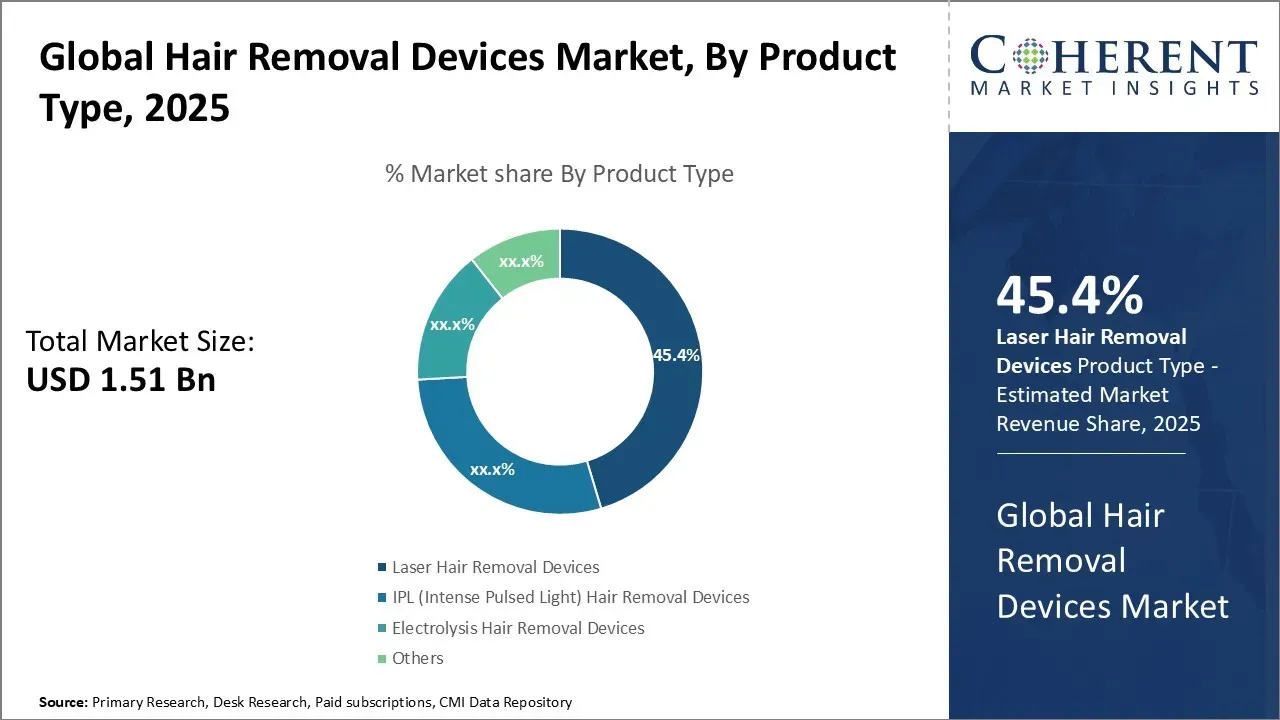
Hair Removal Devices Market Insights, By Product Type
Laser hair removal devices contribute the highest share of the market owing to its ability to provide long-lasting and near-permanent hair reduction
Laser hair removal devices segment is expected to contribute the highest market share of 46.4% in 2026. Laser technology utilizes selective photo thermolysis which targets the melanin pigment in the hair follicle through pulses of laser light. This damages the follicles and inhibits future hair growth. The precision and control afforded by laser devices allow them to effectively treat all skin types and hair colors. Their popularity stems from delivering noticeable hair-free results with minimal sittings required compared to other products. Advancements in laser technology have additionally increased efficacy and comfort levels. Integrated cooling systems and tailored pulsing patterns minimize pain and reduce treatment times. The non-invasive nature and long-lasting effects of laser hair removal make it a preferred choice for both women and men seeking convenient solutions to hair removal. For instance, in April 2025, Lumenis Be. Ltd., a leading energy-based medical device company, unveiled the latest edition of its groundbreaking dual-wavelength laser hair removal system, SPLENDOR X™. This new version enhances the proven benefits of BLEND X® and patented square-fiber technologies, while introducing a user-focused design and advanced digital features. This is further proliferating the hair removal devices market demand.
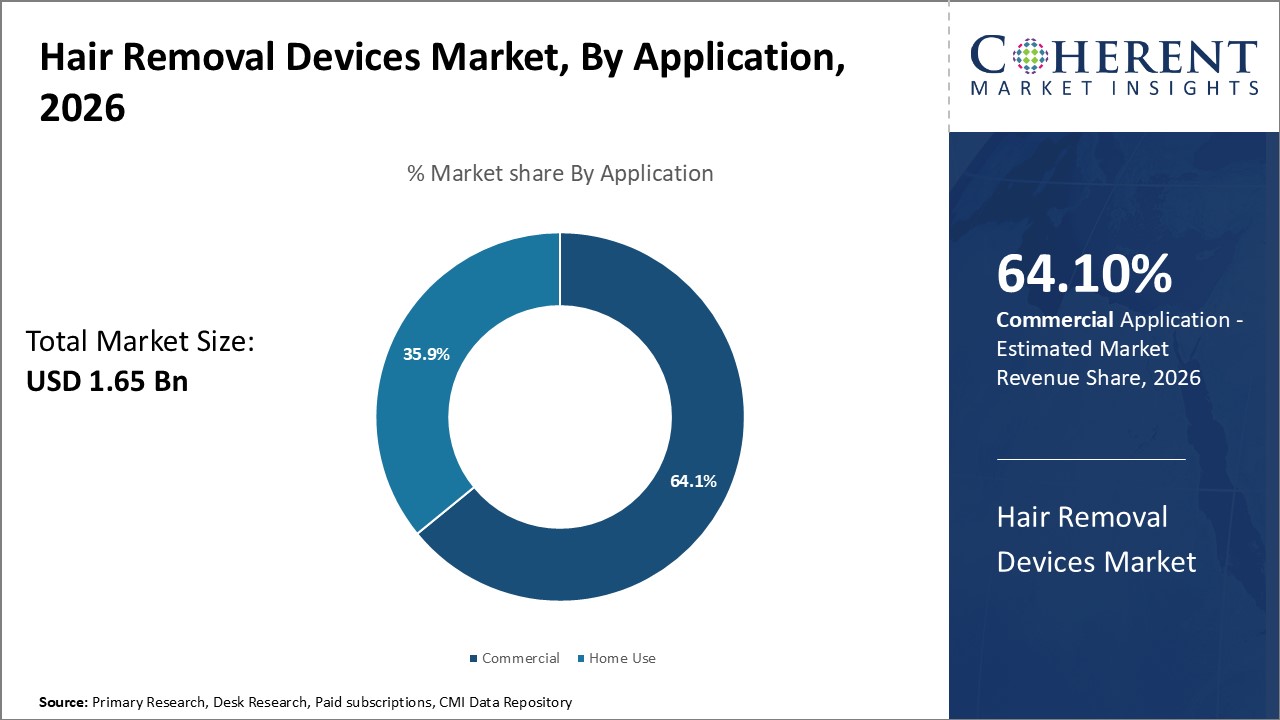
Hair Removal Devices Market Insights, By Application
Commercial contribute the highest share of the market owing to its growing normalization of hair removal treatments
Commercial segment is expected to hold the highest market share of 64.1% in 2026. Salons, spas, dermatology, and cosmetic clinics commonly offer hair removal services to leverage the capabilities of medical-grade equipment. These commercial settings allow consistent and proper administration of treatments by trained professionals. This addresses anxieties regarding complications from at-home use and uncertainty in treatment protocols. The commoditization of hair removal has made it an everyday consumer service on par with other beauty procedures. Commercialization fosters greater access through walk-in options and discounted packages. The conveniences of one-stop solutions in commercial establishments drive increased patronage and frequency of repeat visits. For instance, in March 2024, Reveal Lasers LLC, a top distributor of innovative aesthetic technology, launched the AlloraPro Laser Workstation—a cutting-edge device designed for permanent hair reduction and skin rejuvenation treatments.
Hair Removal Devices Market Insights, By End-User
Women contribute the highest share of the market owing to its evolving beauty standards that increasingly emphasize hair removal
Women segment is expected to hold the highest share of 71.53% in the market in 2026. Traditional expectations of femininity norms associate hairlessness with youthfulness, attractiveness, and vanity. These norms permeate mainstream representations that socially condition female consumers. At the same time, growing social liberties and financial autonomy have allowed independent articulations of beauty and identity. Women thus embrace hair removal as a means of self-care, empowerment, and customization of their own images. The influx of products catering to both functional and aesthetic hair removal needs has heightened expectations around grooming routines. Such influences sustain ongoing demand from the women's segment seeking devices that simplify hair care. For instance, in May 2025, Wilkinson Sword Intuition, the women’s shaving brand known for its intuitive hair removal tools, launched a new brand campaign called ‘Any Hair, anywhere’ to make hair removal feel more real and relatable, further positively influencing the hair removal devices market forecast.
Regional Insights
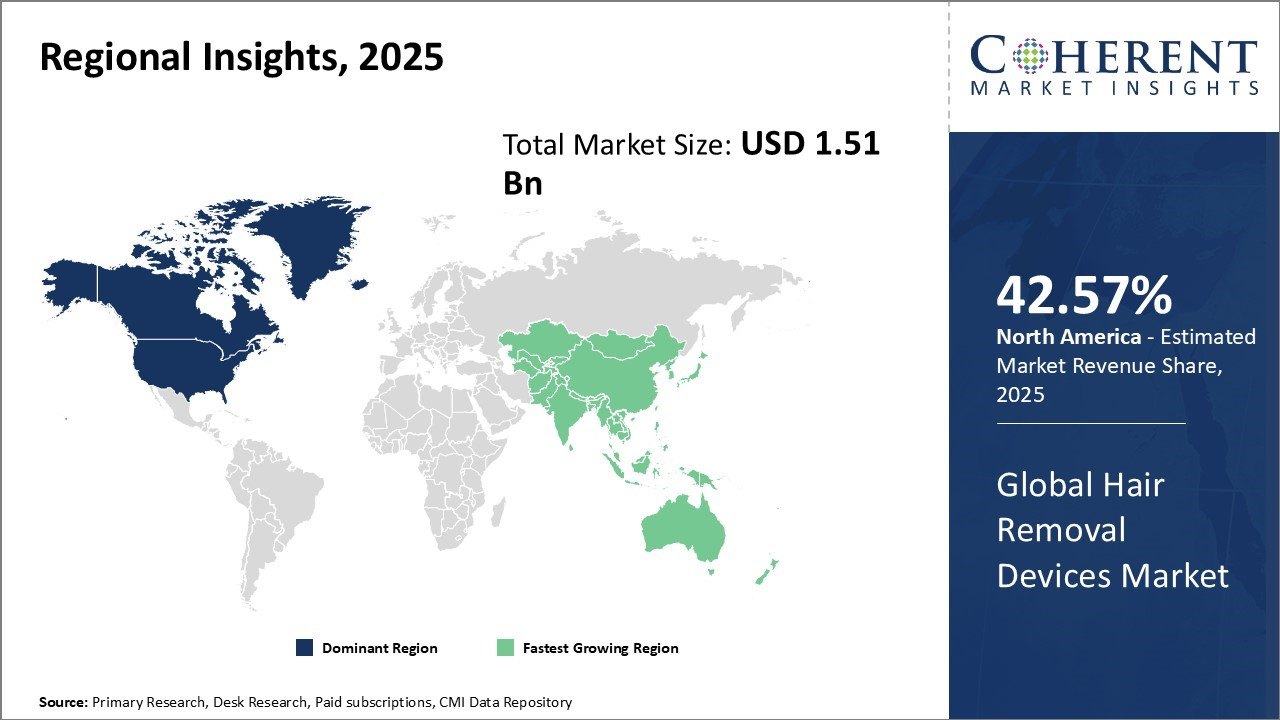
North America Hair Removal Devices Market Trends
North America is expected to lead the hair removal devices market, holding a market share of 42.57% in 2026. The dominance can be attributed to the presence of reputed brands and the preference for hair removal among consumers in the region. Factors, such as product awareness, demand for aesthetics, and disposable income levels, have contributed to North America's leadership position in the market. For instance, in October 2024, Ulike, the global leader in at-home IPL (Intense Pulsed Light) laser hair removal, has proudly launched Ulike X—the first professional IPL hair removal device in North America specifically designed for men.
Asia Pacific Hair Removal Devices Market Trends
The Asia Pacific region, is expected to exhibit the fastest growth driven by growing consciousness about personal grooming and appearance. The increasing women workforce and rising spending power are fueling the adoption of hair removal devices in the region's developing markets. Moreover, lenient regulatory environments and lower production costs have attracted notable global brands, such as Tria Beauty and Yale, to expand their footprint in Asia Pacific. JOVS has introduced cutting-edge portable devices for laser hair removal and skincare in India, reflecting the growing demand for innovative solutions in the hair and skincare industry.
China Hair Removal Devices Market Trends
The China hair removal devices market is experiencing rapid double-digit growth, driven by increased awareness and consumer education surrounding hair removal technologies. Chinese consumers are becoming more open to investing in personal care and grooming products as disposable incomes rise and standards of living improve, particularly in urban areas. Domestic Chinese brands, such as Xiaomi and Keenovo, have gained traction by offering affordable alternatives to Western products, aligning with local consumers' desire for high-quality but competitively priced products. These brands have invested heavily in research and development (R&D) to create products specifically tailored to the needs of Chinese consumers, such as devices designed to handle different skin types and hair textures.
Germany Hair Removal Devices Market Trends
Germany is home to a growing demand for advanced hair removal technologies, as German consumers are generally early adopters of cutting-edge products. Known for their keen interest in premium, high-quality products, German consumers prefer devices that promise precision, long-lasting results, and advanced safety features. The country serves as an important launch pad for new, premium products targeting high-income consumers. Philips, with its Philips Lumea series, has played a crucial role in driving the adoption of IPL technology in the country. For instance, in October 2024, DermRays launched its Amazon Germany shop, expanding its presence in the European market. The new store offers a range of popular laser devices, including the V4S, V6S, and V8S hair removal models, along with the Laser Skin Revive S5.
Market Report Scope
Hair Removal Devices Report Coverage
| Report Coverage | Details | ||
|---|---|---|---|
| Base Year: | 2025 | Market Size in 2026: | USD 1.65 Bn |
| Historical Data for: | 2020 To 2024 | Forecast Period: | 2026 To 2033 |
| Forecast Period 2026 to 2033 CAGR: | 9.0% | 2033 Value Projection: | USD 3.01 Bn |
| Geographies covered: |
| ||
| Segments covered: |
| ||
| Companies covered: | Philips Electronics, Braun (Procter & Gamble), Remington (Spectrum Brands, Inc.), Lumenis Ltd., Syneron Candela, Alma Lasers, Cutera, Inc., Panasonic Corporation, HomeSkinovations Ltd., TriBeCa Labs, Inc., Quanta System S.p.A., Lutronic, Strata Skin Sciences, Inc., Fotona d.o.o., and Venus Concept | ||
| Growth Drivers: |
| ||
| Restraints & Challenges: |
| ||
Hair Removal Devices Market Trend
Rise of At-Home Laser and IPL Devices
Consumers are increasingly shifting from salon-based hair removal to at-home laser and IPL devices for convenience, privacy, and cost efficiency. Brands are responding with compact, user-friendly tools that replicate clinical results. These devices appeal especially to time-conscious users and those in remote locations. The trend also reflects growing confidence in self-care technology and a desire to avoid frequent clinic visits, making home-use devices one of the fastest-evolving segments in the market.
Technological Integration with AI and Smart Features
Hair removal devices are becoming smarter, with AI-powered features that adjust treatment intensity based on skin tone, hair density, and location. Devices now often include skin sensors, app connectivity, and personalized treatment tracking. These innovations improve safety and user satisfaction while enabling real-time feedback. Smart technology also enhances usability for first-time users, creating a more intuitive and tailored experience. This digital evolution aligns with broader consumer demand for smarter, connected beauty solutions.
Hair Removal Devices Market Opportunity
Untapped Demand in Emerging Markets
Countries in Asia-Pacific, Latin America, and the Middle East present significant growth opportunities due to rising disposable incomes, increasing beauty awareness, and improving access to aesthetic technology. Urbanization and digital access are introducing more consumers to modern grooming trends. However, many of these regions are still underserved in terms of product availability and professional clinics. Localized marketing, affordable pricing, and skin-tone inclusive technologies can help companies successfully tap into these growing consumer bases.
Hair Removal Devices Market News
- In March 2025, Ulike, the world’s leading hair removal device brand recognized by the American Academy of Dermatology (AAD), introduced a cutting-edge beauty tech haven featuring an immersive display of its innovative devices, including the Ulike Air10 Pro and Ulike Clear Pro.
- In November 2024, DermRays has announced a groundbreaking new addition to its product line, specifically designed for male users. Scheduled for launch in summer 2025, the new men’s hair removal device will feature a completely redesigned look and enhanced functionalities to address men’s unique grooming needs.
- In February 2025, Keskine launched its new hair removal device, promising users up to 98% hair reduction within four weeks and optimal results in six to twelve weeks. Designed for 24-minute full-body sessions, the device uses ice-cooling technology to deliver a painless experience across multiple areas, including the armpits, legs, face, and bikini line.
- In February 2024, Braun, the pioneering German electronics brand, introduced the Braun Skin i·expert from its world-class IPL innovation facility in Kronberg, Germany. This is the only fully connected IPL system that learns, adapts, and delivers personalized feedback in real time.
Analyst Opinion (Expert Opinion)
- The hair removal devices market is rapidly evolving, but growth remains deeply bifurcated between innovation leadership and accessibility failure. Brands like Philips and Braun have successfully commoditized at-home IPL solutions in developed markets, yet even flagship models such as the Philips Lumea Prestige still struggle with skin tone inclusivity—an issue critics have pointed out for over a decade. This points to a fundamental gap in R&D prioritization, particularly given that over 30% of global users have Fitzpatrick skin types IV–VI, which many devices inadequately serve.
- Moreover, user feedback from platforms like Reddit’s r/LaserHairRemoval and Amazon Verified Purchases reveal that despite multi-hundred-dollar price tags, device dropout rates remain high—mainly due to perceived ineffectiveness, pain, or unclear usage protocols. This is not just a UX issue; it’s a design failure rooted in oversimplified automation. For instance, Silk’n Infinity promises universal suitability but still underperforms for coarser hair types without the patient seeing meaningful results for weeks—an expectation gap brands have not addressed transparently.
- Interestingly, male adoption is no longer a marginal factor. Brands like Ulike and Tria are quietly shifting visual campaigns toward men, targeting beard-line shaping and chest grooming. Reddit discussions among male users reveal that hair removal has moved beyond aesthetics into comfort, sports performance, and even dermatological hygiene. Yet no major brand has launched a male-specific device with ergonomics tailored for body hair—representing an untapped design opportunity.
- As more home-use devices focus on key areas around eye safety, skin burn liability, and efficacy claims, the FDA and EU bodies are likely to tighten Class II device oversight. The next frontier in differentiation won’t be hardware—it will be regulatory-proof design and medically validated results. Devices that can integrate AI-based diagnostic layers—tracking treatment adherence, real-time skin changes, and cumulative laser exposure—will gain the upper hand in what is becoming a clinically adjacent market.
Speak to the analyst
Want personalized insights?
Take the findings above to one of our principal consultants, or have the report rebuilt around the segments, geographies and competitors you actually track.
Market Segmentation
- Product Type Insights (Revenue, USD Bn, 2021 - 2033)
- Laser Hair Removal Devices
- IPL (Intense Pulsed Light) Hair Removal Devices
- Electrolysis Hair Removal Devices
- Others
- Application Insights (Revenue, USD Bn, 2021 - 2033)
- Commercial
- Home Use
- End User Insights (Revenue, USD Bn, 2021 - 2033)
- Women
- Men
- Regional Insights (Revenue, USD Bn, 2021 - 2033)
- North America
- U.S.
- Canada
- Latin America
- Brazil
- Argentina
- Mexico
- Rest of Latin America
- Europe
- Germany
- U.K.
- Spain
- France
- Italy
- Russia
- Rest of Europe
- Asia Pacific
- China
- India
- Japan
- Australia
- South Korea
- ASEAN
- Rest of Asia Pacific
- Middle East
- GCC Countries
- Israel
- Rest of Middle East
- Africa
- South Africa
- North Africa
- Central Africa
- Key Players Insights
- Philips Electronics
- Braun (Procter & Gamble)
- Remington (Spectrum Brands, Inc.)
- Lumenis Ltd.
- Syneron Candela
- Alma Lasers
- Cutera, Inc.
- Panasonic Corporation
- HomeSkinovations Ltd.
- TriBeCa Labs, Inc.
- Quanta System S.p.A.
- Lutronic
- Strata Skin Sciences, Inc.
- Fotona d.o.o.
- Venus Concept
Get access to 250+ pages report
Every segment, forecast, competitor profile and data table behind the analysis above — available for instant download.
- ESOMAR Member
- ISO 9001:2015 Certified
- D-U-N-S Registered
- GDPR & CCPA Compliant
Missing comfort of reading report in your local language? Find your preferred language:
Transform your Strategy with Exclusive Trending Reports
Frequently Asked Questions
The global hair removal devices market is estimated to be valued at USD 1.65 Bn in 2026 and is expected to reach USD 3.01 Bn by 2033.
The CAGR of the global hair removal devices market is projected to be 9.0% from 2026 to 2033.
Rising consumer awareness regarding personal grooming and technological advancements in hair removal devices are the major factors driving the growth of the global hair removal devices market.
High initial cost of devices and side effects and skin sensitivity issues are the major factors hampering the growth of the global hair removal devices market.
In terms of product type, the laser hair removal devices segment is estimated to dominate the market revenue share in 2026.
Philips Electronics, Braun (Procter & Gamble), Remington (Spectrum Brands, Inc.), Lumenis Ltd., Syneron Candela, Alma Lasers, Cutera, Inc., Panasonic Corporation, HomeSkinovations Ltd., TriBeCa Labs, Inc., Quanta System S.p.A., Lutronic, Strata Skin Sciences, Inc., Fotona d.o.o., and Venus Concept are the major players.
North America is expected to lead the global hair removal devices market with a share of 42.57% in 2026.