

Industrial Cooling Systems Market Size and Forecast – 2026 to 2033
The Global Industrial Cooling Systems Market is estimated to be valued at USD 23.20 Bn in 2026 and is expected to reach USD 37.92 Bn by 2033, exhibiting a compound annual growth rate (CAGR) of 7.3% from 2026 to 2033.
Key Takeaways
- By Type, Evaporative Cooling System contributes the 36.9%share of the market in 2026 owing to its unparalleled efficiency and cost-effectiveness.
- By End Use, Industrial Manufacturing segment contributes the 36.2%share of the market in 2026 owing to its massive cooling infrastructure needs.
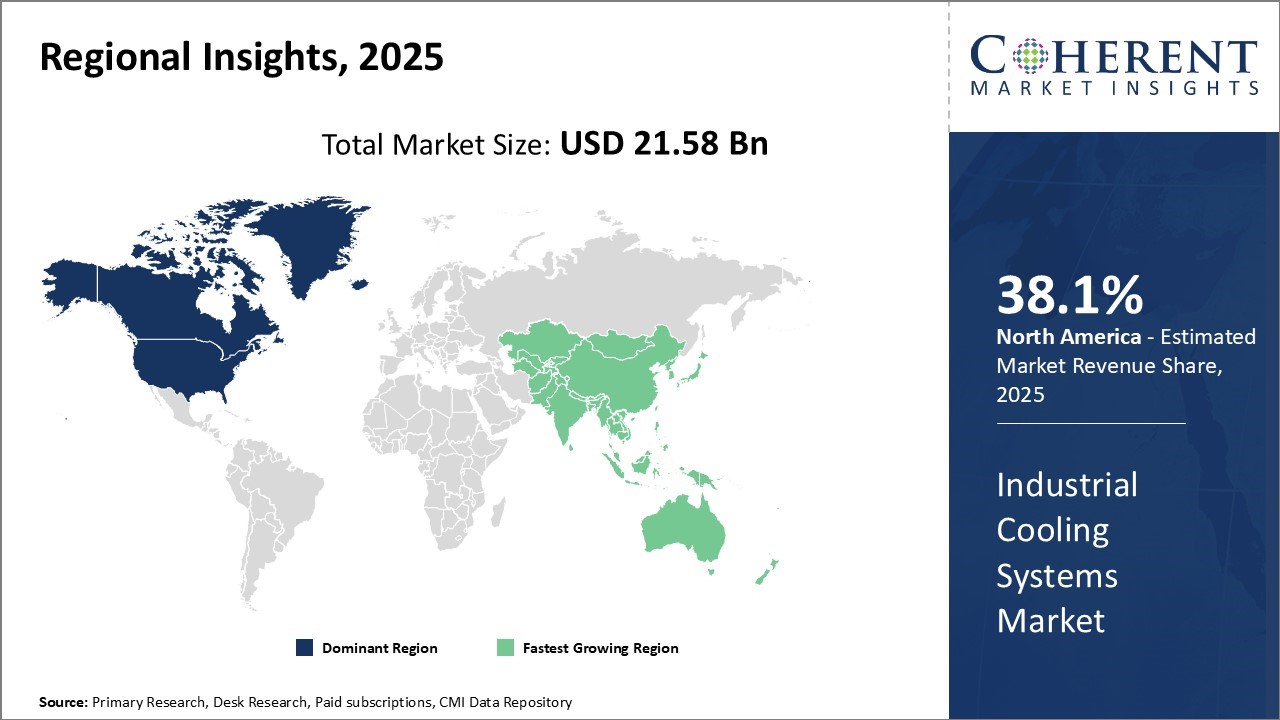
- By Region, North America hold the largest market share of 38. 1%share in 2026 owing to its boom in data centers & ai infrastructure.
Market Overview
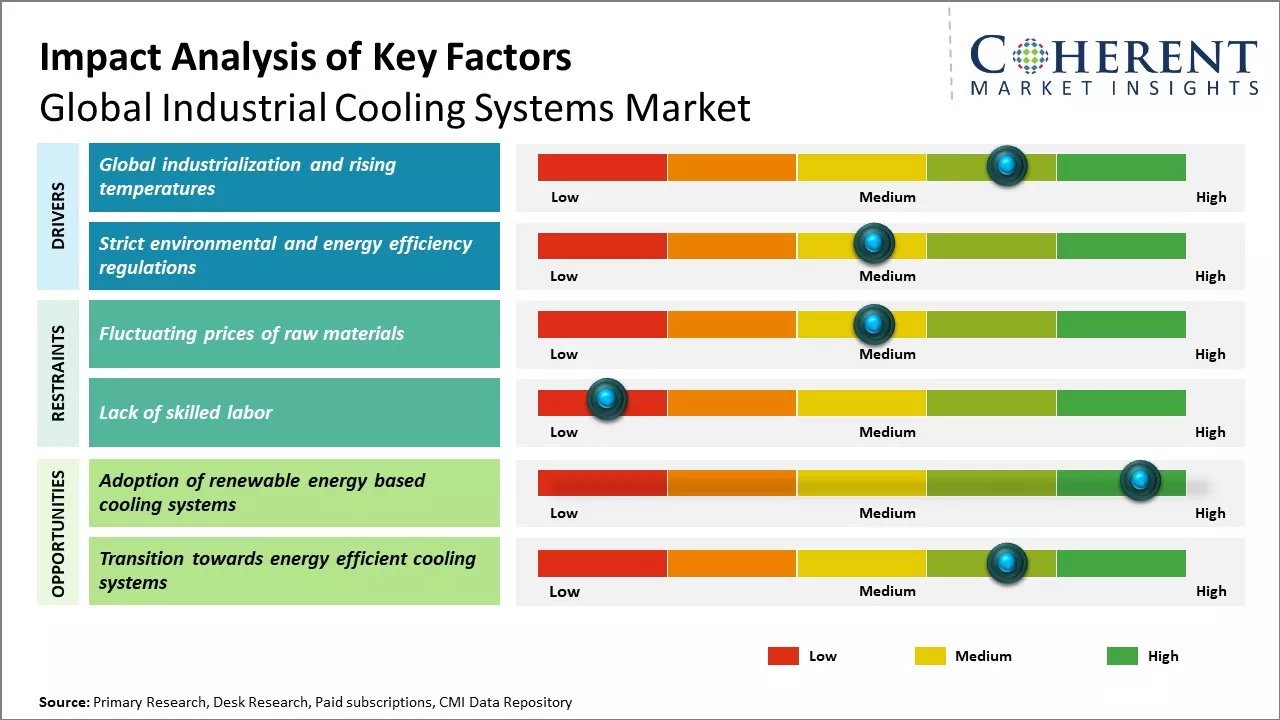
The industrial cooling systems market is growing owing to the rising adoption of energy-efficient and eco-friendly cooling systems. With growing environmental concerns and stringent regulations regarding carbon emissions, companies operating in industries such as power generation, automotive, and oil & gas are incorporating green technologies in their existing infrastructure. Other factors driving the demand include rapid industrialization in developing countries of Asia Pacific and Latin America and the increasing need for process cooling in industries.
Current Events and their Impact on the Industrial Cooling Systems Market
Current Events | Description and its impact |
Regulatory Shifts in Refrigerant Standards |
|
Geopolitical Energy Infrastructure Disruptions |
|
Climate-Driven Industrial Adaptation |
|
End-user Feedback and Unmet Needs in the Industrial Cooling Systems Market End-user Feedback and Unmet Needs
- Complex Maintenance & Downtime Risks: End-users frequently report that many cooling systems require intensive maintenance and are prone to unexpected breakdowns. Limited access to skilled technicians and the lack of predictive diagnostics contribute to higher downtime, which disrupts production schedules and increases operating costs—especially in critical sectors like pharmaceuticals, chemicals, and data centers.
- High Energy Consumption & Operating Costs: A common concern among industrial users is the high energy consumption of traditional cooling systems. While energy-efficient models exist, users note limited availability or high upfront costs. They seek solutions that balance long-term savings with short payback periods, particularly in energy-intensive sectors like steel, cement, and power generation.
- Inconsistent Performance in Extreme Climates: Users operating in extreme climates—hot, humid, or arid—often find that standard cooling systems underperform or lose efficiency. There’s a clear demand for robust systems that can handle variable weather without compromising performance or increasing water and energy use, especially in outdoor or remote industrial installations.
- Current Industry Events of 2026
- Market Size Estimation
- Regional Breakdown
- Competitive Landscape
- Customer Intelligence
- Segmental Analysis
- Pricing Analysis
- Key Market Drivers, Challenges & Future Trends
- Customized Insights Section
Segmental Insights
Industrial Cooling Systems Market Insights, By Type
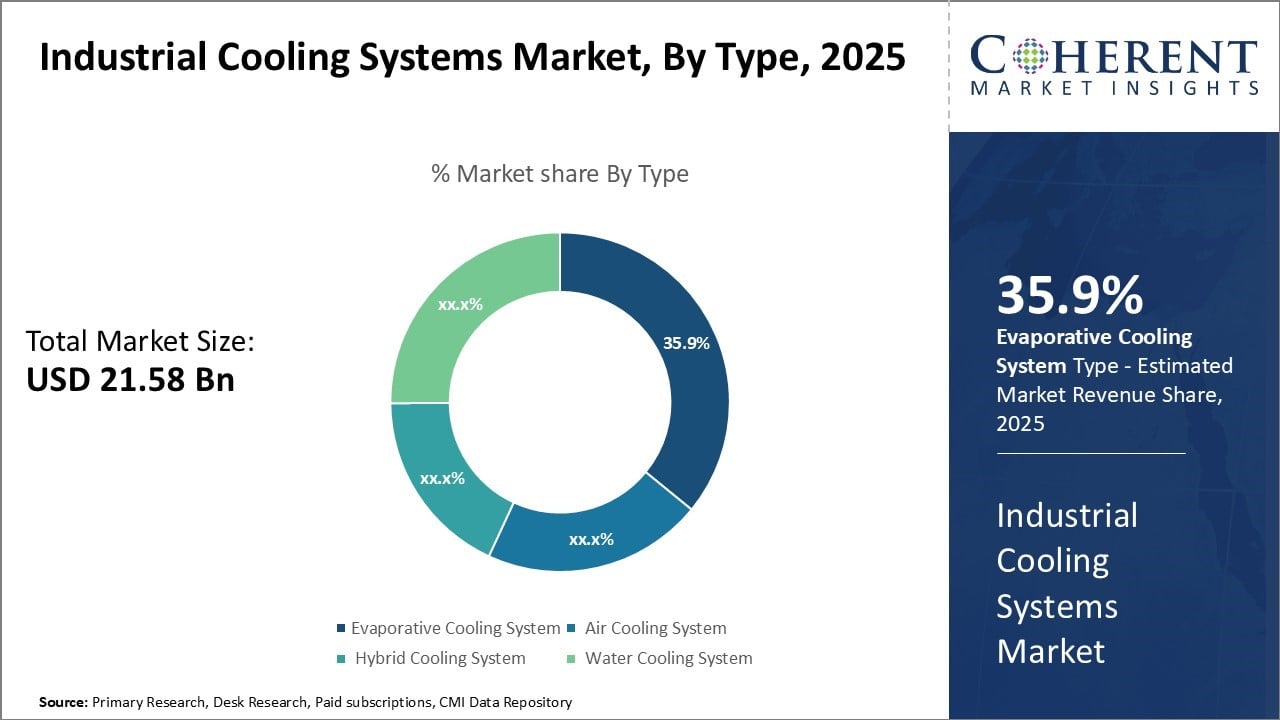
Evaporative Cooling System contribute the highest share of the market owing to its energy efficiency & cost savings
Evaporative Cooling System contributes the 36.9% share of the market in 2026. Evaporative cooling systems leverage the principle of evaporation to provide cost-effective cooling solutions for industrial facilities. By passing air through water pads or mediums, these systems lower air temperature, resulting in significant energy savings compared to conventional cooling technologies. This sustainable and eco-friendly approach places minimal strain on electrical infrastructure, making it an attractive option for businesses seeking to optimize their cooling needs while minimizing environmental impact. The energy efficiency of evaporative cooling systems has made them a popular choice across various industries. They are extensively utilized in manufacturing facilities, power plants, data centers, and other settings that require continuous, large-scale cooling without incurring substantial capital and operational expenditures.
In March 2025, Atlas Copco released a new resource titled Industrial Cooling Technologies: A Guide to Evaporative and Adiabatic Systems, offering plastics industry professionals valuable insights for choosing the most advanced cooling systems for their operations.
Industrial Cooling Systems Market Insights, By End Use
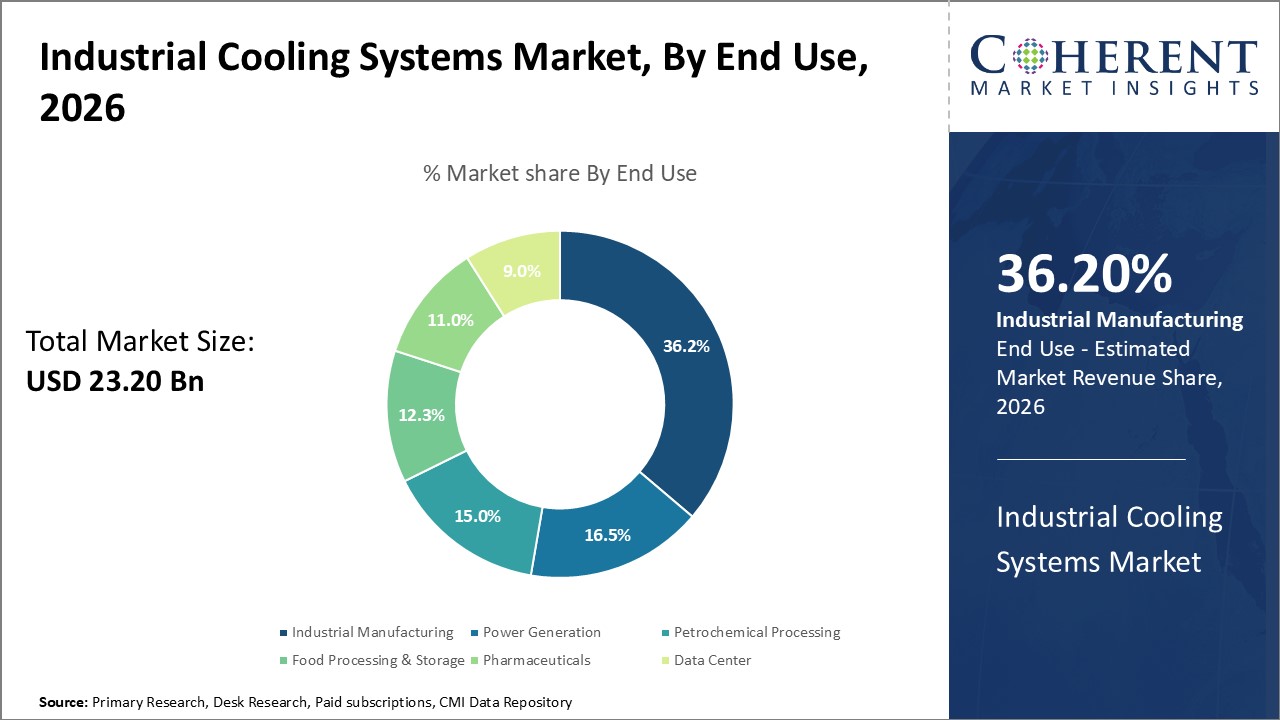
Industrial Manufacturing contribute the highest share of the market owing to its escalating industrial output & heat load
Industrial Manufacturing segment contributes the 36.2% share of the market in 2026. Industrial manufacturing encompasses vast production capabilities across diverse industry verticals. It involves energy-intensive operations and large plants that generate significant heat loads. Effective thermal management through industrial cooling systems is crucial to ensure optimal production outputs, product and personnel safety, and quality standards compliance. The scale and complexity of manufacturing processes necessitate substantial capital investment in cooling infrastructure. A seamless, reliable and efficient cooling network is paramount considering the enormous costs of any production downtimes. It is a strategic imperative for manufacturing facilities to implement cooling solutions best suited to their operational requirements and budgets.
In May 2025, ZJK Industrial unveiled its new liquid-cooled quick connectors at COMPUTEX 2025 as part of NVIDIA’s MGX Ecosystem. These connectors offer self-sealing functionality to prevent fluid leakage, support one-hand operation, require no tools, and are highly compatible with a wide range of pipe diameters.
Regional Insights
North America Industrial Cooling Systems Market Trends
The North American industrial cooling systems market is rapidly adopting digital and energy-efficient technologies, with hybrid systems—combining wet and dry cooling—driving growth. Leading manufacturers like Johnson Controls and Schneider Electric are actively integrating smart controls to enhance predictive maintenance and system performance. The region focuses heavily on data center cooling due to rising AI infrastructure investments and increasing demand for liquid and hybrid cooling. Sustainability initiatives, low-GWP refrigerants, and strict efficiency regulations are also fueling the shift toward greener cooling solutions.
In January 2026, In North America, the National Renewable Energy Laboratory, a federally funded research center, has initiated a new project to reduce the growing energy consumption of data center cooling systems.
Asia Pacific Industrial Cooling Systems Market Trends
The rise in cloud computing workloads across APAC is driving demand for advanced cooling technologies such as liquid immersion, rack-based, and economizer systems. Hyperscale data centers in South Korea, China, India, and Southeast Asia are increasingly adopting efficient cooling to manage high-density servers. Governments actively enforce strict energy regulations and promote eco-friendly cooling technologies—like district cooling, variable-frequency drives, low-GWP refrigerants, and heat recovery systems—often implemented through public-private collaborations to support sustainable infrastructure. In October 2024, Tata Power Trading Company Limited, a subsidiary of Tata Power, partnered with Singapore-based Keppel to introduce sustainable Cooling-as-a-Service (CaaS) solutions in India.
United States Industrial Cooling Systems Market Trends
American industrial companies like Honeywell, Gates Industrial, and Generac are actively focusing on data center cooling. They are leveraging strong demand for data center infrastructure to serve hyperscaler clients by deploying hybrid systems and specialized cooling pumps. To manage dense servers, hyperscale and high-performance data centers are rapidly adopting liquid immersion and direct-to-chip cooling. U.S. operators such as Vertiv and Nvidia are driving this shift as they seek more efficient solutions to support rising rack power demands tied to AI workloads. For instance, in February 2026, Carrier Global Corporation, US based company a global leader in intelligent climate and energy solutions, has unveiled Carrier QuantumLeap™—a comprehensive suite of solutions specifically designed to support the fast-growing data center industry. Carrier QuantumLeap is an advanced data center cooling system that combines cutting-edge cooling, controls, and services to deliver high efficiency tailored to customer needs.
China Industrial Cooling Systems Market Trends
China’s rapid expansion of data centers, especially AI-optimized hyperscale facilities, is accelerating the adoption of liquid cooling technologies such as immersion and direct-to-chip systems. Operators and colocation providers rely on these solutions to manage high-density racks and maintain efficient PUE, making them vital in modern AI infrastructure. Meanwhile, manufacturers are actively integrating IoT sensors, variable-speed drive (VSD) chillers, and real-time monitoring into commercial and industrial systems. These technologies enhance energy efficiency, enable predictive maintenance, and improve operational control across healthcare, industrial parks, and urban infrastructure.
In April 2026, Thermo King, a strategic brand of Trane Technologies, a global climate innovator, has launched its first Asian-made trailer refrigeration unit production line at its new smart facility in Wujiang, China.
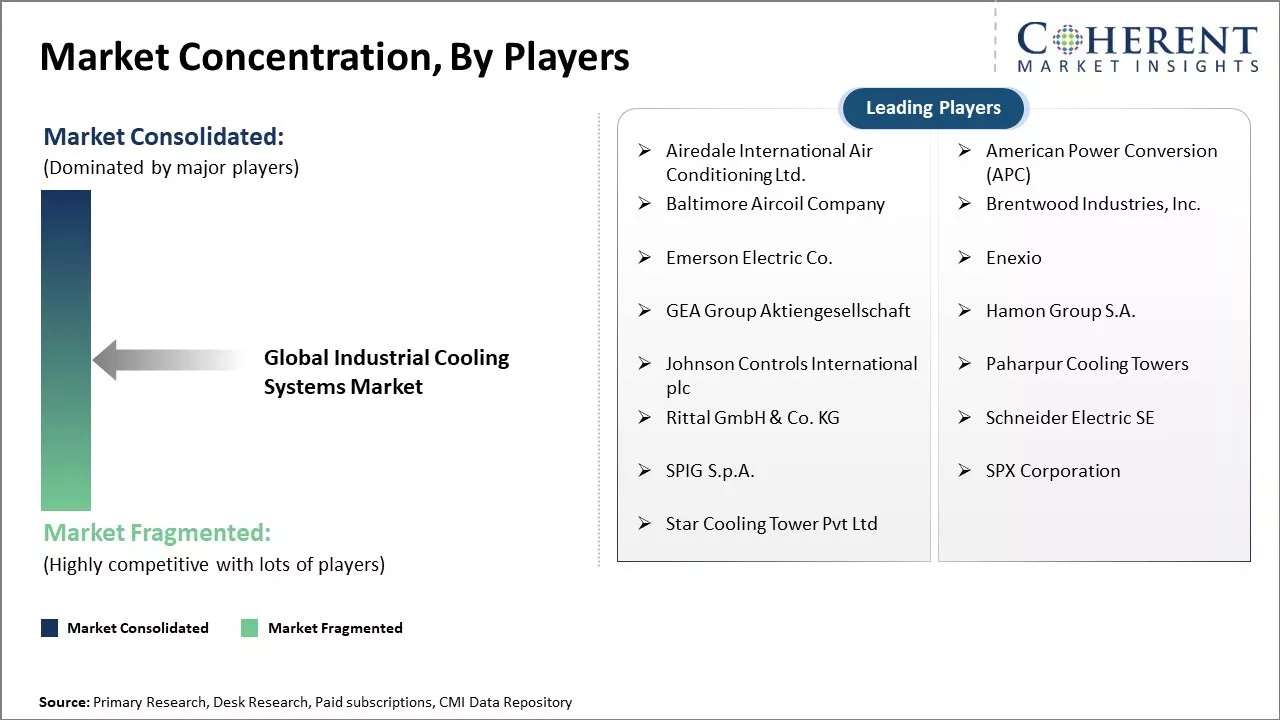
Market Concentration and Competitive Landscape
Industrial Cooling Systems Market News
- In June 2025, Lubricant specialist Castrol introduced a fluid management service for data center liquid cooling. The company aims to bridge the industry’s knowledge gap as data centers shift from air-based cooling to liquid systems, which are becoming essential for managing high-density rack temperatures.
- In October 2024, the leading U.S.-based designer and manufacturer of packaged chiller systems for food and dairy processing, fermented craft beverages, machine and process cooling, and extraction companies has launched the PRO4 Series under its PRO Chiller line.
- In October 2024, UK heating and cooling specialist Arriba Technologies developed an all-in-one solar-integrated heating and cooling unit with a DC electrical system. The company installed the unit at a 750 kW plant at Cambridge’s Rosie Hospital and earned the Lighthouse Heat Pump Award from the European Heat Pump Association.
Market Report Scope
Industrial Cooling Systems Market Report Coverage
| Report Coverage | Details | ||
|---|---|---|---|
| Base Year: | 2025 | Market Size in 2026: | USD 23.20 Bn |
| Historical Data for: | 2020 To 2024 | Forecast Period: | 2026 To 2033 |
| Forecast Period 2026 to 2033 CAGR: | 7.3% | 2033 Value Projection: | USD 37.92 Bn |
| Geographies covered: |
| ||
| Segments covered: |
| ||
| Companies covered: | Airedale International Air Conditioning Ltd., American Power Conversion (APC), Baltimore Aircoil Company, Brentwood Industries, Inc., Emerson Electric Co., Enexio, GEA Group Aktiengesellschaft, Hamon Group S.A., Johnson Controls International plc, Paharpur Cooling Towers, Rittal GmbH & Co. KG, Schneider Electric SE, SPIG S.p.A., SPX Corporation, and Star Cooling Tower Pvt Ltd. | ||
| Growth Drivers: |
| ||
| Restraints & Challenges: |
| ||
Industrial Cooling Systems Market Trend
Shift Toward Energy-Efficient & Sustainable Cooling
Industries are increasingly adopting energy-efficient cooling systems to meet environmental regulations and reduce operational costs. Solutions like variable-speed chillers, hybrid evaporative systems, and low-GWP refrigerants are replacing older, energy-intensive models. This shift aligns with global climate goals and corporate sustainability targets. Government incentives, stricter emissions laws, and rising electricity prices further accelerate this transition, encouraging manufacturers to innovate eco-friendly solutions that support long-term efficiency without compromising performance, especially in high-demand sectors like data centers, chemicals, and food processing.
Integration of AI, IoT, and Smart Controls
The rise of Industry 4.0 is driving the integration of smart technologies into industrial cooling systems. AI and IoT-enabled solutions offer real-time monitoring, predictive maintenance, and automated performance optimization. These systems help reduce downtime, improve energy use, and provide insights into thermal performance. End-users benefit from better asset management and more responsive controls. As demand for data transparency and automation grows, intelligent cooling systems are becoming essential in modern industrial facilities seeking higher uptime and operational agility.
Industrial Cooling Systems Market Opportunity
Expansion of Data Centers and AI Infrastructure
The global surge in data centers—fueled by AI, cloud computing, and digital transformation—creates a massive opportunity for advanced cooling systems. These facilities demand highly efficient, scalable, and low-PUE solutions like liquid cooling and modular chillers. Industrial cooling providers can capitalize by offering customized, energy-efficient systems that support dense server environments. As hyperscalers and colocation providers expand into emerging markets, vendors that deliver cutting-edge thermal management will gain long-term contracts and recurring service revenue.
Analyst Opinion (Expert Opinion)
- The industrial cooling systems market is undergoing a critical transformation, driven less by incremental demand and more by radical technological shifts and strategic imperatives. The surge in AI-driven data centers alone is reshaping cooling requirements—liquid cooling technologies, once niche, now dominate designs. For instance, Nvidia’s recent investment in immersion cooling for its AI hardware exemplifies how thermal management is a key performance enabler, not just a support function. This paradigm shift demands vendors accelerate innovation cycles to remain relevant.
- Moreover, energy efficiency is no longer a regulatory checkbox but a competitive differentiator. According to the U.S. Department of Energy, HVAC systems account 38% of industrial energy use, making efficiency gains in cooling systems a direct lever for cost reduction and sustainability. Firms like Johnson Controls have made strategic moves embedding AI and IoT for predictive maintenance, reducing downtime by up to 20% in real-world deployments.
- However, challenges persist: retrofitting legacy plants with smart, low-GWP systems faces capital constraints and integration hurdles, particularly in heavy industries such as steel and chemicals, where cooling needs are complex and operational tolerance for downtime is minimal. The market’s winners will be those who marry deep process understanding with digital capabilities, offering modular, scalable solutions customized for sector-specific thermal profiles.
- Apart from this, geopolitical factors—such as supply chain disruptions and evolving environmental policies in key manufacturing hubs like China and the U.S.—will increasingly shape vendor strategies. Companies must proactively align R&D with evolving regulations and localize supply chains to avoid costly bottlenecks. This market is not just about cooling—it’s about enabling the next industrial revolution through smarter, cleaner thermal management.
Speak to the analyst
Want personalized insights?
Take the findings above to one of our principal consultants, or have the report rebuilt around the segments, geographies and competitors you actually track.
Market Segmentation
- Type Insights (Revenue, USD Bn, 2021 - 2033)
- Evaporative Cooling System
- Air Cooling System
- Hybrid Cooling System
- Water Cooling System
- End-use Insights (Revenue, USD Bn, 2021 - 2033)
- Power Generation
- Industrial Manufacturing
- Petrochemical Processing
- Food Processing & Storage
- Pharmaceuticals
- Data Center
- Regional Insights (Revenue, USD Bn, 2021 - 2033)
- North America
- U.S.
- Canada
- Latin America
- Brazil
- Argentina
- Mexico
- Rest of Latin America
- Europe
- Germany
- U.K.
- Spain
- France
- Italy
- Russia
- Rest of Europe
- Asia Pacific
- China
- India
- Japan
- Australia
- South Korea
- ASEAN
- Rest of Asia Pacific
- Middle East & Africa
- GCC Countries
- Israel
- South Africa
- Rest of Middle East & Africa
- Key Players Insights
- Airedale International Air Conditioning Ltd.
- American Power Conversion (APC)
- Baltimore Aircoil Company
- Brentwood Industries, Inc.
- Emerson Electric Co.
- Enexio
- GEA Group Aktiengesellschaft
- Hamon Group S.A.
- Johnson Controls International plc
- Paharpur Cooling Towers
- Rittal GmbH & Co. KG
- Schneider Electric SE
- SPIG S.p.A.
- SPX Corporation
- Star Cooling Tower Pvt Ltd.
Sources
Primary Research interviews
- Industry experts and key opinion leaders from manufacturing, data centers, and HVAC sectors
- Technical engineers and product managers from leading industrial cooling system manufacturers
- Facility managers and end-users from chemical, pharmaceutical, and power generation industries
Databases
- International Energy Agency (IEA) Database
- U.S. Environmental Protection Agency (EPA) Energy Star Database
- National Renewable Energy Laboratory (NREL) Database
- World Bank Global Energy Database
Magazines
- HVACR Business
- Cooling Technology Institute Magazine
- Industrial Cooling
- Energy Manager Today
Journals
- International Journal of Refrigeration
- Applied Thermal Engineering
- Energy and Buildings
- Journal of Cleaner Production
Newspapers
- The Wall Street Journal
- Financial Times
- The New York Times – Energy & Environment Section
- China Daily – Business & Industry Section
Associations
- American Society of Heating, Refrigerating and Air-Conditioning Engineers (ASHRAE)
- International Institute of Refrigeration (IIR)
- Air Conditioning and Refrigeration Institute (ARI)
- Industrial Energy Consumers of America (IECA)
Public Domain sources
- Government reports on energy efficiency and environmental regulations
- Patent filings and technical disclosures on cooling technologies
- Press releases from major industrial cooling system manufacturers
- Open-access datasets from national statistics bureaus
Proprietary Elements
- CMI Data Analytics Tool, and Proprietary CMI Existing Repository of information for last 8 years
Get access to 250+ pages report
Every segment, forecast, competitor profile and data table behind the analysis above — available for instant download.
- ESOMAR Member
- ISO 9001:2015 Certified
- D-U-N-S Registered
- GDPR & CCPA Compliant
Missing comfort of reading report in your local language? Find your preferred language:
Transform your Strategy with Exclusive Trending Reports
Frequently Asked Questions
The Industrial Cooling Systems Market is estimated to be valued at USD 23.20 Bn in 2026, and is expected to reach USD 37.92 Bn by 2033.
The CAGR of the Industrial Cooling Systems Market is projected to be 7.3% from 2026 to 2033.
Global industrialization and rising temperatures and strict environmental and energy efficiency regulations are the major factors driving the growth of the global industrial cooling systems market.
Fluctuating prices of raw materials and lack of skilled labor are the major factors hampering the growth of the global industrial cooling systems market.
In terms of Type, Evaporative Cooling System is estimated to dominate the market revenue share in 2026.
Airedale International Air Conditioning Ltd., American Power Conversion (APC), Baltimore Aircoil Company, Brentwood Industries, Inc., Emerson Electric Co., Enexio, GEA Group Aktiengesellschaft, Hamon Group S.A., Johnson Controls International plc, Paharpur Cooling Towers, Rittal GmbH & Co. KG, Schneider Electric SE, SPIG S.p.A., SPX Corporation, and Star Cooling Tower Pvt Ltd are the major players.
North America is expected to lead the global industrial cooling systems market.