

Connected Game Console Market Size and Share Analysis - 2026 To 2033
The global connected game console market size is estimated to total USD 30,500 Mn in 2026 and is projected to grow at a compound annual growth rate (CAGR) of 12% from 2026 to 2033, reaching USD 67,500 Mn by 2033. This is mostly due to rising demand for immersive gaming experiences and continuous advancements in cloud gaming and subscription-based services.
Key Takeaways from the Connected Game Console Market Report
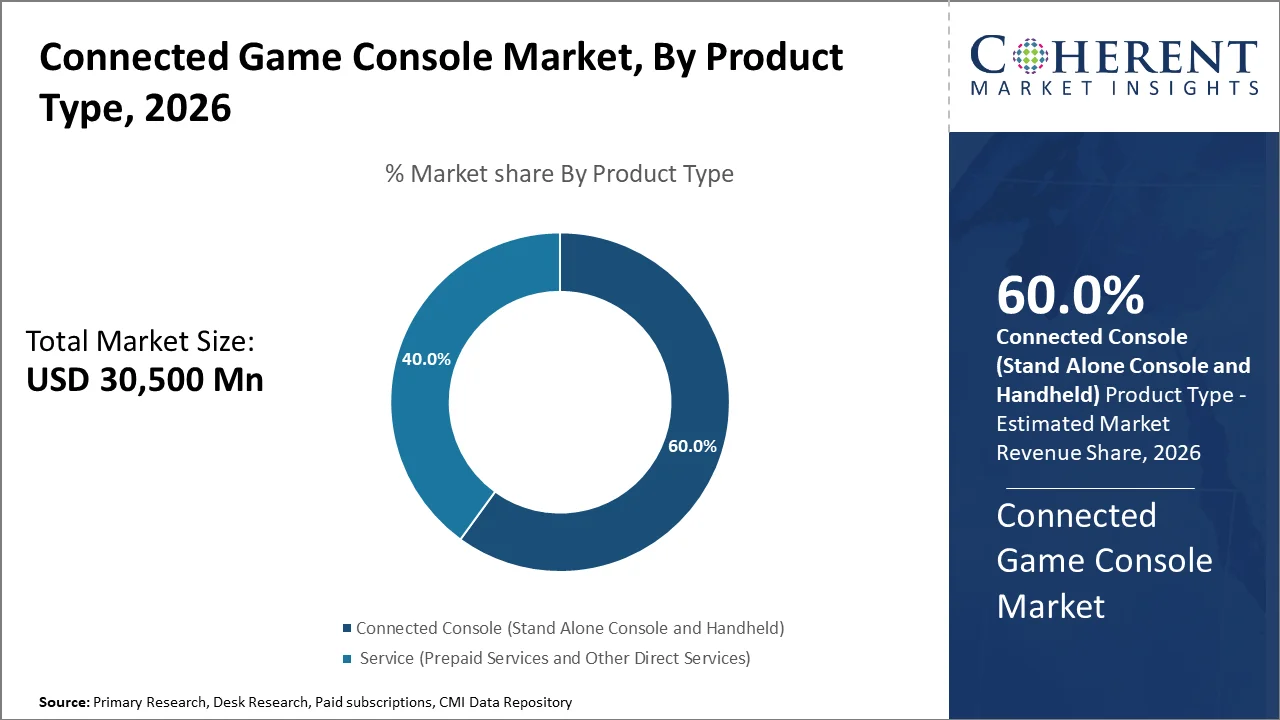
- By product type, connected console segment is expected to lead the market with a share of 60% in 2026, thanks to rising consumer demand for immersive gaming experiences and continuous hardware advancements.
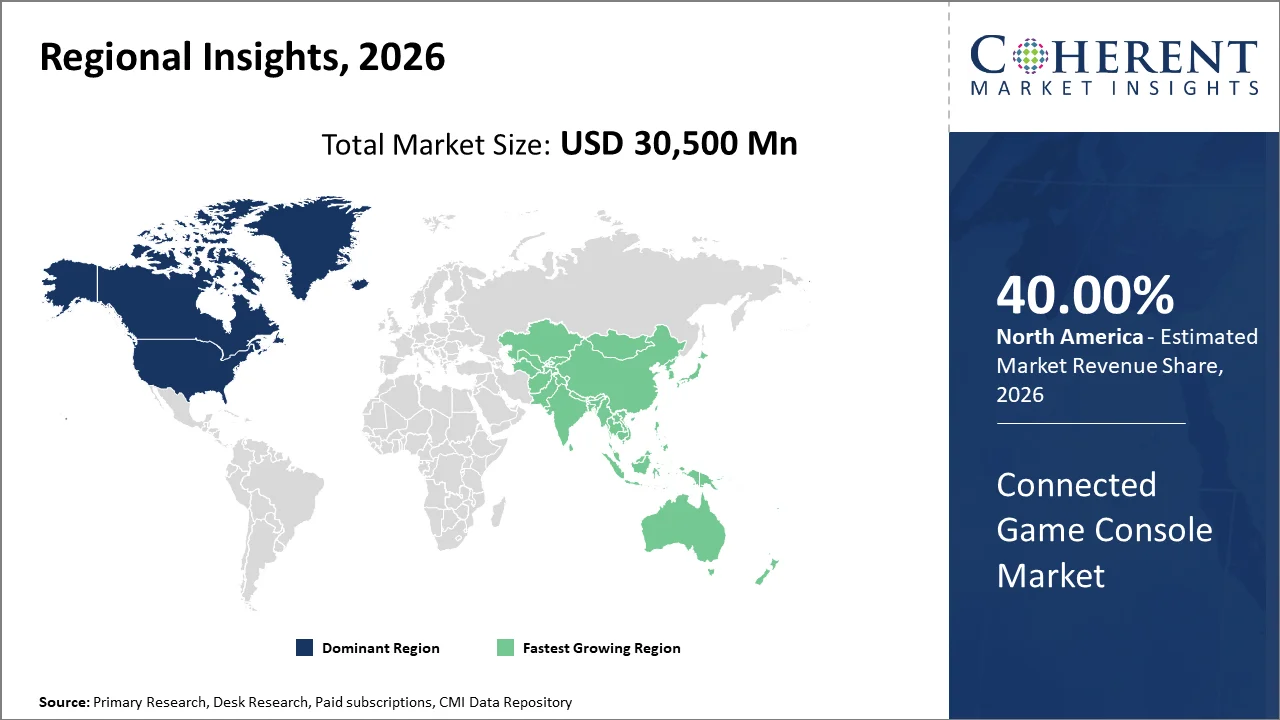
- North America is projected to retain its dominance over the connected game console industry, accounting for a share of 40% in 2026, mostly due to high consumer spending on gaming and increasing adoption of subscription-based gaming services. According to the Entertainment Software Association (ESA), about 61% of Americans play video games every week. This shows that a large number of people are gamers, which is increasing the demand for smart gaming consoles.
- Asia Pacific, with an estimated share of 32% in 2026, is poised to emerge as the fastest-growing market for connected game consoles during the forecast period, thanks to rapid urbanization, rising disposable incomes, expanding internet penetration, and growing popularity of online and multiplayer gaming across nations like China, Japan, and India.
Connected Game Console Market Overview
The global connected game console market is poised to exhibit strong growth during the forecast period. This can be attributed to rising consumer demand for immersive gaming experiences, increasing adoption of high-speed internet connectivity, rapid advancements in console hardware and cloud gaming integration, and growing popularity of online multiplayer ecosystems and subscription-based gaming services.
A video game console refers to a computer device that allows one or more people to play video games. The term video game console is mainly used to distinguish dedicated gaming consoles from arcade machines or home computers. Various types of video game consoles are handheld consoles, home consoles, dedicated consoles, and microconsoles.
Connected game consoles have evolved significantly with advancements such as Wi-Fi and broadband connectivity, high-definition and 4K graphics support, and integration with digital distribution platforms. Increasing adoption of connected gaming technologies across major markets, including the United States, China, Japan, and India, is expected to boost growth of the global connected game console market during the forecast period.
Segmental Insights
Which Product Type Dominates the Connected Game Console Market?
Connected Console Segment Holds the Lion’s Share of the Market
As per Coherent Market Insights’ latest connected game console market analysis, connected console (standalone console and handheld) segment is slated to lead the market with a share of 60% in 2026. This dominance is primarily attributed to the superior gaming experience offered by connected consoles, including higher performance and wider game availability compared to service-based or cloud gaming alternatives.
Rising consumer demand for high-quality gaming hardware and continuous advancements in console technology are supporting growth of this segment. Moreover, the expanding ecosystem of exclusive game titles and strong integration with online multiplayer services are enhancing the appeal of connected consoles.
- Current Industry Events of 2026
- Market Size Estimation
- Regional Breakdown
- Competitive Landscape
- Customer Intelligence
- Segmental Analysis
- Pricing Analysis
- Key Market Drivers, Challenges & Future Trends
- Customized Insights Section
Connected Game Console Market Growth Drivers
Rising Expenditure on Games
Increasing expenditure on games and gaming-related equipment is expected to support growth of the global connected game console market during the forecast period. Consumers in the contemporary world are increasingly spending on gaming accessories such as controllers, headsets, and other peripherals, driven by growing engagement in console gaming and online gaming ecosystems. For instance, as per our research, the global gaming accessories industry revenue is poised to reach USD 11.52 Bn by 2033. This is providing impetus for the connected game console market growth.
Shift from Hardware Ownership to Service-Led Gaming
A major structural change is taking place in the connected game console market, where consoles are increasingly evolving from “buy-and-play devices” into service-based platforms. The growing adoption of subscription models such as Xbox Game Pass and PlayStation Plus is driving this transformation.
Consumers are showing a rising preference for “access over ownership,” which is further supporting this trend. Likewise, expansion of Game-as-a-Service (GaaS) ecosystems and the shift from physical game sales to digital storefronts are expected to foster gaming console market growth during the forthcoming period.
Connected Game Console Market Opportunities
Increasing Broadband and Internet Penetration Worldwide
There is a significant increase in the internet connectivity, enabling wider adoption of online and cloud-based gaming services. According to the This rising global internet penetration is directly supporting demand for connected game consoles, as stable broadband access is a key requirement for online multiplayer gaming, cloud gaming services, and digital game distribution.
Connected Game Console Market Innovations
Mixed Cloud Gaming Integration Transforming Connected Gaming Consoles
Cloud gaming is changing how gaming consoles are used by reducing the need for powerful local hardware as well as allowing games to be streamed over the internet. Instead of running games only on a console, players can access titles through cloud servers using devices such as smart TVs, smartphones, PCs, and supported consoles. A latest example is Microsoft Xbox Cloud Gaming (part of Xbox Game Pass Ultimate), which allows users to stream many Xbox games on Xbox consoles, Windows PCs, Android devices, and some smart TVs.
AI and Immersive Technologies Driving Next-Generation Consoles
Artificial intelligence is increasingly used in gaming to improve performance, visuals, and gameplay experience. AI has the tendency to help in areas such as upscaling graphics, adjusting performance settings, improving non-player character (NPC) behavior, and optimizing game rendering. Immersive technologies such as virtual reality (VR) are also becoming more popular in the market. A recent example is the Sony PlayStation 5 that uses advanced upscaling and performance technologies to improve image quality as well as enhance smooth gameplay.
Current Events and Their Impact on the Connected Game Console Market
Current Event | Description and its Impact |
Expansion of subscription-based gaming ecosystems (Microsoft & Sony official disclosures) |
|
Rising dominance of digital game sales over physical game formats (industry-wide shift) |
|
Regional Insights
High Console Penetration and Strong Digital Ecosystem Driving North America’s Leadership
North America is expected to dominate the global connected game console market with a 40% share in 2026. This is mainly due to high console usage, strong consumer spending power, and a well-developed gaming industry. The region has many active users of platforms like Xbox, PlayStation, and Nintendo, along with growing popularity of online multiplayer games and subscription services such as Xbox Game Pass and PlayStation Plus.
In addition, the growing popularity of esports and cloud gaming is fueling demand for always-connected consoles, as users increasingly prefer digital downloads, cross-platform play, and live streaming, features. Continuous product innovation and ecosystem expansion by key players such as Microsoft, Sony, and Nintendo are also reinforcing the region’s dominance in the global online gaming consoles market.
For example, the U.S. is rapidly shifting to subscription-based gaming. Microsoft had over 34 million Xbox Game Pass subscribers in 2024, showing strong growth in connected gaming ecosystems over physical gameplay. This is increasing demand for always-connected consoles and supporting North America’s market leadership.
Rapid Internet Expansion and Gaming Culture Fueling Asia Pacific Growth
Asia Pacific is expected to emerge as the most lucrative market for connected game console manufacturers, accounting for a 32% global market share in 2026. This growth is driven by rising internet penetration, expanding 5G connectivity, and a strong gaming culture among younger populations. As of early 2025, India has over 1 billion internet subscriptions, with around 958 million active users—about 55–56% of the population.
Nations like China, Japan, South Korea, and India are witnessing increasing adoption of connected consoles for entertainment and online competitive gaming. In addition, the expansion of esports ecosystems and social gaming communities is further fueling demand, particularly among Gen Z users who prefer multiplayer, cross-platform, and streaming-enabled gaming experiences.
Connected Game Console Market Outlook – Country-wise
U.S. Connected Game Console Market Trends
The U.S. is expected to remain one of the leading markets for connected game consoles during the assessment period. This is attributable to high gaming penetration, strong demand for online multiplayer experiences, rising popularity of subscription-based gaming services, and continuous innovation in console hardware and cloud gaming platforms. Increasing preference for digital game distribution and cross-platform play is also supporting steady market expansion.
China Connected Game Console Market Forecast
China is expected to emerge as a highly lucrative market for cloud gaming consoles during the forthcoming period. This is due to rising internet penetration, expanding gaming population, strong mobile and console gaming convergence, and increasing demand for high-quality online multiplayer experiences. Rising interest in immersive entertainment formats like sports and cloud gaming is also supporting market expansion.
Rapid growth of the gaming ecosystem among young, mobile-first users shifting to cross-platform and console-integrated gaming is boosting China’s market. China has about 668 million gamers (CADPA), one of the largest gaming populations globally. This is driving strong demand for connected consoles and cloud-based gaming services.
Who are the Major Companies in the Connected Game Console Market?
Some of the major players in connected game console market are Microsoft Corporation, NVIDIA Corporation, Sony Corporation, Nintendo Co. Ltd., Valve Corp., OUYA Inc., PlayJam, Mad Catz, and BlueStacks.
Key Strategies Adopted by Industry Players
Leading connected game console market players are adopting various strategies to strengthen their market position as well as improve user engagement. One major focus is the shift from hardware-based sales to service-driven models, where companies earn more through subscription services like Xbox Game Pass, PlayStation Plus, and Nintendo Switch Online. This helps them generate stable, long-term revenue while keeping users engaged within their ecosystems. For example,
- In June 2025, Microsoft, in partnership with ASUS, unveiled the ROG Xbox Ally and ROG Xbox Ally X handheld gaming devices. These devices are designed to let players enjoy Xbox games on the go through cloud and PC gaming support.
- In April 2025, Nintendo unveiled the Nintendo Switch 2 console. It supports up to 4K gaming when played on a TV and up to 120 frames per second in handheld mode.
- In November 2024, Sony Interactive Entertainment announced the PlayStation 5 Pro. It is a more powerful version of the PlayStation 5 designed to improve graphics and performance for gamers and developers.
Market Report Scope
Connected Game Console Market Report Coverage
| Report Coverage | Details | ||
|---|---|---|---|
| Base Year: | 2025 | Market Size in 2026: | USD 30,500 Mn |
| Historical Data for: | 2020 To 2024 | Forecast Period: | 2026 To 2033 |
| Forecast Period 2026 to 2033 CAGR: | 12% | 2033 Value Projection: | USD 67,500 Mn |
| Geographies covered: |
| ||
| Segments covered: |
| ||
| Companies covered: | Microsoft Corporation, NVIDIA Corporation, Sony Corporation, Nintendo Co. Ltd., Valve Corp., OUYA Inc., PlayJam, Mad Catz, and BlueStacks | ||
| Growth Drivers: |
| ||
| Restraints & Challenges: |
| ||
Analyst Opinion (Expert Opinion)
- The connected game console market is supported by a massive global installed base. Sony reported over 118 million monthly active users on PlayStation Network, showing the scale of connected console engagement across its ecosystem.
- Subscription and digital ecosystems are now central to the industry. Platforms like Xbox Game Pass and PlayStation Plus together serve tens of millions of subscribers globally, reflecting the shift from one-time game purchases to recurring service-based revenue models.
- The ecosystem remains highly consolidated, with Sony, Microsoft, and Nintendo controlling the majority of global console hardware and software value, supported by exclusive game libraries and tightly integrated online services.
- Going forward, the connected game console market is expected to grow through ecosystem-led and service-led models. This growth will be driven by higher subscription use, cloud gaming integration, and cross-platform content access, rather than only new console generation upgrades.
Speak to the analyst
Want personalized insights?
Take the findings above to one of our principal consultants, or have the report rebuilt around the segments, geographies and competitors you actually track.
Market Segmentation
- By Product Type Insights
- Connected Console
- Stand Alone Console
- Handheld
- Service
- Prepaid Services
- Other Direct Services
- Connected Console
- By Region Insights
- North America
- U.S.
- Canada
- Latin America
- Brazil
- Argentina
- Mexico
- Rest of Latin America
- Europe
- Germany
- U.K.
- Spain
- France
- Italy
- Russia
- Rest of Europe
- Asia Pacific
- China
- India
- Japan
- Australia
- South Korea
- ASEAN
- Rest of Asia Pacific
- Middle East & Africa
- GCC Countries
- Israel
- Rest of Middle East & Africa
- North America
Sources
Primary Research Interviews
- Industry experts
- Game developers
- Console manufacturers
- Distributors
- Retail store managers
- Professional gamers
Databases
- World Bank Data
- International Telecommunication Union (ITU) Statistics
- OECD Data
- UN Data
- Statista Public Data Sections
- Steam Charts
- App Annie (data insights)
- Google Dataset Search
Magazines
- Wired
- TechCrunch
- biz
- IGN Magazine
- Game Informer
- The Verge
- PC Gamer
Journals
- IEEE Xplore Digital Library
- ACM Digital Library
- Journal of Gaming & Virtual Worlds
- Entertainment Computing Journal
- International Journal of Computer Games Technology
Newspapers
- Reuters
- BBC News
- The Wall Street Journal
- Financial Times
- The Guardian
- Bloomberg (technology section)
Associations
- Entertainment Software Association (ESA)
- International Game Developers Association (IGDA)
- Interactive Software Federation of Europe (ISFE)
- Consumer Technology Association (CTA)
- IEEE Computer Society
Public Domain Sources
- Government publications (US Census Bureau, Eurostat, India MeitY reports)
- World Health Organization (digital wellbeing reports)
- World Bank open reports
- United Nations publications
- Official company investor presentations and earnings reports
Proprietary Elements
- CMI Data Analytics Tool
- Proprietary CMI Existing Repository of information for last 8 years
Get access to 250+ pages report
Every segment, forecast, competitor profile and data table behind the analysis above — available for instant download.
- ESOMAR Member
- ISO 9001:2015 Certified
- D-U-N-S Registered
- GDPR & CCPA Compliant
Missing comfort of reading report in your local language? Find your preferred language:
Transform your Strategy with Exclusive Trending Reports
Frequently Asked Questions
The global market is estimated to be valued at USD 30,500 Mn in 2026.
The global Connected Game Console Market value is expected to reach USD 67,500 Mn by 2033.
The global market is poised to exhibit a CAGR of 12% from 2026 to 2033.
Major growth factors include rising spending on gaming accessories and expansion of cloud gaming.
Connected console segment, with about 60% share in 2026, dominates the market.
Some major companies in the Connected Game Console Market includeMicrosoft Corporation, NVIDIA Corporation, Sony Corporation, Nintendo Co. Ltd., Valve Corp., OUYA Inc., PlayJam, Mad Catz, and BlueStacks.
North America, with 40% share in 2026, is set to lead the market during the forecast period.