

LED Stadium Screens Market Size and Share Analysis - 2026 To 2033
The global LED stadium screens market is estimated to be valued at USD 2,490 Mn in 2026 and is projected to reach USD 3,894.5 Mn by 2033, registering a CAGR of 6.6% during the forecast period (2026-2033). This is mostly due to rising adoption of high-resolution digital display technologies in sports venues, increasing investments in stadium modernization projects, and rising demand for immersive fan experiences.
Key Takeaways from the LED Stadium Screens Market Report
- Full color segment is likely to lead the market with an 84% share in 2026 as the result of increasing demand for ultra-high-definition live broadcasting, immersive fan experience, sponsor advertising, and replay screens. For instance, two 4K LED video screens with 40.4 Mn pixels were installed at Levi's Stadium in 2025.
- Surface Mount Display Segment is expected to hold the major market share of 78% in 2026 owing to its high pixel density, brightness, reliability, and low maintenance cost in comparison with individually mounted LEDs. This can be exemplified by the April 2025 announcement by Daktronics to offer 37 fine pixel-pitch LED displays for the new Nissan Stadium of Tennessee Titans.
- Regionally, Asia Pacific is projected to lead the global LED stadium screens industry with a share of 40% in 2026 due to increasing stadium construction and renovation in China, India, Japan, and South Korea, along with a strong local LED manufacturing base. For example, Japan expanded its Stadium and Arena Reform program to 21 flagship venues by 2025, supporting the modernization of sports infrastructure.
- North America, holding a share of 29% in 2026, is anticipated to emerge as a highly lucrative market for LED stadium screen manufacturers during the forecast period, thanks to rising investments in stadium modernization as well as increasing adoption of advanced display technologies and growing demand for enhanced fan experiences. For example, in June 2025, the Dallas Cowboys upgraded AT&T Stadium with the largest LG MAGNIT Micro LED display in North America and about 1,000 new 4K displays to enhance the fan experience.
LED Stadium Screens Market Overview
The global LED stadium screens market is expected to register steady growth during the forecast period. This is primarily due to increasing demand for high-quality visual experiences at sporting events, concerts, and large-scale entertainment venues. Stadium operators in the contemporary world are increasingly investing in advanced LED display technologies to improve fan engagement through ultra-high-definition visuals, real-time replays, interactive content, and dynamic advertising.
Growing popularity of live sports and rising investments in the modernization of sports infrastructure and smart stadium projects are also driving market expansion. In addition, advancements in fine-pixel pitch LED technology, improved energy efficiency, and greater durability of outdoor displays are encouraging widespread adoption across developed and emerging economies.
A stadium LED screen or LED display is a large-format flat-panel display that uses numerous light-emitting diodes (LEDs) to display images, videos, live broadcasts, scores, and advertisements. Its high brightness ensures clear visibility even in direct sunlight, making it ideal for outdoor stadiums and arenas.
Stadium LED screens are widely used during sporting events, concerts, and other large-scale public events to enhance audience engagement and communicate real-time information. Sports clubs, stadium operators, and advertisers also use these displays to generate revenue through digital advertising and sponsorships during events.
Increasing number of stadiums across the world is providing a strong impetus for the growth of LED stadium screens market. New stadiums are being constructed to accommodate rising demand for live sports, concerts, and large-scale entertainment events. For instance, in July 2025, Detroit City FC selected HOK to design its planned 15,000-seat stadium in Southwest Detroit. The stadium is targeted to open around the 2027 USL season. Such expansions are expected to boost LED stadium screen sales during the forthcoming period.
Advancements in display technologies like increased brightness levels, better energy efficiency and longer life span of the displays, coupled with falling prices, are prompting users to switch from conventional displays to LED-based displays. This is anticipated to drive the growth of the global LED stadium displays market during the forecast period.
For instance, a Samsung spokesperson in 2021 stated that the price of LED displays had fallen by about 50 percent in the last four to five years. This kind of reduction in price is expected to lead to more installations of LED display systems at stadiums.
Segmental Insights
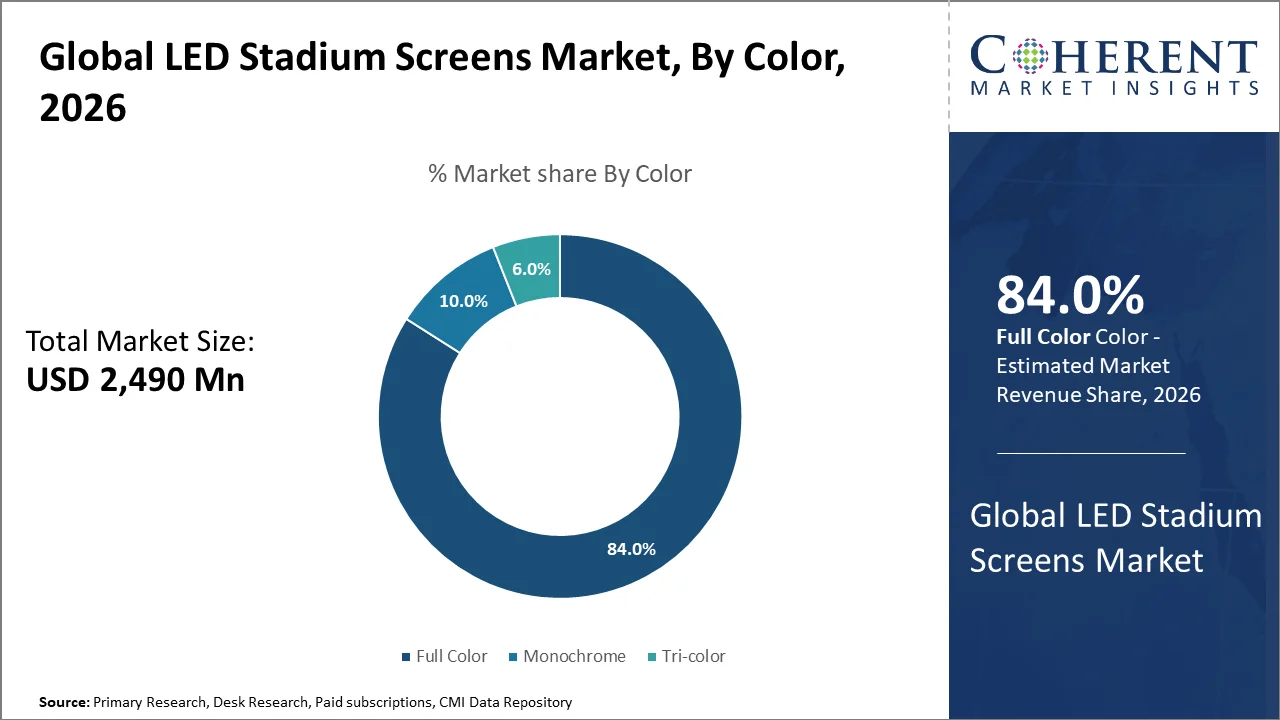
Which Color Dominates the LED Stadium Screens Market?
Full Color Segment to Hold 84% Market Share in 2026
According to Coherent Market Insights’ latest LED Stadium Screens Market analysis, full color segment is set to lead the market, accounting for a share of 84% in 2026. This dominance is attributable to growing demand for immersive and high-definition visual experiences in sports stadiums and entertainment venues.
Stadiums are expanding premium digital display infrastructure ahead of major international sporting events. For example, in 2024, AT&T Stadium installed LG MAGNIT full-color Micro LED displays as part of renovations for the 2026 FIFA World Cup, highlighting the growing adoption of full-color LED technology to enhance fan experiences and digital advertising.
Full-color LED stadium screens deliver superior image quality, vibrant color reproduction, and exceptional brightness. They enable spectators to enjoy crystal-clear live broadcasts, instant replays, advertisements, and interactive content even under direct sunlight. Rising investments in stadium modernization, increasing adoption of advanced display technologies, and the need for enhanced fan engagement are also driving adoption of full-color LED screens across professional sports arenas and multipurpose venues worldwide.
- Current Industry Events of 2026
- Market Size Estimation
- Regional Breakdown
- Competitive Landscape
- Customer Intelligence
- Segmental Analysis
- Pricing Analysis
- Key Market Drivers, Challenges & Future Trends
- Customized Insights Section
What Makes Surface-Mounted LED Stadium Screens So Popular in the Market?
High Pixel Density and Easy Installation Drive Demand
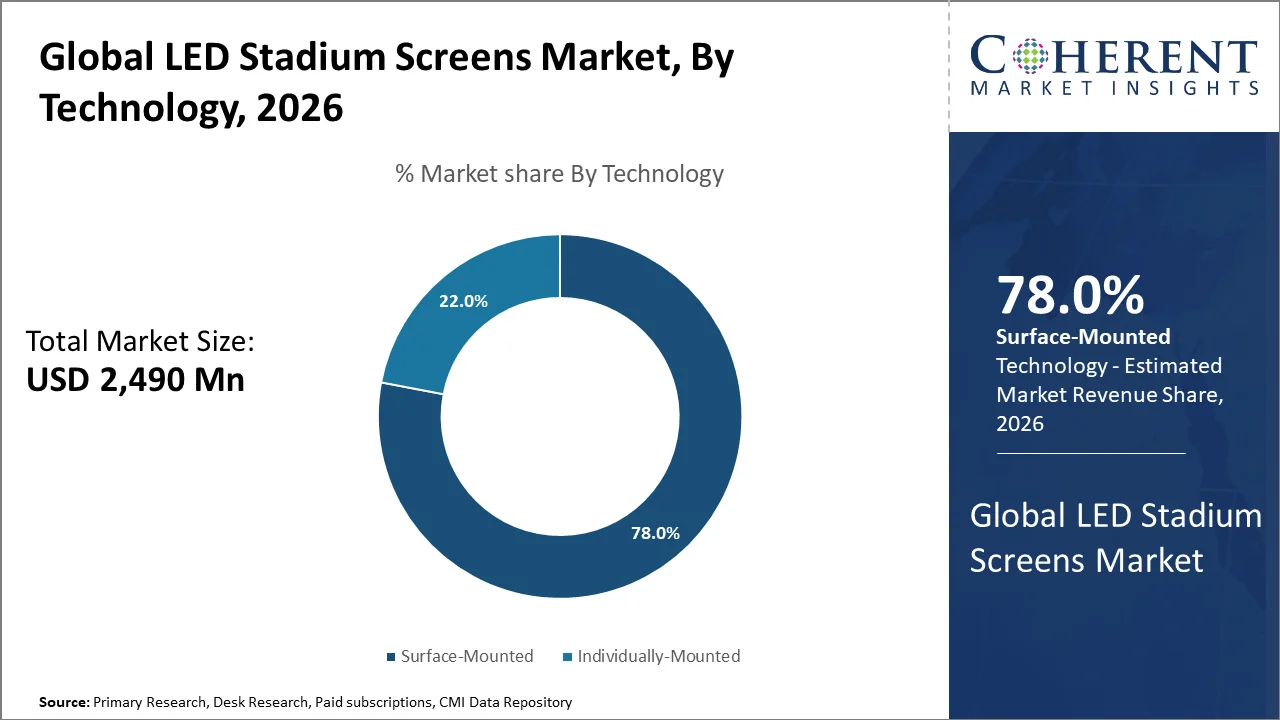
By technology, surface-mounted segment is projected to dominate the market, capturing a prominent share of 78% in 2026. This can be attributed to its superior image quality, high pixel density, wide viewing angles, and enhanced brightness, making it ideal for large outdoor and indoor stadium displays.
The recent stadium deployments have shown how the trend towards using SMD display technology is becoming popular. For instance, FC Barcelona has applied Philips Urban LED 7000 series display with 3.9 mm pixel pitch, 6,000 nits luminance, and IP66 in 2025 for video replays, live videos, and player analysis. This shows that there is a preference of SMD displays because of better luminance and pixels.
Surface-mounted LED (SMD) technology integrates red, green, and blue LED chips into a single compact package. With this kind of technology, it is possible to ensure smooth high-definition visuals, vivid colors, and good contrast for those spectators who see the content displayed from various seats. Moreover, the installation of such SMD panels requires less effort than installing traditional ones.
LED Stadium Screens Market Growth Drivers
Rising Sports and Entertainment Events
Growing number of global sports leagues, tournaments, concerts, and esports events is driving demand for large, high-quality LED stadium screens. These displays are widely used for live replays, scoring updates, and delivering immersive fan experiences. Their rising adoption is expected to boost growth of LED stadium screens market during the forecast period.
LED Stadium Screens Market Opportunities
Increasing Sports Infrastructure Investments
Governments and private investors across the world are heavily investing in new stadium construction and renovation projects, especially for international events such as FIFA tournaments and the Olympics. A significant portion of budgets is allocated to advanced display systems. Thus, increasing investments in sports infrastructure are expected to create lucrative growth opportunities for the LED stadium screens market in the coming years.
For example, the City of Toronto and MLSE upgraded BMO Field for FIFA World Cup 2026, including fan experience and digital display systems. Similarly, Manchester United has advanced plans and secured land for a proposed 100,000-seat stadium redevelopment expected to feature modern LED technologies. These developments are expected to drive strong demand for LED stadium screens in the coming years.
LED Stadium Screens Market Trends
Shift toward Smart and Connected Stadium Experiences
The shift toward smart, immersive, and connected stadium experiences is a key growth-shaping trend in the LED stadium screens market. Modern stadiums are evolving into digitally integrated entertainment hubs where LED screens are no longer limited to displaying scores but are used to deliver real-time data, live replays, interactive content, and augmented reality enhancements. These systems are increasingly integrated with centralized content management platforms and AI-driven technologies, enabling more engaging and personalized fan experiences. This transformation is also helping stadium operators enhance audience engagement and unlock new revenue streams.
Current Events and Their Impact on the LED Stadium Screens Market
Current Event | Description and its Impact |
Large-Scale LED Installations in New Sports Venues |
|
Growing Adoption of LED Displays to Improve Fan Experience |
|
Regional Insights
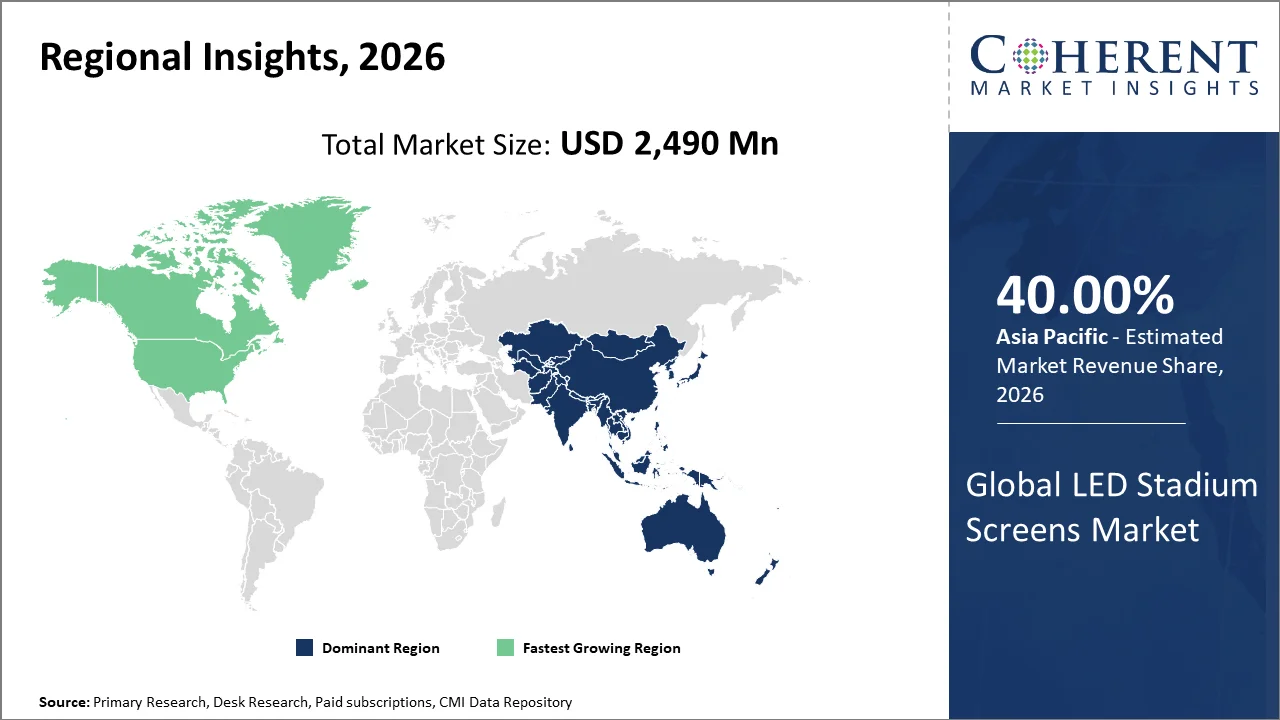
Asia Pacific Set to Emerge as the Most Dominant LED Stadium Screens Market
Asia Pacific is expected to lead the global LED stadium screens market, accounting for a share of around 40% in 2026. The dominance is attributable to rapid stadium construction, rising sports events, and large-scale government-backed smart city and sports infrastructure projects across China, India, Japan, and Korea.
Increasing deployment of advanced digital display systems in newly built and renovated stadiums to support international tournaments and domestic leagues is boosting Asia Pacific LED stadium screens market. LED screens improve both audience engagement and broadcast quality. For instance, the Hangzhou Asian Games featured 56 competition venues, which were integrated with advanced digital technologies, including LED displays, smart scoreboards, and centralized event management systems.
North America Becoming a Hotbed for LED Stadium Screen Manufacturers
North America is expected to offer lucrative growth opportunities to manufacturers of LED stadium displays during the forecast period, holding a global market share of 29% in 2026. This is mostly due to increasing investments in stadium modernization, high sports viewership, rapid adoption of immersive fan engagement technologies, and growing popularity of ultra-fine pixel pitch & UHD. By 2027, live sports streaming viewership in the U.S. is projected to reach 127.4 million, representing a 21% increase compared to 2024.
Continuous upgrades in stadium infrastructure across the U.S. and Canada, where major leagues such as the NFL, NBA, and MLB are heavily investing in digital fan experience system, including ultra-large LED scoreboards, ribbon displays, and 360-degree screens, are also boosting North American LED stadium screens market. This rising demand is driven by the need to enhance live viewing experiences and generate higher in-stadium advertising revenue.
LED Stadium Screens Market Outlook – Country-wise
U.S. LED Stadium Screens Market Trends
The United States is projected to remain a key market for LED stadium screens during the forecast period, owing to continuous stadium modernization across NFL, NBA, MLB, and MLS venues, along with rising demand for immersive fan engagement and higher in-stadium advertising revenue. Similarly, large-scale redevelopment of sports arenas ahead of global events like the FIFA World Cup 2026, where stadiums are upgrading to high-resolution LED scoreboards, ribbon displays, and 360-degree digital screens, is supporting market expansion in the country.
China LED Stadium Screens Market Forecast
The LED stadium screens market in China is projected to record strong growth over the forecast period. This is due to large-scale investments in sports infrastructure, rapid urban development, and increasing focus on smart stadium technologies for both domestic leagues and international events. Increasing construction and modernization of stadiums equipped with advanced digital display systems to support high-quality broadcasting and fan engagement are also boosting sales of LED stadium screens in China.
Who are the Major Companies in the LED Stadium Screens Market?
Some of the major players in LED stadium screens market are Daktronics, Inc., TechnoVISION SRL, Data Display Co., Ltd., HS Sports Ltd., Panasonic Corporation, Leyard Optoelectronic Co., Ltd., Barco N.V., Mitsubishi Electric Corporation, Shenzhen Dicolor Optoelectronics Co., Ltd., Vegas LED Screens, and The ADI Group.
Key Strategies Adopted by Industry Players
Top manufacturers of LED stadium screens are adopting various organic and inorganic strategies to boost their sales as well as gain a competitive edge in the industry. These include new product launches, distribution agreements, partnerships, collaborations, mergers, acquisitions, and joint ventures.
- In May 2026, Daktronics partnered with the University of North Carolina to enhance the Kenan Stadium game-day experience. The project included the installation of 11 LED displays totaling more than 10,000 square feet.
- In 2026, ADI worked with Burnley FC on digital transformation upgrades at Turf Moor. The project added multiple LED screens and digital installations across the stadium.
- In April 2026, Daktronics worked with the New York Yankees on LED display upgrades at Yankee Stadium. The project included new LED video boards and ribbon boards to improve visual quality in the stadium.
Market Report Scope
LED Stadium Screens Market Report Coverage
| Report Coverage | Details | ||
|---|---|---|---|
| Base Year: | 2025 | Market Size in 2026: | USD 2,490 Mn |
| Historical Data for: | 2020 To 2024 | Forecast Period: | 2026 To 2033 |
| Forecast Period 2026 to 2033 CAGR: | 6.6% | 2033 Value Projection: | USD 3,894.5 Mn |
| Geographies covered: |
| ||
| Segments covered: |
| ||
| Companies covered: | Daktronics, Inc., TechnoVISION SRL, Data Display Co., Ltd., HS Sports Ltd., Panasonic Corporation, Leyard Optoelectronic Co., Ltd., Barco N.V., Mitsubishi Electric Corporation, Shenzhen Dicolor Optoelectronics Co., Ltd., Vegas LED Screens, and The ADI Group | ||
| Growth Drivers: |
| ||
| Restraints & Challenges: |
| ||
Analyst Opinion (Expert Opinion)
- LED stadium screens are becoming a key part of the modern fan experience. Stadium operators are investing in larger, higher-resolution displays to provide live replays, real-time statistics, and interactive content that keeps spectators engaged. This increases demand for advanced LED video boards and display management systems.
- Advertising revenue is making LED displays more valuable for stadium owners. The modern LED ribbon boards and video screens enable displaying ads, sponsors' messages, and promotion materials in real-time. Greater revenues from the ads drive stadium owners to use premium LED display systems.
- LED technology is becoming more energy-efficient and durable. The new generation of displays uses fewer watts but offers better brightness and image quality than previous models, which makes them perfect for outdoor stadiums. This leads to greater adoption rates due to lower operational expenses.
- The technology of the displays evolves into higher image quality and efficiency. The modern stadium owners prefer 4K-compatible, high-brightness, and energy efficient LED screens that operate under any weather and light conditions.
Speak to the analyst
Want personalized insights?
Take the findings above to one of our principal consultants, or have the report rebuilt around the segments, geographies and competitors you actually track.
Market Segmentation
- By Color Insights ( Revenue, USD Mn, 2021 - 2033)
- Monochrome
- Tri-color
- Full-color
- By Technology Insights ( Revenue, USD Mn, 2021 - 2033)
- Individually-Mounted
- Surface-Mounted
- By Type Insights ( Revenue, USD Mn, 2021 - 2033)
- LED Ribbon Displays
- LED Video Screens
- Scoreboards and Timing Screens
- Perimeter LED Screens
- By Region Insights ( Revenue, USD Mn, 2021 - 2033)
- North America
- U.S.
- Canada
- Latin America
- Brazil
- Argentina
- Mexico
- Rest of Latin America
- Europe
- Germany
- U.K.
- Spain
- France
- Italy
- Russia
- Rest of Europe
- Asia Pacific
- China
- India
- Japan
- Australia
- South Korea
- ASEAN
- Rest of Asia Pacific
- Middle East
- GCC
- Israel
- Rest of Middle East
- Africa
- North Africa
- Central Africa
- South Africa
- North America
Sources
Primary Research interviews
- Chief Executive Officers (CEOs)
- Vice Presidents (VPs)
- Business Development Managers
- Product Managers
- Sales & Marketing Directors
- Display Technology Engineers
- Stadium Infrastructure Managers
- System Integrators
- AV Solution Providers
- Procurement Managers of Sports Venues
- Industry Experts and Key Opinion Leaders (KOLs)
Databases
- United Nations Comtrade Database
- World Bank Open Data
- International Monetary Fund (IMF) Data
- Eurostat
- U.S. Census Bureau
- U.S. Energy Information Administration (EIA)
- Organisation for Economic Co-operation and Development (OECD) Data
- National Bureau of Statistics of China
- Data.gov
- Open Government Data (OGD) Platform India
Magazines
- Digital Signage Magazine
- InAVate Magazine
- Installation International
- AV Magazine
- Sports Venue Business
- Digital Signage Today
- Commercial Integrator
- Sound & Video Contractor (SVC)
Journals
- IEEE Transactions on Consumer Electronics
- IEEE Access
- Journal of the Society for Information Display (JSID)
- Displays
- Optics Express
- Journal of Display Technology
- Electronics
- Applied Sciences
Newspapers
- The Wall Street Journal
- Financial Times
- The New York Times
- USA Today
- The Guardian
- Nikkei Asia
- The Economic Times
- Business Standard
Associations
- Society for Information Display (SID)
- Audiovisual and Integrated Experience Association (AVIXA)
- Digital Signage Federation (DSF)
- International Association of Venue Managers (IAVM)
- Sports Video Group (SVG)
- National Center for Spectator Sports Safety and Security (NCS4)
- European Association of Event Centres (EVVC)
Public Domain sources
- U.S. Department of Energy (DOE)
- U.S. General Services Administration (GSA)
- European Commission
- International Energy Agency (IEA)
- International Telecommunication Union (ITU)
- World Trade Organization (WTO)
- United Nations Industrial Development Organization (UNIDO)
- National Institute of Standards and Technology (NIST)
- Government publications and annual reports
- Company annual reports, SEC filings, investor presentations, and official press releases
Proprietary Elements
- CMI Data Analytics Tool
- Proprietary CMI Existing Repository of information for last 8 years
Get access to 250+ pages report
Every segment, forecast, competitor profile and data table behind the analysis above — available for instant download.
- ESOMAR Member
- ISO 9001:2015 Certified
- D-U-N-S Registered
- GDPR & CCPA Compliant
Missing comfort of reading report in your local language? Find your preferred language:
Transform your Strategy with Exclusive Trending Reports
Frequently Asked Questions
The global LED Stadium Screens Market is estimated to be valued at USD 2,490 Mn in 2026.
The global LED Stadium Screens Market value is expected to reach USD 3,894.5 Mn by 2033.
The global LED Stadium Screens Market is poised to exhibit a CAGR of 6.6% from 2026 to 2033.
Major growth factors include increasing sports infrastructure investments, high demand for improved viewing experience through visual elements, and increasing promotional activities and brand advertising.
Surface-mounted segment is set to lead the market with a share of 78% in 2026.
Some major companies in the LED Stadium Screens Market include Daktronics, Inc., TechnoVISION SRL, Data Display Co., Ltd., HS Sports Ltd., Panasonic Corporation, Leyard Optoelectronic Co., Ltd., Barco N.V., Mitsubishi Electric Corporation, Shenzhen Dicolor Optoelectronics Co., Ltd., Vegas LED Screens, and The ADI Group.
Asia Pacific, with a 40% share in 2026, is set to lead the market during the forecast period.