

Electric Cooktops Market Size and Forecast — 2026 - 2033
The Global Electric Cooktops Market size is estimated to be valued at USD 8.5 billion in 2026 and is expected to reach USD 14.3 billion by 2033, exhibiting a compound annual growth rate (CAGR) of 7.8% from 2026 to 2033.
Overview
The electric cooktops market is driven by increasing consumer preference for energy-efficient and modern kitchen appliances. Rapid urbanization, rising disposable incomes, and growing adoption of smart homes are encouraging demand for advanced cooking solutions. Electric cooktops offer benefits such as precise temperature control, faster heating, easy cleaning, and enhanced safety compared to traditional gas stoves, supporting their widespread adoption. Government initiatives promoting energy-efficient appliances and reducing carbon emissions are further accelerating market growth. Additionally, expanding residential construction and renovation activities, particularly in urban areas, are boosting installation rates. Technological advancements such as induction technology and touch-control features are also strengthening market demand.
Key Takeaways
The residential segment holds the largest share of the Electric Cooktops Market, supported by rising consumer spending on modern kitchen appliances and home renovation activities.
Growing preference for energy-efficient and smart cooking solutions is further strengthening demand within residential applications globally.
The hospitality sector is the fastest-growing application segment, driven by hotels and commercial kitchens focusing on improved cooking efficiency, safety, and operational convenience.
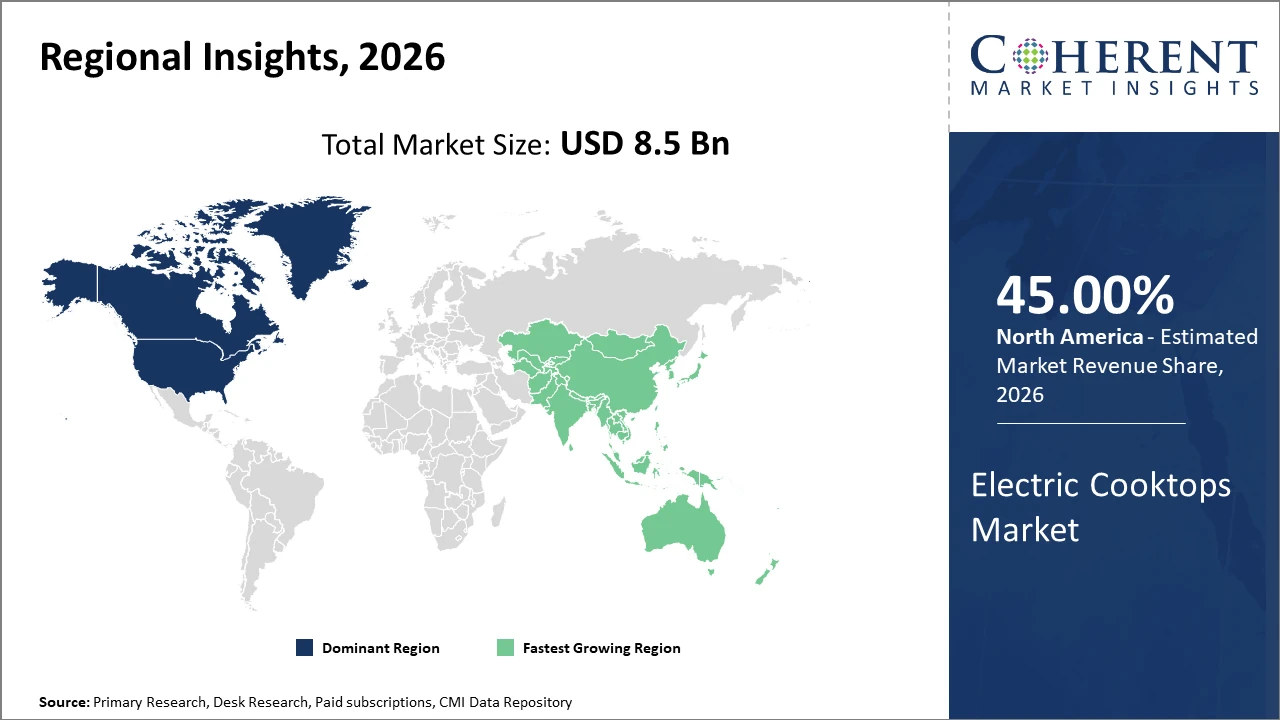
North America accounts for the largest regional market share of 45% due to strong adoption of smart kitchen technologies and a well-developed retail and e-commerce infrastructure.
Asia Pacific is projected to register the fastest growth, fueled by rapid urbanization, infrastructure expansion, rising disposable income, and increasing electricity access in rural and semi-urban regions.
Electric Cooktops Market Segmentation Analysis
Electric Cooktops Market Insights, By Product Type
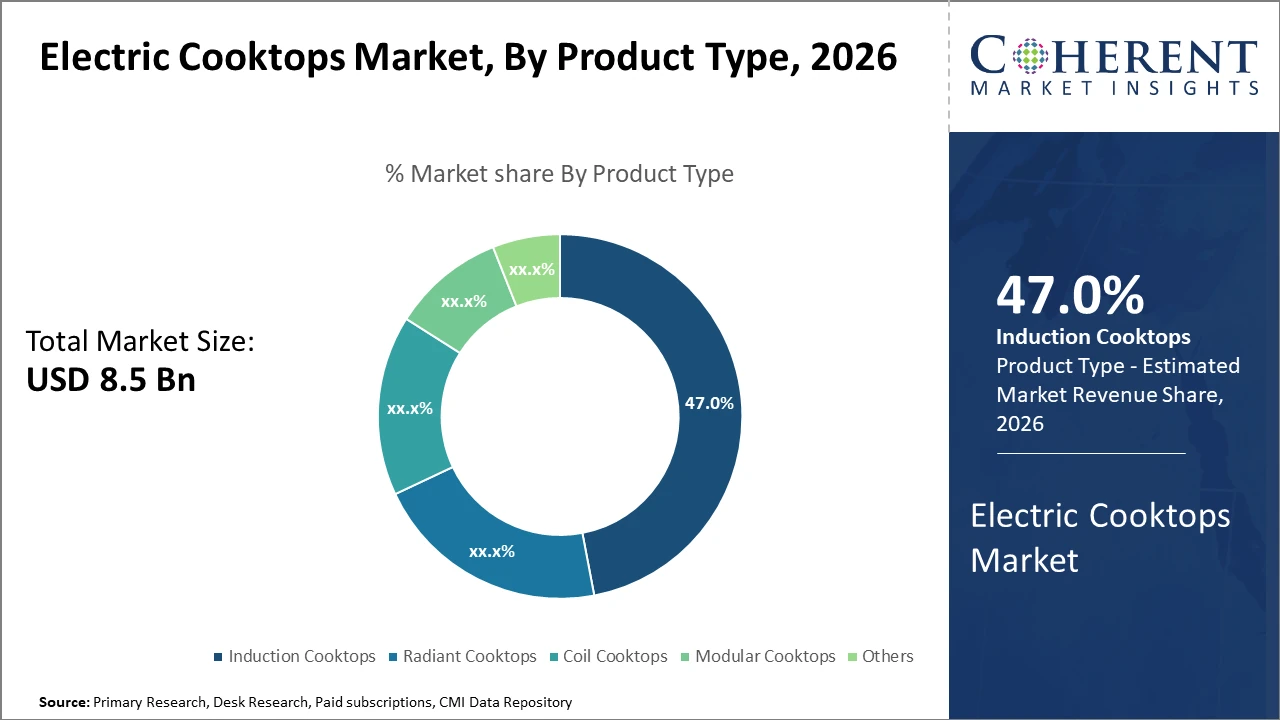
Induction Cooktops account for nearly 47% of the Electric Cooktops Market share due to their high energy efficiency, rapid heating performance, and precise temperature control features. Continuous technological advancements, including smart connectivity and touch-control systems, are further increasing their popularity among residential and commercial users. Radiant Cooktops remain widely adopted because of their uniform heat distribution and comparatively lower installation costs. Coil Cooktops continue to serve budget-conscious households seeking affordable cooking solutions. Modular Cooktops are emerging as the fastest-growing segment, driven by increasing demand for customizable and space-efficient kitchen designs in modern urban homes. Other categories include hybrid and specialty cooktops developed for specific cooking preferences and applications.
Electric Cooktops Market Insights, By Application
Residential applications hold the largest share of the Electric Cooktops Market due to increasing urbanization, rising disposable incomes, and growing investments in modern kitchen renovation projects. Demand is further supported by the adoption of smart electric cooktops featuring energy-efficient technologies and advanced safety functions aligned with regulatory standards. Commercial applications are the fastest-growing segment, driven by expanding hospitality, restaurant, and foodservice industries that prioritize operational efficiency, consistent heat distribution, and simplified maintenance. Portable electric cooktops continue gaining popularity among consumers seeking flexible cooking solutions for compact apartments, temporary housing, and outdoor usage. Other applications include industrial and specialized cooking environments that currently contribute a comparatively smaller market share.
Electric Cooktops Market Insights, By End User
Household users represent the largest share of the Electric Cooktops Market, supported by ongoing residential construction activities, rising home renovation projects, and increasing consumer preference for modern kitchen appliances. Continuous demand for energy-efficient and smart cooking technologies further strengthens this segment’s market dominance. The hospitality sector is the fastest-growing end-user category, driven by increasing investments in hotels, resorts, and restaurants adopting electric cooktops to improve energy efficiency, operational safety, and kitchen performance. The foodservice industry maintains stable demand due to regulatory compliance requirements and the need for efficient cooking systems. Other end users include educational institutions and government facilities, which are gradually contributing to overall market expansion.
Electric Cooktops Market Trends
The Electric Cooktops Market is increasingly driven by rising adoption of smart kitchen appliances and sustainability-focused consumer preferences.
Sales of smart induction cooktops featuring app-based controls and voice assistant integration increased by nearly 25% in 2025 due to growing demand for connected kitchen ecosystems.
Modular cooktops are gaining rapid popularity as consumers seek flexible and customizable kitchen layouts, with annual growth rates exceeding 10%.
Sustainability initiatives and stricter European energy-efficiency regulations contributed to approximately 14% growth in eco-friendly electric cooktop sales between 2024 and 2026.
Electric Cooktops Market Insights, By Geography
North America Electric Cooktops Market Analysis and Trends
North America dominates the Electric Cooktops Market due to high consumer purchasing power, widespread adoption of advanced home technologies, and a strong retail and e-commerce infrastructure. The United States contributes more than 35% of the regional market share, supported by growing demand for premium electric cooktops equipped with smart connectivity, touch controls, and energy-efficient features. Rising consumer preference for modern kitchen appliances and smart home integration continues to strengthen market growth. In addition, government regulations and incentive programs encouraging energy-efficient household appliances are accelerating adoption across residential and commercial sectors. Continuous product innovation by major appliance manufacturers further reinforces North America’s leading position in the global market.
Asia Pacific Electric Cooktops Market Analysis and Trends
The Asia Pacific Electric Cooktops Market is projected to witness the fastest growth, registering a CAGR exceeding 9% during the forecast period. Rapid urbanization, rising disposable incomes, and expanding middle-class populations are significantly increasing demand for modern kitchen appliances across the region. Growing electrification initiatives in rural and semi-urban areas, particularly in China and India, are further accelerating adoption of electric cooking solutions. Governments and private manufacturers are investing heavily in manufacturing infrastructure and smart appliance production capabilities to meet both domestic and export demand. Additionally, increasing awareness regarding energy-efficient cooking technologies and the popularity of compact urban housing continue to support strong market expansion across Asia Pacific.
Electric Cooktops Market Outlook for Key Countries
USA Electric Cooktops Market Analysis and Trends
The United States Electric Cooktops Market is experiencing strong growth due to increasing consumer preference for smart, energy-efficient kitchen appliances integrated with connected home ecosystems. In 2025, sales of smart electric cooktops featuring AI-enabled controls rose by nearly 20%, driven by compatibility with platforms such as Amazon Alexa and Google Assistant. Major manufacturers including Whirlpool Corporation and GE Appliances continue strengthening their market positions through continuous innovation and extensive service networks. Additionally, stricter energy efficiency and emission regulations are accelerating replacement of older gas cooktops, further boosting electric cooktop demand and market revenue.
Germany Electric Cooktops Market Analysis and Trends
Germany represents one of the most significant markets for electric cooktops in Europe due to strong consumer awareness regarding energy efficiency, sustainability, and environmentally friendly household appliances. By 2025, induction cooktops accounted for nearly 42% of total kitchen appliance sales in the country, reflecting rapid adoption of advanced cooking technologies. Leading manufacturers such as Bosch and Siemens have strengthened their market presence through the launch of energy-efficient induction cooktops featuring enhanced safety systems and smart controls. Supportive government incentives, well-developed retail networks, and rising demand for premium kitchen appliances continue to drive steady market growth in Germany.
Analyst Opinion
Induction cooktop production capacity increased by nearly 12% in 2025, supported by manufacturing expansions across East Asia and improved supply efficiency.
Premium smart electric cooktops recorded an average price increase of approximately 3% in 2024, while total market revenue grew by over 9% in 2025 due to strong sales volumes.
Adoption of electric cooktops in hospitality and commercial kitchens rose by nearly 15% in 2025 as businesses focused on energy efficiency and operational cost savings.
North American imports of high-end electric cooktops increased by around 18% in 2026, while Asia Pacific exports grew by nearly 10%, supporting global market expansion.
- Current Industry Events of 2026
- Market Size Estimation
- Regional Breakdown
- Competitive Landscape
- Customer Intelligence
- Segmental Analysis
- Pricing Analysis
- Key Market Drivers, Challenges & Future Trends
- Customized Insights Section
Market Scope
| Report Coverage | Details | ||
|---|---|---|---|
| Base Year: | 2025 | Market Size in 2026: | USD 8.5 billion |
| Historical Data for: | 2020 To 2024 | Forecast Period: | 2026 To 2033 |
| Forecast Period 2026 to 2033 CAGR: | 7.8% | 2033 Value Projection: | USD 14.3 billion |
| Geographies covered: |
| ||
| Segments covered: |
| ||
| Companies covered: | Samsung Electronics, Whirlpool Corporation, Electrolux, GE Appliances, Siemens, Panasonic, Miele, Haier, Falcon, Wolf | ||
| Growth Drivers: |
| ||
Electric Cooktops Market Growth Factors
The Electric Cooktops Market is experiencing strong growth driven by continuous technological advancements, including improvements in induction heating technology, smart connectivity, and IoT-enabled cooking features that enhance user convenience and energy efficiency. Rapid urbanization and rising disposable incomes across emerging economies are increasing adoption of modern kitchen appliances in residential applications. Additionally, strict environmental regulations related to energy consumption and carbon emissions are accelerating the transition from traditional gas cooktops to electric alternatives, particularly across Europe, where electrification of cooking solutions increased significantly in 2025. The expanding hospitality and foodservice industries are also contributing to market growth through rising demand for reliable, easy-to-maintain, and uniform-heat cooking appliances in commercial kitchens.
Electric Cooktops Market Development
In April 2026, Reurja introduced EFS (Electric Fire Stove), an advanced electric cooking system powered by German plasma technology, capable of reaching temperatures up to 1300°C for commercial and modern residential kitchens.
Key Players
Leading Companies of the Market
Samsung Electronics
Whirlpool Corporation
GE Appliances
Siemens
Falcon
Panasonic
Miele
Haier
Wolf
Electrolux
Leading companies in the Electric Cooktops Market are increasingly focusing on product innovation, smart technology integration, and distribution expansion to strengthen their competitive positioning. LG Electronics introduced a smart induction cooktop in early 2026 featuring AI-based temperature sensing technology, which enhanced consumer engagement and contributed to nearly 4% market share growth across North America. Meanwhile, Whirlpool Corporation collaborated with home automation platforms in 2025 to enable seamless smart-home connectivity and remote appliance control, driving premium residential segment sales growth of over 7%. Additionally, Bosch expanded its distribution network throughout Europe, resulting in approximately 12% revenue growth during 2024.
Electric Cooktops Market Future Outlook
The Electric Cooktops Market is expected to witness strong growth in the coming years due to increasing adoption of smart kitchen appliances, rising urbanization, and growing consumer preference for energy-efficient cooking solutions. Technological advancements such as AI-enabled controls, IoT integration, and modular induction systems will continue enhancing product appeal across residential and commercial applications. Expanding hospitality and foodservice industries are likely to accelerate demand for efficient and easy-to-maintain cooktops globally. Additionally, stricter environmental regulations promoting electrification and reduced carbon emissions will encourage replacement of conventional gas cooktops. Emerging economies in Asia Pacific are projected to offer significant growth opportunities through infrastructure development and rising disposable incomes.
Electric Cooktops Market Historical Analysis
The Electric Cooktops Market has evolved steadily over the past decades alongside advancements in household electrification, urban housing development, and modern kitchen appliance technologies. Initially dominated by basic coil and radiant cooktops, the market gradually shifted toward ceramic and induction technologies offering improved energy efficiency, safety, and cooking precision. Rising consumer awareness regarding convenience and environmental sustainability significantly accelerated adoption of electric cooking appliances globally. Expansion of smart home ecosystems further transformed the market with the introduction of connected cooktops featuring touch controls and IoT integration. Growth in residential construction, hospitality infrastructure, and disposable incomes across emerging economies has continuously strengthened long-term market demand and innovation.
Sources
Primary Research Interviews:
Electric cooktop manufacturers, kitchen appliance distributors, smart home technology providers, hospitality procurement managers, retail appliance chains, and commercial kitchen equipment suppliers involved in electric cooking appliance supply chains.
Electrical engineers, product designers, energy efficiency specialists, regulatory consultants, IoT integration experts, and R&D directors specializing in induction technologies, smart kitchen appliances, and energy-efficient cooking systems.
Magazines:
Appliance Design – Insights into kitchen appliance innovation, induction technology developments, and smart cooking solutions.
Kitchen & Bath Business – Coverage of modern kitchen trends, premium appliance adoption, and modular kitchen technologies.
Smart Homes Magazine – Updates on connected appliances, IoT-enabled kitchens, and intelligent cooking systems.
Journals:
International Journal of Home Appliances – Research on energy-efficient appliances, cooking technologies, and smart kitchen systems.
Journal of Consumer Electronics – Studies focused on connected kitchen devices, appliance performance, and user experience innovations.
Energy Efficiency Journal – Research related to sustainable appliances, energy consumption optimization, and eco-friendly household technologies.
Newspapers:
Financial Times – Coverage of consumer electronics investments, smart appliance market expansion, and manufacturing trends.
Reuters – Reporting on appliance technology launches, energy regulations, and consumer electronics industry developments.
Bloomberg – Insights into mergers, acquisitions, and strategic initiatives among global kitchen appliance manufacturers.
Associations:
Association of Home Appliance Manufacturers – Industry standards, appliance efficiency guidelines, and market research updates.
Consumer Technology Association – Insights into smart home technologies, connected appliances, and consumer electronics trends.
ENERGY STAR Program – Information on energy-efficient appliance standards, sustainability initiatives, and environmental compliance developments.
Get access to 250+ pages report
Every segment, forecast, competitor profile and data table behind the analysis above — available for instant download.
- ESOMAR Member
- ISO 9001:2015 Certified
- D-U-N-S Registered
- GDPR & CCPA Compliant
Missing comfort of reading report in your local language? Find your preferred language:
Transform your Strategy with Exclusive Trending Reports
Frequently Asked Questions
Leading companies in the Electric Cooktops Market include Samsung Electronics, Whirlpool Corporation, Falcon, Haier, and Electrolux, all of which maintain strong market positions through advanced product innovation and extensive distribution networks.
The Electric Cooktops Market is projected to grow from USD 8.5 billion in 2026 to USD 14.3 billion by 2033, registering a CAGR of 7.8% during the forecast period.
The residential segment remains the dominant end-user category, while the hospitality industry presents strong growth opportunities, supported by increasing electric cooktop adoption in commercial kitchens and hotels.
Future market trends will emphasize IoT integration, AI-enabled cooking systems, modular product designs, and sustainability-focused appliance technologies aimed at improving energy efficiency and consumer convenience.
The market is highly competitive, characterized by rapid innovation, pricing competition, and supply chain optimization efforts. Key challenges include rising raw material costs and the need to maintain technological differentiation in smart appliance features.
Major strategies include partnerships with smart home technology providers, product customization initiatives, expansion into emerging regional markets, and strengthening after-sales service networks to improve customer retention and brand loyalty.