

Electrical Enclosure Market Analysis & Forecast
Electrical Enclosure Market is estimated to be valued at USD 59.39 Bn in 2026 and is expected to reach USD 87.55 Bn in 2033, exhibiting a compound annual growth rate (CAGR) of 5.7% from 2026 to 2033. The Electrical Enclosure Market Size continues to grow rapidly due to strict safety regulations, infrastructure improvements, and industrial automation.
Key Takeaways
- According to Product Type, The Wall-Mounted Enclosures Category is anticipated to account for 42.6% share of the Electrical Enclosure market in 2026.
- According to region, North America holds the largest market share of 39.1% for Electrical Enclosure market growth by 2026.
Market Overview
There is increasing adoption of electrical enclosures across industries owing to their distinctive features like dust proofing, fire resistance and corrosion resistance. These enclosures provide protection for active electrical components from moisture, dust, oil, and other environmental threats. Rise in investments towards building smart infrastructure and growing focus on renewable energy tehcnologies are further augmenting the demand for high quality electrical enclosures. In addition, steady growth in industrial automation and stringent safety regulations are expected to propel the electrical enclosure market in the coming years.
For instance, in April 2025, Stellantis N.V. announced plans to introduce Leapmotor's electric vehicle lineup to the Indian market, according to a statement released from Pune on Friday. The move represents a significant expansion of the global automaker's electric vehicle strategy in India.
Current Events and Its Impact on the Electrical Enclosure Market
Event | Description and Impact |
Expansion of EV Charging Infrastructure |
|
Digitalization of European Energy Grids |
|
Pricing Analysis
Pricing in the electrical enclosure market is influenced by several factors, including material costs, technological advancements, and competitive dynamics. Major manufacturers maintain tight control over pricing, which pressures smaller players to reduce prices to remain competitive.
Fluctuating raw material costs, particularly for metals like steel and aluminum, also impact pricing structures. Additionally, the introduction of advanced features—such as corrosion resistance, modularity, and IoT-readiness—can command premium pricing, while standard enclosures face price compression due to commoditization. High initial costs and complex regulatory standards remain challenges for both buyers and sellers.
- Current Industry Events of 2026
- Market Size Estimation
- Regional Breakdown
- Competitive Landscape
- Customer Intelligence
- Segmental Analysis
- Pricing Analysis
- Key Market Drivers, Challenges & Future Trends
- Customized Insights Section
Role of Artificial Intelligence (AI)
Artificial intelligence is playing an increasingly significant role in the electrical enclosure market. AI-driven design and manufacturing tools, such as nVent HOFFMAN’s Design to Manufacturing (DTM) software, are optimizing enclosure design through 2D/3D digital workflows, reducing errors and enhancing efficiency.
AI is also being integrated into smart enclosures to enable predictive maintenance, real-time monitoring, and adaptive thermal management, which are essential for Industry 4.0 and IIoT applications. These advancements support the trend toward automation and operational efficiency, positioning enclosures as not just protective housings but as intelligent components within smart factories and infrastructure.
Consumer Preference and Unmet Demand
- Consumers in the electrical enclosure market increasingly prefer products that offer high durability, customization, and compliance with stringent safety and environmental regulations.
- There is a growing demand for enclosures that are waterproof, fire-resistant, and corrosion-proof, especially for applications in harsh environments such as offshore wind farms, water-treatment plants, and EV charging stations.
- The shift towards eco-friendly and repairable designs, using recycled or low-carbon materials, is also gaining traction, particularly in regions with strict sustainability mandates.
Segmental Insights
Electrical Enclosure Market Insights, by Product Type
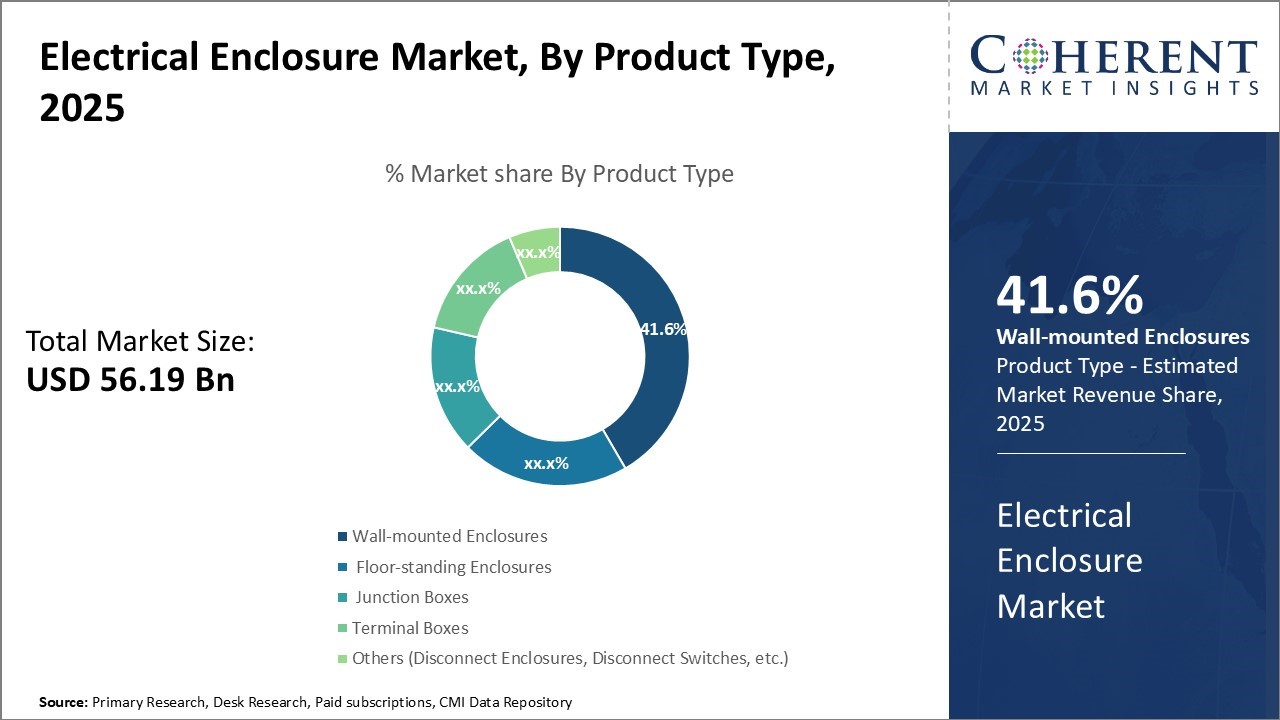
In terms of product type, the wall-mounted enclosures segment is expected to contribute 42.6% estimated share of the market in 2026 owing to their inherent reliability and cost benefits. As electrical and electronic systems continue to become more complex, the need for safely housing sensitive components from environmental factors like moisture, dust and temperature fluctuations has increased.
Wall-mounted enclosures provide sturdy, tamper-proof protection against such external intrusions at a lower total cost of ownership compared to alternatives. Their modular, pre-assembled design allows for quick and hassle-free installation with minimal on-site labor.
Maintenance is also simplified since components are easily accessible through door openings. These enclosures occupy minimal floor space, an important consideration in space-constrained industrial and commercial facilities. With standardized dimensions and construction, wall-mounted boxes facilitate interchangeability of spare parts. Their longevity results in reduced replacement and repurchase costs over the lifetime of protected assets.
Electrical Enclosure Market Insights, by Application
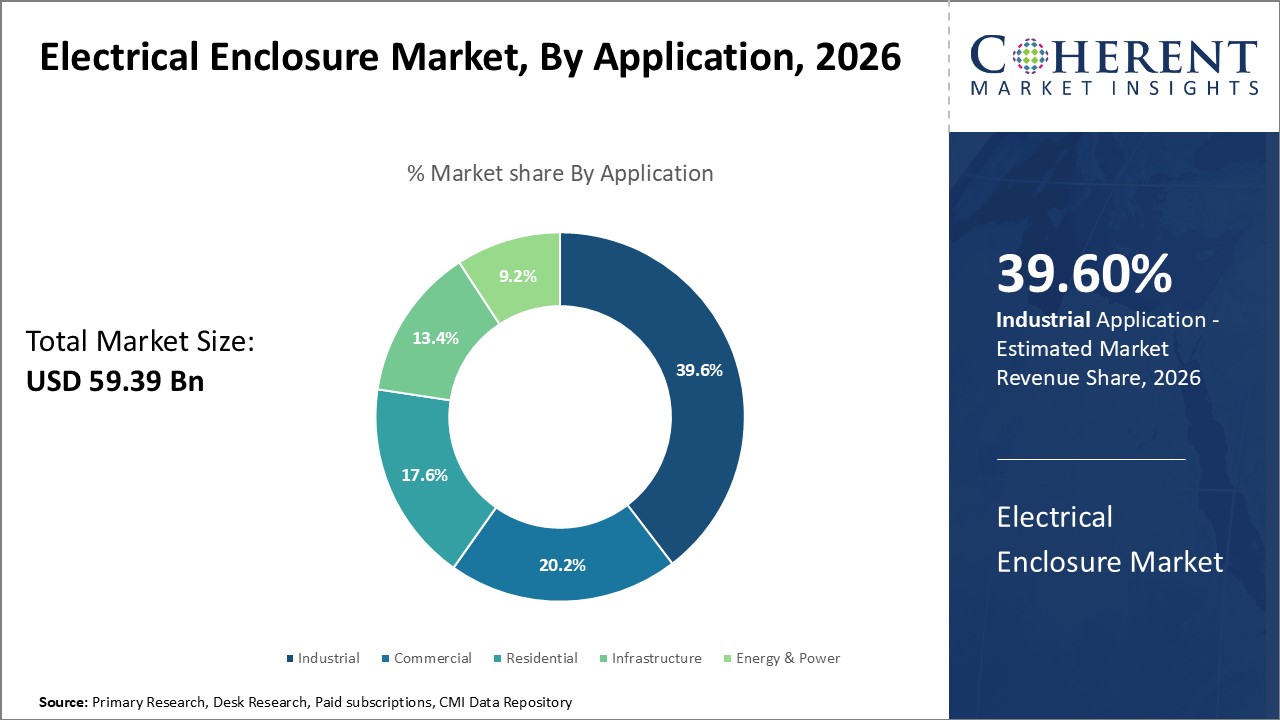
In terms of application, the industrial segment is expected to contribute 39.6% share of the market in 2026 due to the extensive utilization of electrical and electronic systems across a wide range of industrial processes and machinery. Robotic automation, industrial internet of things technologies and growing digitization within manufacturing have increased both the complexity and sensitivity of industrial control systems that require robust environmental shielding.
Safety is also a major concern in hazardous industrial environments involving chemicals, heavy machinery or flammable substances. Enclosures protect expensive programmable logic controllers, drives, switches and other control components from vibrations, dust, moisture, and temperature swings to ensure reliability of operations. Their tamper-proof locking mechanisms further prevent unauthorized access and adjustments. With industries constantly modernizing to improve productivity and output, demand for highly durable and securely enclosed control solutions remains steady.
Electrical Enclosure Market Insights, by End-use Industry
In terms of end-use industry, the manufacturing segment is expected to contribute 48.3% share of the market in 2026 due to its status as a major consumer of pre-fabricated electrical enclosures. With intense competitive pressures to reduce costs and accelerate manufacturing processes, industries are increasingly outsourcing enclosure fabrication work.
Specialized enclosure manufacturers can leverage economies of scale to mass produce customized enclosures faster and at lower unit prices compared to one-off fabrications at manufacturing plant sites. Prefabricated enclosures integrate all required mounting accessories and cutouts as per machinery specifications, saving assembly time. Their modular designs allow for future expansion of control systems without requiring new enclosures.
For quality-critical applications, third-party fabrication maintains consistently high production standards. These benefits are driving manufacturing end-users to widely adopt offsite prefabricated enclosure solutions for their plants across geographies.
Regional Insights
North America Electrical Enclosure Market
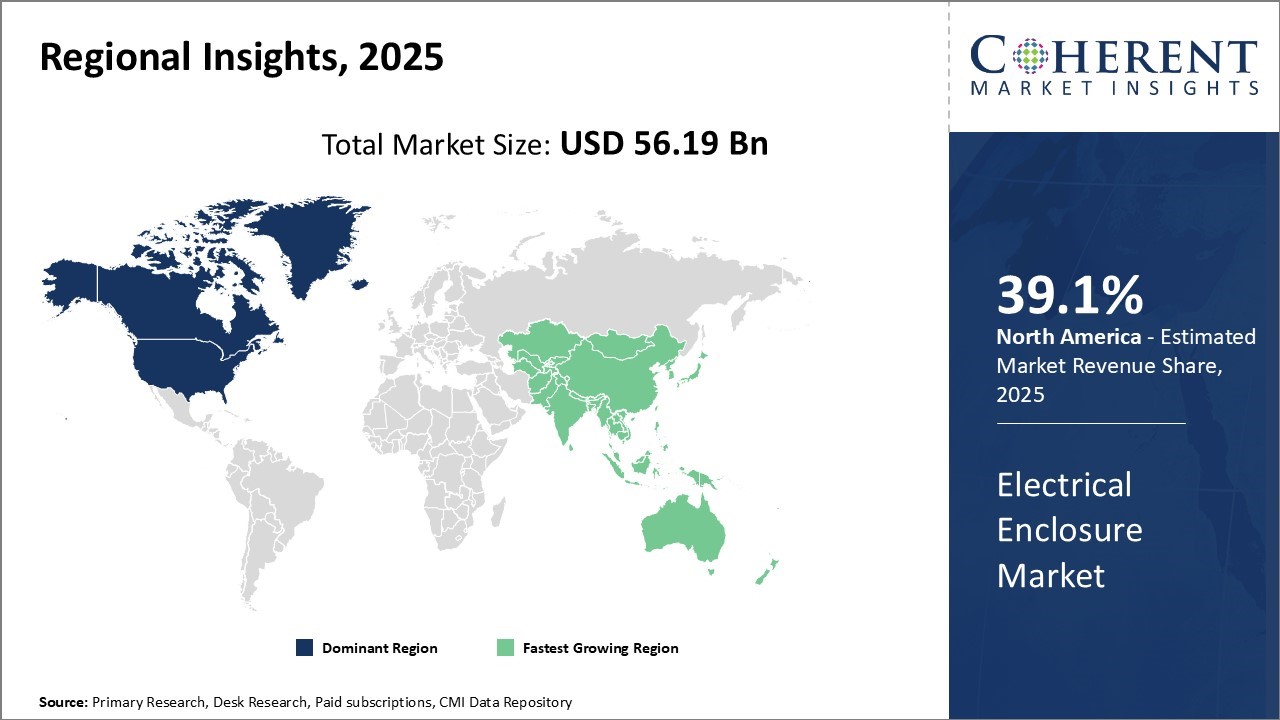
North America has established itself as the dominant regional market for electrical enclosures globally. The region is expected to account for 39.1% of the market share in 2026. The region enjoys a strong presence of leading enclosure manufacturers as well as robust industrial and infrastructure sectors that generates sustained demand for enclosures. With majority of world's data centers located in the U.S., there is growing need for enclosures that can withstand harsh and unpredictable server room environments. Moreover, ongoing investments in network upgrades by communication companies support the demand.
Stringent safety regulations regarding installation and maintenance of electrical equipment also drives the need for high-quality certified enclosures. Many national laboratories in the region approve and certify enclosures based on industry-defined testing standards, giving local manufacturers an edge over global competitors. In terms of pricing, enclosures in the North American market command a small premium owing to higher material and production costs compared to Asian counterparts. However, buyers willing to pay extra for additional protection, certification and reliability.
Asia Pacific Electrical Enclosure Market
The Asia Pacific region has emerged as the fastest growing regional market for electrical enclosures. Rapid industrialization and infrastructure growth and in developing countries such as China and India is the core growth driver. Factory expansions and establishment of new production plants require installation of control panels, switchgears, junction boxes and terminal boxes that fall under enclosures. Exposure trips installation of enclosures in harsh, dusty and humid environments in regions like Southeast Asia, necessitating use of corrosion-resistant and weatherproof variants.
Governments actively promote domestic manufacturing through PLI schemes and by mandating the use of locally made industrial goods and capital equipment. This has prompted global enclosure brands to set up local manufacturing plants to address the immense and sustained demand. Easy availability of low-cost labor and raw materials allow regional brands to maintain competitive pricing without compromising on quality and functionality. Enclosures priced 20-30.5% lower than U.S. counterparts gain rapid market acceptance. Growing exports to Europe and Americas indicates rising global competitiveness of Asian enclosure makers.
Electrical Enclosure Market In Europe
The market’s upward trajectory is further fueled by significant investments in smart grids, government initiatives for energy efficiency, and the integration of enclosures in telecommunications, transportation, and smart city projects.
Electrical Enclosure Market Dominating Countries
U.S Electrical Enclosure Market
The use of smart grids, the increase of renewable energy, and the requirement for strong electrical component protection in sectors including manufacturing, information technology, and energy are important growth drivers. Leading companies in this industry include Siemens, ABB, Legrand, Schneider Electric, and Emerson Electric. They provide both metallic and non-metallic enclosures that adhere to strict NEMA, IP, and IEC regulations. Future demand is also being shaped by the move toward IoT-enabled, real-time monitoring enclosures.
India Electrical Enclosure Market
India’s electrical enclosure market is experiencing strong growth, propelled by rapid urbanization, industrialization, and government initiatives to expand the power and energy sector. The country is investing heavily in infrastructure development, smart cities, and renewable energy projects, all of which require advanced electrical protection solutions.
Electrical Enclosure Market In China
China dominates the Asia-Pacific electrical enclosure market, driven by its status as a global manufacturing hub and its aggressive investments in industrial automation, renewable energy, and infrastructure upgrades.
Market Report Scope
Electrical Enclosure Market Report Coverage
| Report Coverage | Details | ||
|---|---|---|---|
| Base Year: | 2025 | Market Size in 2026: | USD 59.39 Bn |
| Historical Data for: | 2020 To 2024 | Forecast Period: | 2026 To 2033 |
| Forecast Period 2026 to 2033 CAGR: | 5.7% | 2033 Value Projection: | USD 87.55 Bn |
| Geographies covered: |
| ||
| Segments covered: |
| ||
| Companies covered: | ABB Ltd, Adalet, Austin Electrical Enclosures, Eaton Corporation, Eldon Holding AB, Emerson Electric Co., Hubbell Inc., Legrand SA, Pentair PLC, Rittal GmbH & Co. Kg, Schneider Electric SE, Siemens AG, nVent (Eldon Holdings), AZZ Inc., and TE Connectivity | ||
| Growth Drivers: | |||
| Restraints & Challenges: | |||
Electrical Enclosure Market: Growth Drivers
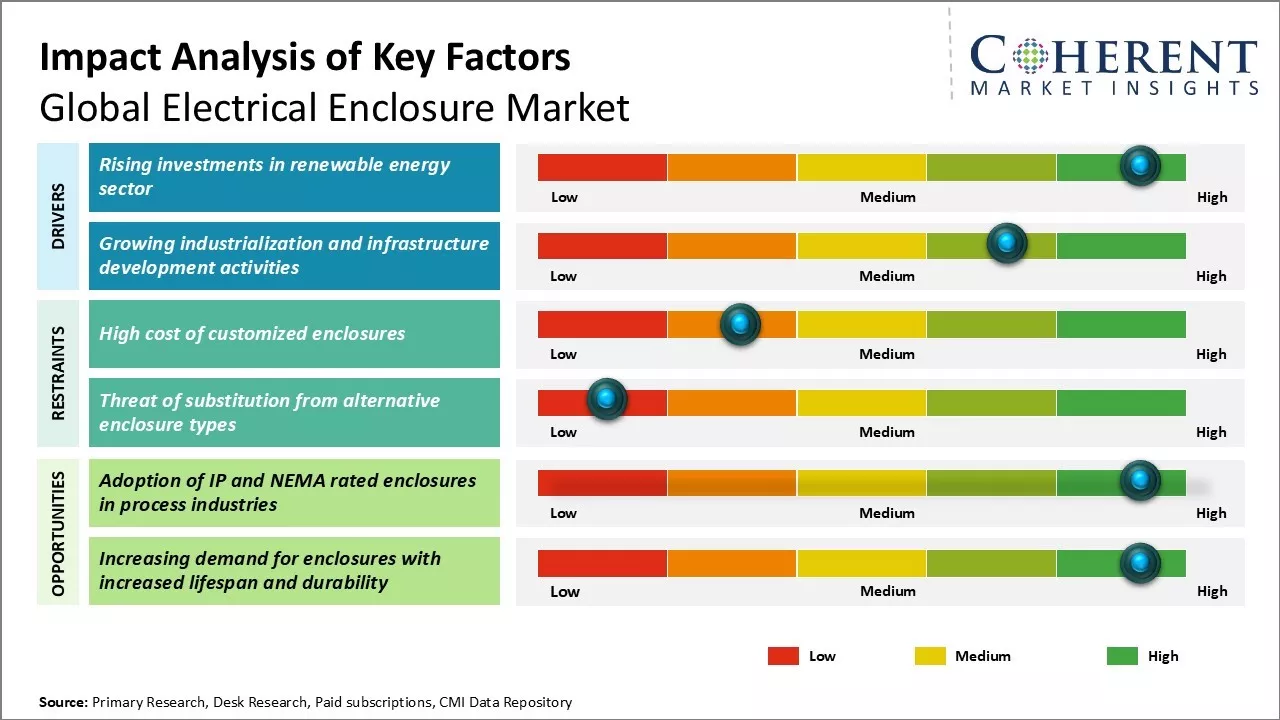
- Rising investments in renewable energy sector
The global push towards renewable energy sources is bringing large scale investments in solar and wind power generation capacities. Countries around the world have set ambitious targets to increase the share of renewables in their energy mix to reduce carbon emissions. Significant capital is being poured into developing utility scale solar and wind farms. As these projects require electrical enclosures to house various control equipment, power converters and switchgears, it is directly translating to increased demand.
Most solar and wind power projects are located away from urban centers making infrastructure development challenging. Therefore, electrical enclosures used for these projects need to be robust, weatherproof and able to withstand harsh environmental conditions. They house sophisticated monitoring and communication devices that relay critical performance data to control rooms.
Manufacturers are focusing on developing enclosures that meet the specialized functional and design requirements of renewable power producers. The growing commissioning of renewable capacities, especially in regions with high potential such as Asia Pacific and Europe, is a key driver promoting the electrical enclosures market growth.
- Growing industrialization and infrastructure development activities
Rising urbanization and population growth across developing economies are propelling large scale industrial and infrastructure development programs. Many countries are aggressively investing in highways, metros, airports, and power transmission networks to modernize their countries. Massive investments are also occurring in manufacturing facilities, oil & gas projects, data centers and telecom infrastructure. All these development initiatives place high demand for electrical enclosures to safeguard critical electronic components.
Furthermore, there is increasing focus on the maintenance and refurbishment of aging electrical infrastructure in developed markets. New technologies are also being inducted to upgrade existing industrial facilities and make them more energy efficient. This presents upgrade and retrofitting opportunities for electrical enclosure manufacturers.
The enclosures need to provide rugged design and meet certain IP protection ratings when installed in demanding industrial environments and outdoor applications subjected to dust, moisture and vibration. The ever-growing construction spending on industrialization and infrastructure globally is expected to drive steady requirement for robust and specialized electrical enclosures.
Electrical Enclosure Market: Trends
Significant trends in the electrical enclosure market are being influenced by changes in regulations, end-user demands, and technology advancements. The need for strong, adaptable enclosures that can protect delicate equipment from environmental dangers and operational interruptions is rising dramatically as a result of the implementation of industrial automation and smart factory projects.
Non-metallic and hybrid materials, including fiberglass and polycarbonate, are becoming more and more popular because of their affordability, exceptional corrosion resistance, and lightweight nature—especially in harsh or outdoor settings.
Electrical Enclosure Market: Opportunities
- Adoption of IP and NEMA Rated Enclosures in Process Industries
One of the prominent opportunities for the global electrical enclosure market is the growing adoption of IP and NEMA rated enclosures in process industries. Process industry facilities like oil & gas refineries, chemical plants, power plants, and manufacturing plants have stringent safety and reliability needs due to hazardous environmental conditions.
IP and NEMA rated electrical enclosures offer protection against dust, water, and corrosion. They help maintain the required internal temperature and prevent equipment failure in these tough industrial settings. With increasing investments into new process facilities globally, especially in developing regions, the demand for reliable and durable IP and NEMA rated enclosures is expected to rise substantially. Enclosures manufacturers can capitalize on this opportunity by developing product portfolios that cater specifically to the process industry niche.
Electrical Enclosure Market: Key Developments
- January 2025, Hammond Manufacturing has expanded its 1550Z series of rugged die-cast enclosures with the introduction of the IP68-rated 1550ZF range. This new series features flanged versions of all 18 sizes, designed for secure mounting on surfaces. The flanges are spot-welded to the base, ensuring a strong and smooth attachment point. The enclosures come in sizes ranging from 50mm x 45mm x 30mm to 223mm x 147mm x 83mm, with lid thicknesses varying from 5mm to 33mm, depending on the model.
- May 2025, Ledes, a trusted name in non-metallic conduit solutions, expands its portfolio with the introduction of conduit bodies and gang boxes. Engineered for performance, safety, and long-term durability, these new products are built to support modern electrical systems across residential, commercial, and industrial environments.
- August 2024, US compounder of engineering resins Polymer Resources has debuted its new unfilled, impact-modified polybutylene terephthalate (PBT) resin. The injection-molding-grade TP-FR-IM3 resin is intended for such electrical applications as outdoor, intermittent-outdoor, and indoor components like enclosures and housings.
Analyst Opinion
- The global electrical enclosure market is experiencing steady growth driven by increasing investments in infrastructure development and industrial automation across major regions. Rapid urbanization coupled with strengthening grid infrastructure in developing economies is fueling demand for outdoor electrical enclosures.
- Additionally, growing requirements for safe and secure operation of electrical equipment from industries such as oil & gas, energy, and manufacturing is propelling the market forward. However, high material costs associated with metal enclosures pose a challenge to market growth.
- The market is witnessing increasing adoption of fiberglass and polycarbonate enclosures as they provide superior corrosion resistance and operate at a lower total cost of ownership.
- North America currently dominates market revenue owing to widespread industrial activities and early adoption of industrial automation. However, Asia Pacific is likely to take over as the highest revenue generator due to the Chinese government's massive investments in power transmission and focus on industrial automation. Moreover, growing electronics and automotive industries in Southeast Asian countries are expected to boost the regional market.
- Demand for indoor enclosures is rising rapidly with increasing deployment of intelligent switches and relays for applications ranging from access control to environmental monitoring.
- Market players are thriving on opportunities from custom outdoor enclosures demand for applications in solar energy generation and electric vehicle charging stations. They are actively introducing innovative enclosure designs with IP66/IP67 ratings and modular structures to capture the growing demand.
Speak to the analyst
Want personalized insights?
Take the findings above to one of our principal consultants, or have the report rebuilt around the segments, geographies and competitors you actually track.
Market Segmentation
- By Product Type (Revenue, USD Bn, 2021 - 2033)
- Wall-mounted Enclosures
- Floor-standing Enclosures
- Junction Boxes
- Terminal Boxes
- Others (Disconnect Enclosures, Disconnect Switches, etc.)
- By Application (Revenue, USD Bn, 2021 - 2033)
- Industrial
- Commercial
- Residential
- Infrastructure
- Energy & Power
- By End-use Industry (Revenue, USD Bn, 2021 - 2033)
- Manufacturing
- Construction
- Energy & Utilities
- IT & Telecom
- Others (Transportation, Healthcare, etc.)
- By Region (Revenue, USD Bn, 2021 - 2033)
- North America
- U.S.
- Canada
- Latin America
- Brazil
- Argentina
- Mexico
- Rest of Latin America
- Europe
- Germany
- U.K.
- Spain
- France
- Italy
- Russia
- Rest of Europe
- Asia Pacific
- China
- India
- Japan
- Australia
- South Korea
- ASEAN
- Rest of Asia Pacific
- Middle East
- GCC Countries
- Israel
- Rest of Middle East
- Africa
- South Africa
- North Africa
- Central Africa
- North America
- Key Players Insights
- ABB Ltd
- Adalet
- Austin Electrical Enclosures
- Eaton Corporation
- Eldon Holding AB
- Emerson Electric Co.
- Hubbell Inc.
- Legrand SA
- Pentair PLC
- Rittal GmbH & Co. Kg
- Schneider Electric SE
- Siemens AG
- nVent (Eldon Holdings)
- AZZ Inc.
- TE Connectivity
Sources
Primary Research interviews
- Procurement Managers – Electrical Equipment Manufacturers
- Product Design Engineers – OEMs and Panel Builders
- Facility Managers – Industrial Plants
- Distributors – Electrical Components
- Consultants – Industrial Automation
- Maintenance Heads – Data Centers & Utilities
- Project Engineers – Renewable Energy Projects
Databases
- IEEE Xplore
- ThomasNet
- TechNavio Knowledge Store
- IBISWorld
- GlobalData
Magazines
- Electrical Business
- Electrical Contractor
- EC&M (Electrical Construction & Maintenance)
- Industrial Equipment News (IEN)
- Power & Motion
Journals
- IEEE Transactions on Industry Applications
- Journal of Electrical Engineering & Technology
- Electric Power Systems Research
- International Journal of Electrical Power & Energy Systems
- Journal of Industrial Engineering and Management
Newspapers
- The Economic Times – Energy Section
- The Hindu Business Line – Industry/Power
- Financial Times – Energy & Utilities
- Business Standard – Infrastructure
- Mint – Manufacturing & Energy
- Nikkei Asia – Electronics & Automation
Associations
- National Electrical Manufacturers Association (NEMA)
- International Electrotechnical Commission (IEC)
- Institute of Electrical and Electronics Engineers (IEEE)
- Electrical Safety Foundation International (ESFI)
- International Association of Electrical Inspectors (IAEI)
- European Committee for Electrotechnical Standardization (CENELEC)
- Automation Federation
Proprietary Elements
- CMI Data Analytics Tool, Proprietary CMI Existing Repository of information for last 8 years
*Definition: An electrical enclosure is a cabinet, box, or housing specifically designed to protect electrical or electronic equipment—such as switches, circuit breakers, control panels, and other sensitive components—from environmental hazards and accidental contact.
Get access to 250+ pages report
Every segment, forecast, competitor profile and data table behind the analysis above — available for instant download.
- ESOMAR Member
- ISO 9001:2015 Certified
- D-U-N-S Registered
- GDPR & CCPA Compliant
Missing comfort of reading report in your local language? Find your preferred language:
Transform your Strategy with Exclusive Trending Reports
Frequently Asked Questions
The Electrical Enclosure Market size is estimated to be valued at USD 59.39 Bn in 2026, and is expected to reach USD 87.55 Bn by 2033.
The CAGR of the global Market is projected to be 5.7% from 2026 to 2033.
Rising investments in renewable energy sector and growing industrialization and infrastructure development activities are the major factors driving the growth of the global market.
High cost of customized enclosures and threat of substitution from alternative enclosure types are the major factors hampering the growth of the global market.
In terms of product type, wall-mounted enclosures segment is estimated to dominate the market revenue share in 2026.
ABB Ltd, Adalet, Austin Electrical Enclosures, Eaton Corporation, Eldon Holding AB, Emerson Electric Co., Hubbell Inc., Legrand SA, Pentair PLC, Rittal GmbH & Co. Kg, Schneider Electric SE, Siemens AG, nVent (Eldon Holdings), AZZ Inc., and TE Connectivity are the major players.
North America is expected to lead the global electrical enclosure industry.