

Head Mounted Display (HMD) Market Size And Share Analysis - (2026 to 2033)
The Global Head-mounted Display (HMD) Market was valued at USD 36.55 Bn in 2026 and is expected to reach USD 521.82 Bn by 2033, growing at a ( CAGR) of 46.2% between 2026 and 2033.
Key Takeaways
- Based on Component, the Eyewear Display – Micro-Display segment is expected to capture the highest share of the market in 2026, driven by the surge in AR/VR eyewear adoption across gaming, entertainment, healthcare, and enterprise training.
- Based on Application, the Video Gaming & Entertainment segment is projected to hold the greatest share of the market in 2026, driven by the explosive adoption of virtual reality (VR) headsets, immersive gaming experiences, and content advancements.
- Based on Region, North America is set to lead the global Head-mounted Display (HMD) market in 2026 with a 36% share. While, Asia Pacific is estimated to be the fastest growing region.
Market Overview
A head-mounted display is an electronic wearable device, mounted on a head that includes a small display optic near the eye. The display optic projects a virtual environment in front of the user’s eyes. The screens used in the head-mounted display are liquid crystal displays (LCDs) since they are compact, efficient, and lightweight. The Head-mounted Display (HMD) market demand is growing rapidly due to its wide applications in military, gaming, medical, sports, training and simulation, engineering, etc. The virtual reality headsets used in gaming and other applications are HMDs combined with inertial measurement unit (IMU). Furthermore, optic head-mounted display (OHMD) is a wearable display that can reflect projected images and enables the user to see through it.
Current Events and their Impact on the Head-mounted Display (HMD) Market
Current Event | Description and its Impact |
Enterprise Digital Transformation and Hybrid Work Revolution |
|
Market Leadership Shifts and New Player Competition |
|
Role of Artificial Intelligence (AI) in the Head-mounted Display (HMD) Market
AI in the Head-mounted Display (HMD) Market is transforming user experiences by enabling real-time environment mapping, gesture recognition, and predictive analytics. Artificial intelligence enhances immersive applications in gaming, healthcare, industrial training, and military simulations by optimizing graphics rendering, motion tracking, and object detection. The integration of AI-driven algorithms improves personalization, safety, and interactive functionality, driving Head-mounted Display (HMD) Market demand.
For instance, in June 2025, Sphere Technology Holdings partnered with Vuzix Corporation to integrate its AI-powered mixed reality platform into Vuzix M400 and M4000 smart glasses. This collaboration enables frontline workers to access hands-free workflows, real-time decision-making, and immersive experiences. The platform supports Microsoft Teams integration, workflow automation, and content management, aiming to enhance operational efficiency and worker safety across industries such as manufacturing, healthcare, automotive, and defense.
- Current Industry Events of 2026
- Market Size Estimation
- Regional Breakdown
- Competitive Landscape
- Customer Intelligence
- Segmental Analysis
- Pricing Analysis
- Key Market Drivers, Challenges & Future Trends
- Customized Insights Section
Segmental Insights
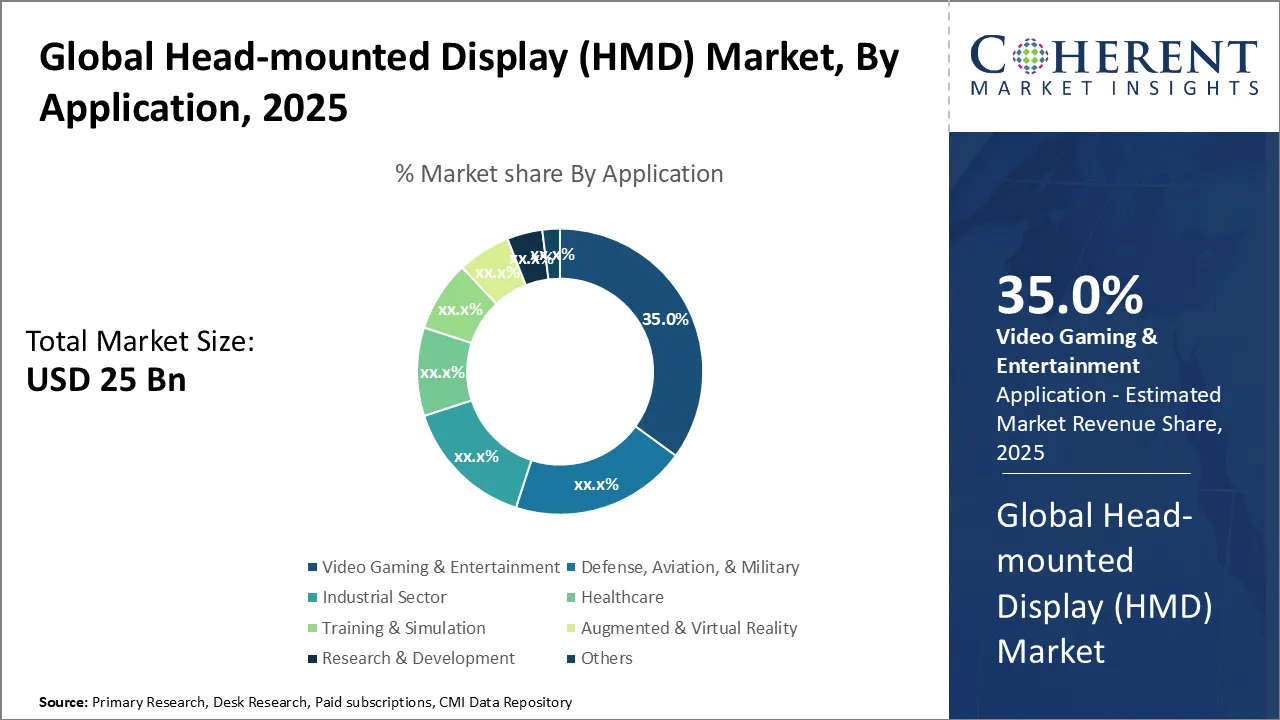
Head-mounted Display (HMD) Market Insights, By Application, Video Gaming & Entertainment is Fueled by Immersive VR Adoption and Booming Esports Demand
In terms of application, the video gaming and entertainment segment is projected to account of the greatest share of the market in 2026, driven by the explosive adoption of virtual reality (VR) headsets, immersive gaming experiences, and content advancements supported by platforms such as PlayStation VR, Meta Quest, and HTC Vive. The surge in eSports, online gaming, and consumer demand for realistic, interactive experiences further consolidates this segment’s leading position compared to industrial, defense, or healthcare applications.
For instance, in January 2025, Sony unveiled a new spatial content creation system featuring a high-quality XR head-mounted display and dedicated controllers for interacting with 3D objects. Designed for immersive experiences, the system enables creators to intuitively manipulate virtual environments for gaming, entertainment, design, and education, highlighting Sony’s push to bridge the physical and digital worlds.
-market-by-component.webp "Head-mounted Display (HMD) Market, By Component")
Head-mounted Display (HMD) Market Insights, By Product, Eyewear Display is Driven by Its Lightweight Design and Widespread Adoption in Gaming, Healthcare, And Industrial Applications
In terms of product, the eyewear display segment is expected to capture the largest share of the market in 2026, driven by the massive adoption of virtual reality (VR) and augmented reality (AR) headsets in gaming, entertainment, healthcare training, industrial simulation, and education. Eyewear displays are lightweight, compact, and more comfortable for prolonged use compared to helmet-mounted systems, making them the preferred choice for both consumer and enterprise applications.
For instance, in August 2025, Meta unveiled its latest augmented reality (AR) innovation, the Hypernova AR glasses, paired with a wristband controller. This new system offers a more immersive and intuitive AR experience, allowing users to interact seamlessly with digital environments. The wristband enhances gesture recognition, providing precise control without the need for external devices. Meta aims to redefine user interaction in the AR space with this advanced technology.
Head-mounted Display (HMD) Market Insights, By Component, Eyewear Display – Micro-Display is Driven By AR/VR Adoption Across Gaming, Healthcare, and Enterprise Training
In terms of component, the eyewear display segment and within that the micro-display sub-segment are projected to hold the highest share of the market in 2026, driven by the surge in AR/VR eyewear adoption across gaming, entertainment, healthcare, and enterprise training, where compact micro-displays deliver high-resolution visuals, lightweight form factors, and immersive experiences. Tech giants such as Meta, Sony, and Apple are fueling demand with next-gen AR/VR headsets, making eyewear micro-displays the market leader.
For instance, in May 2025, Samsung Electronics unveiled a significant advancement in augmented reality (AR) technology with the launch of its next-generation microdisplays for AR glasses. This move positions Samsung to compete with industry leaders like Apple and Sony in the rapidly evolving AR market. The new microdisplays aim to enhance user experience with improved performance and efficiency.
Regional Insights
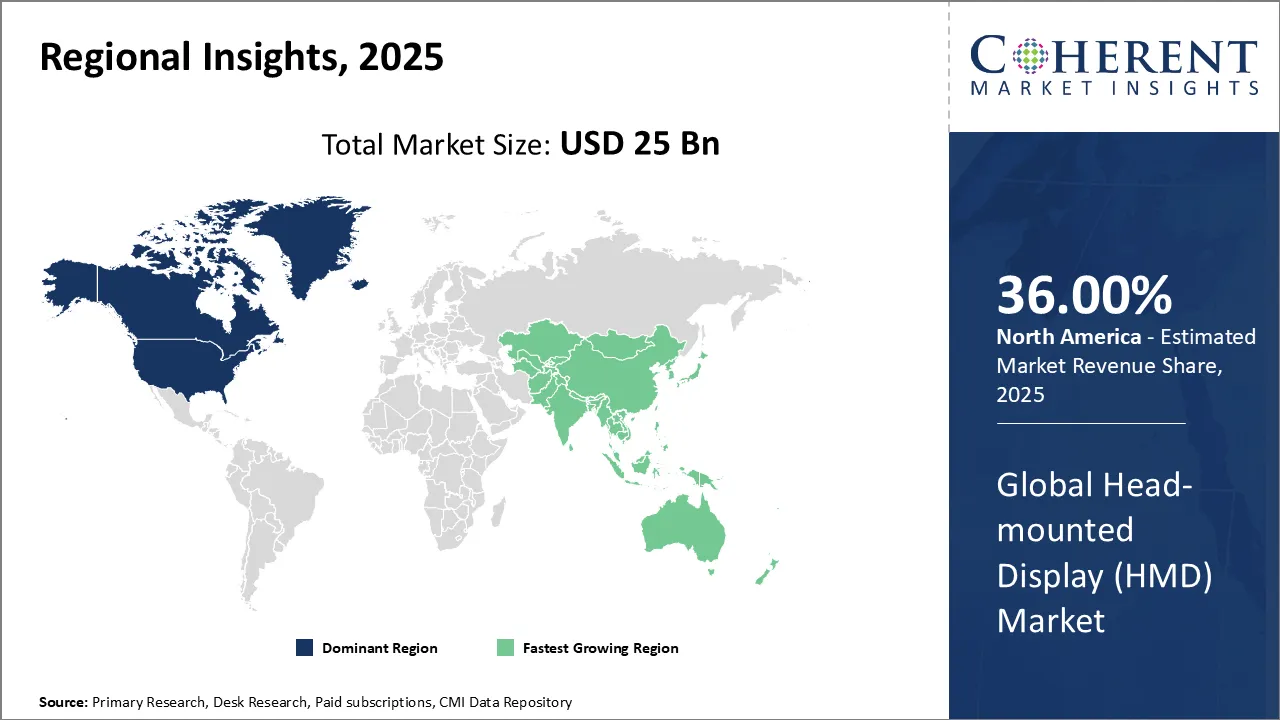
North America Head-mounted Display (HMD) Market Analysis & Trends
The North America region is projected to lead the market with a 36% share in 2026, driven by strong adoption of AR/VR in gaming, defense training, and healthcare simulations. The region’s advanced R&D ecosystem, high consumer spending on immersive technologies, and government defense modernization programs fuel demand. Additionally, growing integration of HMDs in industrial training and medical procedures strengthens market growth.
For instance, in January 2026, Kopin Corporation secured a USD 2 million follow-on order for its Brillian™ microdisplays, enhancing helmet-mounted display systems for both rotary and fixed-wing aircraft. These high-brightness displays, exceeding 34,000 nits, are utilized in platforms like the F-15, F-16, F/A-18 jets, and CH47F and UH-60 helicopters. The contract underscores Kopin's role in advancing mission-critical aviation technologies.
Asia Pacific Head-mounted Display (HMD) Market Analysis & Trends
The Asia Pacific region is expected t exhibit the fastest growth in the market in 2026, due to rapid adoption of virtual and augmented reality technologies across gaming, healthcare, education, and industrial training sectors. Strong investments in electronics manufacturing, increasing smartphone penetration, and supportive government initiatives for digital innovation in countries like China, Japan, and South Korea are further driving market growth in the region.
For instance, in August 2026, FunIT Inc., a South Korean innovator in AI and XR fitness technology, introduced KOach AI in Thailand and Malaysia. This AI-powered Mixed Reality boxing system combines a vision camera, MR head-mounted display, and real-time coaching algorithm to provide instant feedback on form, speed, and accuracy without wearables. The system's pre-motion coaching feature aims to reduce injury risks by up to 45%.
Head-mounted Display (HMD) Market Outlook Country-Wise
The U.S. Head-mounted Display (HMD) Market Trends
The United States shows strong Head-mounted Display (HMD) market demand, driven by gaming, healthcare, military, and industrial applications. HMDs are used for immersive VR gaming, surgical simulations, military training, and industrial visualization. Early adoption of innovative technologies, robust infrastructure, and a tech-savvy population further accelerate market growth, making the U.S. a key contributor to global HMD demand.
For instance, in September 2026, Anduril Industries secured a USD 159 million contract from the U.S. Army to develop a helmet-mounted mixed reality system under the Soldier Borne Mission Command (SBMC) program. This initiative aims to enhance situational awareness by integrating night vision, augmented reality, and AI-driven command tools into a unified platform. The system is designed to improve decision-making and battlefield clarity, addressing issues faced by previous systems like Microsoft's IVAS.
South Korea Head-mounted Display (HMD) Market Trends
South Korea drives Head-mounted Display (HMD) market demand due to high consumer adoption of VR/AR devices and a strong gaming culture. Government initiatives promoting immersive technologies, digital infrastructure, and smart applications further support growth. The tech-savvy population and widespread high-speed internet enable rapid adoption of HMDs across gaming, education, healthcare training, and industrial sectors.
For instance, in September 2026, Samsung introduced first extended reality (XR) head-mounted display, codenamed "Project Moohan,". The device will run Google's Android XR operating system and is expected to feature Qualcomm's Snapdragon XR2+ Gen 2 chipset, eye and hand tracking, and immersive mapping capabilities. It will be available first in the South Korean market.
Market Report Scope
Head-mounted Display (HMD) Market Report Coverage
| Report Coverage | Details | ||
|---|---|---|---|
| Base Year: | 2025 | Market Size in 2026: | USD 36.55 Bn |
| Historical Data for: | 2020 To 2024 | Forecast Period: | 2026 To 2033 |
| Forecast Period 2026 to 2033 CAGR: | 46.2% | 2033 Value Projection: | USD 521.82 Bn |
| Geographies covered: |
| ||
| Segments covered: |
| ||
| Companies covered: | Sensics Corporation, Sony Corporation, Recon Instruments, Kopin Corporation, Thales Visionix, Inc., Oculus VR, Rockwell Collins, Inc., eMagin Corporation, Google Inc., Lockheed Martin, Japan Display Inc., and Seiko Epson Corporation. | ||
| Growth Drivers: |
| ||
| Restraints & Challenges: |
| ||
Market Dynamics
Head-mounted Display (HMD) Market Driver
Increasing Expenditure on Defense Equipment and Personnel
Rising defense budgets worldwide are driving the adoption of advanced training and operational technologies, boosting Head-mounted Display (HMD) market growth. Military organizations increasingly use HMDs for simulation-based training, battlefield visualization, situational awareness, and mission planning. The ability to provide immersive, real-time virtual environments enhances soldier readiness while reducing training costs and risks. Continuous investments in defense infrastructure, personnel modernization, and cutting-edge combat technologies further accelerate the deployment of helmet-mounted and eyewear-based HMD systems in armed forces globally.
Rising Consumer Preference for Sophisticated Wearable Devices
Growing consumer interest in advanced wearable technologies is fueling the Head-mounted Display (HMD) Market research. Users increasingly prefer HMDs that offer high-resolution displays, lightweight design, enhanced comfort, and integrated features like AI-based motion tracking and augmented reality. This trend is particularly strong in gaming, virtual reality entertainment, industrial training, and healthcare applications, where immersive and interactive experiences drive adoption. Manufacturers are responding with innovative, user-friendly devices that cater to evolving consumer expectations, boosting overall market growth.
Analyst Opinion (Expert Opinion)
The head-mounted display market value is undergoing a structural realignment that separates commodity consumer VR from mission-critical enterprise and defence wearables. Hardware advances (lighter optics, higher on-device compute), platform consolidation around a small set of silicon and OS standards, and an emerging bifurcation in buyer intent will determine winners and losers over the next three years.
The consumer segment remains volume-sensitive and content-dependent. Standalone devices built on a common hardware stack (notably Qualcomm’s Snapdragon XR family) have driven much of the recent consumer activity by lowering system complexity for OEMs and enabling richer mixed-reality features on mid-price devices. Qualcomm’s XR2 variants now power the bulk of standalone HMDs, with the XR2+ roadmap materially expanding per-eye resolution and camera counts to enhance passthrough and AR/VR convergence.
Enterprise and defence procurement are shifting from speculative experimentation to targeted ROI deployments. The U.S. Army’s Integrated Visual Augmentation System (IVAS) program — originally tied to Microsoft HoloLens and now involving Anduril — illustrates how large government contracts can transform supplier trajectories despite consumer market volatility.
A visible inventory correction among major players is reshaping commercial strategies. Sony’s PS VR2, after stronger-than-expected initial shipments, has faced demand challenges that prompted aggressive pricing adjustments and manufacturing pauses. Similarly, Apple’s Vision Pro, despite its technological leadership, is scaling back production to align with actual demand for ultra-premium mixed reality. These developments highlight a broader reality: cutting-edge hardware alone cannot secure adoption without accessible pricing, compelling use cases, and socially acceptable form factors.
Speak to the analyst
Want personalized insights?
Take the findings above to one of our principal consultants, or have the report rebuilt around the segments, geographies and competitors you actually track.
Recent Developments
- In August, 2025, Vuzix Corporation unveiled its LX1 smart glasses, purpose-built for warehouse operations. Designed for rugged durability and hands-free functionality, the LX1 offers a 10-hour battery life, a Sony OLED color HD display, and a Qualcomm processor. Manufactured by Quanta Computer, the LX1 is expected to begin sampling shortly, with production and general availability anticipated before the end of 2025.
- In January 2025, Siemens and Sony unveiled a transformative mixed reality engineering solution at CES 2025, combining Siemens’ NX software with Sony’s XR head-mounted display (SRH-S1). This collaboration enables engineers to interact with high-fidelity 3D CAD models in immersive environments, enhancing design reviews and collaboration.
Market Segmentation
- Global Head-mounted displays (HMD) Market, By Component (Revenue, USD Bn, 2021 - 2033)
- Helmet-Mounted Display
- Micro-Display
- Head Tracker
- Camera
- Connectivity
- Combined Mirror
- Control Unit
- Helmet
- Accessories
- Eyewear Display
- Micro-Display
- Goggle
- Head Tracker
- Controller
- Connectivity
- Battery
- Accessories
- Helmet-Mounted Display
- Global Head-mounted displays (HMD) Market, By Application (Revenue, USD Bn, 2021 - 2033)
- Defence, Aviation & Military
- Industrial Sector
- Augmented & Virtual Reality
- Research & Development
- Healthcare
- Video Gaming & Entertainment
- Training & Simulation
- Others
- Global Head-mounted displays (HMD) Market, By Region (Revenue, USD Bn, 2021 - 2033)
- North America
- U.S.
- Canada
- Latin America
- Brazil
- Argentina
- Mexico
- Rest of Latin America
- Europe
- Germany
- U.K.
- Spain
- France
- Italy
- Russia
- Rest of Europe
- Asia Pacific
- China
- India
- Japan
- Australia
- South Korea
- ASEAN
- Rest of Asia Pacific
- Middle East
- GCC Countries
- Israel
- Rest of Middle East
- Africa
- South Africa
- North Africa
- Central Africa
- North America
- Global Head-mounted displays (HMD) Market Companies
- Sony Corporation
- Recon Instruments
- Kopin Corporation
- Thales Visionix, Inc.
- Oculus VR
- Rockwell Collins, Inc.
- eMagin Corporation
- Google Inc.
- Lockheed Martin
- Japan Display Inc.
- Seiko Epson Corporation
Sources
Primary research — Interviews
Interviews with stakeholders across leading global markets to gather demand signals, deployment drivers, procurement criteria, technical requirements, and content/UX priorities.
- Commercial display manufacturers — product roadmaps, component sourcing, supply-chain constraints, panel choices for HMD ecosystems.
- AV integrators & AV consultants (corporate, education, healthcare) — system design, integration challenges, cost drivers, standardization.
- Signage installers & mall/retail fit-out contractors — on-site installation constraints, environmental requirements, retrofitting work.
- Facility & operations managers (transport hubs, malls, campuses) — operational readiness, maintenance cycles, uptime/SLA expectations.
- Digital content managers & advertising/media managers at DOOH agencies and mall operators — content formats, measurement/KPIs, ad monetization for HMD/AR overlays.
- Procurement heads (retail, hospitality, transport authorities) — purchase decision criteria, TCO expectations, vendor evaluation.
- Digital transformation leads at retail chains — (examples to interview: Reliance Retail, Carrefour, Best Buy) — use-cases, pilot programs, shopper experience KPIs.
- Facility and operations managers at transport hubs — (examples: Heathrow, Chhatrapati Shivaji Maharaj Int’l Airport, JFK) — passenger flow use-cases, durability, certification needs.
- IT infrastructure heads at hospitality & hotel groups — (examples: Marriott, Taj Hotels, Accor) — network/edge compute requirements, privacy/security concerns.
- AV consultants and integrators in corporate & education sectors — procurement cycles, lifecycle planning, AV-IT convergence.
- Product managers at display technology OEMs and component suppliers — (panel makers, touch module suppliers) — roadmap for micro-LED/OLED, optical engines, sensors.
Secondary / Quantitative databases
Trade, import/export, and macro datasets for sizing, regional flows, and component trade patterns.
- World Trade Organization (WTO) — trade statistics and tariff information.
- UN Comtrade Database — HS-code based import/export volumes for displays, optics, sensors.
- Ministry of Electronics and Information Technology (MeitY), India — policy, production & incentives for electronics/HMDs.
- Bureau of Economic Analysis (U.S.) — industry output and ICT spending benchmarks.
- Eurostat — EU production, trade and ICT usage statistics.
- China Customs Statistics — export volumes, port-level flows for display components.
- Korea Customs Service Data Portal — component trade (Korea → global).
- Japan External Trade Organization (JETRO) — trade & industry briefs relevant to display and optics.
- Directorate General of Commercial Intelligence and Statistics (DGCIS), India — national commodity flows and historical series.
Industry magazines & trade press
Technical features, product launches, deployment case studies, and integrator interviews.
- AV Magazine
- Installation International
- Digital Signage Today
- InAVate
- Systems Contractor News (SCN)
- Display Daily
- TechRadar Pro (Commercial Display section)
- Future Store Guide
Academic & technical journals
Peer-reviewed research, technology maturity, optics and human factors study relevant to HMDs.
- Journal of Display Technology
- IEEE Transactions on Consumer Electronics
- Displays (Elsevier)
- Journal of Visual Communication and Image Representation
- Journal of Retailing and Consumer Services (for retail adoption & shopper behaviour)
Major newspapers & business press
Market context, large contracts, M&A, supply-chain and macro trends.
- The Wall Street Journal — Tech & Media coverage
- The Economic Times — Technology & Industry (India)
- The Hindu Business Line — Consumer Tech & Retail
- Financial Times — AV & display industry reporting
- Nikkei Asia — electronics supply chain and manufacturing trends
- South China Morning Post — regional tech & manufacturing coverage
Industry associations & standards bodies
Standards, roadmaps, events, and member research.
- Society for Information Display (SID)
- International Sign Association (ISA)
- AVIXA (Audiovisual and Integrated Experience Association)
- Digital Signage Federation (DSF)
- Consumer Technology Association (CTA)
- Confederation of Indian Industry (CII) — Electronics & Display Panel Forum
- Display Industry Council (Japan)
Public-domain government & institutional sources
Regulatory, standards, incentives, and investment information.
- Ministry of Electronics and IT (Government of India) — policy & incentive documents
- National Institute of Standards and Technology (NIST), U.S. — measurement/standards guidance relevant to displays/optics
- Ministry of Economy, Trade and Industry (METI), Japan — industry programmes
- U.S. International Trade Commission (USITC) — trade remedy and industry reports
- NITI Aayog — technology adoption and policy frameworks (India)
- India Investment Grid — electronics sector investment projects
- EU Single Market Observatory — digital media & market reports
- Reserve Bank of India (RBI) reports — macro/retail sector indicators where relevant
Proprietary / internal data elements (to cite as internal sources)
- CMI Data Analytics Tool, and Proprietary CMI Existing Repository of information for last 8 years
Get access to 250+ pages report
Every segment, forecast, competitor profile and data table behind the analysis above — available for instant download.
- ESOMAR Member
- ISO 9001:2015 Certified
- D-U-N-S Registered
- GDPR & CCPA Compliant
Missing comfort of reading report in your local language? Find your preferred language:
Transform your Strategy with Exclusive Trending Reports
Frequently Asked Questions
The Global Head-mounted Display (HMD) Market was valued at USD 36.55 Bn in 2026 and is expected to reach USD 521.82 Bn by 2033, growing at a CAGR of 46.2% between 2026 and 2033.
The Market is expected to witness a CAGR of 46.2% during the forecast period (2026-2033).
Rising consumer preference for sophisticated wearable devices is one of the major factors that is expected to propel the growth of the market over the forecast period
In the Market, by application segment Video Gaming & Entertainment dominated the global head-mounted display (HMD) market
Among regions, North America held a dominant position in the market in 2026, and is expected to retain its dominance over the forecast period.
Major players operating in the market include Sensics Corporation, Sony Corporation, Recon Instruments, Kopin Corporation, Thales Visionix, Inc., Oculus VR, Rockwell Collins, Inc., eMagin Corporation, Google Inc., Lockheed Martin, Japan Display Inc., and Seiko Epson Corporation.