

New Zealand Air Purifier Market Size and Forecast – 2026 to 2033
The New Zealand Air Purifier Market is estimated to be valued at USD 9.8 Mn in 2026 and is expected to reach USD 19.4 Mn by 2033, exhibiting a compound annual growth rate (CAGR) of 10.2% from 2026 to 2033.
Key Takeaways
- By Technology, High-Efficiency Particulate Air (HEPA) acquired the prominent share of 46.8% in 2026 as rising pollution levels & indoor air quality concerns.
- By End User, Commercial hold the largest market share in 2026 owing to its indoor air quality concerns in high-traffic commercial spaces.
- By Distribution Channel, E-commerce channel dominates the overall market share in 2026 owing to the convenience, accessibility & variety.
Market Overview
New Zealand's air purifier market continues to grow as consumers prioritize cleaner indoor air due to rising pollution from wood-burning stoves, and vehicle emissions. Residential, commercial, and institutional buyers are actively driving the air purifier demand, especially for HEPA-based purifiers. E-commerce platforms enhance product accessibility, while tech-savvy users favor smart and energy-efficient models. Urban development, widespread respiratory issues, and supportive government actions further fuel the market, encouraging both local and international brands to expand their presence across the country.
Current Events and their Impact on the New Zealand Air Purifier Market
Current Events | Description and its impact |
Macro-Level Event: Global Supply Chain Disruptions |
|
Nano-Level Event: Localized Wildfire and Air Pollution Episodes |
|
Emergence of Smart and IoT-Enabled Air Purifiers |
|
End-user Feedback and Unmet Needs in the New Zealand Air Purifier Market
- Effectiveness and Reliability: Users appreciate HEPA filters’ strong performance but seek clearer information on long-term effectiveness and maintenance requirements to ensure consistent air quality improvement.
- Noise Levels: Many end-users find some air purifiers noisy, especially in quiet environments like bedrooms or offices, highlighting the need for quieter operation without sacrificing efficiency.
- Current Industry Events of 2026
- Market Size Estimation
- Regional Breakdown
- Competitive Landscape
- Customer Intelligence
- Segmental Analysis
- Pricing Analysis
- Key Market Drivers, Challenges & Future Trends
- Customized Insights Section
Role of Artificial Intelligence (AI) in Air Purifier Industry
AI is transforming the air purifier industry by enabling smarter, more efficient performance. AI-powered purifiers can automatically monitor indoor air quality in real time and adjust fan speeds or modes accordingly, optimizing energy use and filtration. Advanced sensors and machine learning algorithms allow these devices to detect specific pollutants, allergens, and odor sources, ensuring targeted purification. AI also supports predictive maintenance, alerting users to filter cleaning or servicing needs before performance drops.
In June 2025, Samsung Electronics released the Infinite AI Air Purifier, designed to reduce waste with a reusable, washable dust filter that doesn’t require regular replacement. It also includes a photocatalytic deodorization filter that breaks down odors using UV light and can be reused through UV Regeneration Mode. The purifier conserves energy by automatically turning off the fan when air quality improves, cutting energy use by up to 54%.
Segmental Insights
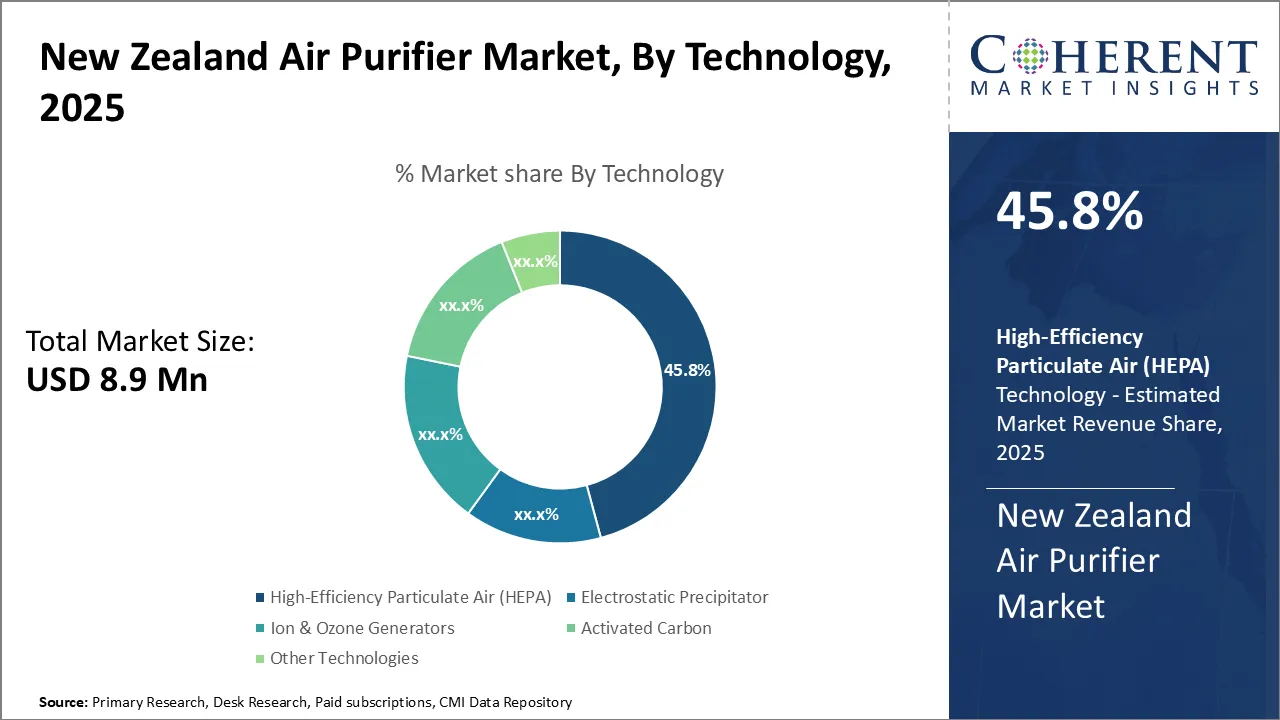
New Zealand Air Purifier Market Insights, By Technology: High-Efficiency Particulate Air (HEPA) contribute the highest share of the market owing to its awareness of VOCS, allergens & smart features.
High-Efficiency Particulate Air (HEPA) acquired the prominent share of 46.8% in 2026. Consumers in New Zealand are increasingly choosing HEPA-based air purifiers as concerns about indoor air pollution grow, particularly from wood-burning stoves, vehicle emissions, and industrial sources. Rising cases of asthma and allergies are pushing households and businesses to adopt effective air filtration solutions. Urban development and higher living standards are also encouraging the use of advanced purification technologies. At the same time, manufacturers continue to improve HEPA systems, boosting their appeal across residential, commercial, and institutional spaces. For instance, Kent RO Systems launched its new in-car air purifier, the Kent Magic Car Air Purifier. The company claims that Kent Magic effectively removes allergens, viruses, dust, odors, chemicals, and other pollutants from vehicles. It uses HEPA (High Efficiency Particulate Arrestor) dust collection technology and features a built-in ionizer to maintain fresh air inside the car.
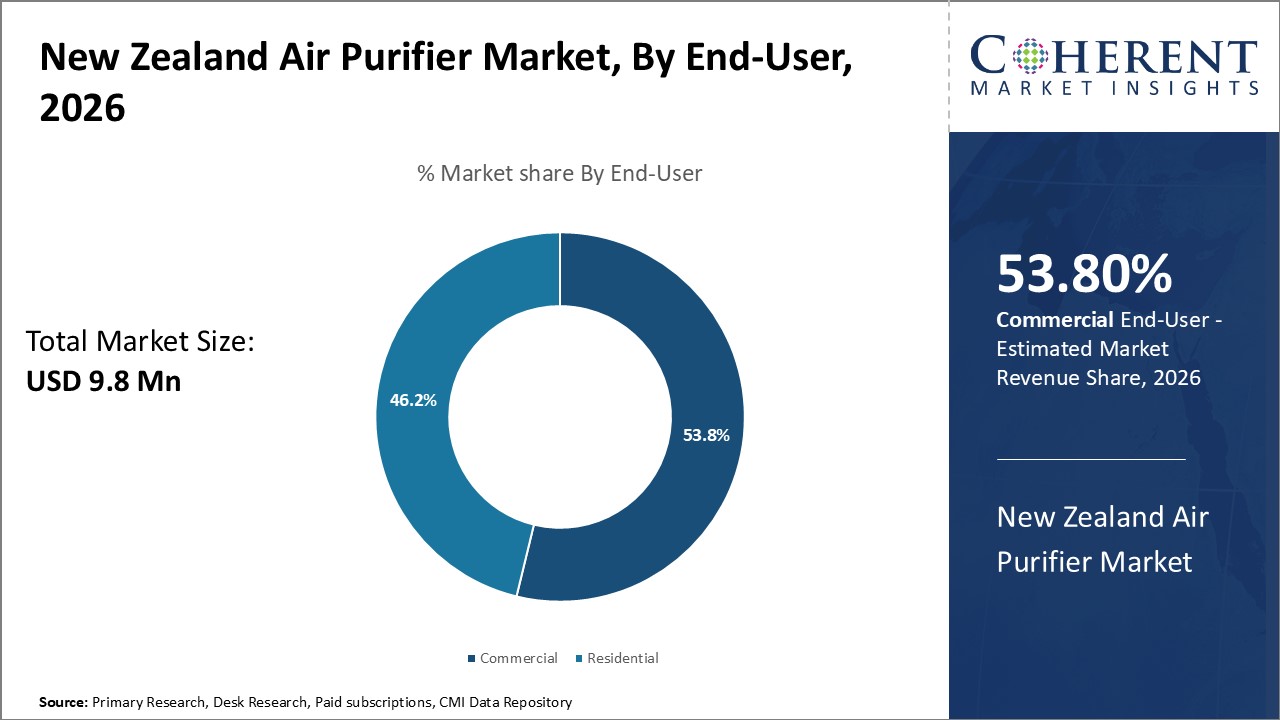
New Zealand Air Purifier Market Insights, By End-User: Commercial contribute the highest share of the market owing to its air pollution triggers—wood burning, traffic, industry
Businesses in New Zealand are driving growth in the commercial air purifier market share by prioritizing cleaner indoor environments to safeguard the health of employees and customers. Offices, hospitals, schools, and hospitality venues are actively installing air purifiers to eliminate airborne pollutants and allergens. Government bodies are supporting this shift through initiatives that promote air quality, while ongoing urban development and the rising demand for smart, high-capacity systems are motivating commercial sectors to adopt advanced purification technologies.
For instance, in September 2024, Blueair, a pioneer in the air wellness industry, formed a groundbreaking partnership with Lanaco, a New Zealand company specializing in wool filter technology. Together, they aim to develop a new range of high-performance electrostatic filters made from wool and plant fibers, setting a major milestone in the industry.
New Zealand Air Purifier Market Insights, By Distribution Channel: E-commerce contributes the highest share of the market owing to its rising internet & mobile penetration
Consumers in New Zealand are fueling growth in the air purifier market through e-commerce by enjoying greater convenience, a wider product selection, and competitive prices. They use online platforms to compare models, read reviews, and make informed purchases from home. According to an article published by the International Trade Administration, around 65% of online shoppers in New Zealand research online before making a significant purchase. Moreover, the increasing internet and smartphone usage, combined with flexible payment options like buy now, pay later, encourages more online shopping. Retailers, both local and international, are enhancing delivery services and promoting eco-friendly products, making e-commerce the preferred channel for buying air purifiers.
Market Report Scope
New Zealand Air Purifier Market Report Coverage
| Report Coverage | Details | ||
|---|---|---|---|
| Base Year: | 2025 | Market Size in 2026: | USD 9.8 Mn |
| Historical Data for: | 2020 To 2024 | Forecast Period: | 2026 To 2033 |
| Forecast Period 2026 to 2033 CAGR: | 10.2% | 2033 Value Projection: | USD 19.4 Mn |
| Geographies covered: |
| ||
| Segments covered: |
| ||
| Companies covered: | Honeywell International Inc., Koninklijke Philips N.V., LG Electronics, Filtercorp International Limited, Fellowes Brands, Breathing Better NZ Ltd, Blueair AB, Daikin Industries, Ltd., Dyson Ltd., Sharp Corporation, Winix Co., Ltd., Xiaomi Corporation, Molekule | ||
| Growth Drivers: |
| ||
| Restraints & Challenges: |
| ||
New Zealand Air Purifier Market Trend
- Rising Demand for Smart Air Purifiers
Consumers in New Zealand increasingly prefer smart air purifiers featuring app connectivity, voice control, and real-time air quality monitoring. These devices offer convenience through remote operation and personalized settings, catering to tech-savvy buyers. Integration with home automation systems is also growing, enhancing user experience. Manufacturers are focusing on innovation to meet these demands, blending efficiency with digital features that enable better control over indoor air quality.
New Zealand Air Purifier Market Opportunity
- Growth Potential in Commercial and Institutional Markets
New Zealand’s offices, schools, healthcare facilities, and hospitality venues offer untapped potential for advanced air purification solutions. Businesses increasingly prioritize air quality to ensure employee health and safety. Providing high-capacity, smart, and customizable units tailored to large indoor spaces can capture the air purifier market demand. Collaborating with facility managers and government bodies can create awareness and incentivize investments in commercial-grade air purifiers.
New Zealand Air Purifier Market News
- In September 2024, Blueair, a pioneer in air wellness, advances its mission of providing clean air for future generations by partnering with Lanaco, a wool filter company based in New Zealand. Together, they are leading the industry’s first initiative to create high-performance electrostatic filters made from wool and plant fibers.
- In October 2024, Versuni, formerly Philips Domestic Appliances, launched a new range of air purifiers in India. The company claims these purifiers combine powerful performance and energy efficiency with modern design to meet diverse user needs while ensuring a quiet and clean indoor environment.
- In July 2025, Coway, South Korea's leading wellness tech company, has introduced the Airmega 50 to the Asia Pacific market—the most compact model in its popular Airmega air purifier series. With this launch, Coway brings premium air purification to everyday spaces, emphasizing portability, high performance, and peace of mind.
Analyst Opinion (Expert Opinion)
- The New Zealand air purifier market is poised for transformative growth, but success will hinge on brands’ ability to address unique local challenges and consumer behaviors rather than merely riding global trends. Despite relatively low urban pollution compared to international megacities, indoor air quality issues in New Zealand are disproportionately driven by specific sources such as widespread wood-burning heating and increasing vehicular emissions in growing urban centers like Auckland and Wellington. For instance, a 2023 Ministry for the Environment report highlighted that particulate matter from domestic wood burners contributes significantly to winter smog episodes, pushing consumers to seek effective HEPA filtration solutions.
- However, the market’s real growth driver is evolving consumer sophistication. Unlike early adopters focused primarily on basic filtration, today’s New Zealand buyers demand intelligent, energy-efficient devices with seamless smart home integration. Brands like Dyson and Xiaomi have capitalized on this shift by offering app-enabled air purifiers with real-time air quality monitoring—features now becoming standard expectations. Ignoring this tech-savvy consumer base risks commoditizing products and undermining brand loyalty.
- E-commerce’s rapid expansion further intensifies competitive dynamics. Platforms such as Trade Me and Mighty Ape have lowered entry barriers for new and international players, pressuring established brands to enhance value beyond price—through superior after-sales service, transparent filter replacement programs, and localized warranties.
- Moreover, sustainability is no longer optional. New Zealand consumers are increasingly eco-conscious, demanding products that minimize environmental impact, from energy-efficient operation to recyclable filters and sustainable packaging. Brands failing to align with this trend risk alienating a critical segment of buyers and missing out on government incentives promoting green technologies.
Speak to the analyst
Want personalized insights?
Take the findings above to one of our principal consultants, or have the report rebuilt around the segments, geographies and competitors you actually track.
Market Segmentation
- By Technology (Revenue, USD Mn, 2021 - 2033)
- High-Efficiency Particulate Air (HEPA)
- Electrostatic Precipitator
- Ion & Ozone Generators
- Activated Carbon
- Other Technologies
- By End-user (Revenue, USD Mn, 2021 - 2033)
- Commercial
- Residential
- By Distribution Channel (Revenue, USD Mn, 2021 - 2033)
- E-commerce Channel
- Retail
- Key Players Insights
- Honeywell International Inc.
- Koninklijke Philips N.V.
- LG Electronics
- Filtercorp International Limited
- Fellowes Brands
- Breathing Better NZ Ltd
- Blueair AB
- Dyson Ltd.
- Sharp Corporation
- Winix Co., Ltd.
- Xiaomi Corporation
- Molekule
Sources
Primary Research Interviews
- Interviews with New Zealand-based manufacturers, distributors, and retailers of air purifiers
- Discussions with healthcare professionals and indoor air quality experts
- Consumer surveys conducted across major cities like Auckland, Wellington, and Christchurch
Databases
- New Zealand Ministry for the Environment data portal
- New Zealand Customs and Trade Statistics
- Statistics New Zealand (Stats NZ)
- New Zealand Health Survey datasets
Magazines
- Home & Garden New Zealand
- New Zealand Product Review
- Consumer NZ Magazine
- Eco-Business Magazine
Journals
- New Zealand Medical Journal
- Journal of Environmental Health
- Australasian Journal of Allergy and Clinical Immunology
- Journal of Air Quality, Atmosphere & Health
Newspapers
- The New Zealand Herald
- Stuff.co.nz
- Otago Daily Times
- The Dominion Post
Associations
- New Zealand Allergy & Asthma Association
- Indoor Air Quality Association New Zealand
- Environmental Protection Authority (EPA) New Zealand
- Heating, Ventilation and Air Conditioning (HVAC) New Zealand
Public Domain Sources
- Government of New Zealand publications and reports on air quality
- Ministry of Health public health advisories and guidelines
- Local council environmental monitoring reports
- Consumer product safety recalls and standards information
Proprietary Elements
- CMI Data Analytics Tool, and Proprietary CMI Existing Repository of information for last 8 years
Get access to 250+ pages report
Every segment, forecast, competitor profile and data table behind the analysis above — available for instant download.
- ESOMAR Member
- ISO 9001:2015 Certified
- D-U-N-S Registered
- GDPR & CCPA Compliant
Missing comfort of reading report in your local language? Find your preferred language:
Transform your Strategy with Exclusive Trending Reports
Frequently Asked Questions
The global New Zealand Air Purifier Market size was valued at USD 9.8 Mn in 2026 and is expected to reach USD 19.4 Mn in 2033.
The demand for air purifiers is rising sharply as consumers increasingly prioritize indoor air quality and health, driven by pollution concerns and heightened awareness post-pandemic.
The market is expected to witness a CAGR of 10.2% during the forecast period (2021-2027).
The increasing pollution levels and health issue is expected to drive growth of the market during the forecast period.
Commercial segment held the largest market share, as air purifiers are used in various commercial applications such as offices, schools, restaurants shopping malls, hospitals, conference centers, and other facilities. These air purifiers are deployed in offices to maintain indoor air quality, as poor air quality can hamper employees health and overall productivity of the business.
Key players operating in the market include Honeywell International Inc., Koninklijke Philips N.V., LG Electronics, Filtercorp International Limited, Fellowes Brands, Breathing Better NZ Ltd, Blueair AB, Dyson Ltd., Sharp Corporation, Winix Co., Ltd., Xiaomi Corporation, Molekule.