

Global Air Purifier Market Size and Forecast – 2026-2033
The Global Air Purifier Market is estimated to be valued at USD 19.47 Bn in 2026 and is expected to reach USD 34.24 Bn by 2033, exhibiting a compound annual growth rate (CAGR) of 8.4% from 2026 to 2033.
Key Takeaways of the Air Purifier Market
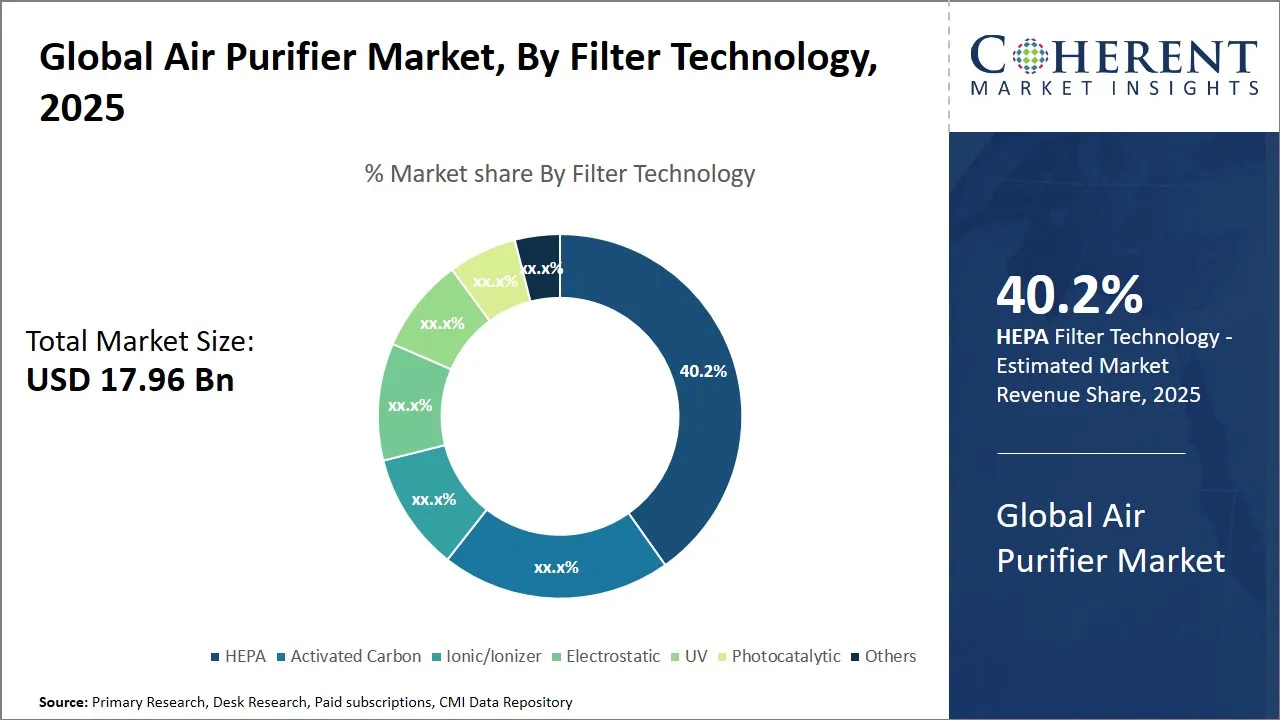
- The HEPA segment leads the market holding an estimated share of 41.2 % in 2026.
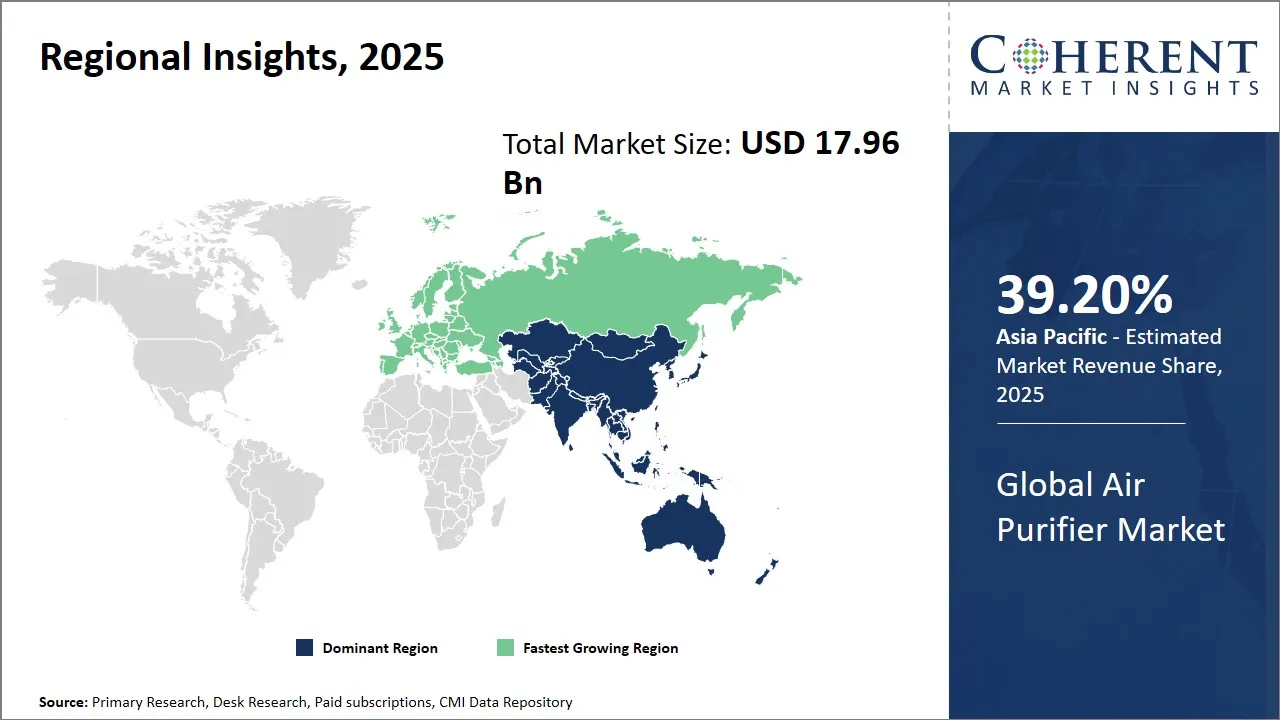
- Asia Pacific is estimated to lead the market with a share of 39.2 % in 2026.
- Europe, holding a share of 22.9% in 2026, is projected to be the fastest growing region.
Market Overview
The market is seeing a strong shift towards smart and energy-efficient air purifiers with advanced filtration technologies such as High-Efficiency Particulate Air (HEPA) and activated carbon filters. Integration of IoT and AI for real-time monitoring and improved user experience is also being seen. Also, the increase in demand from emerging economies, coupled with growing environmental regulations, is adding to product adoption.
Current Events and Its Impact
Current Events | Description and its impact |
Geopolitical and Trade Developments |
|
Economic and Infrastructure Trends |
|
Segmental Insights
- Current Industry Events of 2026
- Market Size Estimation
- Regional Breakdown
- Competitive Landscape
- Customer Intelligence
- Segmental Analysis
- Pricing Analysis
- Key Market Drivers, Challenges & Future Trends
- Customized Insights Section
Global Air Purifier Market Insights, by Filter Technology – Superior Filtration Efficiency and Growing Health Awareness are Driving HEPA Segment Growth
HEPA is expected to contribute the highest share of 41.2% in the market in 2026. HEPA filters trap at least 99.97% of particles as small as 0.3 microns, making them very effective against pollutants such as dust, pollen, pet dander, mold spores, and even some bacteria and viruses. This filtration capacity makes HEPA technology a preferred choice among consumers looking for reliable indoor air purification.
Rising concerns related to respiratory issues, allergies, and airborne diseases have compelled consumers to adopt advanced air purification solutions. HEPA filters effectively address these health concerns by significantly improving indoor air quality, thus making environments safer for vulnerable populations such as children, the elderly, and individuals with pre-existing respiratory conditions.
Moreover, the widespread adoption of HEPA technology in healthcare settings, including hospitals and clinics, reinforces its credibility and encourages usage in residential and commercial spaces. Its proven efficacy in reducing airborne contaminants has led to regulatory recommendations in environments demanding high air quality standards, further boosting market demand.
Technological advancements have also enhanced HEPA filter efficiency, durability, and integration into compact, aesthetically designed air purifiers. The ability to combine HEPA with other purification techniques such as activated carbon filters for odor removal and UV lights for microbial disinfection enhances overall performance, increasing consumer preference for HEPA-based products.
Additionally, urbanization trends and escalating pollution levels in rapidly growing cities amplify the need for effective air purification. Given HEPA’s established reputation and performance, consumers gravitate towards devices equipped with this technology to mitigate outdoor pollution infiltration indoors.
Price Analysis of the Air Purifier Market
Segment/Model | Typical Retail Price |
Budget Portable HEPA (e.g., Levoit Core, PureZone Mini) | USD 50–100 |
Mid‑Range HEPA (Winix A230, Honeywell HPA094) | USD 100–300 |
Premium Smart HEPA (Coway Airmega 150/250) | USD 165 – 415 |
Large‑Room/Premium (Dyson, Coway Icon/ProX) | USD 649–999 |
Commercial-grade HEPA (e.g., XPOWER, Medify MA-112) | USD 300–600 |
Regional Insights
Asia Pacific Air Purifier Market Analysis and Trends
Asia Pacific, holding a share of 39.2% in 2026, is expected to dominate the global air purifier market. The region includes countries with some of the most polluted cities globally, which propels consumer demand for reliable air purification solutions. Governments in countries like China, India, and South Korea are implementing stricter environmental regulations and promoting health and wellness measures, which further accelerates market expansion. The region's market ecosystem is flourishing with a blend of global giants, such as LG Electronics and Philips, as well as local powerhouses like Xiaomi and Sharp, who offer cost-effective, technologically advanced air purifiers tailored to local consumer needs. Moreover, the region’s expanding e-commerce sector enhances product accessibility across urban and semi-urban populations.
Europe Air Purifier Market Analysis and Trends
Europe, holding a share of 22.9% in 2026, is expected to exhibit the fastest growth in the air purifier market. The European Union's Ecodesign Directive and related initiatives such as the Green Deal have mandated higher energy efficiency and emission reduction standards, encouraging households and businesses to adopt air purification systems. Rising concerns over allergens, airborne viruses, and urban pollution—especially in cities like Paris, Milan, and Warsaw—are prompting a shift toward advanced air filtration technologies, including HEPA and activated carbon systems.
Major players, such as Blueair (Sweden) and Dyson (UK), are continuously innovating to meet regulatory and consumer demands Philips launched its Series 3000i Smart Air Purifier across several European markets in 2024, featuring real-time air quality sensors and app connectivity. Additionally, government-backed wellness programs and building health certifications (like WELL and BREEAM) are reinforcing air purifier adoption in both new and retrofitted buildings across the region.
Global Air Purifier Market Outlook for Key Countries
U.S. Air Purifier Market Analysis and Trends
The U.S. air purifier market is characterized by strong consumer preference for advanced technologies and smart home integrations. Major players including Honeywell, Blueair, and Dyson actively compete through innovation and product differentiation, emphasizing features such as allergen removal and IoT connectivity. U.S. regulatory frameworks such as Clean Air Act amendments promote stricter air quality standards indoors and outdoors, creating a favorable environment for air purifier adoption. Additionally, growing public awareness and corporate initiatives towards healthy workplaces contribute to sustained demand in both residential and commercial segments.
China Air Purifier Market Analysis and Trends
China air purifier market is driven by heightened concerns over heavy air pollution, especially in metropolitan areas. Government initiatives to improve air quality, including subsidies and public health campaigns, encourage consumers to invest in air purification devices. The competitive landscape includes strong local brands like Xiaomi and Midea, alongside international players such as Philips. These companies focus on offering affordable yet technologically sophisticated solutions to cater to a vast and diverse population. China’s well-developed manufacturing base and efficient logistics network also support rapid distribution and market expansion.
Germany Air Purifier Market Analysis and Trends
Germany continues to lead in Europe’s air purifier market, supported by stringent environmental laws and high ecological consciousness among consumers. German companies such as Bosch and Beurer are at the forefront of developing energy-efficient and environmentally friendly air purifiers. The nation’s well-established healthcare and industrial sectors drive demand for advanced air purification technology in hospitals, offices, and factories. In addition, Germany’s emphasis on renewable energy and sustainability influences the market toward greener products with enhanced performance and lower emissions.
India Air Purifier Market Analysis and Trends
India air purifier market is expanding rapidly as rising pollution levels pose significant health challenges in urban centers. Increasing disposable incomes and rising awareness about respiratory ailments propel consumer interest across both middle and upper-income groups. Government measures like the National Clean Air Programme focus on reducing pollution, indirectly supporting market growth. Local and international companies, including Philips, Xiaomi, and Sharp, compete to offer a wide range of products from budget to premium categories. The country’s growing electronic retail networks and e-commerce platforms bolster accessibility to these products nationwide.
South Korea Air Purifier Market Analysis and Trends
South Korea’s air purifier market thrives on technological innovation and high consumer expectations for product efficacy and design. Leading firms, such as LG Electronics and Coway, drive the market by launching smart, multifunctional air purifiers integrated with sensors and mobile app controls. Government initiatives emphasizing air quality improvement and indoor pollution control support market growth, particularly in urban regions extensively affected by fine particulate matter (PM2.5). South Korea’s robust manufacturing capabilities and export orientation also position it as both a significant consumer and supplier in the global air purifier ecosystem.
Market Players, Key Development, and Competitive Intelligence
Key Developments
- In November 2024, Dyson launched a new air purifier—the Dyson Purifier Hot plus Cool Gen 1—in India. The announcement comes amid growing air pollution with Delhi, Noida, Ghaziabad, and other parts of the National Capital Region (NCR) reporting low visibility from smog and “very poor” AQI levels.
- In October 2024, Philips, under Versuni India, introduced a new range of air purifiers designed to offer both silent and powerful air purification. The new models, including the 3200, 4200 Pro, and 900 Mini (with a WiFi-enabled version), are built to deliver cleaner air while maintaining a quiet, undisturbed environment.
- In February 2023, Samsung Electronics introduced its ceramic catalyst filter technology that simultaneously collects particulate matter (PM) and decomposes Volatile Organic Compounds (VOCs) and can be used for 20 years through simple water washing.
- In March 2021, Blueair, a global leader in indoor air purification solutions, launched DustMagnet – a new family of smart air purifiers with patent-pending technology that attracts airborne dust before it settles on floors and surfaces.
Top Strategies Followed by Air Purifier Market Players
- Established players in this market devote substantial resources towards research and development to consistently innovate and deliver high-performance air purification solutions.
- Dyson (UK) invested significantly in developing the Dyson Zone, a wearable air purifier combined with noise-canceling headphones. This high-tech device uses electrostatic filters and dual purification fans to provide on-the-go clean air in urban environments.
- Mid-level players in the air purifier industry adopt a distinct yet complementary strategy focused on delivering cost-effective solutions that strike an optimal balance between quality and affordability.
- Xiaomi (China) offers its Mi Air Purifier 4 Lite and similar models with HEPA filtration and real-time AQI monitoring at prices significantly lower than competitors.
- In contrast, small-scale players differentiate themselves by carving out specialized niches within the broader air purifier market. Their strategies often revolve around focusing on unique or innovative product features such as compact designs, eco-friendly materials, or integration with smart home ecosystems.
- Molekule (USA) targets niche consumers concerned about chemical pollutants and viruses. Its proprietary Photo Electrochemical Oxidation (PECO) technology, unlike traditional HEPA, is designed to destroy pollutants at a molecular level—including VOCs and pathogens.
Market Report Scope
Air Purifier Market Report Coverage
| Report Coverage | Details | ||
|---|---|---|---|
| Base Year: | 2025 | Market Size in 2026: | USD 19.47 Bn |
| Historical Data for: | 2020 To 2024 | Forecast Period: | 2026 To 2033 |
| Forecast Period 2026 to 2033 CAGR: | 8.4% | 2033 Value Projection: | USD 34.24 Bn |
| Geographies covered: |
| ||
| Segments covered: |
| ||
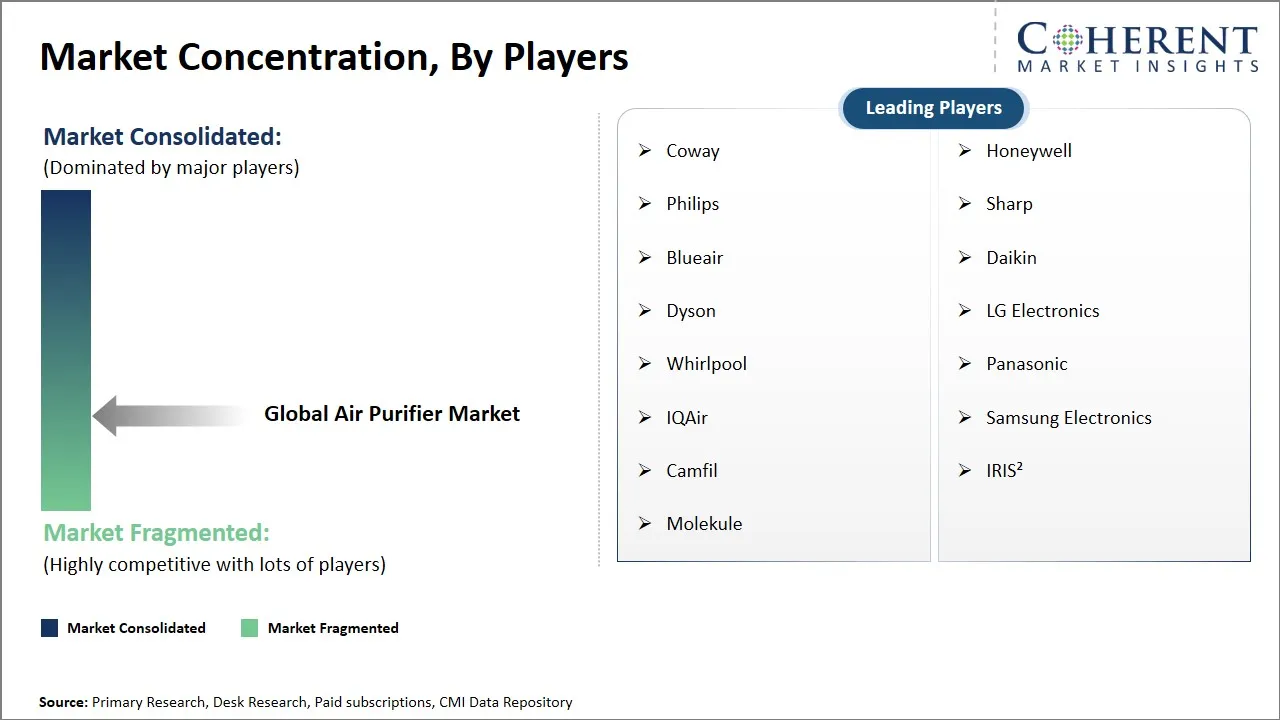
| Companies covered: | Coway, Honeywell, Philips, Sharp, Blueair, Daikin, Dyson, LG Electronics, Whirlpool, Panasonic, IQAir, Samsung Electronics, Camfil, IRIS², and Molekule | ||
| Growth Drivers: |
| ||
| Restraints & Challenges: |
| ||
Market Dynamics
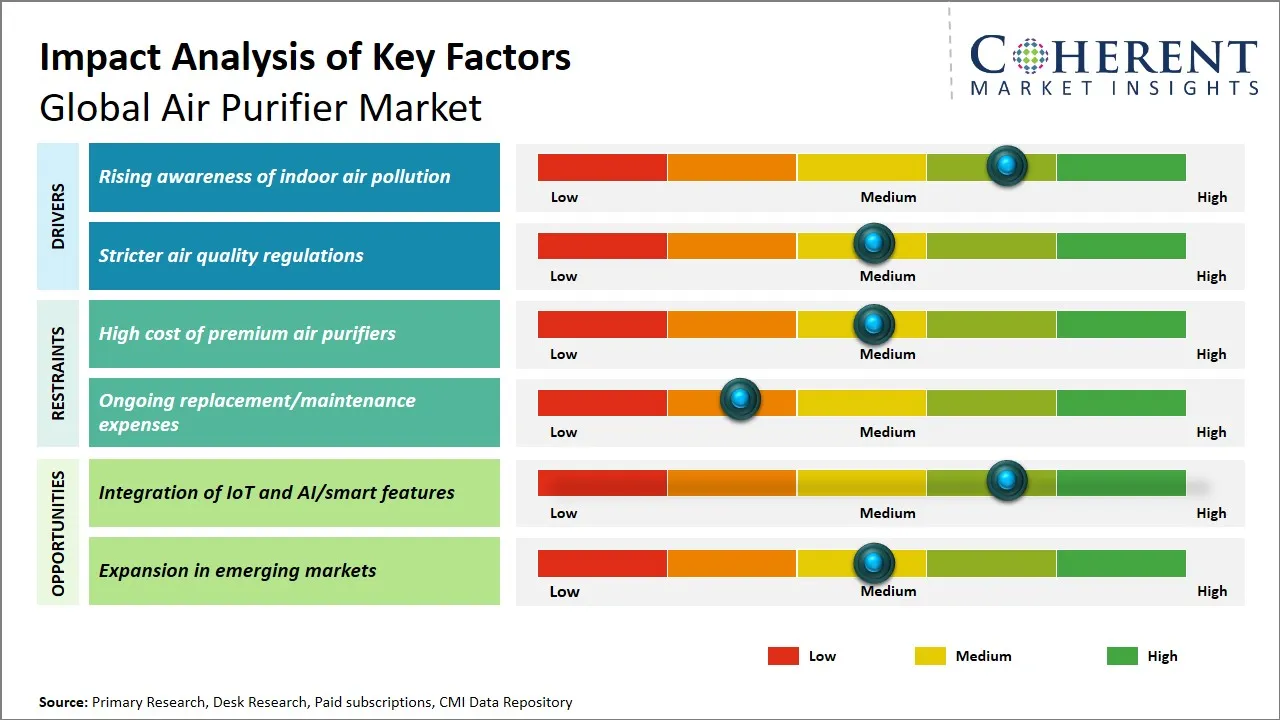
Global Air Purifier Market Driver - Rising Awareness of Indoor Air Pollution
People are becoming more conscious of the harmful pollutants such as dust, allergens, volatile organic compounds (VOCs), and airborne pathogens that accumulate inside homes and workplaces. In India, the National Clean Air Programme (NCAP) and public initiatives like System of Air Quality and Weather Forecasting and Research (SAFAR) have heightened public concern over indoor air quality, especially in metros like Delhi and Mumbai. This heightened awareness is driven by a better understanding of how indoor air quality directly impacts respiratory health, allergies, and overall well-being.
Additionally, factors like the global pandemic have intensified the focus on maintaining clean and safe indoor environments, leading consumers to actively seek solutions that can purify the air they breathe. The realization that indoor air can often be more polluted than outdoor air has motivated individuals to invest in air purifiers equipped with advanced filtration technologies.
Global Air Purifier Market Opportunity – Integration of IoT and AI/Smart Features in the Global Air Purifier Market
As consumers increasingly seek smarter, more efficient home appliances, air purifiers equipped with IoT capabilities enable real-time monitoring and remote control via smartphones or other connected devices, enhancing user convenience and engagement. AI-driven features such as adaptive filtration systems, air quality prediction, and automated adjustment of purification levels based on environmental data offer superior performance and energy efficiency. This technological advancement allows devices to learn from user habits and environmental patterns, optimizing operation while reducing power consumption.
Moreover, smart air purifiers can integrate seamlessly into smart home hubs, functioning alongside other connected appliances for holistic indoor environment management. Blueair offers its HealthProtect 7470i model equipped with SmartFilter tracking, app integration, and real-time air quality sensors. Using Wi-Fi and Blueair’s HEPASilent Ultra technology, it learns user behavior and adjusts purification accordingly. The increasing prevalence of urban pollution, rising awareness about indoor air quality, and growing demand for personalized, intelligent solutions propel this trend. Manufacturers incorporating IoT and AI technologies can differentiate their product offerings, command premium pricing, and foster customer loyalty through enhanced user experiences.
Analyst Opinion (Expert Opinion)
- Rising demand from hospitals, diagnostic centers, and eldercare facilities is fueling the uptake of medical-grade air purifiers with HEPA, UV, and activated carbon technologies. Post-pandemic air hygiene standards have made air purification an operational necessity rather than a luxury in clinical environments.
- Offices, co-working spaces, and hospitality venues are increasingly adopting IoT-enabled purifiers to meet indoor air quality (IAQ) regulations and ESG standards. Integration with smart building systems is driving demand for connected, large-area solutions—especially in Europe and North America.
- Manufacturing units, warehouses, and food processing facilities are deploying heavy-duty air purifiers for particulate matter, fumes, and chemical pollutant control. This segment prioritizes durability and high-CADR systems, with notable growth in APAC’s rapidly industrializing economies.
Speak to the analyst
Want personalized insights?
Take the findings above to one of our principal consultants, or have the report rebuilt around the segments, geographies and competitors you actually track.
Market Segmentation
- Filter Technology Insights (Revenue, USD Bn, 2021 - 2033)
- HEPA
- Activated Carbon
- Ionic/Ionizer
- Electrostatic
- UV
- Photocatalytic
- Others
- Regional Insights (Revenue, USD Bn, 2021 - 2033)
- North America
- U.S.
- Canada
- Latin America
- Brazil
- Argentina
- Mexico
- Rest of Latin America
- Europe
- Germany
- U.K.
- Spain
- France
- Italy
- Russia
- Rest of Europe
- Asia Pacific
- China
- India
- Japan
- Australia
- South Korea
- ASEAN
- Rest of Asia Pacific
- Middle East
- GCC Countries
- Israel
- Rest of Middle East
- Africa
- South Africa
- North Africa
- Central Africa
- North America
- Key Players Insights
- Coway
- Honeywell
- Philips
- Sharp
- Blueair
- Daikin
- Dyson
- LG Electronics
- Whirlpool
- Panasonic
- IQAir
- Samsung Electronics
- Camfil
- IRIS²
- Molekule
Sources
Primary Research Interviews
Stakeholders
- Consumer Electronics Retailers (e.g., Store Managers, Category Heads)
- HVAC Technicians and Air Quality Engineers
- Facility Managers of Hospitals, Airports, and Office Complexes
- Air Purifier Manufacturers and Component Suppliers (e.g., HEPA filter and fan system producers)
- Real Estate Developers integrating smart HVAC systems
- Environmental Health & Safety (EHS) Professionals
- Smart Home Integrators and IoT Product Consultants
Databases
- Eurostat
- U.S. Census
- GreenTech Asia Index
- OECD
- Urban Air Quality Dashboard (UAQD)
Magazines
- Smart Living Asia
- CleanTech Today
- Indoor Air Quality & Filtration Monthly
- Environmental Technology Review
- Home & Health Appliances Magazine
Journals
- Journal of Environmental Health and Indoor Air Quality
- International Journal of Smart Home Technologies
- Energy and Built Environment Journal
- Journal of Sustainable Electronics and Appliances
- Clean Environment & Public Health Journal
Newspapers
- The Guardian (UK)
- South China Morning Post (Hong Kong)
- The Economic Times (India)
- The Japan Times
- Clean Future Daily
Associations
- International Association for Indoor Air Quality (IAIAQ)
- Global Smart Home Alliance (GSHA)
- National Environmental Health Association (NEHA)
- European Indoor Environment Consortium (EIEC)
- Asia-Pacific Smart Cities Forum (APSCF)
Public Domain Sources
- U.S. Census Bureau
- EUROSTAT
- United Nations Economic Commission for Europe (UNECE)
- World Bank
- ResearchGate
Proprietary Elements
- CMI Data Analytics Tool, Proprietary CMI Existing Repository of information for last 8 years
Get access to 250+ pages report
Every segment, forecast, competitor profile and data table behind the analysis above — available for instant download.
- ESOMAR Member
- ISO 9001:2015 Certified
- D-U-N-S Registered
- GDPR & CCPA Compliant
Missing comfort of reading report in your local language? Find your preferred language:
Transform your Strategy with Exclusive Trending Reports
Frequently Asked Questions
The global air purifier market is estimated to be valued at USD 19.47 billion in 2026 and is expected to reach USD 34.24 billion by 2033.
The CAGR of the global air purifier market is projected to be 8.4% from 2026 to 2033.
Rising awareness of indoor air pollution and stricter air quality regulations are the major factors driving the growth of the global air purifier market.
High cost of premium air purifiers and ongoing replacement/maintenance expenses are the major factors hampering the growth of the global air purifier market.
In terms of filter technology, HEPA is estimated to dominate the market revenue share in 2026.
Coway, Honeywell, Philips, Sharp, Blueair, Daikin, Dyson, LG Electronics, Whirlpool, Panasonic, IQAir, Samsung Electronics, Camfil, IRIS², and Molekule are the major players.
Asia Pacific is expected to lead the global air purifier market in 2026.