

U.S. Pawn Shop Market Size and Forecast – 2026 to 2033
The U.S. Pawn Shop Market is anticipated to grow at a CAGR of 7.4% with USD 3.7 Bn in 2026 and is expected to reach USD 8.4 Bn in 2033. Rising short-term liquidity needs, restricted access to traditional credit, economic uncertainty, and inflation drive the U.S. pawn shop market.
Key Takeaways
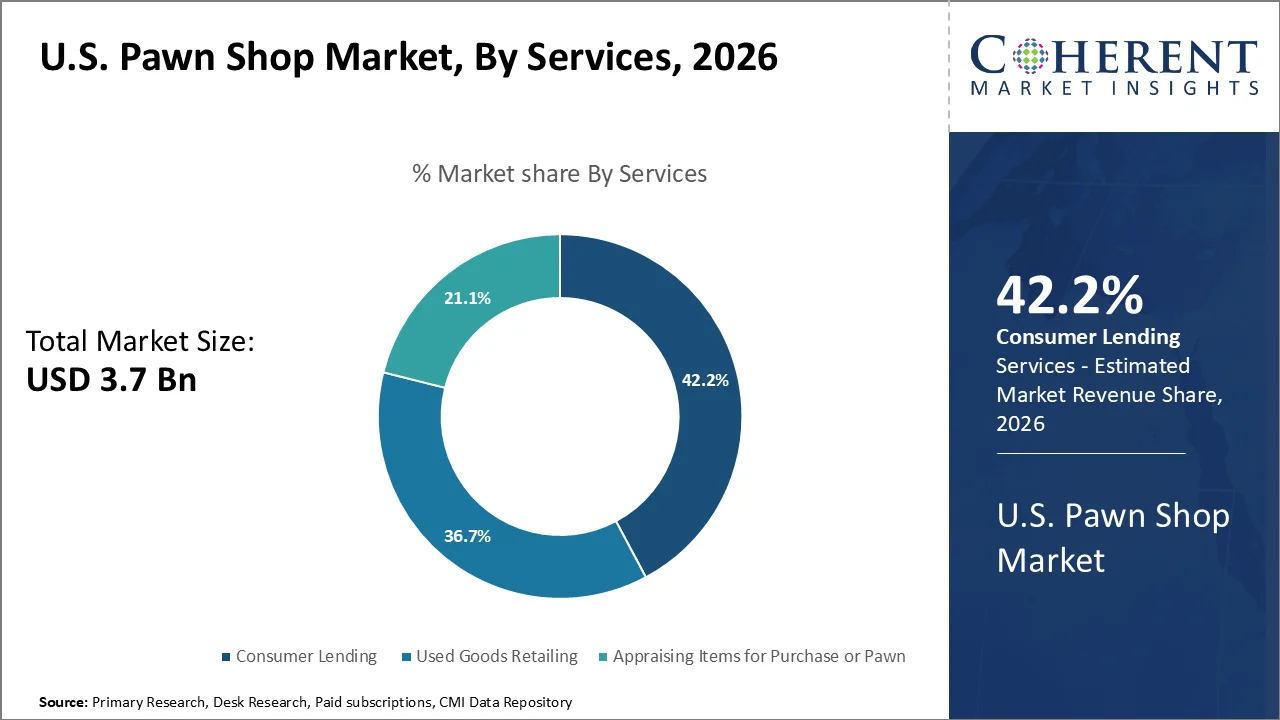
- Consumer Lending hold the largest market share of 42.2% in 2026 owing to its financial inclusion gap. About 30 million Americans, representing roughly 7.4% of U.S. households, use pawn shops each year.
- Baby Boomers expected to hold largest market share of 41.1% in 2026 owing to the large aging population base: 73 million Americans projected to be aged 65+ by 2030.
Current Events and Their Impact on the U.S. Pawn Shop Market
Current Event | Description and its Impact |
Regulatory and Legal Developments |
|
Federal Interest Rate Environment (Federal Reserve Policy 2022–2025 tightening cycle impact) |
|
Segmental Insights
- Current Industry Events of 2026
- Market Size Estimation
- Regional Breakdown
- Competitive Landscape
- Customer Intelligence
- Segmental Analysis
- Pricing Analysis
- Key Market Drivers, Challenges & Future Trends
- Customized Insights Section
Why is Consumer Lending Acquiring the Largest Market Share?
Consumer Lending hold the largest market share of 42.2% in 2026. Limited access to traditional credit, particularly among underbanked individuals, drives consumer lending in the U.S. pawn shop market, along with strong demand for fast and hassle-free liquidity. Borrowers choose pawn loans because they require minimal documentation, avoid credit checks, and offer non-recourse structures that lower financial risk. Rising economic pressures, including inflation and income volatility, push consumers toward short-term financing, while the option to use personal assets like jewelry or electronics sustains demand and encourages repeat usage. Pesto has launched its first product, the Pesto Mastercard® issued by Continental Bank, which allows customers to use valuables as collateral to secure a credit card. Backed by Activant Capital, Plural, and other investors, Pesto aims to help Americans build or rebuild credit with more affordable access to credit.
Which End User segment dominates the market?
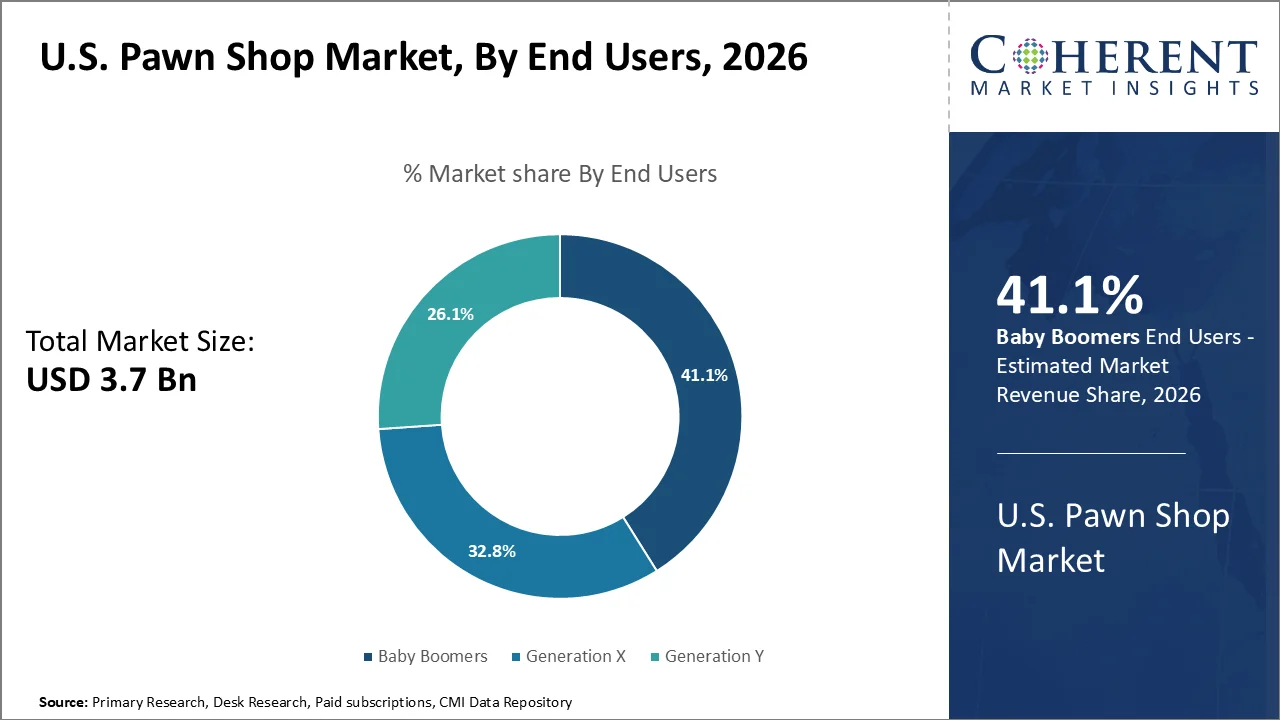
Baby Boomers expected to hold largest market share of 41.1% in 2026. Fixed incomes, rising healthcare costs, and the need for short-term liquidity drive Baby Boomers to use pawn shops without taking on long-term debt. Per capita health spending in the U.S. rose by 6.4%, exceeding the previous year’s increase of 5.4% between 2022 and 2023. Many hold valuable assets but face cash constraints, so they leverage items like jewelry and collectibles to secure loans. They prefer in-person, trust-based transactions and familiar financial systems. Additionally, they downsize and monetize unused assets, while economic pressures push them to repeatedly use pawn services to maintain financial flexibility.
U.S. Pawn Shop Market Trends
- Rising demand for short-term, collateral-based lending driven by limited access to traditional credit and reliance on alternative financial services enhances market growth and retention.
In the U.S., 6% of adults reported using pawn shops, payday loans, or auto-title loans for credit needs, while 14.2% of households are underbanked, indicating strong dependence on non-traditional lending channels. - Economic pressures such as inflation, rising living costs, and income volatility increase demand for pawn loans, while asset-backed lending supports continued market activity.
S. inflation peaked at 9.1% in June 2022, the highest in over 40 years, contributing to increased reliance on short-term credit instruments. Additionally, gold prices exceeded $2,000 per ounce during 2024–2025, strengthening collateral values used in pawn lending (jewelry remains the most pledged asset category).
Who are the Major Companies in U.S. Pawn Shop Industry
Some of the major key players in U.S. Pawn Shop are First Cash Financial Services Inc., EZCORP, INC., DFC Global Corp., Picasso Pawn, Buckeye Pawn Shop, Borro Private Finance, Welsh Pawn, Luxury Asset Capital, Beverly Loan Company, and Big Store Pawn Shop.
Key News
- In August 2024, EZCORP launched its first EZ+ Rewards “Buy More, Earn More” promotion, offering members up to 4x EZ Points on purchases and layaways. The free EZ+ Rewards program applies across participating U.S. pawn brands, including EZPAWN, Value Pawn & Jewelry, and USA Pawn & Jewelry.
Market Report Scope
U.S. Pawn Shop Market Report Coverage
| Report Coverage | Details | ||
|---|---|---|---|
| Base Year: | 2025 | Market Size in 2026: | USD 3.7 Bn |
| Historical Data for: | 2020 To 2024 | Forecast Period: | 2026 To 2033 |
| Forecast Period 2026 to 2033 CAGR: | 7.4% | 2033 Value Projection: | USD 8.4 Bn |
| Segments covered: |
| ||
| Companies covered: | First Cash Financial Services Inc., EZCORP, INC., DFC Global Corp., Picasso Pawn, Buckeye Pawn Shop, Borro Private Finance, Welsh Pawn, Luxury Asset Capital, Beverly Loan Company, and Big Store Pawn Shop | ||
Analyst Opinion
- The U.S. pawn shop market is not expanding because of innovation hype—it is structurally anchored in financial gaps. Over 60 million Americans remain underbanked or credit-constrained, and pawn lending persists because traditional institutions continue to exclude this segment. This is not a cyclical trend; it reflects a permanent layer of demand driven by systemic inefficiencies in mainstream credit access.
- Pawn lending operates as a real-time liquidity mechanism rather than a discretionary financial service. With average loan sizes typically below $200 and loan durations around 30 days, the model directly mirrors paycheck volatility and cash flow mismatches. The fact that a significant portion of borrowers return within months underscores that pawn usage is habitual liquidity management, not emergency-only behavior.
- Collateral dominance—particularly gold jewelry, which accounts for the majority of pledged assets—fundamentally de-risks the business model while enabling high loan recovery rates. Industry data suggests that the majority of loans are redeemed, indicating that consumers treat pawn transactions as short-term financing rather than asset liquidation, reinforcing repeat engagement and stable revenue cycles.
Speak to the analyst
Want personalized insights?
Take the findings above to one of our principal consultants, or have the report rebuilt around the segments, geographies and competitors you actually track.
Market Segmentation
- By Services (Revenue, USD Bn, 2021-2033)
- Consumer Lending (Secured Loans with Personal Property Used as Collateral)
- Used Goods Retailing
- Appraising Items for Purchase or Pawn
- By End Users (Revenue, USD Bn, 2021-2033)
- Generation X
- Generation Y
- Baby Boomers
Sources
Primary Research interviews
- Interviews with pawn shop owners and operators across the United States
- Discussions with retail staff and store managers in urban and suburban pawn outlets
- Inputs from industry practitioners involved in second-hand retail and collateral lending
- Feedback from regional distributors and resale market participants
Databases
- Federal Reserve Economic Data (FRED)
- U.S. Census Bureau datasets
- Bureau of Labor Statistics (BLS) retail and consumer expenditure data
- National pawn transaction and retail trade datasets (publicly available aggregates)
- State-level licensing and regulatory databases for pawn businesses
Magazines
- Retail and consumer finance trade publications
- Second-hand retail and resale industry magazines
- Small business and entrepreneurship magazines covering retail lending and pawn operations
- Financial lifestyle and personal finance magazines featuring alternative credit markets
Journals
- Consumer economics and retail trade journals
- Behavioral finance and household credit access journals
- Urban economics and informal lending system research journals
- Journals focusing on small business operations and microfinance systems
Newspapers
- National business newspapers covering retail and consumer credit trends
- Regional newspapers reporting on pawn shop expansion, closures, and regulatory updates
- Financial news sections covering credit alternatives and consumer liquidity trends
- Local city newspapers with coverage of neighborhood pawn retail activity
Associations
- U.S. retail trade associations relevant to small and independent retailers
- Small business advocacy organizations
- Industry groups focused on resale, second-hand goods, and collateral lending
- Local and state-level pawn licensing and regulatory bodies
Public Domain sources
- Government publications on consumer credit and household debt
- Legislative and regulatory filings related to pawn lending and interest regulations
- Court and legal case records involving pawn operations and lending practices
- Public economic reports on informal credit markets and retail trends
Proprietary Elements
- CMI Data Analytics Tool
- Proprietary CMI Existing Repository of information for last 10 years
Get access to 250+ pages report
Every segment, forecast, competitor profile and data table behind the analysis above — available for instant download.
- ESOMAR Member
- ISO 9001:2015 Certified
- D-U-N-S Registered
- GDPR & CCPA Compliant
Missing comfort of reading report in your local language? Find your preferred language:
Transform your Strategy with Exclusive Trending Reports
Frequently Asked Questions
The U.S. Pawn Shop Market is anticipated to grow at a CAGR of 7.4% with USD 3.7 Bn in 2026 and is expected to reach USD 8.4 Bn in 2033.
Growing utilization of pawn services by households is a major driver fuelling the market growth.
Growth of online business in the market.
Stringent government regulations pertaining to the pawn industry is expected to negatively impact the market.
Major players operating in the market include First Cash Financial Services Inc., EZCORP, INC., DFC Global Corp., Picasso Pawn, Buckeye Pawn Shop, Borro Private Finance, Welsh Pawn, Luxury Asset Capital, Beverly Loan Company, and Big Store Pawn Shop.