

Asia Pacific Abortion Drugs Market Size and Forecast – 2026 To 2033
The Asia Pacific abortion drugs market is expected to grow from USD 841.7 Mn in 2026 to USD 1,478.4 Mn by 2033, registering a compound annual growth rate (CAGR) of 8.4% from 2026 to 2033. The market for Asia Pacific abortion drugs is poised for significant expansion, fueled by the rising demand for medical abortion amid increasing reported abortions.
According to India’s Ministry of Health and Family Welfare, medical terminations of pregnancy increased from 534,000 (5.34 lakh) in 2020–21 to 893,000 (8.93 lakh) in 2024–25, representing a 67% increase over five years, highlighting growing demand for medical abortion services and pharmaceutical-based pregnancy termination options. (Source: The Print)
Key Takeaways of the Asia Pacific Abortion Drugs Market
- Mifepristone is projected to hold 41.0 % of the Asia Pacific abortion drugs market share in 2026, making it dominant drugs segment, supported by regulatory approvals of mifepristone-based medical-abortion regimens across the region. In February 2026, Australia’s Therapeutic Goods Administration (TGA) registered ARZESTRA, a mifepristone–misoprostol combination, as a new generic medicine for medical termination up to 63 days of gestation.
- Generic is projected to hold 69.5 % of the Asia Pacific abortion drugs market share in 2026, making it dominant prescription category segment, supported by the increasing availability of lower-cost generic abortion medicines. Japan’s Pharmaceuticals and Medical Devices Agency (PMDA) approved Mefeego Pack, a mifepristone–misoprostol product manufactured by Linepharma K.K., in May 2023, expanding regulated access to medical-abortion medicines.
- Up to 7 weeks segment is projected to hold 56.6 % of the Asia Pacific abortion drugs market share in 2026, making it dominant gestational age segment, reflecting the concentration of medication abortion in early pregnancy. India’s regulatory framework permits medical abortion using mifepristone and misoprostol during early pregnancy under specified conditions, supporting demand within the early gestational-age segment.
Segmental Insights
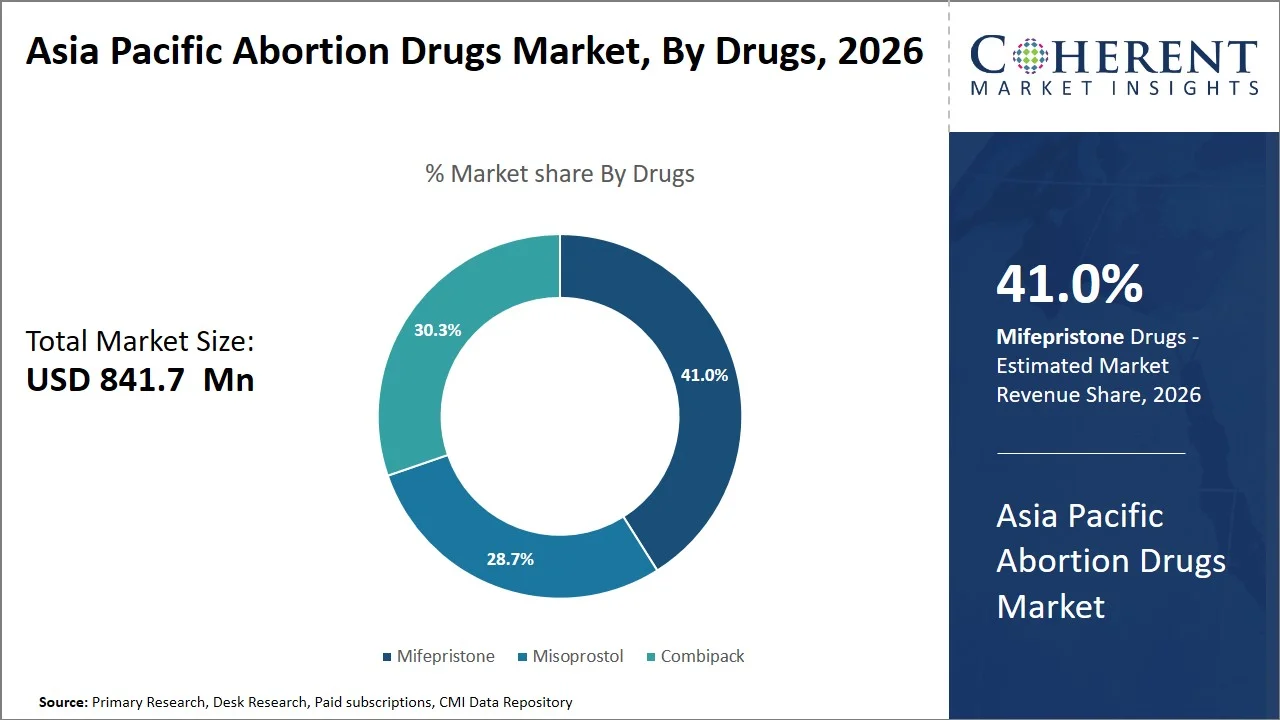
Why Do Mifepristone Dominate the Asia Pacific Abortion Drugs Market?
Mifepristone is projected to hold the market share of 41.0% in 2026, attributable to its existing use as the progesterone blocker component in most medical abortion drugs along with coadministration with misoprostol. Availability of authorized mifepristone products in the region is propelling the demand for this segment. For instance, the Pharmaceutical Benefits Advisory Committee in Australia recommended that mifepristone and misoprostol to be listed on the Pharmaceutical Benefits Scheme, and the combination was listed in August 2023, enhancing subsidized access to medical abortion medication. (Source: Australian Government)
- Current Industry Events of 2026
- Market Size Estimation
- Regional Breakdown
- Competitive Landscape
- Customer Intelligence
- Segmental Analysis
- Pricing Analysis
- Key Market Drivers, Challenges & Future Trends
- Customized Insights Section
Why are Generic the Most Preferred Prescription Category in Asia Pacific Abortion Drugs Market ?
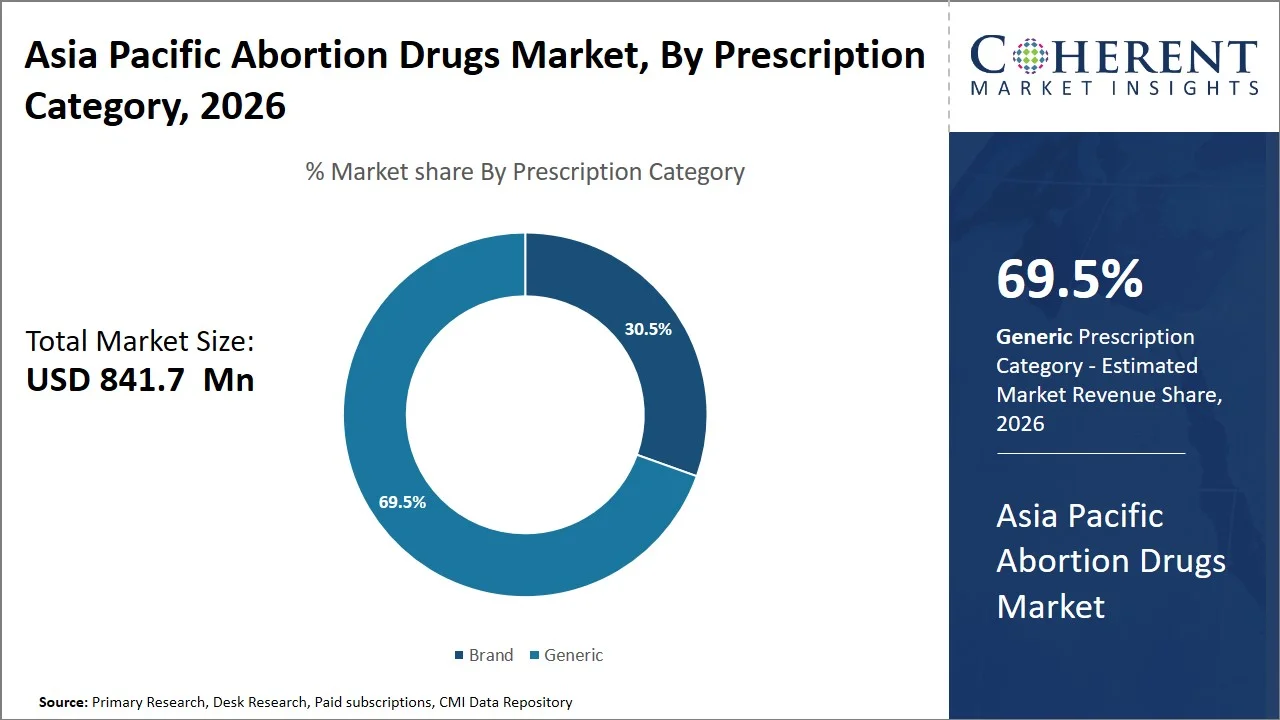
Generic is projected to hold a market share of 69.5% in 2026, because their affordability, easy accessibility and number of local manufacturers contribute in reducing the overall medical abortion treatment price particularly in the price-sensitive markets. Moreover, the existence of more than one type of generic mifepristone and misoprostol products enhance the rivalry and increase choices of supply. For instance, in October 2025, an assessment by WHO found that India, Bangladesh, and Nepal have some of the least expensive medical-abortion combi-packs in the Southeast Asia region, with multiple generic products contributing to greater price competition and lower out-of-pocket costs. (Source: WHO Southeast Asia)
Up to 7 weeks Segment Dominates the Asia Pacific Abortion Drugs Market
The Up to 7 weeks segment is projected to hold a market share of 56.6% in 2026, owing to the efficacy and convenience of medical abortion in early pregnancy. Early treatment allows out-patient management and reduces the need of resource-intensive procedures. For instance, the 2025 Abortion Care Guideline by the World Health Organization considers medical abortion an evidenced-based approach for use up to 12-weeks’ gestation and advocates for the provision of medication-based abortions.
Currents Events and their Impact
Current Events | Description and its Impact |
South Korea Accelerated Review of Abortion Pill Approval and Insurance Coverage (August 2026) |
|
Haryana Strengthened Oversight of MTP Drugs and Authorized Distribution (June 2026) |
|
Australia Registered New Generic Mifepristone–Misoprostol Medicine (February 2026) |
|
Asia Pacific Abortion Drugs Market Dynamics
Market Drivers:
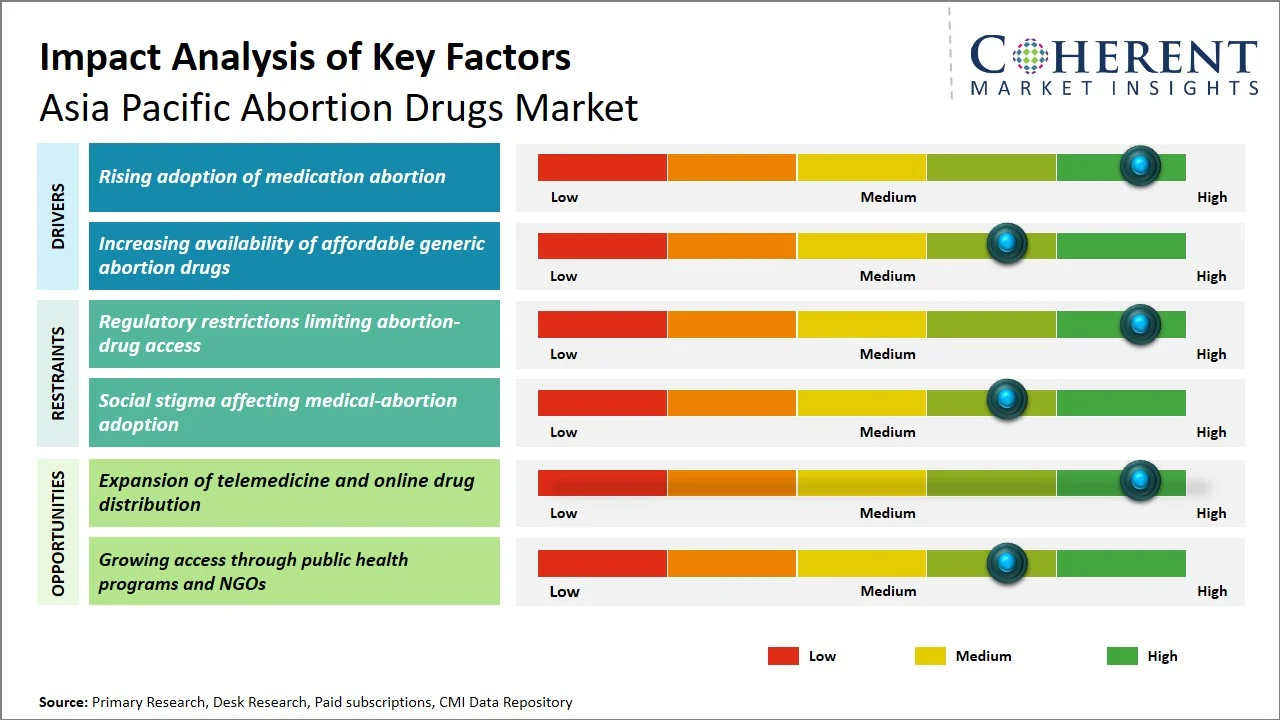
- Rising adoption of medication abortion: The Asia Pacific abortion drugs market is driven by the growing adoption of medication-based pregnancy termination as an alternative to surgical procedures, supported by improving access to mifepristone–misoprostol regimens. Increasing use of medical termination services across developed APAC healthcare systems reflects this shift toward pharmacological abortion care. For instance, Australia’s Department of Health reported that medical termination services increased from 80 per 100,000 women in 2015 to 315 per 100,000 in 2023, demonstrating substantial growth in medication-abortion utilization.
- Increasing availability of affordable generic abortion drugs: The Asia Pacific abortion drugs market is benefiting from the growing availability of affordable generic mifepristone and misoprostol, which improves treatment affordability and expands access to medical-abortion services. Increasing generic competition and government price-regulation measures are further supporting the supply of cost-effective abortion medicines across the region. For instance, India’s National Pharmaceutical Pricing Authority (NPPA) regulates the prices of misoprostol formulations under the country’s drug price-control framework, helping keep essential abortion medicines affordable.
- Rising demand for safe abortion services: The Asia Pacific abortion drugs market is supported by the substantial unmet need for safe, timely, and affordable abortion care, particularly across South and Southeast Asia. Limited access to safe services continues to create demand for medically supervised abortion options, including mifepristone–misoprostol regimens. For instance, WHO reported in September 2025 that more than half of unsafe abortions globally occur in Asia, with most concentrated in South and Central Asia, highlighting the need for safer medical-abortion alternatives.
Emerging Trends
- Growing Adoption of Telemedicine-Based Abortion Care: Abortion drug access is increasingly shifting toward telemedicine and digital healthcare platforms, enabling remote consultations and prescription-based care. This trend is improving privacy and accessibility, particularly for women in underserved and rural areas.
- Increasing Regulatory Acceptance of Medical Abortion: Asia Pacific countries are gradually developing clearer regulatory frameworks for mifepristone and misoprostol, supporting their integration into formal healthcare systems. Evolving approval pathways are expected to expand access to regulated abortion medicines.
- Rising Availability of Generic Abortion Drugs: Growing availability of generic mifepristone and misoprostol is improving affordability and widening access to medical-abortion treatments. Price-sensitive emerging markets across Asia Pacific are expected to increasingly rely on cost-effective generic alternatives.
Country-wise Regulatory Status and Availability of Abortion Drugs in Asia Pacific
Country | Mifepristone | Misoprostol | Combi-pack | Key Regulatory Authority |
China | Registered / Marketed | Registered / Marketed | Available | National Medical Products Administration |
India | Approved | Approved | Approved | Central Drugs Standard Control Organisation |
Japan | Approved | Approved | Approved | Pharmaceuticals and Medical Devices Agency / Ministry of Health, Labour and Welfare |
Australia | Approved | Approved | Approved | Therapeutic Goods Administration |
Rest of Asia Pacific | Varies by country | Varies by country | Varies by country | Respective national regulatory authorities |
How is the expansion of telemedicine and online drug distribution creating new growth opportunities in the Asia Pacific abortion drugs market?
Telemedicine has paved the path for abortion drugs market to bloom, due to its accessibility to remote reproductive care for abortion consultations apart from various physical care facilities. Teleconsultations can overcome both geographical and privacy related barriers especially in rural and remote regions. For instance, the Australian Government has boost access to remote reproductive healthcare services with additional Medicare-supported telehealth consultancies expanded to cover sexual and reproductive healthcare services related to the termination of pregnancy.
Market Players, Company Insights, and Competitive Landscape
Company Insights
- Sun Pharmaceutical Industries Ltd.
- Company Overview
- Headquarters: Mumbai, India
- Establishment Year: 1983
- Employee Strength: More than 43,000 globally
- Leadership: Dilip Shanghvi, Executive Chairman
- Core Services/Products: Generic, branded-generic, specialty, complex pharmaceutical products, APIs, and gynecological medicines, including Mifeprin/Mifeprin Kit and Zitotec (misoprostol).
- SWOT Analysis
- Strengths
- Strong pharmaceutical presence across 100+ countries, supported by extensive manufacturing, R&D capabilities, and distribution infrastructure.
- Established abortion-drug portfolio comprising mifepristone and misoprostol products, including Mifeprin Kit, supporting its position in medical-abortion treatment.
- Weaknesses
- Abortion drugs represent a small component of Sun Pharma’s highly diversified portfolio, limiting the segment’s contribution to overall company growth.
- Demand for abortion medicines remains sensitive to country-specific regulations and social attitudes, particularly across conservative APAC markets.
- Opportunities
- Regulatory modernization across APAC can create new opportunities for mifepristone–misoprostol approvals and broader distribution.
- Expansion of affordable generic medicines in emerging APAC economies can strengthen access to Sun Pharma’s cost-effective abortion-drug portfolio.
- Threats
- Intense competition from Indian and Chinese manufacturers offering generic mifepristone–misoprostol products.
- Regulatory restrictions, changing abortion policies, and unauthorized distribution channels may affect product availability and market penetration.
- Strengths
- Company Overview
- Cipla Ltd.
- Company Overview
- Headquarters: Mumbai, India
- Establishment Year: 1935
- Employee Strength: Approximately 31,369
- Leadership: Y. K. Hamied, Chairman
- Core Services/Products: Generic and branded medicines across respiratory, anti-retroviral, urology, cardiology, anti-infective, CNS, and gynecological therapies, including MTP Kit (mifepristone + misoprostol) and misoprostol products.
- SWOT Analysis
- Strengths
- Broad global pharmaceutical footprint covering 69 markets, 48 manufacturing sites, and more than 1,500 products, providing a strong platform for regional distribution.
- Established MTP Kit containing mifepristone and misoprostol, supported by Cipla’s long-standing expertise in affordable generic medicines
- Weaknesses
- Abortion medicines form a niche part of Cipla’s diversified therapeutic portfolio, with major revenue exposure concentrated in respiratory and other chronic-care segments.
- Market access for abortion drugs remains dependent on local prescription, distribution, and regulatory requirements, limiting uniform commercialization across APAC.
- Opportunities
- Growing demand for affordable generic medical-abortion medicines across emerging APAC markets can support portfolio expansion.
- Increasing integration of reproductive-health services into formal healthcare systems can create opportunities for regulated procurement and institutional distribution.
- Threats
- Competition from numerous regional manufacturers offering lower-priced mifepristone–misoprostol combinations can pressure pricing and margins.
- Changes in abortion legislation, prescription controls, and public-health policies across APAC countries may create uncertainty in product access and commercialization.
- Strengths
- Company Overview
Competitive Landscape
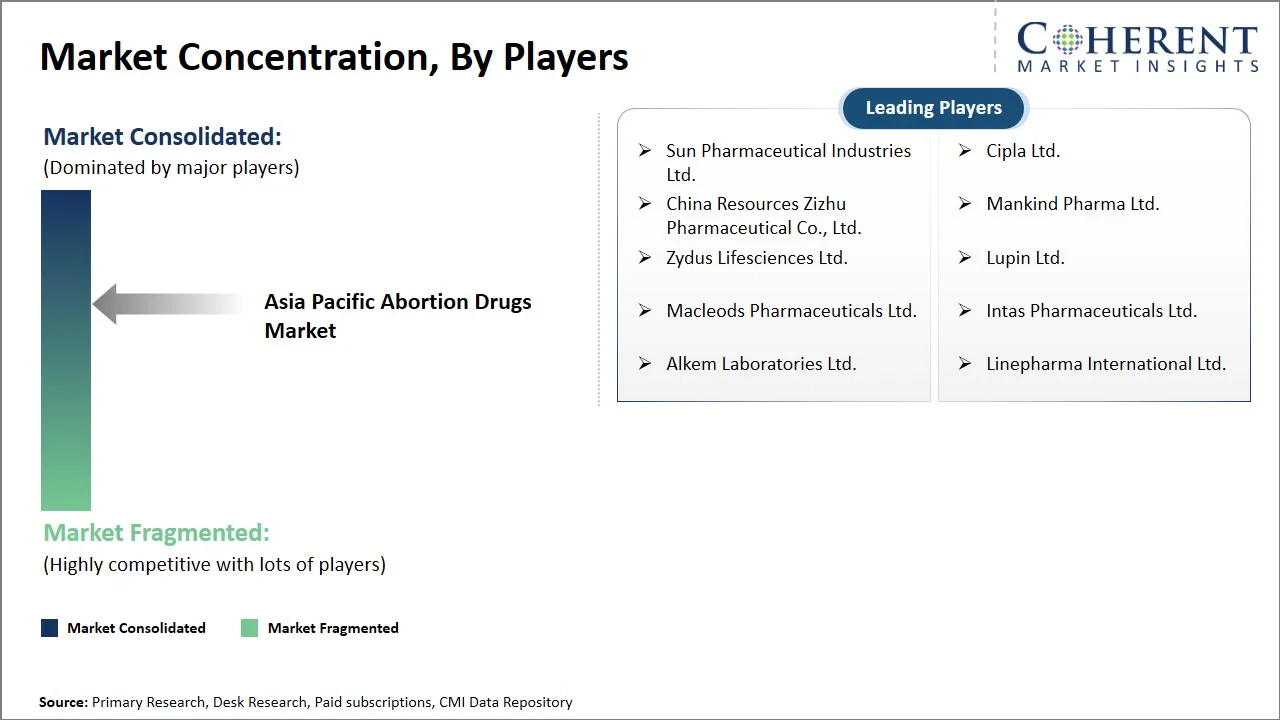
The Asia Pacific abortion drugs market is moderately fragmented, with competition centered on product availability, affordability, regulatory approvals, manufacturing capabilities, quality assurance, and distribution reach. Leading pharmaceutical companies are strengthening their positions by expanding mifepristone–misoprostol portfolios, increasing access to generic formulations, and building broader distribution networks across APAC. Key focus areas include:
- Expansion of approved mifepristone and misoprostol products across countries with established medical-abortion frameworks.
- Strengthening generic and combination-drug portfolios to improve affordability and broaden access to medical-abortion treatments.
- Investment in quality-assured manufacturing and regional distribution networks, supporting reliable supply and reducing dependence on informal or unauthorized abortion-drug channels.
Market Report Scope
Asia Pacific Abortion Drugs Market Report Coverage
| Report Coverage | Details | ||
|---|---|---|---|
| Base Year: | 2025 | Market Size in 2026: | USD 841.7 Mn |
| Historical Data for: | 2020 To 2024 | Forecast Period: | 2026 To 2033 |
| Forecast Period 2026 to 2033 CAGR: | 8.4% | 2033 Value Projection: | USD 1,478.4 Mn |
| Geographies covered: |
| ||
| Segments covered: |
| ||
| Companies covered: | Sun Pharmaceutical Industries Ltd., Cipla Ltd., China Resources Zizhu Pharmaceutical Co., Ltd., Mankind Pharma Ltd., Zydus Lifesciences Ltd., Lupin Ltd., Macleods Pharmaceuticals Ltd., Intas Pharmaceuticals Ltd., Alkem Laboratories Ltd., Linepharma International Ltd. | ||
| Growth Drivers: |
| ||
| Restraints & Challenges: |
| ||
Analyst Opinion (Expert Opinion)
- In the coming years, Asia Pacific abortion drugs market is expected to move toward greater formalization, wider regulatory acceptance, and increased adoption of mifepristone–misoprostol regimens. Growth will increasingly be supported by generic competition, improved healthcare access, and integration of medical abortion into regulated reproductive-health services.
- The maximum opportunities will probably exist within generic mifepristone–misoprostol products for medical abortion in India, given the country’s established regulatory framework, large patient base, and extensive generic pharmaceutical manufacturing ecosystem. Players can also target public-sector procurement and underserved Tier-2/Tier-3 markets to expand penetration.
- In order to obtain a competitive advantage, market participants should prioritize regulatory compliance, quality-assured manufacturing, competitive pricing, and reliable distribution while building partnerships with healthcare providers and reproductive-health organizations. Developing differentiated combination packs, strengthening supply availability, and selectively expanding into markets with evolving abortion frameworks can provide a competitive advantage.
Speak to the analyst
Want personalized insights?
Take the findings above to one of our principal consultants, or have the report rebuilt around the segments, geographies and competitors you actually track.
Market Segmentation
- Drugs Insights (Revenue, USD Mn, 2021 - 2033)
- Mifepristone
- Misoprostol
- Combipack
- Prescription Category Insights (Revenue, USD Mn, 2021 - 2033)
- Brand
- Generic
- Gestational Age Insights (Revenue, USD Mn, 2021 - 2033)
- Up to 7 weeks
- 7–9 weeks
- Above 9 weeks
- Application Insights (Revenue, USD Mn, 2021 - 2033)
- Elective Abortion
- Therapeutic Abortion
- Route of Administration Insights (Revenue, USD Mn, 2021 - 2033)
- Oral
- Vaginal
- Sublingual/Buccal
- End User Insights (Revenue, USD Mn, 2021 - 2033)
- Hospitals
- Clinics and Family Planning Centers
- Homecare Settings
- Others
- Distribution Channel Insights (Revenue, USD Mn, 2021 - 2033)
- Hospital Pharmacies
- Retail Pharmacies
- Online Pharmacies
- Country Insights (Revenue, USD Mn, 2021 - 2033)
- China
- India
- Japan
- Australia
- Rest of Asia Pacific
- Key Players Insights
- Sun Pharmaceutical Industries Ltd.
- Cipla Ltd.
- China Resources Zizhu Pharmaceutical Co., Ltd.
- Mankind Pharma Ltd.
- Zydus Lifesciences Ltd.
- Lupin Ltd.
- Macleods Pharmaceuticals Ltd.
- Intas Pharmaceuticals Ltd.
- Alkem Laboratories Ltd.
- Linepharma International Ltd.
Sources
Primary Research Interviews
- Senior executives and regulatory affairs leaders at abortion-drug manufacturers across Asia Pacific
- CEOs and commercial directors of pharmaceutical companies specializing in mifepristone and misoprostol
- Obstetricians, gynecologists, and reproductive-health specialists across India, China, Japan, Australia, and Southeast Asia
- Government officials involved in drug regulation, reproductive health, and maternal healthcare
- Representatives from reproductive-health NGOs, pharmacies, telemedicine providers, and healthcare distribution companies
Stakeholders
- Pharmaceutical manufacturers and generic-drug companies
- Reproductive-health clinics, hospitals, and healthcare providers
- Pharmacies and pharmaceutical distributors
- Telemedicine and digital-health platforms
- Reproductive-health NGOs and advocacy organizations
- Government health departments and drug regulatory authorities
- End-use Sectors
- Hospitals and abortion-care clinics
- Gynecology and obstetrics departments
- Family planning and reproductive-health centers
- Pharmacies and authorized drug retailers
- Telemedicine and digital reproductive-health providers
- Government healthcare facilities and public health programs
- NGOs and community-based reproductive-health organizations
- Regulatory & Health Bodies
- Central Drugs Standard Control Organization (CDSCO), India
- National Medical Products Administration (NMPA), China
- Pharmaceuticals and Medical Devices Agency (PMDA), Japan
- Therapeutic Goods Administration (TGA), Australia
- Ministry of Food and Drug Safety (MFDS), South Korea
- Health Sciences Authority (HSA), Singapore
- Thai Food and Drug Administration (Thai FDA)
- National Pharmaceutical Regulatory Agency (NPRA), Malaysia
- World Health Organization (WHO) – South-East Asia and Western Pacific Regions
- United Nations Population Fund (UNFPA)
Databases
- WHO Global Health Observatory – Reproductive Health Statistics
- WHO South-East Asia Health Observatory
- UNFPA Data Portal – Sexual and Reproductive Health
- World Bank – Health, Fertility, and Population Data
- National Health Statistics and reproductive-health databases of APAC countries
- National drug-registration and product databases maintained by CDSCO, NMPA, PMDA, TGA, and MFDS
Newspapers
- The Hindu
- The Indian Express
- Reuters
- South China Morning Post
- The Japan Times
- The Korea Herald
- The Korea Times
- The Straits Times
- Bangkok Post
- The Star Malaysia
Associations
- International Federation of Gynecology and Obstetrics (FIGO)
- International Planned Parenthood Federation (IPPF)
- Federation of Obstetric and Gynaecological Societies of India (FOGSI)
- Asia Pacific Initiative on Reproduction (ASPIRE)
- Asian Pacific Council on Contraception (APCOC)
- Indian Pharmaceutical Alliance (IPA)
Public Domain Sources
- WHO – Global Health Observatory and Reproductive Health Data
- WHO – Access to Medical Abortion Medicines in the South-East Asia Region
- UNFPA – State of World Population and reproductive-health data
- World Bank Open Data – Population and Health Indicators
- UNICEF – Maternal and Reproductive Health Data
- National ministries of health and drug-regulatory authorities across Asia Pacific
Proprietary Elements
- CMI Data Analytics Tool, Proprietary CMI Existing Repository of information for last 10 years.
Get access to 250+ pages report
Every segment, forecast, competitor profile and data table behind the analysis above — available for instant download.
- ESOMAR Member
- ISO 9001:2015 Certified
- D-U-N-S Registered
- GDPR & CCPA Compliant
Missing comfort of reading report in your local language? Find your preferred language:
Frequently Asked Questions
The Asia Pacific abortion drugs market is estimated to be valued at USD 841.7 Mn in 2026 and is expected to reach USD 1,478.4 Mn by 2033.
Mifepristone dominates due to its established use in combination with misoprostol for medical abortion and broad regulatory acceptance.
Abortion drugs are medicines, primarily mifepristone and misoprostol, used to medically terminate an early pregnancy.
The CAGR of Asia Pacific abortion drugs market is projected to be 8.4% from 2026 to 2033.
Mifepristone blocks progesterone activity, while misoprostol induces uterine contractions to facilitate pregnancy termination.
Mifepristone is widely used as part of the mifepristone–misoprostol regimen for medical abortion.
The up to 7 weeks segment dominates due to the established use of medication abortion during early pregnancy.