

Asia Pacific Medical Tourism Market Size and Forecast – 2026 To 2033
The Asia Pacific medical tourism market is expected to grow from USD 65.74 Bn in 2026 to USD 178.95 Bn by 2033, registering a compound annual growth rate (CAGR) of 15.4% from 2026 to 2033. The market for Asia Pacific medical tourism is poised for significant expansion, fueled by the increasing government support for medical tourism and initiatives aimed at facilitating international patient inflows.
India recorded 507,244 foreign nationals arriving specifically for medical treatment in 2025, while the Ministry of Tourism has extended e-medical and e-medical attendant visas to facilitate international patients’ access to treatment. (Source: Press Information Bureau)
Key Takeaways of the Asia Pacific Medical Tourism Market
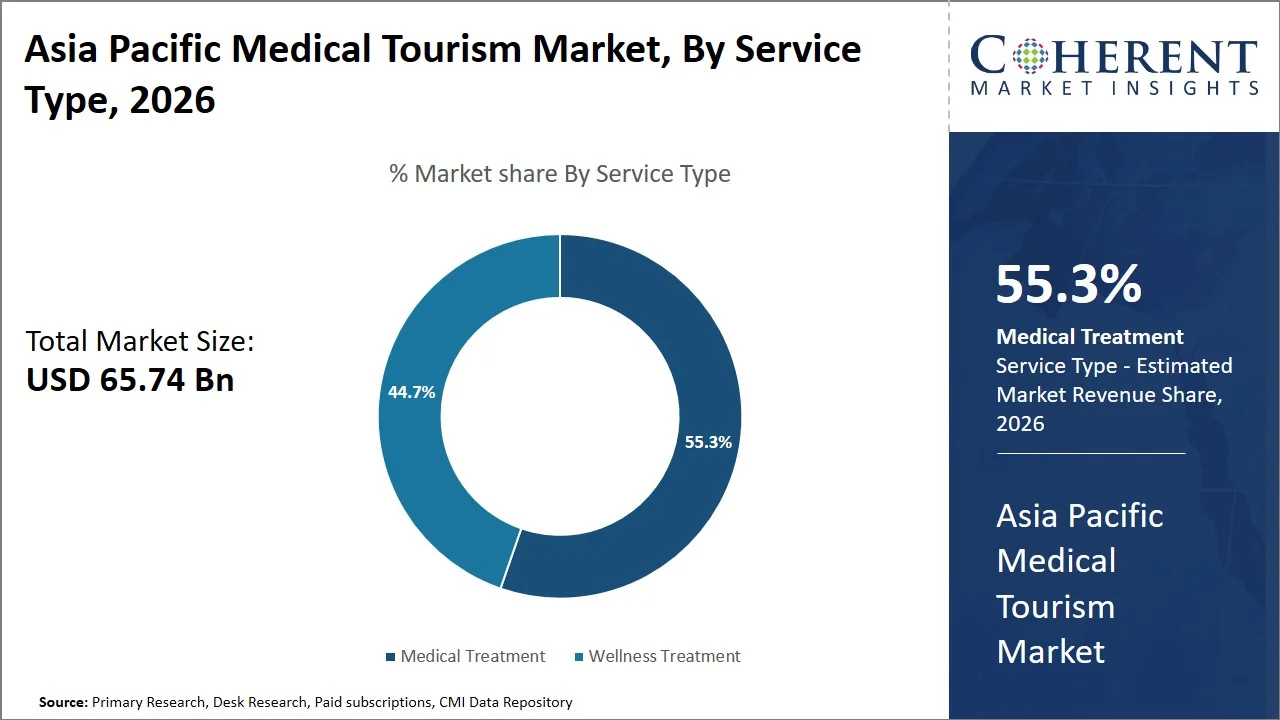
- Medical treatment is projected to hold 55.3 % of the Asia Pacific medical tourism market share in 2026, making it dominant service type segment, supported by increasing demand for specialized and advanced medical procedures. For instance, according to Ministry of Health and Welfare, South Korea recorded 2.01 million foreign patients from 201 countries in 2025, representing a 71.9% increase from 1.17 million in 2024, with strong demand for dermatology, internal medicine, plastic surgery, and other specialized treatments.
- Expansion of Cross-Border Digital Healthcare: The growing adoption of telemedicine, digital health records, and AI-enabled consultations is simplifying pre- and post-treatment care for international patients. This enables remote consultations and follow-ups, reducing the logistical barriers associated with medical travel.
- Development of Integrated Medical Tourism Hubs: Asia Pacific countries are developing specialized healthcare hubs that combine advanced treatments, diagnostics, rehabilitation, accommodation, and patient-support services. These integrated offerings enhance patient convenience and strengthen the region’s competitiveness as a medical tourism destination.
Segmental Insights
Why Do Medical Treatment Dominate the Asia Pacific Medical Tourism Market?
Medical treatment is projected to hold the market share of 55.3% in 2026, due to the sophisticated healthcare facilities and variety of medical procedures performed by qualified surgeons, existence of top medical expertise and low treatment prices in the region. Increasing demand for oncology treatment, cardiological procedure, orthopedic surgery, transplantation surgeries and minimal surgery attract more overseas customers to Asia Pacific. Enlarged hospitals facilities and border crossing alliances continue to develop accessible specialized treatment at main medical tourist destinations. For instance, in February 2026, Malaysian Healthcare Travel Council (MHTC) has joined hands with OneHealth Cambodia to further improve cross-border health-care cooperation, referral of patient and access to Malaysia medical facilities.
- Current Industry Events of 2026
- Market Size Estimation
- Regional Breakdown
- Competitive Landscape
- Customer Intelligence
- Segmental Analysis
- Pricing Analysis
- Key Market Drivers, Challenges & Future Trends
- Customized Insights Section
Currents Events and their Impact
Current Events | Description and its Impact |
South Korea Strengthens Global Medical Tourism Through Medical Korea 2026 (March 2026) |
|
Malaysia–China Healthcare Collaboration Expanded (May 2026) |
|
Thailand Expands Global Health and Medical Tourism Promotion (April 2026) |
|
Japan Expands Infrastructure for Foreign Patient Access (June 2026) |
|
APAC Medical Tourism Market Dynamics
Market Drivers
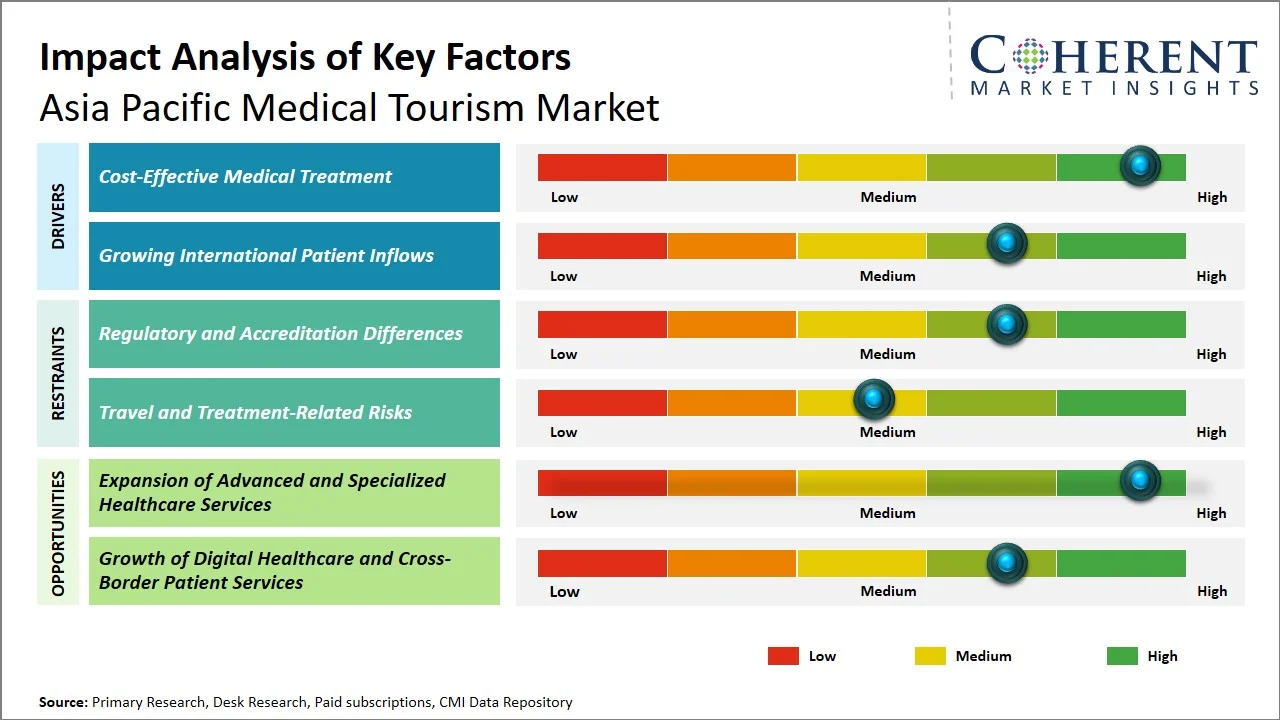
- Cost-Effective Medical Treatment: Cost-effective medical treatment remains a key growth driver for the Asia Pacific medical tourism market, as destinations such as Thailand and Malaysia combine competitive treatment pricing with advanced healthcare capabilities. Lower procedure costs, shorter waiting times, and established specialist facilities strengthen the region’s value proposition for international patients. For instance, Thailand’s Tourism Authority reported that international visitors seeking medical, health, and wellness services spent an average of USD 3,058 (THB 100,259) per trip in 2024, reflecting the economic value of the segment.
- Growing International Patient Inflows: Growing international patient inflows are strengthening the Asia Pacific medical tourism market as patients increasingly travel within and beyond the region for specialized, affordable, and timely healthcare services. Improving air connectivity, international hospital networks, medical-visa facilitation, and targeted healthcare-travel promotion are making regional destinations more accessible to overseas patients. For instance, Malaysia recorded approximately 1.85 million medical tourists in 2025, up 15.6% from 1.6 million in 2024, while healthcare-travel revenue increased 23.2% to USD 829.2 million (RM3.35 billion). This growth highlights the continued expansion of cross-border patient demand in Southeast Asia
- Government Support and Medical Tourism Promotion: Government-led initiatives across Asia Pacific are strengthening medical tourism by promoting healthcare destinations, facilitating international patient access, and building cross-border industry partnerships. Such programs improve destination visibility and create stronger channels for hospitals and healthcare providers to attract overseas patients. For example, in March 2025, Thailand’s Tourism Authority launched the “Amazing Thailand Health and Beauty” initiative in Cambodia, bringing together 14 Thai health, wellness, and beauty providers and targeting more than 600,000 consumers across the ASEAN market.
Emerging Trends
- AI-Powered and Digital Patient Facilitation: Medical tourism providers are increasingly adopting AI, telemedicine, digital health platforms, and automated patient-engagement tools to support remote consultations, treatment planning, and cross-border care coordination. In Asia Pacific, 75% of healthcare providers expect greater productivity gains from agentic AI, indicating accelerating adoption across healthcare workflows.
- Shift Toward Preventive and Personalized Healthcare: Medical tourism is increasingly moving beyond conventional treatment toward preventive diagnostics, personalized care, longevity programs, and early disease detection. The trend is particularly relevant to APAC, where nearly 60% of the global aging population resides and healthcare systems face rising chronic-disease burdens.
- Integration of Medical, Wellness, and Hospitality Services: APAC destinations are increasingly combining medical treatment with wellness, rehabilitation, preventive care, and hospitality services, creating more comprehensive healthcare-travel experiences. This convergence is expanding the addressable patient base and encouraging destinations to develop integrated medical and wellness tourism offerings.
Health Expenditure per Capita in Major Asia Pacific Medical Tourism Destinations, 2024
Country | Health Expenditure per Capita (USD PPP), 2024 |
Australia | 7,469 |
Japan | 5,790 |
South Korea | 4,979 |
Thailand | 1,102 |
China | 1,223 |
India | 334 |
How is the expansion of advanced and specialized healthcare Services creating new growth opportunities in the Asia Pacific medical tourism market?
Enhancements in the field of advanced and specialized services across Asia Pacific are reinforcing the region’s capabilities as a chosen medical tourism destination with an increased focus on robotic surgery, minimum invasive treatments and specialized center facilities in Asia Pacific. Such facilities allow hospitals to perform sophisticated surgeries with increased accuracy, possibly leading to faster convalescence periods, and are highly regarded by international patients. For instance, in October 2025, Singapore General Hospital has introduced a Centre of Excellence for robotic-assisted with an initial focus on robotic total knee replacement and regional surgeon training for the region of South-East Asia.
Market Players, Key Development, and Competitive Landscape
Key Developments
- In April 2026, Bangladesh’s Rhythm Group and India’s Manipal Hospitals signed an agreement to streamline medical tourism and facilitate Bangladeshi patients’ access to advanced healthcare services in India. The partnership provides end-to-end support covering medical consultations, hospital selection, travel arrangements and specialist consultations, potentially strengthening India–Bangladesh medical travel flows.
- In June 2025, Vaidam Health acquired MediJourney in an all-cash transaction to strengthen its digital infrastructure and expand cross-border healthcare services. The acquisition integrates AI-enabled patient facilitation tools to streamline international patient onboarding and treatment coordination, supporting Vaidam’s expansion across Africa and Southeast Asia.
- In September 2024, EaseMyTrip entered the medical tourism sector by acquiring a 30% stake in Rollins International for INR 60 crore and a 49% stake in Pflege Home Healthcare for INR 30 crore. The investments broadened its healthcare service portfolio and strengthened its potential to offer integrated travel and medical tourism solutions.
Competitive Landscape
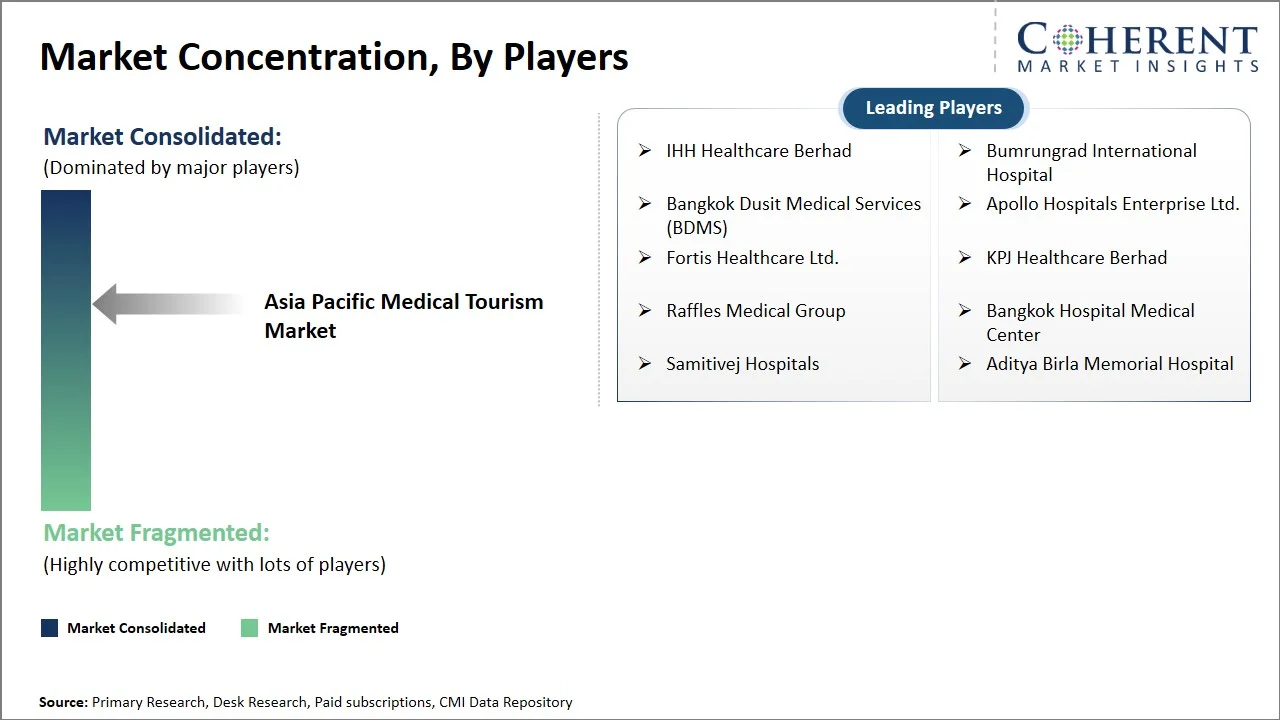
The Asia Pacific medical tourism market is moderately fragmented, with competition centered on clinical expertise, treatment quality, affordability, hospital accreditation, advanced technology, and international-patient experience. Leading healthcare providers are strengthening their market positions by expanding specialized treatment capabilities, upgrading medical infrastructure, and building stronger cross-border patient networks. Key focus areas include:
- Expansion of accredited hospitals and specialty centers across major medical tourism destinations.
- Strengthening complex-treatment capabilities in oncology, cardiology, orthopedics, fertility, transplantation, and neurology.
- Investment in advanced medical technologies, including robotic surgery, minimally invasive procedures, AI-enabled diagnostics, and precision medicine.
- Enhancement of international-patient services, including multilingual assistance, treatment coordination, visa support, and post-treatment care.
- Expansion of cross-border partnerships and referral networks with insurers, medical-tourism facilitators, overseas healthcare providers, and travel companies.
- Development of integrated medical tourism offerings combining treatment with diagnostics, rehabilitation, accommodation, transportation, and wellness services.
Market Report Scope
Asia Pacific Medical Tourism Market Report Coverage
| Report Coverage | Details | ||
|---|---|---|---|
| Base Year: | 2025 | Market Size in 2026: | USD 65.74 Bn |
| Historical Data for: | 2020 To 2024 | Forecast Period: | 2026 To 2033 |
| Forecast Period 2026 to 2033 CAGR: | 15.4% | 2033 Value Projection: | USD 178.95 Bn |
| Geographies covered: | China, India, Singapore, Thailand, Vietnam, Malaysia, Philippines, Indonesia, Cambodia, Rest of Asia Pacific | ||
| Segments covered: |
| ||
| Companies covered: | IHH Healthcare Berhad, Bumrungrad International Hospital, Bangkok Dusit Medical Services (BDMS), Apollo Hospitals Enterprise Ltd., Fortis Healthcare Ltd., KPJ Healthcare Berhad, Raffles Medical Group, Bangkok Hospital Medical Center, Samitivej Hospitals, Aditya Birla Memorial Hospital | ||
| Growth Drivers: |
| ||
| Restraints & Challenges: |
| ||
Analyst Opinion (Expert Opinion)
- In the coming years, Asia Pacific medical tourism market will shift from cost-driven medical travel toward value-driven, specialized, and technology-enabled care. International patients will increasingly evaluate destinations based on treatment outcomes, specialist expertise, technology, accreditation, convenience, and continuity of care rather than price alone. Integrated journeys combining virtual consultation, treatment, rehabilitation, and wellness are likely to become increasingly important.
- The maximum opportunities will probably exist within advanced orthopedic and oncology treatment in Thailand and Malaysia, where providers can combine specialized clinical capabilities with comparatively affordable treatment, international-patient services, and integrated recovery programs. Fertility treatment in Malaysia and Thailand and complex cardiac and oncology care in India also offer attractive opportunities, particularly for patients from the Middle East, Southeast Asia, and Africa
- In order to obtain a competitive advantage, market participants should move beyond simply promoting low treatment costs and build end-to-end international patient ecosystems. Priority should be given to developing Centers of Excellence, demonstrating treatment outcomes, strengthening digital pre- and post-treatment care, creating transparent treatment packages, and establishing referral relationships with overseas hospitals, insurers, and facilitators. Providers that combine clinical specialization, digital patient engagement, seamless travel and recovery support are likely to gain a stronger competitive advantage.
Speak to the analyst
Want personalized insights?
Take the findings above to one of our principal consultants, or have the report rebuilt around the segments, geographies and competitors you actually track.
Market Segmentation
- Service Type Insights (Revenue, USD Bn, 2021 - 2033)
- Medical Treatment
- Wellness Treatment
- Country Insights (Revenue, USD Bn, 2021 - 2033)
- China
- India
- Singapore
- Thailand
- Vietnam
- Malaysia
- Philippines
- Indonesia
- Cambodia
- Rest of Asia Pacific
- Key Players Insights
- IHH Healthcare Berhad
- Bumrungrad International Hospital
- Bangkok Dusit Medical Services (BDMS)
- Apollo Hospitals Enterprise Ltd.
- Fortis Healthcare Ltd.
- KPJ Healthcare Berhad
- Raffles Medical Group
- Bangkok Hospital Medical Center
- Samitivej Hospitals
- Aditya Birla Memorial Hospital
Sources
Primary Research Interviews
- Medical tourism facilitators and international patient service executives across Asia Pacific
- CEOs and Directors of International Patient Departments at hospitals in India, Thailand, Malaysia, Singapore, South Korea, and Japan
- Healthcare tourism consultants and Medical Value Travel (MVT) specialists
- Specialty physicians in oncology, cardiology, orthopedics, transplantation, fertility, and cosmetic surgery
- Government officials involved in medical tourism, healthcare tourism, and Medical Value Travel initiatives
- Healthcare accreditation and international-patient service professionals
Stakeholders
- Multispecialty and specialty hospitals
- Medical Value Travel facilitators and healthcare travel agencies
- Ministries of Health and Ministries/Departments of Tourism across Asia Pacific
- Medical tourism promotion agencies, including Malaysia Healthcare Travel Council (MHTC)
- International patient departments and healthcare concierge providers
- Insurance companies and international assistance providers
- Airlines, hospitality providers, rehabilitation centers, and wellness operators
- Digital health, telemedicine, and international-patient coordination platforms
- End-use Sectors
- Multispecialty hospitals
- Specialty hospitals (cardiology, oncology, orthopedics, fertility, cosmetic surgery)
- Ambulatory surgery centers (ASCs)
- Fertility and reproductive health clinics
- Dental clinics
- Cosmetic and aesthetic surgery centers
- Rehabilitation and wellness centers
- Organ transplant centers
- Regulatory & Health Bodies
- Ministry of Health and Family Welfare, Government of India
- Ministry of Public Health, Thailand
- Ministry of Health, Malaysia
- Ministry of Health, Singapore
- Ministry of Health, Labour and Welfare (MHLW), Japan
- Ministry of Health and Welfare (MOHW), South Korea
- National Health Commission of the People's Republic of China
- Australian Government Department of Health and Aged Care
- Joint Commission International (JCI)
Databases
- UN Tourism – Tourism Statistics Database
- Medical Korea – Foreign Patient Statistics
- Malaysia Healthcare Travel Council (MHTC) – Healthcare Travel Statistics
- Thailand Ministry of Public Health – Health Statistics
- Japan MHLW – Foreign Patient/Medical Institution Statistics
- India Ministry of Tourism – Tourism Statistics
- India Bureau of Immigration – Foreign Tourist Arrivals
- China National Health Commission – Health Statistics
Newspapers
- The Straits Times
- Bangkok Post
- The Nation Thailand
- The Korea Herald
- The Korea Times
- The Star Malaysia
- The Edge Malaysia
- The Japan Times
- South China Morning Pos
Associations
- Malaysia Healthcare Travel Council (MHTC)
- Medical Tourism Association (MTA)
- Asia-Pacific Healthcare Travel Council / regional healthcare-travel associations
- Federation of Malaysian Manufacturers (FMM)
- Thai Private Hospitals Association
- Singapore Medical Association (SMA)
- Korea Hospital Association
- Japan Hospital Association
- International Hospital Federation (IHF)
- Joint Commission International (JCI)
Public Domain Sources
- WHO – Global Health Observatory and Global Health Expenditure Database
- World Bank Open Data
- OECD Health Statistics
- UN Tourism – Tourism Data and Statistics
- ASEAN – Tourism and Health Cooperation Data
- APEC – Health Working Group
Proprietary Elements
- CMI Data Analytics Tool, Proprietary CMI Existing Repository of information for last 10 years.
Get access to 250+ pages report
Every segment, forecast, competitor profile and data table behind the analysis above — available for instant download.
- ESOMAR Member
- ISO 9001:2015 Certified
- D-U-N-S Registered
- GDPR & CCPA Compliant
Missing comfort of reading report in your local language? Find your preferred language:
Transform your Strategy with Exclusive Trending Reports
Frequently Asked Questions
The Asia Pacific medical tourism market is estimated to be valued at USD 65.74 Bn in 2026 and is expected to reach USD 178.95 Bn by 2033.
Medical treatment dominates due to the availability of advanced tertiary-care infrastructure, specialized medical expertise, complex treatment capabilities, and comparatively affordable healthcare services for international patients.
Medical tourism refers to the practice of traveling to another country to obtain medical treatment, surgical procedures, or specialized healthcare services.
Medical procedures in major Asia Pacific destinations are generally more affordable than comparable treatments in the U.S. and other developed Western markets.
International accreditation helps hospitals demonstrate standardized quality and patient-safety practices, strengthening confidence among international patients.
Dedicated medical and e-medical visa pathways can simplify international patient entry and reduce administrative barriers associated with cross-border treatment.
Medical tourism facilitators coordinate consultations, hospital selection, travel arrangements, treatment logistics, and post-treatment support for international patients.