

Global Attack Surface Management Market Size and Forecast – 2026 To 2033
The global attack surface management market is expected to grow from USD 1.25 Bn in 2026 to USD 4.15 Bn by 2033, registering a compound annual growth rate (CAGR) of 16.3% from 2026 to 2033. The global attack surface management market is driven by growing adoption of continuous threat exposure management. On February 25, 2025, Zscaler, Inc. announced the introduction of Zscaler Asset Exposure Management, designed to advance how organizations manage their asset risk, commonly referred to as Cyber Asset Attack Surface Management (CAASM).
Key Takeaways of the Global Attack Surface Management Market
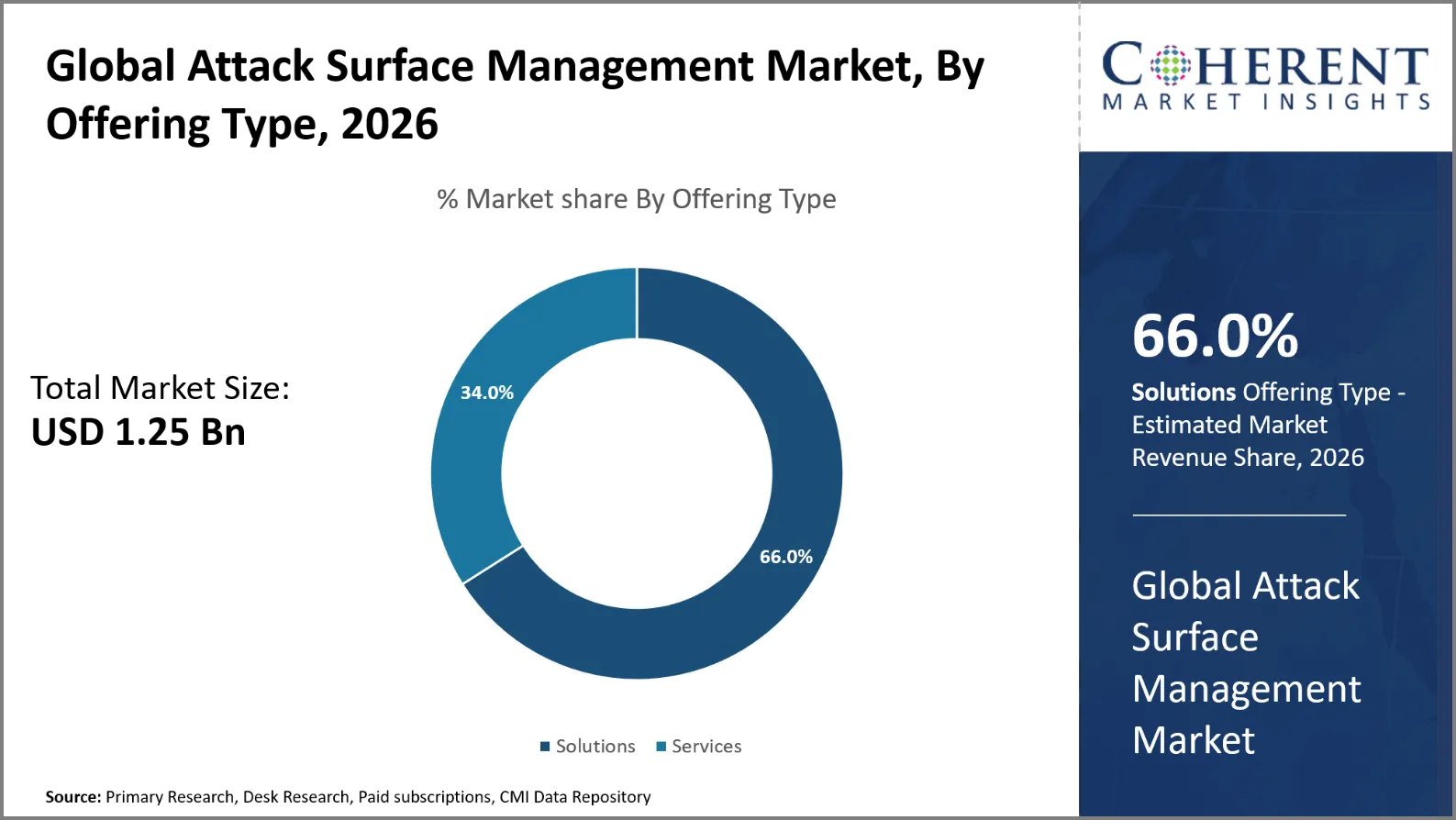
- The Solutions segment is expected to account for 66.0% of the global attack surface management market share in 2026. Rising demand for external attack surface visibility is driving the growth of the segment. On February 5, 2025, NordStellar introduced Attack Surface Management capabilities within its threat exposure management platform. The feature automatically discovers internet-exposed websites, servers, applications, cloud resources, and connected devices.
- The Cloud-Based segment is estimated to capture 57.0% of the market share in 2026. Increasing cybersecurity compliance requirements is majorly driving the growth of the segment. On January 17, 2025, Teleport announced Digital Operational Resilience Act compliance readiness for its access platform. The solution supports financial institutions through centralized infrastructure access visibility and real-time monitoring.
- The Cyber Asset Attack Surface Management segment is estimated to capture 43.0% of the market share in 2026. Expansion of Internet of Things and connected devices is driving the growth of the segment. On February 25, 2025, Aeris launched IoT Watchtower, a cellular Internet of Things security solution. The platform provides enterprise device visibility, traffic monitoring, and security enforcement.
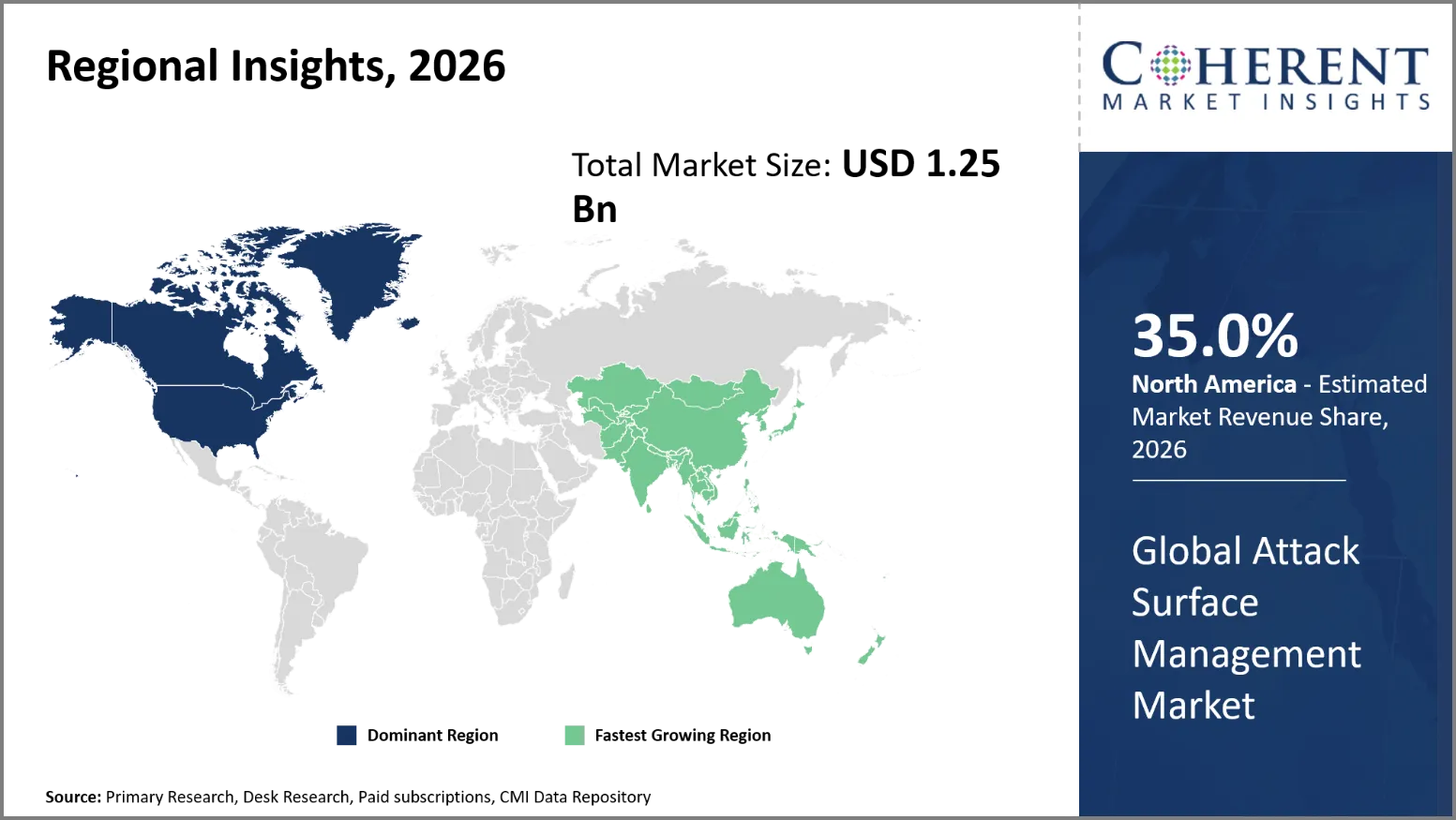
- North America is expected to dominate the attack surface management market in 2026 with a market share of 35.0%. Increasing demand for managed attack surface management services in North America is driving the growth of the regional market. On March 25, 2025, Cycurion, Inc. launched its Cyber Shield Managed Security Services Platform from McLean, Virginia. The offering combines 24/7 security monitoring, managed detection and response, and threat and vulnerability management.
- Asia Pacific is expected to account for 23.0% share in 2026. Rising protection requirements for operational technology in Asia Pacific is driving the growth of the regional market. On March 19, 2025, Westcon-Comstor announced a regional partnership with Claroty to strengthen operational technology security across Indonesia, Malaysia, the Philippines, Thailand, Singapore, and Vietnam.
Segmental Insights
Why Does Solutions Dominate the Global Attack Surface Management Market?
The solutions segment is expected to account for 66.0% of the global attack surface management market share in 2026. Solutions are leading because organizations want constant visibility into their expanding digital footprints. These technologies help identify internet-facing assets, discover vulnerabilities, and prioritize potential security exposures. Organizations are increasingly looking for integrated solutions that include asset discovery, risk assessment and threat intelligence. Automated monitoring also allows security teams to reduce human tasks and accelerate cleanup. The growing adoption of cloud and linked nature of enterprise networks are driving need for complete attack surface visibility. These qualities are key to solutions for proactive cybersecurity management.
On March 24, 2025, CrowdStrike introduced new CrowdStrike Falcon Exposure Management innovations that speed cybersecurity consolidation by retiring legacy vulnerability management solutions and bringing AI-powered risk prioritization to network assets. The Network Vulnerability Assessment feature is now generally available, allowing security teams to discover and address high-risk vulnerabilities in network devices such as routers, switches and firewalls in real time.
- Current Industry Events of 2026
- Market Size Estimation
- Regional Breakdown
- Competitive Landscape
- Customer Intelligence
- Segmental Analysis
- Pricing Analysis
- Key Market Drivers, Challenges & Future Trends
- Customized Insights Section
Why is Cloud-Based the Most Preferred Deployment Type?
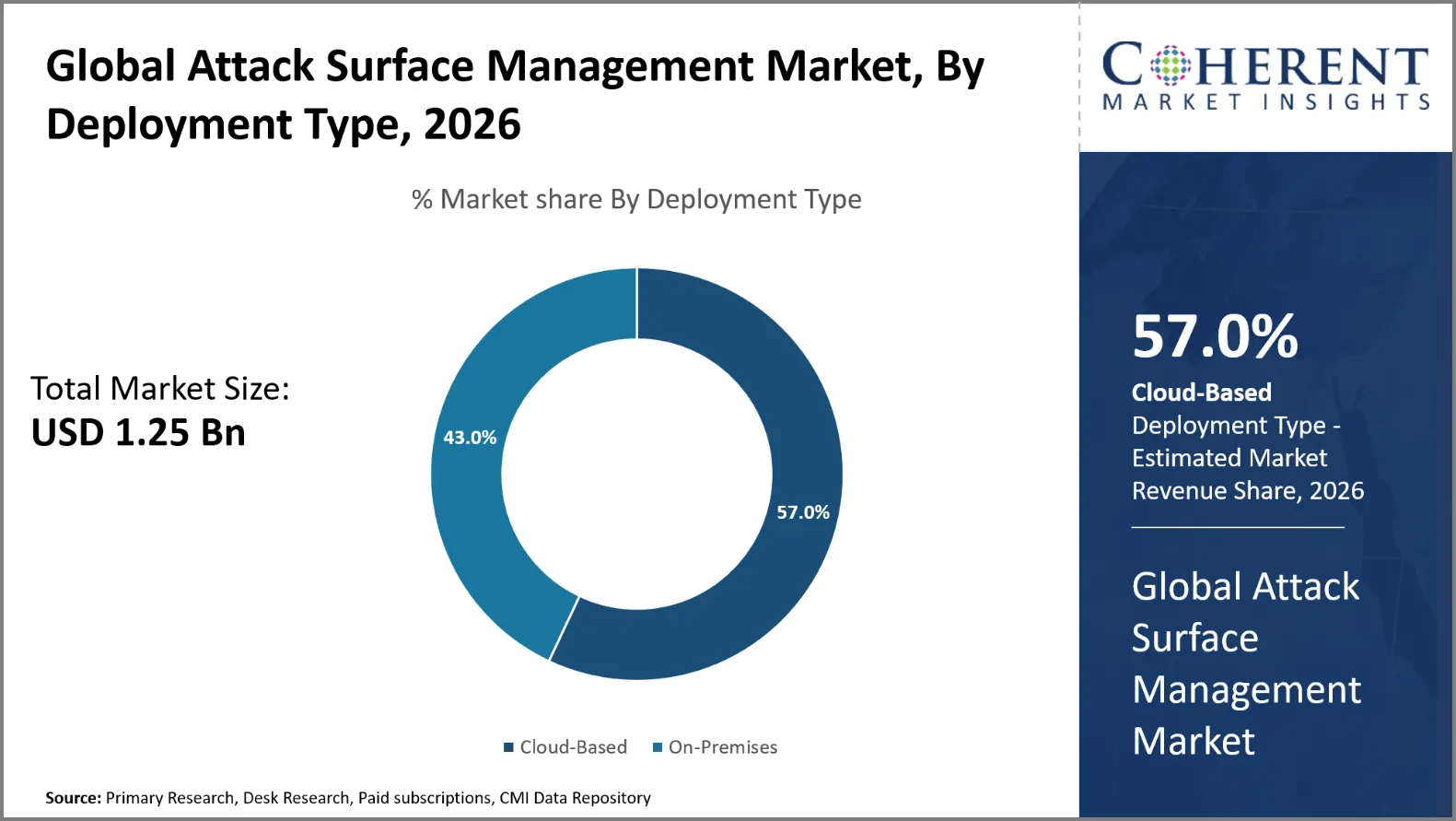
The cloud-based segment is expected to account for 57.0% of the global attack surface management market share in 2026. Cloud-based deployment leads the market, due to ongoing surveillance across distributed digital infrastructure. Many organizations also have hybrid systems that include cloud apps, remote endpoints and third-party platforms. With cloud-based solutions enterprises have centralized visibility without a lot of on-premises equipment. Their flexible scalability supports organizations to adapt to fluctuating asset inventories and increasing security requirements. Automatic software updates also indicate that users can get access to developing threat intelligence faster. These benefits motivate enterprises to utilize cloud-based attack surface management technologies.
On November 3, 2025, Wiz introduced Wiz Attack Surface Management to extend its cloud-native security platform. The solution merges external attack surface discovery with internal cloud security context. It connects cloud infrastructure, software development environments, and internet-facing assets through the Wiz Security Graph.
Cyber Asset Attack Surface Management Dominates the Global Attack Surface Management Market
The cyber asset attack surface management segment is expected to account for 43.0% of the global attack surface management market share in 2026. Cyber asset attack surface management dominates because organizations need comprehensive visibility into their expanding technology environments. They are constantly discovering, classifying and monitoring managed and unmanaged digital resources. They detect security exposures across cloud infrastructure, endpoints, applications and linked devices. This access allows security teams to discover undiscovered assets and remediate issues before they are exploited. Another factor driving the need for continuous cyber asset monitoring is the rising deployment of hybrid infrastructure. As such, enterprises are focusing on cyber asset attack surface management to achieve greater visibility of assets and manage security risk throughout the enterprise.
On March 20, 2025, Axonius, Inc. introduced the Axonius Asset Cloud at at their Adapt Conference in Dallas, Texas, U.S. The technology merges cyber asset visibility with responsive security operations. Axonius Identities and Axonius Exposures are part of its product portfolio. These features enable enterprises to find unmanaged assets, security misconfigurations and vulnerabilities.
Current Events and their Impact
Current Events | Description and its Impact |
European Union – Cyber Resilience Act (Regulation (EU) 2024/2847) |
|
European Union - Cyber Solidarity Act (Regulation (EU) 2025/38) |
|
Attack Surface Management Market Dynamics
Market Drivers
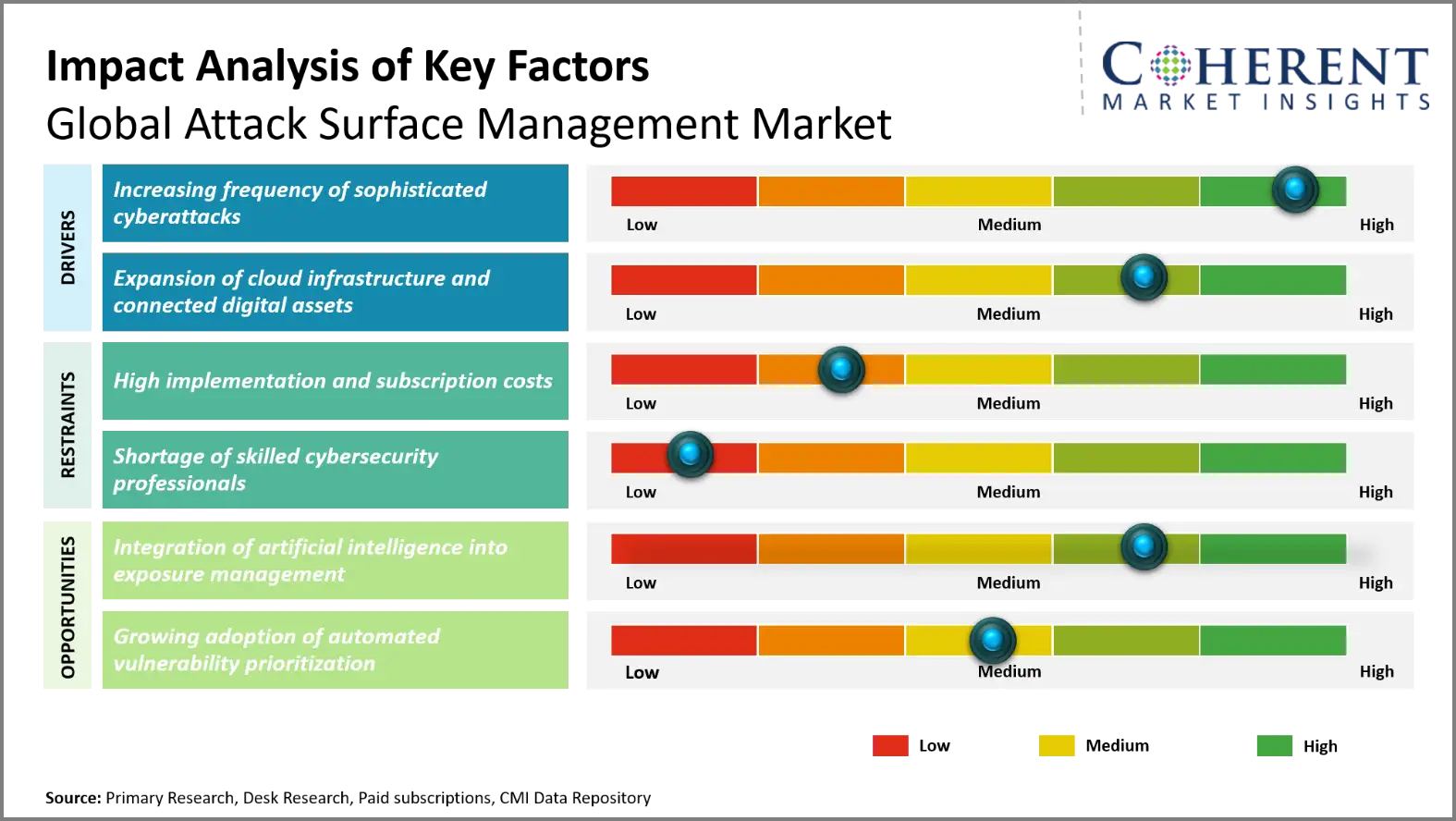
Increasing frequency of sophisticated cyberattacks
Complex cyberattacks are occurring with more regularity, which is fueling the demand for the worldwide attack surface management market. Cybercriminals are increasingly targeting unprotected applications, misconfigured cloud settings and vulnerable internet-facing equipment. Ransomware, phishing, and supply chain assaults pose security dangers to companies. Organizations must constantly be discovering assets in an effort to detect potential entry ways before attackers do. Attack Surface Management solutions enable security teams to prioritize vulnerabilities and track new exposures. As cyber security threats grow, companies are looking to improve proactive threat identification and external attack surface monitoring.
On September 29, 2025, Asahi Group Holdings Ltd. suffered a ransomware assault that paralyzed its corporate systems in Japan. The attackers apparently had gained illegal access to the network through compromised network equipment some ten days before detection. They took advantage of password flaws to get administrator access and probe internal servers.
Expansion of cloud infrastructure and connected digital assets
The growth of cloud infrastructure and connected digital resources is boosting the need for the worldwide attack surface management market. Enterprises are deploying cloud applications, remote endpoints, application programming interfaces and Internet of Things devices with growing frequency. These interconnected ecosystems offer further entry points for possible cyberattacks. The traditional security technologies can have a hard time keeping up the visibility in the fast-changing digital infrastructures. Attack Surface Management solutions are continuously discovering assets and identifying configuration weaknesses inside dispersed setups. The increasing digital connectedness means enterprises need to use centralized asset monitoring and exposure management solutions.
On June 11, 2026, Digi International announced seven new features for Digi Axess, its cloud-based infrastructure management platform, expanding native remote access, cellular SIM management, and advanced data visualization. Three of these characteristics are exclusive to Digi and made feasible since Digi owns the end-to-end hardware, cellular SIM, private network and cloud.
Restraining Factors
- High Implementation and Integration Costs: Implementing complete Attack Surface Management platforms demands large financial outlays for software, infrastructure, and cybersecurity expertise. The integration with existing security systems increases the complexity of the operations. Such costs can deter smaller businesses from using advanced attack surface monitoring technologies.
- Shortage of Skilled Cybersecurity Professionals: Organizations have a hard time hiring individuals who can manage complicated attack surface scenarios. They need technical competence to effectively discover assets, prioritize vulnerabilities and remediate exposure. A limited personnel availability can delay security evaluations and undermine ongoing surveillance capabilities.
Emerging Trends
- Artificial Intelligence-Driven Attack Surface Discovery: Artificial intelligence is increasingly being used for automated asset discovery, vulnerability correlation and threat exposure prioritization. Security systems use machine learning to detect suspicious changes occurring on company networks and in the ever-changing digital world.
- Impact: Automation minimizes the need for manual security assessments and speeds up the discovery of vulnerabilities. This provides organizations with better visibility into hidden assets for faster remediation and more efficient allocation of cybersecurity resources.
- Relevance to the market: Microsoft Defender External Attack Surface Management and Palo Alto Networks Cortex Xpanse have shown automated asset finding capability. These trends are driving organizations to embrace intelligence-driven exposure management technologies.
- Integration of Continuous Threat Exposure Management: Increasingly, organizations are implementing Continuous Threat Exposure Management frameworks to continuously assess security exposures. This method combines asset discovery, vulnerability assessment, threat intelligence, and remediation workflows throughout the enterprise infrastructure.
- Impact: Continuous exposure assessment allows security teams to concentrate on exploitable vulnerabilities rather than isolated technical weaknesses. This improves the effectiveness of repair and also increases the adaptability of the company to upcoming cyber assaults.
- Relevance to the market: Gartner’s Continuous Threat Exposure Management framework supports organized exposure management. Tenable Exposure Management and Qualys Enterprise TruRisk Management have demonstrated the acceptance of unified risk prioritizing capabilities in the market.
Regional Insights
Why is North America a Strong Market for Attack Surface Management?
North America is expected to account for a market share of 35.0% in 2026. North America is also experiencing widespread cybersecurity upgrading in financial services, healthcare, energy, and government infrastructure. The National Cyber Threat Assessment 2025–2026 for Canada identifies increased vulnerabilities from concentrated technological service providers. The major cloud platforms establish interdependencies between banks, airlines, and healthcare institutions. The study recognizes Amazon Web Services, Microsoft Azure and Google Cloud as key cloud infrastructure providers. Cross-border energy pipelines, electrical grids and railroad systems only add to the monitoring needs. Organizations have an increasing requirement to perform external asset identification to uncover supplier vulnerabilities and exposures of interconnected infrastructure. These requirements strengthen demand for continuous attack surface visibility across North American enterprises.
Why Does Asia Pacific Attack Surface Management Market Exhibit High Growth?
Asia Pacific is expected to register the fastest growth with a CAGR of 21.5% over the forecast period. Asia Pacific is projected to account for 23.0% of the global attack surface management market in 2026. Asia Pacific experiences growing attack surface management adoption through connected manufacturing, digital infrastructure, and consumer Internet of Things deployments. Singapore’s Cyber Security Agency reported that it detected 117,300 malicious computers in 2024, a 67% year-on-year jump. Unpatched routers, obsolete firmware and botnet infections expose vulnerabilities across connected systems. Singapore also announced measures to boost cybersecurity protection for Critical Information Infrastructure. Regional firms are demanding more and more monitoring across operational technology, industrial networks and connected production systems. These requirements create opportunities for asset discovery platforms supporting complex industrial environments.
Global Attack Surface Management Market Outlook for Key Countries
Why is U.S. Emerging as a Major Hub in the Attack Surface Management Market?
The U.S. market benefits from federal cybersecurity modernization and increasingly structured vulnerability remediation requirements. The Cybersecurity and Infrastructure Security Agency maintains its Known Exploited Vulnerabilities Catalog. Federal civilian agencies must prioritize vulnerabilities listed in this catalog under Binding Operational Directive 22-01. During Operation THUNDERSTRUCK, the agency coordinated remediation across more than 7,000 affected devices. Approximately 93% were patched or disconnected within 54 days across 53 federal agencies. Initiatives like these emphasize the significance of finding exposed network devices and verifying the effectiveness of cleanup efforts. They also urge widespread use of continuous external asset monitoring among government contractors and operators of vital infrastructure.
Is China the Next Growth Engine for the Attack Surface Management Market?
China’s desire for attack surface control is bolstered by cybersecurity obligations for vital information infrastructure operators. The new Cybersecurity Law enhances obligations for network monitoring, vulnerability management and incident response. Critical information infrastructure operators must do security evaluations at least yearly. These areas include telecommunications, energy, transportation, finance, public services and electronic governance. The law also requires network operators to have security monitoring and incident response capabilities. Such obligations force companies to upgrade asset inventories and find vulnerabilities in critical digital systems. Domestic cyber security firms can benefit from the demand for localized monitoring and compliance-driven exposure management solutions.
Germany Attack Surface Management Market Analysis and Trends
Germany’s market is driven by industrial cybersecurity needs and increased exposure across production networks. During the reporting period of 2025, an average of 119 new information technology vulnerabilities were discovered each day, the Federal Office for Information Security reports. This represents almost 24% gain compared to the last reporting period. The agency also pointed to weak protections in public online infrastructure. In Germany, automotive, chemical, mechanical and industrial automation industries need insight over connected production systems. Small and medium-sized firms confront specific hurdles in finding outmoded internet-facing assets. Such conditions drive targeted monitoring of exposures and vulnerability prioritization across industrial supply chains.
Japan Attack Surface Management Market Analysis and Trends
Japan’s market is buoyed by its move toward active cyber defense and better public-private cybersecurity coordination. The 2025 National Cybersecurity Strategy stresses government-led threat intelligence analysis and enhanced exchange of vulnerability information. Japan also aims to establish centralized reporting mechanisms for vital infrastructure providers and important computer equipment. Its approach calls for expanding threat hunting efforts across government and business sector institutions. These efforts increase the urgency of finding systems that are exposed before attackers may exploit vulnerabilities. Automotive manufacturers, semiconductor makers and telecom operators need to see across networks of interlinked suppliers.” The increasing collaboration between infrastructure operators and government agencies is driving the demand for sophisticated asset discovery and exposure assessment capabilities.
India Attack Surface Management Market Analysis and Trends
Increasing digital payments and enhanced cybersecurity monitoring fuel growth in the attack surface management industry in India. The Indian Computer Emergency Response Team processed more than 29.44 lakh cyber incidents in 2025. The organization also published 1,530 alerts and 390 vulnerability notes. The empaneled cybersecurity audit ecosystem had 231 organizations. Cybersecurity audits were heavily focused on banking and financial institutions, power and transportation. The proliferation of Unified Payments Interface architecture increases the need for protection of interlinked payment applications and supporting systems. More and more enterprises require constant asset identification and vulnerability evaluation across digital payment infrastructure. These advancements create potential for domestic cybersecurity platforms and specialist assessment providers.
Global Attack Surface Management Market - Agentic Artificial Intelligence in Exposure Management
Metric | Adoption Rate | Scope and Interpretation |
Security teams prioritizing agentic AI | 87% | Surveyed security professionals identifying agentic AI as a priority |
Automation reducing response time | 92% | Respondents reporting that automation reduces mean time to respond |
AI adoption in cloud security policy enforcement | 53% | Security teams using AI for cloud security policy enforcement |
AI adoption in incident response | 44% | Security teams using AI in incident response workflows |
AI adoption in threat intelligence correlation | 43% | Security teams using AI to correlate threat intelligence |
AI adoption in vulnerability remediation | 42% | Security teams using AI for vulnerability response and remediation |
Business impact analysis in risk prioritization | 60% | Security professionals using business impact analysis for risk prioritization |
Cybersecurity exposure score usage | 51% | Companies using exposure scores or risk-based indices |
Annual growth in vulnerability submissions | 92% | Year-over-year increase reported across HackerOne's platform |
Mean time to remediate reduction | 80% | Reduction reported across organizations supported by HackerOne |
How is Integration of Artificial Intelligence into Exposure Management Creating New Growth Opportunities in the Attack Surface Management Market?
Embedding artificial intelligence into exposure management drives growth by allowing security platforms to automatically connect asset inventory, vulnerability intelligence and attacker activity. Machine learning can aid in separating exploitable flaws from routine security findings, which can save effort for unneeded remediation. For example, Microsoft Security Exposure Management links attack pathways, important assets, and security recommendations to expose business-critical exposures. Palo Alto Networks Cortex Xpanse also provides external asset detection and risk research for internet-facing infrastructure. Generative artificial intelligence can also assist in translating complex exposure findings into prioritized remediation recommendations. These characteristics drive organizations to buy sophisticated platforms providing contextual risk rating, automated investigation and streamlined remedial workflows.
On March 23, 2026, Agent Val was launched by Qualys, Inc. as part of its Enterprise TruRisk Management platform. The AI agent confirms exploitability, identifies crucial attack pathways, and orchestrates autonomous cleanup. It prioritizes actual security exposures using business context and asset criticality.
Market Players, Key Development, and Competitive Landscape
Key Developments
- On May 21, 2026, Tenable Holdings, Inc. announced the next evolution of its technology partner ecosystem, the Tenable Open Partner Exchange Network (OPEN), to help organizations unify security data, accelerate AI-driven workflows and operationalize exposure management across their existing technology stack.
- On March 31, 2026, HCLTech and CrowdStrike announced the expansion of their strategic collaboration with the launch of Continuous Threat Exposure Management (CTEM) services. This integrated solution allows continuous, intelligence-led identification, prioritization and remediation of exposure across endpoints, cloud, identity, applications and data, allowing companies retain an always-on view of exposure and address risk in a more structured and timely manner.
- On March 31, 2026, Censys announced a series D fundraising round led by Morgan Stanley Expansion Capital with participation from Decibel Partners, Greylock Partners, GV, Intel Capital and others. The company will use the USD 40 million Series D round and USD 30 million debt financing to accelerate building AI-driven solutions for modern security operations on its recently launched Internet intelligence platform.
Competitive Landscape
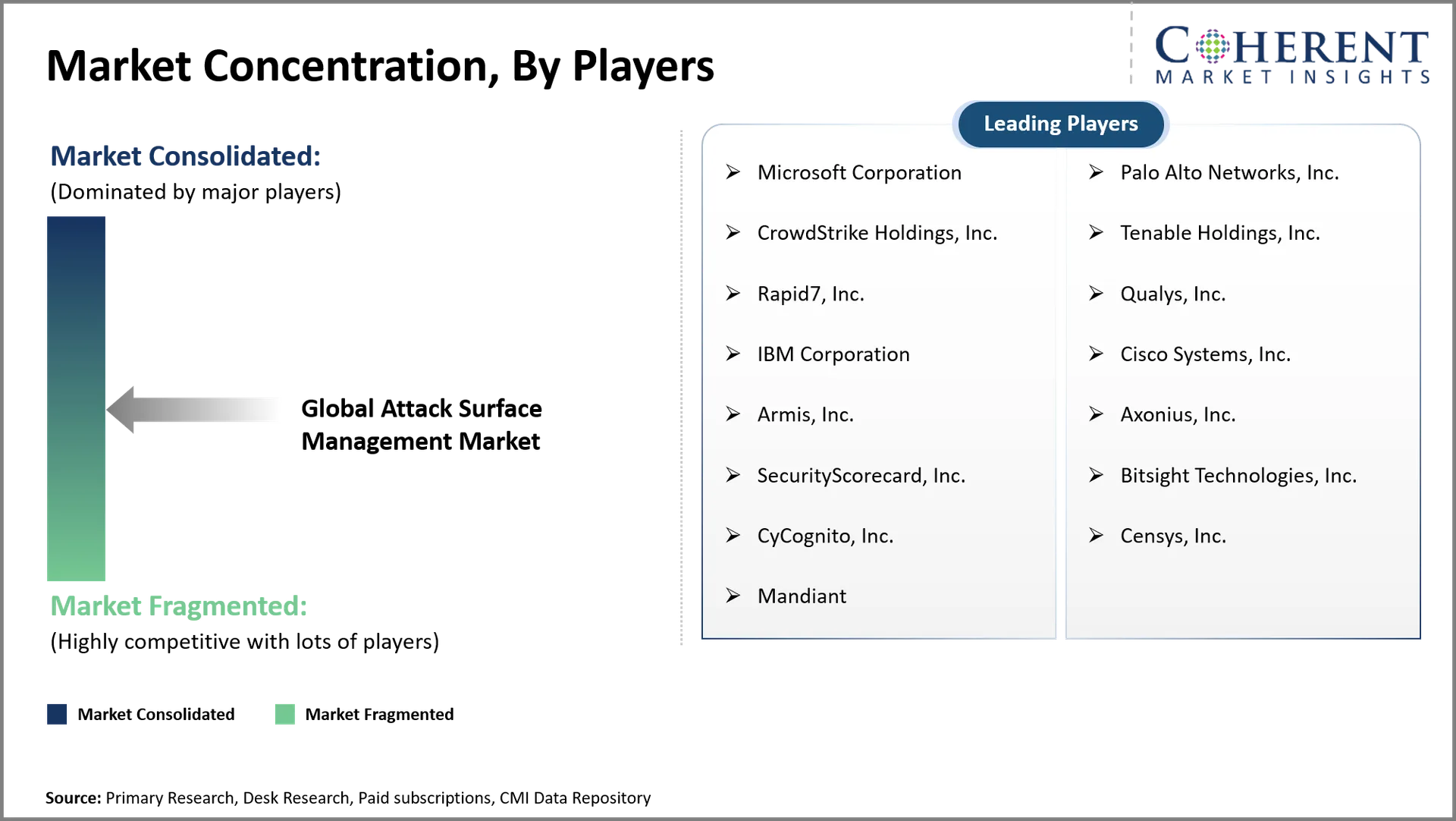
The global attack surface management market features intense competition among cybersecurity platform providers. Palo Alto Networks is doubling down on the Cortex Xpanse and automated external asset discovery. Its platform continuously discovers internet-facing assets and provides for automated cleanup. Microsoft Corporation is committed to integrating Defender External Attack Surface Management into its larger security ecosystem. Tenable Holdings, Inc. Expands exposure management with Tenable One, Identity Security, Cloud Protection & Autonomous Patch Management. Rapid7, Inc. focuses on vulnerability intelligence and integrated exposure assessment. CrowdStrike Holdings, Inc. emphasizes endpoint telemetry and exposure prioritization through its Falcon platform.
Top Manufacturers and Notable Products/Solutions in the Attack Surface Management Market
Manufacturer | Notable Product/Solution | Key features |
Palo Alto Networks, Inc. | Cortex Xpanse | Continuous internet-wide asset discovery, unknown asset identification, machine-learning risk prioritization, automated response playbooks, shadow cloud detection |
Microsoft Corporation | Microsoft Defender External Attack Surface Management | External asset discovery, dynamic asset inventory, shadow IT identification, vulnerability insights, internet-facing infrastructure mapping |
CrowdStrike Holdings, Inc. | Falcon Surface | Continuous external asset discovery, real-time asset inventory, adversary-driven intelligence, context-based risk prioritization, vulnerability remediation guidance |
Tenable Holdings, Inc. | Tenable One Attack Surface Management | Internet-connected asset discovery, unknown asset attribution, continuous monitoring, business-context enrichment, external exposure assessment |
Rapid7, Inc. | Surface Command | Internal and external asset visibility, cloud asset correlation, vulnerability prioritization, threat intelligence, remediation workflows, security tool integrations |
Attack Surface Management Market | |||
Report Coverage | Details | ||
Base Year | 2025 | Market Size in 2026: | USD 1.25 Bn |
Historical Data For: | 2020 To 2024 | Forecast Period: | 2026 To 2033 |
Forecast Period 2026 To 2033 CAGR: | 16.3% | 2033 Value Projection: | USD 4.15 Bn |
Geographies covered: |
| ||
Segments covered: |
| ||
Companies covered: | Microsoft Corporation, Palo Alto Networks, Inc., CrowdStrike Holdings, Inc., Tenable Holdings, Inc., Rapid7, Inc., Qualys, Inc., IBM Corporation, Cisco Systems, Inc., Armis, Inc., Axonius, Inc., SecurityScorecard, Inc., Bitsight Technologies, Inc., CyCognito, Inc., Censys, Inc., Mandiant | ||
Growth Drivers: |
| ||
Restraints & Challenges: |
| ||
Analyst Opinion (Expert Opinion)
- The future of the Global Attack Surface Management Market will increasingly revolve around continuous exposure management rather than periodic vulnerability scanning. Security platforms will need to connect external asset discovery with identity risks, cloud misconfigurations, and exploitable attack paths. Artificial intelligence will become important for distinguishing business-critical exposures from low-priority security findings. Vendors offering automated remediation and measurable exposure reduction will gain stronger enterprise adoption. Integration with Security Information and Event Management and Security Orchestration, Automation, and Response platforms will become an important competitive differentiator.
- The maximum opportunities will emerge in cyber asset attack surface management and external attack surface management solutions. Large enterprises across banking, financial services, insurance, telecommunications, and manufacturing will require deeper asset visibility. Cloud-based deployment will attract organizations managing distributed infrastructure and multiple cloud environments. Given the complexity of government contractor networks and reliance on key infrastructure, the U.S. remains a major opportunity. For India and Japan, there are further prospects with the increasing digital payment infrastructure and connected manufacturing ecosystems. Vendors should concentrate on identity exposure mapping and third-party asset discovery.
- Platforms must differentiate themselves by providing correct asset attribution, validating exploitability, and providing automated remediation. Integration with ServiceNow, Microsoft Sentinel and other vulnerability management systems can make enterprise adoption easier. Companies need to build specific competencies in operational technology, Internet of Things devices and artificial intelligence infrastructure. Transparent risk score and explainable remediation recommendations might increase security team confidence. Vendors also need to have regional alliances and local compliance skills. These tactics help boost client retention and increase competitiveness in tough business security environments.
Speak to the analyst
Want personalized insights?
Take the findings above to one of our principal consultants, or have the report rebuilt around the segments, geographies and competitors you actually track.
Market Segmentation
- Offering Type Insights (Revenue, USD Billion, 2021 - 2033)
- Solutions
- Services
- Deployment Type Insights (Revenue, USD Billion, 2021 - 2033)
- Cloud-Based
- On-Premises
- Solution Type Insights (Revenue, USD Billion, 2021 - 2033)
- Cyber Asset Attack Surface Management
- External Attack Surface Management
- Digital Risk Protection
- Exposure Validation and Attack Path Analysis
- Asset Type Insights (Revenue, USD Billion, 2021 - 2033)
- Internal IT Assets
- External IT Assets
- Cloud Assets
- Internet of Things Assets
- Operational Technology Assets
- End User Insights (Revenue, USD Billion, 2021 - 2033)
- BFSI
- IT and Telecommunications
- Healthcare
- Retail and E-Commerce
- Manufacturing
- Government and Public Sector
- Energy and Utilities
- Aerospace and Defense
- Others
- Regional Insights (Revenue, USD Billion, 2021 - 2033)
- North America
- U.S.
- Canada
- Latin America
- Brazil
- Argentina
- Mexico
- Rest of Latin America
- Europe
- Germany
- U.K.
- Spain
- France
- Italy
- Russia
- Rest of Europe
- Asia Pacific
- China
- India
- Japan
- Australia
- South Korea
- ASEAN
- Rest of Asia Pacific
- Middle East
- GCC Countries
- Israel
- Rest of Middle East
- Africa
- South Africa
- North Africa
- Central Africa
- North America
- Key Players Insights
- Microsoft Corporation
- Palo Alto Networks, Inc.
- CrowdStrike Holdings, Inc.
- Tenable Holdings, Inc.
- Rapid7, Inc.
- Qualys, Inc.
- IBM Corporation
- Cisco Systems, Inc.
- Armis, Inc.
- Axonius, Inc.
- SecurityScorecard, Inc.
- Bitsight Technologies, Inc.
- CyCognito, Inc.
- Censys, Inc.
- Mandiant
Sources
Primary Research Interviews
- Chief Information Security Officers (CISOs)
- Cybersecurity Solution Providers & Vendors
- IT Infrastructure & Network Security Specialists
- Cloud Security Architects & Consultants
Magazines
- SC Magazine (Cybersecurity)
- Dark Reading Magazine
- Infosecurity Magazine
- CSO Magazine
Journals
- Journal of Cybersecurity (Oxford Academic)
- IEEE Transactions on Information Forensics and Security
- Journal of Information Security and Applications (Elsevier)
Associations
- Information Systems Security Association (ISSA)
- Cloud Security Alliance (CSA)
- International Information System Security Certification Consortium (ISC²)
- Cyber Threat Alliance (CTA)
Public Domain Sources
- U.S. Cybersecurity and Infrastructure Security Agency (CISA) – cisa.gov
- National Institute of Standards and Technology (NIST) – nist.gov
- European Union Agency for Cybersecurity (ENISA) – enisa.europa.eu
- U.S. Securities and Exchange Commission (SEC) – Cybersecurity Disclosures
Proprietary Elements
- CMI Data Analytics Tool
- Proprietary CMI Existing Repository of Information for the Last 10 Years
Get access to 250+ pages report
Every segment, forecast, competitor profile and data table behind the analysis above — available for instant download.
- ESOMAR Member
- ISO 9001:2015 Certified
- D-U-N-S Registered
- GDPR & CCPA Compliant
Frequently Asked Questions
The global attack surface management market is expected to stand at USD 1.25 Bn in 2026 and is expected to reach USD 4.15 Bn by 2033.
The CAGR of the global attack surface management market is projected to be 16.3% from 2026 to 2033.
Increasing frequency of sophisticated cyberattacks and Expansion of cloud infrastructure and connected digital assets are the major factors driving the growth of the global attack surface management market.
High implementation and subscription costs and Shortage of skilled cybersecurity professionals are the major factors hampering the growth of the global attack surface management market.
In terms of offering type, solutions segment is estimated to dominate the market revenue share in 2026.
The market covers solutions and services that identify, monitor, and manage an organization's exposed digital assets.
Cloud computing expands enterprise asset inventories and creates additional security monitoring requirements across distributed infrastructure.