

Autoclave Market Size and Share Analysis – 2026 To 2033
The Global Autoclave Market size is anticipated to grow at a CAGR of 5.3%, valued at USD 2.57 Bn in 2026, and is expected to reach USD 3.68 Bn by 2033. The primary growth drivers are largely defined by the increasing demand for sterilization equipment across hospitals, pharmaceutical manufacturing facilities, biotechnology laboratories, and research institutions, rising emphasis on infection prevention and control, growing volumes of surgical procedures, and stringent sterilization and patient safety standards. According to the U.S. Centers for Disease Control and Prevention (CDC) recommends steam sterilization as the preferred method for sterilizing heat- and moisture-stable critical medical and surgical instruments and emphasizes the necessity of autoclaves for healthcare infection prevention and instrument reprocessing.
Key Takeaways
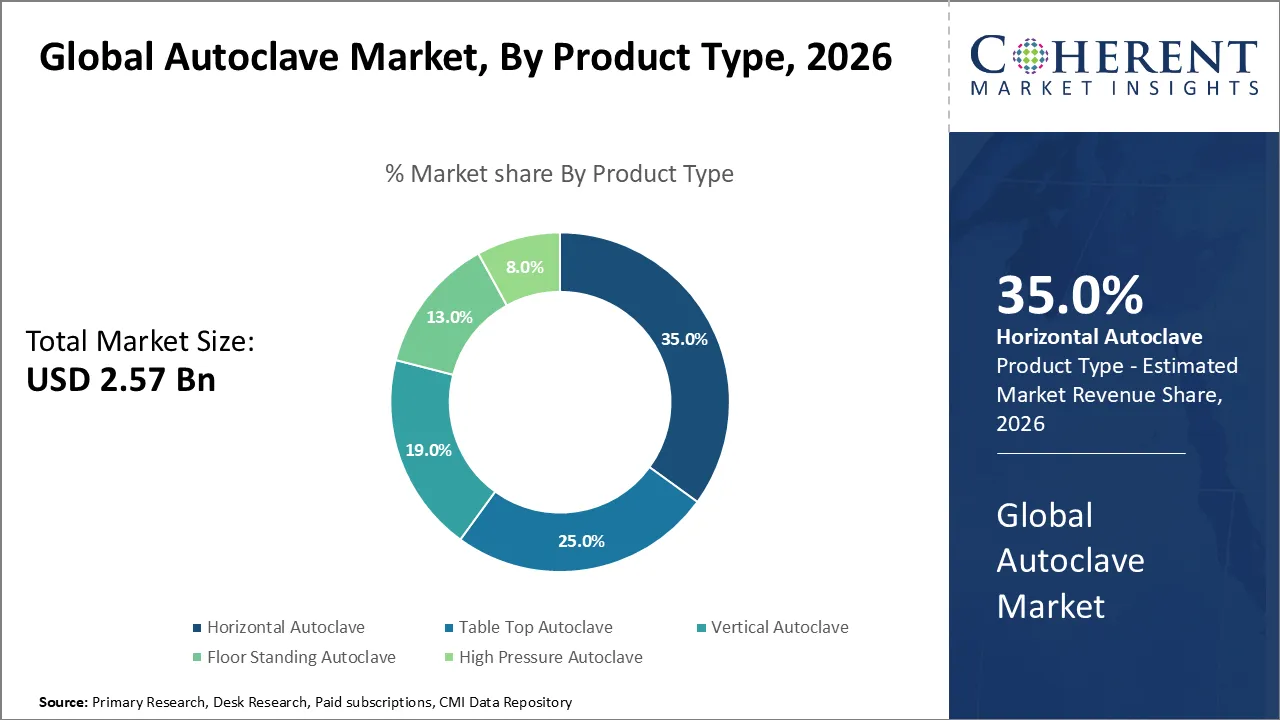
- The horizontal autoclave segment is projected to hold the largest share of the global autoclave market in 2026 with an estimated share of 35.0%. The segment is growing due to increasing demand for high-capacity sterilization systems, centralized sterile services departments (CSSDs), automated instrument reprocessing and large-scale pharmaceutical sterilization. According to the U.S. Centers for Disease Control and Prevention (CDC) reports that the time to process steam sterilization can be between 3 and 30 minutes depending on the instrument and sterilization conditions, thereby highlighting the need for equipment that can accommodate a variety of sterilization cycles.
- The medical applications segment is anticipated to dominate the market with the estimated share of 49.0% in 2026. The market growth is driven by increasing reprocessing demands for surgical instruments, growing hospital infrastructure, and rising demand for infection prevention and sterilization protocols. Healthcare-associated infections remain a major cause of patient harm, antimicrobial resistance and increased healthcare costs, the World Health Organization (WHO) Global Report on Infection Prevention and Control published in November 2024 reads. Reliable sterilization infrastructure is a must in healthcare facilities.
- The 200-500 liters capacity segment is anticipated to hold the major share of 32.0% in 2026. The growth of the segment is driven by the demand for medium capacity sterilizers in multi-specialty hospitals, surgical centers and medical teaching institutions, where the capacity of the equipment has to be in line with instrument throughput, installation space and operating costs. In December 2025, India’s Ministry of Health and Family Welfare said that the country approved 74 new medical colleges in 2024–25 and 44 in 2025–26, indicating an expansion of healthcare education infrastructure and potentially institutional demand for sterilization equipment.
- The steam autoclave segment is expected to dominate the technology segment with a market share of 73.0% in 2026. The growth is driven by the reliability of saturated steam sterilization, the relatively economical operating costs, the established hospital sterilization protocols and the compatibility with reusable surgical instruments. The CDC also recommends steam sterilization for critical medical and surgical instruments that can withstand heat and moisture. This again reinforces the importance of steam sterilization in healthcare instrument reprocessing.
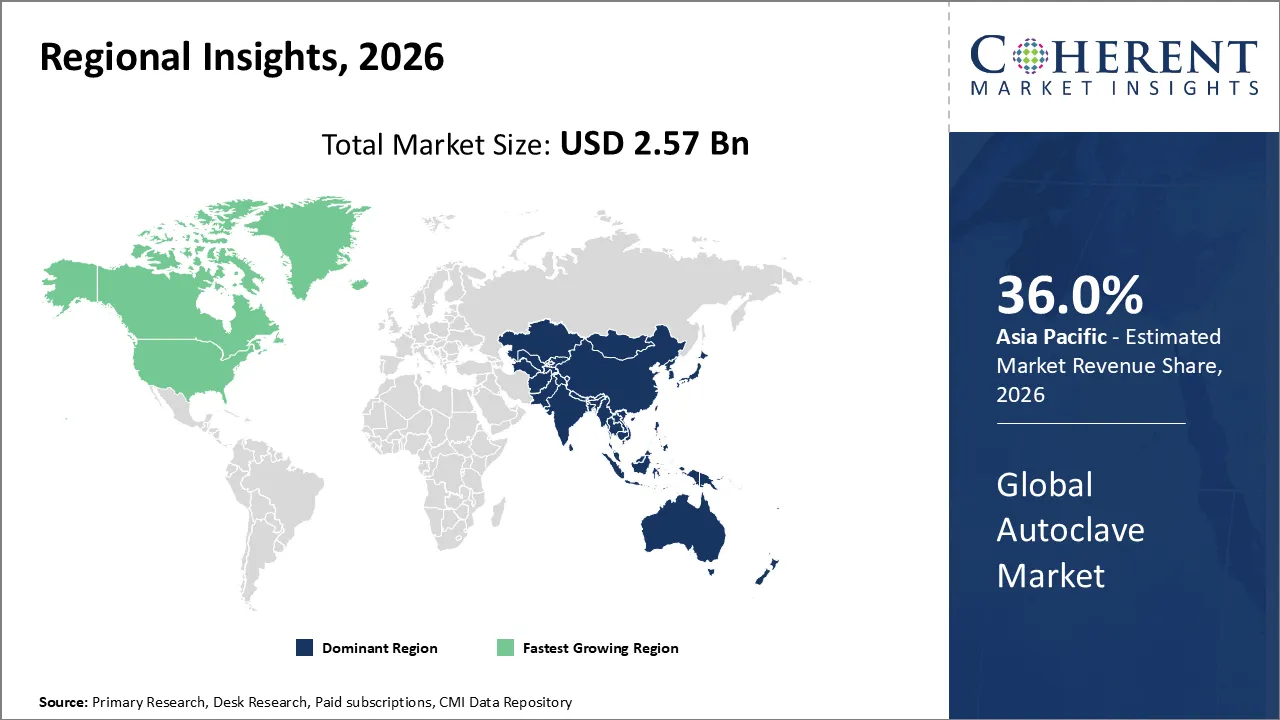
- Asia Pacific is expected to account for the leading regional share of 36.0% in 2026. Regional growth is driven by increasing investments in healthcare infrastructure, growing pharmaceutical manufacturing capabilities, increasing need for hospital sterilization and growing adoption of centralized sterilization systems. In September 2025, the Government of India approved an investment of INR 15,034.50 crore for upgrading the postgraduate and undergraduate medical education capacity in existing medical colleges and government hospitals during 2025–2029, which will also help in further development of healthcare infrastructure and its allied sterilization requirements.
Market Drivers
Expansion of Healthcare Infrastructure and Medical Institutions is Accelerating Autoclave Market Growth
The global autoclave market is driven by increasing investments in hospitals, medical colleges, diagnostic laboratories and healthcare infrastructure, especially in emerging economies. Opportunities for the installation of horizontal autoclaves, vertical sterilizers and high capacity steam sterilization equipment are being created by the development of new healthcare facilities and the expansion of surgical and laboratory capabilities.
In March 2026, the Ministry of Health and Family Welfare announced the setting up of 43 new medical colleges for the academic session 2025-26. The government has sanctioned 11,682 MBBS seats and 8,967 postgraduate medical seats for the academic year 2025-26. Further, 157 medical colleges were approved under the Centrally Sponsored Scheme with the total project cost of INR 41,332.41 crore.
Current Events and Their Impact on the Autoclave Market
Current Event | Description and its Impact |
U.S. FDA Introduces New Regulatory Classification for Electronic Sterilization Monitoring Systems (June 2026) |
|
Indian Government Simplifies Medical Device Outsourced Sterilization Regulations (August 2026) |
|
- Current Industry Events of 2026
- Market Size Estimation
- Regional Breakdown
- Competitive Landscape
- Customer Intelligence
- Segmental Analysis
- Pricing Analysis
- Key Market Drivers, Challenges & Future Trends
- Customized Insights Section
Segmental Insights
Why is the Horizontal Autoclave Segment Acquiring the Largest Market Share?
On the basis of product type, the horizontal autoclave segment is projected to account for the largest global Autoclave Market share of 35.0% in 2026. The segment growth is driven by the increasing demand for high-throughput sterilization equipment from multispecialty hospitals, centralized sterile services departments (CSSDs), pharmaceutical manufacturing facilities, and research institutions. Horizontal autoclaves are ideal for larger instrument loads, facilities requiring several sterilization cycles, automated loading systems and the efficient processing of reusable surgical instruments.
In February 2025, the Maharashtra Medical Goods Procurement Authority (MMGPA) issued tender E-210/MMGPA for supply, installation and commissioning of horizontal high-pressure autoclaves of two-drum configurations of 400 x 600 mm.
In July 2026, the Association for the Advancement of Medical Instrumentation (AAMI) issued the latest standard for hospital steam sterilizers, ANSI/AAMI ST8:2026. The standard outlines minimum requirements for the safety, performance, labeling and testing of steam sterilization equipment.
Why is the Medical Application Segment Dominating the Autoclave Market?
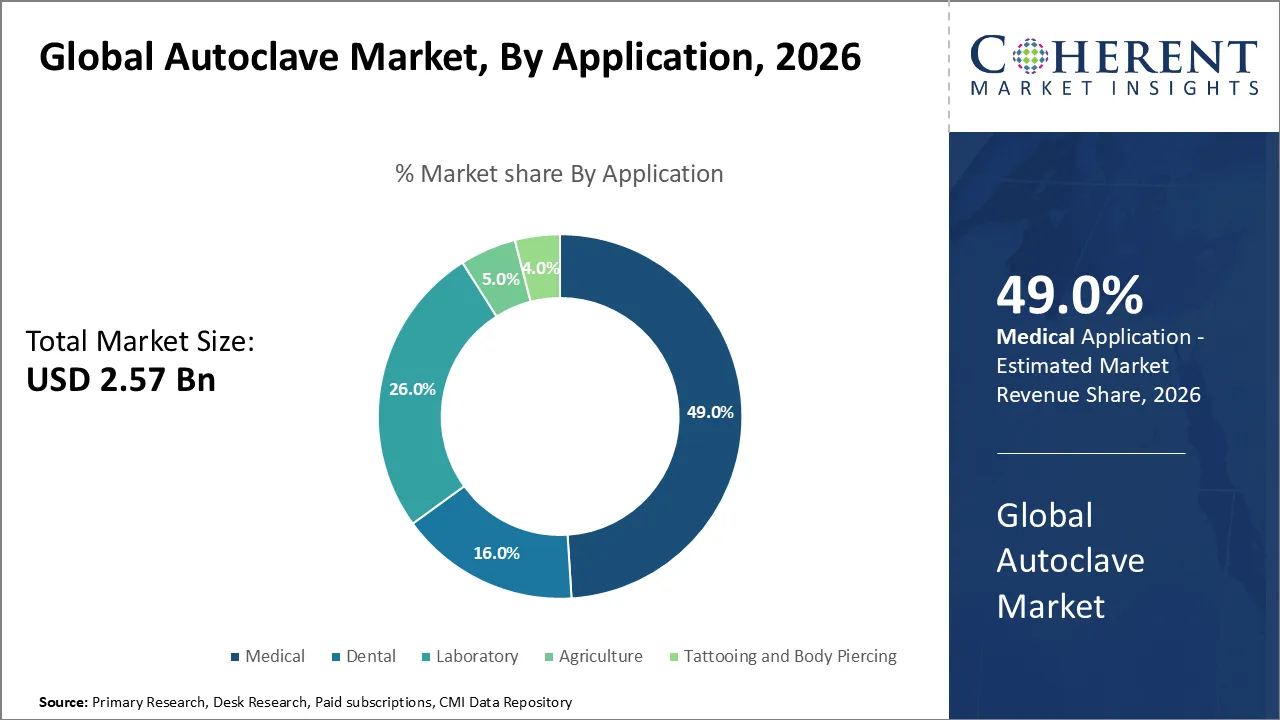
Based on application, the medical segment is expected to dominate the global Autoclave Market with a share of 49.0% in 2026. The segment is driven by increasing demand for surgical instrument sterilization, prevention of hospital-acquired infections, expansion of surgical services, and increasing investments in sterile processing infrastructure. The need for dependable autoclave systems is increasing as hospitals and surgical centers require systems to guaranty instrument sterility, improve operational efficiency, and meet standardized infection control protocols.
According to a 2025 JAMA Surgery study of a surgical infection prevention program in five low-resource countries reported a decrease in 30-day surgical site infection rates from 28.4% to 12.1% among 1,865 surgical patients. These included reprocessing of surgical instruments, maintaining sterile fields and other infection prevention practices.
Why is the 200–500 Liters Capacity Segment Holding the Largest Market Share?
Based on capacity, the 200–500 liters segment is projected to account for the largest share of the global Autoclave Market, at 32.0%, in 2026. The expansion is driven by its use in medium and large hospitals, surgical centers, medical colleges and centralized sterilization departments. These autoclaves are a good compromise between processing capacity, sterilization throughput, installation footprint and operational costs.
In March 2025, Jammu and Kashmir Medical Supplies Corporation Limited (JKMSCL) issued a rate-contract document for specifications of horizontal steam sterilizers with 200-300 liters chamber capacity and double-door configuration.
The Central Sterile Services Department of Women Hospital, Akola, Maharashtra floated Government e-Marketplace tender for the same in October 2025 and was in need of two horizontal steam sterilizers with chamber capacities of 450 liters and 540 liters. The equipment required included automated PLC control, the ability to reach 135 degrees Celsius and cycle level monitoring.
Why is the Steam Autoclave Segment Dominating the Technology Category?
On the basis of technology, the steam autoclave segment is estimated to dominate the global Autoclave Market with a 73.0% share in 2026. The segment is driven by the proven effectiveness of saturated steam sterilization, relatively low operational costs, compatibility with heat-resistant medical instruments, and broad acceptance in healthcare facilities and pharmaceutical manufacturing operations. Demand for validation of sterilization cycles, process monitoring and documented equipment performance is also increasing and further driving demand for advanced steam autoclave systems.
In May 2024, the U.S. Food and Drug Administration (FDA) adopted ISO 17665:2024 specifying requirements for the development, validation and routine control of moist-heat sterilization processes for medical devices. The standard contains several methods including saturated steam sterilization using gravity displacement and other methods of air removal.
In December 2024, the FDA recognized AAMI TIR17:2024 which covers material compatibility across 10 sterilization methods including moist heat, dry heat, ethylene oxide and vaporized hydrogen peroxide.
Autoclave Market Trends
- The growing use of IoT-enabled autoclaves, cloud-based sterilization monitoring and automatic cycle documentation improves equipment traceability, reduces operational downtime and enables remote diagnostics across hospitals and laboratories. Tuttnauer’s T-Connect platform, which provides remote cycle-history access, automated notifications and equipment diagnostics through connected devices, was featured in Tuttnauer’s T-Top autoclave product literature published in December 2025.
- The increasing focus on energy-efficient and water-saving autoclave technologies is forcing healthcare facilities and laboratories to adopt sterilization equipment that lowers utility consumption and operating costs. Consolidated Sterilizer Systems’ WaterEco technology can reduce cooling-water use by as much as 90%. With the WaterEco Plus configuration, 50–99% water savings can be achieved depending on the installation and cooling-water configuration.
- Increasing use of rapid BI monitoring systems improves sterilization workflow efficiency and enables faster instrument processing decisions. In August 2025, Advanced Sterilization Products (ASP) introduced its BIOTRACE Instant Read Steam System, which offers biological-indicator readouts in seven seconds, two concurrent testing locations, and storage of the last 50 results.
Regional Insights
Asia Pacific Dominates the Autoclave Market Owing to Expanding Pharmaceutical Manufacturing and Healthcare Infrastructure
Asia Pacific is anticipated to hold the largest share in the global Autoclave Market with a share of 36.0% in 2026. Major factors driving growth of the market are growth of pharmaceutical manufacturing sector, investments in healthcare infrastructure, demand for sterilization equipment in hospitals and laboratories, and increasing adoption of advanced steam sterilization technologies in China, India, Japan, and South Korea.
According to the Ministry of Commerce and Industry, pharmaceutical exports in India stood at USD 30.47 billion in February 2026 during FY 2024-25, registering growth of 9.4% over the previous year.
In July 2025, China-based medical equipment manufacturer Shinva Medical Instrument Co., Ltd. announced the commercial launch of its LAS-M Series Vertical Autoclave, which is expected to help improve the efficiency of laboratory sterilization through better safety, intelligent controls, faster sterilization, and better equipment durability.
North America Autoclave Market Trends
North America is expected to hold the highest growth in the global Autoclave Market during the period 2026-2033. The growth of the region is driven by increasing investments in healthcare modernization, replacement of aging sterilization equipment, adoption of automated sterilization technologies, and substantial demand for validated sterilization systems in hospitals, pharmaceutical manufacturing facilities, and biotechnology laboratories. The United States and Canada are expected to provide opportunities for advanced autoclaves with digital cycle documentation, automated monitoring and energy-efficient operation.
According to Statistics Canada, the capital expenditure in the country’s healthcare and social assistance sector is predicted to be CAD 20.7 billion in 2026, compared to CAD 20.0 billion in 2025, in June 2026. The agency also said that approximately CAD 4.42 billion of the planned 2026 spending is for machinery and equipment.
Expansion of Domestic Pharmaceutical Manufacturing and Advanced Sterilization Infrastructure is Accelerating the Autoclave Market in the United States
The U.S. Autoclave Market is following a steady growth trajectory on account of increasing investments in domestic pharmaceutical manufacturing, growing demand for validated steam sterilization systems, and modernization of sterile processing infrastructure in hospitals and biotechnology facilities. Manufacturers are also investing in more sophisticated sterilization machinery with automated process monitoring and digital documentation capabilities with the growing traction in pharmaceutical supply-chain resilience and regulatory compliance.
The U.S. Food and Drug Administration (FDA) announced in June 2026 the selection of seven pharmaceutical manufacturers to participate in the FDA PreCheck Pilot Program, aimed at increasing domestic drug manufacturing capacity and bolstering pharmaceutical supply chains. More than 80 applications were received by the FDA between February 1 and March 1, 2026 Companies selected include Amneal Pharmaceuticals and Regeneron Pharmaceuticals and proposed facilities include sterile pharmaceutical manufacturing capabilities.
In April 2026, PCI Pharma Services announced major investments of more than USD 1 billion across its U.S. and European operations, including the expansion of sterile fill-finish manufacturing capabilities and high-speed isolator filling lines for prefilled syringes, cartridges and vials.
China Autoclave Market Trends
China is expected to experience significant growth in the Autoclave Market during the forecast period owing to its large hospital network, rising demand for surgical instrument reprocessing, growing medical device manufacturing capabilities, and increasing adoption of automated sterilization technologies. The country’s mature domestic manufacturing ecosystem is also helping drive the availability of high-capacity autoclaves, laboratory sterilizers, and integrated Central Sterile Supply Department (CSSD) solutions.
According to the National Bureau of Statistics of China in February 2026, China had approximately 38,000 hospitals and 10.09 million beds in healthcare institutions at the end of 2025, including 7.99 million hospital beds. In 2025, China also discharged approximately 300 million people from hospitals.
For instance, SHINVA Medical Instrument Co., Ltd. is a Chinese medical equipment manufacturer. The company has a 2025 company-wide turnover of USD 1.35 billion and an international footprint in over 150 countries. The company's portfolio includes medical autoclaves, pharmaceutical sterilization equipment, low-temperature sterilizers, and integrated infection-control solutions.
Who are the Major Companies in Autoclave Industry
Some of the major key players in Autoclave Market are MELAG Medizintechnik oHG, Tuttnauer, Getinge AB, Belimed, SAKURA SEIKI Co., Ltd., Shinva Medical Instrument Co., LTD., Astell Scientific, STERIS plc., BMM Weston Ltd., LTE Scientific Ltd, Panasonic Biomedical Sales Europe B.V., Priorclave Ltd., Life Steriware, Accumax India, and Consolidated Sterilizer Systems.
Key News
- In May 2026, Consolidated Sterilizer Systems, a U.S.-based manufacturer of steam sterilizers, unveiled a compact, wall-mounted water purification system designed for healthcare facilities and life science laboratories.
- In September 2025, Astell Scientific, a UK-based autoclave manufacturer, highlighted the supply of seven laboratory autoclaves to Imperial College London's Containment Level 3 laboratory refurbishment project. The equipment included two 63-liter benchtop autoclaves and five 120-liter top-loading autoclaves, equipped with containment filtration to support laboratory sterilization requirements.
Market Report Scope
Autoclave Market Report Coverage
Report Coverage | Details | ||
Base Year: | 2025 | Market Size in 2026: | USD 2.57 Bn |
Historical Data for: | 2020 to 2024 | Forecast Period: | 2026 to 2033 |
CAGR: | 5.3% | 2033 Value Projection: | USD 3.68 Bn |
Geographies covered: |
| ||
Segments covered: |
| ||
Companies covered: | MELAG Medizintechnik oHG, Tuttnauer, Getinge AB, Belimed, SAKURA SEIKI Co., Ltd., Shinva Medical Instrument Co., LTD., Astell Scientific, STERIS plc., BMM Weston Ltd., LTE Scientific Ltd, Panasonic Biomedical Sales Europe B.V., Priorclave Ltd., Life Steriware, Accumax India, and Consolidated Sterilizer Systems. | ||
Growth Drivers: |
| ||
Restraints & Challenges: |
| ||
Analyst Opinion
- Government backed modernization of healthcare infrastructure is expected to generate ongoing replacement demand for advanced autoclave systems. NHS England’s 2026-2029 capital guidance states that the NHS has been allocated over GBP 44 billion of capital funding over four years, including around GBP 4.0 billion for operational capital in 2026-27, which includes equipment replacement, maintenance and infrastructure improvements.
- Institutional procurement structures are creating opportunities for integrated sterilization solutions, not just equipment sales. NHS Supply Chain has launched a decontamination capital equipment procurement framework on 19 February 2025 for a two-year period (with a possible two-year extension) to 18 February 2027. The framework includes central decontamination units, endoscopy decontamination equipment and reverse osmosis water treatment systems.
- The move toward integrated sterile processing facilities is likely to bolster the long-term commercial prospects for manufacturers of autoclaves. The UK’s NHS procurement system announced a framework opportunity worth estimated GBP 150m (ex-VAT) in 2025 for the design, build, fit-out and maintenance of sterile services and endoscopy decontamination units from September 2025 to August 2029.
Speak to the analyst
Want personalized insights?
Take the findings above to one of our principal consultants, or have the report rebuilt around the segments, geographies and competitors you actually track.
Market Segmentation
- By Product Type (Revenue, USD Bn, 2021-2033)
- Table Top Autoclave
- Vertical Autoclave
- Horizontal Autoclave
- Floor Standing Autoclave
- High Pressure Autoclave
- By Application (Revenue, USD Bn, 2021-2033)
- Medical
- Dental
- Laboratory
- Agriculture
- Tattooing and Body Piercing
- By Capacity (Revenue, USD Bn, 2021-2033)
- 50–200 Liters
- 200–500 Liters
- 500–1,000 Liters
- 1,000–2,000 Liters
- Above 2,000 Liters
- By Technology (Revenue, USD Bn, 2021-2033)
- Dry Heat Autoclave
- Steam Autoclave
- Chemical Solution Autoclave
- Glass Bead Autoclave
- By Region (Revenue, USD Bn, 2021-2033)
- North America
- U.S.
- Canada
- Latin America
- Brazil
- Mexico
- Argentina
- Rest of Latin America
- Europe
- Germany
- U.K.
- France
- Italy
- Spain
- Russia
- Rest of Europe
- Asia Pacific
- China
- India
- Japan
- Australia
- South Korea
- ASEAN
- Rest of Asia Pacific
- Middle East
- GCC
- Israel
- Rest of Middle East
- Africa
- South Africa
- Central Africa
- North Africa
- North America
Sources
Primary Research Interviews
- Autoclave and steam sterilization equipment manufacturers
- Hospital sterilization department heads and CSSD managers
- Infection prevention and control specialists
- Pharmaceutical and biotechnology manufacturing experts
- Medical device sterilization and validation specialists
- Hospital, laboratory, and pharmaceutical equipment procurement managers
- Sterilization equipment distributors and service providers
- Key opinion leaders (KOLs) in sterilization technology and healthcare infection control
Databases
- World Health Organization (WHO)
- World Bank
- Organisation for Economic Co-operation and Development (OECD)
- U.S. Food and Drug Administration (FDA)
- U.S. Centers for Disease Control and Prevention (CDC)
- U.S. Centers for Medicare & Medicaid Services (CMS)
- Eurostat – European Commission
- National Health Service (NHS) – England
- United Nations Comtrade Database
- National Bureau of Statistics of China
Magazines
- Healthcare Purchasing News
- Infection Control Today
- Medical Device Network
- Pharmaceutical Technology
- Cleanroom Technology
- Hospital Management
- European Pharmaceutical Review
Journals
- American Journal of Infection Control
- Journal of Hospital Infection
- Infection Control & Hospital Epidemiology
- Journal of Healthcare Engineering
- Journal of Pharmaceutical Sciences
- PDA Journal of Pharmaceutical Science and Technology
- Journal of Applied Microbiology
- Sterilization and Disinfection
Newspapers
- The New York Times
- The Guardian
- The Wall Street Journal
- Financial Times
- The Economic Times
- Reuters
- Business Standard
Associations
- Association for the Advancement of Medical Instrumentation (AAMI)
- Healthcare Sterile Processing Association (HSPA)
- Association of periOperative Registered Nurses (AORN)
- Association for Professionals in Infection Control and Epidemiology (APIC)
- ASTM International – Sterilization Standards
- International Organization for Standardization (ISO)
- Parenteral Drug Association (PDA)
- International Federation of Infection Control (IFIC)
- European Committee for Standardization (CEN)
Public Domain Sources
- Company Annual Reports and Investor Presentations
- Government Healthcare Infrastructure and Medical Equipment Procurement Reports
- Hospital Sterilization and Infection Prevention Guidelines
- Pharmaceutical Manufacturing and GMP Compliance Publications
- FDA Medical Device Sterilization Guidance and Regulatory Databases
- WHO and CDC Infection Prevention and Control Publications
- Publicly Available Hospital Equipment Tender and Procurement Documents
- Autoclave Manufacturer Product Catalogues and Technical Specifications
- Patent Databases such as WIPO, USPTO, and Google Patents
- Regulatory and Standards Publications, including ISO 17665, EN 285, and ANSI/AAMI ST79
- Publicly Available Sterilization Equipment Validation and Performance Studies
Proprietary Elements
- CMI Data Analytics Tool
- Proprietary CMI Existing Repository of Information for the Last 10 Years
Get access to 250+ pages report
Every segment, forecast, competitor profile and data table behind the analysis above — available for instant download.
- ESOMAR Member
- ISO 9001:2015 Certified
- D-U-N-S Registered
- GDPR & CCPA Compliant
Missing comfort of reading report in your local language? Find your preferred language:
Transform your Strategy with Exclusive Trending Reports
Frequently Asked Questions
The global Autoclave Market is expected to reach USD 3.68 Bn in 2033, compared to USD 2.57 Bn in 2026.
Major players operating in the global Autoclave Market include MELAG Medizintechnik oHG, Tuttnauer, Getinge AB, Belimed, SAKURA SEIKI Co., Ltd., Shinva Medical Instrument Co., LTD., Astell Scientific, STERIS plc., BMM Weston Ltd., LTE Scientific Ltd, Panasonic Biomedical Sales Europe B.V., Priorclave Ltd., Life Steriware, Accumax India, and Consolidated Sterilizer Systems.
High initial equipment procurement costs, increasing maintenance and operational expenses, stringent sterilization validation requirements, and limited compatibility with heat-sensitive medical instruments are the key factors hampering market growth.
Increasing demand for advanced sterilization equipment, rising emphasis on infection prevention, expanding healthcare infrastructure, and growing pharmaceutical and biotechnology manufacturing activities are driving demand for autoclaves.
The global Autoclave Market is anticipated to grow at a CAGR of approximately 5.3% between 2026 and 2033.
Asia Pacific is expected to account for the largest share of 36.0% in 2026, while North America is projected to be the fastest-growing region during the forecast period, based on the report's market estimates.
An autoclave is a sterilization device that uses pressurized saturated steam at controlled temperatures to eliminate microorganisms, including bacterial spores, from medical instruments, laboratory equipment, and other heat-resistant materials.