
Global Automated Organoid Screening Platforms Market Size and Forecast – 2026-2033
The global automated organoid screening platforms market is expected to grow from USD 684.2 Mn in 2026 to USD 1,946.5 Mn by 2033, registering a compound annual growth rate (CAGR) of 16.1% from 2026 to 2033. The global automated organoid screening platforms market is expected to witness significant growth owing to the rising demand of more predictive, human-relevant preclinical drug testing models.
In September 2025, the U.S. National Institutes of Health (NIH) awarded contracts worth USD 87 million for the first three years to develop its Standardized Organoid Modeling Center, which facilitates reproducible organoid models for drug discovery and safety assessment. This public investment is part of a growing institutional interest in organoid-based research and screening technologies.
Key Takeaways of the Global Automated Organoid Screening Platforms Market
- Automated organoid screening platform segment will hold 34.7% share in automated organoid screening platforms market by 2026 driven by its widespread adoption worldwide. The rapidly growing adoption of automation platform in North America is due to strong drug R&D infrastructure, laboratory infrastructure, and high investment in new organoid drug discovery research.
- The robotic liquid handling and dispensing category is projected to account for the highest share of 28.7% in the global automated organoid screening platforms market by 2026. Regionally, Europe will dominate the global organoid screening platforms market by 2026 owing to the presence of advanced life sciences research infrastructure and increasing focus on a reproducible automated platform for laboratory work.
- Automated organoid screening platforms are expected to hold 38.2% of the global automated organoid screening platforms market share in 2026, thereby maintaining their dominant position in the screening throughput segment. The Asia-Pacific region holds great opportunity for the growth of the global automated organoid screening platforms market owing to ongoing pharmaceutical research & development investments and advancement in biotech research capabilities in China, Japan, and South Korea.
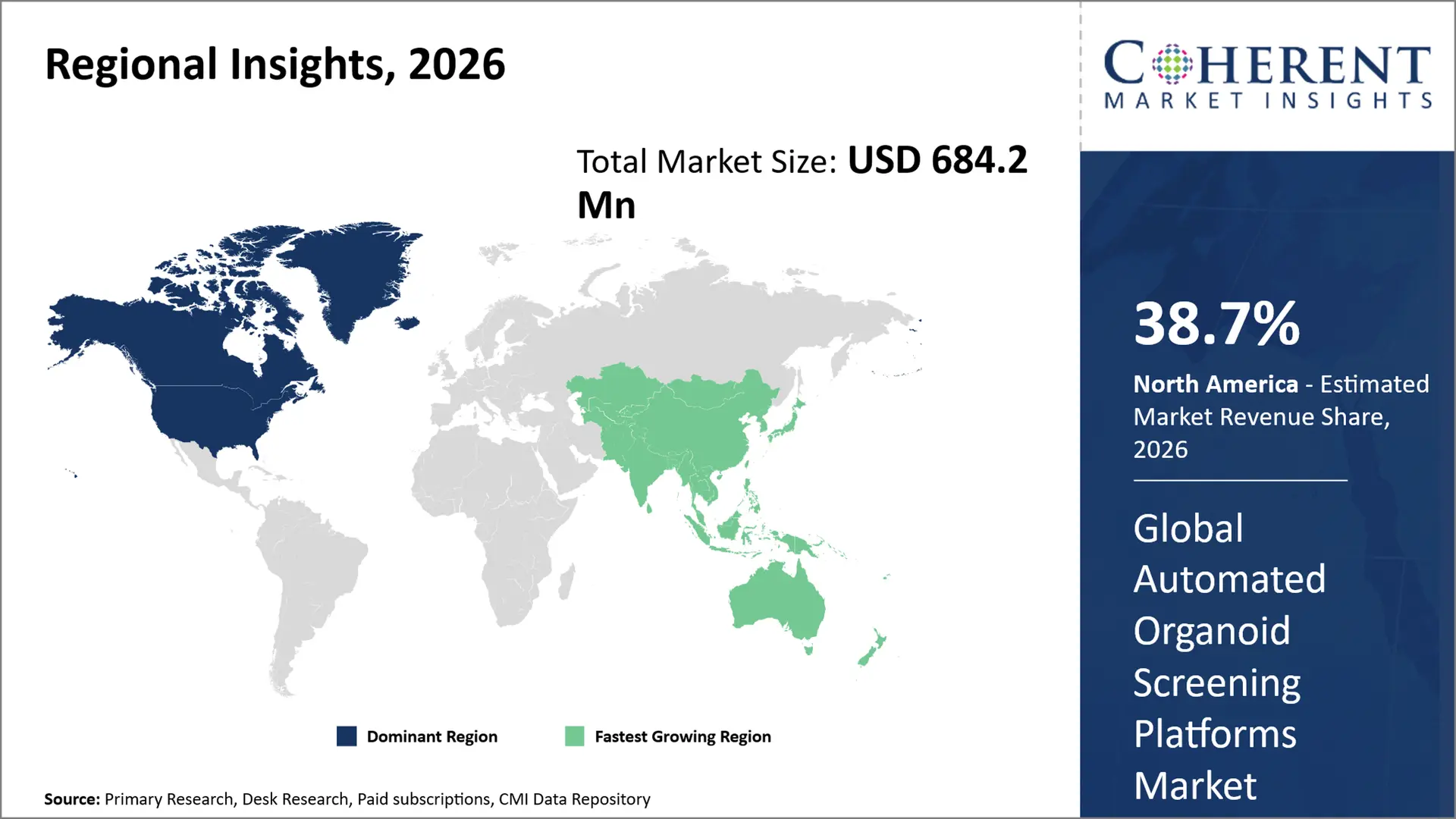
- North America market continues to dominate with an estimated share of 38.7% by 2026, aided by well-established biotechnology infrastructure and pharmaceutical innovation. For instance, the U.S. The National Center for Advancing Translational Sciences (NCATS) supports the creation of human-based tissue models to improve drug discovery and preclinical research.
- Asia Pacific is expected to exhibit the fastest growth in the global automated organoid screening platforms market, registering an estimated CAGR of 17.8% during 2026–2033, driven by expanding investment in organoid research and advanced drug screening technologies. For instance, in June 2026, KAIST and Taiwan’s Formosa Group launched the KAIST–FORMOSA BIO R&D Center, backed by approximately USD 12.8 million (KRW 17 billion) in research funding over five years to develop an organoid-based alternative testing platform.
Segmental Insights
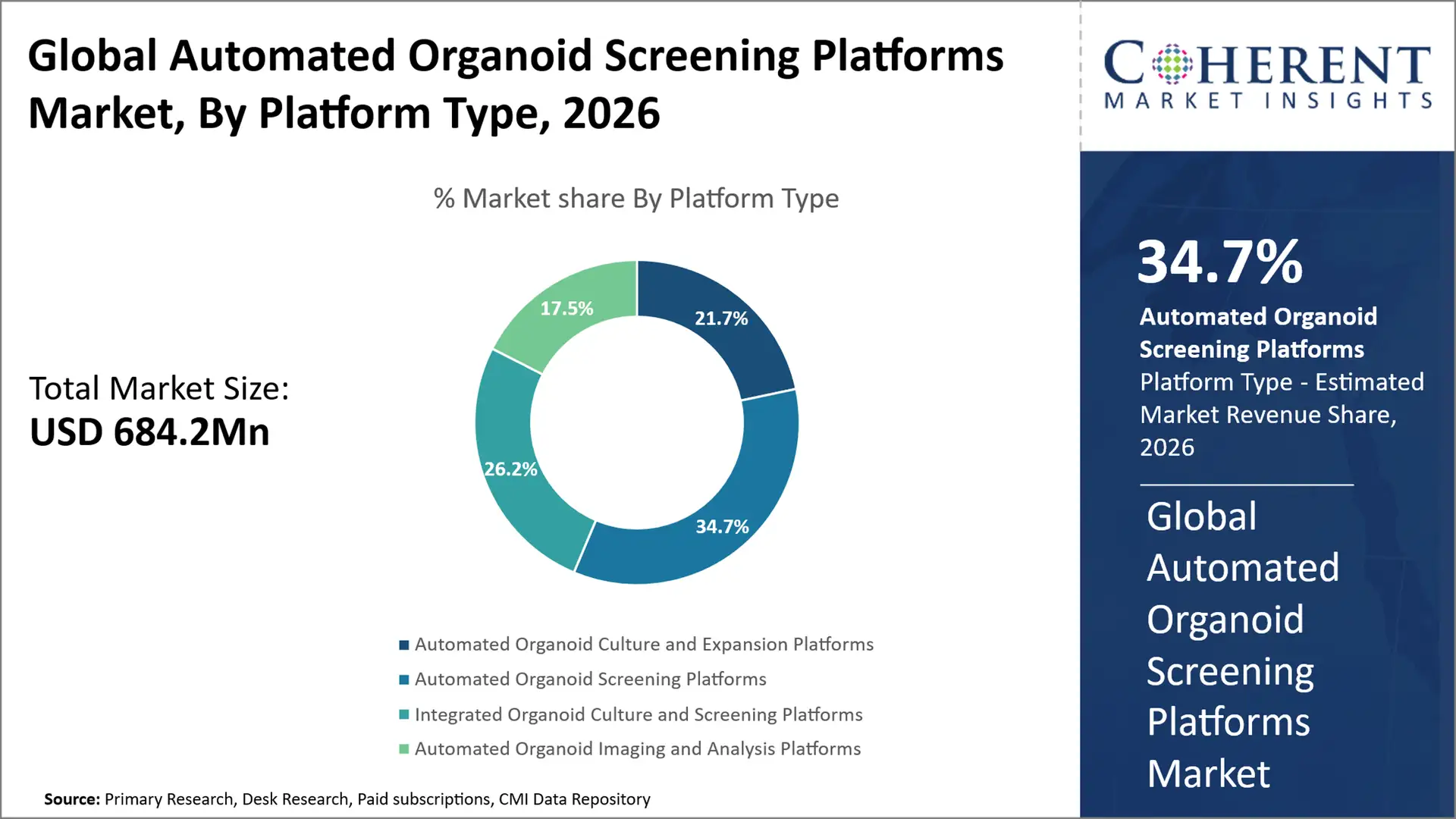
Why Do Automated Organoid Screening Platforms Dominate the Global Automated Organoid Screening Platforms Market?
Automated organoid screening platforms are projected to hold the market share of 34.7% in 2026, as they bring the various processes involved with organoid culture, compound screening, imaging and data analysis into seamless, user-friendly workflows. Their high-throughput screening capacity, reproducibility and amenability to high-throughput drug discovery and toxicity screening make these systems highly attractive to pharma and biotech firms, as well as to research institutions seeking reliable, human-relevant preclinical screening methods. For instance, in June 2025, Samsung Biologics launched its Samsung Organoids, a service that enables organoid-based drug screening and drug development. The launch illustrates the growing adoption of organoid-based platforms to evaluate drug response and on improving preclinical research.
- Current Industry Events of 2026
- Market Size Estimation
- Regional Breakdown
- Competitive Landscape
- Customer Intelligence
- Segmental Analysis
- Pricing Analysis
- Key Market Drivers, Challenges & Future Trends
- Customized Insights Section
Why Do Robotic Liquid Handling and Dispensing Systems Represent the Largest Automation Technology Segment in the Automated Organoid Screening Platforms Market?
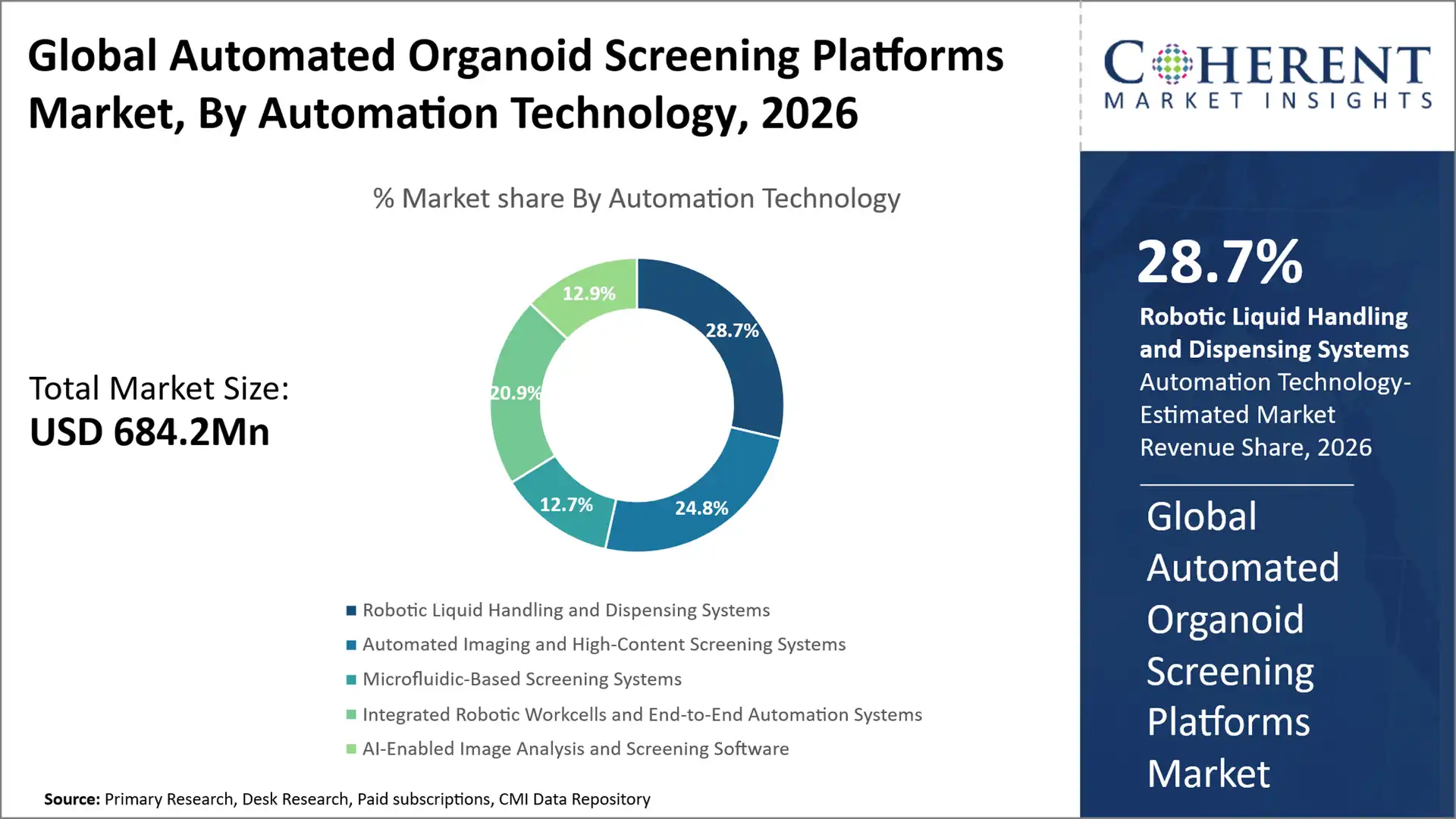
Robotic liquid handling and dispensing systems are projected to hold a market share of 28.7% in 2026, due to their ability to dispense reagents, media and compounds accurately, eliminating manual errors and making organoid screening more reproducible. Their ability to interface with imaging and microfluidic systems to enable high-throughput, real-time, high-content data acquisition accelerates drug discovery and toxicity testing workflows. For instance, the Opentrons Flex modular lab automation platform uses robotic liquid handling to automate precise liquid transfer and repetitive laboratory workflows. It enables scalable and reproducible sample prep for organoid-based drug screening.
High-Throughput Screening Platforms Segment Dominates the Global Automated Organoid Screening Platforms Market
The high-throughput screening platforms segment is projected to hold a market share of 38.2% in 2026, as they allow rapid screening of large compound libraries with the organoids which increases the efficiency of toxicity and drug discovery studies. High-throughput screening platforms also incorporate advanced features like automated imaging & data analysis which can eliminate manual intervention. For instance, led by the U.S. National Cancer Institute, the Human Cancer Models Initiative builds and distributes innovative cancer models to help accelerate drug screening and translational research.
Current Events and their Impact
Current Events | Description and its Impact |
NIH Establishes Standard Organoid Modeling Center (September 2025) |
|
|
|
France Launches Organs and Organoids-on-Chips Research Program (July 2025) |
|
Automated Organoid Screening Platforms Market Dynamics
Market Drivers
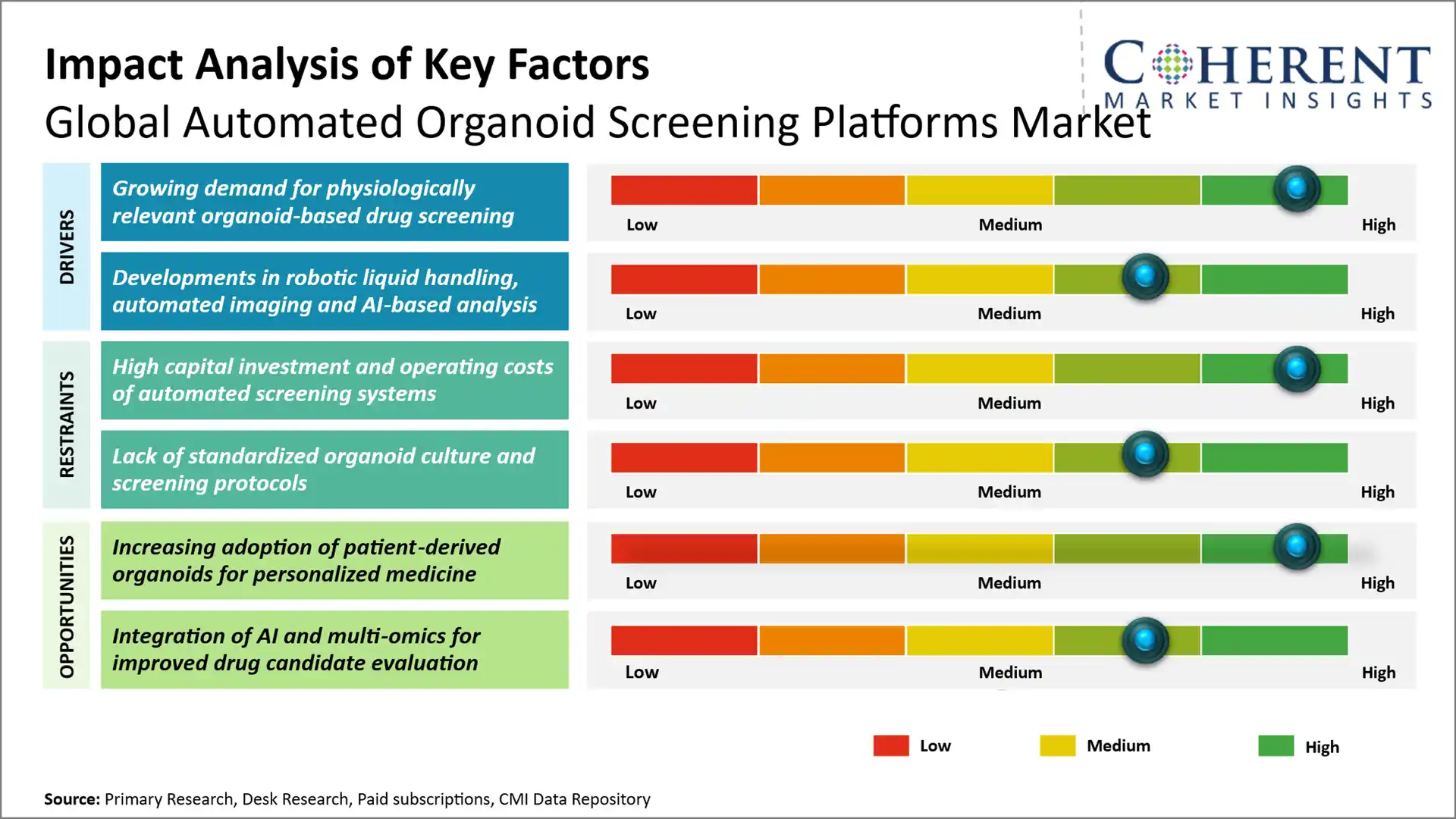
- Growing demand of physiologically relevant organoid-based drug screening: The demand for physiologically relevant organoid based drug screening and automated systems that mimic human tissue interactions better for improved pre-clinical drug evaluation is on the rise. These systems can help to test safety and efficacy of drugs reliably in complex disease models. In 2024, the U.S. Food and Drug Administration (FDA), officially unveiled its long-term framework to reduce animal testing in preclinical safety studies, promoting the adoption and generation of human relevant alternative approaches, organoid-based models being one of them
- Developments in robotic liquid handling, automated imaging and AI-based analysis: Recent advances in robotic liquid handling, automated imaging and artificial intelligence-based analysis are enabling the adoption of automated organoid screening platforms. These tools provide automated experimental rigor and repeatability and enable to scale up throughput in screening complex 3D models of biology and drug responses. In 2024, the United States National Institute of Standards and Technology, highlighted the improvement in measurement and analysis capabilities in biotechnologies as a result of automation and machine learning.
- Growing demand for patient specific drug screening: There is a rising demand for personalized care, and the use of Automated Organoid screening Platforms using patient-derived tissues to test for treatment response and discovery of drugs to test efficacy and drug sensitivity is on the rise. Such platforms allow for a more personalized in vitro testing of drug efficacy and sensitivities in cancer, while allowing for rapid testing of several drugs.
Emerging Trends
- AI-Driven Organoid Image Analysis and Phenotypic Screening: Artificial intelligence (AI) and machine learning are slowly infiltrating organoid screening workflows to automate segmentation of images, to quantify morphological alterations and to recognize phenotypic response signatures, thus contributing to a more consistent analysis and more rapid progress in compound screening.
- Microfluidics and Robotic Automation Integration: The integration of microfluidic devices with robotic liquid handling platforms and high-content automated imaging enables control over organoid culture conditions and the testing of multiple compounds in parallel. This trend is enabled for increasing reproducibility, reducing reagent use and driving scaled screening workflows.
- Patient-Derived Organoids for Individualized Drug Screening: Pharma researchers are moving towards using patient-derived organoids to show how drugs will perform in a disease-relevant context. Such systems with automated screening provide personalized drug selection, cancer research and drug sensitivity testing.
Regional Insights
Why is North America a Strong Market for Automated Organoid Screening Platforms?
North America leads the global automated organoid screening platforms market, accounting for an estimated 38.7% share in 2026, owing to the well-established research infrastructure, favorable R&D ecosystem, and investments by the government and private stakeholders in the life sciences industry. Institutions such as the National Institutes of Health (NIH) support organoid research which may contribute to an increased demand for screening platforms. For instance, National Institutes of Health (NIH) Standardized Organoid Modeling Center program supports reproducible organoid models to accelerate drug discovery and safety evaluation. Furthermore, strong industry-academic collaboration strongly supports the development and application of high-throughput screening approaches in drug discovery and pre-clinical testing.
Why Does Asia Pacific Automated Organoid Screening Platforms Market Exhibit High Growth?
Asia Pacific is expected to exhibit the fastest growth in the global automated organoid screening platforms market, registering an estimated CAGR of 17.8% during 2026–2033. The region is projected to account for 24.2% of the global market in 2026, owing to growth in research on life sciences, emerging investments in biotechnological innovations, and upgrading pharmaceutical R&D infrastructure. The demand for advanced organoid screening technology is intensifying due to the focus on precision medicine and regenerative medicines in nations like China, Japan and South Korea.
In addition, the government funding for advancements in biomedical research and increasing adoption of automated laboratory procedures are also likely to fuel the regional market growth. For instance, Japan’s AMED Regenerative Medicine Realization Research Support Program aims to provide support for research promoting regenerative medicine and stem-cell technology as well as the development of organoid-based drug discovery and preclinical evaluation models.
Global Automated Organoid Screening Platforms Market Outlook for Key Countries
Why is the U.S. Leading Innovation and Adoption in the Automated Organoid Screening Platforms Market?
The U.S. is a global leader in innovation and implementation with a strong ecosystem spanning research on organoids, pharma, and automation laboratory infrastructure. NIH's push towards establishing organoid models through their collection of established standardized organoid models enables more reproducible screening workflows. At the same time the availability of cancer organoid models through the patient-derived models repository of the NCI to screen for response to drugs.
Is Japan a Favorable Market for Automated Organoid Screening Platforms Market?
Japan is an attractive market, driven by its strong research landscape in induced pluripotent stem cell (iPSC) technology and its highly developed pharma research capabilities. The country’s government-supported research (by the Japan Agency for Medical Research and Development, or AMED) enables innovative opportunities in organoid automation, drug-response screening and toxicology studies.
Is China Emerging as a Key Growth Hub for the Automated Organoid Screening Platforms Market?
China remains a promising hotspot, bolstered by emerging innovations in drug R&D, stem-cell research, and investments in complex drug-discovery technology. Government-funded biomedical research, along with rising demands for human-scale preclinical testing to predict disease and drug responses will support automation of organoid culture, high throughput screening and analysis with artificial intelligence.
Why Does Germany Top the European Automated Organoid Screening Platforms Market?
Germany leads the European automated organoid screening platforms market due to its extensive pharmaceutical and biotechnology research and development network. Its existing laboratory automation technologies and biomedical research expertise are highly developed. The country’s rapid pace of adoption of technology such as preclinical drug testing, 3D cell culture and organ on a chip is further boosting the demand for automated organoid culture, imaging and high-throughput screening.
Is Automated Organoid Screening Platforms Market Developing in UK?
The UK market for automated organoid screening platforms is emerging supported by strong research in the life sciences, pharmaceutical R&D and by government support to have leading next-generation biomedical technologies. The UK research environment supports and enables automated organoid culture, high-content imaging, and drug-response screening for use in oncology, disease modelling, and preclinical safety.
Government-funded organoid screening infrastructure
Government-funded organoid screening infrastructure
Public initiative | Quantifiable data / focus | Relevance to the market |
European Innovation Council — OCENTRA (July 2026) | USD 335,790 (€300,000) in EU funding for an automated organoid screening platform for drug discovery and precision medicine. | Facilitates the automated creation of organoids, standardized microfluidics and digital analysis for drug screening. |
European Research Council — FAR-O (August 2026) | USD 16,790 (€150,000) in EU funding for a fully automated reprogramming-to-organoid platform. | The figure depicts state financial assistance for fully automated production of patient-specific organoids, which could potentially enable scalable screening workflows. |
U.S. National Cancer Institute — Patient-Derived Models Repository | Offers researchers access to molecularly characterized patient-derived organoids and a variety of other models of cancer. | Expands access to standardized biological models that researchers can use for drug-response testing and cancer screening studies. |
How is the increasing adoption of patient-derived organoids for personalized medicine creating new growth opportunities in the automated organoid screening platforms market?
The expanding role of PDOs indicates a potential for automated screening platforms, because they allow personalized drug-response screening on models derived from individual patients. In addition, automation, robotics, and AI-based analysis could potentially improve screening throughput, reproducibility, and the evaluation of promising treatments, especially in cancer and in diseases with a rare onset. For instance, in March 2026, the U.S. National Center for Advancing Translational Sciences (NCATS) funded the Advancing Personalized Cardiac Organoids project that combines patient-specific cardiac organoids, artificial intelligence-based modeling, and multi-omics analysis to enable personalized therapeutic screening.
Market Players, Key Development, and Competitive Landscape
Key Developments
- In August 2026, Axxam has announced that it has successfully validated the cardiac organoid platform developed in collaboration with Molecular Devices and Heart Beat. Bio. The platform enables drug discovery as well as early risk assessment using cardiac organoid models, demonstrating the growing importance of the advanced three-dimensional biological systems in analyzing drug responses and potential cardiotoxicity, and represents a significant step forward for the use of organoid-based screening in preclinical safety assessment.
- In April 2026, InSphero AG launched 3D InSight DIGIT, a new 3D platform for early screening of drug-related gastrointestinal toxicity. The platform combines patient-derived human intestinal organoids with scalable Gri3D platform and automated imaging for high-content quantitative screening analysis. The launch illustrates the broadening deployment of automated high-content organoid screening for drug discovery and preclinical safety assessment.
Competitive Landscape
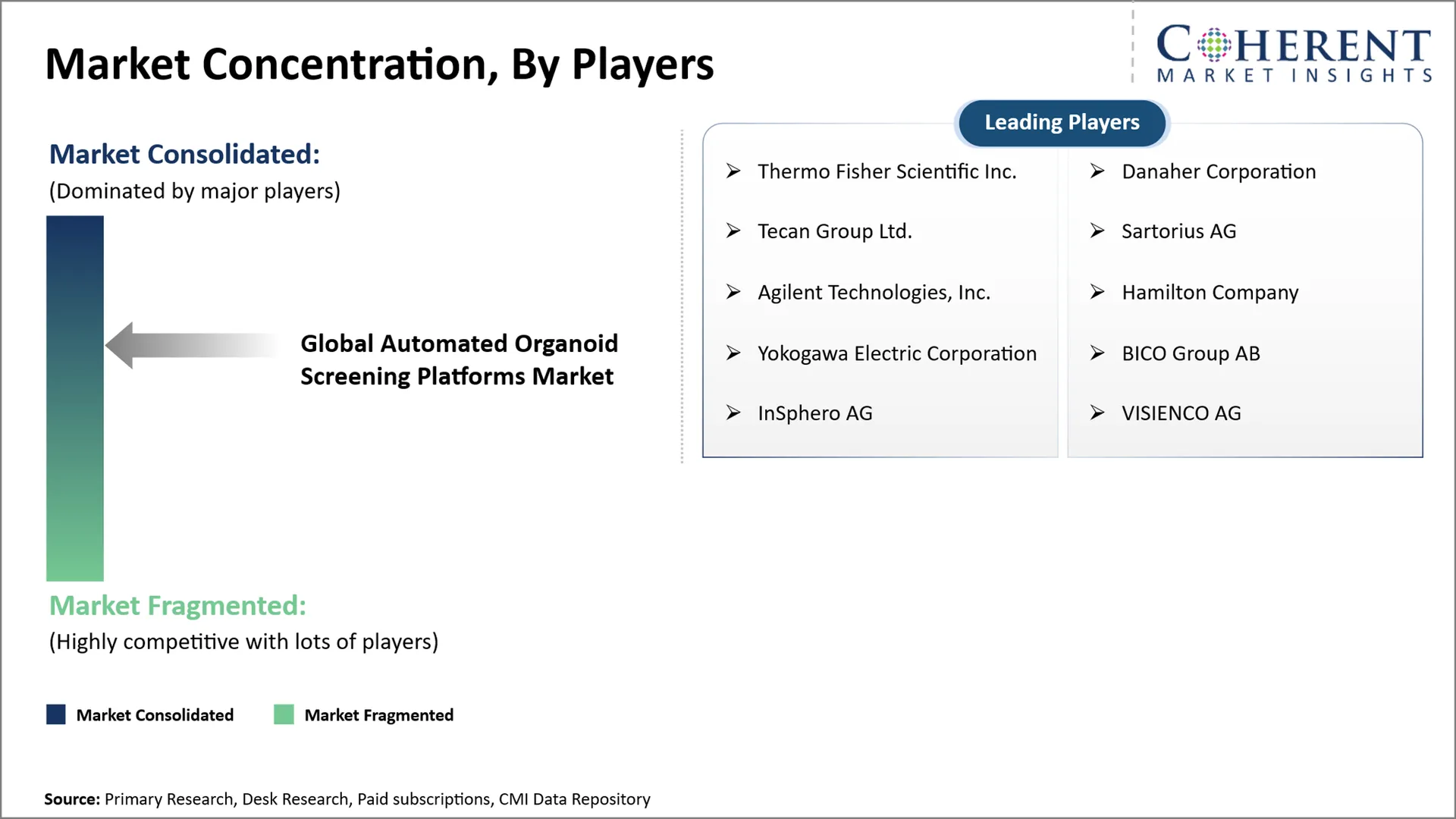
The automated organoid screening platforms market is a very competitive space with players focused on robotic automation, high content imaging, AI, microfluidics, and integrated organoid culture and screening workflows. The players in this market are working towards improved organoid reproducibility, screening throughput, standardizing workflow protocols, and acceleration of drug discovery, and preclinical safety assessment. The leading areas of focus include:
- Design and implementation of integrated automated platforms for organoid culture, media feeding, compound dispensing and high throughput screening.
- Combining image analysis, machine learning, and phenotypic profiling derived from artificial intelligence (AI) to monitor changes in the morphology, drug responsiveness, and toxic responses of organoids.
- Development of robotic liquid handling, automated imaging and microfluidic techniques to improve the precision, reproducibility and throughput of screening.
Market Report Scope
Automated Organoid Screening Platforms Market Report Coverage | |||
Report Coverage | Details | ||
Base Year | 2025 | Market Size in 2026: | USD 684.2 Mn |
Historical Data For: | 2020 To 2024 | Forecast Period: | 2026 To 2033 |
Forecast Period 2026 To 2033 CAGR: | 16.1% | 2033 Value Projection: | USD 1,946.5 Mn |
Geographies covered: |
| ||
Segments covered: |
| ||
Companies covered: | Thermo Fisher Scientific Inc., Danaher Corporation, Tecan Group Ltd., Sartorius AG, Agilent Technologies, Inc., Hamilton Company, Yokogawa Electric Corporation, BICO Group AB, InSphero AG, VISIENCO AG | ||
Growth Drivers: |
| ||
Restraints & Challenges: |
| ||
Analyst Opinion (Expert Opinion)
- The market will be shifting towards AI-integrated platforms to enable organoid culture, robotic handling, automated imaging and automated analysis. Standardization and reproducibility will be important factors for driving further uptake in pharmaceutical research and preclinical testing.
- The key opportunity lies in the integrated automated organoid culture and screening platforms for drug discovery and development in the U.S., owing to the demand for scalable and human-relevant drug testing. The other opportunity exists in AI-enabled imaging and analysis for personalized medicine in Japan.
- In order to secure a competitive edge, market players needs to maintain the reproducibility, high-throughput screening, and lower costs of the assay and develop modular platforms that fit with existing laboratory workflows. Partnerships with pharma, contract research organizations and research institutes can help verify performance and accelerate commercialization.
Speak to the analyst
Want personalized insights?
Take the findings above to one of our principal consultants, or have the report rebuilt around the segments, geographies and competitors you actually track.
Market Segmentation
- Platform Type Insights (Revenue, USD Mn, 2021 - 2033)
- Automated Organoid Culture and Expansion Platforms
- Automated Organoid Screening Platforms
- Integrated Organoid Culture and Screening Platforms
- Automated Organoid Imaging and Analysis Platforms
- Automation Technology Insights (Revenue, USD Mn, 2021 - 2033)
- Robotic Liquid Handling and Dispensing Systems
- Automated Imaging and High-Content Screening Systems
- Microfluidic-Based Screening Systems
- Integrated Robotic Workcells and End-to-End Automation Systems
- AI-Enabled Image Analysis and Screening Software
- Screening Throughput Insights (Revenue, USD Mn, 2021 - 2033)
- Low-Throughput Screening Platforms
- Medium-Throughput Screening Platforms
- High-Throughput Screening Platforms
- Ultra-High-Throughput Screening Platforms
- Organoid Type Insights (Revenue, USD Mn, 2021 - 2033)
- Tumor and Cancer Organoids
- Intestinal and Gastrointestinal Organoids
- Liver Organoids
- Brain and Neural Organoids
- Kidney Organoids
- Lung Organoids
- Cardiac Organoids
- Others
- Application Insights (Revenue, USD Mn, 2021 - 2033)
- Drug Discovery and Development
- Drug Efficacy and Sensitivity Screening
- Drug Toxicity and Safety Assessment
- Disease Modeling and Mechanistic Research
- Personalized Medicine and Patient-Specific Drug Testing
- Regenerative Medicine and Other Research Applications
- Others
- End User Insights (Revenue, USD Mn, 2021 - 2033)
- Pharmaceutical and Biotechnology Companies
- Contract Research Organizations (CROs)
- Academic and Research Institutes
- Hospitals and Clinical Research Centers
- Others
- Regional Insights (Revenue, USD Mn, 2021 - 2033)
- North America
- U.S.
- Canada
- Latin America
- Brazil
- Argentina
- Mexico
- Rest of Latin America
- Europe
- Germany
- U.K.
- Spain
- France
- Italy
- Russia
- Rest of Europe
- Asia Pacific
- China
- India
- Japan
- Australia
- South Korea
- ASEAN
- Rest of Asia Pacific
- Middle East
- GCC Countries
- Israel
- Rest of Middle East
- Africa
- South Africa
- North Africa
- Central Africa
- North America
- Key Players Insights
- Thermo Fisher Scientific Inc.
- Danaher Corporation
- Tecan Group Ltd.
- Sartorius AG
- Agilent Technologies, Inc.
- Hamilton Company
- Yokogawa Electric Corporation
- BICO Group AB
- InSphero AG
- VISIENCO AG
Sources
Primary Research Interviews
- Automated organoid screening platform providers and laboratory automation specialists
- Pharmaceutical and biotechnology R&D executives involved in drug discovery, toxicity testing, and organoid screening
Stakeholders
- Organoid Platform Developers and Automation Technology Providers
- Academic and Biomedical Research Institutions
- Pharmaceutical and Biotechnology Companies
- Contract Research Organizations (CROs)
- Government Research Agencies and Regulatory Authorities
- Stem Cell and Organoid Research Scientists
- Laboratory Automation and High-Content Imaging Specialists
- End-use Sectors
- Pharmaceutical Companies
- Biotechnology Companies
- Academic and Research Institutes
- Contract Research Organizations
- Government and Public Research Laboratories
- Hospitals and Clinical Research Centers
- Regulatory & Health Bodies
- U.S. Food and Drug Administration (FDA)
- European Medicines Agency (EMA)
- Organisation for Economic Co-operation and Development (OECD)
Databases
- ClinicalTrials.gov
- National Cancer Institute (NCI) Patient-Derived Models Repository
- National Institutes of Health (NIH) RePORTER
Associations
- International Society for Biofabrication (ISBF)
- International Society for Stem Cell Research (ISSCR)
- Society for Laboratory Automation and Screening (SLAS)
Public Domain Sources
- National Institutes of Health (NIH)
- National Center for Advancing Translational Sciences (NCATS)
- European Commission — CORDIS Research Projects
Proprietary Elements
- CMI Data Analytics Tool, Proprietary CMI Existing Repository of information for last 10 years.
Get access to 250+ pages report
Every segment, forecast, competitor profile and data table behind the analysis above — available for instant download.
- ESOMAR Member
- ISO 9001:2015 Certified
- D-U-N-S Registered
- GDPR & CCPA Compliant
Frequently Asked Questions
The global automated organoid screening platforms market is estimated to be valued at USD 684.2 Mn in 2026 and is expected to reach USD 1,946.5 Mn by 2033.
Automated organoid screening platforms dominate because of the ability to perform scalable drug testing, compound screening, and high-throughput organoid model analysis.
An automated organoid screening platform is an integrated platform consisting of robotic, imaging and data analysis capabilities to automate organoid drug screening and analysis.
The CAGR of global automated organoid screening platforms market is projected to be 16.1% from 2026 to 2033.
Growing demand for physiologically relevant organoid-based drug screening, and developments in robotic liquid handling, automated imaging and AI-based analysis are the major factors driving the growth of the global automated organoid screening platforms market.
High capital investment and operating costs of automated screening systems, and lack of standardized organoid culture and screening protocols are the key factors hampering the growth of the global automated organoid screening platforms market.
In terms of automation technology, robotic liquid handling and dispensing systems are estimated to dominate the market revenue share in 2026.