

Global Automotive Leaf Spring Market Size and Forecast – 2026 To 2033
The global automotive leaf spring market is expected to grow from USD 5.70 Bn in 2026 to USD 8.00 Bn by 2033, registering a compound annual growth rate (CAGR) of 4.7% from 2026 to 2033. The global automotive leaf spring market is driven by expansion of heavy-duty truck fleets. On August 21, 2025, Volvo Trucks secured an order for 264 VNL trucks from Averitt Express, a leading freight transportation company based in the US. The deal marks one of the largest single orders for the new flagship model in North America to date.
Key Takeaways of the Global Automotive Leaf Spring Market
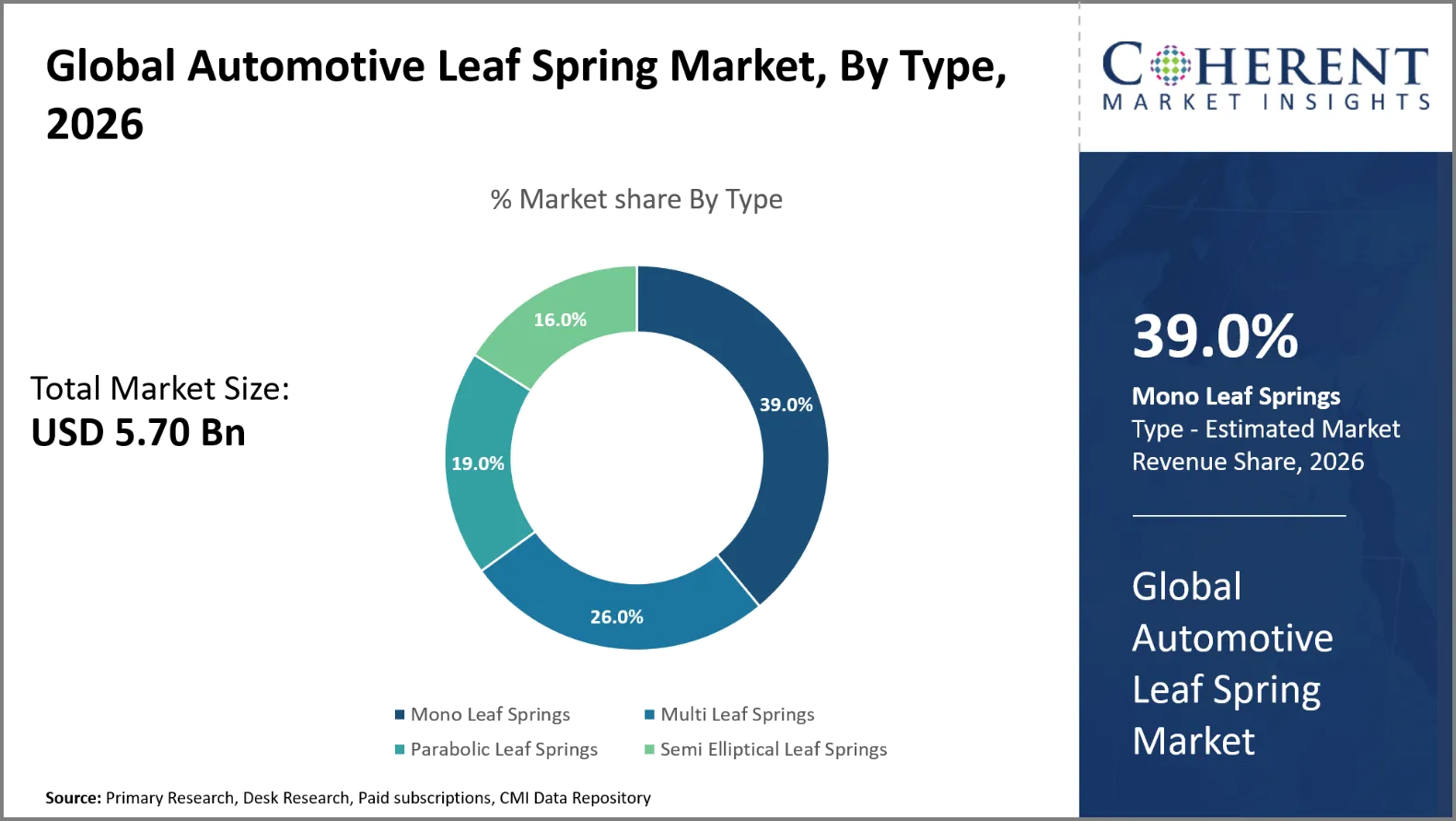
- The Mono Leaf Springs segment is expected to account for 39.0% of the global automotive leaf spring market share in 2026. Increasing demand for durable suspension components is driving the growth of the segment. In October 2025, Link Manufacturing introduced enhanced severe-duty bushings and torque rods for Air Link suspension systems. The components target 46,000 to 52,000-pound suspension applications.
- The Steel segment is estimated to capture 43.0% of the market share in 2026. Growth of aftermarket replacement demand is majorly driving the growth of the segment. On July 10, 2025, Simard Suspensions announced construction of a new manufacturing facility. The project is intended to modernize equipment, increase production capacity, and bring selected operations in-house.
- The Passenger Vehicles segment is estimated to capture 57.0% of the market share in 2026. Adoption of lightweight suspension components is majorly driving the growth of the segment. On June 9, 2025, Hendrickson introduced updated STEERTEK NXT technology for Blue Bird school buses. The optimized axle design reduced weight by an additional 25 pounds
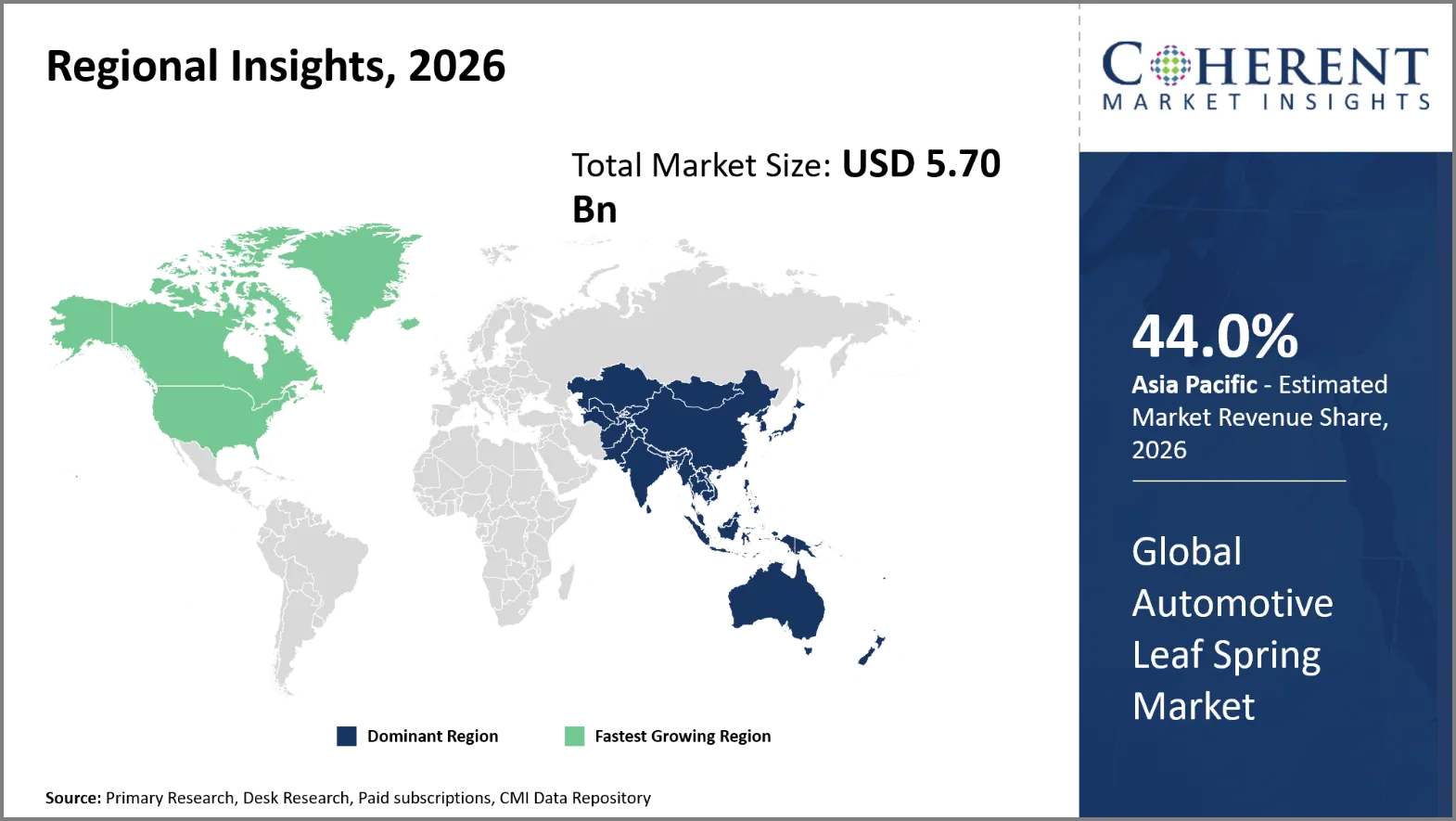
- Asia Pacific is expected to dominate the automotive leaf spring market in 2026 with a market share of 44.0%. Advanced parabolic leaf spring development in Asia Pacific is driving the growth of the regional market. On August 7, 2026, Jamna Auto Industries announced plans for a dedicated parabolic spring plant in Indore, India.
- North America is expected to account for 23.0% share in 2026 and is projected to record the fastest growth over the forecast period. Expansion of aftermarket distribution in North America is driving the growth of the regional market. In September 2026, Dana Incorporated expanded its North American commercial vehicle aftermarket distribution through a new agreement with VIPAR Heavy Duty. The agreement expands access to Spicer, Victor Reinz, and other Dana commercial vehicle products.
Segmental Insights
Why Does Mono Leaf Springs Dominate the Global Automotive Leaf Spring Market?
The mono leaf springs segment is expected to account for 39.0% of the global automotive leaf spring market share in 2026. Mono leaf springs provide a simplified suspension design with fewer parts and less total system weight. The lightweight structure allows a reduction in vehicle weight while yet providing enough load bearing capacity for appropriate applications. Manufacturers also gain by easier manufacturing and less material use in comparison to multi-leaf arrangements. These features make mono leaf springs suited for light weight commercial vehicles and some passenger car applications. The rising demand for efficient suspension systems also encourages their use in certain car platforms. On June 13, 2026, EMCO Industries announced the debut of their high-performance mono-leaf spring for heavy-duty trailer applications. The new spring has a gross-axle-weight rating of 22,400 pounds and hopes to tackle significant onshore supply chain delays that have long plagued major OEMs and distributors, leaving them scrambling to acquire this basic, but essential, component.
- Current Industry Events of 2026
- Market Size Estimation
- Regional Breakdown
- Competitive Landscape
- Customer Intelligence
- Segmental Analysis
- Pricing Analysis
- Key Market Drivers, Challenges & Future Trends
- Customized Insights Section
Why is Steel the Most Preferred Material?
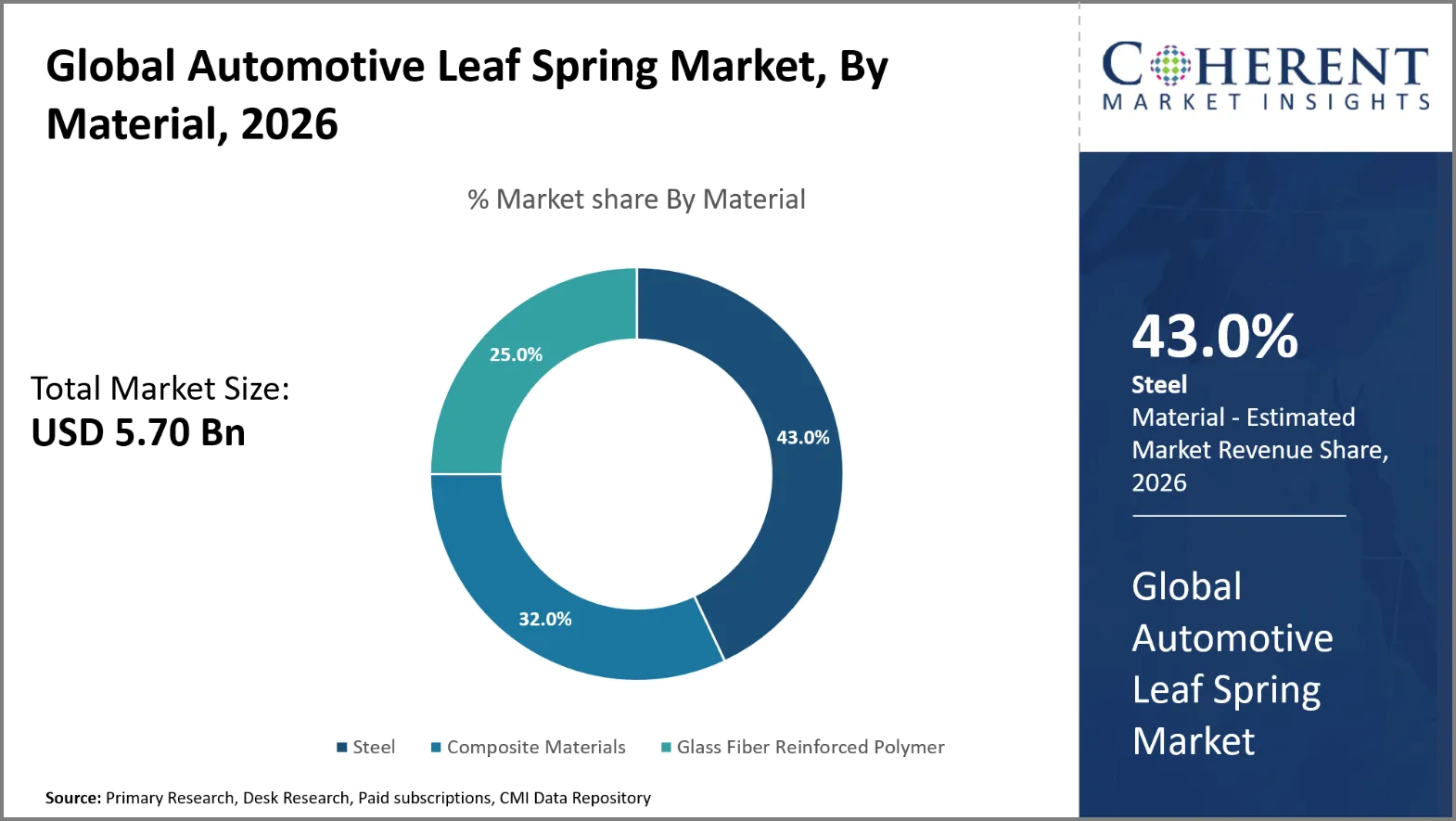
The steel segment is expected to account for 43.0% of the global automotive leaf spring market share in 2026. Steel offers the strong tensile and fatigue strength needed for demanding automotive suspension applications. Its resistance to repeated loading ensures reliable operation under different road and cargo circumstances. Steel also has proven manufacturing procedures that can reliably produce springs for different types of vehicles. Steel’s very low material cost enables cost effective fabrication of suspension components for original equipment and replacement markets. These properties continue to favor the use of steel in commercial vehicles and heavy-duty automotive applications. On January 20, 2025, Mitsubishi Steel established a new car coil spring plant in India. The facility incorporates hot and cold forming, high-strength spring shot-peening technology, and an enhanced coating line. Although the investment concerns coil springs, the project demonstrates continued investment in advanced steel spring manufacturing.
Passenger Vehicles Dominates the Global Automotive Leaf Spring Market
The passenger vehicles segment is expected to account for 57.0% of the global automotive leaf spring market share in 2026. Passenger vehicles increasingly use compact suspension components that balance load handling with space and weight requirements. Leaf springs can be a robust suspension support for several passenger car platforms and utility-oriented models. Their comparatively simple construction can reduce component complexity and maintenance requirements. Moreover, increasing production of pickup trucks, sport utility vehicles and utility vehicles promotes demand for leaf spring systems. Replacement needs of aging passenger car fleets also contribute to the aftermarket demand for these suspension components. On July 28, 2026, Toyota Kirloskar Motor announced the launch of the all-new Hilux, marking another significant milestone in strengthening its SUV portfolio in India. As an embodiment of Toyota’s inherited spirit of reliability, endurance, and quality, the Ninth-Generation Hilux combines rugged durability and ever-ready capability engineered to deliver a versatile performance.
Current Events and their Impact
Current Events | Description and its Impact |
European Union Regulation 2019/2144 |
|
United Nations Regulation No 13 |
|
Automotive Leaf Spring Market Dynamics
Market Drivers
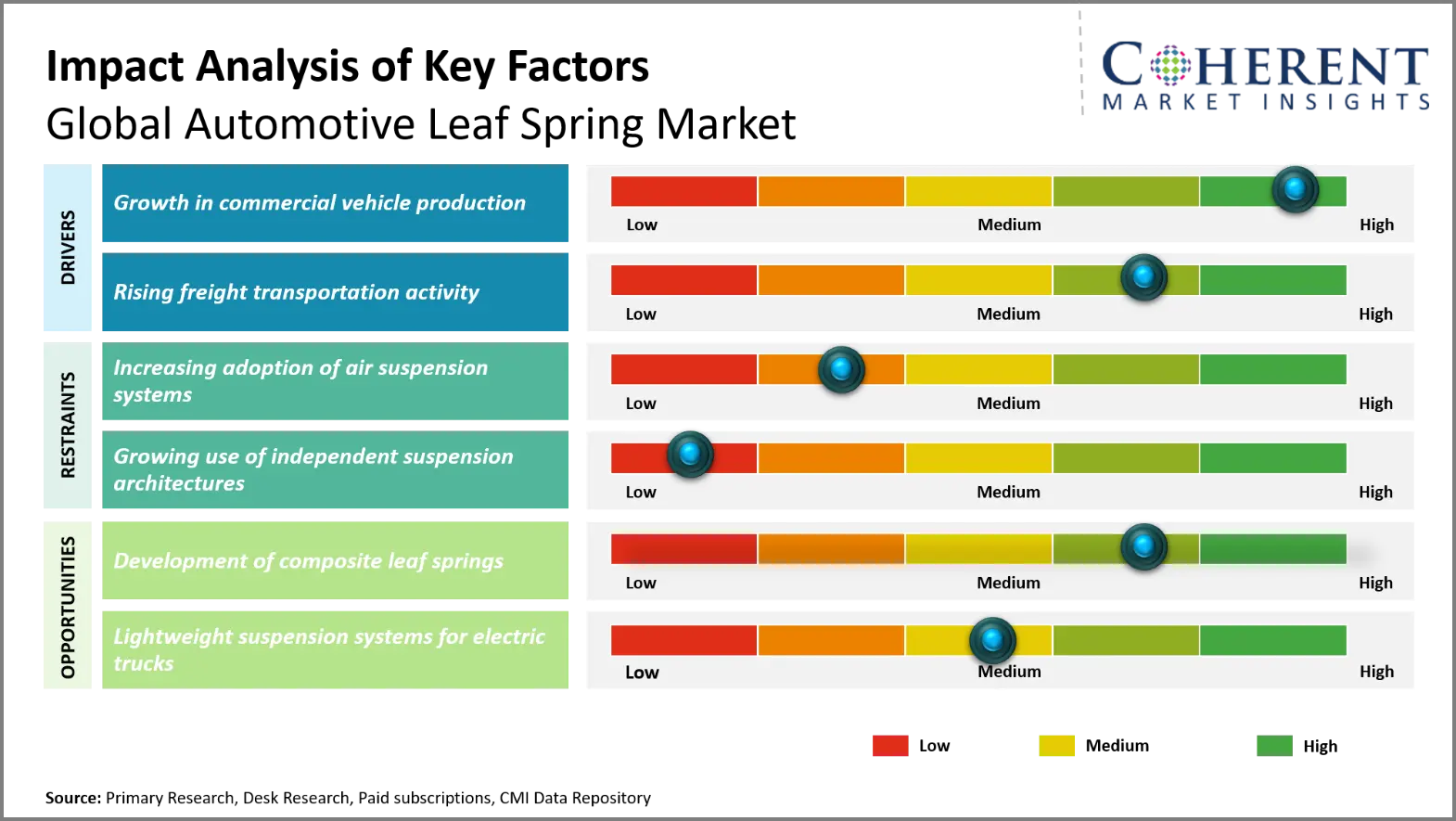
- Growth in commercial vehicle production: Commercial vehicle production growth directly increases demand for suspension components across trucks, busses, trailers, and utility vehicles. What Manufacturers Want: Leaf springs that can last through all the different payloads and operating situations. Furthermore, the growth of vehicle production in emerging economies is also driving the demand for original equipment for locally produced suspension components. With a growing output of heavy and medium commercial vehicles, the needs for high load carrying capacity and fatigue resistance are further supported. This production expansion hence increases demand for standard and application specific vehicle leaf spring systems. On October 15, 2025, Scania inaugurated a new industrial hub in Rugao, Jiangsu, China. The facility represents approximately USD 2 billion investment and covers 800,000 square meters. It has licensed production capacity of 50,000 vehicles annually and creates approximately 3,000 local jobs.
- Rising freight transportation activity: Increasing freight transportation activity enhances the need for trucks and trailers used throughout regional and long-distance logistics networks. Increased use of a vehicle puts more stress on suspension parts that have to withstand frequent loading cycles and tough road conditions. While leaf springs are still important for many commercial vehicles in terms of load support and sturdy suspension performance. Expansion of the logistics network and distribution infrastructure also supports commercial fleet use in key markets. Growing freight movement therefore supports both original equipment demand and replacement requirements for automotive leaf springs. On April 10, 2026, Tata Motors, India’s largest commercial vehicle manufacturer, began deliveries of the Prima E.55S electric prime movers to BillionE Mobility. The company also revealed an order for 250 additional electric prime movers, showing significant momentum in zero-emission heavy-duty freight transport.
Emerging Trends
- Lightweight Leaf Spring Development: Manufacturers are developing lightweight leaf springs to minimize vehicle bulk while retaining required load carrying capability, durability and fatigue resistance. This approach provides fuel economy gains and complements lightweighting techniques across commercial vehicles, pickup trucks, and specialty automotive platforms.
- Composite Leaf Spring Adoption: Composite materials are becoming increasingly popular because to their ability to reduce suspension weight, while also offering corrosion resistance and a long service life. Manufacturers are looking at the use of glass fiber reinforced polymer leaf springs for commercial vehicles that need to be more efficient, durable and require less maintenance.
- Parabolic Spring Technology: Parabolic leaf springs are being adopted because of their tapered geometry that can help minimize weight and friction between individual spring leaves. This design provides superior suspension performance, less noise and enhanced ride characteristics in commercial vehicles working under different loading circumstances.
- Electric Commercial Vehicle Integration: The emergence of electric commercial vehicles is prompting suspension manufacturers to design leaf springs that can handle bigger battery systems and shifting axle loads. Suppliers are concentrating on optimum spring rates, lightweight construction and durability to meet changing electric truck and bus architectures.
Regional Insights
Why is Asia Pacific a Strong Market for Automotive Leaf Spring?
Asia Pacific is expected to account for a market share of 44.0% in 2026. The concentration of commercial vehicle manufacturing in China, India, Japan, and South Korea favors the Asia Pacific. Large-scale automotive component production in China by 2025, producing 29.92 million passenger vehicles. In fiscal year 2025-26, India manufactured 1.17 million commercial cars. South Korea produced 3.84 million automobiles in 2025. These production clusters support leaf spring demand through trucks, buses, pickups, and utility vehicles. Expanding electric commercial vehicle production is also encouraging suspension suppliers to develop lighter spring architectures.
Why Does North America Automotive Leaf Spring Market Exhibit High Growth?
North America is expected to register the fastest growth with a CAGR of 5.8% over the forecast period. The region is projected to account for 23.0% of the global automotive leaf spring market in 2026. North America has a robust light truck and heavy commercial vehicle production, mainly in the U.S. and Canada. The United States produced over 10 million automobiles (including light trucks) in 2025. There is also a heavy traffic of trailer and freight vehicles in the area that requires hard suspension systems. Demand for heavy commercial vehicles is very strong and industry forecasts call for 257,000 heavy commercial vehicles for the U.S. in 2025. Pickups, vocational vehicles and trailers have special requirements for high-load leaf spring systems.
Global Automotive Leaf Spring Market Outlook for Key Countries
Why is China Emerging as a Major Hub in the Automotive Leaf Spring Market?
China’s automotive sector offers a huge manufacturing base for leaf spring applications due to high truck and commercial vehicle output. Passenger car production in China is forecast to reach roughly 29.92 million units in 2025, an increase of 10% over 2024. Increasingly, commercial vehicle manufacturers are offering applications in the areas of logistics, construction, agricultural and municipal transit. The country’s heavy commercial vehicle category is estimated to reach roughly 929,000 units by 2025. This means that robust suspension systems are required to accommodate high payloads and frequent operating cycles.
Is U.S. the Next Growth Engine for the Automotive Leaf Spring Market?
The U.S. automotive leaf spring market benefits from large use of pickup trucks, light trucks, trailers and vocational vehicles. Production data for the world includes light trucks. The nation built about 10 million automobiles in 2025. Demand for heavy commercial vehicles is forecast to grow by 7% in 2025 to around 257,000 units. Fleet operators also need suspension components that can sustain big payloads for construction, transport, agriculture and utility applications. These operating criteria support demand for durable steel leaf springs and replacement parts.
Germany Automotive Leaf Spring Market Analysis and Trends
Germany boasts a sophisticated automotive manufacturing environment and engineering skills in the commercial vehicle space. In 2025 German manufacturers built some 4.15 million passenger automobiles in their home country, up 2%. Electric vehicle production also saw strong growth, with 856,600 electric cars registered in 2025. The commercial vehicle and trailer industries in the country produce need for sophisticated suspension systems with controlled weight and durability. With increasing electrification, producers are optimizing spring designs for changing axle loads and vehicle layouts.
South Korea Automotive Leaf Spring Market Analysis and Trends
South Korea has a concentrated automotive manufacturing structure involving Hyundai, Kia, Korea General Motors, Renault Korea, KG Mobility, Daewoo Bus, and Tata Daewoo. The Korea Automobile and Mobility Association recorded domestic production statistics covering these seven manufacturers during 2025. South Korea produced approximately 3.84 million vehicles during 2025. Pickup trucks, sport utility vehicles, busses and commercial platforms have various suspension needs. The country’s deeply entrenched export-oriented automotive industry further supports demand for standardized leaf spring components compatible with worldwide vehicle platforms.
India Automotive Leaf Spring Market Analysis and Trends
Leaf spring demand in India is closely tied to commercial vehicle manufacture, freight movement and growing domestic logistics. The Society of Indian Automobile Manufacturers registered 1.17 million commercial vehicles produced in fiscal 2025-26. Commercial vehicle manufacturing rose to 1.03 million units in fiscal 2024-25. Sales of commercial vehicles were up 7.7 % to 1.03 million units in calendar year 2025. Freight activity and intra-city logistics needs also rose in 2025, driving need for sturdy suspension systems.
Global Automotive Leaf Spring Market - Average Commercial Vehicle Age By Country
Country | Average Vehicle Age (Years) |
Greece | 22.6 |
Italy | 19.5 |
Poland | 18.4 |
Romania | 16.2 |
Slovakia | 15.9 |
Portugal | 15.5 |
Finland | 14.9 |
Spain | 14.9 |
Croatia | 14.5 |
Latvia | 13.4 |
Global Automotive Leaf Spring Market - Major Spring Manufacturing Facilities By Region
Region | Major Manufacturing Facility | Country | Company |
Asia Pacific | Nanchang, Jiangxi | China | Jiangxi CARHOME Automobile Technology |
Zibo, Shandong | China | STURDY Auto Parts | |
Chu Lai Industrial Park | Vietnam | THACO Industries | |
Tokyo | Japan | Nakano Spring | |
Sriperumbudur, Tamil Nadu | India | Mitsubishi Steel Manufacturing | |
Chennai region | India | NHK Spring | |
Thailand | Thailand | Mitsubishi Steel Manufacturing | |
Europe | Hagen-Hohenlimburg | Germany | thyssenkrupp Springs & Stabilizers |
Finnentrop | Germany | Eibach | |
Various European sites | Europe | Lesjöfors | |
North America | Kentucky | U.S. | Mitsubishi Steel Manufacturing |
Ontario | Canada | Mitsubishi Steel Manufacturing | |
Corona, California | U.S. | Eibach | |
Multiple facilities | U.S. and Canada | NHK Spring |
How is Development of Composite Leaf Springs Creating New Growth Opportunities in the Automotive Leaf Spring Market?
Composite leaf springs are gaining opportunity, replacing traditional steel assemblies with lighter glass-fiber reinforced polymer designs. Hendrickson has developed composite suspension solutions for heavy-duty commercial vehicles, while Volvo Group has been testing composite leaf springs for electric truck applications. Composite springs reduce unsprung bulk and remove corrosion associated with steel. Lighter suspension also helps electric vehicles deal with the weight of batteries and become more energy efficient. The concept is especially essential for electric busses, delivery trucks and heavy commercial vehicles that require high payload capacity with lower chassis weight. On May 13, 2025, SGL Carbon’s Austrian composite production facility was awarded Ford Motor Company’s Q1 supplier award. The site produces glass-fiber-reinforced plastic leaf springs for automotive applications. SGL Carbon supplies longitudinal composite leaf springs for Ford Transit rear axles.
Market Players, Key Development, and Competitive Intelligence
Key Developments
- On May 26, 2025, NHK Spring announced construction of a new automotive suspension spring facility in Aurangabad, India. The investment strengthens localized production capacity for automotive suspension springs.
- On February 11, 2025, Lesjöfors signed an agreement to acquire India-based International Industrial Springs (IIS). The acquisition strengthens the Beijer Component’s growth trajectory with the addition of new product capabilities, building on Lesjӧfors’ recognition of having the widest product portfolio in the industry.
- On January 26, 2024, Hendrickson launched a dedicated composite springs microsite. The initiative highlighted composite spring solutions designed around high strength-to-weight ratios. The company linked these technologies with lightweight vehicle designs and electric mobility requirements.
Competitive Landscape
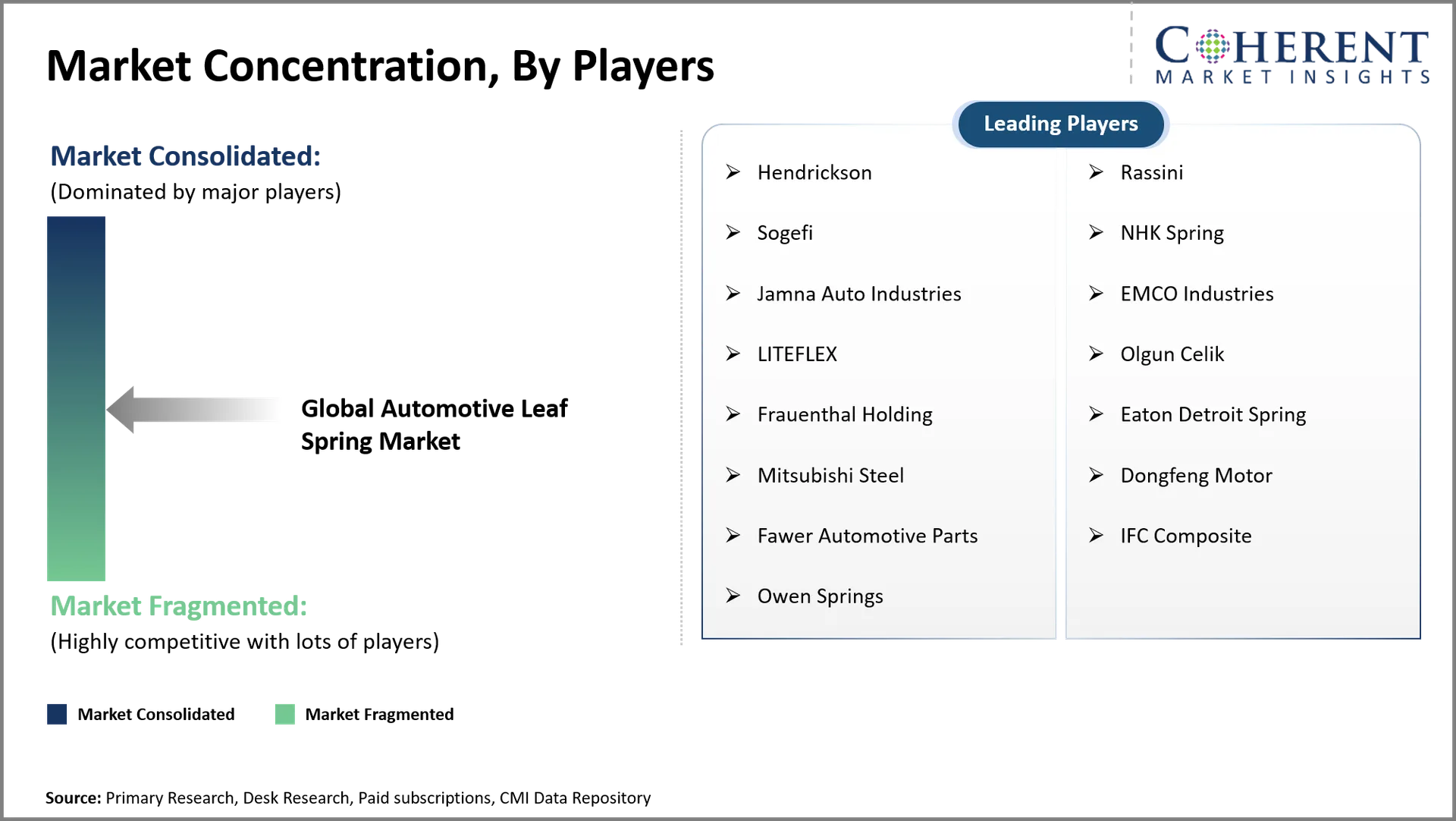
The competitive landscape is a mix of steel leaf spring competence, lightweight suspension development and application specific engineering. Hendrickson specializes in commercial vehicle mono leaf, parabolic, multi leaf and composite systems, including their SOFTEK NXT integrated mono leaf system for Peterbilt 567 and 579 trucks. Sogefi specializes in parabolic and conventional springs, employing high stress spring technology to cut weight but still provide performance. Mubea is expanding GFRP leaf spring applications, including longitudinal and tension designs offering substantial weight savings and corrosion resistance. Companies are therefore focusing on lightweighting, fatigue life, ride behavior, payload improvement, and compatibility with evolving vehicle architectures.
Market Report Scope
Global Automotive Leaf Spring Market Report Coverage | |||
Report Coverage | Details | ||
Base Year | 2025 | Market Size in 2026: | USD 5.70 Bn |
Historical Data For: | 2020 To 2024 | Forecast Period: | 2026 To 2033 |
Forecast Period 2026 To 2033 CAGR: | 4.70% | 2033 Value Projection: | USD 8.00 Bn |
Geographies covered: |
| ||
Segments covered: |
| ||
Companies covered: | Hendrickson, Rassini, Sogefi, NHK Spring, Jamna Auto Industries, EMCO Industries, LITEFLEX, Olgun Celik, Frauenthal Holding, Eaton Detroit Spring, Mitsubishi Steel, Dongfeng Motor, Fawer Automotive Parts, IFC Composite, Owen Springs | ||
Growth Drivers: |
| ||
Restraints & Challenges: |
| ||
Analyst Opinion (Expert Opinion)
- The industry is likely to develop around two parallel technologies, advanced steel springs and composite suspension systems. Steel will remain important for heavy duty applications requiring established manufacturing, high load capacity, and proven fatigue performance. Composite springs will gain attention where weight reduction, corrosion resistance, and packaging flexibility provide measurable vehicle benefits. Hendrickson already offers GFRP springs for light commercial vehicles through heavy duty trucks, while Mubea reports production of GFRP tension springs in Europe and North America.
- The strongest opportunities should concentrate on mono leaf and composite configurations for electric commercial vehicles, light commercial vehicles, and weight sensitive truck platforms. Mubea’s GFRP tension spring can save up to 50 kg per car compared with standard steel leaf springs. Hendrickson offers a full range of front and rear axles for light commercial and heavy-duty vehicles. China and India present potential for commercial vehicle production, while North America and Europe provide opportunities for the adoption of innovative lightweight suspensions.
- Players seeking an advantage should blend material innovation with vehicle specific suspension engineering rather than simply selling standardized springs. Suppliers can build modular spring structures for diverse axle loads, riding needs and vehicle platforms. Composite manufacturers need to focus on the key economic obstacles to automated production, quality consistency and scalable manufacturing. Steel spring producers can strengthen competitiveness through high strength materials, optimized leaf counts, advanced heat treatment, and fatigue improvement. Hendrickson demonstrates this approach through proprietary processing, reduced leaf counts, and integrated suspension systems.
Speak to the analyst
Want personalized insights?
Take the findings above to one of our principal consultants, or have the report rebuilt around the segments, geographies and competitors you actually track.
Market Segmentation
- Type Insights (Revenue, USD Billion, 2021 - 2033)
- Mono Leaf Springs
- Multi Leaf Springs
- Parabolic Leaf Springs
- Semi Elliptical Leaf Springs
- Material Insights (Revenue, USD Billion, 2021 - 2033)
- Steel
- Composite Materials
- Glass Fiber Reinforced Polymer
- Vehicle Type Insights (Revenue, USD Billion, 2021 - 2033)
- Passenger Vehicles
- Commercial Vehicles
- Application Insights (Revenue, USD Billion, 2021 - 2033)
- Front Suspension
- Rear Suspension
- Trailer Suspension
- Heavy Duty Suspension
- Regional Insights (Revenue, USD Billion, 2021 - 2033)
- North America
- U.S.
- Canada
- Latin America
- Brazil
- Argentina
- Mexico
- Rest of Latin America
- Europe
- Germany
- U.K.
- Spain
- France
- Italy
- Russia
- Rest of Europe
- Asia Pacific
- China
- India
- Japan
- Australia
- South Korea
- ASEAN
- Rest of Asia Pacific
- Middle East
- GCC Countries
- Israel
- Rest of Middle East
- Africa
- South Africa
- North Africa
- Central Africa
- North America
Sources
Primary Research Interviews
- Automotive Leaf Spring Manufacturers
- Commercial Vehicle OEMs (Original Equipment Manufacturers)
- Automotive Component Distributors & Suppliers
- Aftermarket & Replacement Parts Dealers
Magazines
- Automotive Engineering International
- Commercial Vehicle Magazine
- Auto Components India
- SAE Automotive Engineering Magazine
Journals
- International Journal of Automotive Technology
- Journal of Mechanical Engineering & Automotive Research
- SAE International Journal of Commercial Vehicles
Associations
- Automotive Component Manufacturers Association (ACMA)
- Society of Automotive Engineers (SAE International)
- European Automobile Manufacturers Association (ACEA)
- Alliance for Automotive Innovation
Public Domain Sources
- U.S. Department of Transportation (DOT)
- European Commission – Mobility & Transport
- Ministry of Road Transport & Highways, Government of India
- World Trade Organization (WTO) – Automotive Trade Data
Proprietary Elements
- CMI Data Analytics Tool
- Proprietary CMI Existing Repository of Information for Last 10 Years
Get access to 250+ pages report
Every segment, forecast, competitor profile and data table behind the analysis above — available for instant download.
- ESOMAR Member
- ISO 9001:2015 Certified
- D-U-N-S Registered
- GDPR & CCPA Compliant
Missing comfort of reading report in your local language? Find your preferred language:
Frequently Asked Questions
The global automotive leaf spring market is expected to stand at USD 5.70 Bn in 2026 and is expected to reach USD 8.00 Bn by 2033.
The CAGR of the global automotive leaf spring market is projected to be 4.7% from 2026 to 2033.
Growth in commercial vehicle production and Rising freight transportation activity are the major factors driving the growth of the global automotive leaf spring market.
Increasing adoption of air suspension systems and Growing use of independent suspension architectures are the major factors hampering the growth of the global automotive leaf spring market.
In terms of type, mono leaf springs segment is estimated to dominate the market revenue share in 2026.
An automotive leaf spring is a flexible suspension component that supports vehicle loads and controls axle movement.
Its primary function is supporting vehicle weight while absorbing road shocks and maintaining axle positioning.