

Global Automotive Oxygen Sensor Market Size and Forecast – 2026 To 2033
The global automotive oxygen sensor market is expected to grow from USD 7.50 Bn in 2026 to USD 10.75 Bn by 2033, registering a compound annual growth rate (CAGR) of 4.6% from 2026 to 2033. The global automotive oxygen sensor market is driven by growth in global passenger vehicle production. On May 11, 2026, Toyota Motor Corporation announced plans to develop a new Toyota Kirloskar Motor plant in the Bidkin industrial Area, Maharashtra, India. The new facility is expected to be operational in the first half of 2029 and is targeted at strengthening Toyota’s commercial base in the Indian market.
Key Takeaways of the Global Automotive Oxygen Sensor Market
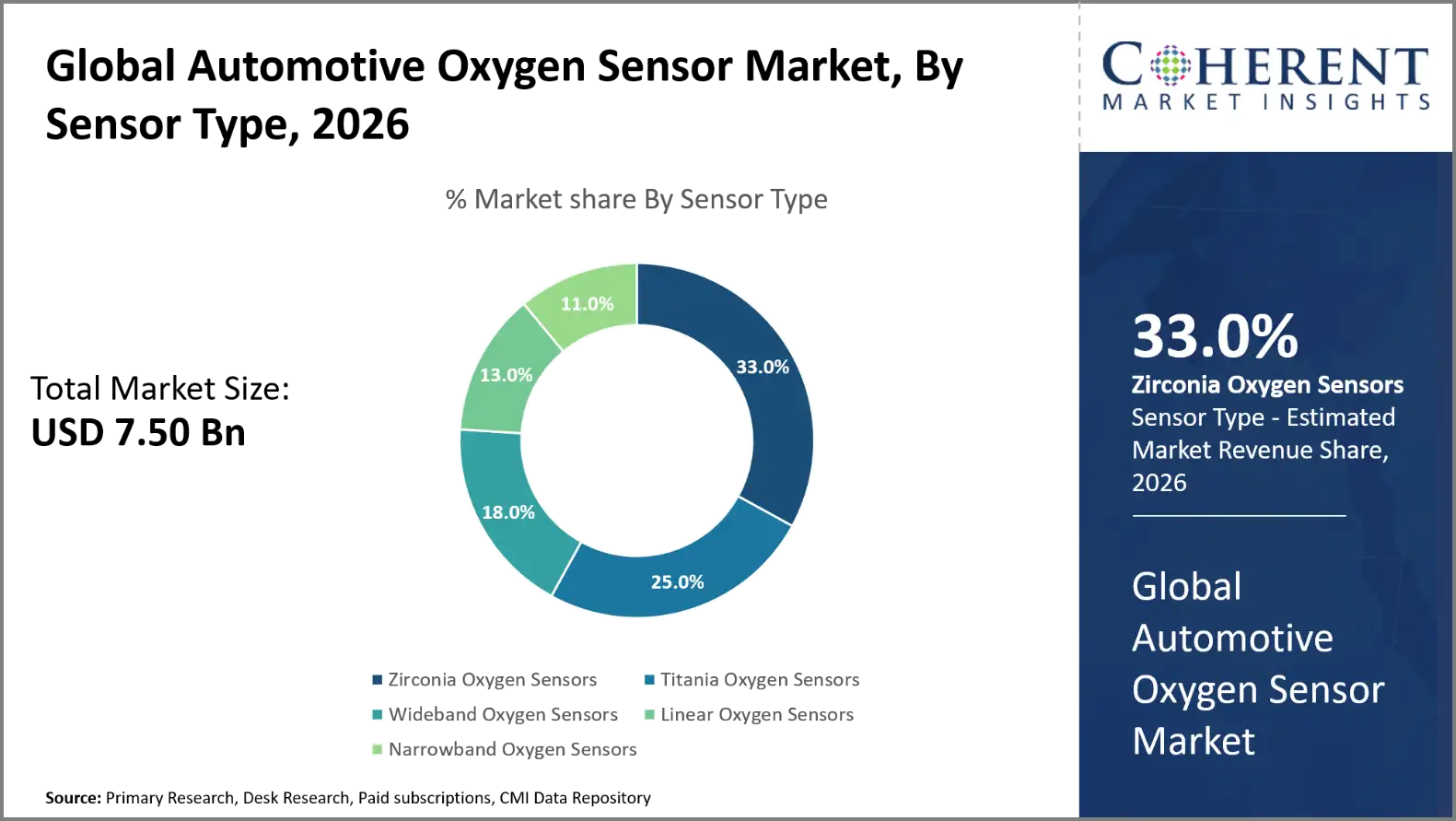
- The Zirconia Oxygen Sensors segment is expected to account for 33.0% of the global automotive oxygen sensor market share in 2026. Expansion of hybrid vehicle production is driving the growth of the segment. On November 18, 2025, Toyota Motor North America, Inc. announced an investment of USD 912 million in five manufacturing plants in the U.S. involved in hybrid vehicle production to meet growing demand for the vehicles in the U.S.
- The Passenger Vehicles segment is estimated to capture 62.0% of the market share in 2026. Increasing oxygen sensor replacement demand is majorly driving the growth of the segment. In March 2025, Walker Products introduced three new oxygen sensors covering Ford vehicles. The additions included an OE-based sensor covering approximately 870,000 U.S. vehicles.
- The Gasoline segment is estimated to capture 41.0% of the market share in 2026. Rising demand for precise air-fuel mixture control is majorly driving the growth of the segment. In June 2026, Bosch marked 50 years of lambda sensor technology and reported approximately 1.7 billion units produced. The company highlighted precise residual-oxygen measurement for optimal air-fuel mixture control.
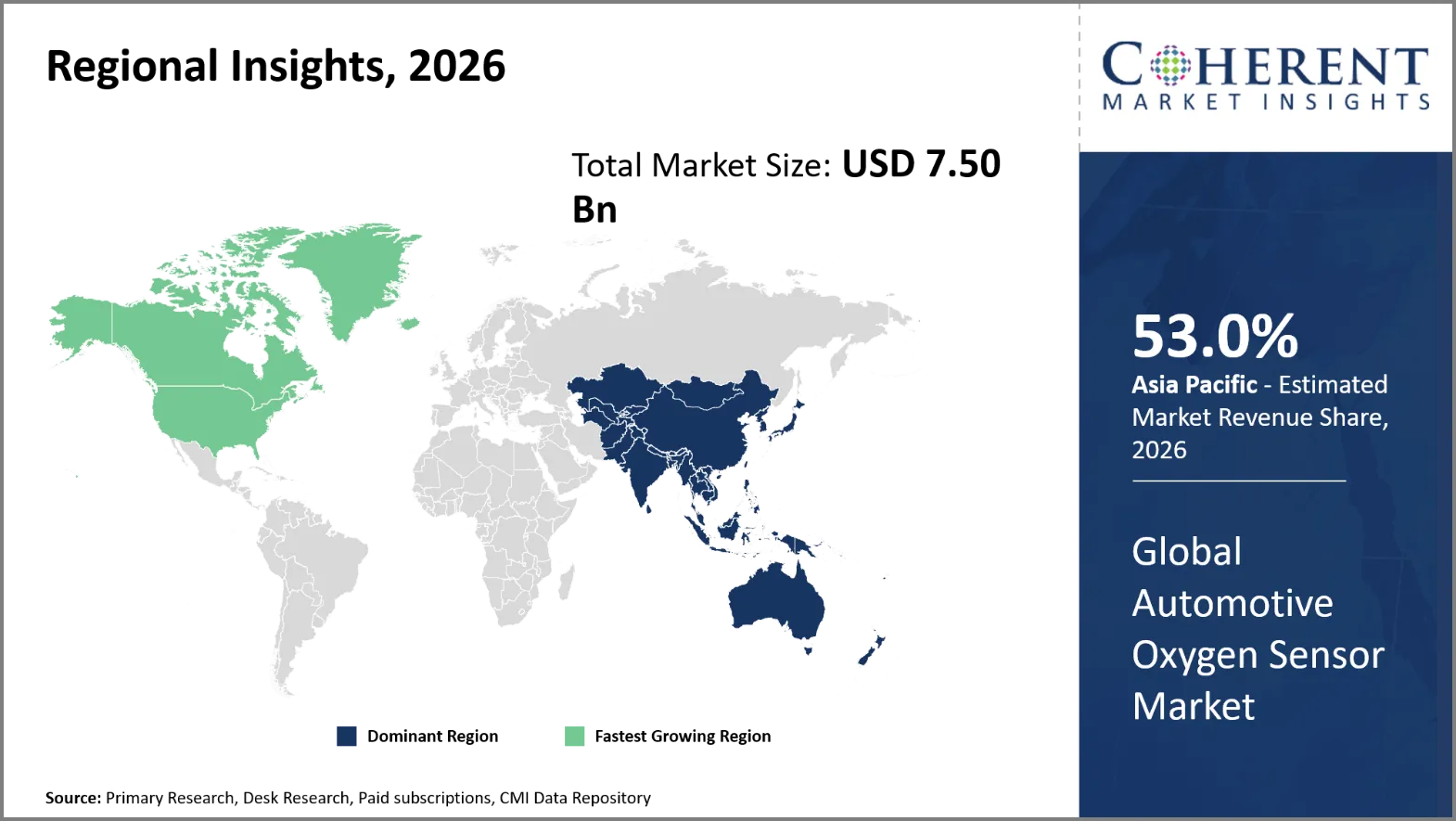
- Asia Pacific is expected to dominate the automotive oxygen Sensor market in 2026 with a market share of 53.0%. Advanced diagnostic sensor integration in Asia Pacific is driving the growth of the regional market. On September 13, 2026, Hyundai Motor Group declared that it would use Nvidia’s Hyperion platform in automobiles starting in 2028. The architecture combines cameras, radar, and ultrasonic sensors for Level 2+ and Level 2++ driving functions.
- North America is expected to account for 21.0% share in 2026 and is projected to record the fastest growth over the forecast period. Growing use of smart exhaust monitoring systems in North America is driving the growth of the regional market. For instance, BorgWarner expanded its portfolio of electronically controlled exhaust and thermal-management technologies for commercial and passenger vehicle applications during 2025. Its integrated systems combine sensing, control, and aftertreatment functions to manage emissions more precisely.
Segmental Insights
Why Does Zirconia Oxygen Sensors Dominate the Global Automotive Oxygen Sensor Market?
The zirconia oxygen sensors segment is expected to account for 33.0% of the global automotive oxygen sensor market share in 2026. Zirconia oxygen sensors dominate due to its ability to offer dependable oxygen concentration measurements in severe exhaust environments. Their solid electrolyte creates a measured voltage differential between the exhaust gasses and the reference air. The technology helps ensure correct air-fuel mixture regulation in petrol engines. Zirconia sensors also offer good thermal stability and durability at high exhaust temperatures. They have a proven connection with engine control systems, and can be widely used in passenger and commercial vehicles. In September 2025, Walker Products launched seven new powersports oxygen sensors. The sensors employed premium sensing elements to obtain accurate air-fuel ratio readings. The items use certain vehicle uses, such as direct-fit connections and OE-based designs. This launch extended zirconia-based oxygen sensing technology into motorcycles and other powersports vehicles.
- Current Industry Events of 2026
- Market Size Estimation
- Regional Breakdown
- Competitive Landscape
- Customer Intelligence
- Segmental Analysis
- Pricing Analysis
- Key Market Drivers, Challenges & Future Trends
- Customized Insights Section
Why is Passenger Vehicles the Most Crucial Vehicle Type?
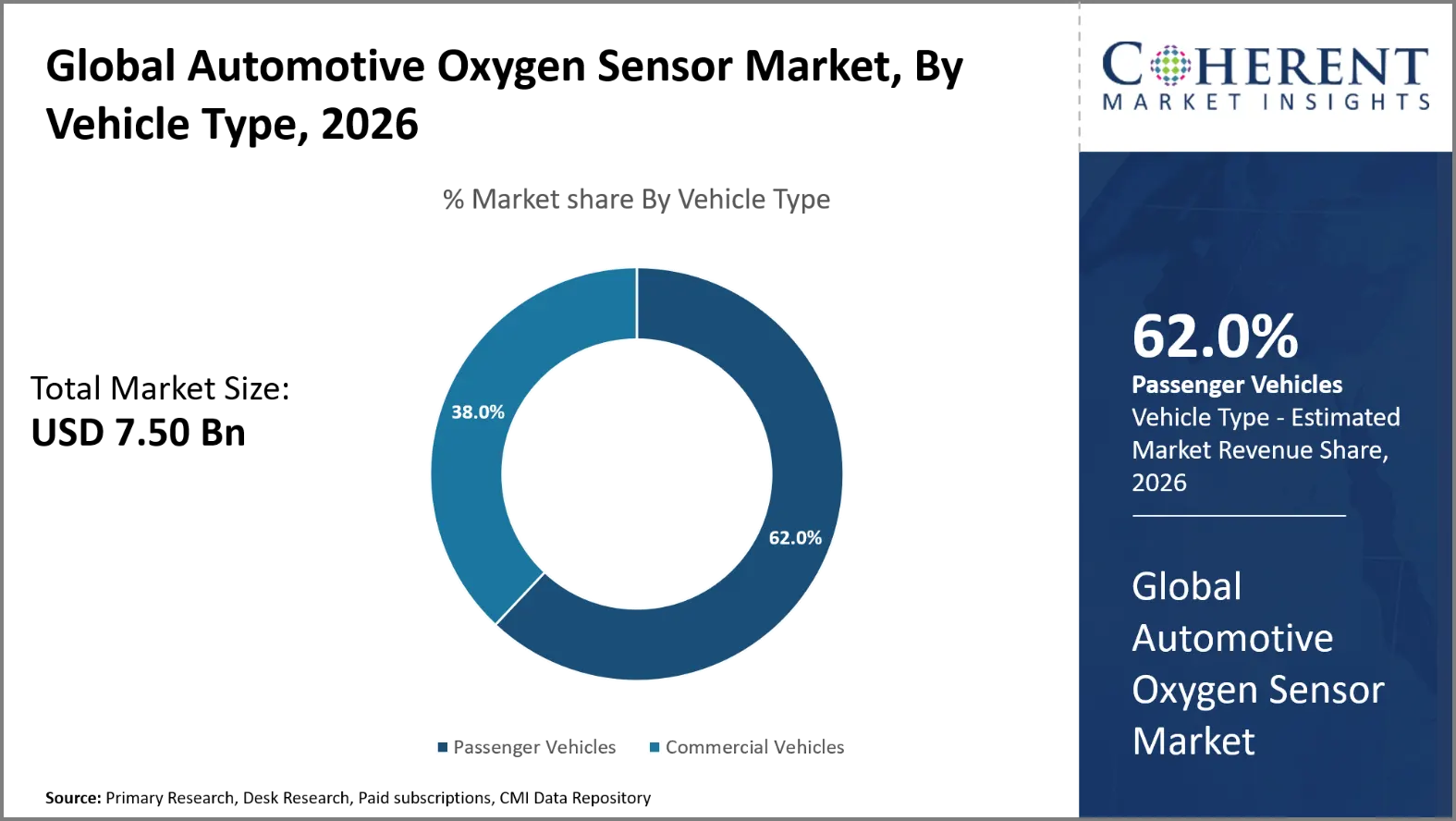
The passenger vehicles segment is expected to account for 62.0% of the global automotive oxygen sensor market share in 2026. Passenger vehicles are equipped with oxygen sensors to continuously measure the oxygen in the exhaust to control combustion efficiently. The large number of passenger cars produced globally provides significant demand for these sensors as original equipment. More stringent emission rules also raise the necessity for accurate air-fuel monitoring in passenger cars. The production increase in hybrid vehicles will further drive the demand for better oxygen detecting technologies. The vast installed passenger car fleet also creates periodic replacement demand in key automotive markets. On May 30, 2025, Toyota announced production of the GR Corolla at its U.K. manufacturing facility from 2026. The expansion means Toyota Motor Manufacturing U.K. will build more passenger vehicles and the new model will sit on current manufacturing and supplier capabilities.
Gasoline Dominates the Global Automotive Oxygen Sensor Market
The gasoline segment is expected to account for 41.0% of the global automotive oxygen sensor market share in 2026. Gasoline engines require oxygen sensors to maintain precise air-fuel ratios during combustion. These sensors are widely used on gasoline powertrains for pollution control and catalytic converter efficiency. The necessity for accurate exhaust monitoring is driven by the increased use of electronically controlled gasoline engines. Tougher emission requirements also drive manufacturers to put sophisticated oxygen detection systems into gasoline cars. The enormous worldwide gasoline vehicle fleet also generates continuous replacement demand across the automotive aftermarket. In 2025, DENSO continued development of gasoline powertrain technology with oxygen and air-fuel-ratio sensors. The sensors feedback into engine control systems for accurate fuel-injection regulation. They are still vital for usage in gasoline engines, because the combustion conditions alter continuously with engine speed, load, temperature, and driving circumstances.
Current Events and their Impact
Current Events | Description and its Impact |
European Union - Euro 7 Regulation (EU) 2024/1257 |
|
U.S. - Multi-Pollutant Emissions Standards, 40 CFR Parts 86 and 600 |
|
Automotive Oxygen Sensor Market Dynamics
Market Drivers
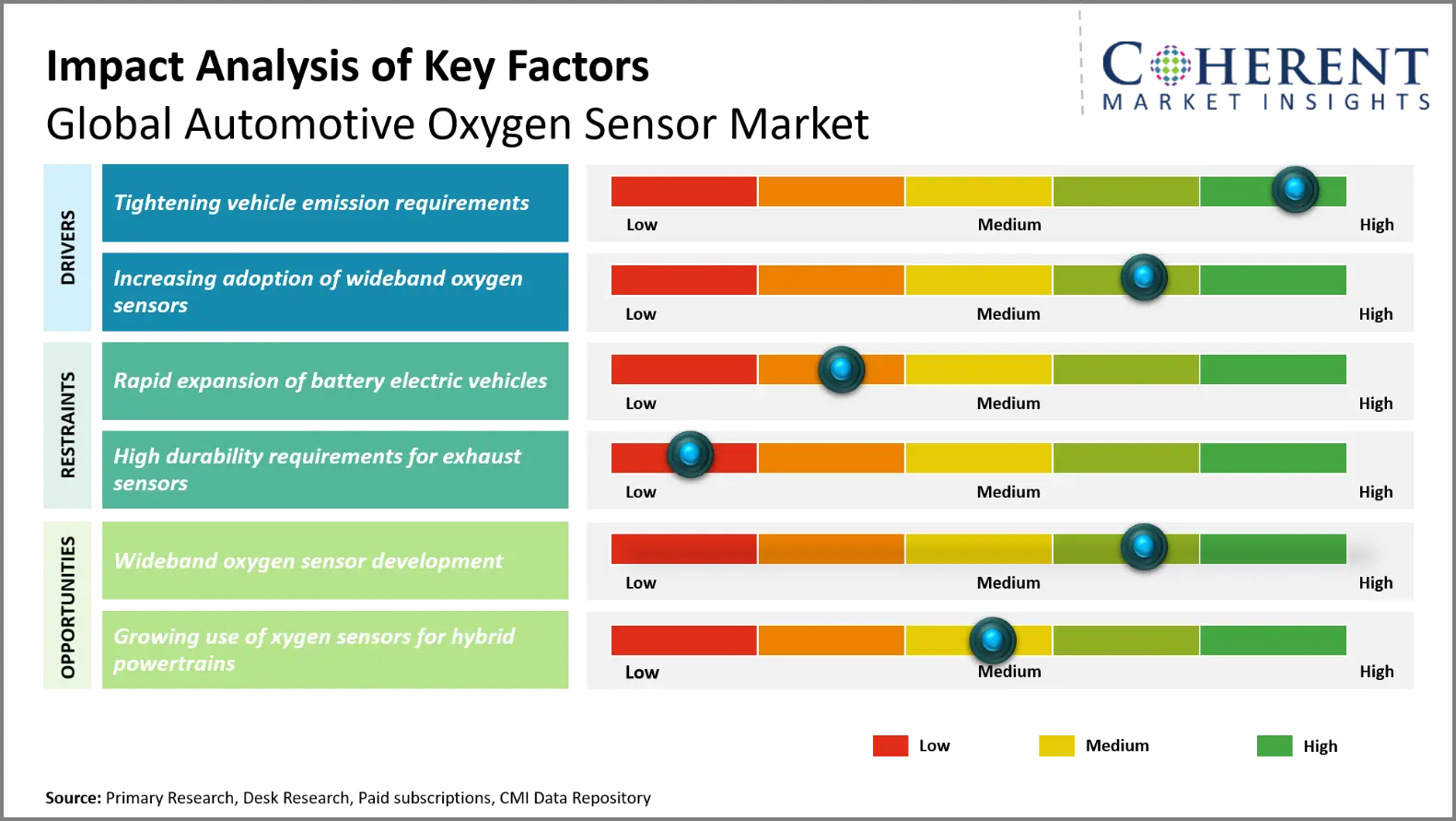
- Tightening vehicle emission requirements: Governments are tightening vehicle emission requirements to cut nitrogen oxides, carbon monoxide, hydrocarbons and particle pollutants. These demands promote car manufacturers to improve combustion control and exhaust aftertreatment performance. Oxygen sensors measure the oxygen in the exhaust in real time and help to maintain the correct air/fuel ratio. Enhanced on-board diagnostics and testing requirements raise the demand for accurate sensor performance. This regulatory pressure supports the existing demand for oxygen sensors in gasoline and hybrid vehicle applications. On April 20, 2026, Peugeot, a French automotive brand owned by Stellantis, applied the future Euro 7 plug-in-hybrid homologation process to current models ahead of the rule. The business has re-calculated certified combined power statistics for the 3008, 5008 and 408 plug-in hybrids. This preparation is an example of how manufacturers are adapting powertrain calibration and certification processes to tougher emissions rules.
- Increasing adoption of wideband oxygen sensors: Wideband oxygen sensors are being adopted due to their wider and accurate air-fuel measurement capabilities. Their accuracy allows sophisticated engine management systems to continuously optimize combustion conditions. Automakers are increasingly using these sensors in gasoline engines that require precise control of fuel injection. Wideband technology also supports stringent emission compliance by improving closed-loop engine control. Growing electronic integration in modern powertrains is therefore expanding opportunities for advanced oxygen sensing systems. In November 2025, Bosch introduced a new technical documentation for its wideband lambda sensor LSU-4.9. The sensor is a planar dual cell zirconium dioxide design with an included heater. Bosch specifies measurement over a wide lambda range, supporting gasoline and diesel engine control.
Emerging Trends
- Expansion of Wideband Oxygen Sensing: Automakers are increasingly integrating wideband oxygen sensors into gasoline powertrains for accurate air-fuel monitoring, enhanced combustion efficiency and reduced emissions, particularly as engine management systems become more electronically controlled and emission standards become increasingly stringent worldwide.
- Integration with Advanced Engine Management: Increasingly, oxygen sensors are being coupled with advanced engine management systems that continually fine-tune fuel injection and combustion characteristics. This incorporation increases responsiveness, helps meet emission regulations, and allows for more precise powertrain operating under varying driving situations.
- Growth of Oxygen Sensors in Hybrid Vehicles: Hybrid vehicles are creating new uses for oxygen sensors since their internal combustion engines still require accurate exhaust monitoring. Manufacturers are developing sensors suitable for frequent starts and stops and fluctuating operating temperatures in hybrid powertrains.
- Development of More Durable Sensor Technologies: Sensor makers are concentrating on better thermal resistance, faster response times and longer operating life. These advancements help meet challenging exhaust environments while assisting extended maintenance intervals and reliable emission monitoring throughout modern gasoline-powered vehicle platforms.
Regional Insights
Why is Asia Pacific a Strong Market for Automotive Oxygen Sensor?
Asia Pacific is expected to account for a market share of 53.0% in 2026. Asia Pacific vehicle production was around 59.2 million units in 2025, accounting for more than 61% of the world vehicle production. China, Japan, India and South Korea offer significant regional manufacturing depth. China’s output of automobiles reached 34.53 million, of which 16.626 million were new-energy vehicles. Japan produced 8.41 million vehicles and India achieved 6.49 million units. The 7.6% output rise in the region supports demand for emission-control components on combustion and hybrid platforms. Rising hybridization creates additional oxygen-sensing applications alongside conventional gasoline vehicles. Regional manufacturers also increasingly develop localized powertrain electronics and emission-control systems. These manufacturing concentrations support oxygen sensor demand across original equipment and replacement applications.
Why Does North America Automotive Oxygen Sensor Market Exhibit High Growth?
North America is expected to register the fastest growth with a CAGR of 5.5% over the forecast period. It is projected to account for 21.0% of the global automotive oxygen sensor market in 2026. North American demand is supported by stringent diagnostic requirements and a large installed base of gasoline-powered vehicles. The United States Environmental Protection Agency previously applied Tier 3 standards beginning with model year 2017. These standards established tighter limits for nitrogen oxides, nonmethane organic gases, and particulate matter. California also operates separate vehicle emission programs under its Air Resources Board framework. Oxygen sensors support closed-loop fuel control and catalytic converter monitoring within these vehicles. The U.S. Environmental Protection Agency finalized major changes to federal greenhouse-gas regulation in February 2026. These changes create a different regulatory environment for future combustion vehicle development.
Global Automotive Oxygen Sensor Market Outlook for Key Countries
Why is China Emerging as a Major Hub in the Automotive Oxygen Sensor Market?
China produced 34.53 million vehicles in 2025, making it the largest individual vehicle manufacturing base. New-energy vehicle production reached 16.626 million units during the year. China implemented China VI Stage 6b nationally from July 2023. The standard restricts manufacture, importation and sale of noncompliant automobiles. In April 2026, China made compulsory revisions to GB 18352.6-2016 and GB 17691-2018. These amendments come into force on May 1, 2026. These rules keep the demand for accurate emission monitoring in combustion vehicles. Hybrid powertrain development also creates opportunities for oxygen sensors operating under frequent engine cycling.
Is U.S. the Next Growth Engine for the Automotive Oxygen Sensor Market?
The U.S. automotive oxygen sensor market combines extensive vehicle production with a substantial commercial vehicle manufacturing base. International Organization of Motor Vehicle Manufacturers data show 2025 U.S. car production of approximately 1.28 million units. The same data set also shows significant manufacturing of commercial vehicles in prior reporting periods. Oxygen sensors are still common in gasoline engines with closed loop combustion control. Federal Tier 3 standards cover passenger cars, light-duty trucks, and sport utility vehicles. California maintains additional emissions programs that influence vehicle technologies sold across the market. Federal greenhouse-gas regulatory revisions for 2026 could impact decisions on future engine technologies.
Germany Automotive Oxygen Sensor Market Analysis and Trends
Germany manufactured almost 4.15 million automobiles in 2025, holding its position as Europe’s leading passenger-car production base. Major German car makers have major gasoline, diesel and hybrid powertrain projects. Euro 7 has included further criteria for exhaust emissions and non-exhaust emissions and battery durability. These criteria promote continued use of accurate emission monitoring on combustion powered platforms. German suppliers also have a good track record in engine control and exhaust aftertreatment electronics. So, while production of battery-electric vehicles is ramping up, oxygen sensors remain vital for gasoline and hybrid cars. Germany’s strong export drive also subjects component suppliers to emission regulations in a variety of international markets.
Japan Automotive Oxygen Sensor Market Analysis and Trends
Japan manufactured around 8.41 million automobiles and continued to manufacture large volumes of both passenger and commercial vehicles in 2025. Japanese automakers have a long history of producing gasoline-electric hybrid powertrains. Hybrid vehicles have special sensing requirements because of the repetitive start and stop of combustion engines and their operation with different loads. Oxygen sensors are used to ensure appropriate combustion conditions during these changing operating modes. Japanese suppliers are also developing improved air-fuel ratio monitoring systems for gasoline engines. Toyota, Honda and other automakers still provide large portfolios of hybrid vehicles. This resulting hybrid ecology generates a unique demand stream for oxygen sensors beyond traditional gasoline car applications
South Korea Automotive Oxygen Sensor Market Analysis and Trends
Supported by big domestic automobile manufacturers, South Korea made over 3.84 million cars in 2025. Hyundai and Kia have large offerings of gasoline and hybrid vehicles that need sophisticated engine control systems. South Korean makers have increased hybrid products as well as battery electric vehicles. The applications for oxygen sensors still exist with hybridization, because the internal combustion engine is still working in these vehicles. Local automotive electronics skills can aid in the development of integrated engine management and emissions-control technology. Export-oriented vehicle manufacturing exposes South Korean producers to a range of emissions standards across major target countries. This paves the way for flexible sensing systems capable of addressing a variety of regulatory and calibration needs.
Global Automotive Oxygen Sensor Market - Wideband Versus Switching Sensor Adoption By Region (2025)
Region | Wideband Sensor Adoption | Switching Sensor Adoption |
Asia Pacific | 42.0% | 58.0% |
Europe | 48.0% | 52.0% |
North America | 51.0% | 49.0% |
Latin America | 32.0% | 68.0% |
Middle East & Africa | 29.0% | 71.0% |
How is Wideband Oxygen Sensor Development Creating New Growth Opportunities in the Automotive Oxygen Sensor Market?
The development of wideband oxygen sensors is opening up potential by offering continuous air-fuel measurement across far wider working ranges than conventional switching sensors. Modern systems can better identify leaner and richer combustion conditions, which facilitate gasoline direct injection and turbocharged engines. Wideband sensors coupled with engine control units are enabling manufacturers to optimize fuel injection during transient acceleration, cold starts and high-load running. Their quicker responsiveness also allows improved control of three-way catalytic converters under varying exhaust circumstances. Bosch and Niterra provide wideband air-fuel ratio sensor solutions for current engine applications. The advances offer chances for sensor suppliers to serve high-efficiency gasoline and hybrid powertrains.
On January 17, 2025, DENSO showcased its latest mobility technology at the Bharat Mobility Global Expo 2025 in New Delhi, India. It has created a range of air-fuel ratio sensor technologies for accurate combustion control. DENSO air-fuel sensors use fast response planar zirconia elements to assess air-fuel ratios over a wide operating range.
Market Players, Key Development, and Competitive Landscape
Key Developments
- On July 6, 2026, Standard Motor Products, Inc. (SMP) announced it has entered into a joint venture agreement with Techstrong Holdings Limited to form Techstrong Electronics (Thailand) Company Limited, an automotive sensor manufacturing company. Through this partnership, SMP will acquire a 50% stake in an established and strategic supplier, immediately expanding its manufacturing capabilities across key sensor categories.
- On January 30, 2024, NTK Vehicle Electronics added 44 new wideband oxygen sensors to its range. The new sensors are a crucial element in reducing pollutants in many engines. They constantly measure the residual oxygen content in the exhaust gases and transmit this information to the vehicle's engine control unit (ECU).
Competitive Landscape
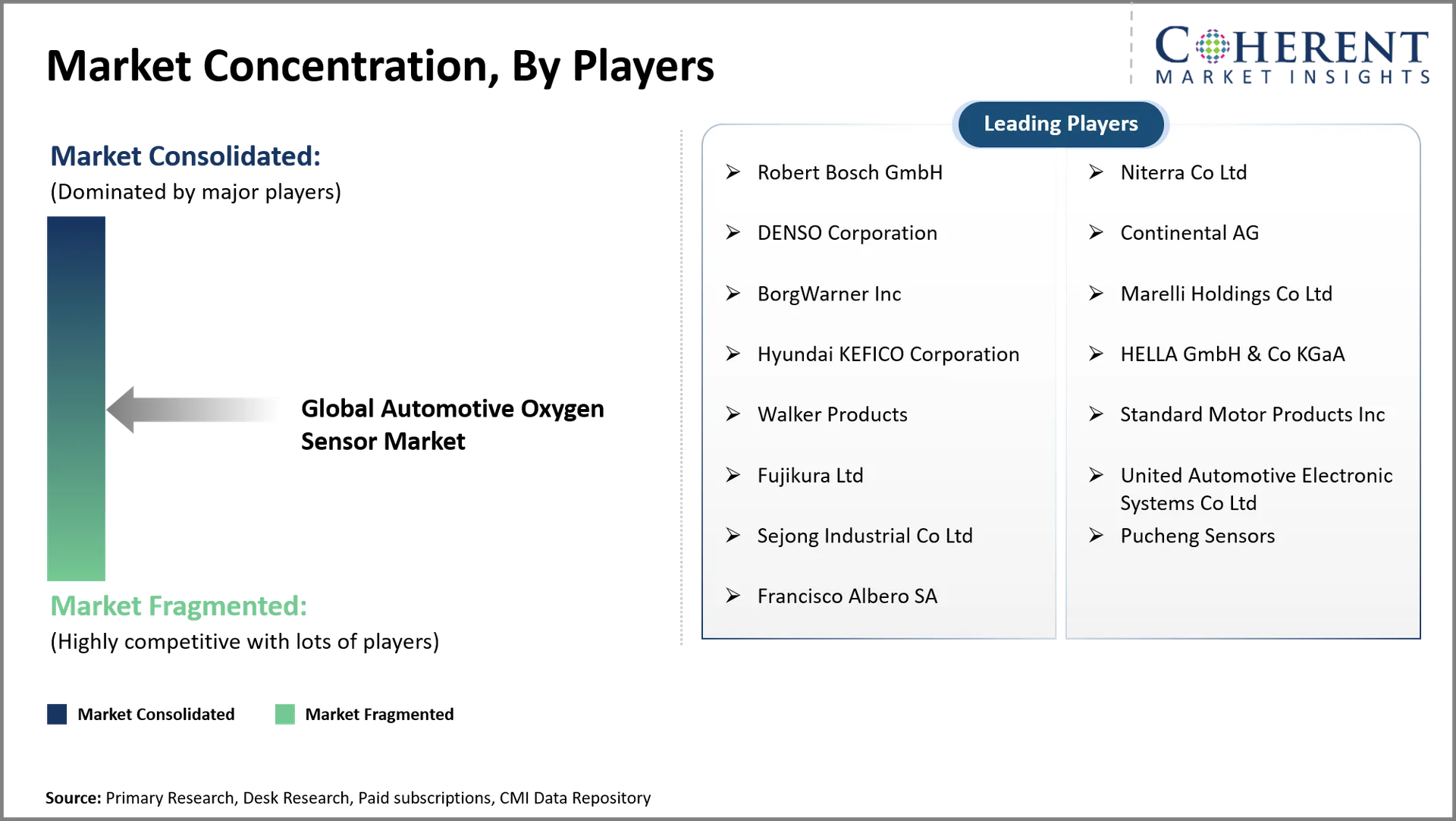
The competition includes Bosch, Niterra, DENSO and other prominent sensor manufacturers with diverse technology agendas. Bosch has specialized in wideband lambda sensors with high measurement accuracy, quick activation and heat resistance up to 1,030 °C. In 2025, Niterra added 52 applications to its NTK Vehicle Electronics oxygen sensor line. The expansion added aftermarket vehicle coverage with wideband and switching sensors. DENSO focuses on precise air-fuel sensing, water resistance, rapid activation, and integration with gasoline engine control systems. DENSO also agreed to transfer its oxygen and air-fuel ratio sensor business to Niterra.
Market Report Scope
Automotive Oxygen Sensor Market Report Coverage | |||
Report Coverage | Details | ||
Base Year | 2025 | Market Size in 2026: | USD 7.50 Bn |
Historical Data For: | 2020 To 2024 | Forecast Period: | 2026 To 2033 |
Forecast Period 2026 To 2033 CAGR: | 4.6% | 2033 Value Projection: | USD 10.75 Bn |
Geographies covered: |
| ||
Segments covered: |
| ||
Companies covered: | Robert Bosch GmbH, Niterra Co Ltd, DENSO Corporation, Continental AG, BorgWarner Inc, Marelli Holdings Co Ltd, Hyundai KEFICO Corporation, HELLA GmbH & Co KGaA, Walker Products, Standard Motor Products Inc, Fujikura Ltd, United Automotive Electronic Systems Co Ltd, Sejong Industrial Co Ltd, Pucheng Sensors, Francisco Albero SA | ||
Growth Drivers: |
| ||
Restraints & Challenges: |
| ||
Analyst Opinion (Expert Opinion)
- The industry is likely to become increasingly focused on advanced sensing for gasoline and hybrid powertrains. Wideband technology should gain strategic importance because it provides continuous air-fuel measurements across rich and lean conditions. Bosch already positions wideband sensors for gasoline direct injection, port injection, diesel, and compressed natural gas applications. Hybrid applications should remain particularly important because combustion engines continue operating alongside electric propulsion systems. DENSO specifically lists oxygen sensors and air-fuel ratio sensors within its hybrid powertrain architecture.
- Wideband sensors, hybrid vehicles and high production Asian automotive sectors offer the best potential. China offers a huge volume since its car production environment remains extraordinarily large. Japan is an opportunity like no other because the manufacturers have deep expertise in hybrid powertrains. Also, South Korea has potential in the form of Hyundai and Kia’s expanding hybrid portfolios. Suppliers also can address applications for gasoline direct-injection, which require quick sensor response and tight control of the mixture. Bosch specifies one particular use of wideband sensors in gasoline direct injection.
- Key points for edge seeking players include sensor reaction time, thermal durability, weather resistance and larger vehicle coverage. Niterra’s 2025 expansion shows the value of offering application-specific aftermarket coverage. Suppliers should also be developing sensors that can be integrated with ever more sophisticated engine control architectures. DENSO sensor design is focused on water resistance and faster air-fuel detection following engine start-up. Partnerships with original equipment manufacturers can further enhance calibration integration and speed adoption across new vehicle platforms.
Speak to the analyst
Want personalized insights?
Take the findings above to one of our principal consultants, or have the report rebuilt around the segments, geographies and competitors you actually track.
Market Segmentation
- Sensor Type Insights (Revenue, USD Billion, 2021 - 2033)
- Zirconia Oxygen Sensors
- Titania Oxygen Sensors
- Wideband Oxygen Sensors
- Linear Oxygen Sensors
- Narrowband Oxygen Sensors
- Vehicle Type Insights (Revenue, USD Billion, 2021 - 2033)
- Passenger Vehicles
- Commercial Vehicles
- Fuel Type Insights (Revenue, USD Billion, 2021 - 2033)
- Gasoline
- Diesel
- Hybrid
- Compressed Natural Gas
- Liquefied Petroleum Gas
- Application Insights (Revenue, USD Billion, 2021 - 2033)
- Engine Management
- Exhaust Aftertreatment Monitoring
- Catalytic Converter Monitoring
- Onboard Diagnostics
- Emission Control
- Regional Insights (Revenue, USD Billion, 2021 - 2033)
- North America
- U.S.
- Canada
- Latin America
- Brazil
- Argentina
- Mexico
- Rest of Latin America
- Europe
- Germany
- U.K.
- Spain
- France
- Italy
- Russia
- Rest of Europe
- Asia Pacific
- China
- India
- Japan
- Australia
- South Korea
- ASEAN
- Rest of Asia Pacific
- Middle East
- GCC Countries
- Israel
- Rest of Middle East
- Africa
- South Africa
- North Africa
- Central Africa
- North America
- Key Players Insights
- Robert Bosch GmbH
- Niterra Co Ltd
- DENSO Corporation
- Continental AG
- BorgWarner Inc
- Marelli Holdings Co Ltd
- Hyundai KEFICO Corporation
- HELLA GmbH & Co KGaA
- Walker Products
- Standard Motor Products Inc
- Fujikura Ltd
- United Automotive Electronic Systems Co Ltd
- Sejong Industrial Co Ltd
- Pucheng Sensors
- Francisco Albero SA
Sources
Primary Research Interviews
- Automotive Oxygen Sensor Manufacturers
- Automotive OEM Representatives
- Tier-1 & Tier-2 Automotive Component Suppliers
- Automotive Aftermarket Distributors & Retailers
Magazines
- Automotive Engineering International
- Motor Trend Magazine
- Automotive Industries Magazine
- SAE Automotive Engineering Magazine
Journals
- Journal of Automotive Engineering
- International Journal of Engine Research
- Journal of Sensors and Actuator Systems
Associations
- Society of Automotive Engineers (SAE International)
- Automotive Parts Manufacturers' Association (APMA)
- Motor & Equipment Manufacturers Association (MEMA)
- European Automobile Manufacturers' Association (ACEA)
Public Domain Sources
- U.S. Environmental Protection Agency (EPA) – Vehicle Emissions Data
- European Commission – Automotive Emissions Regulations & Reports
- International Energy Agency (IEA) – Automotive & Transport Data
- U.S. Department of Energy (DOE) – Vehicle Technologies Reports
Proprietary Elements
- CMI Data Analytics Tool
- Proprietary CMI Existing Repository of Information for Last 10 Years
Get access to 250+ pages report
Every segment, forecast, competitor profile and data table behind the analysis above — available for instant download.
- ESOMAR Member
- ISO 9001:2015 Certified
- D-U-N-S Registered
- GDPR & CCPA Compliant
Missing comfort of reading report in your local language? Find your preferred language:
Frequently Asked Questions
The global automotive oxygen sensor market is expected to stand at USD 7.50 Bn in 2026 and is expected to reach USD 10.75 Bn by 2033.
The CAGR of the global automotive oxygen sensor market is projected to be 4.6% from 2026 to 2033.
Tightening vehicle emission requirements and Increasing adoption of wideband oxygen sensors are the major factors driving the growth of the global automotive oxygen sensor market.
Rapid expansion of battery electric vehicles and High durability requirements for exhaust sensors are the major factors hampering the growth of the global automotive oxygen sensor market.
In terms of sensor type, zirconia oxygen sensors segment is estimated to dominate the market revenue share in 2026.
An automotive oxygen sensor measures oxygen concentration in exhaust gases to help control the engine air-fuel mixture.
It provides exhaust oxygen information to the engine control unit, enabling adjustments that support efficient combustion.