

Global Autonomous Electric Vehicle Market Size and Forecast – 2026 To 2033
The global autonomous electric vehicle market is expected to grow from USD 104.60 Bn in 2026 to USD 378.45 Bn by 2033, registering a compound annual growth rate (CAGR) of 20.2% from 2026 to 2033. The global autonomous electric vehicle market is driven by growing investments in smart transportation infrastructure. On June 4, 2025, Verizon Business commercially launched Edge Transportation Exchange, a mobile-network vehicle-to-everything (V2X) communication platform for connected vehicles, with multiple customers already signed on.
Key Takeaways of the Global Autonomous Electric Vehicle Market
- The Passenger Vehicles segment is expected to account for 62.0% of the global autonomous electric vehicle market share in 2026. Rising demand for improved road safety and accident prevention is driving the growth of the segment. On November 11, 2025, IVECO and Accenture announced successful development of a vehicle-to-everything safety solution. The technology was developed and tested using IVECO's fully electric eDaily commercial vehicle.
- The Battery Electric Vehicles segment is estimated to capture 58.0% of the market share in 2026. Expansion of autonomous ride-hailing and robotaxi services is majorly driving the growth of the segment. On April 8, 2026, Pony.ai launched commercial robotaxi operations in Zagreb, Croatia. The deployment represents Europe's first commercial robotaxi service.
- The Level 1 segment is estimated to capture 38.0% of the market share in 2026. Increasing development of advanced driver assistance systems is driving the growth of the segment. On January 6, 2026, ZF Friedrichshafen AG and Qualcomm Technologies, Inc. announced an ADAS technology collaboration. Their system runs on ZF’s ProAI supercomputer and Qualcomm’s Snapdragon Ride platform.
- North America is expected to dominate the autonomous electric vehicle market in 2026 with a market share of 39.0%. Growing integration of AI with electric vehicle platforms in North America is driving the growth of the regional market. On March 18, 2025, General Motors Company and NVIDIA Corporation announced an expanded relationship. The alliance aims to integrate accelerated computing, artificial intelligence and simulation into next-generation cars and manufacturing facilities.
- Asia Pacific is expected to account for 24.0% share in 2026. Growing demand for autonomous electric logistics and delivery vehicles in Asia Pacific is driving the growth of the regional market. On December 3, 2025, DHL Supply Chain unveiled Singapore’s first autonomous vehicle optimized for supply-chain operations. Developed with Zelostech, the fully electric vehicle operates at Infineon Technologies' Asia Pacific Advanced Regional Centre.
Segmental Insights
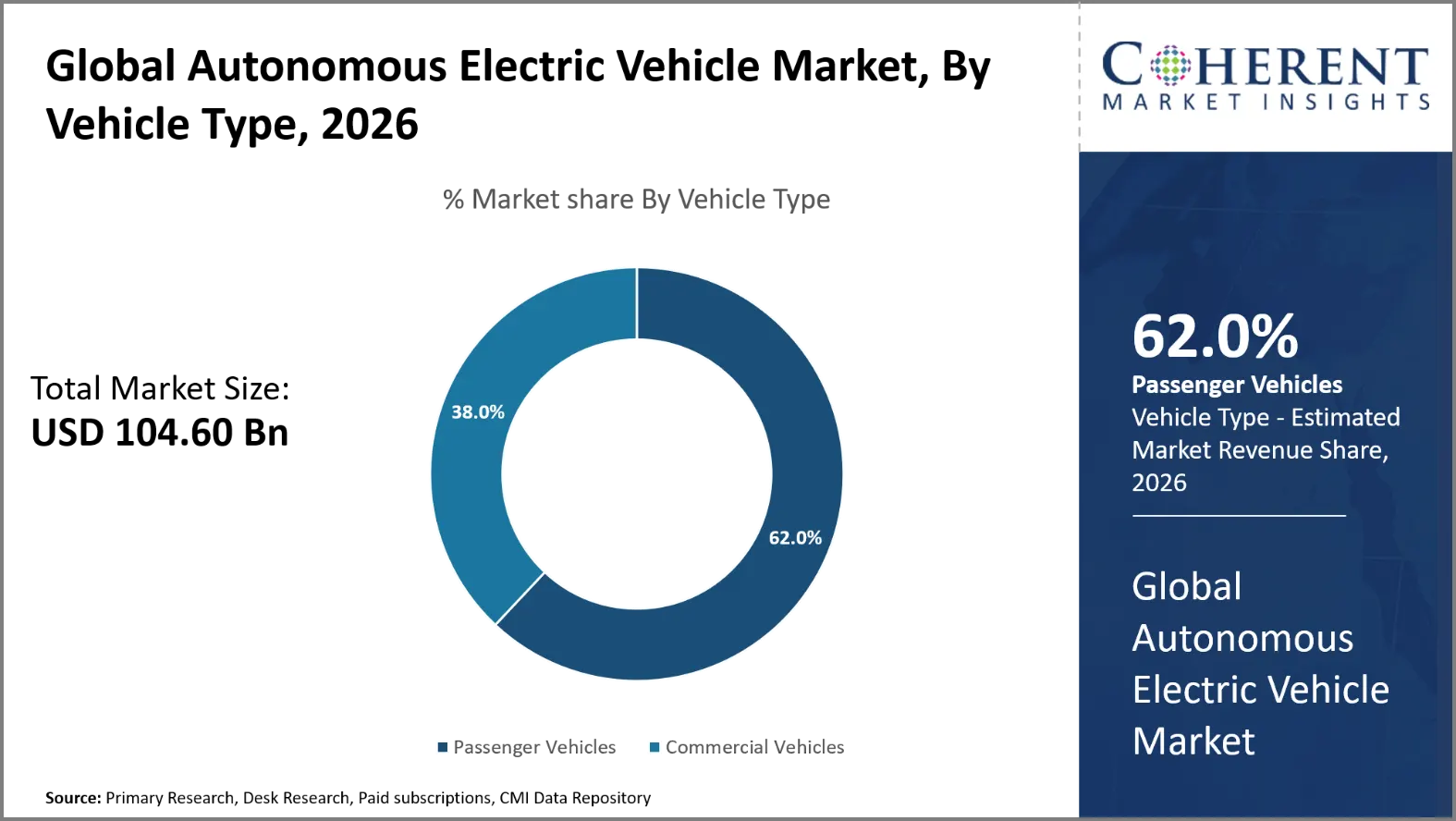
Why Does Passenger Vehicles Dominate the Global Autonomous Electric Vehicle Market?
The passenger vehicles segment is expected to account for 62.0% of the global autonomous electric vehicle market share in 2026. Passenger vehicles dominate the global autonomous electric vehicle market because private mobility generates substantial demand for automated driving technologies. Passenger automobiles are increasingly being equipped with adaptive cruise control, parking assistance, collision avoidance, and lane assistance. Increased customer interest in driving comfort, convenience and vehicle safety also boost adoption. Passenger cars also provide many opportunities for software integration and for the development of advanced driver assistance systems. The International Energy Agency identifies private passenger automobiles as a key application of expanded driving automation technologies. The rising availability of electric cars and the increasing investments in intelligent mobility are strengthening the market leadership of this segment.
On September 22, 2025, Nissan presented their next-generation ProPILOT driver-assistance technology with electric Ariya prototype cars in central Tokyo, Japan. The system combines Wayve’s artificial intelligence driving software with Nissan’s perception technology and next-generation LiDAR. Its sensor package includes 11 cameras, five radar sensors, and one LiDAR sensor.
- Current Industry Events of 2026
- Market Size Estimation
- Regional Breakdown
- Competitive Landscape
- Customer Intelligence
- Segmental Analysis
- Pricing Analysis
- Key Market Drivers, Challenges & Future Trends
- Customized Insights Section
Why is Battery Electric Vehicles the Most Preferred Propulsion Type?
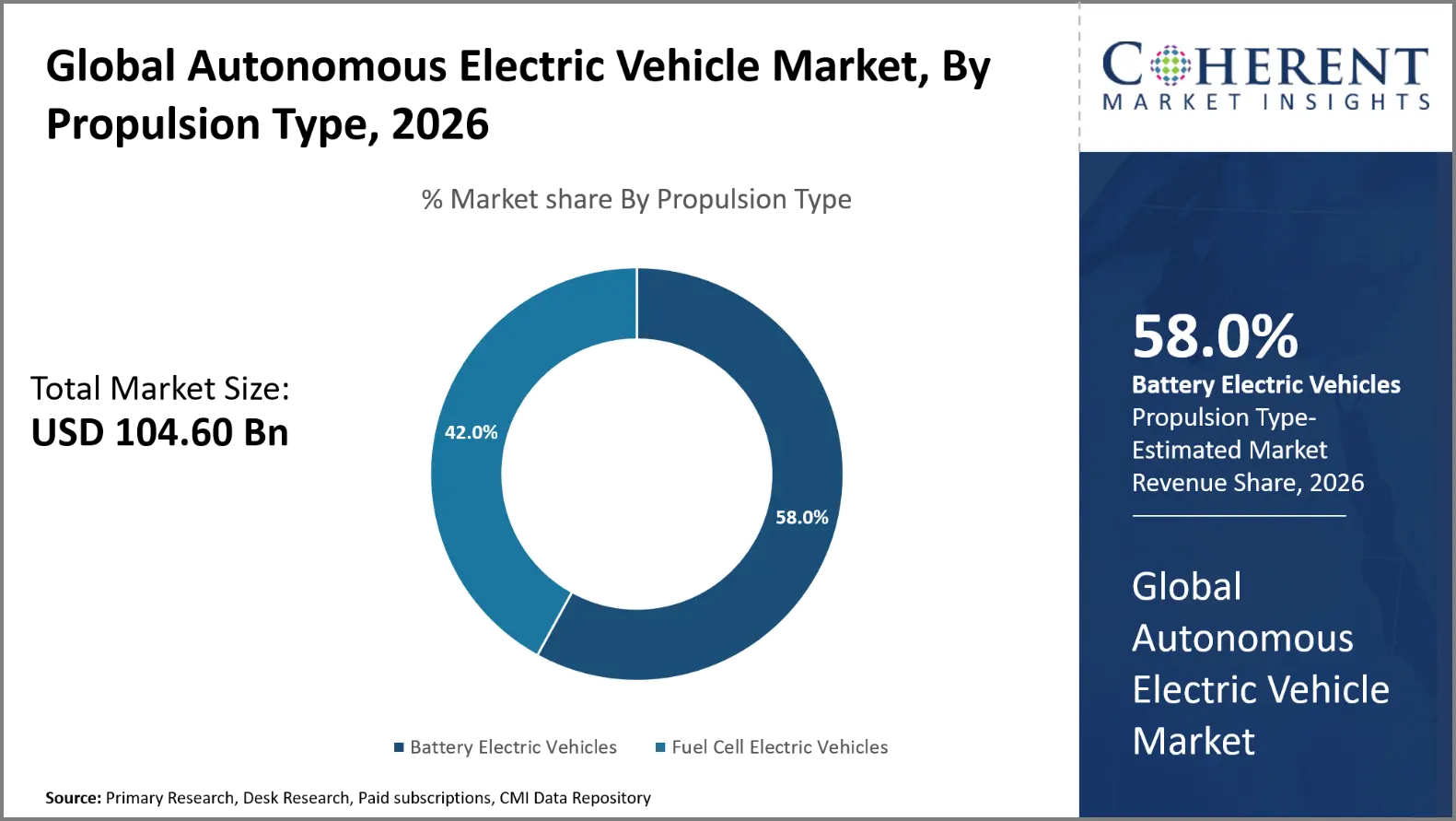
The battery electric vehicles segment is expected to account for 58.0% of the global autonomous electric vehicle market share in 2026. The ideal propulsion type is battery electric vehicles as its electrical design is able to handle modern automation technologies. High voltage battery systems provide reliable power for sensors, computer platforms, cameras and electronic control devices. Electric drivetrains can also precisely manage torque and have less mechanical complexity. The qualities also make it easier to integrate vehicle propulsion and automated driving functions. Battery electric vehicles are technically compatible with automated driving systems according to the International Energy Agency. Moreover, the deployment of charging infrastructure, better battery performance and more models available are spurring customer adoption.
On January 7, 2025, Honda presented the world premiere of the first two models in the company’s new 0 Series line of battery electric vehicles at the 2025 Consumer Electronics Show (CES); the Honda 0 SUV and Honda 0 Saloon prototypes. Production models based on both prototypes will launch in North America in 2026 followed by global markets.
Level 1 Dominates the Global Autonomous Electric Vehicle Market
The level 1 segment is expected to account for 38.0% of the global autonomous electric vehicle market share in 2026. Level 1 dominates the global autonomous electric vehicle market because its driver assistance technologies offer accessible automation at relatively low implementation complexity. These systems provide continuous support for either steering or acceleration and braking. Typical applications include adaptive cruise control and lane keeping assistance. Car manufactures can add these functions without needing to develop costly fully autonomous driving architectures. Level 1 technology likewise requires few changes to the way a regular car is driven. Drivers still need to pay attention to road conditions and control the vehicle. This means it will be compatible with mass-market electric passenger automobiles, supporting larger commercial deployment.
On February 10, 2025, BYD unveiled their DiPilot artificial driving assistance system in Shenzhen, China. The portfolio comprises combinations of DiPilot 600, DiPilot 300 and DiPilot 100. DiPilot 100 features a three-camera sensor system and supports the company’s larger driver assistance strategy. The introduction is a demonstration of efforts to propagate intelligent driving functions across different pricing groups of vehicles.
Current Events and their Impact
Current Events | Description and its Impact |
United Nations Economic Commission for Europe (UNECE) - Global Automated Driving System Regulation, 2026 |
|
China - Mandatory National Standard GB 44721-2026 |
|
Autonomous Electric Vehicle Market Dynamics
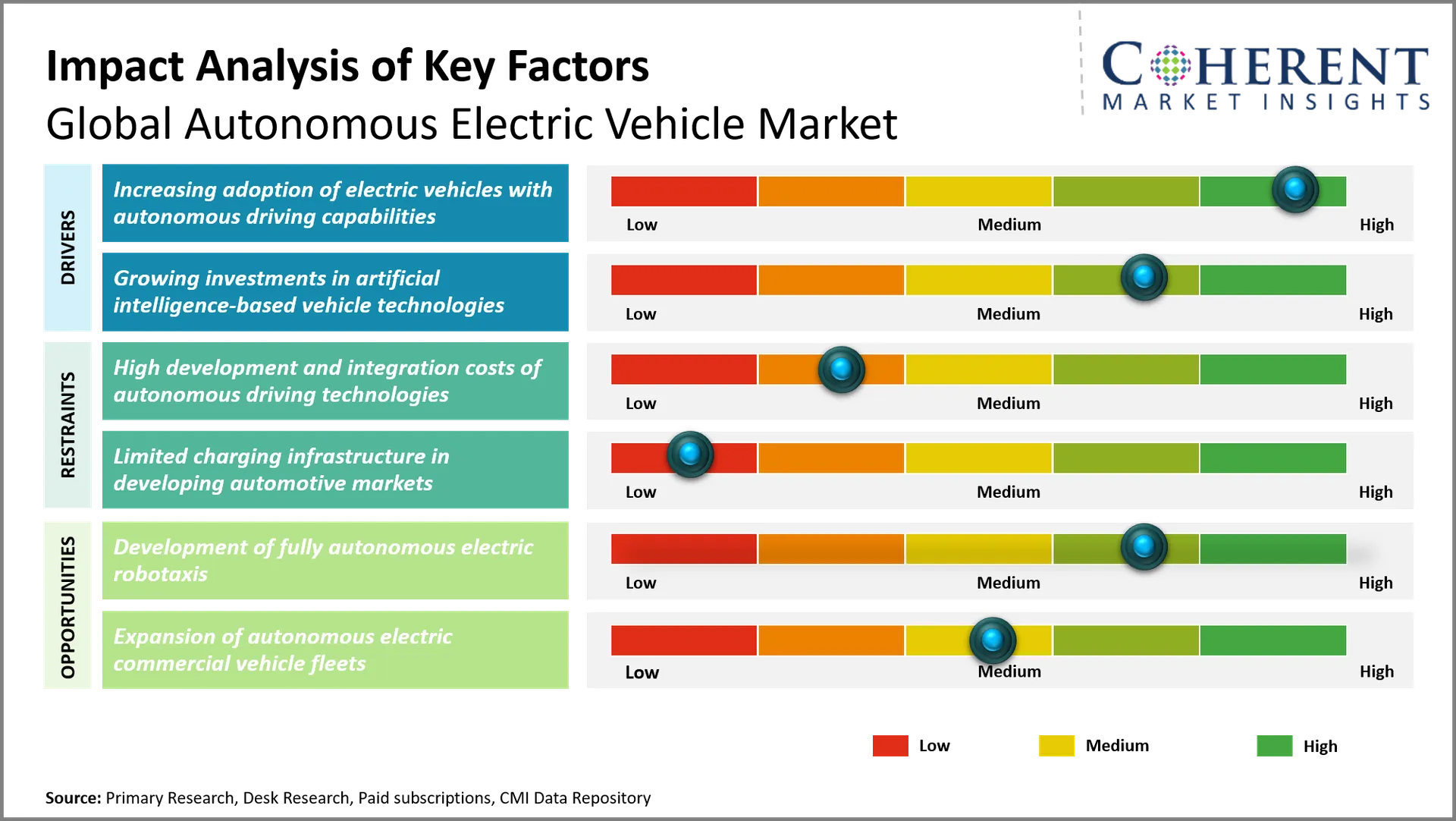
Market Drivers
Increasing adoption of electric vehicles with autonomous driving capabilities
Rising adoption of electric vehicles with autonomous driving capabilities is increasing demand for integrated intelligent mobility solutions. Automakers are pairing battery electric powertrains with modern driver aid systems and automated driving software. Tesla, Inc. keeps expanding its Full Self-Driving technology to compatible electric vehicle models. Mercedes-Benz Group AG has rolled out DRIVE PILOT technology to selected EV cars. China’s BYD Company Limited is likewise rolling out intelligent driving capabilities across its electric car line. Electronic platforms provide central electronic frameworks that facilitate the integration of sensors and computing systems. This market trend is further supported by consumer interest in vehicle safety, convenience and connected mobility.
On March 18, 2025, Zeekr Group announced it is launching the Zeekr G-Pilot, an intelligent driving solution that demonstrates its leadership in the automotive industry focusing on safety, intelligent competence, and technology. As part of Geely’s G-Pilot technology offering, the new Zeekr G-Pilot technologies will come in different levels meeting the differentiated requirements of users who appreciate Zeekr’s intelligent driving experiences.
Growing investments in artificial intelligence-based vehicle technologies
Growing investments in artificial intelligence-based vehicle technologies are accelerating autonomous electric vehicle development. Automakers and technology companies are allocating resources toward machine learning, computer vision, sensor fusion, and predictive driving algorithms. NVIDIA Corporation develops DRIVE computing platforms that support artificial intelligence-powered autonomous driving applications. Qualcomm Incorporated is broadening its Snapdragon Digital Chassis portfolio for intelligent car computing and driver assistance. Mobileye Global Inc. Is pursuing the development of improved driver assistance and autonomous driving technologies using artificial intelligence. The investments increase object detection, road interpretation, decision-making and vehicle control in real-time. Closer cooperation between semiconductor makers, software developers and car manufacturers speeds up technical progress.
On April 30, 2025, Toyota Motor Corporation and Waymo established a memorandum of understanding to explore opportunities in autonomous driving technologies. Woven by Toyota will provide software and mobility engineering expertise. It’s a partnership to build a new autonomous vehicle platform.
Emerging Trends
- Integration of Generative Artificial Intelligence into Autonomous Driving Systems: Auto manufacturers are integrating generative artificial intelligence into autonomous driving systems to increase environmental perception, foresee complicated traffic situations and make quicker driving judgments. These technologies allow vehicles to better grasp unknown road conditions.
- Impact: Advanced artificial intelligence enhances perception accuracy, adaptability and operational reliability. It decreases reliance on pre-defined driving scenarios and improves the performance of the autonomous vehicles in uncertain traffic settings.
- Relevance to the market: Mercedes-Benz Group AG and NVIDIA Corporation are leading the way in AI-based car computing. Their progress increases the need for high-performance CPUs, smart software, and autonomous electric vehicle platforms.
- Development of Software-Defined Electric Vehicles with Centralized Computing Architecture: Automakers are moving toward software-defined electric vehicles that use centralized computing, integrated sensors, and driving software that can be remotely upgraded. This architecture allows the self-driving capability to be improved over time.
- Impact: Centralized computing decreases complexity of the electronic architecture and allows faster software updates. It allows a better integration of battery management, vehicle control, connectivity and automated driving activities.
- Relevance to the market: Tesla, Inc. and Rivian Automotive, Inc. are examples of software-driven electric car development. They advise providers to develop integrated computing platforms, automotive operating systems and scalable autonomous driving solutions.
Regional Insights
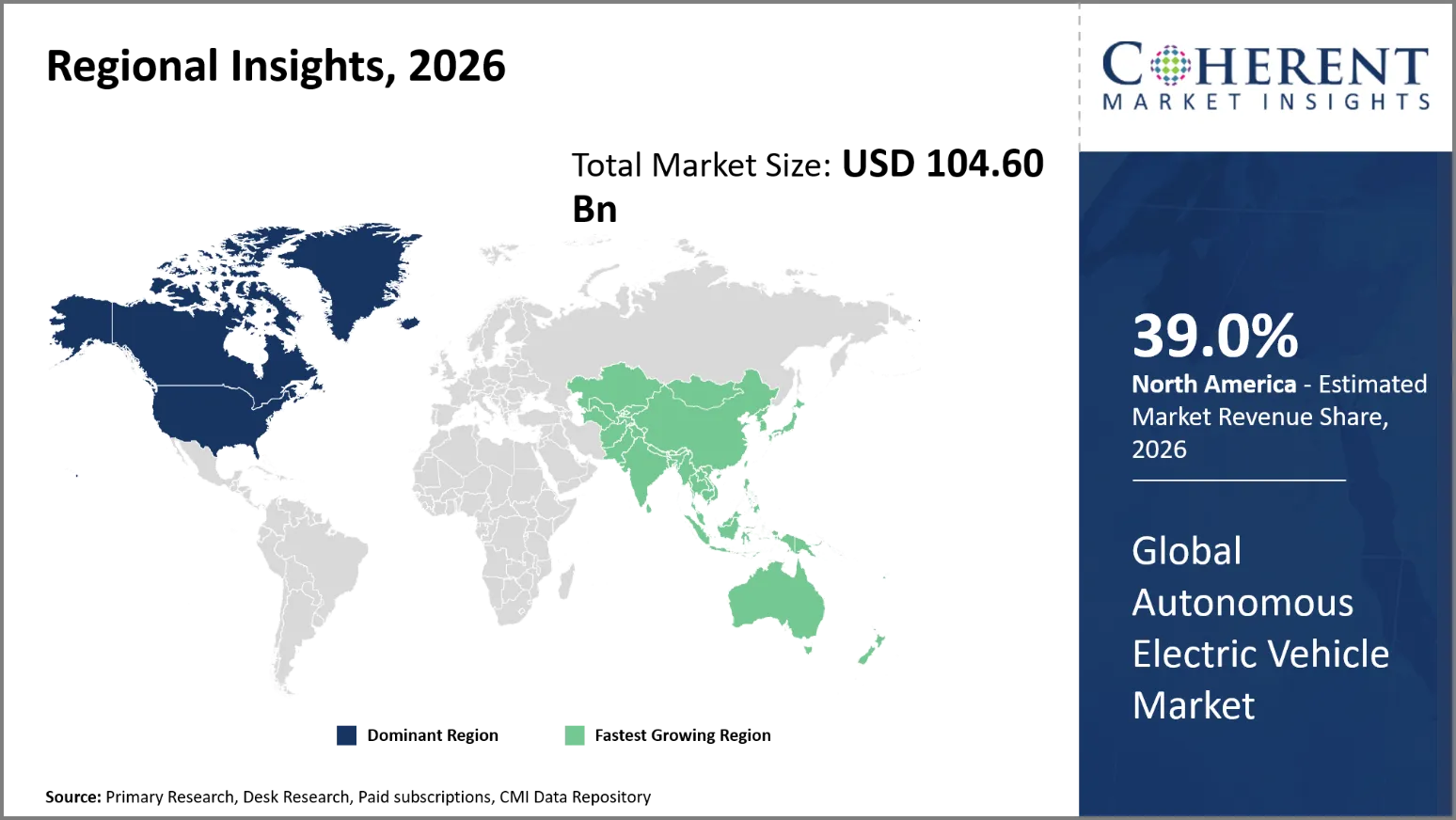
Why is North America a Strong Market for Autonomous Electric Vehicle?
North America is expected to account for a market share of 39.0% in 2026. North America is seeing growth in commercial robotaxis, development of autonomous freight, and cooperation between EV manufacturers and mobility platforms. Waymo’s burgeoning commercial activities are driving the U.S. forward in driverless passenger travel. In Canada, there are also new potential with autonomous vehicle testing and connected transportation research. Uber Technologies Inc. and Rivian Automotive Inc. announced plans to deploy up to 50,000 autonomous R2 robotaxis by March 2026. First deployments are expected in 2028 in San Francisco and Miami. Their agreement includes potential investment of USD 1.25 billion, subject to autonomous performance milestones. These developments strengthen regional demand for purpose-built electric robotaxis and fleet management technologies.
Why Does Asia Pacific Autonomous Electric Vehicle Market Exhibit High Growth?
Asia Pacific is expected to register the fastest growth with a CAGR of 21.0% over the forecast period. The region is projected to account for 24.0% of the global autonomous electric vehicle market in 2026 and is well placed to profit from the commercialization at scale of robotaxis, domestic autonomous driving platforms and huge electric vehicle manufacturing ecosystems. China’s autonomous transportation startups are scaling operations in major metropolitan areas. Japan is researching autonomous electric mobility for public transport and shared passenger services. South Korea is pushing ahead with the testing of driverless vehicles using artificial intelligence through government-backed demonstration programs. In January 2026, WeRide and Pony.ai announced robotaxi fleets of over 1,000 vehicles apiece. XPENG later launched their mass-produced Level 4 robotaxi in May 2026. These developments enhance regional capacities to manufacture, operate and commercialize autonomous vehicles.
Global Autonomous Electric Vehicle Market Outlook for Key Countries
Why is U.S. Emerging as a Major Hub in the Autonomous Electric Vehicle Market?
Growth in the U.S. market is driven by autonomous passenger transportation, governmental approvals and purpose-built driverless vehicles development. In July 2026, the National Highway Traffic Safety Administration granted Zoox, Inc. a temporary exemption. This authorization permits commercial deployment of up to 2,500 robotaxis annually for two years. By May 2026, autonomous vehicles had logged more than 360 million miles on U.S. highways, according to the Autonomous Vehicle Industry Association. Its survey also included 21 million robotaxi journeys. The advancements are the result of growing operational experience and support investment in the manufacture, validation, and commercial fleet operations of autonomous electric vehicles.
Is China the Next Growth Engine for the Autonomous Electric Vehicle Market?
China has homegrown lidar manufacturing, integrated autonomous driving software and growing driverless transportation businesses. Guangzhou has become a key center for autonomous car manufacturing and public road trials. XPENG launched its first mass-production robotaxi in May 2026, built on its proprietary GX platform. The vehicle incorporates four internally developed Turing artificial intelligence chips and delivers 3,000 TOPS of computing power. Pony.ai also reported more than 1,400 robotaxis in operation by March 2026. Its Shenzhen business reached citywide unit-economics break-even in February 2026. These breakthroughs enhance China’s ability to produce and commercially deploy autonomous vehicles.
Germany Autonomous Electric Vehicle Market Analysis and Trends
Germany is pushing the limits of autonomous electric mobility with automated public transport, industrial campus applications and vehicle engineering partnerships. In Hamburg, Volkswagen tested the totally electric ID. of the ALIKE project. Buzz self-driving cars by July 26, 2026. Registered residents can schedule rides through the MOIA application. The initiative links autonomous mobility with the existing urban transport services. Volkswagen is also running autonomous minibus experiments in Berlin and Munich. Germany’s proven automobile testing infrastructure supports validation under difficult traffic situations. These efforts generate potential in electric shuttle manufacturing, autonomous fleet software, passenger monitoring systems, and commercial mobility platforms.
Japan Autonomous Electric Vehicle Market Analysis and Trends
Japan is witnessing movement in its autonomous electric car market fueled by mobility-as-a-service development, modernizing public transit and solutions for elderly communities. In September 2026, May Mobility and NTT Mobility announced they would deploy Toyota’s battery-electric e-Palette on public roads. The companies plan deployments across multiple Japanese locations during fiscal year 2026. May Mobility had already conducted demonstrations and operated autonomous services across nine Japanese cities. These included Tokyo, Nagoya, and Hiroshima. The e-Palette can seat seven persons, and is wheelchair accessible. It can be used for autonomous community transport, accessible mobility services and purpose-built electric shuttle platforms.
South Korea Autonomous Electric Vehicle Market Analysis and Trends
South Korea is boosting development of autonomous electric vehicles through government-backed test tracks, artificial intelligence training and real-world driving data collection. In May 2026, Hyundai Motor Group launched a demonstration project in Gwangju with perhaps 200 autonomous vehicles based on the IONIQ 5 electric vehicle. The project is related to Hyundai Motor Company, Kia Corporation, Ministry of Land, Infrastructure and Transport. Hyundai subsidiary 42dot is providing its Atria artificial-intelligence platform. The program targets Level 4 autonomy for driving in defined operational domains. It creates demand for electric vehicle validation, fleet coordination software, and advanced autonomous driving computing systems.
Global Autonomous Electric Vehicle Market - Robotaxi Fleet Expansion and Commercial Deployment (2025-2026)
Company | Main Deployment Markets | Fleet Size or Deployment Volume | Operating Footprint | Commercial Deployment Status |
Waymo LLC | U.S. | Approximately 3,000 robotaxis | 10 U.S. cities | Public driverless ride-hailing |
WeRide Inc. | China and International Markets | Over 1,800 robotaxis; approximately 3,400 total L4 vehicles | More than 60 cities across 13 countries for autonomous driving businesses | Fully driverless commercial services in selected markets |
Pony.ai Inc. | China and International Markets | 1,975 robotaxis | More than 20 cities targeted globally | Commercial robotaxi services with expanding paid operations |
Uber Technologies, Inc. and Rivian Automotive, Inc. | U.S., Canada, and Europe | 10,000 initial vehicles; option for 40,000 additional vehicles | 25 cities targeted by 2031 | Planned commercial deployment from 2028 |
Mobileye Global Inc. | U.S. | Approximately 100 initial vehicles; target of 17,000 over five years | One major U.S. metropolitan market initially | Planned fully driverless service from 2027 |
How is Development of Fully Autonomous Electric Robotaxis Creating New Growth Opportunities in the Autonomous Electric Vehicle Market?
Fully autonomous electric robotaxis are a major opportunity, allowing for vehicles constructed for purpose without steering wheels, pedals and traditional driver cabins. These designs enable manufacturers to maximize passenger capacity, interior layouts and operating efficiency. Zoox, Inc. is building electric robotaxis that go both ways, with face-to-face seating, and purpose-built autonomous driving hardware. This architecture provides a necessity for specialized battery packaging, redundant brake systems, compact drive-by-wire components and integrated sensor platforms. Fleet operators can also lessen reliance on human drivers and standardize vehicle maintenance across centralized depots. Consequently, robotaxi commercialization creates new revenue opportunities for autonomous vehicle manufacturers, component suppliers, and fleet technology developers.
On February 24, 2025, WeRide announced approval to launch its latest generation Robotaxi, the GXR for fully unmanned paid autonomous ride-hailing services in Beijing. GXR is WeRide’s second Robotaxi model to achieve fully driverless commercial operations in Beijing. This marks GXR’s first large-scale commercial deployment in China, following its launch on the Uber platform in Abu Dhabi in December 2024.
Market Players, Key Development, and Competitive Landscape
Key Developments
- On June 17, 2026, Stellantis, Wayve, and Uber announced they have entered a partnership to jointly explore the development and deployment of Level 4 (driverless) robotaxis at a global scale. The collaboration brings together Stellantis’ L4 Ready Platforms, Wayve’s AI driving technology, and Uber’s global marketplace to power a new generation of fully autonomous vehicles.
- On June 16, 2026, Mobileye announced plans to expand its robotaxi activities beyond supplying self-driving technology and into full ownership of an autonomous ride-hailing business. The new initiative marks a significant evolution of Mobileye's strategy, combining its industry-leading autonomous driving capabilities with fleet operations, rider services, and mobility management into a single vertically integrated offering.
- On May 31, 2026, NVIDIA announced a major expansion of the NVIDIA Hyperion robotaxi-ready platform ecosystem, bringing together leading global automakers, manufacturing and autonomous vehicle (AV) software ecosystem partners along with ride-hailing mobility providers to build and expand level 4-ready robotaxi fleets.
Competitive Landscape
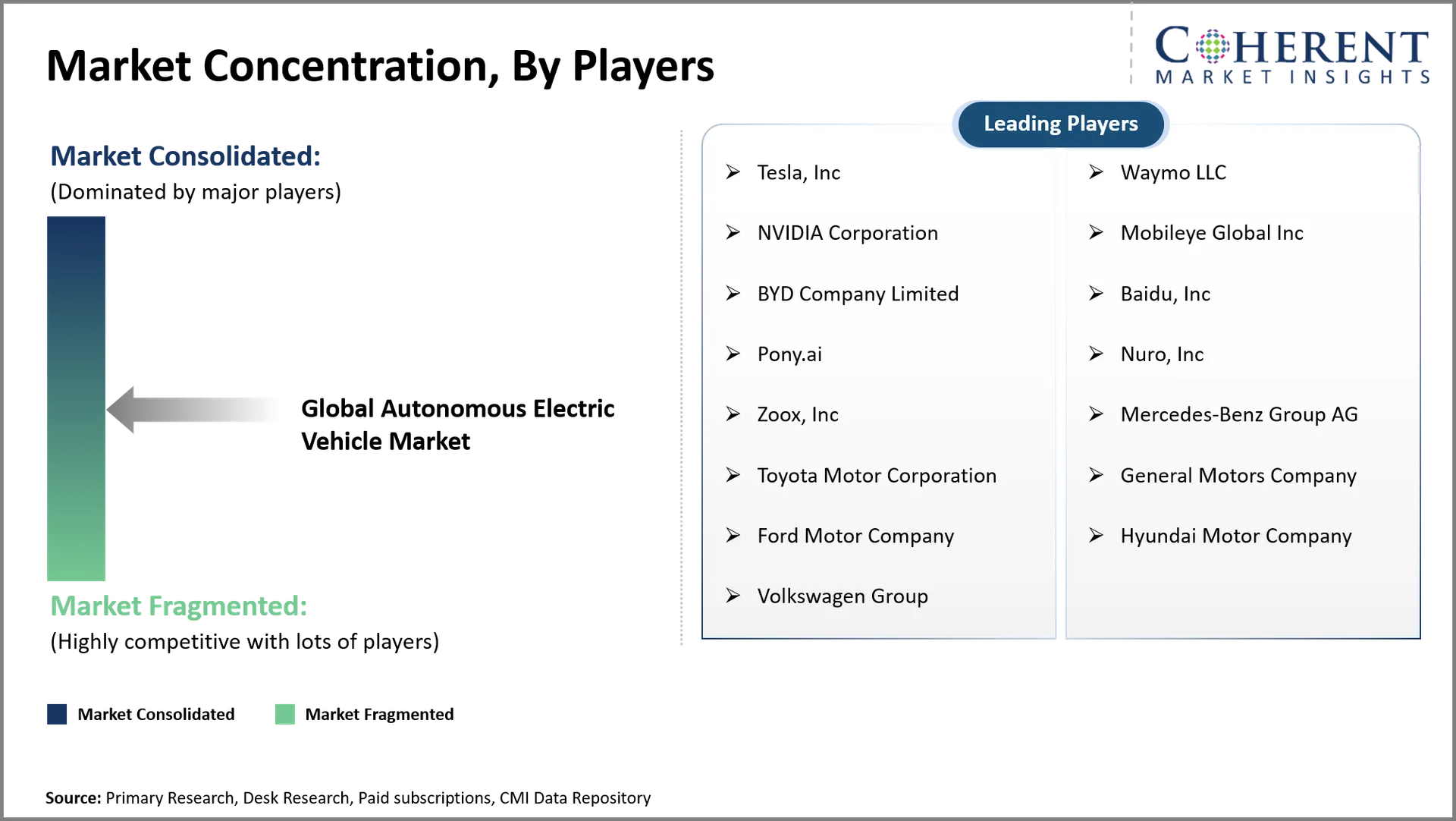
The global autonomous electric vehicle industry is competitive with existing car manufactures, innovators of autonomous technologies and mobility platforms all trying to gain dominance. Waymo LLC is expanding its proprietary Waymo Driver through agreements with manufacturers and purpose-built car integration. Its 6th generation technology supports several vehicle platforms as Zeekr RT. Tesla, Inc. is developing Cybercab as a specialized autonomous mobility platform and extending its Robotaxi operations. Baidu, Inc. is targeting a decrease in manufacturing costs to below USD 30,000 using its Apollo RT6 platform. Amazon.com, Inc. - Amazon.com, Inc. differentiates its strategy through Zoox, Inc. with a focus on purpose-built bidirectional robotaxis and unique passenger cabin designs.
Top Manufacturers and Notable Products in the Autonomous Electric Vehicle Market
Manufacturer | Notable Product | Key features |
Waymo LLC | Waymo Driver - 6th Generation | LiDAR, radar and camera sensor fusion, real-time perception, autonomous navigation, redundant safety systems, driverless ride-hailing |
Baidu, Inc. | Apollo RT6 | Fully electric purpose-built robotaxi, removable steering wheel, autonomous driving computing, multi-sensor perception, AI-based route planning |
Pony.ai Inc. | Seventh-Generation Robotaxi | Multi-sensor fusion, automotive-grade autonomous driving hardware, redundant systems, AI-based driving decisions, scalable production architecture |
WeRide Inc. | GXR Robotaxi | Fully driverless operation, LiDAR and camera integration, autonomous navigation, redundant braking and steering, commercial passenger transportation |
Zoox, Inc. | Zoox Robotaxi | Bidirectional driving, symmetrical vehicle design, face-to-face seating, four-wheel steering, redundant battery and braking systems |
Autonomous Electric Vehicle Market | |||
Report Coverage | Details | ||
Base Year | 2025 | Market Size in 2026: | USD 104.60 Bn |
Historical Data For: | 2020 To 2024 | Forecast Period: | 2026 To 2033 |
Forecast Period 2026 To 2033 CAGR: | 20.2% | 2033 Value Projection: | USD 378.45 Bn |
Geographies covered: |
| ||
Segments covered: |
| ||
Companies covered: | Tesla, Inc, Waymo LLC, NVIDIA Corporation, Mobileye Global Inc, BYD Company Limited, Baidu, Inc, Pony.ai, Nuro, Inc, Zoox, Inc, Mercedes-Benz Group AG, Toyota Motor Corporation, General Motors Company, Ford Motor Company, Hyundai Motor Company, Volkswagen Group | ||
Growth Drivers: |
| ||
Restraints & Challenges: |
| ||
Analyst Opinion (Expert Opinion)
- The future of the autonomous electric vehicle industry will increasingly depend on commercially scalable Level 4 driving systems. Purpose-built electric robotaxis will gain importance as manufacturers optimize vehicle architecture for continuous passenger transportation. Fleet operators will prioritize battery durability, autonomous computing reliability, and rapid vehicle servicing. Automotive companies combining proprietary software with dedicated electric platforms will gain stronger control over operating costs. Commercial success will increasingly depend on reliable driverless operations rather than demonstration capabilities.
- The strongest opportunities will emerge in Level 4 battery electric robotaxis and autonomous passenger transportation. China and the US are particularly interesting potential as their companies are implementing different marketing approaches. Priority should be for purpose-built robotaxis, airport transportation and urban ride-hailing fleets. Suppliers should focus on automotive-grade AI processors, redundant brake systems, lidar sensors and high-efficiency battery topologies. Autonomous electric shuttles can offer prospects in controlled locations such as airports, corporate districts and university campuses.
- Market players should focus on full autonomous driving ecosystems instead of stand-alone vehicle technology. Car manufacturers should work with semiconductor firms, mapping companies, charging companies and fleet management organizations. Developers of technology should make their products better at dealing with bad weather, road construction and people walking around in weird ways. Manufacturers should develop modular platforms to meet diverse vehicle capacity and operating needs. Companies moving into new nations need to establish local testing alliances and get regulatory licenses in place early. Such measures could improve the differentiation of products, dependability of operations and long-term economic competitiveness.
Speak to the analyst
Want personalized insights?
Take the findings above to one of our principal consultants, or have the report rebuilt around the segments, geographies and competitors you actually track.
Market Segmentation
- Vehicle Type Insights (Revenue, USD Billion, 2021 - 2033)
- Passenger Vehicles
- Commercial Vehicles
- Propulsion Type Insights (Revenue, USD Billion, 2021 - 2033)
- Battery Electric Vehicles
- Fuel Cell Electric Vehicles
- Level Of Autonomy Insights (Revenue, USD Billion, 2021 - 2033)
- Level 1
- Level 2
- Level 3
- Level 4
- Level 5
- Application Insights (Revenue, USD Billion, 2021 - 2033)
- Personal Mobility
- Robotaxi and Ride-Hailing
- Public Transportation
- Logistics and Freight Transportation
- Industrial Transportation
- Defense and Security
- End User Insights (Revenue, USD Billion, 2021 - 2033)
- Individual Consumers
- Transportation and Mobility Operators
- Logistics Companies
- Government and Public Transportation Agencies
- Commercial Fleet Operators
- Regional Insights (Revenue, USD Billion, 2021 - 2033)
- North America
- U.S.
- Canada
- Latin America
- Brazil
- Argentina
- Mexico
- Rest of Latin America
- Europe
- Germany
- U.K.
- Spain
- France
- Italy
- Russia
- Rest of Europe
- Asia Pacific
- China
- India
- Japan
- Australia
- South Korea
- ASEAN
- Rest of Asia Pacific
- Middle East
- GCC Countries
- Israel
- Rest of Middle East
- Africa
- South Africa
- North Africa
- Central Africa
- North America
- Key Players Insights
- Tesla, Inc
- Waymo LLC
- NVIDIA Corporation
- Mobileye Global Inc
- BYD Company Limited
- Baidu, Inc
- Pony.ai
- Nuro, Inc
- Zoox, Inc
- Mercedes-Benz Group AG
- Toyota Motor Corporation
- General Motors Company
- Ford Motor Company
- Hyundai Motor Company
- Volkswagen Group
Sources
Primary Research Interviews
- Autonomous EV Manufacturers & OEMs
- EV Battery Technology Providers & Suppliers
- Autonomous Driving Software Developers
- Fleet Operators & Mobility Service Providers
Magazines
- Automotive World Magazine
- Electric & Hybrid Vehicle Technology International
- IEEE Spectrum (Autonomous & EV Technology)
- Charged Electric Vehicles Magazine
Journals
- Journal of Autonomous Vehicles and Systems
- International Journal of Electric and Hybrid Vehicles
- Transportation Research Part C: Emerging Technologies
Associations
- International Energy Agency (IEA) – EV Division
- Society of Automotive Engineers (SAE) International
- Electric Drive Transportation Association (EDTA)
- Autonomous Vehicle Industry Association (AVIA)
Public Domain Sources
- U.S. Department of Energy – Alternative Fuels Data Center (AFDC)
- European Commission – European Green Deal & EV Policy Reports
- National Highway Traffic Safety Administration (NHTSA)
- International Organization of Motor Vehicle Manufacturers (OICA)
Proprietary Elements
- CMI Data Analytics Tool
- Proprietary CMI Existing Repository of Information for the Last 10 Years
Get access to 250+ pages report
Every segment, forecast, competitor profile and data table behind the analysis above — available for instant download.
- ESOMAR Member
- ISO 9001:2015 Certified
- D-U-N-S Registered
- GDPR & CCPA Compliant
Frequently Asked Questions
The global autonomous electric vehicle market is expected to stand at USD 104.60 Bn in 2026 and is expected to reach USD 378.45 Bn by 2033.
The CAGR of the global autonomous electric vehicle market is projected to be 20.2% from 2026 to 2033.
Increasing adoption of electric vehicles with autonomous driving capabilities and Growing investments in artificial intelligence-based vehicle technologies are the major factors driving the growth of the global autonomous electric vehicle market.
High development and integration costs of autonomous driving technologies and Limited charging infrastructure in developing automotive markets are the major factors hampering the growth of the global autonomous electric vehicle market.
In terms of vehicle type, passenger vehicles segment is estimated to dominate the market revenue share in 2026.
An autonomous electric vehicle combines an electric powertrain with automated driving technologies to perform driving tasks independently.
Artificial intelligence processes sensor information, identifies surrounding objects, predicts traffic movements, and determines appropriate driving responses.