

Global Aviation MRO Software Market Size and Forecast – 2026 To 2033
The global aviation MRO software market is expected to grow from USD 9.00 Bn in 2026 to USD 11.00 Bn by 2033, registering a compound annual growth rate (CAGR) of 3.8% from 2026 to 2033. The global aviation MRO software market is driven by increasing digitalization of maintenance records and technical documentation. On July 13, 2026, Air India announced that the Directorate General of Civil Aviation (DGCA) approved the use of Electronic Technical Logbooks (ETL) as the primary technical document for its Boeing 787 fleet and authorizing parallel implementation across the Boeing 777 fleet.
Key Takeaways of the Global Aviation MRO Software Market
- The Software segment is expected to account for 65.0% of the global aviation MRO software market share in 2026. Rising requirements for regulatory compliance and traceable maintenance histories is driving the growth of the segment. In July 2025, flydocs and Air Astana announced a partnership to digitize maintenance records across a fleet exceeding 60 aircraft. The solution is integrated with the airline’s current Trax maintenance system.
- The Maintenance Management Software segment is estimated to capture 39.0% of the market share in 2026. Increasing demand for inventory optimization and reduced aircraft downtime is majorly driving the growth of the segment. On April 16, 2026, Alaska Airlines announced an investment and multiyear partnership with Tailsight. The platform combines maintenance constraints, workforce availability, station capabilities, and parts readiness.
- The Maintenance Planning and Scheduling segment is estimated to capture 35.0% of the market share in 2026. Expansion of integrated maintenance, inventory, and supply chain management is driving the growth of the segment. On January 5, 2026, AAR announced that Thai Airways chose Trax eMRO, eMobility, cloud hosting and Aerostrat’s Aerros maintenance planning software. Integrated systems link maintenance execution with long-range scheduling and AI-powered workflows.
- North America is expected to dominate the aviation MRO software market in 2026 with a market share of 30.0%. Growing adoption of digital twins and real-time aircraft health analytics in North America is driving the growth of the regional market. On June 25, 2026, Bombardier and Rolls-Royce introduced enhanced health monitoring for Global 5500 and Global 6500 aircraft. The system combines Bombardier's Smart Link Plus with Rolls-Royce's engine vibration and health monitoring unit for Pearl 15 engines.
- Asia Pacific is expected to account for 27.0% share in 2026. Growing development of mobile maintenance applications and electronic technical records in Asia Pacific is driving the growth of the regional market. On September 23, 2026, Tigerair Taiwan signed a five-year agreement with flydocs to implement its Digital Records Management Next Generation platform across a fleet of 17 aircraft.
Segmental Insights
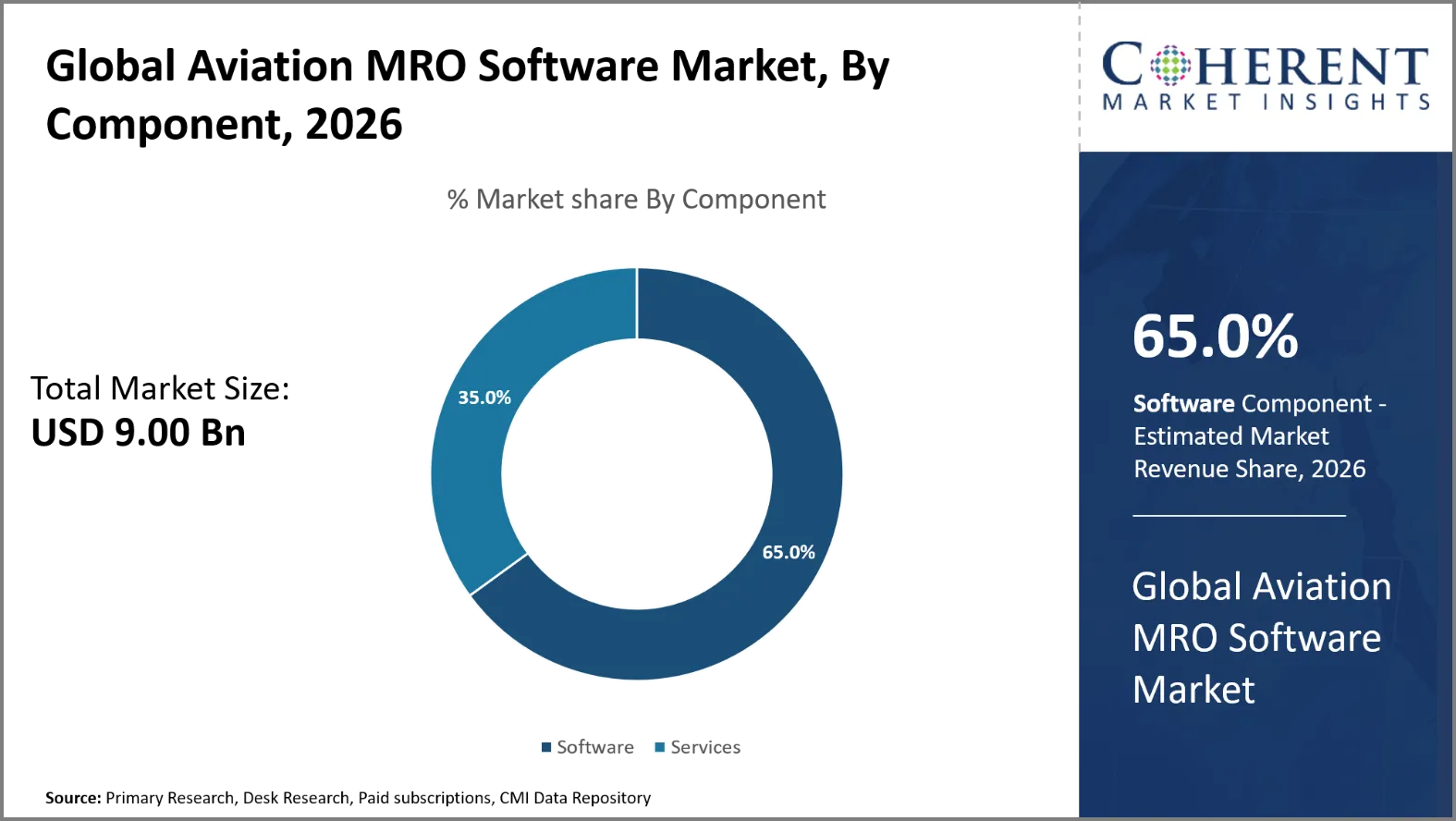
Why Does Software Dominate the Global Aviation MRO Software Market?
The software segment is expected to account for 65.0% of the global aviation MRO software market share in 2026. Software leads with better maintenance accuracy, operational visibility, and regulatory compliance. Digital technologies help airlines manage aircraft inspections, component history, work orders and maintenance documents. Integrated platforms eliminate manual recordkeeping and improve cooperation between engineering, inventory and maintenance teams. Predictive analytics can also help operators anticipate probable component failures before they lead to flight disruptions. The increasing number of aircraft fleets and increasing complexity of maintenance requirements continue to support the demand for specialized aviation maintenance software.
On April 1, 2026, Airbus announced the creation of Skywise, a new fully owned subsidiary integrating Skywise digital solutions and Navblue solutions into a single corporation. This is designed to satisfy shifting customer needs in a fast-moving environment and to simplify flight, technical and ground operations for customers with Airbus and non-Airbus fleets.
- Current Industry Events of 2026
- Market Size Estimation
- Regional Breakdown
- Competitive Landscape
- Customer Intelligence
- Segmental Analysis
- Pricing Analysis
- Key Market Drivers, Challenges & Future Trends
- Customized Insights Section
Why is Maintenance Management Software the Most Preferred Software Type?
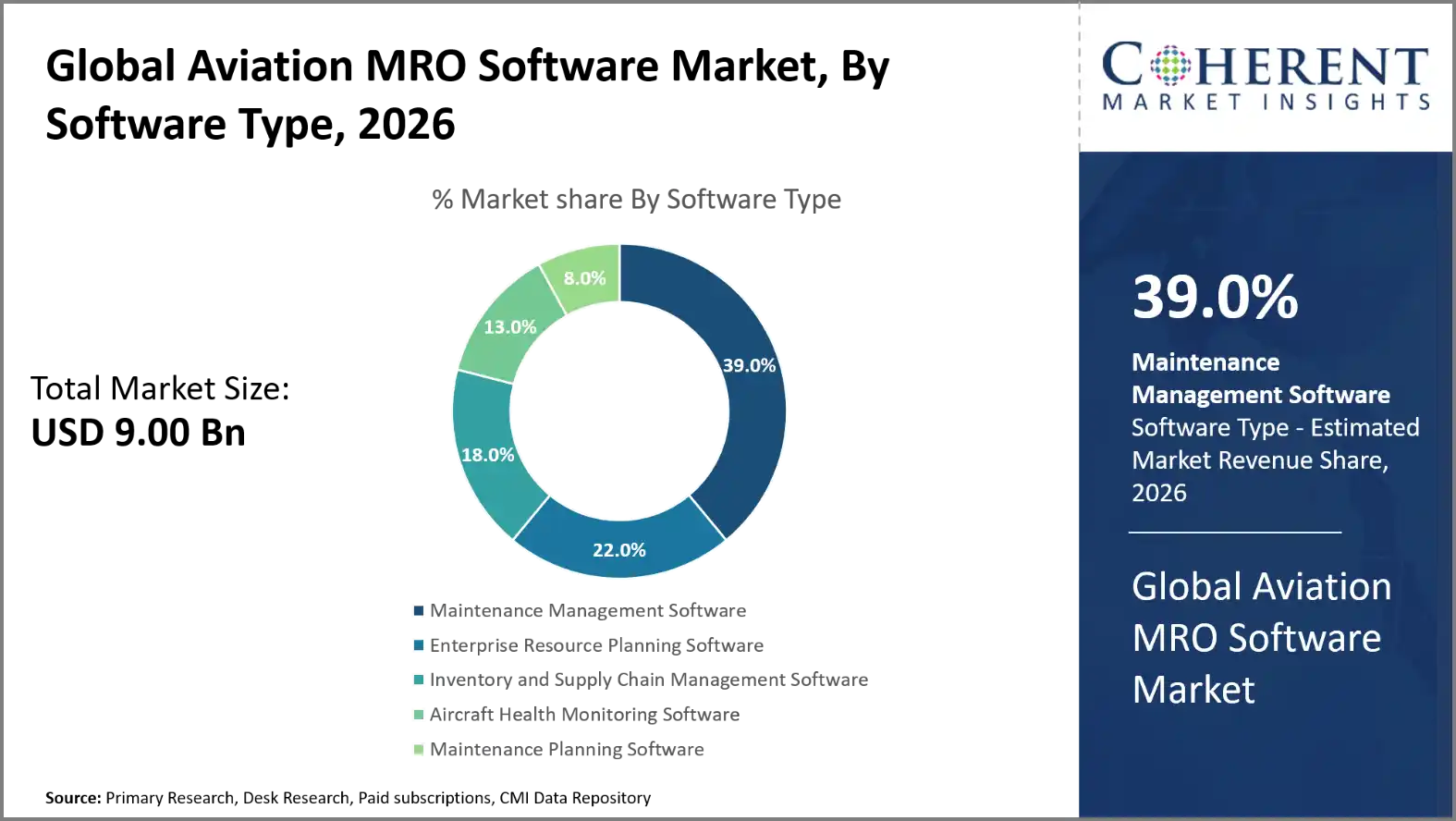
The maintenance management software segment is expected to account for 39.0% of the global aviation MRO software market share in 2026. Maintenance management software is perfect since it consolidates maintenance activities, technical records, work orders and compliance documents. Airlines and maintenance suppliers use these systems to co-ordinate inspections, repairs, staff allotment and availability of spare parts. Workflow automation helps to eliminate administrative delays and enhances traceability in maintenance. The connection with enterprise resource planning systems and aircraft health monitoring tools thus aids in making better operational decisions. These attributes make maintenance management software useful for organizations that desire uniform execution of maintenance and greater aircraft availability.
On June 5, 2025, AAR CORP. announced its aviation maintenance software subsidiary, Trax, has been selected to modernize Delta TechOps’ maintenance and engineering systems. Delta TechOps will replace its legacy maintenance and engineering systems with Trax’s advanced eMRO and eMobility solutions.
Maintenance Planning and Scheduling Dominates the Global Aviation MRO Software Market
The maintenance planning and scheduling segment is expected to account for 35.0% of the global aviation MRO software market share in 2026. Maintenance planning and scheduling software helps aviation operators coordinate inspections, repairs, workforce availability, and aircraft downtime. These tools are applied by airlines to synchronize maintenance activities with flight schedules and required inspection intervals. Automated scheduling better matches the abilities of the technicians, the capacity of the hangars and the availability of spare parts, leading to better use of resources. And digital maintenance projections also assist operators anticipate workload peaks and reduce unexpected aircraft groundings. The drive for improved fleet utilization and regulatory compliance promotes the use by both commercial airlines and independent maintenance providers.
On May 28, 2026, International Airlines Group announced a new commercial partnership between Aer Lingus and AISmartPlan, an advanced AI-powered aircraft maintenance planning platform, after a successful collaboration under the IAGi Accelerator program.
Current Events and their Impact
Current Events | Description and its Impact |
U.S. Federal Aviation Administration Maintenance Records Guidance (Advisory Circular 43-9D) |
|
European Union Continuing Airworthiness Regulation Commission Regulation (European Union) No 1321/2014 |
|
Aviation MRO Software Market Dynamics
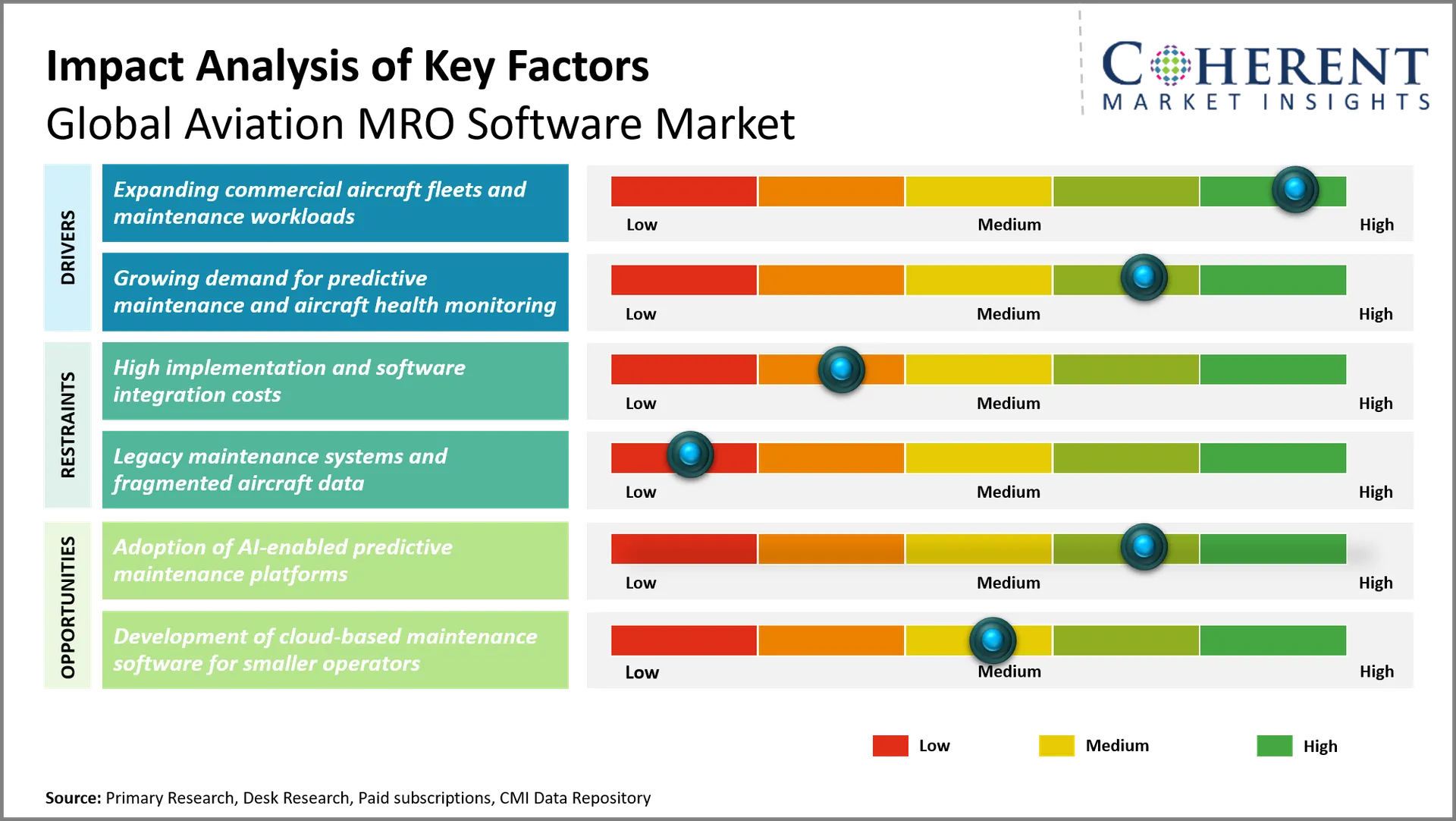
Market Drivers
Expanding commercial aircraft fleets and maintenance workloads
The growth of commercial aircraft fleets requires more maintenance for airlines and maintenance suppliers. More aircraft utilization means more inspections, component replacements and scheduled servicing activities. Aviation MRO software helps arrange maintenance, technician availability, spare parts and downtime of aircraft. Automation of workflows enhances the accuracy of records and reduces administrative delays. Operators are moving toward integrated solutions to improve fleet dependability and operational efficiency, to cope with increasing maintenance burdens.
On January 12, 2026, Airbus announced it had delivered 793 commercial aircraft to 91 customers in 2025. It also booked 1,000 gross orders and an end-year backlog of 8,754 aircraft. With the rise in aircraft deliveries there is a need for maintenance planning, technical records, inspections and coordination of spare parts.
Growing demand for predictive maintenance and aircraft health monitoring
The rising demand for predictive maintenance is fueling the demand for aviation MRO software with advanced analytics capabilities. Systems that monitor aircraft health collect operating data from engines, sensors and onboard components. Software platforms watch these inputs for abnormal performance patterns and for probable equipment faults. Early alerts allow maintenance teams to schedule actions before problems create operational disruptions. Integration with maintenance planning systems will also improve resource allocation, component availability and aircraft readiness.
On February 3, 2026, Embraer signed a long-term deal with Virgin Australia for the supply of AHEAD (Aircraft Health Analysis and Diagnosis) technology to support the airline’s E2 fleet. The system enables airlines to deploy digital predictive maintenance on their E-Jet fleets, utilizing data to identify and predict possible problems before they become crucial.
Emerging Trends
- Artificial Intelligence-Driven Maintenance Optimization: Aviation MRO software is increasingly harnessing artificial intelligence to analyze maintenance records, detect recurring problem patterns, and improve repair decisions. These tools allow maintenance teams to prioritize inspections, improve troubleshooting accuracy, and dispatch technical staff based on operational requirements.
- Cloud-Based MRO Software Adoption: Cloud-based solutions allow airlines and maintenance suppliers to access maintenance data, work orders and inventory information across various locations. The flexible deployment decreases the strain of infrastructure management, and enables communication between engineering teams, suppliers and maintenance facilities.
- Digital Twins and Aircraft Lifecycle Management: Digital twin technology enables maintenance teams to compare aircraft performance with simulated models by leveraging operational and engineering data. The integration with MRO software enables the monitoring of components, analyze maintenance scenarios and plan the lifetime, which in turn helps to make better decisions on repairs and replacements.
- Integrated Aircraft Health Monitoring Systems: Seamlessly integrated with MRO platforms, aircraft health monitoring systems enable the speedier detection of emerging technical issues. Maintenance planners can use automated data interchange to write work orders, manage replacement parts and plan corrective actions before equipment failures cause operational disturbance.
Regional Insights
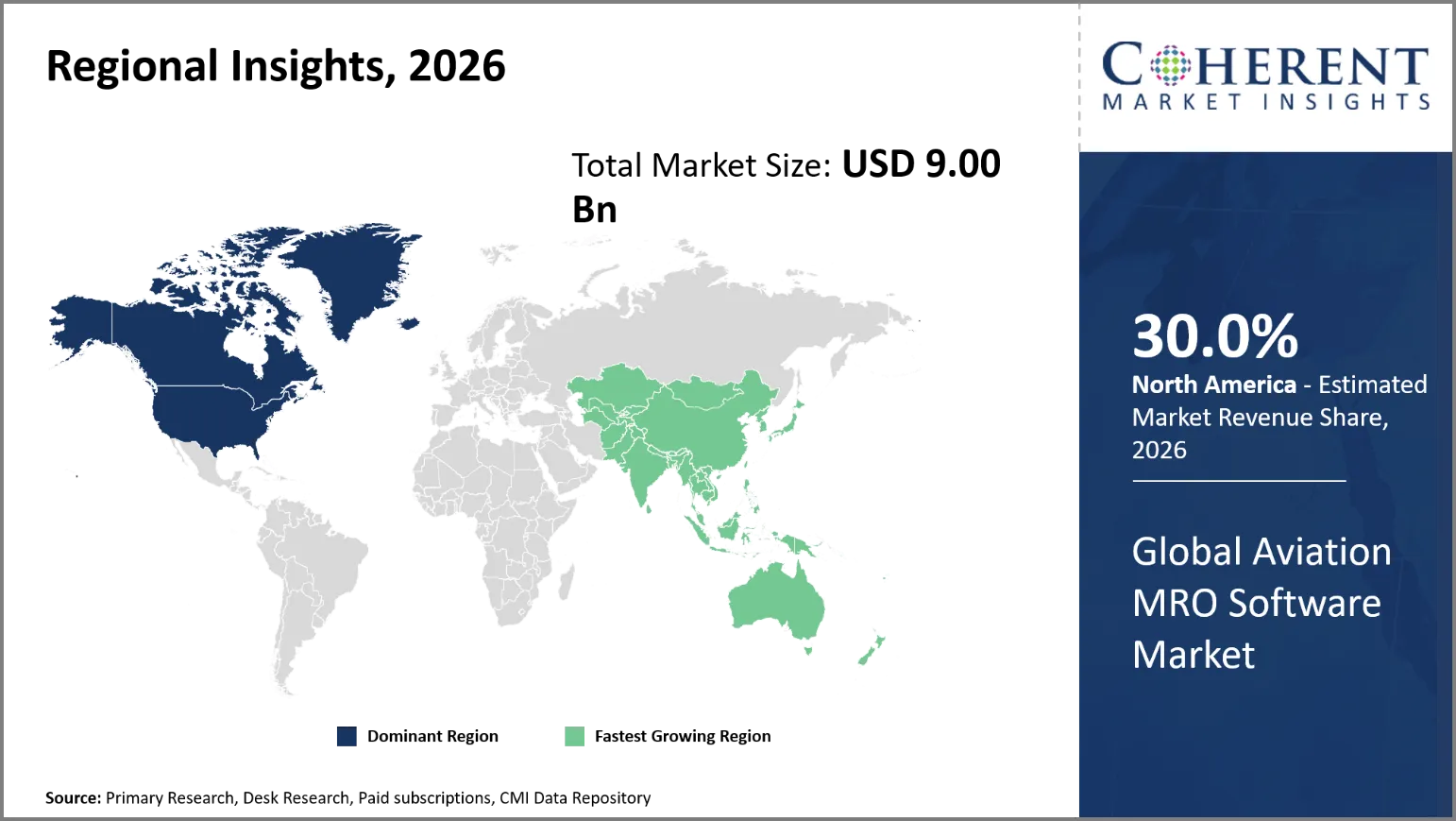
Why is North America a Strong Market for Aviation MRO Software?
North America is expected to account for a market share of 30.0% in 2026. North America has developed airline engineering operations, aircraft manufacturer support networks, and significant investment in connected maintenance technologies. Airbus cited digital and connectivity services as a key development area for regional aviation operations in its services outlook for 2026. Boeing has digital maintenance technologies that help airlines detect technical problems sooner and coordinate maintenance planning. These systems assist fault diagnosis, maintenance forecast and fleet reliability analysis. There’s also demand for software that connects engineering teams with inventory and technical records, owing to the region’s existing aircraft leasing and component repair and maintenance ecosystems.
Why Does Asia Pacific Aviation MRO Software Market Exhibit High Growth?
Asia Pacific is expected to register the fastest growth with a CAGR of 4.0% over the forecast period. The region is projected to account for 27.0% of the global aviation MRO software market in 2026. Maintenance requirements are expanding in Asia Pacific as airlines grow fleets and boost connectivity in the region. Over the next 20 years, the Asia Pacific region will need 19,560 new passenger aircraft deliveries, Airbus estimates. The expansion provides potential for software to manage fleet induction, maintenance capacity planning and component availability. China is tightening its grip on aviation data while Singapore continues to expand its expertise in advanced aerospace maintenance. Regional maintenance providers are increasingly requiring solutions to manage cross-border repairs, supplier documentation and technical data. Digital systems can also allow operators to manage maintenance resources for facilities located at different places.
Global Aviation MRO Software Market Outlook for Key Countries
Why is U.S. Emerging as a Major Hub in the Aviation MRO Software Market?
U.S. aviation MRO software industry driven by complicated fleet operations and need for data-driven maintenance decisions: JetBlue to roll out Airbus Skywise Fleet Performance+ throughout its Airbus A320 family and growing A220 fleet in April 2026. The platform provides for real-time monitoring, speedier troubleshooting, and reliability assessments. Boeing also provides digital maintenance solutions that leverage airplane data and technical expertise. The Federal Aviation Administration Advisory Circular 43-216A contains guidelines regarding aircraft software management during maintenance. These advances promote investment in forecasting analytics, configuration monitoring and maintenance documentation.
Is China the Next Growth Engine for the Aviation MRO Software Market?
The development of domestic airlines and the government’s support for aviation data management provide an opportunity for the aviation MRO software market in China. Release of the Civil Aviation Data Governance Implementation Plan by the Civil Aviation Administration of China and the National Data Administration in September 2026. By 2030, the initiative wants to build stronger fundamental data systems and expanded public-data exchange. China Southern Airlines adopted electronic maintenance signatures based on blockchain in May 2022, showing the real-world usage of digital recordkeeping. Such advancements underpin the necessity for safe maintenance records, standardization of data transmission and digital compliance operations. Local platforms must also comply with Chinese regulatory standards and domestic airline operating procedures.
Germany Aviation MRO Software Market Analysis and Trends
The country's existing aviation engineering ecosystem and Lufthansa Technik's international maintenance activities provide benefits for Germany. Digital systems can assist with complex engine servicing, component repair, technical documentation and maintenance resource allocation. Maintenance providers of foreign airlines in Germany have to operate within several regulatory environments with aircraft-specific processes and documentation. This creates a necessity for software to allow configuration management, component traceability and auditable maintenance histories. Coordination can also be improved by integrating engineering systems with inventory platforms for repair or replacement of specialist components. Germany’s focus on precision engineering and technical process control aligns well with possibilities in advanced maintenance analytics and integrated digital work processes.
U.K. Aviation MRO Software Market Analysis and Trends
The aviation MRO software market in U.K. is fueled by the ongoing demand for airworthiness and the presence of a mature aircraft engine and component repair sector in the country. Recordkeeping is addressed by the U.K. Civil Aviation Authority’s maintenance standards in Regulation (European Union) No 1321/2014, as retained and revised in the U.K. law. 145.A.55 Maintenance records must be kept by approved maintenance companies for three years after release to service. They support the need for safe back-ups, searchable digital records and traceable maintenance approvals. United Kingdom software providers operators also have to consider any post-Brexit compliance arrangements and any domestic regulatory changes which apply to them.
Singapore Aviation MRO Software Market Analysis and Trends
Singapore is likely to gain from the aircraft MRO software market as a hub for specialist maintenance and regional aerospace operations. Singapore has more than 130 aircraft enterprises in manufacturing, engineering, maintenance and aftermarket services, according to the Economic Development Board. Singapore also accounts for about 20% of the global engine MRO output, according to its 2026 aerospace industry outlook. The focus fuels demand for software that tracks engine shop visits, component histories, repair procedures and parts delivery. The Civil Aviation Authority of Singapore requires applicable maintenance businesses to comply with Singapore Airworthiness Requirements Part 145. Reliable documentation and interoperable systems have even more significance in cross-border maintenance recognition.
Global Aviation MRO Software Market - Predictive Maintenance Performance by Aircraft System
Aircraft System | Key Monitored Parameters | Predictive Detection Method | Performance Metrics | Maintenance Outcome |
Engines | Temperature, pressure, vibration, fuel flow, operating signatures | Machine learning, trend analysis, engine health monitoring | Fault detection rate, warning lead time, false alert rate, unscheduled engine removals | Earlier defect detection and planned engine maintenance |
Auxiliary Power Unit | Start cycles, temperature, pressure, operating faults | Sensor analytics and fault trend monitoring | Fault detection rate, repeat faults, unscheduled removals | Improved auxiliary power unit reliability |
Hydraulics | Pressure, leakage indicators, actuator performance | Sensor monitoring and fault pattern analysis | Leak detection rate, warning lead time, repeat defects | Earlier identification of hydraulic faults |
Pneumatics | Pressure, temperature, valve performance, air system faults | Operational data analysis and anomaly detection | Fault detection rate, false alerts, unscheduled maintenance events | Earlier diagnosis of pneumatic system problems |
Avionics | Equipment faults, system status, communication errors | Fault-code analysis and historical trend comparison | Detection rate, diagnostic accuracy, repeat fault frequency | Faster troubleshooting and improved equipment reliability |
Fuel system | Fuel pressure, temperature, flow, leakage indicators | Sensor analytics and abnormal-condition detection | Leak detection rate, warning lead time, repeat defects | Earlier identification of fuel system irregularities |
Air conditioning and environmental control | Temperature, airflow, pressure, cooling performance | Sensor-based anomaly detection and trend analysis | Fault detection rate, cabin system availability, repeat faults | Reduced unexpected environmental control system failures |
How is Adoption of AI-Enabled Predictive Maintenance Platforms Creating New Growth Opportunities in the Aviation MRO Software Market?
By linking aircraft sensor data, failure histories and maintenance planning systems, the use of artificial intelligence-enabled predictive maintenance platforms is offering growth potential. Operators can detect nascent technical problems and organize maintenance interventions owing to Airbus Skywise and Boeing’s digital maintenance technologies. These systems may evaluate engine performance trends, vibration anomalies and component degradation to aid condition-based maintenance decisions. By integrating with maintenance planning software, airlines can create work orders, arrange replacement parts and assign personnel before the aircraft arrive at the repair facility. This capacity is especially helpful for engines and auxiliary power units, where unexpected failures can result in schedule delays and increased repair complexity. Software providers can differentiate their products with aircraft-specific data, explainable alarms, and interaction with the airline’s existing maintenance systems.
On July 15, 2026, Pratt & Whitney, an RTX business, enhanced its engine inspection capabilities with AI-assisted borescope software by the acquisition and integration of Amsterdam-based Aiir Innovations. The technology offers a significant change in how inspections are performed, improving uniformity and efficiency across global maintenance, repair and overhaul (MRO) operations for commercial, civil and military engines.
Market Players, Key Development, and Competitive Landscape
Key Developments
- On April 21, 2026, AAR CORP. announced the launch of Airvoyant, an AI-powered aviation procurement solution that connects buyers directly to suppliers, searches available inventory, requests and consolidates quotes, and guides users to a streamlined, one-click purchasing decision. Powered by Amazon Web Services (AWS), the platform directly integrates with Aeroxchange’s extensive ecosystem of more than 5,000 suppliers.
- On April 14, 2026, Veryon, a leading provider of aviation maintenance software, technical publications, announced the launch of Veryon Work Center and Veryon GSE at MRO Americas, taking place April 21-23, in Orlando, Florida. Veryon Work Center and GSE solutions were formerly known under the EBIS brand, acquired from Tronair last year.
- On March 17, 2025, Ramco Systems announced that it will implement its next-gen Aviation Software at Indamer Technics Pvt. Ltd., a leading Indian aviation services company, designing and delivering technical, operational and financial solutions to enhance the efficiency and competitiveness of the Indian commercial aviation and government sectors.
Competitive Landscape
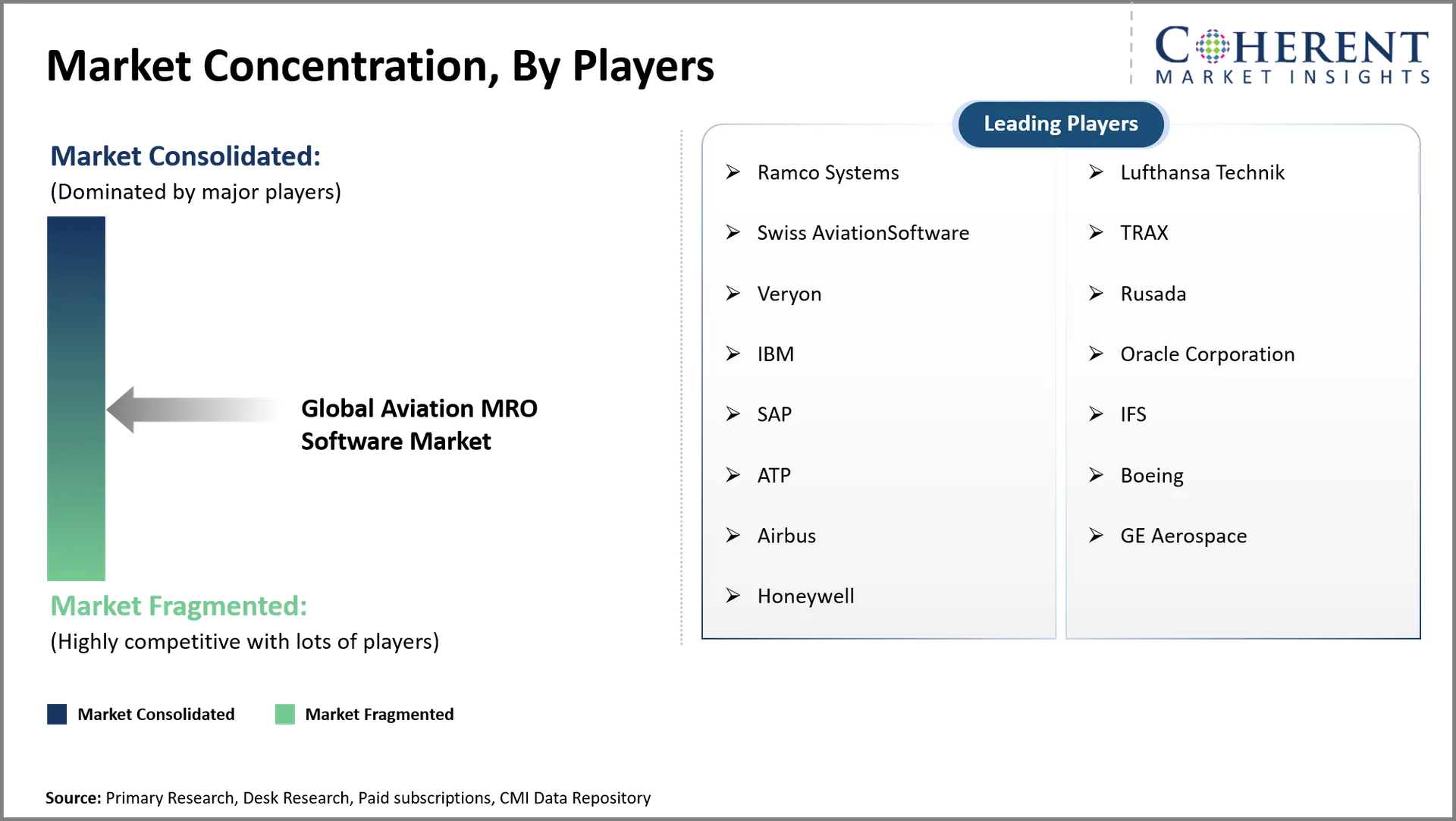
Competitors include Airbus Skywise, Lufthansa Technik, Swiss AviationSoftware and Boeing compete on analytics, maintenance execution and integrated digital services. In April 2026, Airbus launched Skywise as an independent subsidiary for digital services, integrating the Skywise Digital and NAVBLUE systems for technical and operational operations. Lufthansa Technik brings together AMOS maintenance management, AVIATAR analytics and flydocs digital records. Frontier Airlines added predictive health analytics, condition monitoring and artificial intelligence-based Technical Repetitive Examination to this ecosystem in December 2025. SwissAviation Software specializes on AMOS for maintenance, engineering and logistics and Boeing is bringing its aircraft engineering know-how to digital maintenance solutions.
Top Market Players and Notable Products/Solutions in the Aviation MRO Software Market
Market Players | Notable Product/Solution | Key features |
Swiss AviationSoftware | AMOS | Integrated maintenance planning, engineering, logistics, airworthiness management, mobile maintenance execution, electronic technical logbooks, regulatory compliance |
TRAX | eMRO | Maintenance planning, work orders, inventory management, technical records, quality management, financial controls, integrated mobile applications |
Ramco Systems | Ramco Aviation 6.0 | Artificial intelligence-powered planning, predictive maintenance support, workforce optimization, inventory integration, paperless workflows, regulatory compliance |
Veryon | Veryon Tracking+ | Fleet airworthiness monitoring, maintenance scheduling, digital task cards, resource allocation, inventory management, mobile task execution |
Boeing Global Services | Maintenance Performance Toolbox | Centralized technical documentation, task card management, maintenance requirement tracking, revision control, mixed-fleet support, integration with maintenance execution systems |
Market Report Scope
Report Coverage | Details | ||
Base Year | 2025 | Market Size in 2026: | USD 9.00 Bn |
Historical Data For: | 2020 To 2024 | Forecast Period: | 2026 To 2033 |
Forecast Period 2026 To 2033 CAGR: | 3.8% | 2033 Value Projection: | USD 11.00 Bn |
Geographies covered: |
| ||
Segments covered: |
| ||
Companies covered: | Ramco Systems, Lufthansa Technik, Swiss AviationSoftware, TRAX, Veryon, Rusada, IBM, Oracle Corporation, SAP, IFS, ATP, Boeing, Airbus, GE Aerospace, Honeywell | ||
Growth Drivers: |
| ||
Restraints & Challenges: |
| ||
Analyst Opinion (Expert Opinion)
- The future of aviation MRO software will depend on connecting maintenance execution with predictive analytics and aircraft health data. Standalone scheduling systems will face pressure to integrate with component tracking, technical records, and engineering decision-support tools. Software providers should prioritize explainable artificial intelligence that links detected faults to specific maintenance actions. Solutions must also uphold technician oversight and offer auditable logic behind maintenance suggestions.
- The best opportunities are for predictive maintenance software, maintenance planning and scheduling and digital technical records. Airlines operating Airbus A320 and Boeing 737 fleets need scalable systems to do repetitive fault analysis, component forecasts and coordinated maintenance windows. potential in the United States include fleet analytics and integrated maintenance platforms, while Singapore offers potential in engine maintenance and component repair software. China provides opportunities for tailored solutions, adapted to indigenous aviation data needs and airline operating procedures.
- Market players should distinguish themselves by aircraft-specific integrations, fast implementation and quantifiable operational improvements. Maintenance predictions should be tied directly to the inventory reserves, staff assignments and approved maintenance methods from vendors. Partnering with engine manufacturers, maintenance providers and aircraft data systems can build technical credibility. Flexible APIs, secure data ownership and transparent subscription structures can serve to lower obstacles to adoption. Providers should be able to provide value through fewer needless maintenance disruptions, greater component availability, and reduced administrative processing times.
Speak to the analyst
Want personalized insights?
Take the findings above to one of our principal consultants, or have the report rebuilt around the segments, geographies and competitors you actually track.
Market Segmentation
- Component Insights (Revenue, USD Billion, 2021 - 2033)
- Software
- Services
- Software Type Insights (Revenue, USD Billion, 2021 - 2033)
- Maintenance Management Software
- Enterprise Resource Planning Software
- Inventory and Supply Chain Management Software
- Aircraft Health Monitoring Software
- Maintenance Planning Software
- Function Type Insights (Revenue, USD Billion, 2021 - 2033)
- Maintenance Planning and Scheduling
- Work Order Management
- Aircraft Records Management
- Inventory Management
- Compliance and Quality Management
- Predictive Maintenance
- Maintenance Type Insights (Revenue, USD Billion, 2021 - 2033)
- Line Maintenance
- Base Maintenance
- Engine Maintenance
- Component Maintenance
- Deployment Type Insights (Revenue, USD Billion, 2021 - 2033)
- Cloud-Based
- On-Premises
- End User Insights (Revenue, USD Billion, 2021 - 2033)
- Commercial Airlines
- Maintenance, Repair and Overhaul Providers
- Original Equipment Manufacturers
- Military and Defense Operators
- Business and General Aviation Operators
- Regional Insights (Revenue, USD Billion, 2021 - 2033)
- North America
- U.S.
- Canada
- Latin America
- Brazil
- Argentina
- Mexico
- Rest of Latin America
- Europe
- Germany
- U.K.
- Spain
- France
- Italy
- Russia
- Rest of Europe
- Asia Pacific
- China
- India
- Japan
- Australia
- South Korea
- ASEAN
- Rest of Asia Pacific
- Middle East
- GCC Countries
- Israel
- Rest of Middle East
- Africa
- South Africa
- North Africa
- Central Africa
- North America
- Key Players Insights
- Ramco Systems
- Lufthansa Technik
- Swiss AviationSoftware
- TRAX
- Veryon
- Rusada
- IBM
- Oracle Corporation
- SAP
- IFS
- ATP
- Boeing
- Airbus
- GE Aerospace
- Honeywell
Sources
Primary Research Interviews
- MRO Software Solution Providers
- Commercial & Regional Airline Operators
- Aircraft Maintenance Technicians & Engineers
- Aviation Regulatory & Compliance Authorities
Magazines
- Aviation Week & Space Technology
- Aircraft Maintenance Technology Magazine
- Overhaul & Maintenance (O&M) Magazine
- AviTrader MRO Magazine
Journals
- Journal of Air Transport Management
- International Journal of Aviation, Aeronautics, and Aerospace
- Journal of Quality in Maintenance Engineering
Associations
- International Air Transport Association (IATA)
- Aeronautical Repair Station Association (ARSA)
- Aircraft Electronics Association (AEA)
- International Council of Aircraft Owner and Pilot Associations (IAOPA)
Public Domain Sources
- U.S. Federal Aviation Administration (FAA) Official Portal
- European Union Aviation Safety Agency (EASA) Public Reports
- International Civil Aviation Organization (ICAO) Public Data
- Bureau of Transportation Statistics (BTS)
Proprietary Elements
- CMI Data Analytics Tool
- Proprietary CMI Existing Repository of information for last 10 years
Get access to 250+ pages report
Every segment, forecast, competitor profile and data table behind the analysis above — available for instant download.
- ESOMAR Member
- ISO 9001:2015 Certified
- D-U-N-S Registered
- GDPR & CCPA Compliant
Frequently Asked Questions
The global aviation MRO software market is expected to stand at USD 9.00 Bn in 2026 and is expected to reach USD 11.00 Bn by 2033.
The CAGR of the global aviation MRO software market is projected to be 3.8% from 2026 to 2033.
Expanding commercial aircraft fleets and maintenance workloads and Growing demand for predictive maintenance and aircraft health monitoring are the major factors driving the growth of the global aviation MRO software market.
High implementation and software integration costs and Legacy maintenance systems and fragmented aircraft data are the major factors hampering the growth of the global aviation MRO software market.
In terms of component, software segment is estimated to dominate the market revenue share in 2026.
Aviation MRO software manages aircraft maintenance, repairs, inspections, technical records, and airworthiness compliance.
It helps maintenance teams identify upcoming service requirements and coordinate repairs before aircraft enter scheduled maintenance.