

Global Ball Screw Market Size and Forecast – 2026 To 2033
The global ball screw market is expected to grow from USD 1.90 Bn in 2026 to USD 3.25 Bn by 2033, registering a compound annual growth rate (CAGR) of 3.8% from 2026 to 2033. The global ball screw market is driven by rising adoption of industrial robotics. On June 24, 2025, ABB Robotics announced it is expanding its large robot portfolio with the launch of the IRB 6730S, IRB 6750S and IRB 6760. The introduction of these new robots means the company can offer its customers the most comprehensive lineup of industrial robots and variants on the market.
Key Takeaways of the Global Ball Screw Market
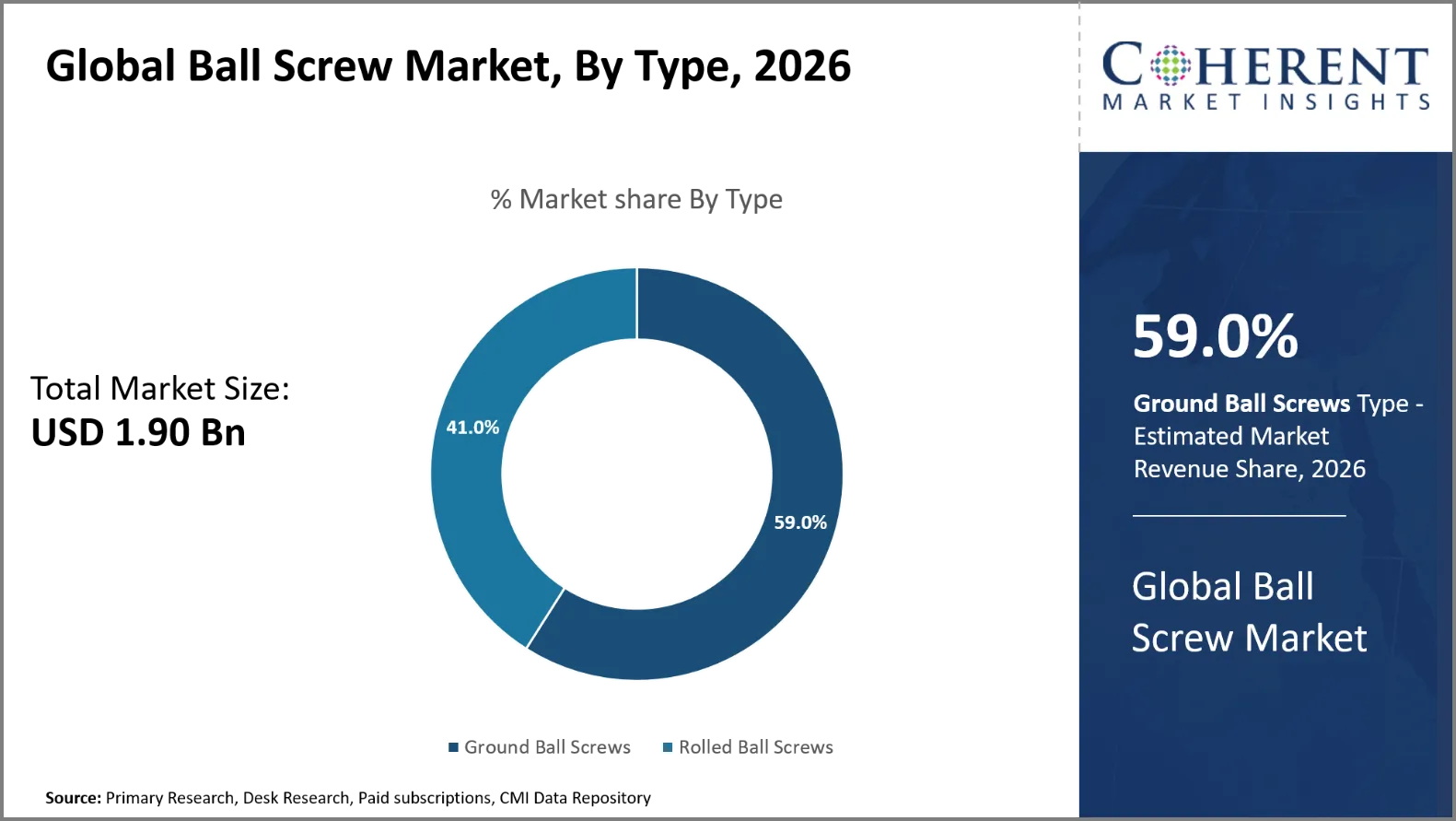
- The Ground Ball Screws segment is expected to account for 59.0% of the global ball screw market share in 2026. Expansion of semiconductor manufacturing equipment is driving the growth of the segment. On June 27, 2025, Rigaku expanded production capacity for semiconductor process-control instruments at its Takatsuki plant and a partner facility in Nirasaki, Japan.
- The Precision Grade segment is estimated to capture 47.0% of the market share in 2026. Increasing use of electric actuators is majorly driving the growth of the segment. On October 20, 2025, Oriental Motor expanded its linear actuator attachment lineup with a rolled ball screw model for stepping motors.
- The Computer Numerical Control Machine Tools segment is estimated to capture 38.0% of the market share in 2026. Demand for accurate and repeatable linear motion is majorly driving the growth of the segment. On September 28, 2026, Salient Motion launched Saginaw Precision, a new division manufacturing precision ball screws and roller screws in Michigan. The operation targets aerospace, defense, robotics, and high-performance actuation applications.
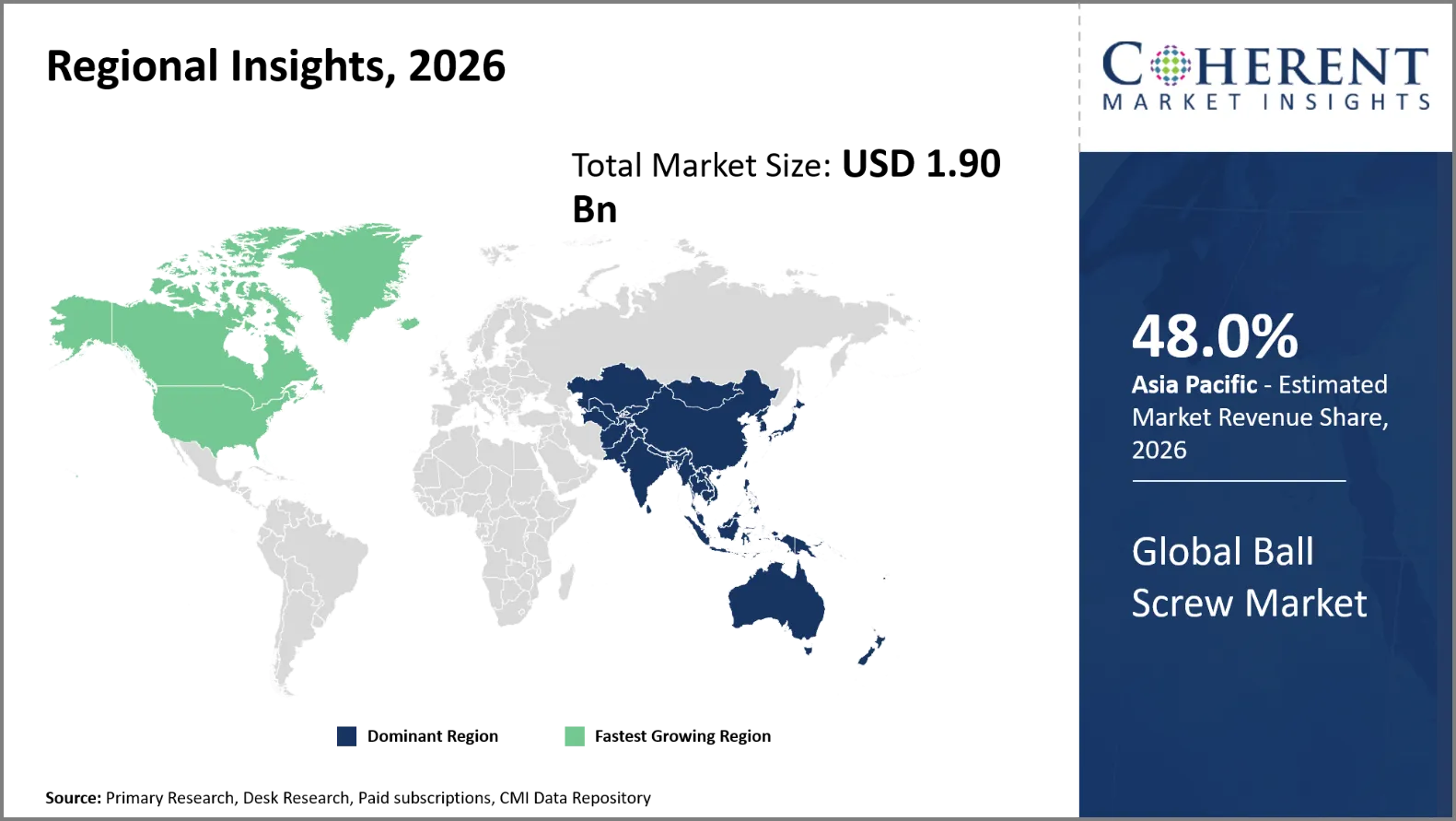
- Asia Pacific is expected to dominate the ball screw market in 2026 with a market share of 48.0%. Increasing electrification of automotive systems in Asia Pacific is driving the growth of the regional market. On April 20, 2026, Toyota Motor Manufacturing Indonesia announced a strategic partnership with Contemporary Amperex Technology Company Limited to develop electrified vehicle battery production in Indonesia.
- North America is expected to account for 25.0% share in 2026 and is projected to record the fastest growth over the forecast period. Development of compact and high-load ball screws in North America is driving the growth of the regional market. On May 15, 2025, PBC Linear announced miniature metric ball screw assemblies. The Illinois-based company combines precision-rolled screws with compact nuts for laboratory equipment, medical devices, semiconductor machinery, and automation systems.
Segmental Insights
Why Does Ground Ball Screws Dominate the Global Ball Screw Market?
The ground ball screws segment is expected to account for 59.0% of the global ball screw market share in 2026. Ground ball screws are widely used in precision applications because their threads are ground in controlled conditions to produce high dimensional accuracy and surface consistency. With the manufacturing process, accurate positioning, smooth motion and consistent repeatability are achieved even in harsh operating situations. A ground ball screw will also include a preload option that reduces axial backlash and increases system stiffness. These properties make them excellent for use in computer numerical control machine tools, semiconductor production equipment, and precision measurement systems. They are more expensive to manufacture, but this is justified if the accuracy of positioning and repeatability of machining quality are more important than the initial cost of the equipment.
On September 25, 2025, KURODA JENA TEC issued a technical product feature on precision ball screw technology. The company noted manufacturing processes that minimize motion faults and torque variation while keeping close tolerances. It also cited its in-house capabilities for grinding machines, which allow more control over the quality of production.
- Current Industry Events of 2026
- Market Size Estimation
- Regional Breakdown
- Competitive Landscape
- Customer Intelligence
- Segmental Analysis
- Pricing Analysis
- Key Market Drivers, Challenges & Future Trends
- Customized Insights Section
Why is Precision Grade the Most Crucial Accuracy Grade?
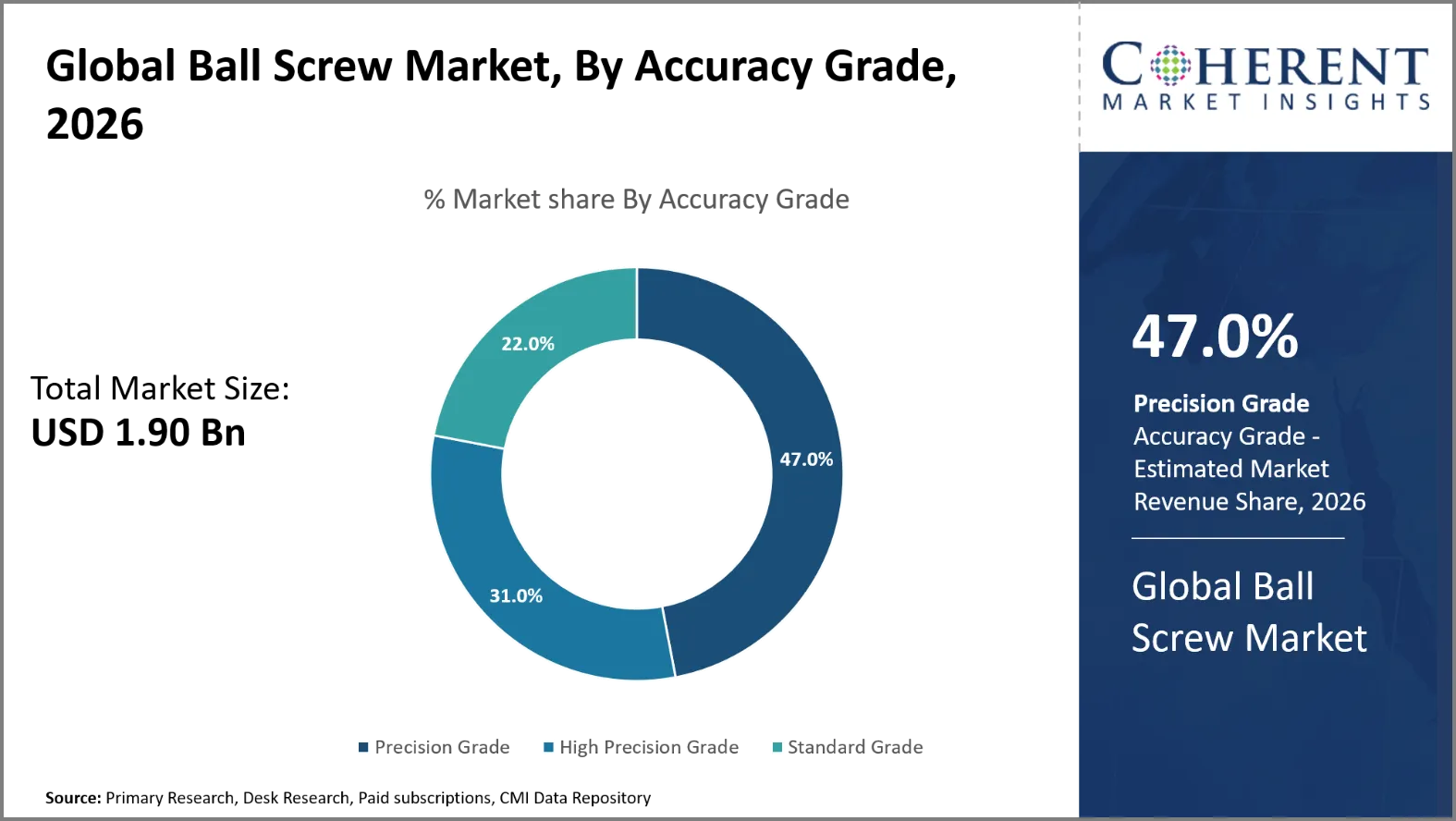
The precision grade segment is expected to account for 47.0% of the global ball screw market share in 2026. Precision grade matters because it influences how accurately a ball screw can translate rotary motion into regulated linear displacement. More precision is the capacity to have tighter dimensional tolerances, better repeatability and less positioning errors on advanced machinery. These features are particularly significant in machining centers, semiconductor equipment and automated inspection systems. Classification of accuracy also assists in choosing the components by engineers according to the requirements of the application and permissible lead deviations. Japanese Industrial Standards and International Organization for Standardization standards are developed criteria for the evaluation of ball screw precision. For instance, NSK began marketing their MT-Frix low-friction ball screw in April 2025. Design minimizes dynamic friction torque and maintains nut rigidity. The lower friction also generates less heat, enabling machine tools to retain their positioning accuracy for extended periods of operation.
Computer Numerical Control Machine Tools Dominates the Global Ball Screw Market
The computer numerical control machine tools segment is expected to account for 38.0% of the global ball screw market share in 2026. Computer numerical control machine tools represent a major application segment because they require precise, repeatable, and efficient linear motion. Ball screws convert servo motor rotation into controlled movement of machine tables, cutting heads, and positioning axes. Low friction, great mechanical efficiency and minimized backlash promote accurate machining and consistent production quality. Ground ball screws are especially useful in applications where precise tolerances and reliable movement over repeated machining cycles are required. The growing demand for complicated precision components and automation is raising the importance of ball screws for modern production equipment.
On March 31, 2025, Mazak unveiled the INTEGREX j-200 and j-200S NEO multitasking machines. The machines combine lathes and mills to save the time needed to produce parts and the need to set up the same work piece several times. Mazak reported better positioning accuracy, more spindle torque and better thermal displacement correction.
Current Events and their Impact
Current Events | Description and its Impact |
European Union Machinery Regulation (EU) 2023/1230 |
|
European Union Ecodesign for Sustainable Products Regulation (EU) 2024/1781 |
|
Ball Screw Market Dynamics
Market Drivers
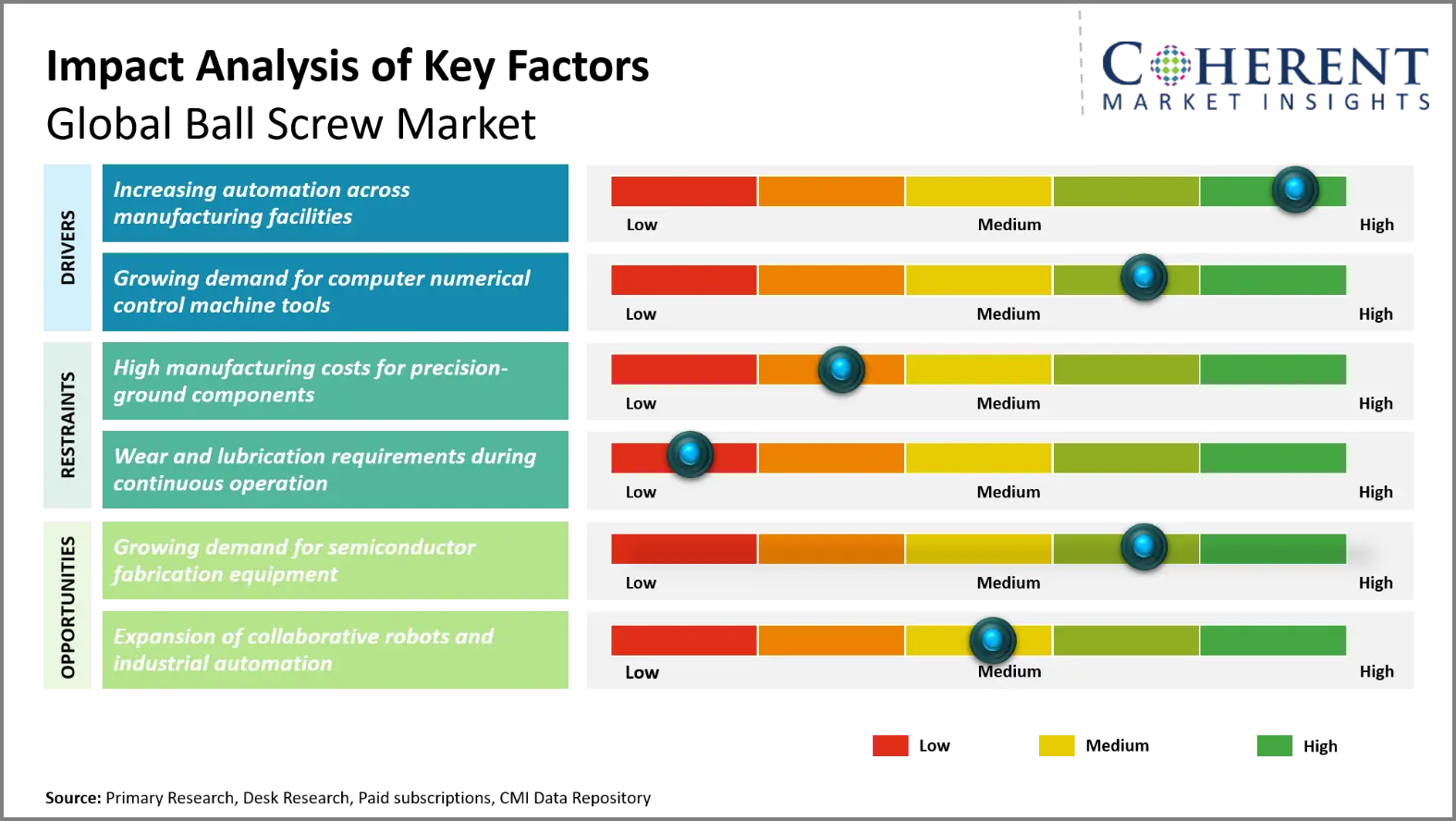
- Increasing automation across manufacturing facilities: Growing automation in manufacturing facilities is creating a demand for ball screws in robotic systems, automated assembly lines, and precise material-handling equipment. Ball screws are high mechanical efficiency and repeatability devices for converting rotary motion into controlled linear motion. Manufacturers are requesting more reliable motion components to help ensure production uniformity, reduce user intervention and limit equipment downtime. They are also integrated with servo motors and sophisticated motion controls to play an even greater role in automated production systems. The trend increases the demand for ball screws with high load capacity, durability and accurate alignment.
- On March 25, 2026, FANUC America, a world leader in robotics and automation systems, stated on March 25, 2026, that it will invest USD 90 million to purchase property and build a new 840,000 sq. ft. facility in Michigan to serve as production-ready space for the possible growth of the company’s existing U.S.-based manufacturing capabilities of robots.
- Growing demand for computer numerical control machine tools: Growing demand for computer numerical control machine tools is driving the need for ball screws for precision machining applications. These components offer precise movement of machine tables, cutting heads and positioning in complex production procedures. Low friction, high efficiency and accurate motion control help to achieve consistency of the machining quality and reduction of the positioning errors. Computer numerical control equipment is used by automotive, aerospace, electronics and industrial machinery makers to build complicated components with strict tolerances. Growing manufacturing capacity and higher dimensional accuracy requirements are driving the demand for high reliability, high precision ball screw assemblies.
- On August 27, 2026, DMG MORI CO., LTD. announced it is expanding its INH Series of 5-axis horizontal machining centers. After releasing the INH 63 and INH 80 in 2023, DMG MORI has now added the INH 63 FD with a mill-turn table specification for turning operations to its lineup. All machines of the INH Series are now available with SIEMENS in addition to the existing FANUC control option.
Emerging Trends
- Integration of Ball Screws with Smart Manufacturing Systems: Manufacturers are combining ball screws with servo motors, sensors and digital monitoring systems to increase motion control and operational visibility. This combination allows for the detection of wear, the monitoring of positioning accuracy, and the planning of maintenance before component failures hinder productivity.
- Growing Adoption of High-Precision Ground Ball Screws: High-precision ground ball screws are increasingly in demand for semiconductor equipment, aerospace production and complex machine tools. These features offer accurate positioning, repeatable lead precision and low backlash and allow applications demanding tight dimensional tolerances and repetitive movement.
- Development of Compact and High-Load Ball Screw Assemblies: Equipment makers are looking for compact ball screw assemblies with high load-carrying capacity for limited installation area. Suppliers are creating stronger materials, improved thread geometries and better recirculation mechanisms to serve demanding industrial applications while not compromising on motion accuracy.
- Increasing Focus on Ball Screw Durability and Predictive Maintenance: Predictive maintenance systems assist operators in identifying abnormal operating conditions early, reducing unplanned downtime, and maintaining consistent performance across automated production equipment.
Regional Insights
Why is Asia Pacific a Strong Market for Ball Screw?
Asia Pacific is expected to account for a market share of 48.0% in 2026. The Asia Pacific has the benefit of a concentration of machine-tool manufacture, electronics manufacturing, semiconductor fabrication, and industrial robots. China leads the demand with automated assembly lines, electric vehicle manufacturing and precision machinery manufacture. High level ball screw technology available from Japan from manufacturers such as THK, NSK and KURODA Precision Industries. South Korea demands precision motion parts for semiconductor inspection equipment and electronics manufacturing. Demand supported by Taiwan’s semiconductor manufacturing and machine tool exports. The region is also benefiting from the higher demand for accurate positioning, faster production cycles and dependable motion control from automated manufacturing.
Why Does North America Ball Screw Market Exhibit High Growth?
North America is expected to register the fastest growth with a CAGR of 4.5% over the forecast period. North America is projected to account for 25.0% of the global ball screw market in 2026. North America benefits from demand for high-performance motion components in aerospace manufacturing, medical equipment, semiconductor machinery, and advanced industrial automation. Ball screws are utilized in the US to enable precise positioning systems in computer numerical control machining centers, the production of aviation components and automated assembly equipment. Canadian firms employ precision motion systems in aircraft, automotive components and industrial machines. In addition, Mexico’s automotive manufacturing clusters drive demand for reliable linear motion components in machining and assembly activities. In complicated industrial production systems, there is a need for durable components, engineering support and reliable availability of replacement parts, which may benefit regional suppliers.
Global Ball Screw Market Outlook for Key Countries
Why is China Emerging as a Major Hub in the Ball Screw Market?
The need for ball screws in China is intimately tied to the production of electric vehicles, battery making equipment and large-scale industrial automation. Automated battery assembly processes need precise linear positioning for handling electrodes, stacking cells, inspection and module assembly. The utilization of industrial robots in China also drives demand for motion components used in robotic transfer systems and automated production equipment. Domestic manufacturers are building expertise on rolled and ground ball screws for various precision needs. Battery production and industrial automation are major development drivers for the ball screw market in China in these applications.
Is U.S. the Next Growth Engine for the Ball Screw Market?
Aerospace engineering and the growing electrification of airplanes and industrial equipment are positive for the U.S. market. Ball screws are used for precision actuation in manufacturing fixtures, machining of aircraft components and specialized positioning systems. Aerospace vendors need components that can provide reproducible movement in extreme working circumstances. Semiconductor equipment makers employ ball screws for wafer handling, inspection and precise positioning applications. Investment in advanced manufacturing at home generates opportunity for suppliers of high-load designs, specific configurations and engineering assistance. These restrictions make the U.S. market unique in its focus on technically challenging applications.
Germany Ball Screw Market Analysis and Trends
The German ball screw market is propelled by the country’s export-driven machine-tool sector and the desire for advanced machining systems. Germany manufactured some €15 billion worth of machine tools in 2024, says the German Machine Tool Builders' Association (VDW). Over 70% of domestic output was shipped overseas. These manufacturing operations are anticipated to boost the need for ball screws for milling machines, grinding equipment, machining centers, and automated production lines. German engineering companies put a premium on positioning accuracy, thermal stability and long-life span. These needs provide opportunities for suppliers to the high-performance machine-tool makers and precise industrial equipment makers.
Japan Ball Screw Market Analysis and Trends
Japan’s ball screw market is driven by the country’s sophisticated precision engineering sector and high domestic output of computer numerical control machine tools. Companies such as THK, NSK and KURODA Precision Industries supply ball screws for machining centers, industrial robots, semiconductor manufacturing equipment and automated inspection systems. In Japan, the semiconductor equipment industry has a need for components that give precise positioning, low friction and repeatable consistency. Ball screws are also used by automotive manufacturers in their production equipment and automated assembly systems. High-accuracy manufacturing and advanced motion-control technology are key priorities for the country, driving sustained demand for precision-ground ball screws and specialized linear motion assemblies.
South Korea Ball Screw Market Analysis and Trends
The South Korea ball screw market is being driven by semiconductor fabrication equipment and the production of next-generation electronics. Wafer inspection systems, semiconductor handling equipment, and precision positioning platforms need smooth movement and precise mechanical control. The country's semiconductor manufacturers and equipment providers produce demand for components that can retain repeatability in continuous production. Ball screws are also seen in automated display production and electronic component assembly equipment. Suppliers may meet these unique criteria with small designs, minimum particle generation and dependable operation. Semiconductor equipment development therefore provides a distinct growth pathway for South Korea's precision ball screw industry.
Global Ball Screw Market - Regional Semiconductor Manufacturing Expansion (2025)
Region/Country | Company | Investment/Capacity Data | Expansion Focus |
North America | Taiwan Semiconductor Manufacturing Company Arizona Expansion | USD 165 billion total planned United States investment | Three fabrication plants, two advanced packaging facilities, and one research and development center |
Intel Ohio One | More than USD 28 billion planned investment | Two planned semiconductor fabrication plants | |
Amkor Technology Arizona Campus | Approximately USD 7 billion planned investment | Advanced semiconductor packaging and testing facilities | |
NGK Insulators / FM Industries Arizona Expansion | Approximately USD 64 million planned investment | Expansion of precision component manufacturing | |
India | Tata Electronics Semiconductor Fabrication Project | More than USD 91.00 billion planned investment | Planned capacity of 50,000 wafer starts per month |
Japan | Rapidus IIM-1 | Advanced semiconductor fabrication project | More than 200 advanced manufacturing tools connected by June 2025 |
South Korea | Samsung–NVIDIA Artificial Intelligence Factory Initiative | More than 50,000 NVIDIA graphics processing units planned | Artificial intelligence manufacturing and semiconductor ecosystem development |
How is Growing Demand for Semiconductor Fabrication Equipment Creating New Growth Opportunities in the Ball Screw Market?
Growing demand for semiconductor fabrication equipment is creating opportunities in the ball screw market as wafer processing requires extremely precise, repeatable, and contamination-controlled movement. Ball screws are incorporated in wafer handling platforms, lithography stages, inspection systems and semiconductor packaging equipment. Positioning systems for advanced manufacturing processes require minimum vibration, backlash and particle creation. Therefore, equipment vendors are looking for customized ball screws with controlled preload, high lead accuracy and cleanroom suitable lubrication. The growth of sophisticated packaging, chiplet integration and fabrication of high-bandwidth memory raises the demand for accurate motion control. Suppliers developing low-particle designs and thermally stable assemblies can address increasingly demanding semiconductor equipment applications.
On May 22, 2025, KLA Corporation announced the opening of its new USD 138 million research and development and manufacturing center in Newport, Wales, U.K. Reflecting KLA’s portfolio strength and growing customer demand, the new 237,000-square-foot Newport facility provides additional production and customer collaboration spaces, designed to support development of semiconductor process technologies across advanced packaging, power devices, microelectromechanical systems (MEMS), radio frequency (RF) and photonics sector technology.
Market Players, Key Development, and Competitive Intelligence
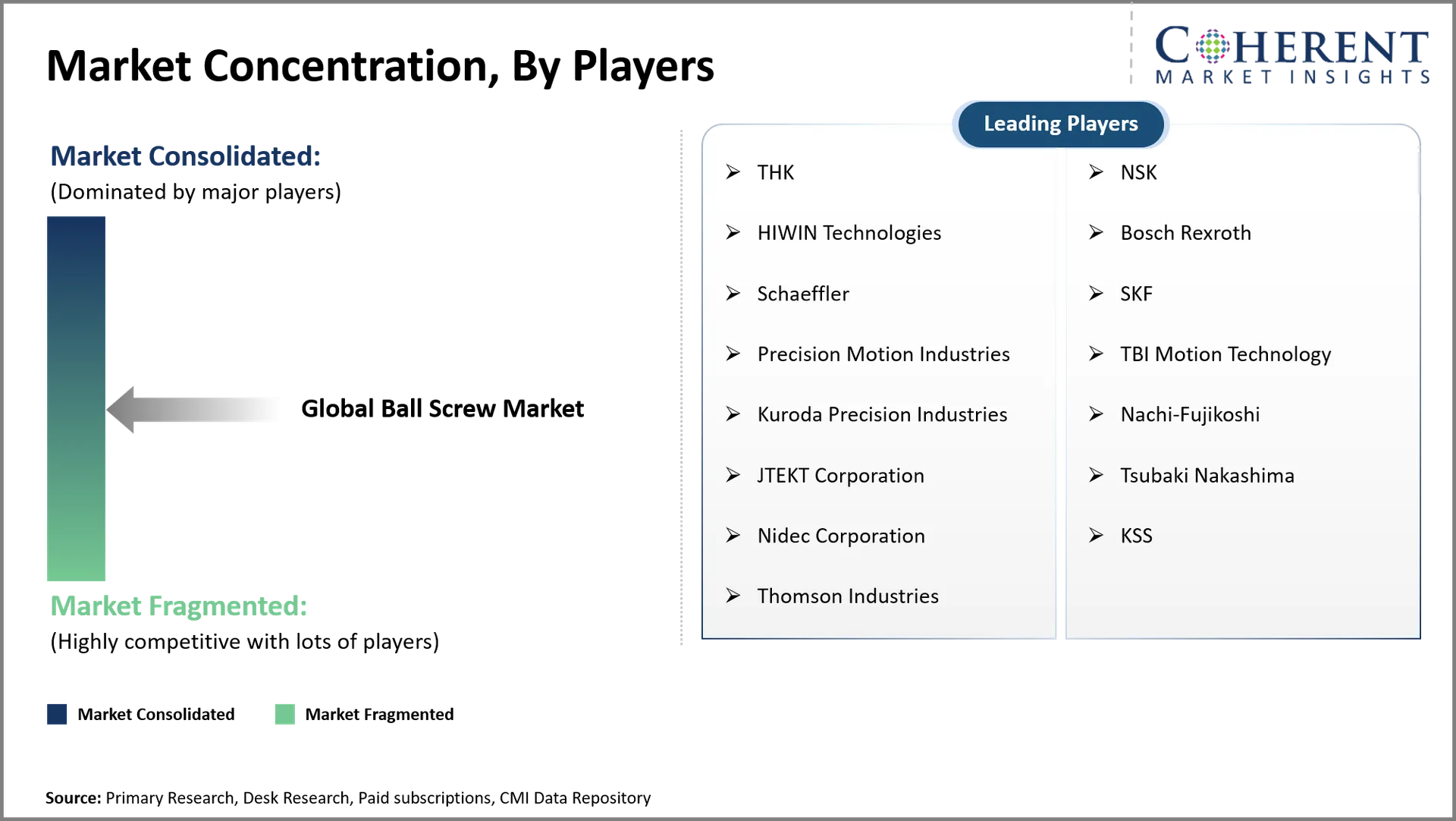
Key Developments
- On July 6, 2026, Bosch Rexroth expanded the Performance Line of its ball screw drives assemblies to include a solution for vertical and dynamic linear applications. A newly developed nut type with optimized travel behavior makes it possible to implement spindle drives for machine tools or servo presses that are even more powerful, reliable, and precise. The new FEH-E-B single nut with flange is available in eight sizes. Compared to the previous model, the dynamic load capacities increased by up to 14% and the service life by up to 50%.
- On April 21, 2025, THK expanded its lineup of the Precision Ball Screw with Finished Shaft Ends Model SDA-VZ. Precision Ball Screw with Finished Shaft Ends Model SDA-VZ is a precision ball screw with a screw shaft that has its end shape standardized to fit the corresponding support unit.
- On April 4, 2025, Schaeffler commenced production of successful ball screw drive for a Chinese EV manufacturer. Schaeffler’s ball screw drives are used predominantly in braking systems such as brake boosters in electric vehicles, electric parking brakes and electromechanical brakes, or in steering systems, where they ensure maneuverability, safety and comfort.
Competitive Landscape
The global ball screw market features established manufacturers competing through precision engineering, product customization, durability, and application-specific innovation. THK focuses on high-speed ball screws, compact designs, and caged-ball technology for machine tools and industrial robots. NSK specializes in precision ground products, high-load designs and long service life including technology for improving load distribution. Bosch Rexroth develops customer-specific screw assemblies for machine tools, robotics, medical technologies and the semiconductor industry. These strategies show how manufacturers differentiate themselves through application-specific engineering, operating reliability, and technical support rather than price alone.
Top Manufacturers and Notable Products in the Ball Screw Market
Manufacturer | Notable Product | Key features |
ASML | TWINSCAN NXE Extreme Ultraviolet Lithography Systems | Extreme ultraviolet lithography, advanced patterning, high-resolution chip production, support for advanced semiconductor nodes |
Applied Materials | Endura Physical Vapor Deposition Systems | Thin-film deposition, integrated wafer processing, precise material control, support for advanced logic and memory |
Lam Research | Kiyo Conductor Etch Systems | Plasma etching, critical-dimension control, uniform material removal, high-volume wafer processing |
Tokyo Electron | Tactras Etch Systems | Plasma etching, advanced pattern transfer, process uniformity, support for complex semiconductor structures |
KLA Corporation | Surfscan Wafer Inspection Systems | Wafer defect detection, surface inspection, process monitoring, manufacturing yield improvement |
Market Report Scope
Global Ball Screw Market Report Coverage | |||
Report Coverage | Details | ||
Base Year | 2025 | Market Size in 2026: | USD 1.90 Bn |
Historical Data For: | 2020 To 2024 | Forecast Period: | 2026 To 2033 |
Forecast Period 2026 To 2033 CAGR: | 3.80% | 2033 Value Projection: | USD 3.25 Bn |
Geographies covered: |
| ||
Segments covered: |
| ||
Companies covered: | THK, NSK, HIWIN Technologies, Bosch Rexroth, Schaeffler, SKF, Precision Motion Industries, TBI Motion Technology, Kuroda Precision Industries, Nachi-Fujikoshi, JTEKT Corporation, Tsubaki Nakashima, Nidec Corporation, KSS, Thomson Industries | ||
Growth Drivers: |
| ||
Restraints & Challenges: |
| ||
Analyst Opinion (Expert Opinion)
- The future of the ball screw market will increasingly depend on precision motion control, equipment electrification, and higher machine productivity. Semiconductor manufacturing equipment, advanced computer numerical control machine tools, and industrial robotics will require components with improved positioning accuracy and operating stability. Manufacturers will also face stronger customer expectations for longer service life and predictable maintenance. This favors vendors that can combine mechanical engineering skills with application-specific testing and performance validation.
- The largest prospects are likely to be in precision-ground ball screws for semiconductor equipment and high-speed machining applications. High-load ball screws also provide potential in electric industrial actuators, injection molding machines and heavy-duty automated systems. Japan, China, Germany, South Korea and the U.S. have distinct potential in the semiconductor, machine-tool, automotive and robotics industries. Suppliers should look at goods that are created for the technical needs of each application rather than standardized components across all industries.
- Market participants should increase their competitive position by adopting sophisticated thread grinding, improved ball recirculation, effective sealing, and optimized lubrication systems. Product development should focus on minimizing backlash, limiting thermal deformation and increasing resistance to contamination in harsh situations. Manufacturers can also differentiate themselves through application engineering, digital product setup, predictive maintenance support and reliable availability of replacement parts. Technical alliances with machine-tool builders and semiconductor equipment manufacturers offer suppliers long-term client relationships and design-in opportunities.
Speak to the analyst
Want personalized insights?
Take the findings above to one of our principal consultants, or have the report rebuilt around the segments, geographies and competitors you actually track.
Market Segmentation
- Type Insights (Revenue, USD Billion, 2021 - 2033)
- Ground Ball Screws
- Rolled Ball Screws
- Accuracy Grade Insights (Revenue, USD Billion, 2021 - 2033)
- Precision Grade
- High Precision Grade
- Standard Grade
- Application Insights (Revenue, USD Billion, 2021 - 2033)
- Computer Numerical Control Machine Tools
- Robotics and Automation
- Injection Molding Machines
- Semiconductor Manufacturing Equipment
- Medical Equipment
- Packaging Machinery
- End User Insights (Revenue, USD Billion, 2021 - 2033)
- Industrial Machinery
- Semiconductor and Electronics
- Automotive
- Aerospace and Defense
- Medical and Healthcare
- Others
- Regional Insights (Revenue, USD Billion, 2021 - 2033)
- North America
- U.S.
- Canada
- Latin America
- Brazil
- Argentina
- Mexico
- Rest of Latin America
- Europe
- Germany
- U.K.
- Spain
- France
- Italy
- Russia
- Rest of Europe
- Asia Pacific
- China
- India
- Japan
- Australia
- South Korea
- ASEAN
- Rest of Asia Pacific
- Middle East
- GCC Countries
- Israel
- Rest of Middle East
- Africa
- South Africa
- North Africa
- Central Africa
- North America
Sources
Primary Research Interviews
- Ball Screw Manufacturers & OEMs
- Industrial Machinery & Automation Equipment Suppliers
- End-Use Industry Professionals (Aerospace, Automotive & Machine Tool Sectors)
- Distributors & Channel Partners of Linear Motion Components
Magazines
- Machine Design Magazine
- Manufacturing Engineering Magazine
- Automation World Magazine
- Motion Control & Motor Association (MCMA) Magazine
Journals
- International Journal of Machine Tools and Manufacture
- Journal of Manufacturing Science and Engineering
- Precision Engineering Journal
Associations
- Association for Manufacturing Technology (AMT)
- Motion Control & Motor Association (MCMA)
- Japan Machine Tool Builders' Association (JMTBA)
- European Association of the Machine Tool Industries (CECIMO)
Public Domain Sources
- U.S. International Trade Commission (USITC) Reports
- European Commission Industrial Policy Reports
- United Nations Industrial Development Organization (UNIDO) Data
- World Trade Organization (WTO) Trade Statistics
Proprietary Elements
- CMI Data Analytics Tool
- Proprietary CMI Existing Repository of Information for Last 10 Years
Get access to 250+ pages report
Every segment, forecast, competitor profile and data table behind the analysis above — available for instant download.
- ESOMAR Member
- ISO 9001:2015 Certified
- D-U-N-S Registered
- GDPR & CCPA Compliant
Frequently Asked Questions
The global ball screw market is expected to stand at USD 1.90 Bn in 2026 and is expected to reach USD 3.25 Bn by 2033.
The CAGR of the global ball screw market is projected to be 3.8% from 2026 to 2033.
Increasing automation across manufacturing facilities and growing demand for computer numerical control machine tools are the major factors driving the growth of the global ball screw market.
High manufacturing costs for precision-ground components and wear and lubrication requirements during continuous operation are the major factors hampering the growth of the global ball screw market.
In terms of type, ground ball screws segment is estimated to dominate the market revenue share in 2026.
A ball screw is a mechanical transmission device that converts rotational motion into precise linear movement using recirculating balls.
Ball screws reduce friction and positioning errors, helping machinery achieve consistent movement and reliable production cycles.