

Global Ballast Water Treatment Market Size and Forecast – 2026 To 2033
The global ballast water treatment market is expected to grow from USD 7.90 Bn in 2026 to USD 14.50 Bn by 2033, registering a compound annual growth rate (CAGR) of 8.2% from 2026 to 2033. The global ballast water treatment market is driven by rising commercial vessel fleet. On February 9, 2026, A.P. Moller - Maersk (Maersk) signed an order of eight large vessels with New Times Shipbuilding Co. Ltd. in China. All eight ships will have the same characteristics and make up a new series of 18,600 TEU vessels with delivery in 2029 and 2030.
Key Takeaways of the Global Ballast Water Treatment Market
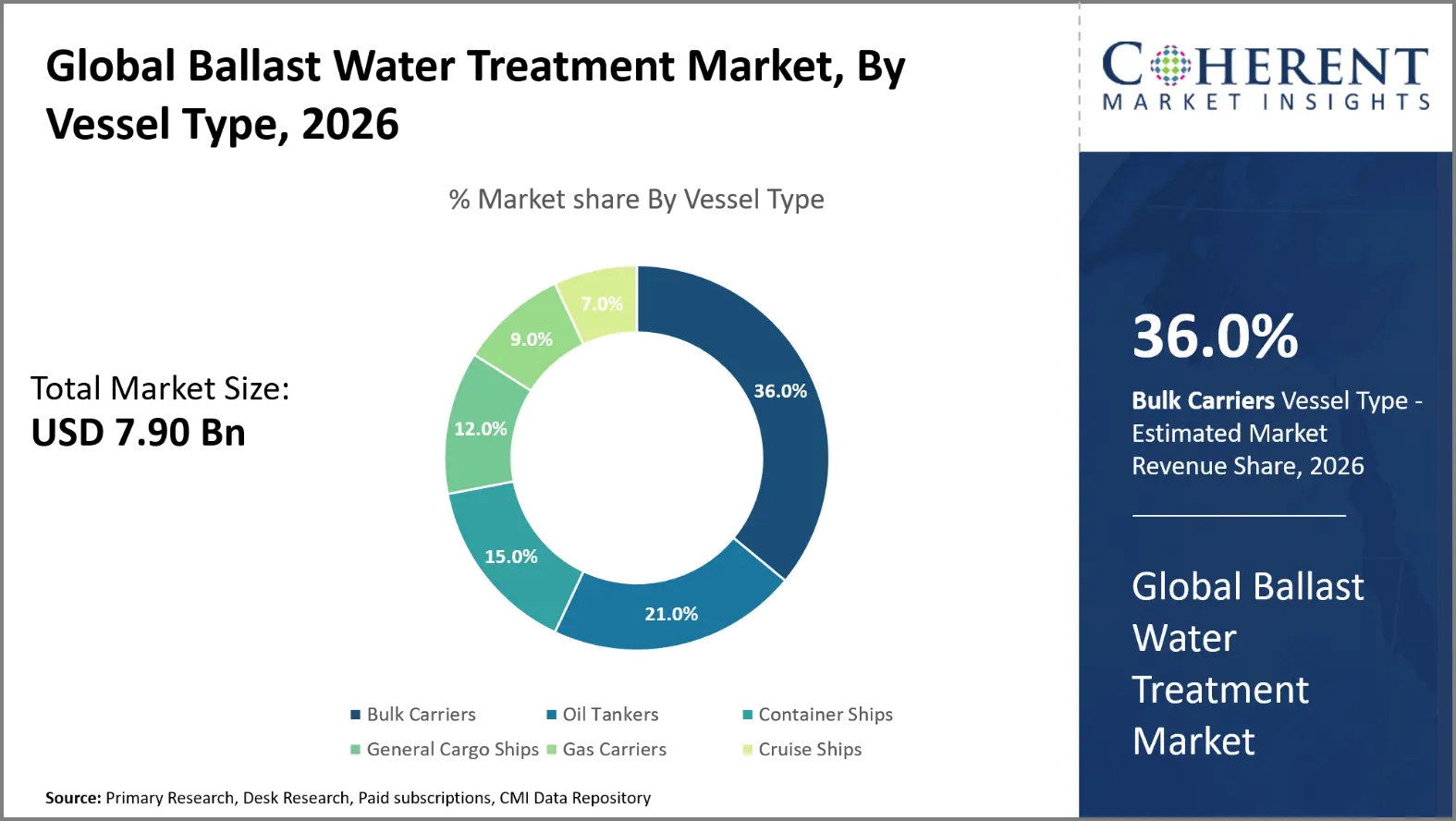
- The Bulk Carriers segment is expected to account for 36.0% of the global ballast water treatment market share in 2026. Increasing ballast water treatment retrofits is driving the growth of the segment. On April 28, 2025, GLO Marine and VMS Group began a 16-vessel retrofit program for Tidewater. The program spans three continents. It includes engineering, prefabrication, installation, commissioning, and lifecycle management.
- The Filtration segment is estimated to capture 32.0% of the market share in 2026. Expansion of international maritime trade is majorly driving the growth of the segment. On June 4, 2026, Maersk launched its FI2 ocean service between China and India. The weekly service uses six vessels with 4,500 TEU nominal capacity. It responds to increased customer demand along the China-India trade route.
- The Stationary Systems segment is estimated to capture 67.0% of the market share in 2026. Development of energy-efficient treatment systems is majorly driving the growth of the segment. On June 19, 2025, Norwegian Greentech secured contracts for five ballast water systems. The company highlighted compact designs and energy-efficient operation for lower fuel consumption.
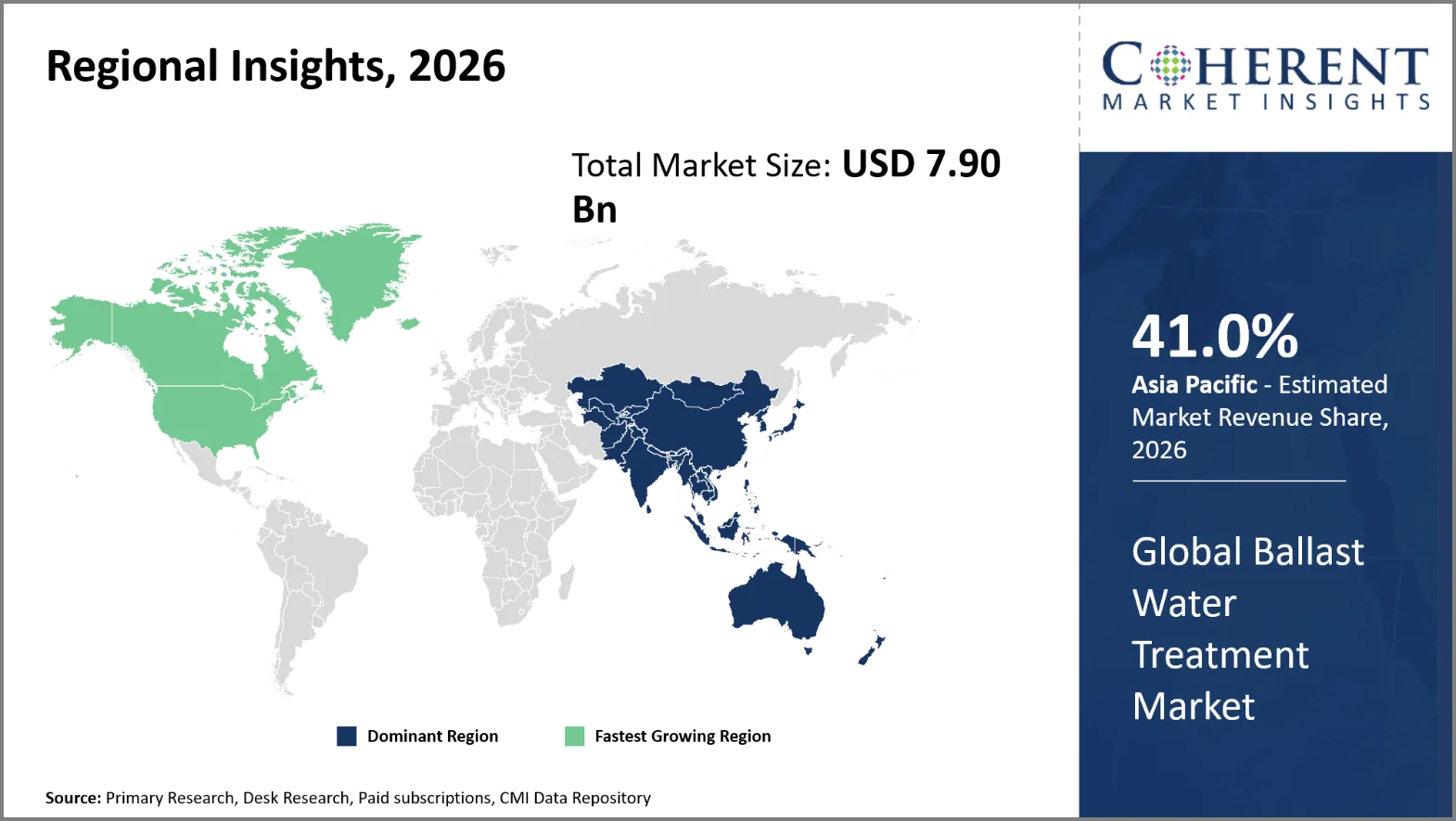
- Asia Pacific is expected to dominate the ballast water treatment market in 2026 with a market share of 41.0%. Growing shipbuilding activity in Asia Pacific is driving the growth of the regional market. On March 19, 2026, China State Shipbuilding Corporation delivered the 24,000 TEU CMA CGM Grand Palais. The vessel was built by Hudong-Zhonghua Shipbuilding. Its delivery demonstrates continued Chinese capacity for ultra-large container vessels.
- North America is expected to account for 22.0% share in 2026 and is projected to record the fastest growth over the forecast period. Rising demand for advanced ultraviolet treatment systems in North America is driving the growth of the regional market. On March 3, 2025, BIO-UV Group shipped a second BIO-SEA system to the U.S. The unit entered trials for potential United States Navy applications. The testing evaluates BIO-UV’s ultraviolet treatment technology under naval operating requirements.
Segmental Insights
Why Does Bulk Carriers Dominate the Global Ballast Water Treatment Market?
The bulk carriers segment is expected to account for 36.0% of the global ballast water treatment market share in 2026. These ships carry commodities like iron ore, coal, grain and bauxite on international routes. Ballast water is taken on board to assist with vessel trim, draft, stability, and structural safety during loading and unloading operations. Their international trade patterns generate recurring requirements for uptake and release of ballast water at many ports. For large ballast tanks treatment systems are needed, capable of treating large amounts of water during ballast operations. The International Maritime Organization requires relevant ships to adhere to the Ballast Water Management Convention. For instance, Goltens retrofitted a ballast water treatment system on a bulk carrier in 2025. The project included an Optimarin system for 2,000 cubic meters per hour. The project involved an Optimarin system rated at 2,000 cubic meters per hour. Goltens used its retrofit engineering capabilities for the large-volume vessel application.
- Current Industry Events of 2026
- Market Size Estimation
- Regional Breakdown
- Competitive Landscape
- Customer Intelligence
- Segmental Analysis
- Pricing Analysis
- Key Market Drivers, Challenges & Future Trends
- Customized Insights Section
Why is Filtration the Most Crucial System Type?
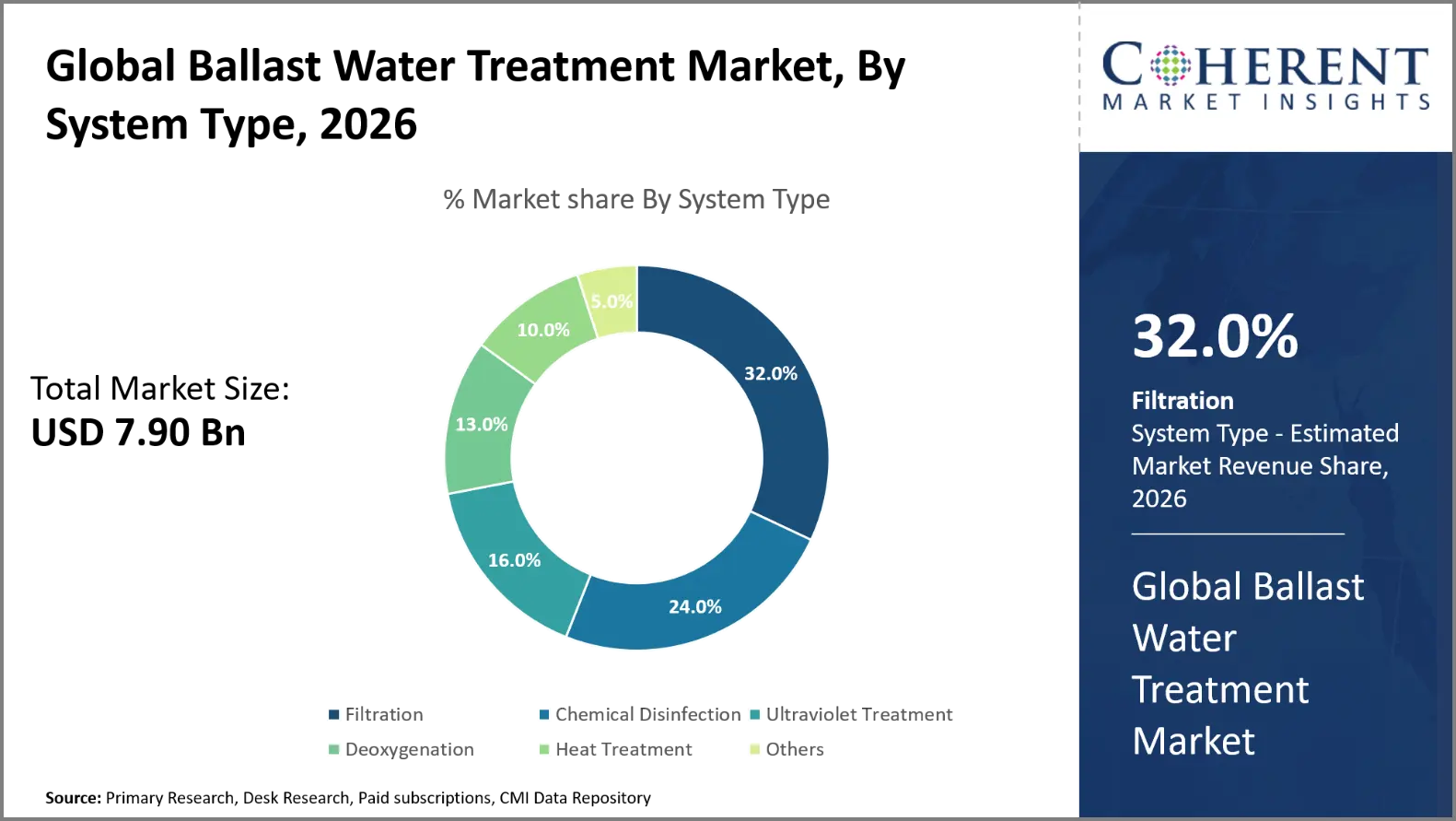
The filtration segment is expected to account for 32.0% of the global ballast water treatment market share in 2026. Filtration is important because it serves as a primary physical barrier to organisms and suspended particles. Most of the ballast water treatment systems use filtration in combination with ultraviolet therapy or chemical treatment methods. Filters remove bigger organisms and particle materials before water flows to later treatment steps. This function decreases biological and particle load to downstream treatment equipment. Reducing the concentration of particulates can improve UV treatment conditions and reduce contamination in downstream components. Filtration is especially critical for vessels working in ports with elevated levels of suspended particles or sediment. Automatic backwashing systems can maintain filtration performance during continuous ballast operations.
On June 18, 2026, Norwegian Greentech announced it has been awarded several contracts to deliver a total of ten new ballast water treatment systems (BWTS) to various undisclosed shipyards and shipowners in Norway, Spain and the Netherlands. The majority of the BWTS systems will be delivered to newbuild vessels, including cable laying vessels, dive support vessels, offshore support vessels and live fish carriers.
Stationary Systems Dominates the Global Ballast Water Treatment Market
The stationary Systems segment is expected to account for 67.0% of the global ballast water treatment market share in 2026. Stationary systems dominate because they remain permanently integrated with the vessel's ballast water piping infrastructure. Permanent installation means treatment equipment can work with existing ballast pumps, valves, sensors and control systems. This arrangement avoids re-positioning of equipment during ballast water operations. Stationary systems also provide automatic treatment of treatment during vessel loading, unloading and ballast exchange operations. Commercial vessels that need to ballast ballast water frequently are particularly suitable to their permanent architecture. For large vessels, systems can be permanently fitted to match their flow rates and piping configurations. In February 2026, Knutsen Ballast Water commissioned two KBAL3000 systems aboard Janeiro Knutsen. The 154,000 deadweight-ton shuttle tanker uses two permanently installed filterless ultraviolet systems. The equipment was certified by the classification organization and the vessel owner at commissioning.
Current Events and their Impact
Current Events | Description and its Impact |
International Maritime Organization Resolution MEPC.383(81) |
|
International Maritime Organization Resolution MEPC.409(84) |
|
Ballast Water Treatment Market Dynamics
Market Drivers
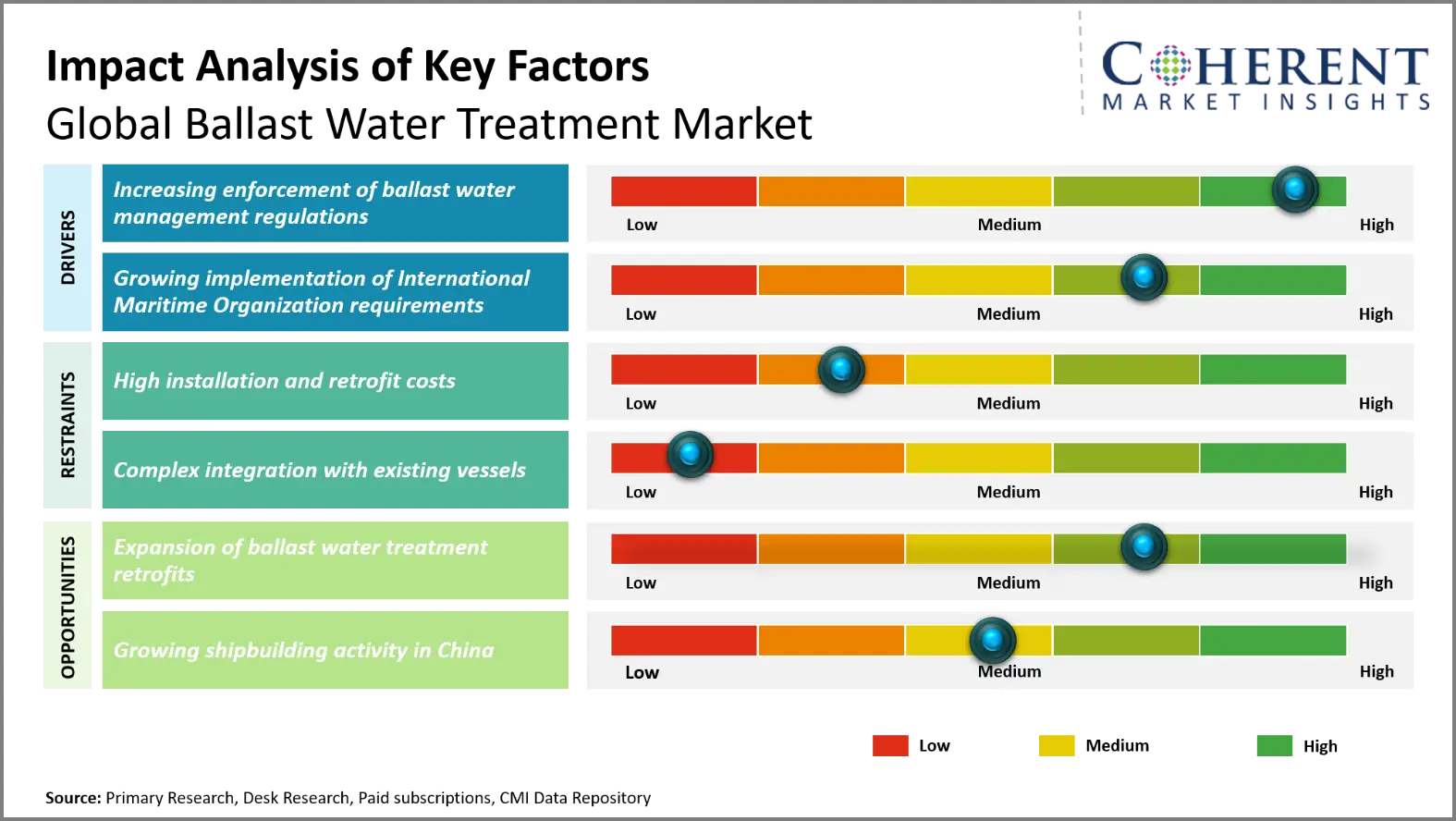
- Increasing enforcement of ballast water management regulations: Growing enforcement of ballast water management regulations is pushing demand for compliance treatment systems across global maritime fleets. When ships visit port, maritime authorities are stepping up checks, evaluating ballast water logs and checking the operation of treatment systems. Under the IMO framework ships are required to fulfill suitable ballast water performance standards and keep proper documentation. Where vessels do not comply with the relevant rules, national authorities may apply deficiencies, corrective actions or penalties. Better enforcement gives ship owners the incentive to upgrade aging equipment and adequately maintain existing systems.
- In July 2025, DNV announced a special campaign for ballast water inspection. From September to November 2025, DNV prepared shipowners for the Paris and Tokyo Memoranda campaign. Its recommendations pointed to defective treatment systems, inaccurate data and crew unfamiliarity.
- Growing implementation of International Maritime Organization requirements: Growing implementation of International Maritime Organization rules is fueling the deployment of ballast water treatment systems across commercial vessels globally. The Ballast Water Management Convention requires ships to apply ballast water and sediment management practices that meet the standards. The D-2 performance standard limits the number of live organisms and selected indicator microorganisms in discharged ballast water. The increased adoption is encouraging ship owners to install certified treatment equipment instead of depending just on ballast water exchange. The International Maritime Organization is also further developing the technical recommendations as operating experience is gathered. Recent advancements have included further electronic recordkeeping requirements and altered ballast water control advice.
- On January 15, 2026, BIO-UV Group announced its strategic alliance with water-monitoring specialist MicroWISE to create novel ballast-water treatment and verification technologies, tailored to meet increased enforcement pressures and the anticipated growth of port-side receiving facilities.
Emerging Trends
- Smart Ballast Water Monitoring Systems: Sensors, automated controls and digital monitoring platforms are becoming more common in ballast water treatment systems. These technologies are used for the continuous tracking of flow rates, UV intensity, chemical concentrations and system condition. Operators realize faster compliance verification and better visibility into treatment performance.
- Energy-Efficient Treatment Technologies: Manufacturers are creating treatment systems that use less electricity while providing the biological treatment performance needed. The importance of energy efficiency to shipowners managing operating costs is well recognized. Optimized electro-chlorination technology and low energy UV systems can improve life-cycle economics across commercial fleets.
- Advanced Filtration for Challenging Water Conditions: Treatment providers are creating filtration technology that can manage high silt concentrations and unpredictable water quality. Better monitoring, automatic backwashing, and upgraded filters can help preserve performance under tough port operations. These advancements reinforce the relevance of filtration in integrated treatment systems.
- Greater Integration with Vessel Automation: More ballast water treatment systems are integrating with centralized vessel automation and monitoring platforms. Integration allows remote monitoring of status, alarm automation, operational diagnostics and centralized recordkeeping. These features can reduce crew workload and enhance operational uniformity and regulatory documentation.
Regional Insights
Why is Asia Pacific a Strong Market for Ballast Water Treatment?
Asia Pacific is expected to account for a market share of 41.0% in 2026. China, Japan and South Korea are the world leaders in ship building activities, making the Asia Pacific a key market for ballast water treatment. China accounted for 55.7% of global ship completions in 2024, according to Clarksons Research figures quoted by the International Chamber of Shipping. Japan was 12.5% and South Korea was 28.4%. Concentrations such as these in shipbuilding create large demands for treatment systems built into the construction of vessels. The region also hosts important export-oriented ports that handle bulk commodities, containers and energy items. Japan and Korea have produced internationally validated systems, enhancing regional technical capabilities. The International Maritime Organization Convention has further accelerated equipment adoption across Asia Pacific fleets.
Why Does North America Ballast Water Treatment Market Exhibit High Growth?
North America is expected to register the fastest growth with a CAGR of 9.0% over the forecast period. North America is projected to account for 22.0% of the global ballast water treatment market in 2026. North America benefits from stringent ballast water requirements administered by national maritime authorities. The United States Coast Guard maintains a dedicated approval framework under 46 CFR 162.060 for ballast water management systems. Its Marine Safety Center publishes approved systems, applications under review, and associated certificates. The Shipboard Technology Evaluation Program also enables real-world testing of prototype systems seeking United States Coast Guard approval. Canada separately operates under the Ballast Water Regulations, SOR/2021-120. These frameworks create demand for equipment capable of meeting national testing requirements. They also support specialist services covering certification, commissioning, testing, maintenance, and regulatory documentation.
Global Ballast Water Treatment Market Outlook for Key Countries
Why is China Emerging as a Major Hub in the Ballast Water Treatment Market?
China’s status as the largest shipbuilder globally greatly supports its ballast water treatment market. In 2024, China built more than half of the world’s newbuild tonnage, providing plenty of prospects for equipment installation. Local manufacturers have also obtained global regulatory clearances for their technologies. Shanghai Electric Cyeco Environmental Technology received its 51st United States Coast Guard type approval certificate in 2023. Its approved system combines filtration and ultraviolet treatment and covers 17 models. The approval included treatment capacities reaching 1,600 cubic meters per hour. Chinese shipyards therefore provide a significant installation channel for ballast water treatment equipment.
Is U.S. the Next Growth Engine for the Ballast Water Treatment Market?
The U.S. market is distinguished by its independent regulatory approval framework for ballast water management systems. The United States Coast Guard requires applicable systems to satisfy requirements under 46 CFR 162.060. Its Marine Safety Center maintains detailed type approval certificates and operating limitations for approved systems. The Coast Guard also operates the Shipboard Technology Evaluation Program for testing emerging treatment technologies under real operating conditions. Its November 2025 guidance clarifies differences between United States and International Maritime Organization discharge standards. These requirements encourage shipowners to select systems with specific United States Coast Guard approval.
South Korea Ballast Water Treatment Market Analysis and Trends
South Korea benefits from its concentration of large commercial shipyards and specialized marine equipment manufacturers. Major Korean shipbuilders construct liquefied natural gas carriers, container vessels, tankers, and bulk carriers requiring compliant ballast water systems. Korean treatment technology has also achieved significant regulatory recognition. Techcross received a United States Coast Guard type approval certificate in June 2018. The South Korean Ministry of Oceans and Fisheries highlighted the certification as an important milestone for domestic ballast water technology. Korean manufacturers consequently gained experience supplying systems for internationally trading vessels. This combination of shipyard integration and specialized technology production supports strong market development.
Japan Ballast Water Treatment Market Analysis and Trends
Japan's market benefits from an advanced shipbuilding base and a large maritime equipment manufacturing ecosystem. Japanese shipbuilders construct commercial vessels serving international bulk, container, tanker, and specialized shipping routes. Japanese technology suppliers also participate in the global ballast water management system approval landscape. The country's shipowners therefore encounter treatment requirements across internationally trading fleets. Japanese engineering skill upgrades systems focused on space savings, energy efficiency and operational dependability. Japanese companies also provide equipment usable in the rigorous conditions of vessel retrofitting. A sustainable need for home treatment systems is created by new vessel build activity, established shipping lines and experience in marine equipment support.
Norway Ballast Water Treatment Market Analysis and Trends
Norway’s specialist marine technology industry and broad ship-owning environment support the ballast water treatment market. Regulation 2017/1368 implements the International Maritime Organization Ballast Water Management Convention in Norwegian regulation. Norwegian-registered vessels must get type permission before adding ballast water control equipment. The Norwegian Maritime Authority authorizes recognized entities to carry out type approvals under the Ballast Water Management Convention. Norway’s fleet also include offshore vessels, tankers, bulk carriers and specialized maritime vessels, working abroad. These operating profiles generate a demand for systems adapted to diverse flow rates and water conditions. Therefore, regulatory oversight is the foundation of technology adoption in
Global Ballast Water Treatment Market - Ballast Water Treatment System Installations by Country (2025)
Country | Estimated Ballast Water Treatment System Installations |
China | 2,100 |
South Korea | 1,150 |
Japan | 650 |
Norway | 320 |
United States | 280 |
Singapore | 240 |
India | 180 |
Netherlands | 140 |
Germany | 120 |
Greece | 110 |
How is Expansion of Ballast Water Treatment Retrofits Creating New Growth Opportunities in the Ballast Water Treatment Market?
Expansion of ballast water treatment retrofits is creating opportunities because thousands of existing vessels require compliant equipment without replacement. Retrofit projects involve engineering surveys, piping modifications, pump integration, electrical upgrades, commissioning and compliance testing. Older bulk carriers, tankers, container ships and passenger ships frequently have limited space for their engine rooms. This creates demand for compact systems with various installation options. Retrofit activity also helps producers of modular filtration, UV and electro-chlorination systems. Shipowners are increasingly assessing energy use, as the equipment for treatment is working in parallel with current ballast pumps. Older installations can also be upgraded with digital monitoring and automatic recordkeeping. In March 2026, Hicool delivered ballast water treatment pumps for the retrofitting of four 57,000 deadweight-ton bulk carriers. The Chinese shipping business wanted booster and backwash pumps for treatment systems it had just installed. Hicool provided equipment that met tight standards for flow, pressure, space and classification.
Market Players, Key Development, and Competitive Intelligence
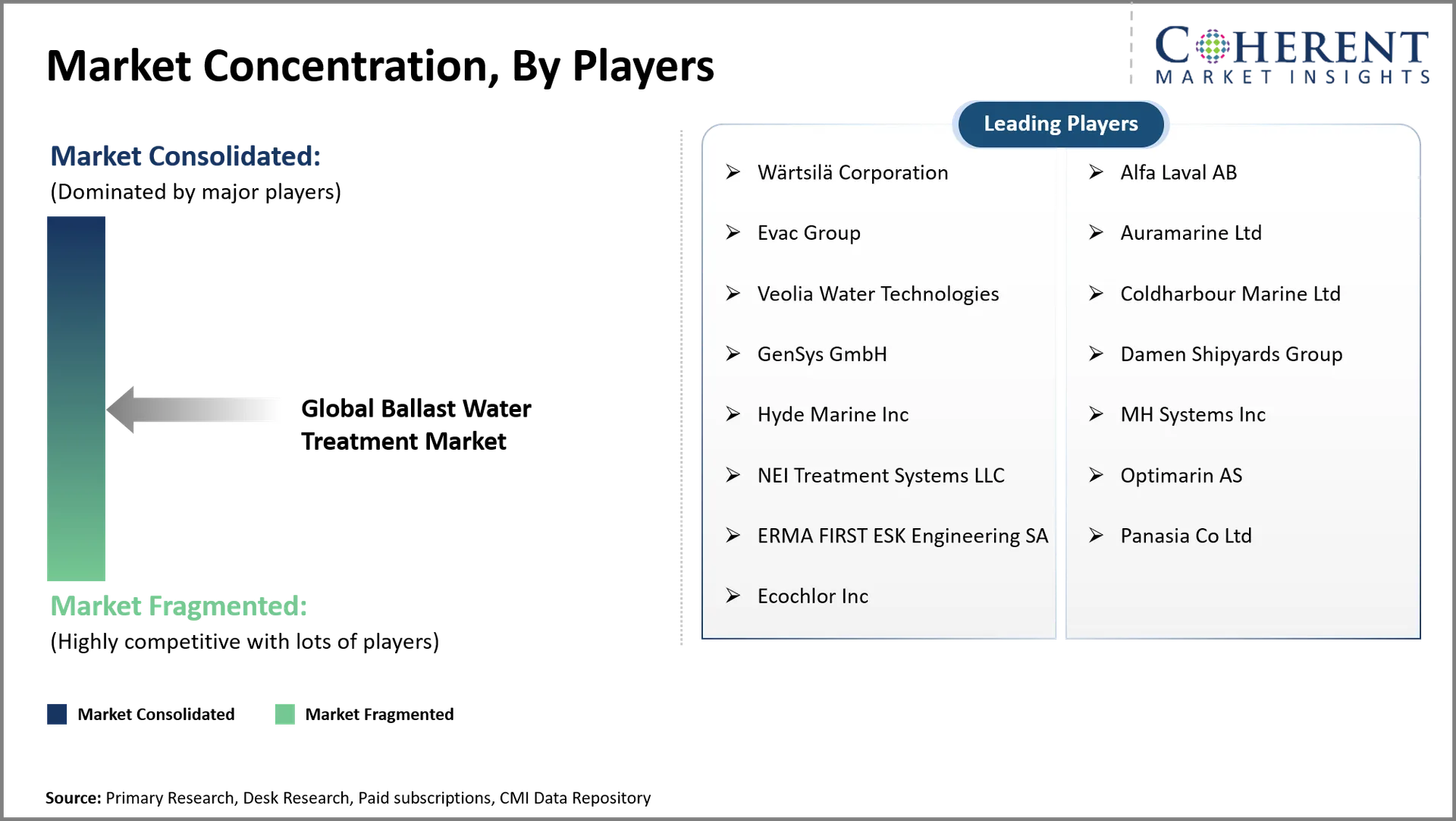
Key Developments
- On September 8, 2026, Techcross completely renewed its Smart Platform, a dedicated web-based service for shipowners. The key focus of the renewal is to go beyond simply providing operational data from Ballast Water Management Systems by improving the information structure and data analytics functions, enabling users to identify vessel conditions and necessary actions more quickly.
- On September 3, 2026, Alfa Laval unveiled the PureBallast 3 Ultra Skid, a new skid-mounted version of its PureBallast 3 Ultra ballast water management system. Developed in response to customer demand, the PureBallast 3 Ultra Skid combines the system’s proven biological treatment performance with a prefabricated design that minimizes footprint and installation time.
- On May 22, 2026, BIO-UV Group confirmed the successful completion of a high-profile program with its shipbuilding partner Chantiers de l’Atlantique to supply BIO-SEA ballast-water treatment systems to a series of five cruise ships.
Competitive Landscape
The global ballast water treatment market is extremely competitive with key companies competing on the basis of technology, retrofit and lifetime support. PureBallast 3 is targeted at compact ultraviolet systems, filtration, lower energy use, connectivity and customizable retrofit options. Its PureBallast 3 Ultra supports flows from 32 to 3,000 cubic meters per hour. Wärtsilä offers AQUARIUS UV and AQUARIUS EC systems for different vessel sizes and operating conditions. Its AQUARIUS range reaches capacities of 6,000 cubic meters per hour or more. Wärtsilä also emphasizes turnkey retrofit engineering, installation planning, training, and lifecycle support. These strategies show increasing competition around compact equipment, retrofit execution, energy efficiency, automation, and long-term service support.
Top Manufacturers and their Notable Products
Manufacturer | Notable Product | Key features |
Alfa Laval | PureBallast 3 Ultra | Chemical-free filtration and enhanced ultraviolet treatment, automated cleaning-in-place, compact installation, 32-3,000 m³/h capacity, reduced power consumption |
Wärtsilä | AQUARIUS UV | Two-stage filtration and ultraviolet treatment, automatic filter backwashing, automatic ultraviolet lamp wiping, continuous ultraviolet intensity monitoring, modular installation |
Techcross | Electro-Cleen System | Direct electrolysis, low power consumption, compact installation, low maintenance costs, residual hypochlorous acid prevents microorganism regrowth |
Optimarin | Optimarin Ballast System | Chemical-free filtration and ultraviolet treatment, automated operation, 65-3,000 m³/h capacity, self-cleaning filters, hazardous-area configuration |
BIO-UV Group | BIO-SEA B | Mechanical filtration and ultraviolet disinfection, automatic ultraviolet dose control, chemical-free operation, modular or skid configuration, low operating costs |
Global Ballast Water Treatment Market Report Scope
Global Ballast Water Treatment Market Report Coverage | |||
Report Coverage | Details | ||
Base Year | 2025 | Market Size in 2026: | USD 7.90 Bn |
Historical Data For: | 2020 To 2024 | Forecast Period: | 2026 To 2033 |
Forecast Period 2026 To 2033 CAGR: | 8.20% | 2033 Value Projection: | USD 14.50 Bn |
Geographies covered: |
| ||
Segments covered: |
| ||
Companies covered: | Wartsila Corporation, Alfa Laval AB, Evac Group, Auramarine Ltd, Veolia Water Technologies, Coldharbour Marine Ltd, GenSys GmbH, Damen Shipyards Group, Hyde Marine Inc, MH Systems Inc, NEI Treatment Systems LLC, Optimarin AS, ERMA FIRST ESK Engineering SA, Panasia Co Ltd, Ecochlor Inc | ||
Growth Drivers: |
| ||
Restraints & Challenges: |
| ||
Analyst Opinion (Expert Opinion)
- The future of the market will increasingly center on retrofit optimization rather than equipment sales alone. Existing vessels require treatment systems without the space allowances available on newbuild vessels. Suppliers therefore need compact reactors, adaptable filtration modules, and prefabricated installation packages. Alfa Laval's retrofit approach includes engineering support, three-dimensional laser scanning, class approval, and installation coordination. Wärtsilä similarly emphasizes phased preparation to reduce installation time and vessel disruption. This direction should make retrofit engineering capability a major competitive differentiator.
- The strongest opportunities should emerge in ultraviolet systems, retrofit applications, and major shipbuilding countries. UV systems can eliminate handling of chemicals and combine filtration and disinfection in little equipment. Demand for retrofits should remain particularly appealing for bulk carriers, tankers, container ships and passenger vessels with limited equipment room. There is considerable potential in China, South Korea and Japan as shipbuilding industries produce concentrated equipment integration opportunities. Standard installations should be replaced by vessel specific engineering packages provided by suppliers. They should have good links with shipyards, classification societies and fleet operators.
- For an edge, players need to integrate equipment sales with commissioning, maintenance, training, spare parts and digital monitoring. Alfa Laval already offers connectivity-based services to help increase system uptime and fleet optimization. Wärtsilä provides training and lifecycle support alongside its treatment systems. Suppliers should also strengthen performance under challenging water conditions and variable salinity. Systems should provide clear diagnostics when filtration loading, ultraviolet performance, or electro-chlorination conditions change. A strong service network can therefore become as important as treatment technology itself.
Speak to the analyst
Want personalized insights?
Take the findings above to one of our principal consultants, or have the report rebuilt around the segments, geographies and competitors you actually track.
Market Segmentation
- Vessel Type Insights (Revenue, USD Billion, 2021 - 2033)
- Bulk Carriers
- Oil Tankers
- Container Ships
- General Cargo Ships
- Gas Carriers
- Cruise Ships
- System Type Insights (Revenue, USD Billion, 2021 - 2033)
- Filtration
- Chemical Disinfection
- Ultraviolet Treatment
- Deoxygenation
- Heat Treatment
- Others
- Application Insights (Revenue, USD Billion, 2021 - 2033)
- Stationary Systems
- Mobile Systems
- Shipboard Systems
- Others
- Regional Insights (Revenue, USD Billion, 2021 - 2033)
- North America
- U.S.
- Canada
- Latin America
- Brazil
- Argentina
- Mexico
- Rest of Latin America
- Europe
- Germany
- U.K.
- Spain
- France
- Italy
- Russia
- Rest of Europe
- Asia Pacific
- China
- India
- Japan
- Australia
- South Korea
- ASEAN
- Rest of Asia Pacific
- Middle East
- GCC Countries
- Israel
- Rest of Middle East
- Africa
- South Africa
- North Africa
- Central Africa
- North America
Sources
Primary Research Interviews
- Ballast Water Treatment System Manufacturers
- Ship Owners & Fleet Operators
- Port Authority Officials & Maritime Regulators
- Environmental Compliance Consultants
Magazines
- Marine Technology News
- Maritime Executive Magazine
- Ship & Bunker Magazine
- Riviera Maritime Media
Journals
- Journal of Marine Science and Engineering
- Ocean & Coastal Management Journal
- Marine Pollution Bulletin
Associations
- International Maritime Organization (IMO)
- Baltic and International Maritime Council (BIMCO)
- International Chamber of Shipping (ICS)
- Society of Naval Architects and Marine Engineers (SNAME)
Public Domain Sources
- IMO Ballast Water Management Convention (BWM Convention) Official Portal
- U.S. Coast Guard (USCG) Ballast Water Management Program
- European Maritime Safety Agency (EMSA) Reports
- United Nations Conference on Trade and Development (UNCTAD) Reports
Proprietary Elements
- CMI Data Analytics Tool
- Proprietary CMI Existing Repository of information for last 10 years
Get access to 250+ pages report
Every segment, forecast, competitor profile and data table behind the analysis above — available for instant download.
- ESOMAR Member
- ISO 9001:2015 Certified
- D-U-N-S Registered
- GDPR & CCPA Compliant
Frequently Asked Questions
The global ballast water treatment market is expected to stand at USD 7.90 Bn in 2026 and is expected to reach USD 14.50 Bn by 2033.
The CAGR of the global ballast water treatment market is projected to be 8.2% from 2026 to 2033.
Increasing enforcement of ballast water management regulations and Growing implementation of International Maritime Organization requirements are the major factors driving the growth of the global ballast water treatment market.
High installation and retrofit costs and Complex integration with existing vessels are the major factors hampering the growth of the global ballast water treatment market.
In terms of vessel type, bulk carriers segment is estimated to dominate the market revenue share in 2026.
Ballast water treatment removes or neutralizes aquatic organisms before ships discharge ballast water.
Ultraviolet reactors deactivate microorganisms after filtration removes larger organisms and particles.