

Global Band Saw Blades Market Size and Forecast – 2026 To 2033
The global band saw blades market is expected to grow from USD 1.95 Bn in 2026 to USD 2.40 Bn by 2033, registering a compound annual growth rate (CAGR) of 2.6% from 2026 to 2033. The global band saw blades market is driven by growing industrial machinery manufacturing. On June 27, 2025, Kobe Steel announced that it has decided to invest in the expansion of a plant at Kobelco Industrial Machinery India (KIMI), a production base of the Kobe Steel Machinery Business division. The expansion is projected to be completed in fiscal 2027, with an estimated total investment of about USD 18 million.
Key Takeaways of the Global Band Saw Blades Market
- The Bi Metal Band Saw Blades segment is expected to account for 34.0% of the global band saw blades market share in 2026. Expansion of aerospace component production is driving the growth of the segment. On March 12, 2025, GE Aerospace announced plans to invest nearly USD 1 billion in its U.S. factories and supply chain to strengthen manufacturing.
- The Regular Tooth segment is estimated to capture 39.0% of the market share in 2026. Increasing adoption of automated cutting systems is majorly driving the growth of the segment. On July 3, 2025, FRIGGI Cutting Solutions deployed a customized gantry band saw capable of cutting workpieces up to 5,100 millimeters in diameter.
- The Metal Working segment is estimated to capture 43.0% of the market share in 2026. Increasing replacement demand from manufacturing facilities is driving the growth of the segment. On May 28, 2025, M-Factor HSN Band Saw Blade was launched by Morse. Used for aluminum billets, engine blocks, aluminum parts. The multi-chip tooth design and narrower kerf help minimize heat and improve blade life.
- North America is expected to dominate the band saw blades market in 2026 with a market share of 36.0%. Increasing adoption of automated and computer numerical control cutting technologies across North America is driving the demand for band saw blades. On September 11, 2025, BEHRINGER SAWS showcased advanced automated sawing and material-handling equipment at FABTECH 2025 in Chicago, Illinois, U.S.
- Asia Pacific is expected to account for 31.0% share in 2026. Development of application specific tooth geometries in Asia Pacific is driving the growth of the regional market. On September 24, 2025, Bichamp participated at China International Machine Tool Show 2025 in Beijing. The company showcased its band saw blade portfolio for specialized metalworking applications.
Segmental Insights
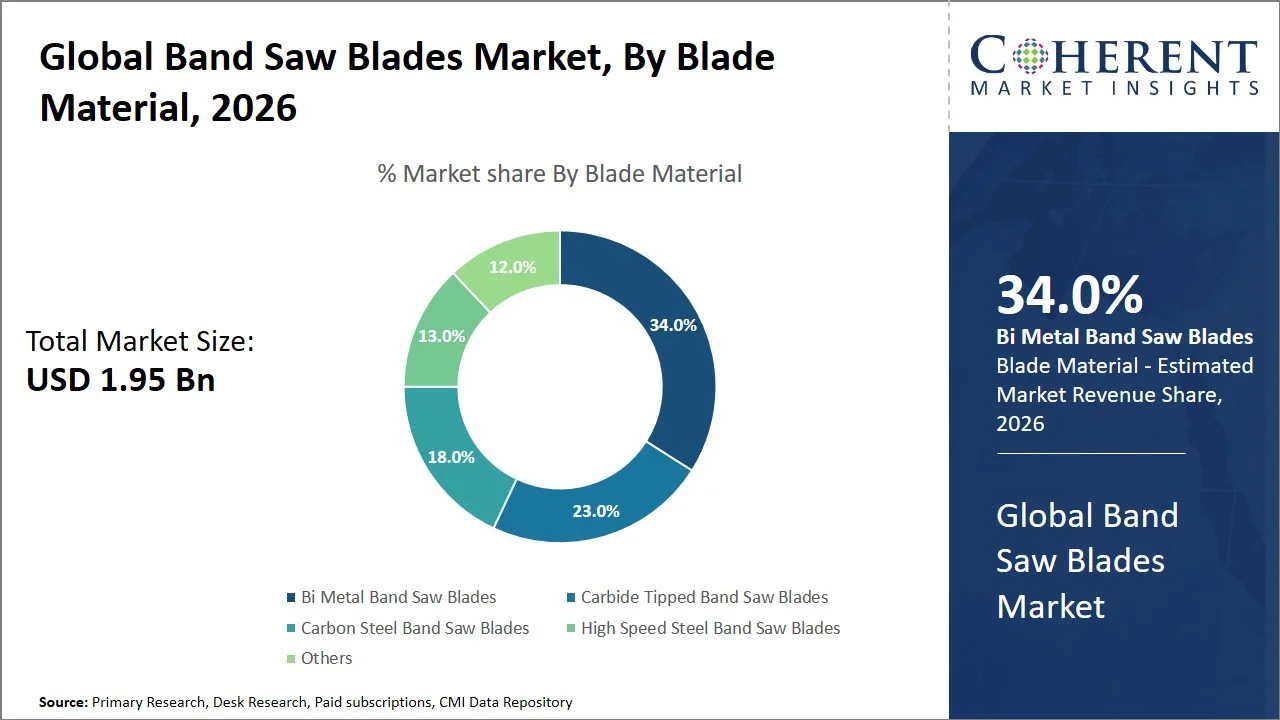
Why Does Bi Metal Band Saw Blades Dominate the Global Band Saw Blades Market?
The Bi metal band saw blades segment is expected to account for 34.0% of the global band saw blades market share in 2026. Bi metal band saw blades provide an excellent combination of cutting performance, durability and operating cost. The flexible alloy backing helps to prevent fatigue in prolonged industrial cutting jobs. High speed steel teeth are good for wear resistance when machining metals like steel and aluminum. This combination provides longer blade life in severe manufacturing circumstances. This enables producers to count on a higher degree of reliability in the cutting process with fewer blade replacements and shorter downtimes. On June 4, 2025, WIKUS presented its bi metal band saw blade GENERO at the trade fair LIGNA 2025. This is a heavy duty sawing tool for mobile or stationary sawmills and can be used on smaller log band saws and band resaws.
- Current Industry Events of 2026
- Market Size Estimation
- Regional Breakdown
- Competitive Landscape
- Customer Intelligence
- Segmental Analysis
- Pricing Analysis
- Key Market Drivers, Challenges & Future Trends
- Customized Insights Section
Why is Regular Tooth the Most Crucial Tooth Configuration?
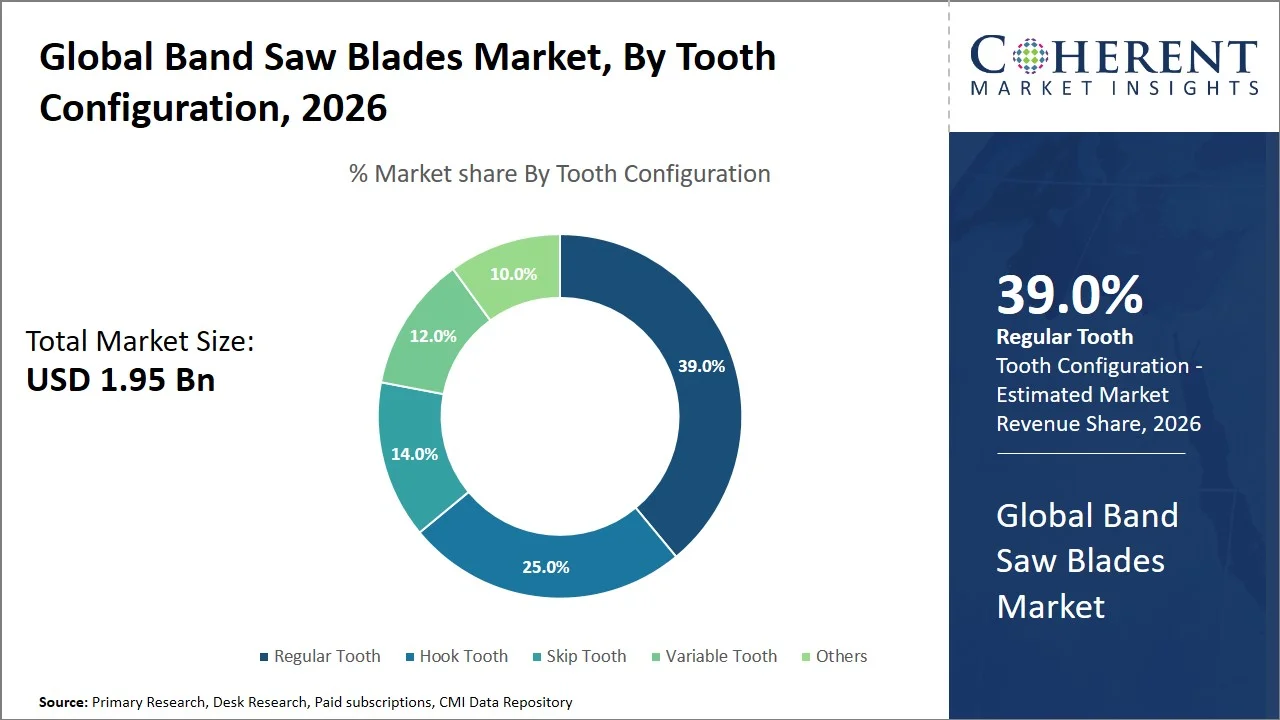
The regular tooth segment is expected to account for 39.0% of the global band saw blades market share in 2026. Regular tooth designs provide balanced cutting performance for different general purpose applications. Their equally spread teeth allow for uniform chip removal in normal metal cutting operations. This setup works well with typical materials such as mild steel and structural steel. Its consistent cutting motion also makes blade selection easier for plants. So, the traditional tooth blades are still quite suitable for the daily cutting needs of the industry. For example, Starrett continued to sell general purpose band saw blades for use in all types of industrial metalworking applications. It has a conventional tooth configuration portfolio for standard steel cutting and manufacturing. The company issued blade-selection recommendations in January 2025, highlighting the significance of match-up of teeth configuration to material parameters.
Metal Working Dominates the Global Band Saw Blades Market
The metal working segment is expected to account for 43.0% of the global band saw blades market share in 2026. Band saws are widely used in metal manufacturing, which keeps a steady demand for blades in metalworking applications. Industrial plants need to cut steel, aluminum, stainless steel and other metals precisely. Band saw blades provide controlled cutting of structural members, pipelines, bars and metal sheets. They are also suitable for use with automatic sawing machines, enabling continuous production runs. This results in a tremendous and repetitive requirement for replacement and high performance blades in metalworking applications. At Blechexpo 2025, WIKUS unveiled PROFIDUR for industrial sheet metal production. The carbide tipped blade is suitable for beams, round profiles, hollow profiles and steel constructions. The tooth design allows for interrupted cuts and increases chip removal efficiency and dimensional accuracy.
Current Events and their Impact
Current Events | Description and its Impact |
European Union - Regulation (EU) 2023/1230 on Machinery |
|
U.S. - Occupational Safety and Health Administration Machine Guarding Requirements |
|
Band Saw Blades Market Dynamics
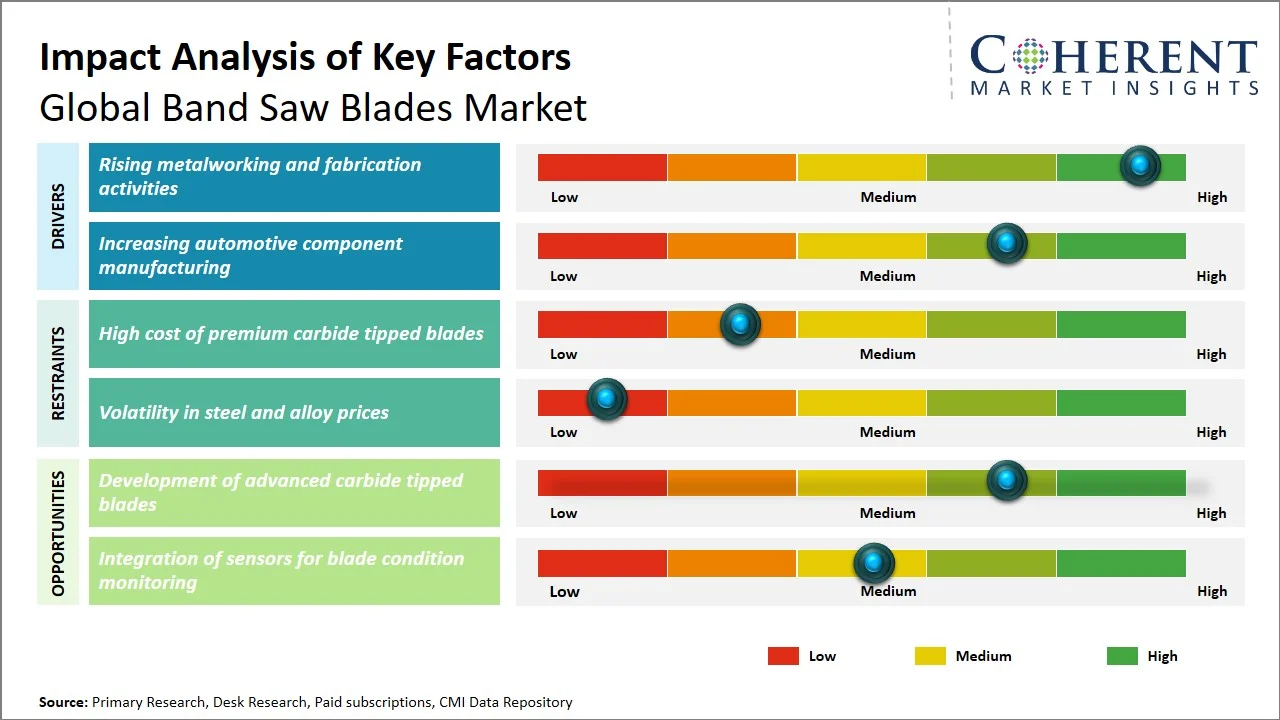
Market Drivers
- Rising metalworking and fabrication activities: Increasing metalworking and fabrication activities are driving demand for efficient industrial cutting equipment. Accurate sizing is important for the manufacturing of structural steel, pipelines, bars, and metal components. Band saw blades enable controlled cutting performance for different grades of metals and sizes of components. Hence, rising investments in fabrication facilities are underpinning periodic blade replacement needs. This tendency is especially relevant in construction, equipment, automotive and general industry sectors. On October 6, 2025, Jindal Stainless established its first stainless steel fabrication factory at Washivali, Patalganga, Mumbai, India. The purpose of this initiative is to establish new benchmarks for integrated infrastructure excellence. The new facility will cater to the needs of bridge sector and focus on fabricating, among other critical components, various types of girders.
- Increasing automotive component manufacturing: Increasing automotive component manufacturing is creating greater demand for precision cutting of metal parts. The purpose of this initiative is to establish new benchmarks for integrated infrastructure excellence. On February 6, 2026, Mahindra Group announced plans to set up its biggest integrated manufacturing facility for autos and tractors in Nagpur, Maharashtra, India. This is an important milestone in the Group’s long-term expansion strategy.
Emerging Trends
- Growing Adoption of Carbide Tipped Blades: The band saw blades with carbide tips are getting more and more used in cutting of tough alloys and challenging materials. Their higher wear resistance ensures longer running cycles and better dimensional precision. These blades are increasingly the choice of manufacturers for tough aerospace, automotive, and heavy industrial jobs.
- Increasing Integration with Automated Sawing Systems: Automated band sawing systems are becoming more common in high-volume industrial environments. These systems incorporate configurable cutting parameters and automatic feeding and blade monitoring. Integration results in increased productivity, reduced operator intervention and assists in ensuring constant cutting quality in continuous industrial production.
- Development of Advanced Tooth Geometries: Manufacturers are developing tooth geometries for specific materials and cutting circumstances. Variable pitch, optimal rake angles and strengthened tooth designs help to improve chip evacuation and reduce vibration. Such improvements are very advantageous for demanding alloys and high-volume cutting processes.
- Rising Demand for Sustainable Cutting Solutions: Environmental concerns are pushing manufacturers to enhance blade durability and minimize material wastage. Longer lasting blades cut down the frequency of replacement and manufacturing consumption. Producers are also investigating efficient production procedures and recyclable steel components for improved sustainability in industrial cutting applications.
Regional Insights
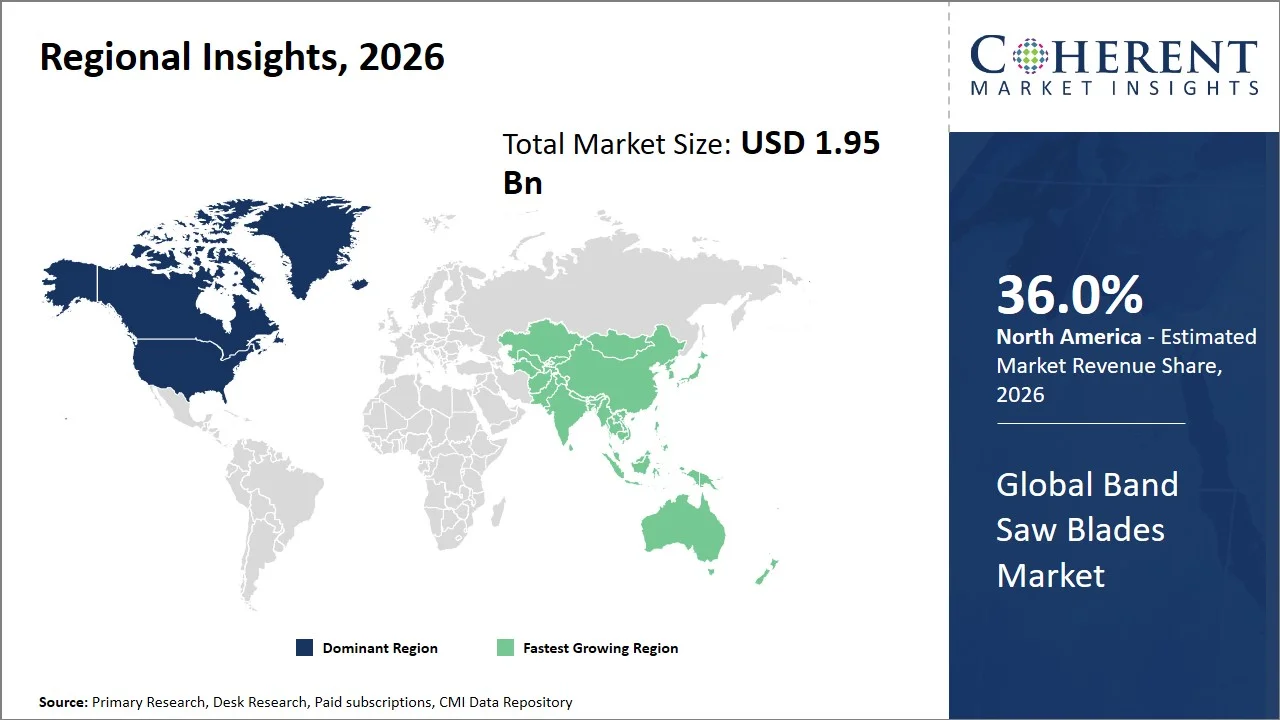
Why is North America a Strong Market for Band Saw Blades?
North America is expected to account for a market share of 36.0% in 2026. The demand for band saw blades in North America is closely driven by the machining of aerospace components and heavy equipment manufacturing. The U.S. aircraft industry requires machining titanium, aluminum, nickel alloys and stainless-steel components. Metal service shops also employ band saws to cut billets, bars, tubes and structural parts. Blades for high-strength steels and aluminum alloys find further demand from automotive suppliers. In 2024, the U.S. made up 87% of North American consumption volume. The region produced less than it consumed, which sustained imports of specialized industrial blades. Demand for longer-life blades and variable-pitch configurations is further supported by the increasing use of automated cutting equipment.
Why Does Asia Pacific Band Saw Blades Market Exhibit High Growth?
Asia Pacific is expected to register the fastest growth with a CAGR of 3.3% over the forecast period. It is projected to account for 31.0% of the global band saw blades market in 2026. Asia Pacific demand is supported by extensive metal processing and machinery manufacturing activity. In 2024, China accounted for 53% of regional consumption of band saw blades. During the same period, China accounted for some 64% of regional production. India is one of the growth markets for developing manufacturing and industrial infrastructure for machines. Japan is a major source of demand for precise automotive and engineering applications. In 2024 China exported around 9,700 tons of band saw blades. The largest importer in the region, India, showed growing demand for specialist cutting products. Regional manufacturers are also expanding production capabilities for bi-metal and carbide-tipped blades.
Global Band Saw Blades Market Outlook for Key Countries
Why is U.S. Emerging as a Major Hub in the Band Saw Blades Market?
U.S. band saw blade market is benefitted by manufacturing activity in aerospace, military, automotive and machinery. Aerospace producers need precise cutting of titanium alloys, aluminum, nickel alloys and high strength steels. Band saws are used by automotive suppliers for the production of forgings, tubes, bars and structural components. Accurate billet preparation is a must for machine manufacturers in producing industrial equipment. The Occupational Safety and Health Administration has specific regulations for machine guarding for band saw operations. In 2024, the U.S. made up 87% of North American consumption volume. Automation is expanding at metal service facilities, which is driving demand for consistent blade performance and longer working cycles.
Is China the Next Growth Engine for the Band Saw Blades Market?
China’s market is driven by its massive metal processing, automotive, machinery and construction equipment sectors. In 2024 the country consumed around 33,000 tons of band saw blades. This represented approximately 53% of Asia Pacific consumption volume. China also produced approximately 64% of regional band saw blades during the year. Construction machinery manufacturers require blades for cutting heavy structural steel and fabricated components. Automotive manufacturers create additional requirements for processing steel and aluminum components. In 2024, China exported around 9,700 tons. Its extensive manufacturing base in the US provides basic industrial blades and custom items for demanding applications.
Germany Band Saw Blades Market Analysis and Trends
Germany’s demand is tightly linked to machinery manufacture, automotive engineering and industrial metalworking. German automotive suppliers need accurate cutting of steel, stainless steel, aluminum, forgings, tubes and structural parts. Band saws are also used by machinery manufacturers to prepare metal sections and billets for subsequent machining. The uptake of controlled-feed-rate automatic sawing equipment is driven by Germany’s advanced engineering sector. More and more industrial users are choosing bi-metal and carbide tipped blades for hard to process metals. German producers also have know-how in the area of premium cutting equipment and industrial saw blades. This combination meets demand for blades that deliver extended service life, dimensional uniformity and predictable cutting performance.
Japan Band Saw Blades Market Analysis and Trends
Japanese demand for band saw blades is driven by precision manufacturing, automotive manufacturing and industrial machinery manufacturing. In 2024, the country consumed around 6,500 tons of band saw blades. That year, Japan accounted for around 10% of consumption volumes in the Asia Pacific. Automotive producers demand precision cutting of high-strength steel, aluminum and specialty components. The machinery manufacturers stipulate more conditions for the correct processing of billets and bars. Japan demonstrated strong domestic production potential with a production capacity of over 7,700 tons in 2024. Japanese industrial users stress dimensional accuracy and blade stability in automated cutting. For rigorous manufacturing situations, premium bi-metal and carbide tipped blades are best matched to these needs.
India Band Saw Blades Market Analysis and Trends
India band saw blade market is growing on the back of increasing industrial, infrastructural and engineering production. In 2024, it consumed almost 14,000 tons, being the second highest user in the Asia Pacific. Increasing demand for cutting steel bars, tubes, billets and fabricated sections is due to growth in the machinery industry. Another important demand source is the automotive component manufacturing throughout large industrial clusters. Steel fabrication activity and component processing needs are also growing due to infrastructural initiatives in India. In Asia Pacific in 2024, India was the leading importer of band saw blades in volume terms. Import dependency creates prospects for specialist bi-metal and carbide tipped blades with better cutting efficiency.
Global Band Saw Blades Market - Bi Metal Blade Adoption by Application (2025)
Application | Adoption Share |
Steel Cutting | 33.84% |
Aluminum Cutting | 27.17% |
Cast Iron Cutting | 16.51% |
Other Applications | 22.48% |
How is Development of Advanced Carbide Tipped Blades Creating New Growth Opportunities in the Band Saw Blades Market?
Development of advanced carbide tipped blades is creating opportunities in difficult material cutting, particularly for aerospace and energy applications. New tooth geometries are being engineered for titanium, Inconel, nickel alloys, hardened steels, and stainless steel, where conventional bi metal blades face shorter operating lives. The Starrett Advanz MC7 uses progressive four tooth grinding to reduce wear during nickel alloy and titanium cutting. Specialized coatings such as AlTiN are also being investigated for titanium alloy sawing, improving resistance under demanding thermal conditions. According to DoALL, carbide blades can have about 20% longer life than bi metal blades in some situations. These advances result in premium potential for manufacturers aiming for faster cutting, less finishing and less production downtime. In February 2025, Fuweisi launched a new coating method for metal-sawing blades. The business intends to begin commercial promotion around April 2025. The development blends its carbide coating technology with its metal cutting band saw blade portfolio.
Market Players, Key Development, and Competitive Landscape
Key Developments
- On March 2, 2026, Morse launched its coated band saw blade for structural cutting, Challenger Edge Lock, a new premium bi-metal band saw blade designed for interrupted cutting. Featuring a temperature-resistant coating on the blade teeth, Challenger Edge Lock delivers higher cutting productivity without sacrificing blade life.
- On May 22, 2025, AMADA MACHINERY CO., LTD. announced it will launch sales of the WS-700VP structural steel drilling and band saw combined production machine from June, 2025 as a new product in its WS Series lineup.
Competitive Landscape
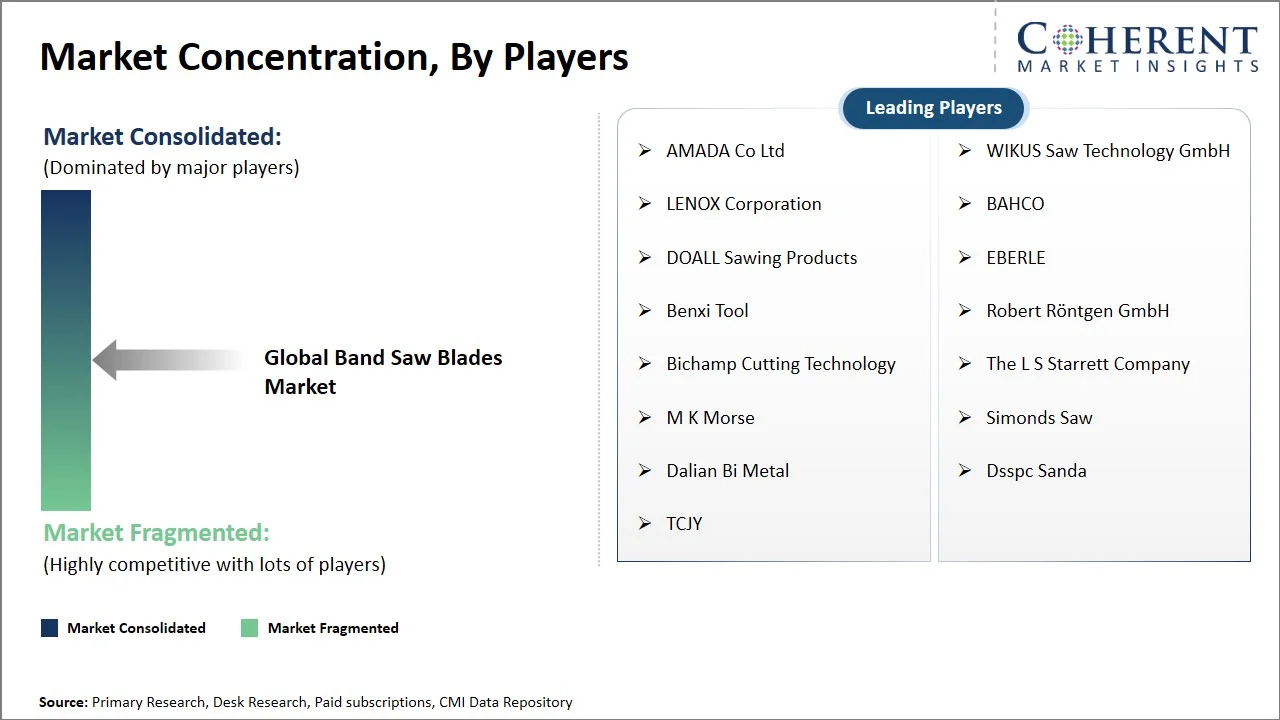
AMADA, WIKUS and LENOX are the major players in the competitive environment with considerable specialization in sophisticated blade technology. AMADA is expanding its carbide capabilities with AXCELA solutions for high-strength steels, stainless steels, titanium and nickel alloys. Its AXCELA A is developed for aluminum castings in automated automotive sawing systems above 1,000 meters per minute. Emphasis on application-specific tooth shapes, carbide grades, coatings and technical assistance. Its FUTURA blade is designed to cut structural, case-hardened, tempered and carbon steels several times. LENOX is emphasizing specialized carbide families for aerospace alloys, superalloys, hardened materials, aluminum, and difficult-to-cut metals. Its MAX CT specifically targets aerospace alloys, while TNT CT focuses on superalloys.
Market Report Scope
Band Saw Blades Market Report Coverage
| Report Coverage | Details | ||
|---|---|---|---|
| Base Year: | 2025 | Market Size in 2026: | USD 1.95 Bn |
| Historical Data for: | 2020 To 2024 | Forecast Period: | 2026 To 2033 |
| Forecast Period 2026 to 2033 CAGR: | 2.6% | 2033 Value Projection: | USD 2.40 Bn |
| Geographies covered: |
| ||
| Segments covered: |
| ||
| Companies covered: | AMADA Co Ltd, WIKUS Saw Technology GmbH, LENOX Corporation, BAHCO, DOALL Sawing Products, EBERLE, Benxi Tool, Robert Röntgen GmbH, Bichamp Cutting Technology, The L S Starrett Company, M K Morse, Simonds Saw, Dalian Bi Metal, Dsspc Sanda, TCJY | ||
| Growth Drivers: |
| ||
| Restraints & Challenges: |
| ||
Analyst Opinion (Expert Opinion)
- The future of the industry is expected to favor application-specific blades rather than broad-purpose products. Carbide tipped blades should gain importance for titanium, nickel alloys, hardened steels, and abrasive materials. AMADA already offers carbide solutions specifically engineered around these challenging materials. Automotive aluminum casting is another promising application because automated systems increasingly demand high-speed, long-life cutting. AMADA’s AXCELA A shows this direction, with compatibility of over 1,000 meters per minute.
- Aerospace, automotive, energy and sophisticated metal processing sectors are likely to offer the best potential. Aerospace gives a specific opportunity for carbide blades tailored to titanium and nickel alloys.” LENOX already addresses these materials with its AEROWOLF product series. China and India should be key production and consumption areas, while Japan and Germany offer chances for precision-oriented premium blades. It is believed that players should design unique tooth geometry for certain alloys and not only depend on common configurations.
- Companies who want an edge should combine blade creation with application engineering and support for cutting parameters. WIKUS demonstrates this through its Blade Selector and technical expertise services. Manufacturers also need to invest in coatings, regulated tooth shape and stronger carbide grades for difficult applications. The AMADA AXCELA G is built for high-alloy steels and has carbide, a micro-chamfered tooth tip and EX-COAT-DP technology. Such application-specific engineering can strengthen differentiation while improving cutting consistency and blade utilization.
Speak to the analyst
Want personalized insights?
Take the findings above to one of our principal consultants, or have the report rebuilt around the segments, geographies and competitors you actually track.
Market Segmentation
- Blade Material Insights (Revenue, USD Billion, 2021 - 2033)
- Bi Metal Band Saw Blades
- Carbide Tipped Band Saw Blades
- Carbon Steel Band Saw Blades
- High Speed Steel Band Saw Blades
- Others
- Tooth Configuration Insights (Revenue, USD Billion, 2021 - 2033)
- Regular Tooth
- Hook Tooth
- Skip Tooth
- Variable Tooth
- Others
- Application Insights (Revenue, USD Billion, 2021 – 2033)
- Metal Working
- Wood Working
- Food Processing
- Plastic Cutting
- Others
- Regional Insights (Revenue, USD Billion, 2021 - 2033)
- North America
- U.S.
- Canada
- Latin America
- Brazil
- Argentina
- Mexico
- Rest of Latin America
- Europe
- Germany
- U.K.
- Spain
- France
- Italy
- Russia
- Rest of Europe
- Asia Pacific
- China
- India
- Japan
- Australia
- South Korea
- ASEAN
- Rest of Asia Pacific
- Middle East
- GCC Countries
- Israel
- Rest of Middle East
- Africa
- South Africa
- North Africa
- Central Africa
- North America
- Key Players Insights
- AMADA Co Ltd
- WIKUS Saw Technology GmbH
- LENOX Corporation
- BAHCO
- DOALL Sawing Products
- EBERLE
- Benxi Tool
- Robert Röntgen GmbH
- Bichamp Cutting Technology
- The L S Starrett Company
- M K Morse
- Simonds Saw
- Dalian Bi Metal
- Dsspc Sanda
- TCJY
Sources
Primary Research Interviews
- Band Saw Blade Manufacturers & Suppliers
- Industrial Cutting Tool Distributors & Retailers
- Procurement & Supply Chain Managers
Magazines
- Modern Machine Shop Magazine
- Cutting Tool Engineering Magazine
- Manufacturing Engineering Magazine
- Wood & Panel Magazine
Journals
- International Journal of Advanced Manufacturing Technology
- Journal of Manufacturing Processes
- Journal of Materials Processing Technology
Associations
- Association for Manufacturing Technology (AMT)
- Precision Metalforming Association (PMA)
- American Saw Manufacturers Association (ASMA)
- European Power Tool Association (EPTA)
Public Domain Sources
- U.S. Census Bureau – Manufacturing & Industrial Data
- United Nations Industrial Development Organization (UNIDO)
- U.S. International Trade Commission (USITC)
- World Bank – Industrial & Trade Statistics
Proprietary Elements
- CMI Data Analytics Tool
- Proprietary CMI Existing Repository of Information for the Last 10 Years
Get access to 250+ pages report
Every segment, forecast, competitor profile and data table behind the analysis above — available for instant download.
- ESOMAR Member
- ISO 9001:2015 Certified
- D-U-N-S Registered
- GDPR & CCPA Compliant
Missing comfort of reading report in your local language? Find your preferred language:
Frequently Asked Questions
The global band saw blades market is expected to stand at USD 1.95 Bn in 2026 and is expected to reach USD 2.40 Bn by 2033.
The CAGR of the global band saw blades market is projected to be 2.6% from 2026 to 2033.
In terms of blade material, bi metal band saw blades segment is estimated to dominate the market revenue share in 2026.
Band saw blades are primarily used for continuous cutting of metals, wood, plastics, and other materials.
Automotive component production requires repeated cutting of steel, aluminum, forgings, tubes, and structural parts.
Aerospace manufacturing involves difficult alloys requiring precise cutting and strong resistance to tooth wear.
Tooth geometry influences cutting speed, chip evacuation, vibration, blade life, and surface quality.