
Global Battery Black Mass Processing Chemicals Market Size and Forecast – 2026 To 2033
The global battery black mass processing chemicals market is estimated to be valued at USD 3,518.6 Mn in 2026 and is expected to reach USD 7,827.2 Mn by 2033, growing at a compound annual growth rate (CAGR) of 12.10% from 2026 to 2033. The significant increase in volume is attributed to the growing demand, especially in the rapidly evolving electric vehicle (EV) industry, alongside the growing importance of sustainable battery recycling solutions to efficiently and cost-effectively recover valuable metals.
Furthermore, investment in hydrometallurgical refining technologies is opening up opportunities for selective extraction, purification and metal recovery chemicals. In March 2026, India's Technology Development Board announced financial support for MiniMines Cleantech Solutions to commercialize its proprietary battery recycling technology, designed to recover battery-grade lithium, cobalt, nickel, and manganese compounds. The initiative focuses on increased investment in chemical recovery processes and how they can enhance domestic supply chains of battery materials.
Key Takeaways of the Global Battery Black Mass Processing Chemicals Market
- Leaching Acids are expected to see an estimated 11.8% CAGR growth till 2033, having accounted for 38.6% of the global battery black mass processing chemicals market in 2026. Sulfuric acid continues to be of commercial significance for its ability to extract valuable metals from black mass at controllable process costs. Researchers in March 2025 showed that the lithium extraction rate of LFP black mass treatment was high under the condition of using sulfuric acid and hydrogen peroxide for the pilot sample.
- Leaching is expected to expand at a compound annual growth rate of 12.3% up to 2033, and will account for a share of 52.7% in the global battery black mass processing chemicals market by processing stage in 2026. This stage is characterized by the need to dose the reagent (controlled) so as to keep the metal dissolving while passing various feedstocks. The Technology Development Board (TDB), an initiative from the Department of Science & Technology (DST) under the Ministry of Commerce, Government of India, facilitated BatX Energies to commercialize the recycling process combining metal leaching and downstream purification in June, 2025.
- Nickel Manganese Cobalt (NMC) and Nickel Cobalt Aluminum (NCA) are expected to grow by 10.9% CAGR to hold 46.9% of the global battery black mass processing chemicals market in 2026. They have a high amount of recoverable nickel and cobalt content to allow intensive separation and refining chemistry. Orano's REC2PCAM project was awarded an EU Innovation Fund grant for a proposed plant that will recycle black mass and produce NMC precursor materials in November 2025.
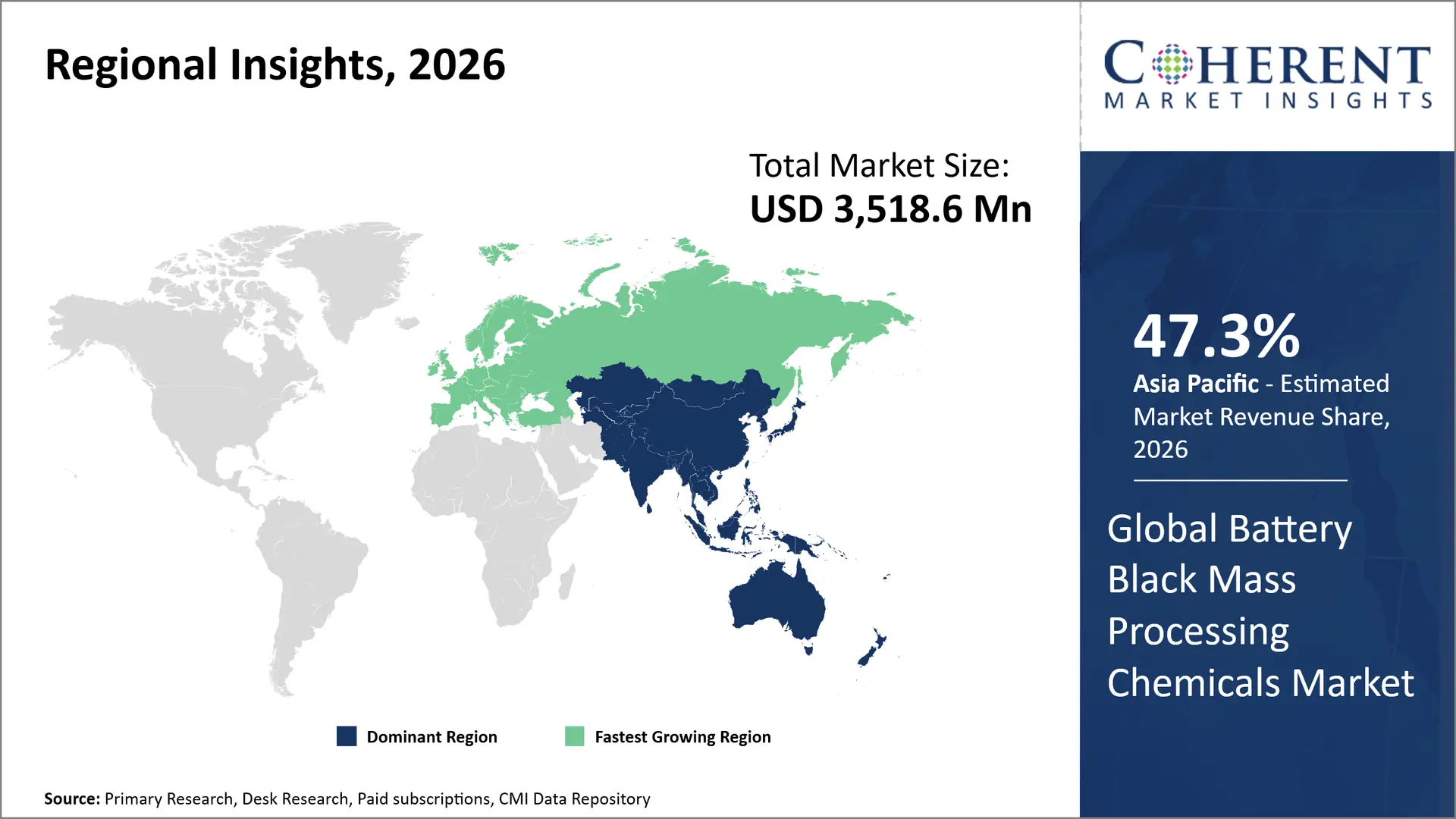
- Asia Pacific is projected to register an estimated CAGR of 11.6% through 2033 and dominate the global battery black mass processing chemicals market with a 47.3% share in 2026. The region has an established battery manufacturing ecosystem that supports localized chemical recovery and process development. In January 2026, India's LNINDTECH announced the installation of a black mass processing pilot plant, enabling the optimization and testing of battery metal recovery processes.
- Europe is expected to record the highest estimated CAGR of 14.2% through 2033, accounting for 24.2% of the global battery black mass processing chemicals market in 2026. Efforts to localize refined battery materials are encouraging investment in chemical recovery facilities across the region. In March 2026, Fortum entered into an EU grant agreement to support its planned NEXT HYDROMET expansion in Finland, aiming to improve processing efficiency and reduce chemical consumption.
Segmental Insights
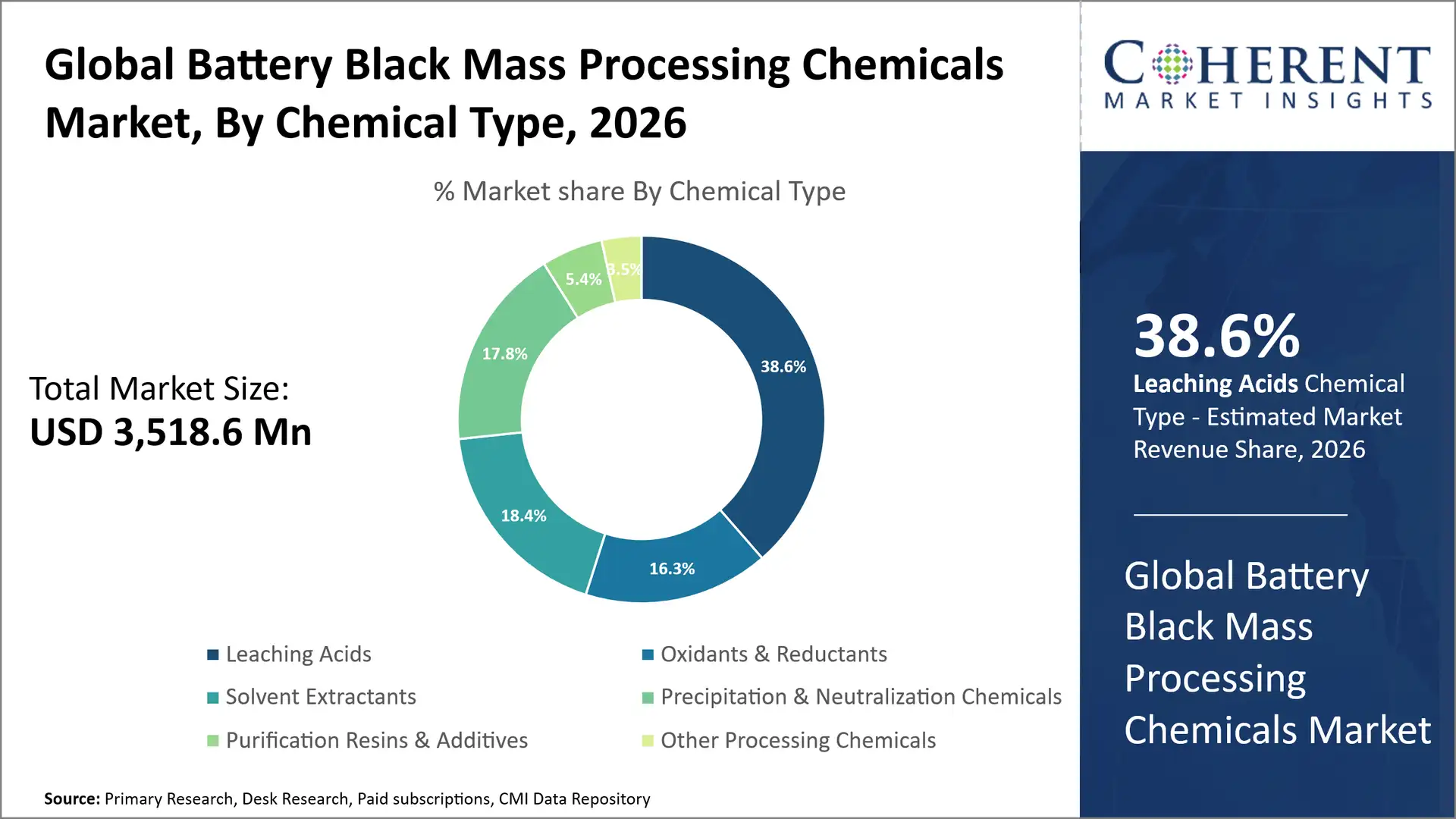
Why Do Leaching Acids Dominate the Global Battery Black Mass Processing Chemicals Market?
Leaching Acids will be the top chemical type category in the battery black mass processing chemicals market in 2026, with a share of 38.6%. In addition to being common, the type of acid used will affect the amount of neutralising chemical that will subsequently be needed, and whether or not the solution will be appropriate for selective extraction. This means that recycling operators dealing with varying black mass compositions compare acids with results of tests on a per feedstock basis, rather than with just the price delivered. Sulfuric and hydrochloric acid systems have well-established bulk chemical infrastructure and organic acids have specialized processing options. In August 2026, RWTH Aachen University researchers reported on research comparing the performance of eight acids on pyrolyzed black mass. The study also revealed that the same solution pH gave different efficiencies of metal extraction, which is a vital consideration when designing a refinery, due to the selection of the acids. Standard specifications and application testing can help build long-term supplier partnerships.
- Current Industry Events of 2026
- Market Size Estimation
- Regional Breakdown
- Competitive Landscape
- Customer Intelligence
- Segmental Analysis
- Pricing Analysis
- Key Market Drivers, Challenges & Future Trends
- Customized Insights Section
Why Does Leaching Represent the Largest Processing Stage in the Global Battery Black Mass Processing Chemicals Market?
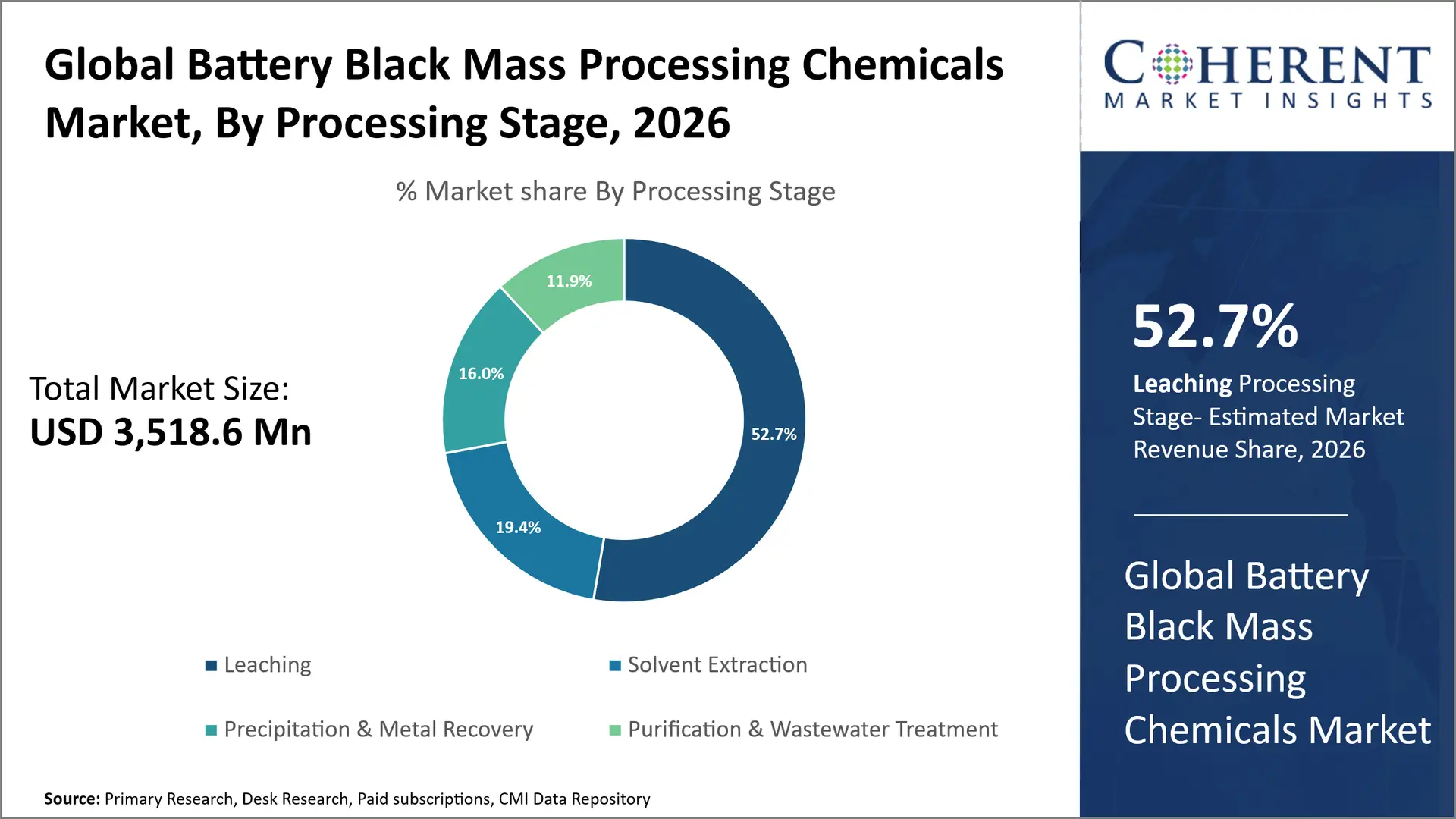
Leaching is expected to represent 52.7% of the global battery black mass processing chemicals market in 2026, the largest share by processing stage. This stage transforms mechanically separated battery powder into a metal rich solution that can be used in the next purification and recovery step. Commercial performance relies on residence time in the reactor, solids loading, solvent re-use and process control, and thus involves continuous chemical costs in addition to the costs of commissioning the plant. Recyclers also have to find a balance between metal extraction and filtration requirements, and equipment corrosion. In December 2024, Aqua Metals reported completing a three-week continuous pilot campaign near Reno, using its proprietary leaching process and recycled solvent to recover lithium, cobalt, and nickel from black mass. This operational achievement demonstrates why processing stability, rather than installed capacity alone, influences chemical procurement decisions and the economics of industrial leaching operations.
Why Do Nickel Manganese Cobalt (NMC) and Nickel Cobalt Aluminum (NCA) Dominate the Battery Chemistry Category?
Nickel Manganese Cobalt (NMC) and Nickel Cobalt Aluminum (NCA) are expected to account for 46.9% of the global battery black mass processing chemicals market in 2026, leading the battery chemistry category. Their recycling economics extend beyond recoverable metal content, as downstream cathode manufacturers require consistent elemental ratios, controlled impurities, and reliable material qualification. Such specifications promote the segregation of feedstock and specific purification to allow battery precursor compounds to be generated for market by the recyclers instead of mixed-metal intermediates. In July 2025, Green Li-ion entered into a binding offtake agreement with WMC for the recycled nickel-cobalt-manganese hydroxide from its Oklahoma facility until 2030. This agreement represents the commercial value of qualified recycled NMC materials and purchasing commitment. Chemical suppliers can provide added value through the development of separation formulations that can be used with various incoming battery compositions and continually provide the required precursor specifications.
Current Events and their Impact
Current Event | Description and Its Impact |
European Commission Introduces Battery Recycling Efficiency Verification Rules – July 2025 |
|
U.S. Introduces Domestic Sales Requirements for Battery Black Mass – August 2026 |
|
India Prohibits Exports of Lithium-Ion Battery Black Mass – November 2026 |
|
Global Battery Black Mass Processing Chemicals Market Dynamics
Key Market Drivers
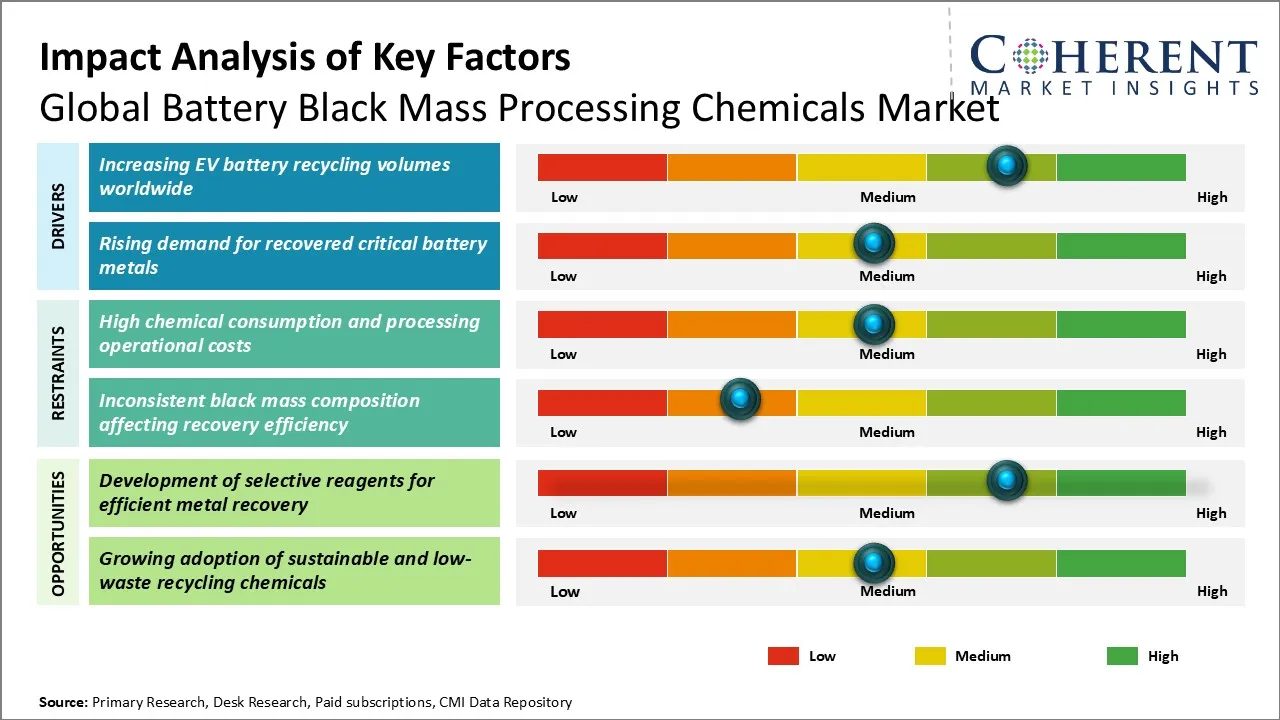
- Increasing EV battery recycling volumes worldwide: The expanding pool of electric vehicles is creating a sustained stream of retired battery packs and manufacturing scrap that must be converted into usable metal-bearing feedstock. In tandem, the volume of EV battery recycling is on the rise. The need for leaching agents, extractants and precipitation chemicals for each additional hydrometallurgical processing line is a boon for industrial chemical producers and specialist reagent suppliers. In October 2024, Mercedes-Benz opened its battery recycling plant in Kuppenheim, Germany. The plant combines mechanical preparation with chemical recovery of lithium, nickel and cobalt. The project shows how automakers' recycling commitments can be converted into recurring chemical procurement rather than one-time waste disposal spending.
- Rising demand for recovered critical battery metals: Black mass is processed into compounds that battery manufacturers can qualify for reuse, so recycled critical minerals have commercial value. This creates a need for selective reagents, impurity removal chemicals and separation consumables beyond simple shredding operations, which is a boon to specialty chemical producers and refiners. The U.S. Department of Energy selected a Nth Cycle project in August 2026 to use electroextraction to process battery black mass into high-purity metals and battery-grade materials, with a proposed federal share of US$100 million. The choice is indicative of the growing investment emphasis on chemical refining capabilities.
Emerging Market Trends
- Selective Lithium-First Recovery for Iron-Phosphate Batteries: Chemical treatment routes move from unchanged Nickel-rich battery recycling recipes to iron-phosphate black mass. A lithium-first extraction can focus on the valuable dissolved fraction, with iron and phosphate locked up in a more manageable residual stream.
Impact: Reagent suppliers will need to adjust to the requirement for custom separation chemistry and oxidation control, rather than the standardized bulk acid packages. If the feedstock is a blend of cathode compositions, process developers must also demonstrate economic performance.
Relevance to the Market: Specialized suppliers can compete through selective recovery efficiency and reduced downstream treatment requirements. Over the forecast period, chemistry-specific purchasing specifications are likely to become more common.
- Modular Chemical Refining at Existing Metallurgical Sites: Battery recyclers are considering modular refining units that can be added beside existing metal-processing infrastructure rather than building every separation stage at one large greenfield complex. These units can match chemical treatment capacity to locally available black mass.
Impact: Equipment integrators may benefit from repeatable designs of plants, while chemical suppliers will need to provide stable reagent quality on smaller delivery schedules. Capital intensive operators are under pressure to minimize idle capacity during feedstock shortages.
Relevance to the Market: Modular installations could attract customers beyond dedicated battery recyclers. Support at commissioning and reliable logistics at site level will increasingly be a factor of competitiveness of suppliers.
Regional Insights
Why Does Asia Pacific Dominate the Global Battery Black Mass Processing Chemicals Market?
Asia Pacific is projected to hold a share of 47.3% of the global battery black mass processing chemicals market by 2026, owing to its high concentration of battery production, chemical manufacturing, and metal refining operations. China’s mature processing infrastructure offers major chemical consumption, while emerging recycling facilities in India are developing regional hydrometallurgical capabilities. Access to industrial reagents and downstream battery material customers provides additional support for large scale processing. in May 2025, Rubamin commissioned its lithium-ion battery recycling plant in Gujarat, India, The plant has an annual capacity to process 10,000 metric tons of batteries and has integrated chemical refining capabilities. This kind of investment indicates that regional processing capacity is spreading out from the old manufacturing centers and this means more opportunities for the purchase of leaching agents, extractants and purification chemicals.
Why Is Europe Emerging as the Fastest-Growing Region in the Global Battery Black Mass Processing Chemicals Market?
Europe is projected to hold 24.2% of the global battery black mass processing chemicals market in 2026 and witness the fastest growth through 2033. The regional expansion is indicative of moves to build up domestic battery-material refining capacity and to lessen reliance on exporting black mass for processing. Environmental permitting, waste-treatment requirements and the ability to recover materials amenable for European battery manufacturing increasingly influence investment decisions. In September 2026, Altilium received a bespoke environmental permit from the UK's Environment Agency for its ACT 2 facility in Plymouth, covering hydrometallurgical recovery of valuable materials from EV battery black mass. This development will enable chemically intensive recycling operations to move toward regulated industrial deployment, creating opportunities for specialized reagent and purification chemical suppliers
Global Battery Black Mass Processing Chemicals Market Outlook for Key Countries
Why Is China a Key Market for the Battery Black Mass Processing Chemicals Market?
China still remains a key global battery black mass processing chemicals market as it has battery manufacturing clusters that provide access to production scrap, retired batteries and downstream cathode material producers. Established recycling networks support ongoing chemical processing, particularly when recovered materials can be directly reintroduced in battery manufacturing. Chinese processors also benefit from in-country expertise in hydrometallurgical separation and industrial reagent production. CATL said in March 2026 it recycled 210,000 tons of spent batteries in 2025 and regenerated 24,000 tons of lithium salts. The scale of industrial processing reflects the importance of reliable chemical recovery systems in the battery value chain in China. Suppliers that can consistently provide high quality reagents and effective separation chemistry are in a good position to optimize downstream processing.
Why Is the U.S. Important in the Global Battery Black Mass Processing Chemicals Market?
The U.S. is strengthening its position in battery black mass processing chemicals through investment in domestic critical mineral recovery and battery recycling infrastructure. The country’s existing automotive and industrial manufacturing base provides potential sources of recyclable batteries, and supply-chain localization encourages more metal refining within national borders. This creates opportunities for chemical suppliers who can meet the industrial purity, safety and delivery standards. Redwood Materials said on Thursday it had launched operations to recover critical minerals at its campus in South Carolina, adding an initial 20,000 metric tons of annual materials production capacity. This development demonstrates the growth of domestic recovery infrastructure, which may support additional procurement of refining chemicals as processing operations develop.
Why Is Germany a Strategic Country in the Battery Black Mass Processing Chemicals Market?
Germany has a strong industrial base for the global battery black mass processing chemicals market with its automotive manufacturing base, developed chemical industry and specialized recycling technology developers. Industrial chemical parks deliver infrastructure for hosting advanced recovery operations, incorporating utilities, logistics and environmental management. Such advantages are particularly important for companies planning to commercialize advanced separation processes. In September 2025, cylib announced the funding of USD 28.84 million for a planned lithium-ion battery recycling facility at CHEMPARK Dormagen. The project will process black mass to recover lithium, graphite, nickel, cobalt and manganese. The development offers opportunities for chemical suppliers to develop technical relationships with emerging industrial recyclers that require controlled process chemistry and reliable supply of reagents.
Why Is Japan an Important Market for Battery Black Mass Processing Chemicals?
Japan is a center of excellence for precision chemical manufacturing, specialty materials and advanced metallurgical research, all of which is a boon to its battery black mass processing chemicals market. The production of high purity recovered materials that meet the established battery manufacturing specifications is of high value to the domestic recyclers. This gives an incentive for research into selective metal separation and process conditions that minimize contamination. In September 2024, Nihon Kagaku Sangyo announced it would build a pilot plant in Fukushima to recover nickel, cobalt and lithium from used EV batteries. It was certified under Japan’s framework for securing the supply of critical minerals. These activities are a basis for the development of specialty refining chemicals and commercially viable recovery processes adapted to the stringent material quality requirements in Japan.
Why Does South Korea Support Growth in the Battery Black Mass Processing Chemicals Market?
South Korea is participating in the global battery black mass processing chemicals market, thanks to its well-established cathode material industry and its know-how in complex metal separation. The domestic recycling operations require selective processing solutions to recover nickel, cobalt and manganese while preserving the chemical purity necessary for the manufacture of battery materials. This permits specialized solvent extractants and reagents for process control. The POSCO Group shared information about the solvent extraction processes in POSCO HY Clean Metal in November 2024, which separate valuable metals from the battery’s black mass using organic solvents and controlled pH levels. This industrial application demonstrates South Korea’s technical capabilities in chemical refining and supports opportunities for selective extraction formulation suppliers and operational reliability.
Black Mass Chemical Processing and Separation Landscape in the Global Battery Black Mass Processing Chemicals Market
Processing Technology | Chemical Function | Adoption Landscape | Commercial Significance |
Redox-Controlled Acid Leaching | Uses mineral acids and suitable oxidizing or reducing agents to dissolve recoverable battery metals. | Established hydrometallurgical approach, with reagent combinations adjusted to battery chemistry. | Supports demand for industrial acids, redox reagents and process-control chemicals. |
Ammoniacal Complexation Leaching | It uses ammonia-based solutions to selectively dissolve the transition metals through complex formation. | Developing alternatives for selected feedstocks Wider adoption dependent on process economics and ammonia management. | It provides opportunities for specialized complexing agents and selective metal recovery formulations. |
Solvent extraction of organophosphorus compounds | It separates the nickel, cobalt, manganese and other dissolved metals with selective extractants. | Established separation technique needing chemistry specific circuit design. | Drives sales of higher value extractants, diluent demand and custom chemical formulations for customers. |
Sequential Chemical Precipitation | Controls solution pH and reagent addition to recover metals as hydroxides, carbonates or other compounds. | Recovery approach broadly applicable. Operating conditions dictated by solution composition. | Maintains the demand for alkalis, precipitation agents and consistent industrial chemical grades. |
Chelating Ion-Exchange Purification | Uses selective functionalized resins to remove residual metal contaminants from process solutions. | Used when the purity of the solution required cannot be obtained by conventional separation techniques. | Allows opportunities for specialty resin replacement and regeneration chemistries. |
Electrodialysis-Based Reagent Recovery | Utilizes electrically driven membranes for separating ionic species and recovering reusable process chemicals. | New process integration option needs cost comparison with conventional chemical treatment. | Could reduce fresh reagent consumption while creating opportunities for specialized membrane and electrolyte systems. |
How Is Battery-Grade Graphite Purification Creating New Growth Opportunities in the Global Battery Black Mass Processing Chemicals Market?
The lost opportunity is to upgrade the graphite recovered with the cathode metals rather than use it as a low-value residue. Frequently the graphite-containing fractions are contaminated with decomposition products of the electrolyte, polymer binders, copper particles and fine metal.
Chemical suppliers may develop particular washing agents, mild oxidants, chelating formulations, and surface-conditioning packages that remove these impurities without damaging the graphite structure.
Demand would come from integrated battery recyclers, specialist graphite processors and anode-material manufacturers seeking qualified recycled feedstock. Analytical capability to measure residual contaminants, pilot trials linked to anode specifications and reliable waste treatment arrangements are required to secure this business.
Suppliers might compete on documented purification outcomes, reduced reagent losses and contract process support, instead of just commodity chemistry volumes. Partnerships with graphite upgrading specialists would ease customer qualification and reduce commercialization risk.
The opportunity favors focused chemical formulators able to work across recycling and anode-production operations; large suppliers would benefit most where they can integrate purification chemistry with existing industrial distribution networks.
Market Players, Key Developments, and Competitive Intelligence
Key Developments
- In March 2026, tozero launched an industrial demonstration plant at Chemical Park Gendorf in Germany using its proprietary acid-free hydrometallurgical process. Recovering lithium carbonate, graphite, and nickel-cobalt material demonstrates an alternative reagent approach that could influence conventional acid-leaching demand and specialty chemical development.
- In June 2025, Electra Battery Materials completed a feasibility-level engineering study for a proposed modular black mass refining facility near its Ontario cobalt sulfate refinery. The design uses a pilot-validated hydrometallurgical process, highlighting future opportunities for suppliers of selective separation and refining chemicals.
- In June 2025, BASF began commercial operation of its black mass production facility in Schwarzheide, Germany, with capacity for processing end-of-life batteries and manufacturing scrap. The facility enlarges the regional supply of chemically recoverable metal-bearing material, creating potential downstream requirements for extraction and separation chemicals.
Competitive Landscape
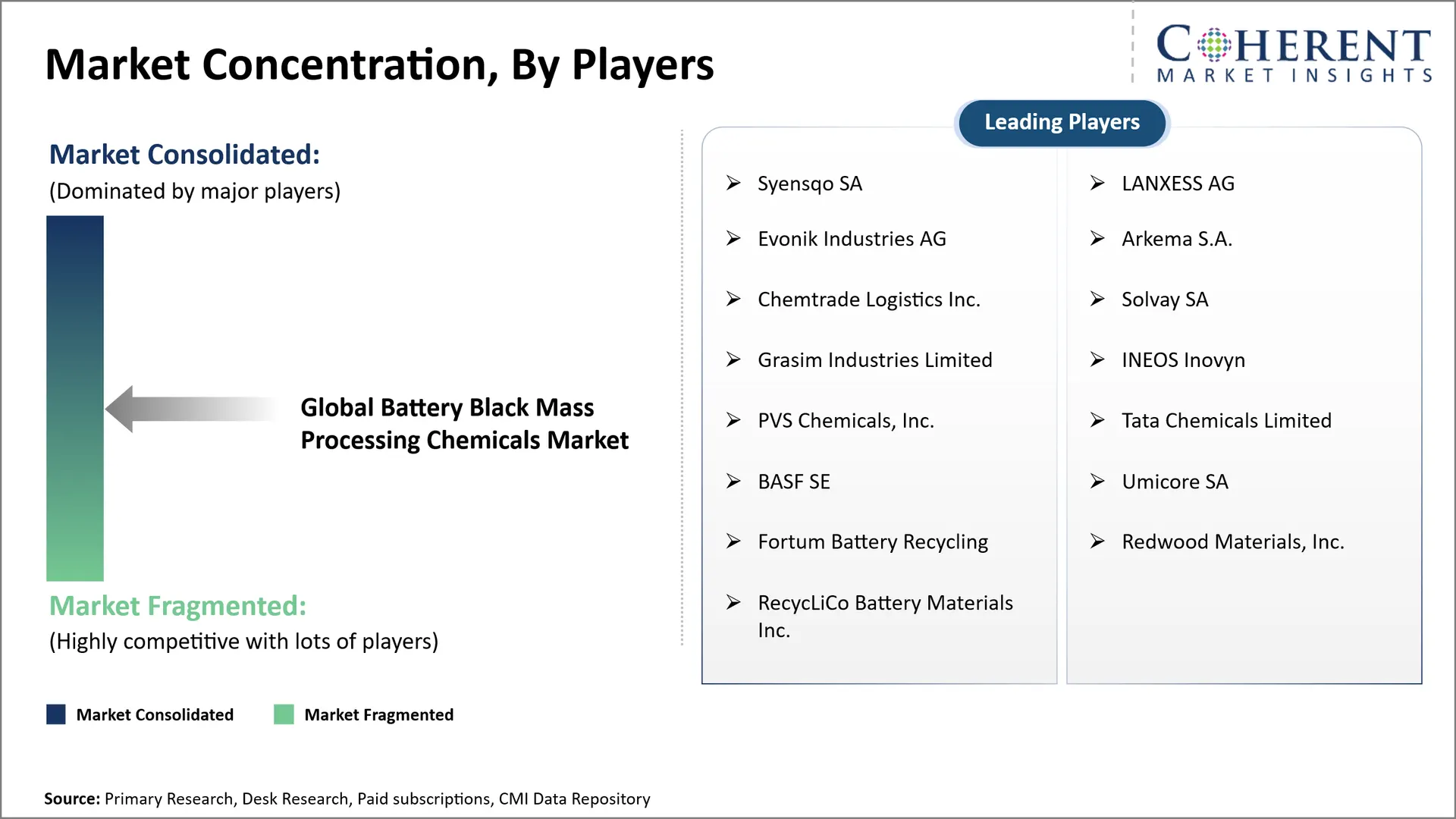
The global battery black mass processing chemicals market is assessed as moderately fragmented, combining multinational commodity chemical manufacturers, specialty separation-chemical suppliers, and regional distributors. Buyers evaluate vendors based on recovery consistency, delivery reliability, chemical purity, handling safety, and processing costs rather than reagent prices alone. Specialist suppliers compete through customized formulations, while larger producers benefit from established sourcing networks and industrial-scale chemical logistics.
Key focus areas include
- Chemical Purity and Specifications: controlled impurities and consistent acid concentrations are necessary for reliable metal recovery.
- Recovery Cost Competitiveness: Suppliers must show a good cost per unit of recovered metal and chemical consumption.
- Manufacturing and Supply Reliability: The availability of reliable reagents is essential for the prevention of interruptions in continuous hydrometallurgical operations.
- Chemical Handling and Safety: Customized extraction and precipitation chemicals are available to suit a variety of processing configurations and recovered-metal requirements.
- Customer-Specific Formulations: Regional stocking capabilities and responsive application support can improve customer retention.
- Distribution and Technical Support: Regional stocking capabilities and responsive application support can strengthen customer retention.
- Key Market Restraints: Uncertain supply of black mass, volatile metal prices, corrosive chemical handling, and waste-treatment costs can constrain commercial processing margins.
Market Report Scope
Global Battery Black Mass Processing Chemicals Market Report Coverage | |||
Report Coverage | Details | ||
Base Year | 2025 | Market Size in 2026: | USD 3,518.6 Mn |
Historical Data For: | 2020 to 2024 | Forecast Period: | 2026 to 2033 |
Forecast Period 2026 To 2033 CAGR: | 12.10% | 2033 Value Projection: | USD 7827.2 Mn |
Geographies covered: |
| ||
Segments covered: |
| ||
Companies covered: | Syensqo SA, LANXESS AG, Evonik Industries AG, Arkema S.A., Chemtrade Logistics Inc., Solvay SA, Grasim Industries Limited, INEOS Inovyn, PVS Chemicals, Inc., Tata Chemicals Limited, BASF SE, Umicore SA, Fortum Battery Recycling, Redwood Materials, Inc., RecycLiCo Battery Materials Inc. | ||
Growth Drivers: |
| ||
Restraints & Challenges: |
| ||
Analyst Opinion (Expert Opinion)
- The global battery black mass processing chemicals market will shift to performance-based chemical supply agreements. Suppliers that can deliver consistent batch quality, transparent process economics and predictable metal yields may be able to win longer-term customer contracts. This could translate into a shift in competitive advantage from selling simple reagents to producing measurable processing value.
- Direct regeneration of cathode material may challenge conventional chemical refining models, especially for well-sorted manufacturing scrap. If these processes are commercialized, some feedstocks may not go to complete metal dissolution. Chemical companies, therefore, need to assess and evaluate complementary surface-treatment and material-restoration formulations and not rely solely on conventional extraction chemistry.
- Chemical suppliers should try to develop long-term supply agreements with qualified recyclers, localize blending capabilities, and improve reagent efficiency. Investment decisions must take into account metal-price fluctuations, chemical waste management costs and the uncertain availability of feedstock. Phased capacity development and customer-linked procurement commitments could provide stronger margin protection than speculative expansion into uncontracted refining capacity.
Speak to the analyst
Want personalized insights?
Take the findings above to one of our principal consultants, or have the report rebuilt around the segments, geographies and competitors you actually track.
Market Segmentation
- Chemical Type Insights (Revenue, USD Mn, 2021 - 2033)
- Leaching Acids
- Oxidants & Reductants
- Solvent Extractants
- Precipitation & Neutralization Chemicals
- Purification Resins & Additives
- Other Processing Chemicals
- Processing Stage Insights (Revenue, USD Mn, 2021 - 2033)
- Leaching
- Solvent Extraction
- Precipitation & Metal Recovery
- Purification & Wastewater Treatment
- Battery Chemistry Insights (Revenue, USD Mn, 2021 - 2033)
- Nickel Manganese Cobalt (NMC) & Nickel Cobalt Aluminum (NCA)
- Lithium Iron Phosphate (LFP) & Lithium Manganese Iron Phosphate (LMFP)
- Lithium Cobalt Oxide (LCO)
- Other Battery Chemistries
- End User Insights (Revenue, USD Mn, 2021 - 2033)
- Independent Battery Recyclers
- Integrated OEM & Battery Manufacturers
- Metal Refiners & Recovery Companies
- Sales Channel Insights (Revenue, USD Mn, 2021 - 2033)
- Direct Manufacturer Sales
- Chemical Distributors
- Regional Insights (Revenue, USD Mn, 2021 - 2033)
- North America
- U.S.
- Canada
- Latin America
- Brazil
- Argentina
- Mexico
- Rest of Latin America
- Europe
- Germany
- U.K.
- Spain
- France
- Italy
- Russia
- Rest of Europe
- Asia Pacific
- China
- India
- Japan
- Australia
- South Korea
- ASEAN
- Rest of Asia Pacific
- Middle East
- GCC Countries
- Israel
- Rest of Middle East
- Africa
- South Africa
- North Africa
- Central Africa
- North America
- Key Players Insights
- Syensqo SA
- LANXESS AG
- Evonik Industries AG
- Arkema S.A.
- Chemtrade Logistics Inc.
- Solvay SA
- Grasim Industries Limited
- INEOS Inovyn
- PVS Chemicals, Inc.
- Tata Chemicals Limited
- BASF SE
- Umicore SA
- Fortum Battery Recycling
- Redwood Materials, Inc.
- RecycLiCo Battery Materials Inc.
Sources
Primary Research Interviews
- Battery recyclers, hydrometallurgical processors, and specialty chemical manufacturers
- Battery OEMs, metal refiners, chemical distributors, and recycling technology providers
Stakeholders
- Leaching acid, solvent extractant, and precipitation chemical manufacturers
- Independent battery recyclers, integrated OEMs, and metal recovery companies
End-use Sectors
- Independent battery recyclers, integrated OEMs, and battery manufacturers
- Metal refining, critical mineral recovery, and battery material production
Regulatory and Industry Bodies
- European Commission (EC)
- U.S. Environmental Protection Agency (EPA)
- U.S. Department of Energy (DOE)
- Ministry of Environment, Forest and Climate Change (MoEFCC), India
Databases
- UN Comtrade and ITC Trade Map
- Eurostat and USGS Mineral Commodity Summaries
- IEA Global EV Data Explorer
- U.S. EPA and European Commission battery recycling databases
Magazines and Journals
- Journal of Power Sources
- Resources, Conservation and Recycling
- Hydrometallurgy
- ACS Sustainable Chemistry & Engineering
Associations
- International Energy Agency (IEA)
- International Battery Recycling Association (IBRA)
- European Battery Alliance (EBA)
- Recharge – European Battery Industry Association
Public Domain Sources
- Battery recycling technical reports, chemical product datasheets, and sustainability reports
- Black mass processing capacities, critical mineral recovery statistics, and chemical pricing data
- Hydrometallurgical process studies, patent publications, and recycling investment announcements
Key Standards and Regulations
- EU Batteries Regulation (EU) 2023/1542
- EU REACH Regulation (EC) No 1907/2006
- U.S. Resource Conservation and Recovery Act (RCRA)
- India's Battery Waste Management Rules, 2022
- Basel Convention – Transboundary Movement of Hazardous Wastes
- ISO 14040/14044 – Life Cycle Assessment
Proprietary Elements
- CMI Data Analytics Tool
- Proprietary research repository, supported by primary interviews, battery black mass generation modeling, chemical consumption analysis, metal recovery assessments, pricing analysis, and competitive intelligence.
Get access to 250+ pages report
Every segment, forecast, competitor profile and data table behind the analysis above — available for instant download.
- ESOMAR Member
- ISO 9001:2015 Certified
- D-U-N-S Registered
- GDPR & CCPA Compliant
Frequently Asked Questions
The CAGR of the global battery black mass processing chemicals market is projected to be 12.10% from 2026 to 2033.
The global battery black mass processing chemicals market is projected to reach USD 7,827.2 Mn by 2033, with a value of USD 3,518.6 Mn in 2026.
Battery black mass is a powder-like material resulting from the processing of spent lithium-ion batteries and the production of scrap. It contains recoverable battery materials such as lithium, nickel, cobalt, manganese and graphite depending on the composition of the battery.
Chemical processing methods are used to recover valuable metals from metal-containing materials by dissolving, separating and purifying them. This creates reusable compounds that can be used in battery manufacturing and other industrial applications.
The choice of chemicals for battery recycling operations has to take into account such factors as chemical purity, efficiency of metal recovery, compatibility with the process, consumption of reagents, safety of handling and total treatment costs.
The report provides insights into chemical processing technologies, supplier positioning, procurement requirements, recovery economics, competitive strategies, and investment activities to support informed business and sourcing decisions.
Increasing EV battery recycling volumes worldwide and Rising demand for recovered critical battery metals are the major factor driving the growth of global battery black mass processing chemicals market.