

Global Beam Seating Market Size and Forecast – 2026 To 2033
The Global Beam Seating Market is estimated to be valued at USD 1.86 Bn in 2026 and is expected to reach USD 2.83 Bn by 2033, growing at a compound annual growth rate (CAGR) of 6.20% from 2026 to 2033. This growth reflects increasing demand for durable, space-efficient, and low-maintenance seating solutions across airports, hospitals, railway stations, and institutional facilities.
Infrastructure modernization, passenger comfort requirements, and the adoption of modular seating configurations are expected to support market expansion. In September 2026, Airports Council International (ACI) World reported that global airports handled a record 9.8 Bn passengers in 2025, highlighting the importance of efficient passenger accommodation and creating opportunities for high-capacity beam seating installations in airport terminals.
Key Takeaways of the Global Beam Seating Market
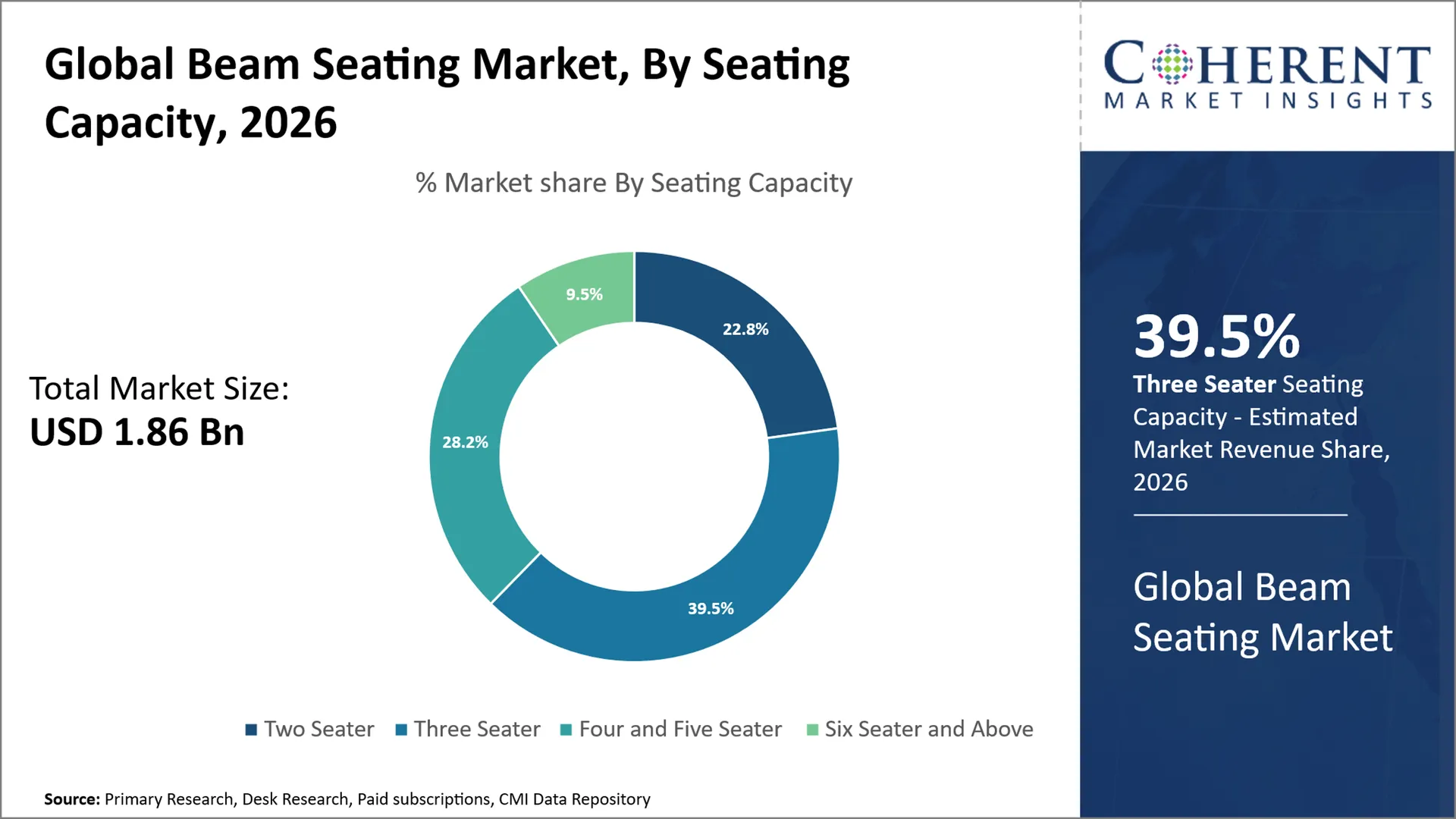
- Three-seater is expected to record an estimated CAGR of 6.3% during 2026–2033, accounting for 39.5% of the global beam seating market in 2026. Three-seat arrangements balance seating capacity, passenger circulation, and installation flexibility across terminal waiting areas. In April 2026, Poltrona Frau showcased its Bay System, featuring configurable three-seater beam seating for airport environments.
- Metal is projected to register an estimated CAGR of 6.0% through 2033, securing 42.6% global beam seating market share in 2026. Steel and aluminum structures offer durability, ease of cleaning, and lower replacement requirements, supporting their preference among institutional buyers. In October 2024, Zaneti Public introduced Altitude beam seating, incorporating metal seat pans, anodized aluminum beams, and die-cast aluminum supports.
- Floor-mounted is forecast to expand at an estimated CAGR of 6.1% during 2026–2033, representing 68.4% of the global beam seating market in 2026. Securely anchored installations improve stability, discourage unauthorized movement, and preserve organized circulation in high-traffic facilities. In January 2026, Metrolinx published architectural standards specifying floor-mounted benches and mechanically anchored base plates for transit infrastructure.
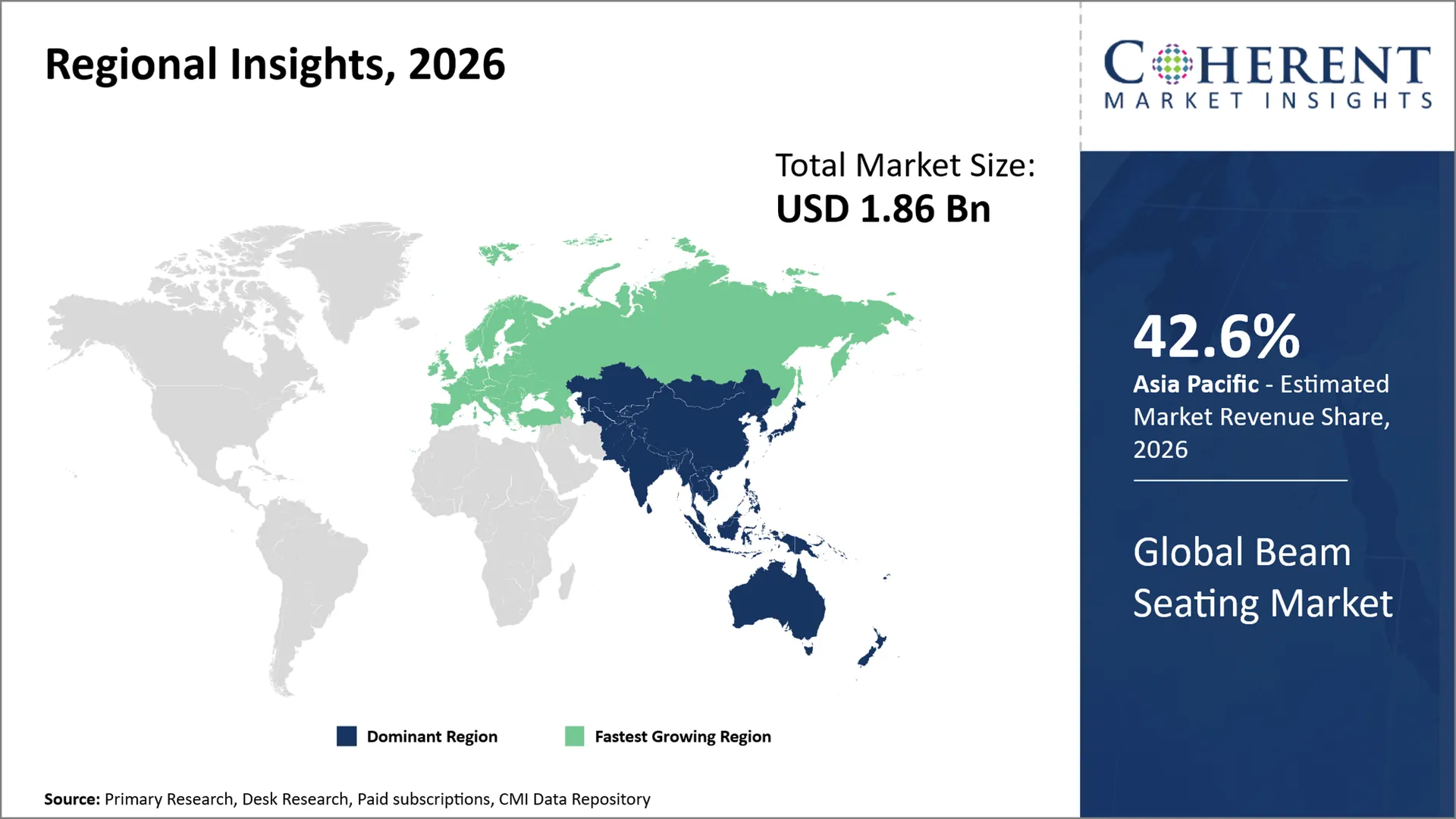
- Asia Pacific is expected to achieve an estimated CAGR of 6.5% during 2026–2033, maintaining its leading 42.6% global beam seating market share in 2026. Large-scale airport construction and expanding passenger infrastructure create substantial opportunities for standardized public seating procurement. In October 2025, India inaugurated Navi Mumbai International Airport, demonstrating continued investment in major aviation facilities and associated terminal infrastructure.
- Europe is estimated to grow at a 7.4% CAGR during 2026–2033, the fastest regional pace, while holding 25.4% global beam seating market share in 2026. Transport interchange modernization and accessibility-focused refurbishment are expected to support replacement seating contracts. In February 2026, Herefordshire Council reported construction progress on Hereford's Transport Hub, incorporating an enclosed waiting area and public seating facilities.
Segmental Insights
Why Does Three Seater Dominate the Global Beam Seating Market?
Three Seater is expected to account for 39.5% of the global beam seating market in 2026, reflecting its suitability for facilities requiring efficient seating arrangements within limited floor space. Institutional buyers prefer standardized three-seat configurations because they simplify furniture planning, quantity estimation, and replacement purchasing. Manufacturers benefit from consistent production dimensions and easier inventory management, supporting cost-effective supply for hospitals, transportation terminals, and public buildings. In April 2025, U.K.-based Rhubarb Seating published its official product price list featuring the Mata Three-Seater Beam, with separate pricing categories for institutional orders of up to 60 seats, 61–120 seats, and more than 120 seats. This structured offering demonstrates how manufacturers accommodate different procurement volumes while maintaining standardized three-seat configurations for commercial and institutional applications
- Current Industry Events of 2026
- Market Size Estimation
- Regional Breakdown
- Competitive Landscape
- Customer Intelligence
- Segmental Analysis
- Pricing Analysis
- Key Market Drivers, Challenges & Future Trends
- Customized Insights Section
Why Does Metal Represent the Largest Seat Material Segment in the Global Beam Seating Market?
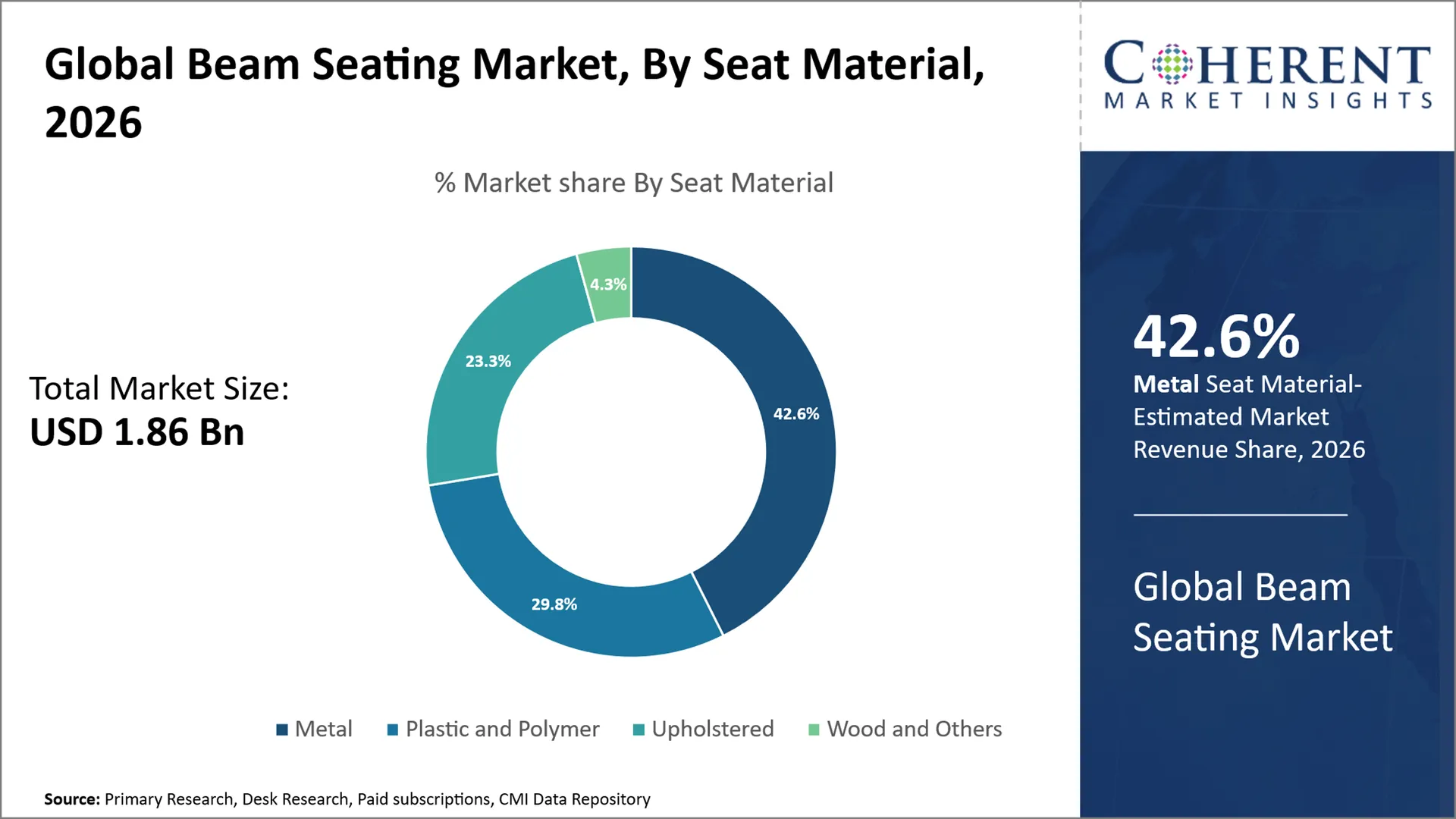
Metal is expected to represent 42.6% of the global beam seating market in 2026, reflecting the manufacturing versatility of steel and aluminum in high-use institutional furniture. Metal components accommodate engineered load paths, closely controlled dimensions, and protective surface treatments, allowing suppliers to meet technical specifications without entirely redesigning their products. Cold-rolled steel can be formed into repeatable seating components, while powder coating provides multiple finish options for transport facilities and government interiors. This gives manufacturers opportunities to compete through fabrication precision and finish quality rather than decorative upholstery. In September 2025, Foshan Winner Furniture introduced its W9801K full-steel waiting chair, identifying cold-rolled steel construction, rust protection, and powder coating as central product characteristics. The introduction illustrates continued investment in metal-based seating platforms for demanding public environments.
Why Does Floor Mounted Dominate the Installation Type Segment of the Global Beam Seating Market?
Floor Mounted is expected to secure 68.4% of the global beam seating market in 2026, as permanent installations help facility managers maintain consistent furniture layouts through successive operating cycles. Unlike movable configurations, anchored systems require coordination among seating suppliers, flooring contractors, and project engineers, particularly when substrate strength, expansion fixings, and finished-floor interfaces must be assessed. Such specification requirements are commercially significant for transport terminals undertaking renovation without extensive layout changes. They also create opportunities for suppliers that offer installation drawings, anchoring hardware guidance, and on-site technical support. In March 2024, Sellex confirmed that 23 units of its AERO Fixed to Tier bench had been installed indoors with floor attachments at Ottawa Macdonald-Cartier International Airport. The project demonstrates the practical role of specified floor-attachment systems in passenger waiting areas.
Current Events and their Impact
Current Event | Description and Its Impact |
India Furniture Quality Control Order – February 2025 |
|
United Kingdom Procurement Act Implementation – February 2025 |
|
United States Revised Metal Import Tariffs – April 2026 |
|
Global Beam Seating Market Dynamics
Key Market Drivers
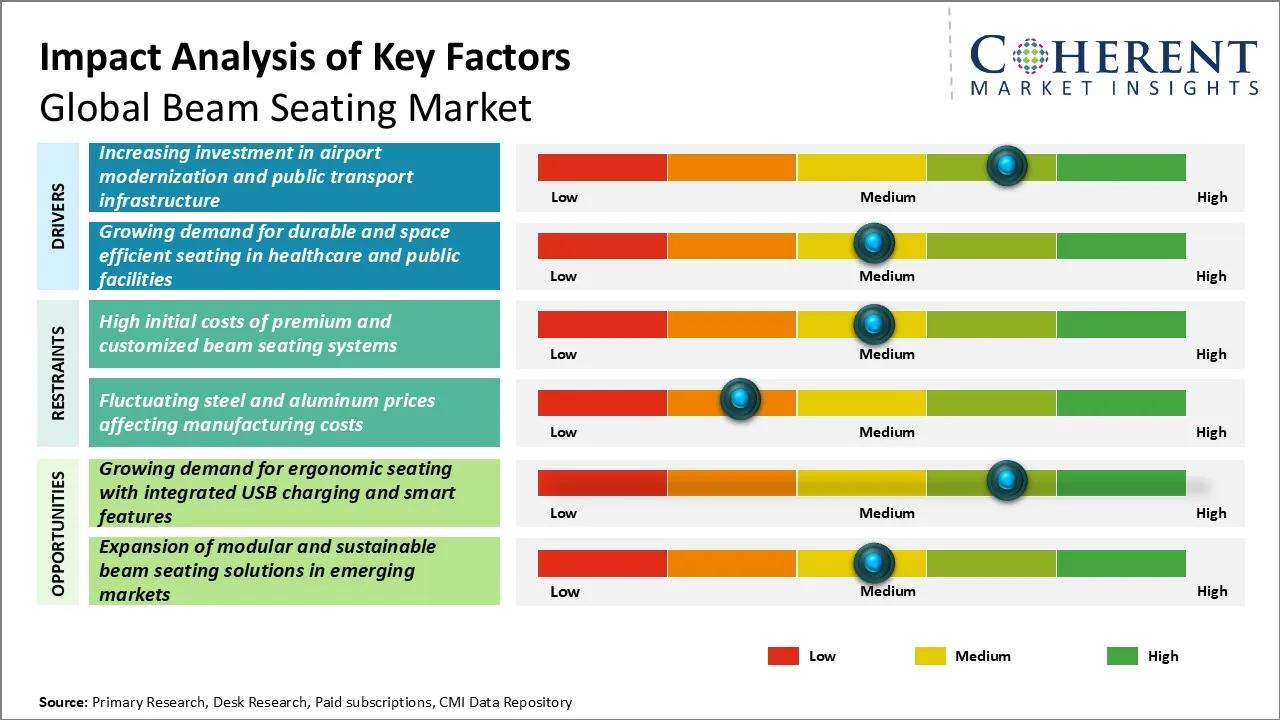
- Increasing Investment in Airport Modernization and Public Transport Infrastructure: Airport redevelopment and transport infrastructure upgrades are creating procurement opportunities for beam seating manufacturers. Terminal operators require seating systems that accommodate changing passenger volumes while maintaining efficient boarding and circulation areas. Infrastructure projects also create opportunities for manufacturers, installation contractors, and public furniture suppliers through new installations and refurbishment contracts. In June 2026, the Port of Seattle announced the opening of its expanded C Concourse at Seattle-Tacoma International Airport, featuring additional passenger seating areas and power-equipped facilities. Such investments strengthen demand prospects for adaptable terminal furniture.
- Growing Demand for Durable and Space Efficient Seating in Healthcare and Public Facilities: Healthcare facilities increasingly require waiting-area furniture that balances patient comfort, infection-control practices, and efficient use of available space. Beam seating provides a structured arrangement that can simplify housekeeping and accommodate changing outpatient volumes. Hospitals and institutional buyers consequently represent important customers for suppliers offering cleanable materials and accessible seating configurations. In June 2026, Birmingham Women's and Children's NHS Foundation Trust opened a redesigned emergency department waiting room, with additional family-friendly seating planned as part of its improvement programmer. This illustrates continued investment in patient waiting environments.
Emerging Market Trends
- Shift Toward Repairable and Lifecycle-Oriented Beam Seating Systems: Procurement teams are gradually treating public seating as a maintainable asset rather than a disposable furnishing. That shift encourages manufacturers to separate seat shells, armrests, surface panels, and support structures so worn elements can be replaced without removing entire rows. It also increases the commercial importance of spare-part continuity, clear disassembly instructions, and material traceability. Producers with standardized connection interfaces may reduce warranty costs and offer credible refurbishment programmers, while suppliers dependent on permanently bonded assemblies could face pressure as institutional customers refine lifecycle purchasing criteria.
- Growing Importance of Digital Product Specification and Design Integration: Digital specification is changing how beam seating enters infrastructure projects. Architects and procurement teams increasingly expect accurate three-dimensional models, verified clearances, finish schedules, and installation details before a purchase order is issued. Suppliers who provide coordinated design files can influence early planning decisions and reduce expensive layout revisions at the construction stage. This creates a route for specialist manufacturers to compete through engineering support rather than discounts alone. Dealers lacking technical documentation capabilities may become less influential as buyer decisions move earlier into the design process.
Regional Insights
Why Does Asia Pacific Dominate the Global Beam Seating Market?
Asia Pacific is expected to hold 42.6% of the global beam seating market in 2026, supported by extensive aviation infrastructure, intercity rail connectivity, and high-volume urban transport networks. Large institutional projects create opportunities for standardized seating supplied across multiple terminals and public waiting areas. Regional manufacturing capabilities in metal fabrication, molded components, and commercial furniture production also support competitive procurement costs and shorter delivery schedules. Airport operators are increasingly considering seating configurations alongside passenger circulation and terminal space utilization. In May 2025, Singapore's Changi Airport completed its Terminal 1 transit-area refurbishment, with the refreshed space offering double the previous seating capacity. This development illustrates continued investment in passenger accommodation and creates opportunities for suppliers of commercial and public seating systems.
Why Is Europe Emerging as the Fastest-Growing Region in the Global Beam Seating Market?
Europe is projected to account for 25.4% of the global beam seating market in 2026, with the fastest regional growth expected during the forecast period. Replacement purchasing across established transport infrastructure provides opportunities beyond new terminal construction. European buyers increasingly evaluate passenger accessibility, furniture service life, component replacement, and interior integration when upgrading waiting environments. These requirements create opportunities for manufacturers offering configurable seating, documented material specifications, and refurbishment support. In February 2024, Amsterdam Airport Schiphol announced the renovation of Lounge 2, including the reconfiguration and expansion of passenger seating areas alongside changes to pedestrian routes. The project highlights the importance of redesigning seating layouts within operating terminals. Manufacturers capable of coordinating seating specifications with complex refurbishment schedules are positioned to benefit from similar European projects.
Global Beam Seating Market Outlook for Key Countries
Why Is the U.S. a Key Market for the Global Beam Seating Market?
The United States remains an important beam seating market because large airports frequently upgrade boarding areas without closing entire terminals. Buyers increasingly assess seating alongside device charging, passenger movement, accessibility, and cleaning access, making product specifications more complex than a basic row of chairs. Manufacturers supplying configurable seating and compatible electrical accessories can therefore compete for targeted refurbishment contracts rather than depending exclusively on major construction programmers. In June 2026, Houston Airports reported adding 47 seats near Gates A14 and A15 at George Bush Intercontinental Airport, increasing seating capacity in that area by 24%. The new layout included group seating, workstations, and charging points. This investment demonstrates the commercial value of adaptable waiting arrangements while reinforcing the importance of coordinating furniture placement with gate operations and electrical infrastructure.
Why Does China Support Growth in the Global Beam Seating Market?
China is a strategically important for global beam seating market because airport expansion can translate into large, technically detailed purchasing contracts for domestic furniture manufacturers. Industrial clusters supplying steel components, aluminum profiles, molded seating, and surface finishes give local producers options for integrated fabrication and assembly. Public procurement also rewards suppliers capable of preparing shop drawings, prototypes, electrical connections, and phased installation schedules. In June 2025, a procurement announcement for passenger waiting seats at Xiamen's new airport and the Fuzhou Airport expansion awarded a contract worth approximately CNY 47.2 million to Guangdong Aoshujian Furniture Manufacturing. The tender covered supply and installation, with detailed requirements for samples and associated charging equipment. This illustrates how Chinese airport development creates opportunities for manufacturers combining production capacity with project execution.
Why Is India Important in the Global Beam Seating Market?
India's beam seating opportunity is closely connected to managing concentrated passenger flows at railway stations, where waiting space must remain organized during festivals and daily rush periods. Unlike premium airport projects, purchasing decisions often prioritize robust, economical seating that can be deployed in clearly defined holding zones without restricting movement. Domestic manufacturers and installation contractors may benefit from repeatable specifications across public-sector station upgrades, provided they meet applicable purchasing and quality requirements. In October 2025, India's Ministry of Railways described the new Yatri Suvidha Kendra at New Delhi Railway Station, built to accommodate approximately 7,000 people and equipped with seating for about 200 passengers. The facility demonstrates how crowd-management planning translates into dedicated seating provision, although the announcement does not specify the particular seating construction used.
Why Is Germany a Strategic Country in the Global Beam Seating Market?
Germany occupies a distinct position in the beam seating market through its emphasis on standardized rail-station upgrades and technically specified public furniture. Transport buyers must balance waiting comfort with narrow platform clearances, weather exposure, cleaning requirements, and accessibility. This favors suppliers that can document structural performance, offer different mounting arrangements, and provide consistent replacement parts across locations. Germany's established metalworking and furniture engineering capabilities also support customization for varied station environments. In June 2025, Deutsche Bahn announced plans to redesign another 100 stations as 'stations of the future,' explicitly identifying new waiting furniture, weather protection, and improved accessibility among the planned enhancements. Such programmers create a channel for manufacturers able to supply durable, compatible furniture through repeatable procurement and maintenance arrangements rather than one-off decorative installations.
Why Is the U.K. an Important Growth Market for the Global Beam Seating Market?
The United Kingdom is important to the beam seating market because station operators are investing in differentiated waiting facilities rather than treating every passenger as having identical seating needs. Accessibility, the availability of quiet areas, and clear movement routes increasingly influence furniture layouts at busy transport hubs. Suppliers that can offer coordinated seating for main concourses and assisted-travel zones may find opportunities in refurbishment projects completed while stations remain operational. In February 2026, Network Rail announced upgrades at London Euston, including new concourse seating and improvements to its Assisted Travel Lounge, where capacity was planned to increase from 18 to 27 seats. This approach indicates how passenger-service priorities can generate separate purchasing requirements for compact public seating, supportive furniture, and specialist installations within the same station
Beam Seating Product and Manufacturing Innovation Landscape
Innovations | Application in Beam Seating | Adoption Landscape | Commercial Impact |
Modular Beam and Interchangeable Seat Assemblies | Standardized support beams accommodate different seat shells, armrests, and accessories. | Established technology with opportunities for further refinement. | Improves configuration flexibility and supports component-level replacement. |
Molded Polyurethane Seating Components | Formed polyurethane seat and backrest surfaces support ergonomic shaping and routine cleaning. | Established in transport seating, with continued material development. | Offers differentiation through comfort, surface durability, and maintenance performance. |
Electrostatic Powder Coating | Protective finishes are applied to steel or aluminum seating structures. | Mature manufacturing process used in commercial furniture production. | Supports finish consistency, corrosion resistance, and product durability. |
Precision Extrusion and CNC Machining | Aluminum profiles and accurately machined connection points support beam assembly. | Established manufacturing methods with ongoing automation opportunities. | Improves dimensional consistency and repeatability across large production batches. |
Integrated Power and USB-C Charging | Power modules and concealed cabling are incorporated into compatible beam seating configurations. | Selective adoption in premium and connected waiting environments. | Creates opportunities for higher-value product specifications and electrical maintenance services. |
BIM-Based Configuration and Digital Fabrication | Product models connect seating layouts, technical dimensions, and fabrication requirements. | Developing adoption among manufacturers serving complex infrastructure projects. | Reduces specification errors and improves coordination between designers, suppliers, and contractors. |
How Are Accessible Multimodal Transport Interchanges Creating New Growth Opportunities in the Global Beam Seating Market?
Multimodal rail and bus interchanges offer a promising opportunity for manufacturers willing to move beyond standard catalogue seating. These facilities must serve commuters, older passengers, people with reduced mobility, and travelers carrying luggage within changing station layouts. Many operators still purchase benches as isolated fixtures rather than specifying a coordinated accessible waiting environment.
Suppliers can address this gap with beam systems offering transfer-support armrests, varied seating heights, contrasting finishes, unobstructed wheelchair spaces, and options suitable for sheltered outdoor platforms.
Commercial success will depend on collaboration with transport consultants, station architects, and specialist accessibility advisers before tenders are finalized. Manufacturers should develop tested assemblies, documented anchoring details, configurable specifications, and dependable local installation capacity.
Distributors capable of handling phased refurbishment work could also secure repeat contracts. This opportunity favors experienced producers and adaptable specialists that can demonstrate usability and maintenance value without making complex bespoke designs economically impractical for resource-constrained transport operators.
Market Players, Key Development, and Competitive Intelligence
Key Developments
- In March 2026, Derlot showcased its Platform beam seating collection at Passenger Terminal Expo in London, alongside other aviation furniture ranges. The presentation reinforced the commercial role of architectural detailing and coordinated product design in airport seating procurement, particularly where passenger areas require cohesive interiors.
- In June 2025, AGATI Furniture announced its Departures Seating system for airport gates, introducing angled rows with modular configurations and optional integrated power. The design gives terminal operators an alternative to conventional straight-line beam layouts while preserving the operational advantages of high-density seating.
- In March 2024, the expanded Terminal 1 at Delhi's Indira Gandhi International Airport was inaugurated, with Zoeftig subsequently confirming its role as the project's sole beam seating supplier. Its Contact systems incorporated polyurethane seats and charging modules, demonstrating the significance of integrated passenger amenities in large terminal contracts.
Competitive Landscape
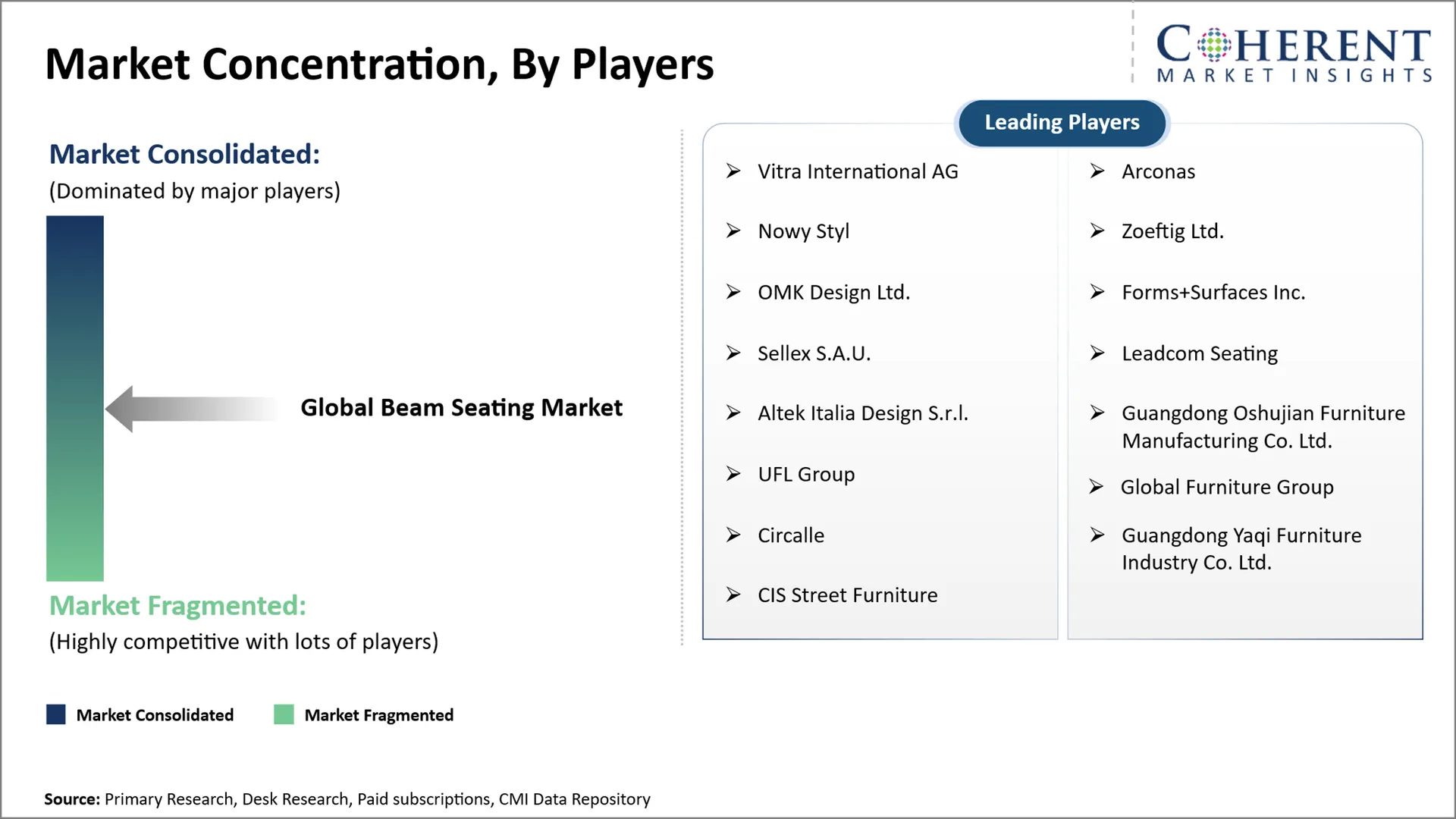
The global beam seating market has a fragmented competitive structure, comprising specialized public seating manufacturers, commercial furniture producers, and regional suppliers. Competition centers on product specifications, pricing discipline, manufacturing consistency, and timely project execution. International manufacturers typically compete for larger institutional contracts, while regional suppliers address localized procurement requirements. Engineering expertise, material sourcing, and dependable customer support remain important differentiators in securing repeat business.
Key Competitive Focus Areas
- Product engineering: Structural strength, ergonomic performance, and verified load-bearing capabilities influence institutional purchasing decisions.
- Pricing competitiveness: Manufacturers must balance material and fabrication costs against project-specific price ceilings.
- Manufacturing reliability: Consistent production quality and predictable delivery schedules strengthen supplier credibility.
- Quality assurance: Relevant furniture testing standards, product documentation, and safety compliance support tender qualification.
- Distribution capabilities: Regional sales representatives and installation partners improve access to geographically dispersed customers.
- Customization capabilities: Material options, finishes, seat configurations, and accessories help manufacturers address varied project requirements.
- After-sales support: Clear warranty terms, spare-part availability, and responsive technical assistance strengthen long-term customer relationships.
Market Report Scope
Global Beam Seating Market Report Coverage | |||
Report Coverage | Details | ||
Base Year | 2025 | Market Size in 2026: | USD 1.86 Bn |
Historical Data For: | 2020 To 2024 | Forecast Period: | 2026 To 2033 |
Forecast Period 2026 To 2033 CAGR: | 6.20% | 2033 Value Projection: | USD 2.83 Bn |
Geographies covered: |
| ||
Segments covered: |
| ||
Companies covered: | Vitra International AG, Arconas, Nowy Styl, Zoeftig Ltd., OMK Design Ltd., Forms+Surfaces Inc., Sellex S.A.U., Leadcom Seating, Altek Italia Design S.r.l., Guangdong Oshujian Furniture Manufacturing Co. Ltd., UFL Group, Global Furniture Group, Circalle, Guangdong Yaqi Furniture Industry Co. Ltd., CIS Street Furniture | ||
Growth Drivers: |
| ||
Restraints & Challenges: |
| ||
Analyst Opinion (Expert Opinion)
- In the global beam seating market, beam seating manufacturers are likely to move toward contract-based customer relationships in which product supply is combined with installation coordination, scheduled inspections, and refurbishment support. Suppliers capable of documenting operational performance throughout a facility's service life may secure stronger relationships with institutional buyers. This transition could gradually shift purchasing decisions away from initial equipment prices toward measurable ownership value.
- Changes in how public waiting spaces are planned could challenge traditional uniform-row seating models. Facility operators may increasingly create separate areas for short-duration waiting, family groups, individual travelers, and passengers requiring assisted access. Manufacturers dependent on standardized beam configurations could face pressure from alternative furniture formats. Companies capable of delivering coordinated seating solutions across different passenger needs would be better positioned to protect their market relevance.
- Manufacturers should prioritize structural testing, reliable metal-component sourcing, electrical safety where charging modules are incorporated, and disciplined production cost management. Healthcare and transport contractors represent attractive long-term customer groups, but tender price competition may restrict margins. Companies should strengthen regional installation partnerships, maintain alternative material suppliers, and avoid excessive investment in highly specialized configurations without confirmed project demand
Speak to the analyst
Want personalized insights?
Take the findings above to one of our principal consultants, or have the report rebuilt around the segments, geographies and competitors you actually track.
Market Segmentation
- Seating Capacity Insights (Revenue, USD Bn, 2021 - 2033)
- Two Seater
- Three Seater
- Four and Five Seater
- Six Seater and Above
- Seat Material Insights (Revenue, USD Bn, 2021 - 2033)
- Metal
- Plastic and Polymer
- Upholstered
- Wood and Others
- Installation Type Insights (Revenue, USD Bn, 2021 - 2033)
- Floor Mounted
- Freestanding
- Application Insights (Revenue, USD Bn, 2021 - 2033)
- Airports
- Hospitals and Healthcare Facilities
- Railway and Bus Stations
- Government and Institutional Buildings
- Commercial and Other Public Spaces
- Distribution Channel Insights (Revenue, USD Bn, 2021 - 2033)
- Direct Manufacturer Sales
- Dealers and Distributors
- Online and E Procurement
- Regional Insights (Revenue, USD Bn, 2021 - 2033)
- North America
- U.S.
- Canada
- Latin America
- Brazil
- Argentina
- Mexico
- Rest of Latin America
- Europe
- Germany
- U.K.
- Spain
- France
- Italy
- Russia
- Rest of Europe
- Asia Pacific
- China
- India
- Japan
- Australia
- South Korea
- ASEAN
- Rest of Asia Pacific
- Middle East
- GCC Countries
- Israel
- Rest of Middle East
- Africa
- South Africa
- North Africa
- Central Africa
- North America
Sources
Primary Research Interviews
- Beam seating manufacturers, commercial furniture suppliers, and seating system designers
- Metal fabricators, component manufacturers, and installation contractors
- Airport operators, railway authorities, hospital procurement teams, and industry experts
Stakeholders
- Beam seating manufacturers and material suppliers
- Steel, aluminum, polymer, and upholstery manufacturers
- Infrastructure developers, architects, and facility managers
- Furniture distributors, institutional buyers, and end users
End-use Sectors
- Airports and transportation terminals
- Hospitals and healthcare facilities
- Railway stations and bus terminals
- Government buildings, educational institutions, and commercial spaces
Regulatory and Industry Bodies
- International Organization for Standardization (ISO)
- ASTM International
- Business and Institutional Furniture Manufacturers Association (BIFMA)
- European Committee for Standardization (CEN)
- U.S. Access Board
- Bureau of Indian Standards (BIS)
Databases
- Company annual reports and investor presentations
- UN Comtrade furniture and seating trade datasets
- Eurostat and national furniture manufacturing statistics
- Airport and railway infrastructure investment databases
- Beam seating production, pricing, procurement, and patent databases
Magazines and Journals
- Applied Ergonomics
- International Journal of Industrial Ergonomics
- Journal of Building Engineering
- Passenger Terminal World
- Railway Gazette International
- Furniture Today
Associations
- Airports Council International (ACI)
- International Air Transport Association (IATA)
- American Public Transportation Association (APTA)
- International Association of Public Transport (UITP)
- Business and Institutional Furniture Manufacturers Association (BIFMA)
- European Furniture Industries Confederation (EFIC)
Public Domain Sources
- Airport modernization and public transport infrastructure statistics
- Beam seating production, installation, and procurement data
- Steel, aluminum, polymer, and upholstery material pricing
- Public seating design, ergonomics, and accessibility developments
- Product launches, manufacturing investments, and sustainability initiatives
Key Standards and Regulations
- ANSI/BIFMA X5.4-2020 (R2025) – Public and lounge seating performance requirements
- EN 16139 – Non-domestic seating strength, durability, and safety requirements
- EN 1728 – Furniture seating strength and durability test methods
- EN 1022 – Seating stability testing requirements
- ISO 7173:2023 – Chairs and stools strength and durability testing
- 2010 ADA Standards for Accessible Design – Accessibility requirements for applicable public facilities
Proprietary Elements
- CMI Data Analytics Tool
- Proprietary research repository covering commercial seating, infrastructure investments, material pricing, procurement trends, product innovation, accessibility requirements, and competitive intelligence.
Get access to 250+ pages report
Every segment, forecast, competitor profile and data table behind the analysis above — available for instant download.
- ESOMAR Member
- ISO 9001:2015 Certified
- D-U-N-S Registered
- GDPR & CCPA Compliant
Frequently Asked Questions
The CAGR of global beam seating market is projected to be 6.20% from 2026 to 2033.
The global beam seating market is estimated to be valued at USD 1.86 Bn in 2026 and is expected to reach USD 2.83 Bn by 2033.
Yes, the report evaluates leading manufacturers, their product portfolios, competitive positioning, business strategies, and global beam seating market presence.
The report is relevant to seating manufacturers, furniture suppliers, distributors, infrastructure developers, procurement consultants, and investors seeking global beam seating market intelligence.
The report examines institutional purchasing requirements, supplier selection criteria, public procurement practices, and commercial buying considerations.
Yes, customized research can cover specific countries, competitor benchmarking, pricing analysis, customer requirements, and market entry strategies.
Increasing investment in airport modernization and public transport infrastructure, along with growing demand for durable, space-efficient seating in healthcare and public facilities, are the major factors driving the growth of the global beam seating market.