
Global Bio-Attributed Automotive Seat Foams Market Size and Forecast – 2026 To 2033
The Global Bio-Attributed Automotive Seat Foams Market is estimated to be valued at USD 65.4 Mn in 2026 and is expected to reach USD 542.8 Mn by 2033, growing at a compound annual growth rate (CAGR) of 35.30% from 2026 to 2033. This growth is driven by automotive manufacturers increasing focus on reducing the carbon footprint of vehicle interiors using renewable polyurethane raw materials, while maintaining seating comfort, durability and manufacturing efficiency.
The development of bio-based polyols and certified biomass-balanced feedstocks is providing chemical suppliers and automotive seating makers with the opportunity to reduce their dependence on fossil-based inputs. In April 2025, a study published in Industrial Crops and Products demonstrated that automotive seating foams formulated with 10% castor oil- or palm oil-derived bio-polyols met the evaluated mechanical and foam-performance requirements. The results confirm the technical feasibility of renewable material substitution for automotive seating applications and they are complementary to the development of bio-attributed polyurethane systems.
Key Takeaways of the Global Bio-Attributed Automotive Seat Foams Market
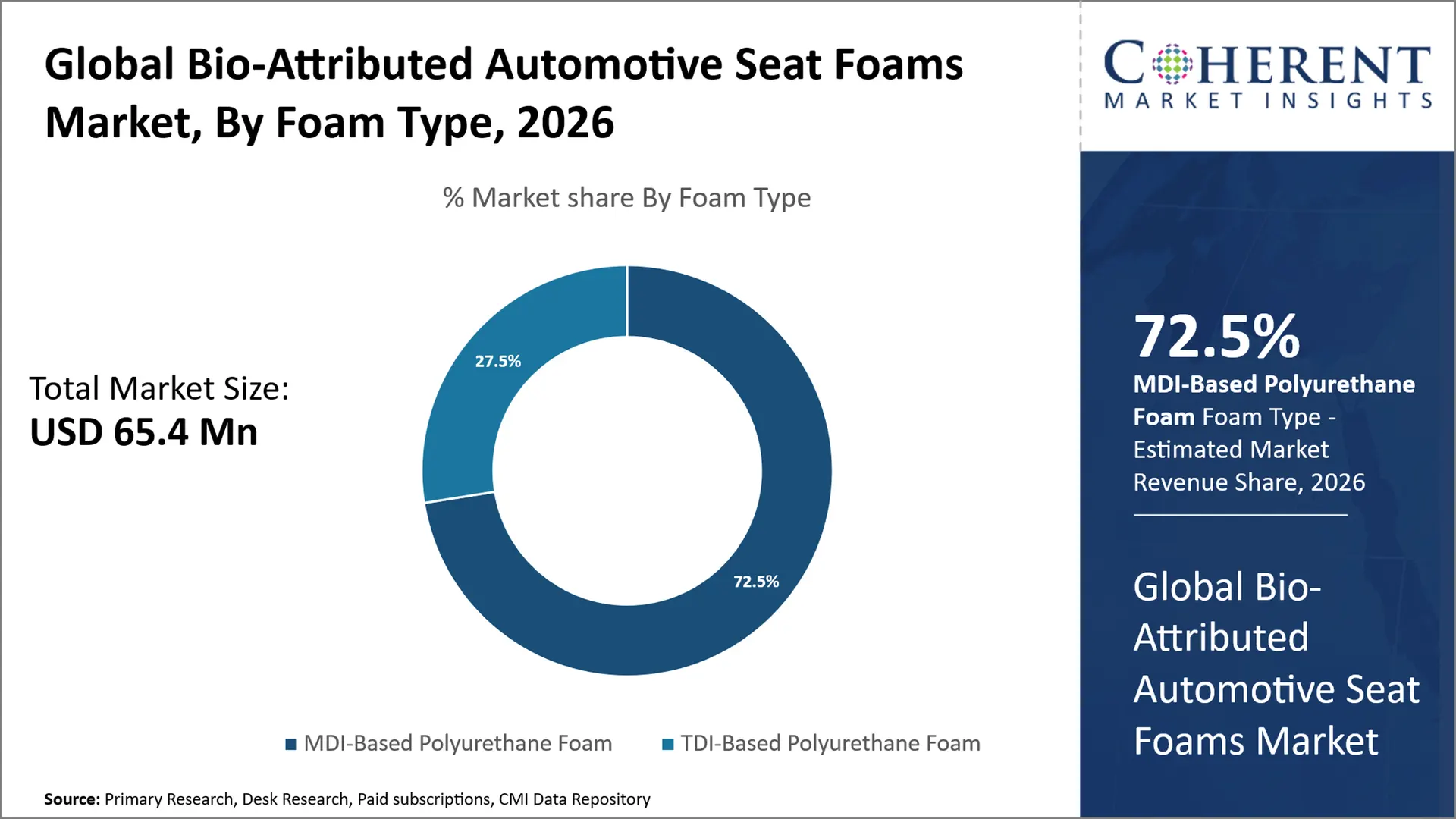
- The MDI-Based Polyurethane Foam is anticipated to record an estimated 35.9% CAGR during 2026 to 2033 and account for 72.5% of the global bio-attributed automotive seat foams market in 2026. Its moldability into high-resilience seats allows suppliers to maintain established performance specs while changing the chemistry of feedstocks. In April 2026, Magna detailed its EcoSphere seating foam, which integrates a plant-derived prepolymer into its MDI ingredient.
- Seat Cushions are estimated to register a 36.5% CAGR during 2026–2033 and represent 48.2% of 2026 global bio-attributed automotive seat foams market revenue. Their substantial foam requirements and demanding compression-performance specifications make material qualification commercially consequential. In June 2025, Ford reported continued use of soybean-based polyurethane foam in seat cushions and backrests throughout its North American-built vehicle range.
- Bio-Attributed Polyols Only is forecast to advance at an estimated 34.8% CAGR during 2026–2033 and account for 52.7% of the global bio-attributed automotive seat foams market in 2026. Changing polyol sourcing while retaining conventional isocyanates can simplify formulation adoption and supplier qualification. In March 2026, BASF announced commercial production of ISCC PLUS-certified biomass-balance polyether polyols at Geismar for automotive and other applications.
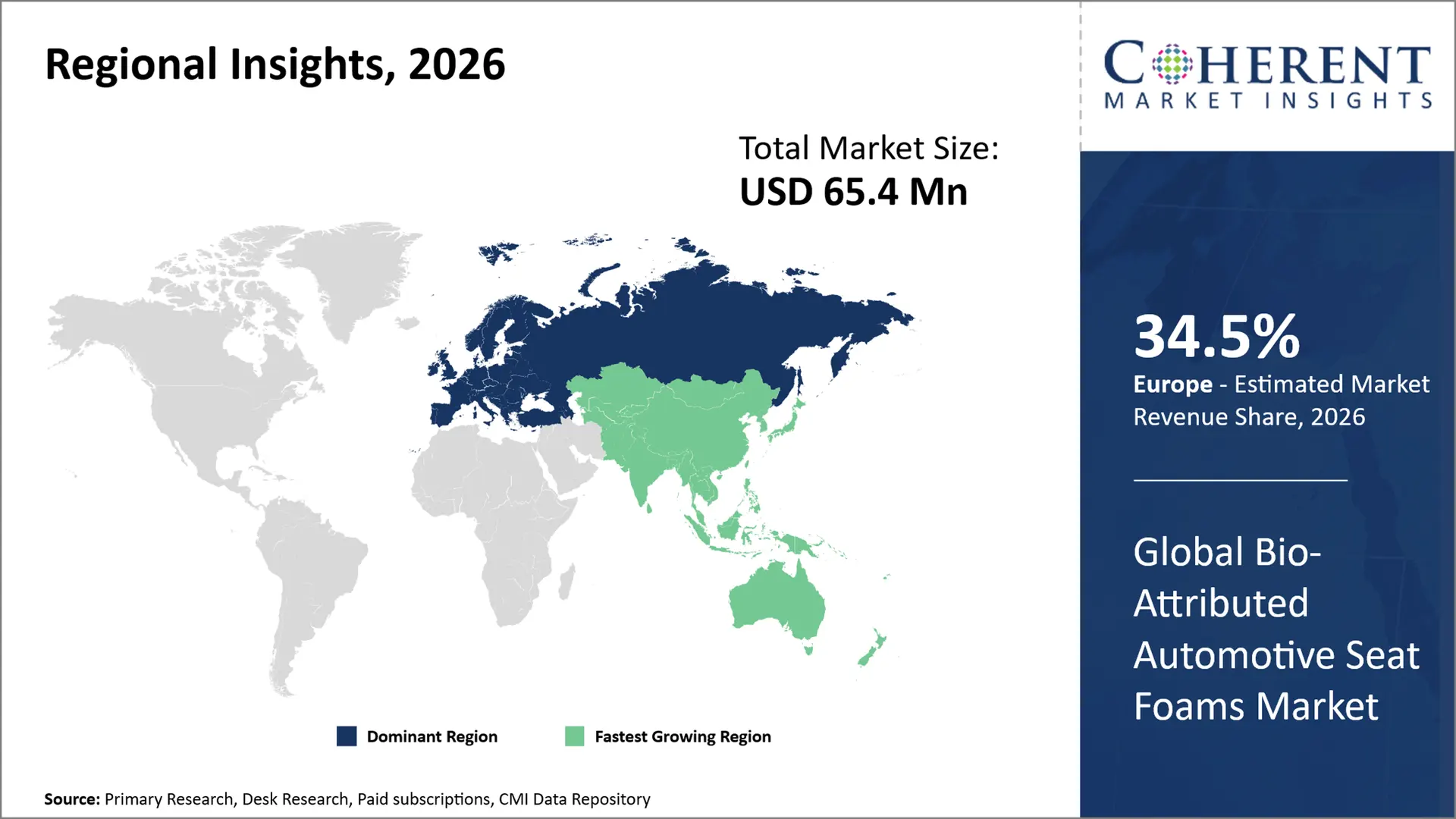
- Europe is anticipated to record a CAGR of 33.8% during 2026-2033, and hold the leading 2026 market share of 34.5% in the global bio-attributed automotive seat foam market. It has an established automotive supply chain that offers opportunities to test renewable polyurethane formulations for durability and processing requirements. October 2026: Germany’s Fraunhofer LBF reported OrganoFoam research into bio-based polyurethane cushioning suitable for vehicle seats and conventional manufacturing equipment.
- Asia Pacific region is expected to grow at the highest CAGR of 39.0% during the forecast period, accounting for 30.2% of the global bio-attributed automotive seat foams market in 2026. Large automotive seating supply chains provide opportunities to scale renewable formulations across vehicle platforms. Hyundai Transys of South Korea detailed automotive foam pads made with bio-polyols sourced from renewable feedstocks including castor seeds in May 2024.
Segmental Insights
Why Does MDI-Based Polyurethane Foam Dominate the Global Bio-Attributed Automotive Seat Foams Market?
MDI-Based Polyurethane Foam is expected to account for 72.5% of the global bio-attributed automotive seat foams market in 2026, leading the foam-type category. MDI chemistry allows for controlled molded foam profiles, enabling seating engineers to tune hardness, thickness and load-bearing response for various seat architectures. The commercial leverage comes from existing supply networks for polyurethane, which provide inputs with renewable attributes, while maintaining material specifications and processing controls. This makes it easier to evaluate materials for automotive Tier-1 suppliers, although finished foam still needs to be validated. In April 2026, BorsodChem announced its Ongronat NEO portfolio, introduced in 2024, of ISCC PLUS-certified MDI produced from bio- and bio-circular feedstocks via mass-balance accounting. This development allows automotive foam formulators using MDI to have more upstream supply options, without adoption in any specific vehicle program.
- Current Industry Events of 2026
- Market Size Estimation
- Regional Breakdown
- Competitive Landscape
- Customer Intelligence
- Segmental Analysis
- Pricing Analysis
- Key Market Drivers, Challenges & Future Trends
- Customized Insights Section
Why Do Seat Cushions Represent the Largest Seat Component in the Global Bio-Attributed Automotive Seat Foams Market?
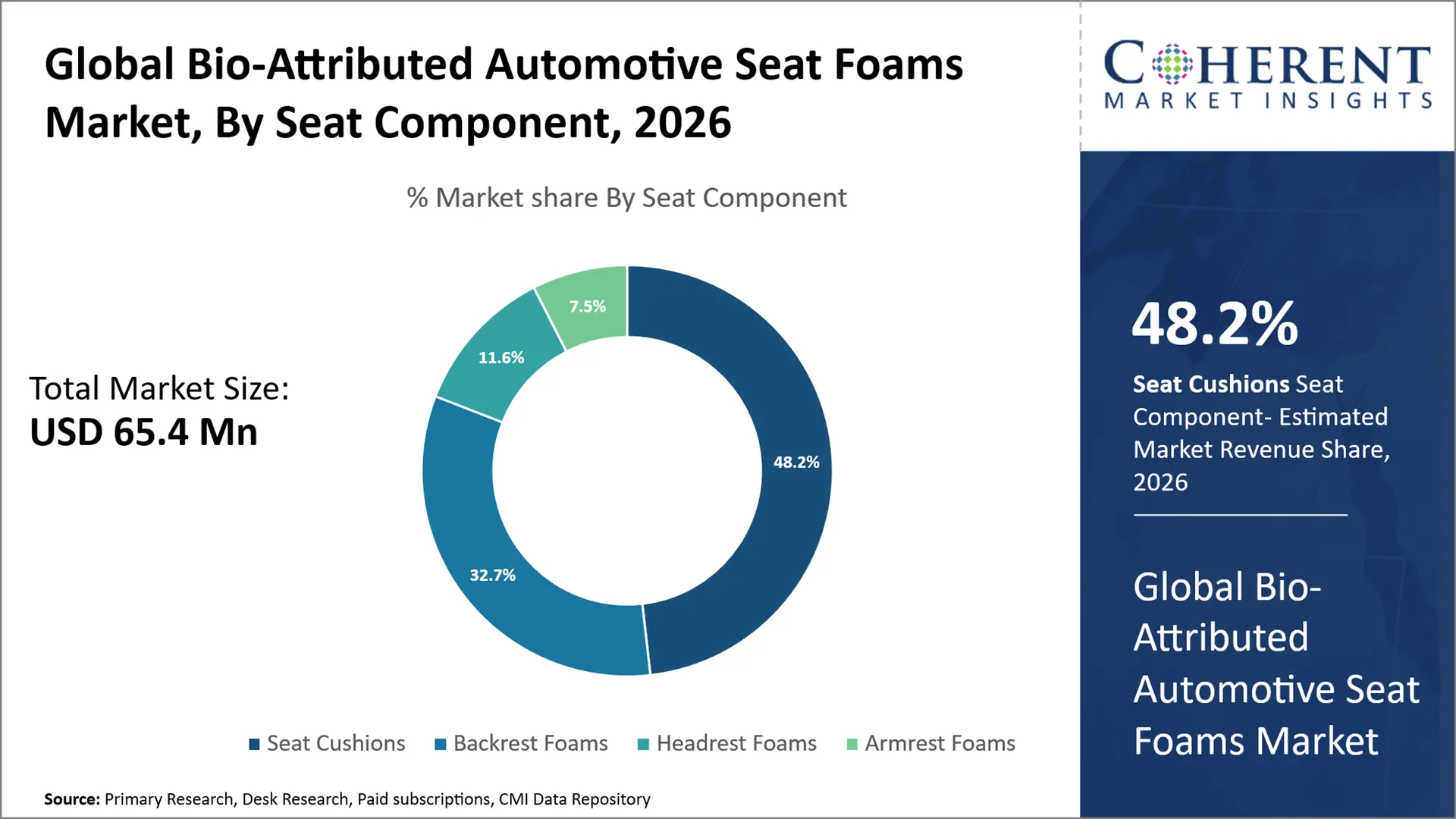
Seat Cushions are projected to represent 48.2% of the global bio-attributed automotive seat foams market in 2026. Foam resilience, localized support and resistance to permanent compression are important criteria in making a purchasing decision. Cushions are the primary point of contact for distributing occupant weight. The substitution of renewable inputs is of greater commercial value because cushions require a lot more molded material per seat position than smaller armrest and headrest components. This means that manufacturers that can combine bio-based formulations with ergonomic molding can compete on comfort and sustainability. In September 2024, FORVIA unveiled its medium-duty commercial vehicle seat with Bioflex padding made from castor oil and a modular cushion design. This development shows the potential for the use of renewable polyurethane cushioning in demanding seating applications and opens up opportunities for specialist foam manufacturers.
Why Does Bio-Attributed Polyols Only Dominate the Bio-Attributed Input Category of the Global Bio-Attributed Automotive Seat Foams Market?
Bio-Attributed Polyols Only is estimated to secure 52.7% of the global bio-attributed automotive seat foams market in 2026, leading the bio-attributed input category. A polyol-driven substitution allows manufacturers to use renewable-attributed materials via one ingredient of polyurethane chemistry and still use the traditional isocyanates. The advantage of this approach is the flexibility in procurement for foam converters who are contending with variations in viscosity, cell structure and cure consistency for their various automotive seating specifications. It also gives polyol producers the ability to compete on certified material traceability and established chemical distribution networks. Repsol Materials obtained ISCC PLUS certification for its activities in Puertollano in September 2025, with polyether polyols being part of the eligible bio and bio-circular materials categories within mass-balance accounting. This certification helps to support the availability of upstream renewable polyols and provides a potential sourcing avenue for automotive seating foam manufacturers.
Current Events and their Impact
Current Event | Description and Its Impact |
August 2026: EU End-of-Life Vehicles Regulation Comes into Force |
|
September 2026: EU Environmental Claims Rules Take Effect |
|
Global Bio-Attributed Automotive Seat Foams Market Dynamics
Key Market Drivers
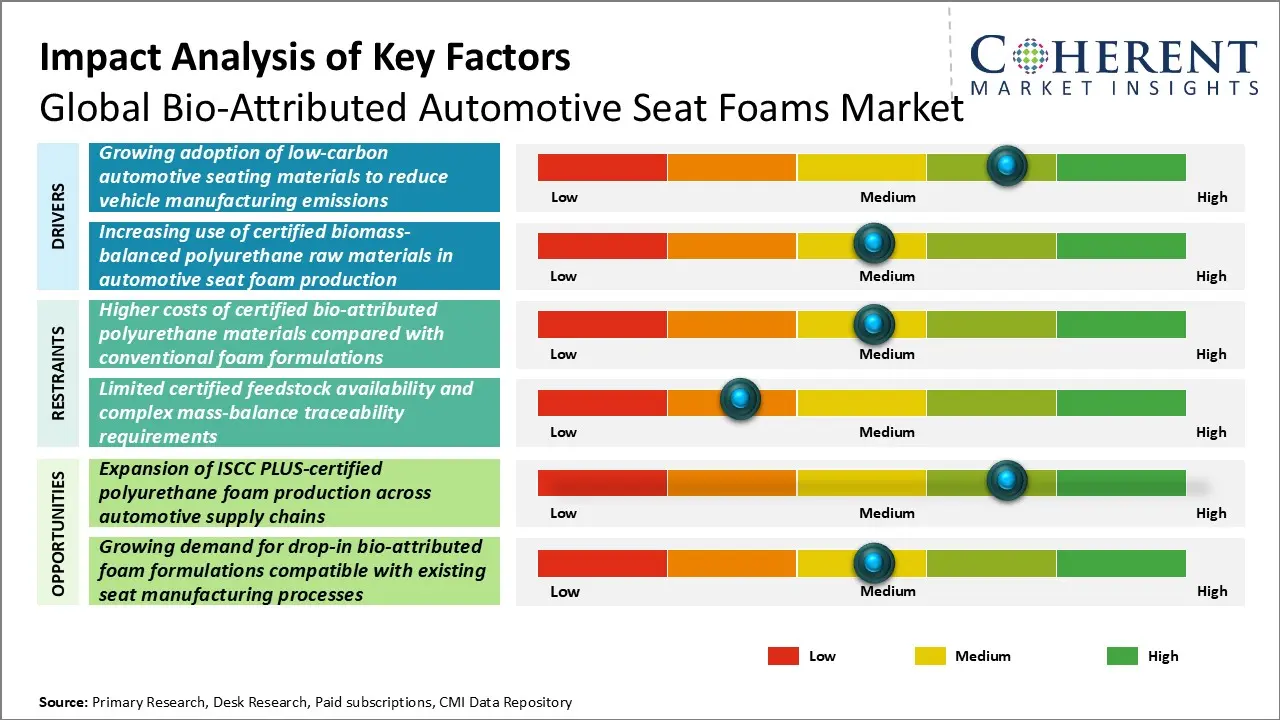
- Growing Adoption of Low-Carbon Automotive Seating Materials to Reduce Vehicle Manufacturing Emissions: Automotive manufacturers are increasingly considering the embedded carbon footprint of seating systems as part of their supply-chain decarbonization strategies, and are increasingly adopting low-carbon automotive seating materials to reduce emissions from vehicle manufacturing. Bio-attributed polyurethane foams can maintain the mechanical properties required for long-term seating performance while reducing dependence on fossil-derived inputs. This provides a commercial opportunity for foam formulators, material suppliers and Tier-1 seating manufacturers who can demonstrate measurable environmental improvements without major changes to production. Woodbridge won the Polyurethane Innovation Award in October 2024 for its TrimVisible BIO product that incorporates biogenic carbon into the foam of automotive seating
- Increasing Use of Certified Biomass-Balanced Polyurethane Raw Materials in Automotive Seat Foam Production: Certified mass-balance systems that enable polyurethane suppliers to allocate renewable feedstock inputs to existing chemical production without the need to completely overhaul the manufacturing infrastructure. This approach is commercially attractive to automotive seating manufacturers seeking independently verified sustainability documentation, traceable material sourcing and consistent foam quality. Chemical producers can also distinguish their products through certified renewable allocations and application-specific performance. In August 2026, Dow and Adient brought to market SPECFLEX REN, a commercial automotive seating solution made from ISCC PLUS-certified bio-circular feedstocks allocated through mass balance.
Emerging Market Trends
- Transition Toward Application-Specific Renewable Foam Formulations: Automotive seating manufacturers are gradually moving away from standardized renewable polyurethane formulations to foam systems that are explicitly tailored to the mechanical requirements, comfort zones and seating geometries of individual vehicles. Compatibility with renewable input, compression recovery, vibration absorption and long-term dimensional stability are becoming increasingly important in the development of materials.
Impact: This change could mean more demand for specialized expertise in formulation and more opportunities for suppliers to provide custom polyurethane systems rather than basic chemical inputs.
Market Relevance: Application specific formulations are expected to promote technical collaboration between foam manufacturers and seating-system designers and to promote product differentiation during the forecast period.
- Diversification of Renewable Feedstock Procurement Strategies: Polyurethane manufacturers are exploring the diversification of their renewable feedstock portfolios in an attempt to reduce the impact of regional sourcing constraints, processing costs and fluctuations in agricultural availability. The consistent nature of the raw material characteristics is increasingly important to automotive manufacturers for their high-volume programs, and that is why the flexibility of the feedstock is becoming increasingly critical.
Impact: Suppliers able to qualify multiple streams of renewable inputs may enjoy increased procurement flexibility and reduced production interruptions associated with concentrated sourcing arrangements.
Market Relevance: This shift is likely to result in more flexible chemical production networks and greater opportunities for specialized renewable-feedstock processors during the forecast period.
Key Restraint Factors
- Higher Material Qualification and Processing Costs: Bio-attributed polyurethane systems may involve additional costs for environmental documentation, formulation validation, chain-of-custody certification and sourcing of renewable feedstocks. In addition, the alternative raw-material routes have to be verified by the automotive manufacturers to meet the established seating requirements. For cost-sensitive vehicle programs, these costs can be a barrier to adoption, particularly if procurement teams cannot justify a commercially acceptable price premium over conventional foam.
- Limited Availability of Qualified Renewable Chemical Inputs: Commercialization of bio-attributed polyols and isocyanates is severely restricted by the lack of reliable sources of the right kind of materials. Variability in feedstock, coverage by certification and limited access to compatible chemical production facilities may complicate procurement. Suppliers that do not have geographically diverse production arrangements may experience longer qualification cycles and may be unable to support automotive manufacturers that require identical formulations across multiple manufacturing locations.
Regional Insights
Why Does Europe Dominate the Global Bio-Attributed Automotive Seat Foams Market?
Europe is projected to account for 34.5% of the global bio-attributed automotive seat foams market share in 2026. The growth is driven by the increasing demand for traceable renewable materials, established automotive seating suppliers, and specialized polyurethane production in the region. An increasing attention of European manufacturers to the carbon footprints of the products and material certification during procurement of vehicle components drives emerging opportunities for bio-attributed foam formulations. In addition, the region is backed by research networks that enable information exchange between automotive component makers and chemical developers. November 2026: The European Commission’s Enterprise Europe Network cited a bio-based polyol technology for polyurethane foams, including automotive interior applications, from a Polish research organization. The initiative’s drive to find industrial partners to validate the formulation and scale-up production further highlights Europe’s continued investment in renewable alternatives to polyurethane.
Why Is Asia Pacific Emerging as the Fastest-Growing Region in the Global Bio-Attributed Automotive Seat Foams Market?
Asia Pacific is expected to hold 30.2% share of the global bio-attributed automotive seat foams market in 2026 due to the concentrated vehicle manufacturing operations and the developing automotive seating development capabilities in the region. Growth opportunities are anticipated. In North America, suppliers are exploring renewable polyurethane formulations that can meet the needs of a variety of vehicle platforms and are compatible with high volume molding processes. Opportunities for localized material qualification are available to automotive OEMs, polyurethane processors and specialized chemical suppliers. In Japan, the TACHI-S ESG Report was published in November, 2025, and provided a comprehensive review of the development of Biomold Urethane Foam for Automotive Seat Pads from Non-Edible Castor Oil. The project aims to reach a comfort and durability level similar to traditional polyurethane, showing the potential for innovation in renewable materials in the region.
Global Bio-Attributed Automotive Seat Foams Market Outlook for Key Countries
Why Is China a Key Market for the Global Bio-Attributed Automotive Seat Foams Market?
China’s share of the global bio-attributed automotive seat foams market is due to its large automotive component manufacturing network and its integrated polyurethane chemical industry. The availability of isocyanates, polyether polyols and formulated polyurethane systems within the country allows for the development of renewable-attributed seating materials. Chinese suppliers’ existing chemical production and export capabilities also allow them to support international automotive programs. A key commercial issue is whether renewables can meet compression-performance, low-odor and volatile organic compound requirements at competitive prices. In November 2023, Wanhua Chemical announced it had obtained ISCC PLUS certification for bio-based polyols, TDI and MDI. The certification is operated by mass-balance accounting. This established an upstream certification scheme relevant to requirements for the international supply chain, and for the future production of bio-attributed automotive foam.
Why Is the U.S. Important in the Global Bio-Attributed Automotive Seat Foams Market?
The U.S. provides a large global market opportunity for bio-attributed automotive seat foams, where domestic automotive seat development combines material engineering capabilities with established supplier relationships and vehicle-platform qualification processes. Before they can be commercialized, manufacturers need to show that renewable polyurethane formulations meet demanding requirements for cabin emissions, durability and comfort. When traceability and reliable deliveries are procurement priorities, domestic sourcing can increase the commercial attractiveness of bio-based inputs. Lear Corporation recognizes SoyFoam of the United States as one of its automotive cushioning technologies. In February 2025, Lear unveiled its partnership with General Motors to integrate its ComfortMax seating technology, a move that highlighted the significance of advanced seat engineering and manufacturing integration. But this is an advance in seating technology, not a confirmed bio-attributed foam deployment.
Why Is Japan a Strategic Market for the Global Bio-Attributed Automotive Seat Foams Market?
Japan’s dominance in the global market for bio-attributed automotive seat foams is testimony to its expertise in manufacturing advanced automotive components, engineering seating comfort and precision polyurethane formulation. It is technically difficult to qualify renewable materials, as Japanese suppliers focus on vibration absorption, stable cushioning performance and dimensional stability. Existing country links between chemical producers and seating manufacturers offer a potential route for the incorporation of alternative feedstocks into future vehicle programs. In January 2025 Archem announced it will develop plant-based polyurethane materials and high-performance seat pads compatible with battery electric vehicles. Commercial use of bio-based materials in those seat pads was not verified, but this avenue offers opportunities for renewable foam formulations that are tailored to the specific comfort requirements of thinner seating structures.
Why Does India Support Growth in the Global Bio-Attributed Automotive Seat Foams Market?
India’s investment in automated polyurethane processing, expansion of domestic seating production and manufacturing of cost sensitive vehicles provide growth opportunities for bio-attributed automotive seat foams. Passenger car and commercial vehicle manufacturers require molded cushioning that is consistent in density, durability and production efficiency. Suppliers could leverage local foam manufacturing capabilities to bring renewable formulations to market without relying entirely on imported finished components. In March 2025, Hennecke announced plans to install two WKH automated foam-molding systems in India in 2025. These systems are designed to make automotive seats, backrests and head rests. The announcement did not confirm that the planned systems would produce bio-attributed polyurethane foams, but the investment suggests domestic processing capabilities are being strengthened.
Why Is Germany a Strategic Country in the Global Bio-Attributed Automotive Seat Foams Market?
Germany’s focused expertise in polyurethane processing, advanced chemical engineering capabilities, and automotive component research infrastructure all contribute to the country’s strategic position in the global bio-attributed automotive seat foams market. German manufacturers are well placed to explore renewable foam feedstocks that meet the needs of the automotive industry for mechanical strength, cushioning performance and production consistency. University, chemical developer and industrial manufacturer research partnerships are helping develop alternative polyurethane formulations. Since June 2024, Leibniz University Hannover has been involved in the Bio2Foam project. The project is focused on converting sugarcane bagasse into bio-based polyurethane materials for automotive and other applications. The project provides a potential route for the development of renewable flexible foams, but industrial validation is needed before commercial automotive applications.
Sustainability, Procurement & Commercialization Landscape in the Global Bio-Attributed Automotive Seat Foams Market
Market Factor | Current Market Landscape | Industry Direction | Commercial Implications |
Automotive OEM & Tier-1 Procurement | Bio-attributed seating foams require qualification within established automotive sourcing programs. | Greater integration of renewable material requirements into seating procurement specifications. | Creates long-term supply opportunities for qualified polyurethane foam manufacturers. |
Sustainability and Carbon Footprint Assessment | The environmental performance of the bio-attributed foam is evaluated in comparison to standard alternatives by calculating the product carbon footprint. | The emphasis on transparent environmental claims and documented life cycle emissions is increasing. | Focuses on sustainability, enhancing product differentiation, and helping automotive buying decisions. |
Certified Raw Material Sourcing | Material acceptance is affected by chain-of-custody certification, supplier traceability and the origin of renewable feedstock. | Increase the use of certified supply chains for polyurethane raw materials and verified bio-circular inputs. | Builds supplier relationships with automotive manufacturers and adds credibility to sourcing. |
Material Cost & Pricing Competitiveness | Commercial viability is impacted by renewable feedstock premiums, certification costs and qualification costs. | More emphasis on cost optimization and long term material supply contracts. | Suppliers with steady performance and competitive price can increase market penetration. |
Automotive Quality and Conformance to Performance | Seat foams must meet the following requirements: durability, compression recovery, comfort and cabin emissions. | Further validation of renewable formulations in automotive production environments. | Preference will be given to manufacturers with established automotive quality assurance systems and testing capabilities. |
End-of-Life Management & Circularity | Automotive seat foam can be recycled only on the basis of suitable recycling processes, sorting and dismantling. | The significance of circular material management and recoverability is increasing throughout the whole vehicle lifecycle. | Provides opportunities to improve material recovery practices and build recycling partnerships. |
How Are Specialized Commercial Vehicle Seating Applications Creating New Growth Opportunities in the Global Bio-Attributed Automotive Seat Foams Market?
Commercial vehicle seating is an underdeveloped opportunity that suppliers looking to expand beyond traditional passenger-car programs should consider. For busses, coaches and light commercial vehicles it is important to have polyurethane cushioning that can withstand long term use, repeated compression and harsh operating conditions. These applications open up opportunities for bio-attributed formulations with extended durability and documented renewable sourcing.
Specialty foam converters and regional seating manufacturers can serve this segment with application-specific grades, custom molding and smaller production batches. To be commercially successful it must demonstrate consistent mechanical performance, acceptable material premiums and compatibility with existing seat manufacturing processes.
Suppliers should focus on assured access to certified chemical inputs, tailored product qualification and technical partnerships to commercial vehicle seating manufacturers. Specialists may compete through custom product development and flexible production, while established polyurethane producers may have an advantage in formulation capabilities. The chance is especially relevant to fleet managers who want to measure progress in the sustainability of their vehicle purchasing.
Market Players, Key Development, and Competitive Intelligence
Key Developments
- In October 2025, Mitsui Chemicals showcased ECONYKOL, a castor-oil-based polyurethane polyol, alongside its automotive seating material portfolio at K 2025. This is relevant to future renewable chemical sourcing and seating-material development. However, the announcement does not establish that ECONYKOL was commercially incorporated into automotive seat foam, leaving that application unconfirmed.
- In March 2025, Covestro implemented improvements at its Dormagen TDI manufacturing plant, reducing energy consumption relative to earlier production processes. TDI is a precursor used in flexible polyurethane foams, including automotive seating. The improvement strengthens the lower-emission production pathway for conventional and potentially bio-attributed polyurethane supply, without itself establishing renewable feedstock attribution.
- In April 2024, Huntsman highlighted plans to showcase polyurethane-based automotive seating foams made using bio-based polyols at UTECH Europe. The company also emphasized formulation pathways supporting recyclability. This development is relevant because it demonstrates continuing supplier investment in renewable-compatible seating chemistry and application-specific polyurethane material development.
Competitive Landscape
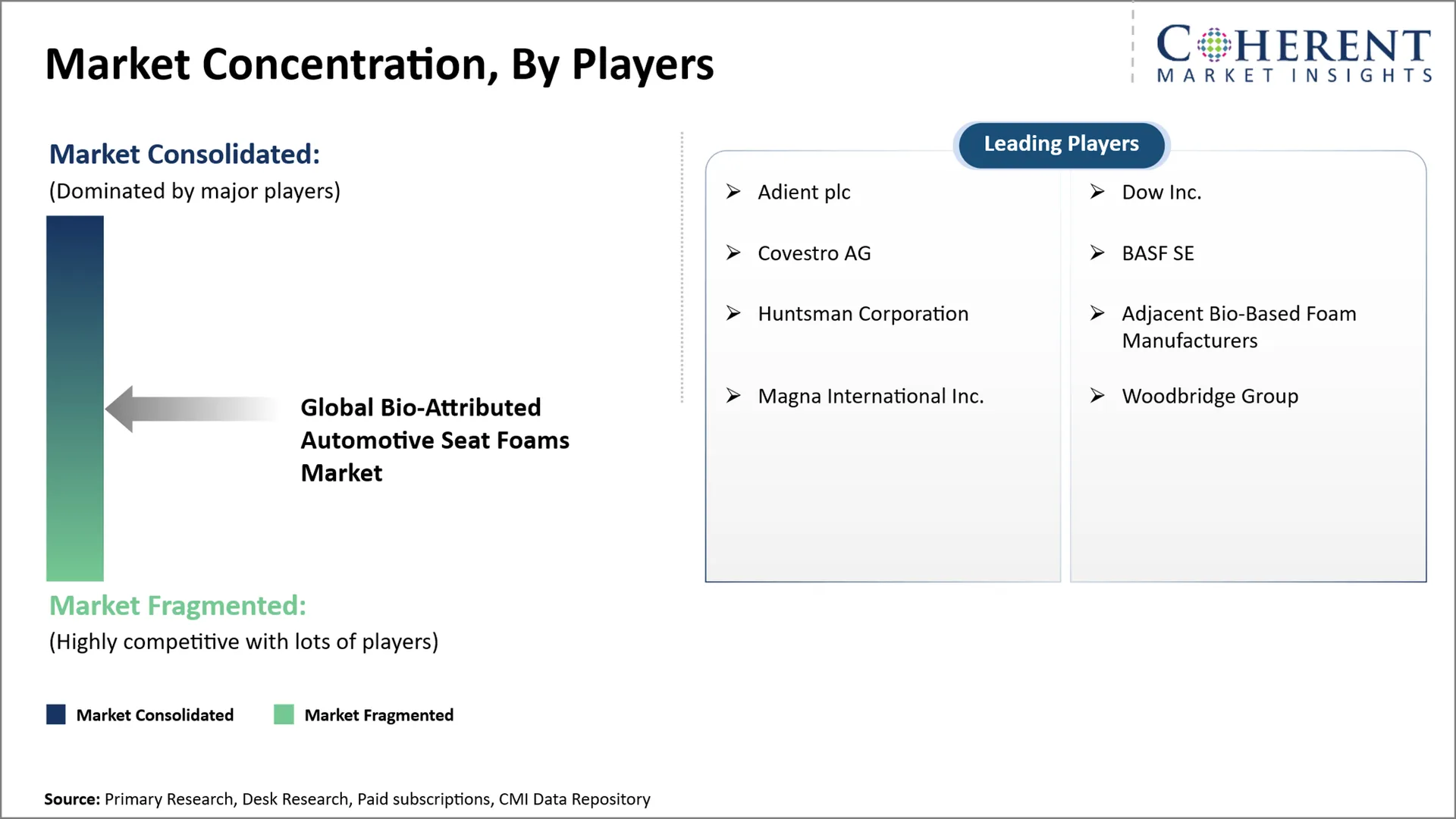
The global bio-attributed automotive seat foams market is moderately consolidated, with material development and qualification influenced by established polyurethane chemical producers and major automotive seating suppliers. The competition is based on the following: consistency of formulation, traceability of renewable inputs, performance of application, reliability of production and commercial pricing. Regional converters and specialty chemical companies provide customized foam development, localized supply, and technical support for vehicle-specific requirements.
Key focus areas include
- Suppliers compete on consistent foam density, resilience, fatigue life and compression resistance.
- Manufacturing efficiency: shorter demolding cycles, stable reaction profiles and reduced material waste have an impact on production economics.
- Competitive pricing: The premiums on renewable materials must be commercially viable as per automotive procurement agreements.
- Supply Reliability: The constant availability of suitable polyols, isocyanates and additives enables the continuous production of cars.
- Certification and quality assurance: Automotive quality-management procedures, batch traceability and credible attribution records are implemented which increases supplier acceptance.
- Product Customization: The geometry of the component, the density of the foam and the hardness distribution are customized to meet the specific seating requirements of each individual.
- Regional Manufacturing Capabilities: Suppliers offer local production and technical support to allow adaptation to changing customer specifications and delivery requirements.
Market Report Scope
Global Bio-Attributed Automotive Seat Foams Market Report Coverage | |||
Report Coverage | Details | ||
Base Year | 2025 | Market Size in 2026: | USD 65.4 Mn |
Historical Data For: | 2020 To 2024 | Forecast Period: | 2026 To 2033 |
Forecast Period 2026 To 2033 CAGR: | 35.30% | 2033 Value Projection: | USD 542.8 Mn |
Geographies covered: |
| ||
Segments covered: |
| ||
Companies covered: | Adient plc, Dow Inc., Covestro AG, BASF SE, Huntsman Corporation, Adjacent Bio-Based Foam Manufacturers, Magna International Inc., Woodbridge Group | ||
Growth Drivers: |
| ||
Restraints & Challenges: |
| ||
Analyst Opinion (Expert Opinion)
- The global bio-attributed automotive seat foams market leadership is likely to shift toward suppliers capable of delivering complete, application-ready foam systems rather than individual renewable chemical components. Automakers increasingly need materials that can be integrated into established manufacturing programs without creating additional engineering complexity. Suppliers combining formulation development, testing capabilities, and manufacturing support should be better positioned to negotiate long-term customer relationships and defend premium positioning.
- The next major competitive transition could be in treating automotive seating foam not as a standardized cushioning material but as an engineered component with configurable material architecture. That would squeeze the traditional volume players and favor those who can combine material chemistry with seating ergonomics, production engineering and digital simulation. The commercial advantage would move toward handling vehicle specific requirements through integrated material and component development.
- Global bio-attributed automotive seat foams market players need to focus on proven polyurethane formulations, reliable chemical supply contracts and early engagement with seating-system procurement teams. Investments should be made in materials with reproducible performance from production batch to production batch. Suppliers also have to contend with renewable feedstock premiums, qualification costs and changes in sustainability claims requirements. Overinvestment in specialized production capacity should be avoided until customers establish credible procurement commitments and acceptable pricing arrangements.
Speak to the analyst
Want personalized insights?
Take the findings above to one of our principal consultants, or have the report rebuilt around the segments, geographies and competitors you actually track.
Market Segmentation
- Foam Type Insights (Revenue, USD Mn, 2021 - 2033)
- MDI-Based Polyurethane Foam
- TDI-Based Polyurethane Foam
- Seat Component Insights (Revenue, USD Mn, 2021 - 2033)
- Seat Cushions
- Backrest Foams
- Headrest Foams
- Armrest Foams
- Bio-attributed Input Insights (Revenue, USD Mn, 2021 - 2033)
- Bio-Attributed Polyols Only
- Bio-Attributed Isocyanates Only
- Both Bio-Attributed Polyols and Isocyanates
- Feedstock Source Insights (Revenue, USD Mn, 2021 - 2033)
- Bio-Circular Waste and Residue Feedstocks
- Virgin Renewable Biomass Feedstocks
- Vehicle Type Insights (Revenue, USD Mn, 2021 - 2033)
- Passenger Cars
- Light Commercial Vehicles
- Heavy Commercial Vehicles
- Buses and Coaches
- Sales Channel Insights (Revenue, USD Mn, 2021 - 2033)
- Direct Supply to Tier-1 Seating Manufacturers
- Direct Automotive OEM Supply
- Specialty Foam Converters
- Regional Insights (Revenue, USD Mn, 2021 - 2033)
- North America
- U.S.
- Canada
- Latin America
- Brazil
- Argentina
- Mexico
- Rest of Latin America
- Europe
- Germany
- U.K.
- Spain
- France
- Italy
- Russia
- Rest of Europe
- Asia Pacific
- China
- India
- Japan
- Australia
- South Korea
- ASEAN
- Rest of Asia Pacific
- Middle East
- GCC Countries
- Israel
- Rest of Middle East
- Africa
- South Africa
- North Africa
- Central Africa
- North America
- Key Players Insights
- Adient plc
- Dow Inc.
- Covestro AG
- BASF SE
- Huntsman Corporation
- Adjacent Bio-Based Foam Manufacturers
- Magna International Inc.
- Woodbridge Group
Sources
Primary Research Interviews
- Bio-attributed polyurethane foam manufacturers, polyol and isocyanate producers
- Automotive OEMs, Tier-1 seating suppliers, foam converters, and renewable feedstock suppliers
Stakeholders
- Bio-attributed MDI, TDI, and polyol manufacturers
- Automotive seating manufacturers, chemical suppliers, and sustainability certification providers
End-use Sectors
- Passenger cars, light commercial vehicles, heavy commercial vehicles, buses, and coaches
- Automotive seat cushions, backrests, headrests, and armrests
Regulatory and Industry Bodies
- European Chemicals Agency (ECHA)
- European Commission (EC)
- U.S. Environmental Protection Agency (EPA)
- National Highway Traffic Safety Administration (NHTSA)
Databases
- OICA global automotive production statistics
- UN Comtrade and International Trade Centre (ITC) Trade Map
- Eurostat PRODCOM and national automotive manufacturing statistics
- ISCC PLUS certification database
Magazines and Journals
- Journal of Cellular Plastics
- Journal of Applied Polymer Science
- Polymer Degradation and Stability
- ACS Sustainable Chemistry & Engineering
Associations
- Center for the Polyurethanes Industry (CPI)
- European Polyurethane Association (ISOPA)
- European Association of Flexible Polyurethane Foam Blocks Manufacturers (EUROPUR)
- International Organization of Motor Vehicle Manufacturers (OICA)
Public Domain Sources
- Polyurethane technical data sheets, sustainability reports, and ISCC PLUS certificates
- Automotive production statistics, renewable feedstock availability, and chemical capacity announcements
- Product carbon footprint studies and bio-based polyurethane research publications
Key Standards and Regulations
- EU REACH Regulation (EC) No 1907/2006
- EU CLP Regulation (EC) No 1272/2008
- EU End-of-Life Vehicles Regulation
- ISO 14040/14044 – Life Cycle Assessment
- ISO 14067 – Product Carbon Footprint
- ISCC PLUS – Voluntary Sustainability and Mass-Balance Certification
Proprietary Elements
- CMI Data Analytics Tool
- Proprietary research repository, supported by primary interviews, automotive seat foam consumption modeling, renewable feedstock assessments, pricing analysis, and competitive intelligence.
Get access to 250+ pages report
Every segment, forecast, competitor profile and data table behind the analysis above — available for instant download.
- ESOMAR Member
- ISO 9001:2015 Certified
- D-U-N-S Registered
- GDPR & CCPA Compliant
Frequently Asked Questions
The CAGR of global bio-attributed automotive seat foams market is projected to be 35.30% from 2026 to 2033.
The of global bio-attributed automotive seat foams market is estimated to be valued at USD 65.4 Mn in 2026 and is expected to reach USD 542.8 Mn by 2033.
Bio-attributed foams use certified renewable feedstock allocation through mass-balance accounting while physically bio-based foams use renewable-derived materials in the chemical composition.
Bio-attributed content is verified using standard chain of custody certification systems, e.g. ISCC PLUS, which track the allocation of eligible renewable feedstock throughout the supply chain.
Automotive manufacturers should consider material performance, the validity of certification, supply reliability, production capacity, pricing and compliance to automotive quality requirements.
The global bio-attributed automotive seat foams market report provides supplier benchmarking, competitive assessment, procurement planning and investment evaluation through analysis of market conditions, material sourcing, manufacturing capabilities and commercialization requirements.
The increasing use of low-carbon automotive seating materials and growing use of certified biomass-balanced polyurethane raw materials are the major factors that are anticipated to drive the growth of the global bio-attributed automotive seat foams market. These developments help car manufacturers reduce emissions from vehicle production and improve material sustainability.