

Global Biodegradable Oral Coating Polymers Market Size and Forecast – 2026 To 2033
The global biodegradable oral coating polymers market is estimated to be valued at USD 242.6 Mn in 2026 and is expected to reach USD 426.7 Mn by 2033, exhibiting a CAGR of 8.40% during the forecast period. Market growth is supported by increasing interest in plant-derived coating materials for pharmaceutical tablets, capsules, and nutraceutical formulations. The film-forming properties of cellulose-based polymers, modified starches, and natural polysaccharides can improve ingredient protection, dosage-form stability, and drug-release characteristics.
In June 2026, researchers published a study in the International Journal of Biological Macromolecules demonstrating that porous starch coated with hydroxypropyl methylcellulose (HPMC) improved probiotic encapsulation efficiency, resistance to gastrointestinal conditions, and tablet storage stability. These findings highlight the potential of natural polymer-based coating technologies for sensitive oral formulations, creating additional development opportunities for pharmaceutical excipient manufacturers and nutraceutical producers.
Key Takeaways of the Global Biodegradable Oral Coating Polymers Market
- Cellulose-based biodegradable polymers are projected to grow at an estimated CAGR of 8.8% during 2026–2033 and account for 48.6% of the global biodegradable oral coating polymers market in 2026. Hypromellose and related cellulose derivatives provide reliable film formation, aqueous processing and familiar excipient qualification pathways that reduce reformulation risk for pharmaceutical manufacturers. In April 2025, IFF introduced Low Nitrite METHOCEL HPMC to improve impurity control in pharmaceutical formulations.
- Immediate-release and aesthetic coatings are projected to register an estimated CAGR of 8.1% during 2026–2033, accounting for 49.3% of the global biodegradable oral coating polymers market in 2026. These coatings provide rapid drug release, better tablet identification, improved surface finish and processing efficiency. In February 2025, Roquette and Tabshield launched their plant-based ReadiLYCOAT platform, providing ready-to-use immediate-release and decorative coating solutions.
- Tablets are forecast to grow at an estimated CAGR of 8.5% during 2026–2033 and account for 71.4% of the global biodegradable oral coating polymers market in 2026. High volume coating lines prefer polymer systems that are uniform, that can survive handling and that are reproducible from batch to batch, without having to modify existing equipment. In April 2025, Ashland finished a $10 Mn expansion of its Aquarius tablet-coating manufacturing facility in Brazil.
- North America is projected to grow at an estimated CAGR of 7.7% during 2026–2033 and account for 35.1% of global biodegradable oral coating polymers market revenue in 2026. Its established oral-solid manufacturing ecosystem enables rigorous excipient screening, formulation development and repeat purchasing from qualified suppliers. Biocon’s oral-solid facility in New Jersey, with a capacity to make 2 billion tablets a year, was commissioned in September 2025.
- Asia Pacific is projected to expand at an estimated CAGR of 10.2% during 2026–2033, accounting for 31.6% of the global biodegradable oral coating polymers market in 2026. Regional formulators benefit from local production of coatings, shorter replenishment cycles and customization for their local pharmaceutical and nutraceutical portfolios. In July 2025, Colorcon opened a film-coating facility in Johor, Malaysia, to serve Asia Pacific manufacturers and strengthen the durability of a regional supply.
Segmental Insights
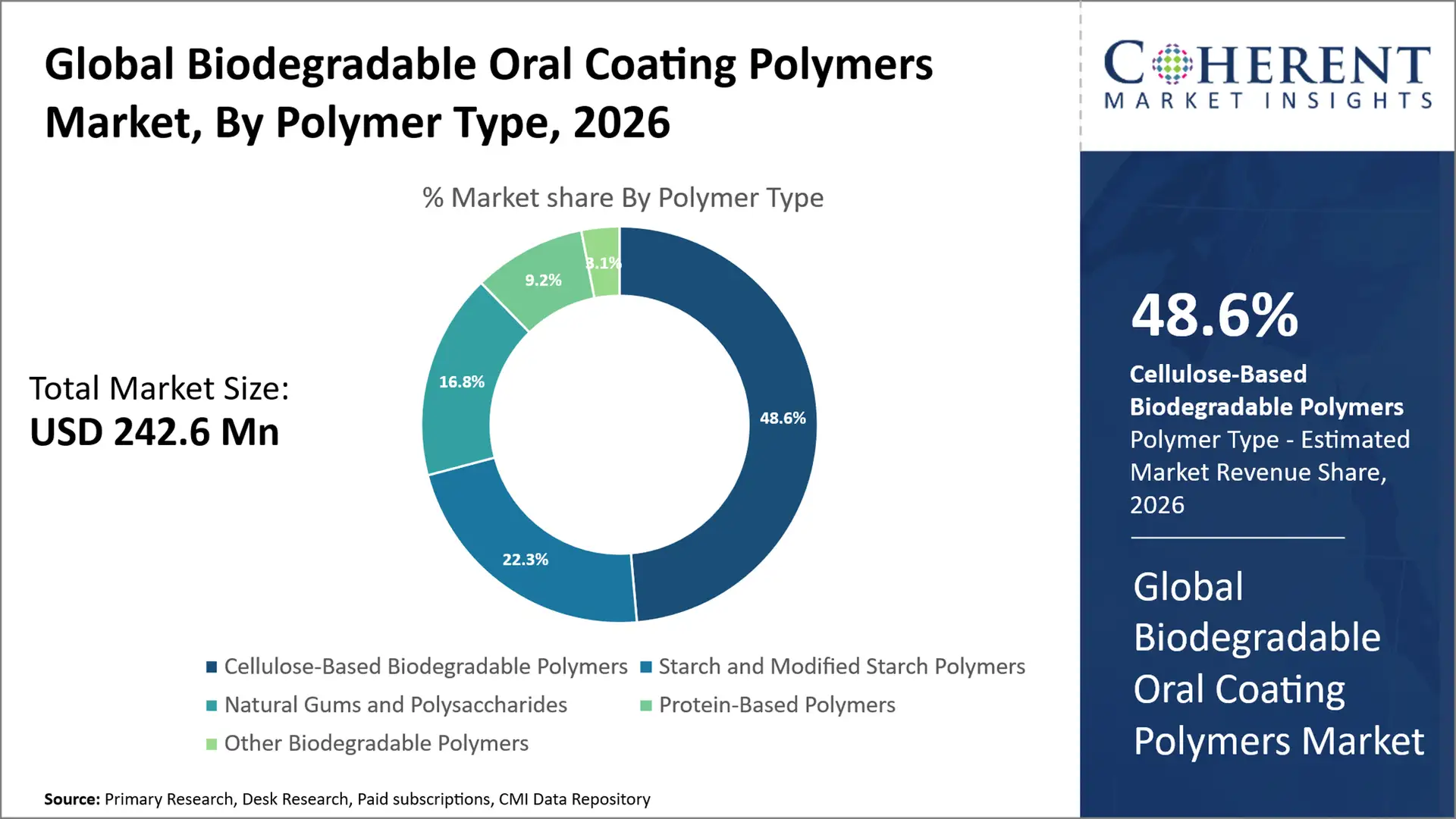
Why Do Cellulose-Based Biodegradable Polymers Dominate the Global Biodegradable Oral Coating Polymers Market?
Cellulose-based biodegradable polymers are expected to account for 48.6% of the polymer-type category in the global biodegradable oral coating polymers market in 2026, reflecting the breadth of cellulose chemistry available for oral coating design. Hypromellose and its functional derivatives can be selected according to solubility, film formation, and gastrointestinal release requirements, giving formulators more options within a familiar material family. Pharmaceutical excipient manufacturers also benefit from established production expertise and specification-driven procurement, although plant origin alone does not demonstrate biodegradability for every grade. In March 2024, Shin-Etsu Chemical announced a JPY 10 billion investment plan to double capacity for Shin-Etsu AQOAT, a plant-pulp-derived hypromellose acetate succinate used in enteric coatings, with completion targeted for the second quarter of 2026. The planned expansion illustrates continued investment in specialized cellulose chemistry, supporting supply security and portfolio depth for oral drug formulators.
- Current Industry Events of 2026
- Market Size Estimation
- Regional Breakdown
- Competitive Landscape
- Customer Intelligence
- Segmental Analysis
- Pricing Analysis
- Key Market Drivers, Challenges & Future Trends
- Customized Insights Section
Why Do Immediate-Release and Aesthetic Coatings Represent the Largest Coating Function in the Global Biodegradable Oral Coating Polymers Market?
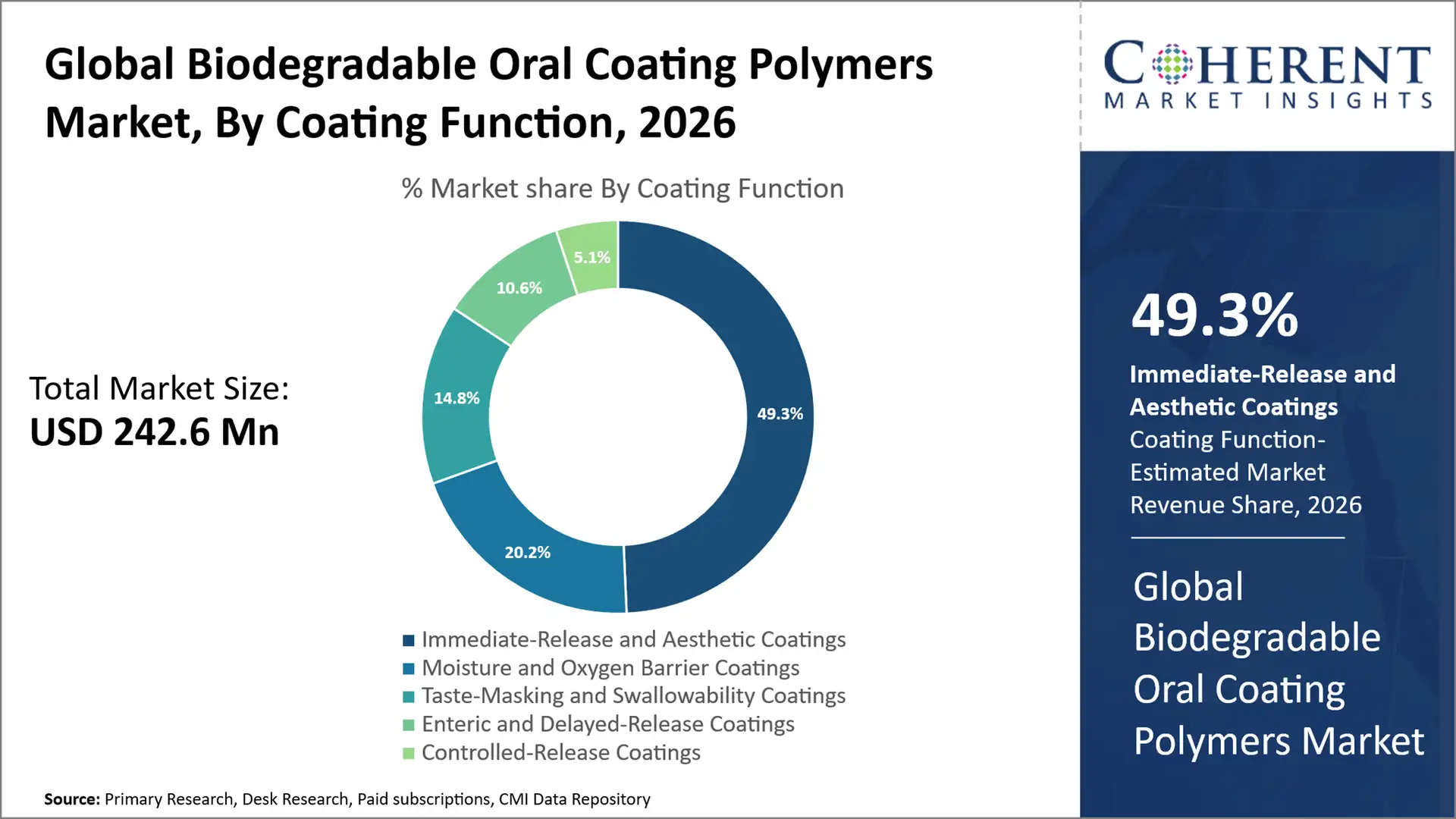
Immediate-Release and Aesthetic Coatings are estimated to account for 49.3% of the global biodegradable oral coating polymers market by 2026 owing to their capacity of meeting finishing requirements without a delayed-release mechanism. Pharmaceutical and supplement brands use these films to differentiate their products, while maintaining the intended tablet disintegration profile, via consistent color, surface texture and legible identification. Assuming dissolution performance is confirmed, their formulation requirements can allow for a wider range of compatible plant-derived polymers and simpler validation pathways compared to more complex functional coatings. In May 2026, GEA unveiled its ConsiGma FC Lab coater, designed for small tablet batches and capable of applying aesthetic coatings through uniform spray distribution. This is an important commercial need: developers of coatings need reproducible visual results and efficient formulation trials before they commit themselves to production scale coating programs.
Why Do Tablets Dominate the Dosage Form Category of the Global Biodegradable Oral Coating Polymers Market?
Tablets are projected to account for 71.4% of the global biodegradable oral coating polymers market in 2026, supported by the cost efficiency of coating compressed solid dosage forms at an industrial scale. Their relatively regular geometry permits controlled spray exposure, measurable coating-weight gain and integration with existing pan-coating and inspection workflows. Pharmaceutical manufacturers can use process controls to control the use of coating materials in existing product lines and nutraceutical manufacturers can use process controls to achieve a uniform coating on large size supplements. In May 2026, Romaco introduced its Tecpharm 400 tablet coater, featuring automatically adjustable mixing baffles and spray-position control to accommodate changing tablet-bed conditions. Although the equipment is not specifically designed for biodegradable polymers, its launch demonstrates continued investment in tablet-coating infrastructure. This infrastructure provides a potential manufacturing pathway for suitably qualified biodegradable formulations without requiring manufacturers to replace their entire coating production systems.
Current Events and their Impact
Current Event | Description and Its Impact |
October 2024 – U.S. FDA finalized ICH M13A bioequivalence guidance |
|
January 2026 – EMA published final guidance on co-processed excipients |
|
May 2026 – Health Canada updated nitrosamine risk-management guidance |
|
Global Biodegradable Oral Coating Polymers Market Dynamics
Key Market Drivers
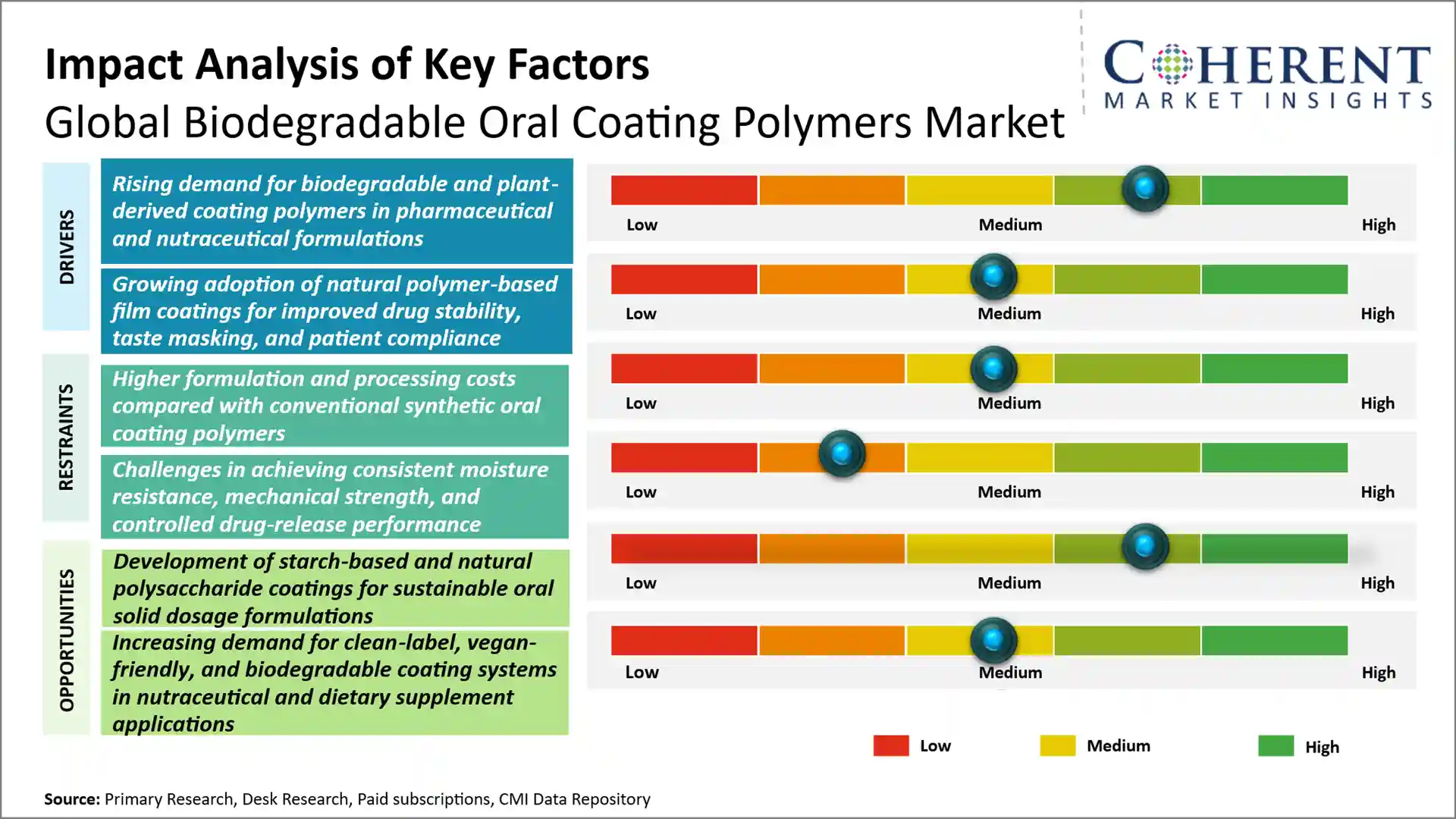
- Rising demand for biodegradable and plant-derived coating polymers in pharmaceutical and nutraceutical formulations: Pharmaceutical and nutraceutical manufacturers are exploring renewable coating ingredients to reduce reliance on conventional mineral additives and improve ingredient transparency. This creates market opportunities for suppliers of cellulose-based materials with simplified ingredient declarations and consistent performance. In March 2026 Seprify and BIOGRUND launched SilvaAlba, a plant-based cellulose ingredient for mineral-free nutraceutical tablet coatings. These formulations were made available for customer evaluation, showing how specialist polymer developers may collaborate with established coating manufacturers to provide alternative coating systems without the need for major changes to existing production methods.
- Growing adoption of natural polymer-based film coatings for improved drug stability, taste masking, and patient compliance: Natural polymer-based coating systems are becoming increasingly relevant as manufacturers seek to protect moisture-sensitive medications while maintaining appropriate tablet disintegration and patient acceptability. To distinguish their products, coating suppliers can focus on validated barrier performance, formulation compatibility, and acceptable sensory attributes. In February 2026, Seppic published the results of a performance comparison study on its HPMC-based SEPIFILM LP film coatings, demonstrating the moisture barrier and the reduction in tablet swelling under high humidity conditions. Such evidence helps pharmaceutical formulators to reduce stability-related development risks, establish more reliable product specifications and select appropriate coating systems.
Emerging Market Trends
- Shift Toward Modular, Ready-to-Use Biopolymer Coating Formulations: Oral-solids producers are moving to flexible coating systems that allow changes to viscosity, pigment load, and plasticizer levels without having to develop new formulations from scratch. These systems can be especially useful for contract manufacturers with diverse product portfolios since the dispersion and application procedures are standardized.
Impact: Faster formulation changeovers could improve production flexibility and reduce development costs. Suppliers of standardized coating premixes may have an advantage over traditional polymer-only vendors.
Market Relevance: This transition creates opportunities to develop customized polysaccharide-, starch-based, and cellulose-based coating systems. Formulation compatibility and consistent performance at manufacturing scale will be more important for adoption.
- Greater Emphasis on Verified Biodegradability and Polymer Traceability: Pharmaceutical manufacturers are expected to distinguish between renewable polymer origin and scientifically demonstrated biodegradability when evaluating coating materials. Material selection will likely become more dependent on documented degradation testing, ingredient traceability and pharmaceutical grade quality specifications.
Impact: Independent biodegradation testing would improve the supplier's credibility but could also increase initial qualification costs. Manufacturers that deliver validated environmental-performance data, as well as transparent material specifications, will be better positioned to meet evolving expectations around procurement.
Market Relevance: The trend encourages the development of biodegradable coatings with measurable performance parameters, and not merely claims of sustainability. It could progressively alter the positioning of premium excipients, and supplier qualification.
Market Restraint Factors
- Variability in natural polymer characteristics: Variations in molecular weight, degree of substitution, and moisture sensitivity among raw materials can affect coating viscosity, film integrity, and processing consistency. Manufacturers must implement stringent process controls and material specifications to ensure consistent pharmaceutical performance.
- Complexity of functional coating qualification: Biodegradable polymers intended for enteric or controlled-release applications must demonstrate predictable dissolution, stability, and compatibility with active pharmaceutical ingredients. The considerations related to development, testing and approval of the extended formulation can add significantly to the costs of commercialization for specialty polymer suppliers.
Regional Insights
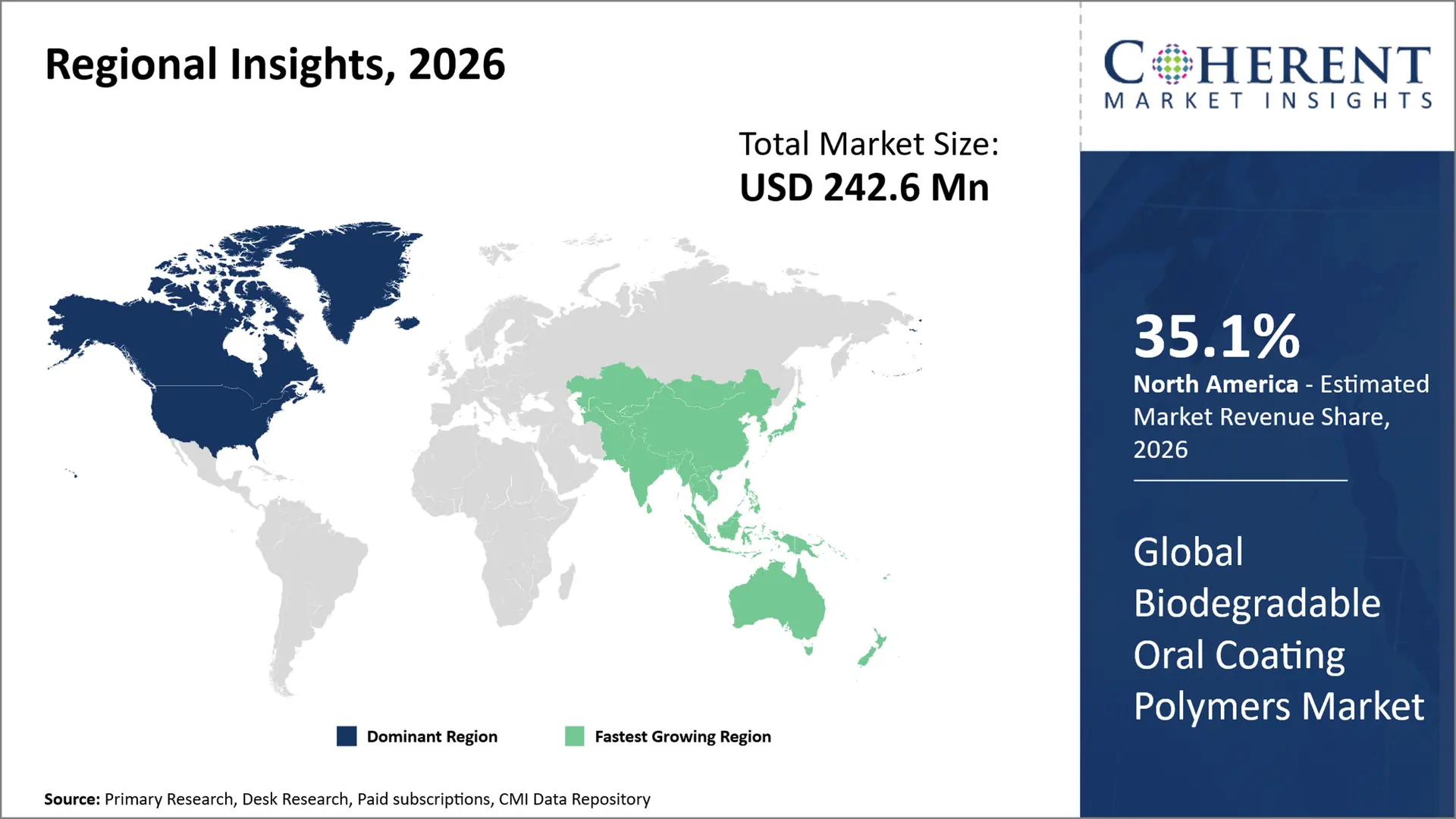
Why Does North America Dominate the Global Biodegradable Oral Coating Polymers Market?
North America is projected to retain its leading position, accounting for 35.1% of the global biodegradable oral coating polymers market in 2026, supported by its concentration of pharmaceutical research, formulation development, and regulated oral-solid manufacturing. Suppliers with strong technical documentation are finding opportunities as pharmaceutical manufacturers increasingly evaluate coating materials through impurity control, dissolution performance and excipient qualification. The region’s existing contract development and manufacturing infrastructure also helps to meet specialized coating needs for complex medicines. In October 2026, Hovione announced its plan to invest USD 35 million to implement a continuous tableting platform at its New Jersey facility. The platform is anticipated to be ready for use in 2027. Although not an investment into biodegradable coating technology, the project demonstrates the continued advancements in oral-solid manufacturing capabilities, creating future opportunities for qualified functional coating materials.
Why Is Asia Pacific Emerging as the Fastest-Growing Region in the Global Biodegradable Oral Coating Polymers Market?
Asia Pacific is projected to represent 31.6% of the global biodegradable oral coating polymers market in 2026, with expanding pharmaceutical excipient production strengthening its growth prospects. Regional manufacturers are expanding cellulose-derivative production facilities to improve material availability and serve pharmaceutical formulators more effectively. This creates opportunities for greater participation in international pharmaceutical supply chains, localized formulation development and competitive sourcing. In January 2025, Meska Joinway Pharmaceutical started full-scale production at its cellulose ether manufacturing facility in Huzhou, China. The facility is dedicated to pharmaceutical grade materials production. The investment could provide a sourcing advantage for tablet-coating manufacturers seeking pharmaceutical-grade cellulose derivatives by strengthening the regional supply of hypromellose.
Global Biodegradable Oral Coating Polymers Market Outlook for Key Countries
Why Is the U.S. a Key Market for the Global Biodegradable Oral Coating Polymers Market?
The United States is a key market for biodegradable oral coating polymers as pharmaceutical manufacturers need coating materials that comply with stringent standards of formulation quality, stability and product consistency. The demand for application specific cellulose and polysaccharide formulations with extensive analytical documentation is an opportunity for the specialty excipient suppliers. Domestic pharmaceutical manufacturing investments may also present opportunities to qualified coating suppliers to new oral-solid production programs. Novartis announced in April 2026 that it would build a new manufacturing site in Morrisville, North Carolina, to support production of active pharmaceutical ingredients for solid dose tablets and capsules. The investment is in drug substances not coatings but it is an example of continued investment in the domestic oral medicines manufacturing ecosystem which could open up opportunities for specialist excipient suppliers in the future.
Why Is India Important in the Global Biodegradable Oral Coating Polymers Market?
India is emerging as an attractive global biodegradable oral coating polymers market because its pharmaceutical manufacturers require cost-effective, scalable coating formulations for generic medicines and nutraceutical tablets. Domestic excipient producers are expanding beyond conventional tablet ingredients into ready-to-use coating premixes, creating opportunities to reduce formulation complexity and strengthen local supply capabilities. In August 2024, Sigachi Industries introduced its PureCoat film-coating systems and UltraMod polymer blends, expanding its pharmaceutical excipient portfolio. Its PureCoat offerings include HPMC-based formulations for pharmaceutical and nutraceutical applications. This development illustrates India's growing capability to manufacture specialized coating systems locally, potentially improving procurement flexibility for domestic formulators and supporting participation in export-oriented pharmaceutical supply chains.
Why Does China Support Growth in the Global Biodegradable Oral Coating Polymers Market?
China's importance in the biodegradable oral coating polymers market is due to its well-established chemical supply chains, pharmaceutical excipient manufacturing capabilities, and integrated cellulose-processing industry. Using material processing expertiseDomestic producers can develop pharmaceutical-grade hypromellose and other cellulose derivatives for oral dosage formulations. Nevertheless, the commercial acceptance is increasingly based on consistent manufacturing practice and documented material quality. In June 2025, China’s National Medical Products Administration issued the new Good Manufacturing Practice requirements for pharmaceutical excipients, to take effect in January 2026. The requirements improve supplier evaluation, production documentation, quality management and change control. This regulatory change could engender confidence among qualified Chinese coating-polymer suppliers, but it would also increase the compliance burden on manufacturers wishing to serve domestic pharmaceutical customers as well as engage in international business.
Why Is Germany a Strategic Country in the Global Biodegradable Oral Coating Polymers Market?
Germany's proficiency in pharmaceutical processing equipment, formulation engineering, and specialized manufacturing technologies has earned it a strategic position in the global biodegradable oral coating polymers market. German equipment suppliers are improving operational flexibility, process containment and spray uniformity to advance the development of polymer coatings. Such capabilities are of commercial interest when manufacturers are comparing alternative coating formulations that require tightly controlled application conditions. In July 2024, Glatt published details of its upgraded GCC tablet coater, which had been presented at ACHEMA in June 2024. The equipment offered improved containment, more efficient air handling, and greater batch flexibility. These advances can allow formulation trials with biodegradable polymers that are suitable by giving manufacturers a greater degree of control over coating operations. The engineering capabilities of Germany thereby bolster its position in the development of pharmaceutical coating technology and the optimization of manufacturing processes.
Why Is Japan an Important Growth Market for the Global Biodegradable Oral Coating Polymers Market?
Japan’s well established expertise in cellulose chemistry and its emphasis on pharmaceutical excipient purity, reproducibility and functional performance is a significant contributor to the global biodegradable oral coating polymers market. Japanese polymer producers support oral-solid formulations and provide specialized grades of hydroxypropyl cellulose for drug-release, film coating and binding applications. Their technical capabilities enable them to provide differential pharmaceutical excipients to meet the needs of domestic and international formulations. In August 2026, Nippon Soda announced that the Nihongi plant had completed the expansion of the NISSO HPC production facilities, which began commercial operation in July. The expansion has increased the production capability to cater for pharmaceutical and other uses. This investment will accelerate the development of specialized oral-solid excipients for global customers, and enhance Japan’s manufacturing base of cellulose derivatives.
Commercial Application and Procurement Landscape for Global Biodegradable Oral Coating Polymers Market
Application Area | Customer Requirements | Commercial Significance | Market Outlook |
Pharmaceutical Tablet Manufacturing | Consistent coating quality, reliable dissolution and pharmaceutical-grade polymer specifications | Supports repeated excipient purchases and qualification contracts with long-term suppliers | Strong |
Dietary Supplements and Nutraceuticals | Plant-based ingredients Attractive appearance of tablets Compatibility with vitamins and botanical extracts | Opens up opportunities for differentiated coating formulations and premium supplement positioning | Increasing |
Moisture-Sensitive Oral Formulations | Humidity protection, integrity of the coating, and documented stability of the product | Promotes procurement of specific polymer grades with verified barrier properties | High Potential |
Pediatric and Geriatric Medicines | Taste masking, improved swallowability, and desirable dosage form characteristics | Supports development of patient-centric oral medicines through tailored coating | Emerging |
Contract Development and Manufacturing Organizations | Flexible formulation, scalable coating processes and steady availability of raw materials | Strengthens demand for standardized coating systems and technical supplier partnerships | Expanding |
Pharmaceutical Excipient Distribution | Regulatory documentation, consistent product specifications, reliable supply and regional stock availability | Enhances market access for specialized polymer manufacturers and supports smaller pharmaceutical customers | Constant |
How Are Gastroprotective Biopolymer Coatings Creating New Growth Opportunities in the Global Biodegradable Oral Coating Polymers Market?
Gastroprotective coatings based on biopolymers for probiotics, enzymes and other sensitive oral ingredients are a promising but technically underdeveloped commercial opportunity. These formulations must be protected from the gastric environment and have suitable release properties at the desired site in the intestine.
Gastroprotective systems, compared to conventional esthetic coatings, require precise control over permeability, film integrity, pH responsiveness and processing conditions. The developers of specialty pharmaceuticals, nutraceutical manufacturers, and contract development organizations might look at multilayer systems using appropriate polysaccharide and cellulose derived materials.
Commercial success depends on proven dissolution profiles, active ingredient viability, reproducible coating thickness and long-term stability testing. Polymer suppliers can distinguish their products with application-specific premixes, technical support, and joint formulation development.
Established excipient manufacturers and specialist developers with strong analytical capabilities are likely to be the biggest beneficiaries. The company will focus investment on laboratory validation, scalable coating processes, regulatory documentation and targeted customer partnerships before moving into large-scale manufacturing.
Market Players, Key Development, and Competitive Intelligence
Key Developments
- In October 2026, Evonik announced the development of a biodegradable polymer platform for next-generation EUDRAGIT oral drug delivery excipients. Laboratory scale quantities (non-commercial) available for select development partners. Success with the qualification and commercialization initiative could lead to future biodegradable options for functional coatings.
- On August 2026, Syntegon introduced the Sepion 75 pilot-scale tablet coater, featuring interchangeable drums with batch volumes ranging from 8 to 75 liters, optimized spraying technology, and reproducible coating conditions. The equipment supports pharmaceutical manufacturers in developing and scaling.
Competitive Landscape
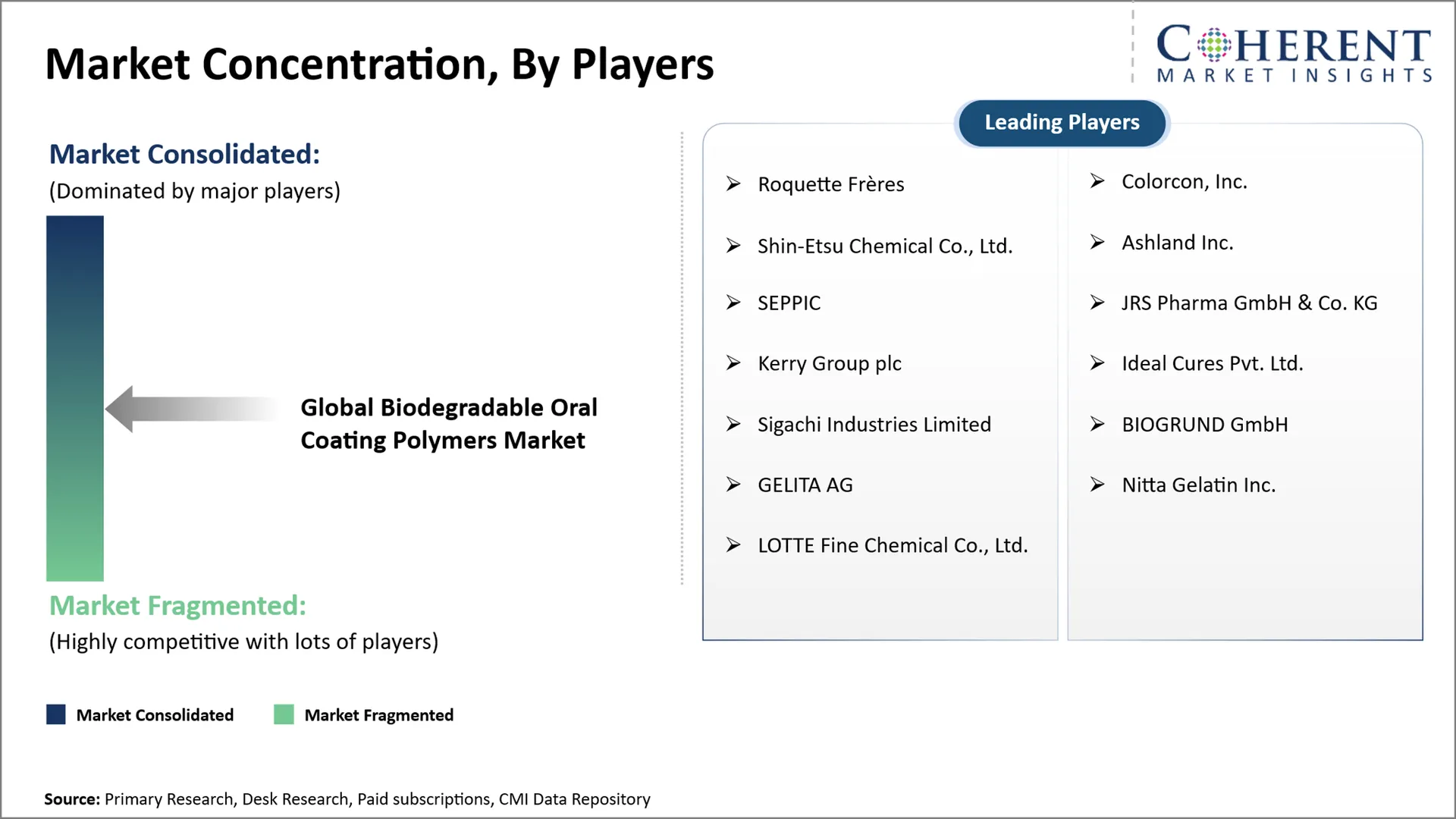
The global biodegradable oral coating polymers market is moderately consolidated, with established multinational excipient suppliers competing against specialist coating formulators and regional players. Competitive differentiation is based on pharmaceutical grade quality, functional performance, regulatory documentation and reliable supply. Formulation specific opportunities may be offered by specialist manufacturers via customization, technical expertise and price competitiveness. Established suppliers have wider product portfolios and international customer relationships.
Key focus areas include
- Polymer Performance: Film strength, adhesion, dissolution characteristics, viscosity, and formulation compatibility are competitive points for manufacturers.
- Excipient quality: Supplier selection is based on consistent molecular properties, impurity specifications and validated manufacturing processes.
- Production Economics: Coating efficiency, solids loading, processing temperatures, and material utilization all affect the total cost of a formulation.
- Technical Differentiation: Premium Product Positioning through proprietary polymer modification & coating grades specific to application.
- Supply Assurance: Raw material traceability, manufacturing redundancy and predictable delivery schedules improve procurement relationships.
- Market Access: Distribution networks and regional technical service capabilities facilitate customer acquisition and international expansion.
- Customer Integration: Long-term supply contracts, joint development programs, and formulation support improve supplier retention.
Market Report Scope
Global Biodegradable Oral Coating Polymers Market Report Coverage | |||
Report Coverage | Details | ||
Base Year | 2025 | Market Size in 2026: | USD 242.6 Mn |
Historical Data For: | 2020 to 2024 | Forecast Period: | 2026 to 2033 |
Forecast Period 2026 To 2033 CAGR: | 8.40% | 2033 Value Projection: | USD 426.7 Mn |
Geographies covered: |
| ||
Segments covered: |
| ||
Companies covered: | Roquette Frères, Colorcon, Inc., Shin-Etsu Chemical Co., Ltd., Ashland Inc., SEPPIC, JRS Pharma GmbH & Co. KG, Kerry Group plc, Ideal Cures Pvt. Ltd., Sigachi Industries Limited, BIOGRUND GmbH, GELITA AG, Nitta Gelatin Inc., LOTTE Fine Chemical Co., Ltd. | ||
Growth Drivers: |
| ||
Restraints & Challenges: |
| ||
Analyst Opinion (Expert Opinion)
- The competitive landscape will probably shift toward integrated formulation partnerships with coating suppliers being brought into pharmaceutical product development earlier. Suppliers that compete on the price of raw polymer can’t forge as strong commercial relationships as companies that provide application-specific material selection, technical documentation and manufacturing validation.
- Biodegradable polymers that can deliver predictable functional release performance may disrupt established material-selection practices. If successful, these alternatives could decrease reliance on traditional coating chemistries, and stimulate technology licensing, specialized IP development, and closer collaboration between polymer manufacturers and pharmaceutical innovators.
- Oral product manufacturers must focus on reproducible film performance, thorough polymer characterization, and differentiated formulations for challenging applications. Companies need to balance premium pricing with customer qualification costs and raw-material variability. A more defensible strategy is investing in application labs, regulatory expertise and diversified sourcing, rather than building capacity for materials that lack proven formulation advantages.
Speak to the analyst
Want personalized insights?
Take the findings above to one of our principal consultants, or have the report rebuilt around the segments, geographies and competitors you actually track.
Market Segmentation
- Polymer Type Insights (Revenue, USD Mn, 2021 - 2033)
- Cellulose-Based Biodegradable Polymers
- Starch and Modified Starch Polymers
- Natural Gums and Polysaccharides
- Protein-Based Polymers
- Other Biodegradable Polymers
- Coating Function Insights (Revenue, USD Mn, 2021 - 2033)
- Immediate-Release and Aesthetic Coatings
- Moisture and Oxygen Barrier Coatings
- Taste-Masking and Swallowability Coatings
- Enteric and Delayed-Release Coatings
- Controlled-Release Coatings
- Dosage Form Insights (Revenue, USD Mn, 2021 - 2033)
- Tablets
- Capsules
- Multiparticulate Pellets and Beads
- Granules and Other Oral Dosage Forms
- End-use Industry Insights (Revenue, USD Mn, 2021 - 2033)
- Pharmaceutical Manufacturing
- Nutraceutical and Dietary Supplement Manufacturing
- Functional Foods and Confectionery
- Sales Channel Insights (Revenue, USD Mn, 2021 - 2033)
- Direct Manufacturer Sales
- Specialty Excipient Distributors and Formulation Suppliers
- Regional Insights (Revenue, USD Mn, 2021 - 2033)
- North America
- U.S.
- Canada
- Latin America
- Brazil
- Argentina
- Mexico
- Rest of Latin America
- Europe
- Germany
- U.K.
- Spain
- France
- Italy
- Russia
- Rest of Europe
- Asia Pacific
- China
- India
- Japan
- Australia
- South Korea
- ASEAN
- Rest of Asia Pacific
- Middle East
- GCC Countries
- Israel
- Rest of Middle East
- Africa
- South Africa
- North Africa
- Central Africa
- North America
- Key Players Insights
- Roquette Frères
- Colorcon, Inc.
- Shin-Etsu Chemical Co., Ltd.
- Ashland Inc.
- SEPPIC
- JRS Pharma GmbH & Co. KG
- Kerry Group plc
- Ideal Cures Pvt. Ltd.
- Sigachi Industries Limited
- BIOGRUND GmbH
- GELITA AG
- Nitta Gelatin Inc.
- LOTTE Fine Chemical Co., Ltd.
Sources
Primary Research Interviews
- Biodegradable polymer manufacturers, pharmaceutical excipient suppliers, and film-coating formulators
- Pharmaceutical manufacturers, nutraceutical producers, and contract development and manufacturing organizations (CDMOs)
Stakeholders
- Cellulose, modified starch, natural polysaccharide, and protein-based polymer suppliers
- Coating manufacturers, specialty excipient distributors, and pharmaceutical formulation specialists
End-use Sectors
- Pharmaceutical manufacturing, nutraceuticals, dietary supplements, and functional foods
- Tablets, capsules, multiparticulate pellets, granules, and other oral dosage forms
Regulatory and Industry Bodies
- U.S. Food and Drug Administration (FDA)
- European Medicines Agency (EMA)
- European Directorate for the Quality of Medicines & HealthCare (EDQM)
- World Health Organization (WHO)
Databases
- FDA Inactive Ingredient Database (IID) and PubMed
- UN Comtrade and International Trade Centre (ITC) Trade Map
- United States Pharmacopeia–National Formulary (USP–NF) and European Pharmacopoeia
Magazines and Journals
- International Journal of Pharmaceutics
- Carbohydrate Polymers
- European Journal of Pharmaceutics and Biopharmaceutics
- Journal of Drug Delivery Science and Technology
Associations
- International Pharmaceutical Excipients Council (IPEC)
- American Association of Pharmaceutical Scientists (AAPS)
- International Society for Pharmaceutical Engineering (ISPE)
- Controlled Release Society (CRS)
Public Domain Sources
- Pharmaceutical excipient technical data sheets, coating formulation specifications, and manufacturer sustainability reports
- Drug dissolution studies, polymer biodegradability research, pharmaceutical patents, and production capacity announcements
Key Standards and Regulations
- ICH Q8(R2), Q9(R1), and Q10 – Pharmaceutical Development, Quality Risk Management, and Pharmaceutical Quality Systems
- USP–NF and European Pharmacopoeia – Pharmaceutical Excipient Quality Standards
- IPEC–PQG Good Manufacturing Practices Guide for Pharmaceutical Excipients
- OECD Test Guideline 301 – Ready Biodegradability Testing, where applicable
Proprietary Elements
- CMI Data Analytics Tool
- Proprietary research repository, supported by primary interview findings, oral coating polymer consumption modeling, pharmaceutical formulation assessments, pricing analysis, and competitive intelligence.
Get access to 250+ pages report
Every segment, forecast, competitor profile and data table behind the analysis above — available for instant download.
- ESOMAR Member
- ISO 9001:2015 Certified
- D-U-N-S Registered
- GDPR & CCPA Compliant
Frequently Asked Questions
The global biodegradable oral coating polymers market is projected to register a CAGR of 8.40% from 2026 to 2033.
Pharmaceutical-grade purity, excipient compatibility, stability testing, dissolution performance, and compliance with applicable pharmaceutical quality standards are important considerations.
Manufacturers can evaluate suppliers based on polymer quality, formulation compatibility, production capacity, technical support, regulatory documentation, and supply reliability.
The report examines key manufacturers, product portfolios, competitive positioning, manufacturing capabilities, and strategic developments shaping industry competition.
The report provides insights into supplier capabilities, purchasing considerations, manufacturing economics, and competitive strategies to support sourcing, partnership, and investment planning.
The major growth factors include increasing demand for biodegradable and plant-derived coatings in pharmaceutical and nutraceutical products, along with greater adoption of natural polymer-based films that improve drug stability, mask unpleasant tastes, and make oral medicines easier to swallow.
Higher formulation and processing costs compared with conventional synthetic oral coating polymers, along with difficulties in achieving consistent moisture resistance, mechanical strength, and controlled drug-release performance, are the major factors restraining market growth.